

I have spent years writing about U.S. freelance law, and the one thing that never changes is this: most freelancers get hurt not because they did bad work, but because they skipped the legal basics. Freelancing legal tips are not just advice for cautious people. They are the difference between getting paid and spending months chasing an invoice that was never going to arrive. In this guide, I cover 12 of the most important legal protections every independent contractor operating in the U.S. needs to understand before signing a single contract, issuing a single invoice, or delivering a single file.
What Are Freelancing Legal Tips and Why Do They Matter?
Freelancing legal tips are practical, plain-language guidelines that help independent contractors understand their rights, obligations, and legal protections under U.S. law. These tips are designed to help freelancers avoid contract disputes, unpaid invoices, tax penalties, and worker misclassification the four most common legal risks in self-employment. Every freelancer, whether operating as a sole proprietor or an LLC, needs a basic understanding of these rules before signing a contract or issuing an invoice.
I started covering freelance legal topics after noticing a consistent pattern across dozens of forum threads and reader questions: freelancers knew their craft cold, but had almost no working knowledge of the legal framework governing their businesses. A graphic designer who could build a brand identity from scratch had no idea what “net 30” meant legally. A content writer delivering 10,000 words a month had never heard of the work-for-hire doctrine.
The legal risks for U.S. independent contractors cluster around four main areas: contract enforcement, payment collection, tax compliance, and intellectual property ownership. Every tip in this guide addresses at least one of those areas directly.
I cover freelance law and independent contractor rights at Gig Law Guide, and the questions I see most often from both new and experienced freelancers almost always trace back to one of these four gaps. This guide closes all of them.
Tip 1: Always Use a Written Freelance Contract
A written freelance contract is a legally binding document that defines the scope of work, payment terms, deadlines, revision limits, and kill fee provisions between a freelancer and a client. Without a written agreement, freelancers have limited legal recourse if a client refuses to pay or disputes the deliverables. Courts in most U.S. states treat written contracts as the primary evidence of agreed terms in commercial disputes.
This is the single most repeated piece of advice in freelancing, and yet it is still the most ignored. I have read through hundreds of forum threads on Reddit, JustAnswer, and Web Designer Forum where freelancers described losing hundreds or thousands of dollars over work they completed without a signed agreement. The response from other freelancers is always the same: “Get a contract. Always.”
The reason written contracts matter legally is straightforward. When a dispute reaches small claims court or arbitration, the judge or arbitrator needs documented proof of what both parties agreed to. A contract provides that. A handshake, a friendly email chain, or a verbal confirmation does not have anywhere near the same legal weight.
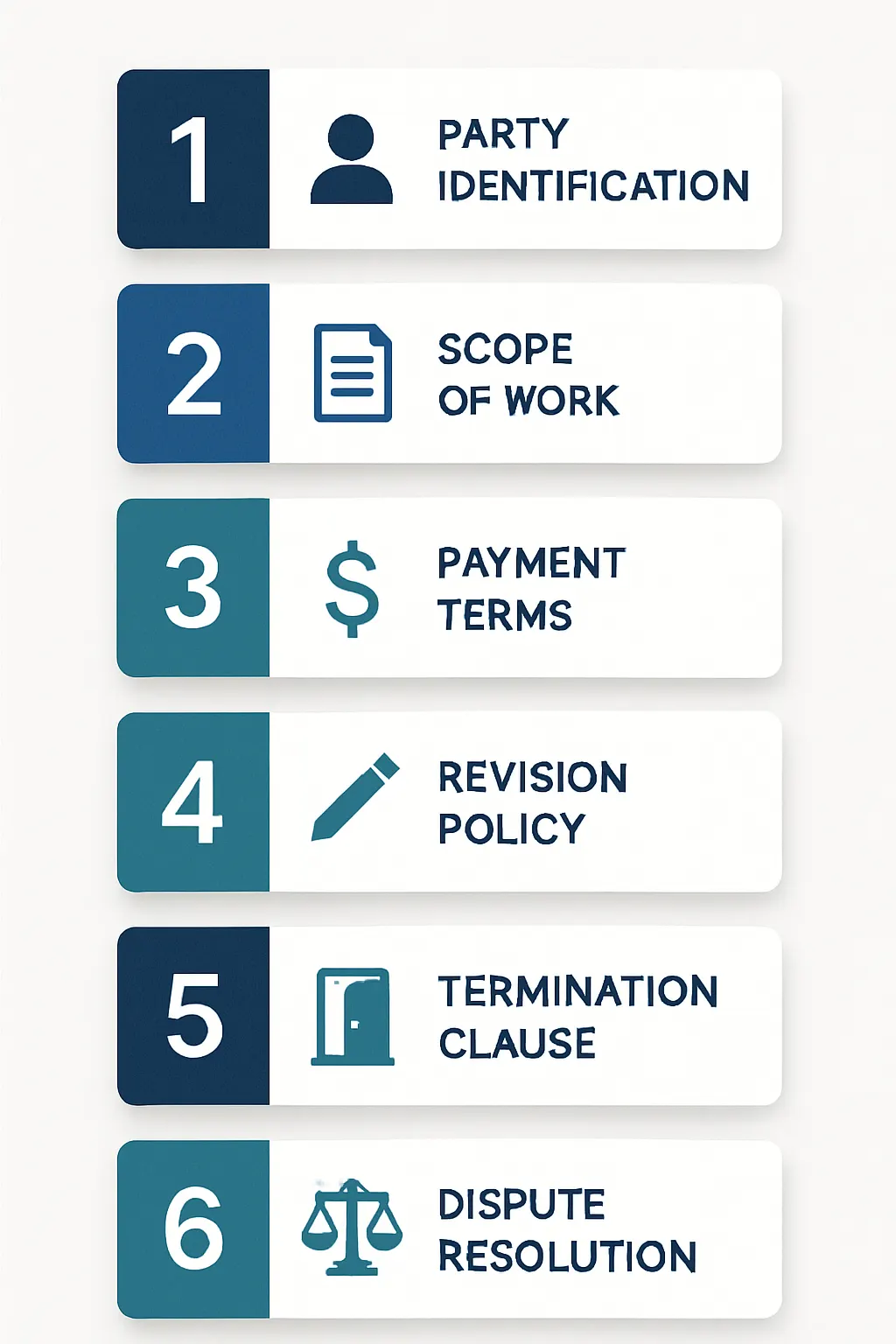
six essential elements.
A verbal agreement can technically be enforceable in most U.S. states, but proving its terms without documentation is nearly impossible. Written contracts eliminate that ambiguity entirely.
What a Freelance Contract Must Include to Be Enforceable
An enforceable freelance contract must include the full legal names of both parties, a clear description of deliverables, the agreed payment amount and schedule, a project deadline, a revision or change order policy, and a termination clause. Contracts that omit payment terms or scope of work are frequently challenged in small claims court and may be treated as unenforceable oral agreements under state contract law.
Here are the six elements that every freelance contract needs to hold up legally:
- Party identification: Full legal names and business names of both the freelancer and the client.
- Scope of work: A specific description of what will be delivered, in what format, and by what deadline.
- Payment terms: The agreed total fee, payment schedule, accepted payment methods, and due dates.
- Revision policy: How many rounds of revisions are included and what constitutes a change order.
- Termination clause: What happens if either party ends the agreement early, including kill fee provisions.
- Dispute resolution method: Whether disputes go to mediation, arbitration, or small claims court.
You can start with a professionally structured template rather than building one from scratch. I recommend reviewing our freelance contract template as a base, then customizing it for each project. If you are unsure how detailed your agreement needs to be, our guide on how long a freelance contract should be breaks that down by project type and value. It also helps to understand the difference between a scope of work and a statement of work before you draft either one.
For external reference, the Freelancers Union contract resources offer a free, attorney-reviewed contract builder that covers U.S. freelance law standards.
Tip 2: Lock In Payment Terms Before You Start a Single Task
Payment terms in a freelance contract are the agreed conditions under which a client is obligated to pay, including the invoice due date, accepted payment methods, and penalties for late payment. The most common structures are Net 7, Net 15, and Net 30, which specify the number of calendar days after invoice issuance that payment is due. Freelancers who fail to define payment terms in writing before starting a project have no legal basis to charge late fees if payment is delayed.
Payment terms are not just about money. They are about legal standing. The moment you define payment terms in a signed contract, you have created an enforceable obligation. Without that definition, you are essentially asking a client to pay you on their own schedule and some of them will use that ambiguity deliberately.
I have audited freelance agreements sent to me by readers, and the most common missing element is not the scope of work or the deadline. It is the payment due date. Freelancers write “payment due upon invoice” with no specified number of days, which in practice means payment is due whenever the client decides it is convenient.
According to the Freelancers Union 2023 Freelancing in America report, 71% of freelancers have experienced difficulty collecting payment from clients at some point in their careers, with an estimated $9,880 in unpaid invoices per affected freelancer annually.
That number is not abstract. It represents a real annual income loss for a majority of active U.S. freelancers. Payment terms, written into your contract before work begins, are the first line of defense against becoming part of that statistic.
How Late Payment Clauses Protect Your Freelance Income
A late payment clause is a contract provision that entitles a freelancer to charge an additional fee, typically expressed as a percentage of the outstanding invoice amount, if a client fails to pay by the agreed due date. A late payment clause creates a legal mechanism for the freelancer to recover additional compensation for delayed payment and signals to clients that payment deadlines are contractually binding, not suggestions.
The most commonly used late payment rate in U.S. freelance contracts is 1.5% per month on the outstanding balance, which is legal in most states. Some freelancers use a flat late fee, for example, $50 after 7 days past due. Both approaches work, but the percentage method scales better for larger invoices.
Three things your late payment clause must specify:
- The number of days after which the fee activates (e.g., 7 days past the due date)
- The rate or flat amount of the fee
- Whether the fee compounds monthly or applies once
For a full breakdown of how to structure these clauses legally, read our guide on how to charge late payment fees legally. You should also understand net 30 payment terms and net 15 payment terms before deciding which structure fits your business model best.
Tip 3: Know the Difference Between Employee and Independent Contractor
Independent contractor vs. employee classification is a legal determination made by the IRS and state labor agencies that defines whether a worker is self-employed or an employee for tax and benefits purposes. The IRS applies a three-part test covering behavioral control, financial control, and the type of relationship to determine correct classification. Freelancers misclassified as employees by clients may be entitled to back pay, benefits, and employer tax contributions under federal law.
This one trips up both freelancers and the businesses that hire them. A client who tells you what hours to work, provides your tools, and dictates exactly how you complete your tasks may legally treat you as an employee, even if your contract says “independent contractor.” The label on the contract does not override the reality of the working relationship.
The IRS uses three categories to determine classification:
Behavioral control: Does the company control how you do the work, not just the result?
Financial control: Does the company control your business expenses, tools, and ability to work for others?
Type of relationship: Is there a written contract, and do you receive employee benefits like insurance or paid leave?
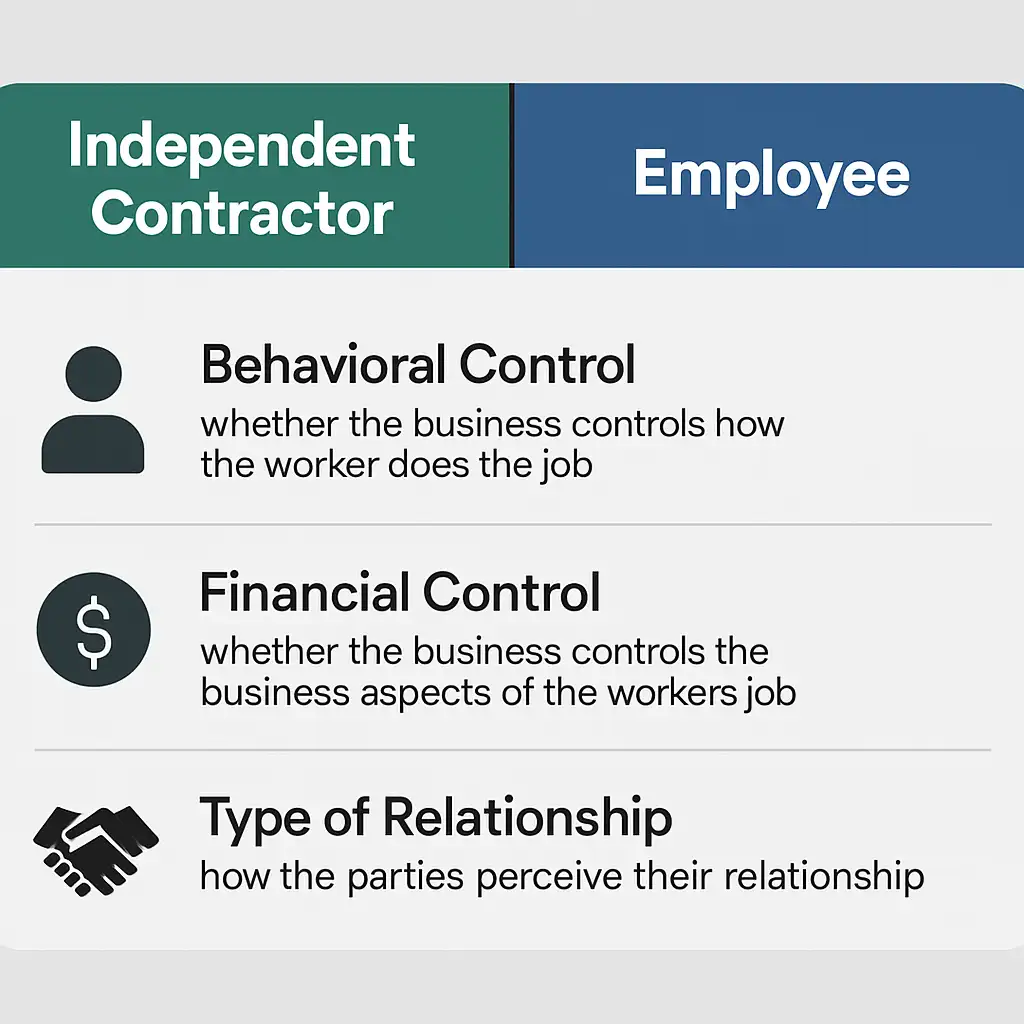
as an independent contractor or employee.
If the answers to most of those questions lean toward “yes, the client controls these things,” you may legally be an employee regardless of what your contract calls you.
What Is Worker Misclassification and What Are the Legal Consequences?
Worker misclassification occurs when a business incorrectly classifies an employee as an independent contractor to avoid payroll taxes, benefits obligations, and labor law compliance requirements. The legal consequences for misclassified workers include loss of eligibility for unemployment insurance, workers’ compensation coverage, and overtime protections. Misclassified freelancers may file IRS Form SS-8 to request a federal determination of their employment status.
Worker misclassification is not a technicality. It costs misclassified workers real money in the form of employer-side payroll taxes they should not be paying, benefits they are legally entitled to, and overtime wages they never received.
If you believe you are being misclassified, the IRS provides a formal process for challenging it. Filing IRS Form SS-8 asks the federal government to make an official determination about your employment status. This determination can trigger back-tax liability for the employer and may result in reclassification.
For a detailed breakdown of where the legal line sits, our guide on employee vs. independent contractor classification walks through every factor the IRS weighs.
Tip 4: Know Your Rights Under Freelance Payment Protection Laws
The Freelance Isn’t Free Act is a U.S. law, first enacted in New York City in 2017 and subsequently adopted in Illinois and Minnesota in 2024, that requires written contracts for freelance work valued at or above a minimum dollar threshold and gives freelancers the right to sue for double damages if clients fail to pay on time. The Freelance Isn’t Free Act is considered the strongest freelancer payment protection law in the United States and serves as the model for proposed federal legislation.
Most freelancers have no idea these laws exist. They chase unpaid invoices with politely worded follow-up emails when they could be filing a legal complaint that entitles them to twice what they are owed, plus attorney’s fees. That is a meaningful legal advantage that goes completely unused because freelancers do not know to look for it.
Which States Have Freelance Payment Protection Laws?
Freelance payment protection laws are state and municipal statutes that require written contracts for freelance work above a minimum value and create civil penalties for clients who fail to pay freelancers on time. As of 2026, New York City, Illinois, and Minnesota have enacted specific freelance payment protection legislation, while California addresses independent contractor classification through its ABC test under AB 5.
| State / Jurisdiction | Law | Enacted | Min. Contract Threshold | Key Provision |
|---|---|---|---|---|
| New York City | Freelance Isn’t Free Act | 2017 | $250 | Double damages + attorney fees |
| Illinois | Freelance Worker Protection Act | 2024 | $500 | Written contract required |
| Minnesota | Freelance Worker Protection Act | 2024 | $250 | Civil penalty on violation |
| California | AB 5 / Prop 22 | 2020 (ongoing) | N/A | ABC classification test |
| Federal (Proposed) | FLSA Independent Contractor Rule | 2024 (DOL Rule) | N/A | Economic realities test |
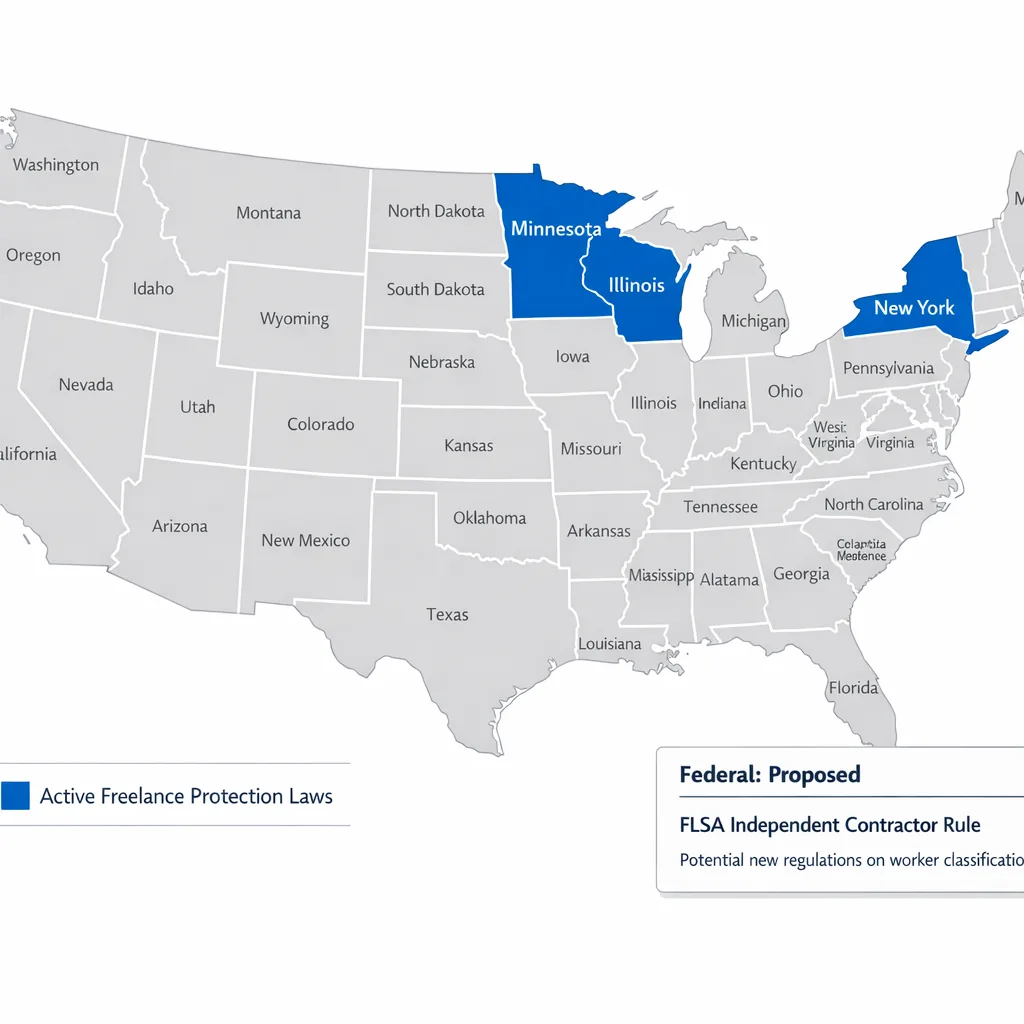
payment protection laws as of 2026.
If you live in New York City, Illinois, or Minnesota and a client owes you money above the threshold, you are not just owed your invoice. You may be owed double that amount, plus the cost of any legal fees you incurred pursuing it. Check the NCSL’s state law database for updates on emerging freelance protection legislation in additional states.
Tip 5: Add a Kill Fee Clause Before Every Project Starts
A kill fee clause is a contractual provision that entitles a freelancer to receive a percentage of the agreed project fee if the client cancels the project after work has begun. Kill fees typically range from 25% to 50% of the total contract value and are triggered when a client terminates a project without cause after the freelancer has started work. Without a kill fee clause, freelancers who have already invested time in a cancelled project have no legal mechanism to recover compensation for that work.
Kill fees are one of the most underused protections in freelancing. I have spoken with freelancers who spent weeks on a project, received a cancellation email with no explanation, and had no clause in their contract that gave them any right to payment for the work they had already completed.
In my research into cancelled project disputes across multiple freelancer forums, the pattern is almost always the same. The freelancer trusted a friendly working relationship. The client cancelled for business reasons entirely outside the freelancer’s control. And without a kill fee clause, the freelancer walked away with nothing.
A kill fee clause changes that entirely. Once it is in the contract, a client who cancels owes you a defined percentage of the total project fee, regardless of how far along the work was or why they cancelled.
For a complete walkthrough of how kill fees work legally and how to draft one, read our guide on how a kill fee clause protects freelancers from cancelled projects. You should also understand your rights when a client cancels mid-project before you negotiate your next agreement.
Tip 6: Handle Self-Employment Taxes Before They Handle You
Self-employment tax is a federal tax obligation that covers Social Security and Medicare contributions for freelancers and independent contractors who work for themselves rather than an employer. As of 2025, the self-employment tax rate is 15.3% on net earnings, comprising 12.4% for Social Security on earnings up to $176,100 and 2.9% for Medicare with no income ceiling. Freelancers who fail to make quarterly estimated tax payments may face underpayment penalties from the IRS regardless of whether they file an annual return.
Tax is the area where freelancers are most often blindsided. Not because the rules are hidden, but because no one automatically withholds anything on your behalf when you are self-employed. Every dollar you earn as an independent contractor arrives in full and the IRS wants its portion on a quarterly schedule, not at the end of the year.
The IRS self-employment tax rate for 2025 is 15.3% comprising 12.4% for Social Security on net earnings up to $176,100 and 2.9% for Medicare with no income ceiling meaning a freelancer earning $60,000 net pays approximately $8,478 in self-employment tax before income tax deductions.
That $8,478 does not include federal or state income tax. It is purely the Social Security and Medicare portion. If a freelancer earning $60,000 has not been setting aside quarterly payments, that bill arrives as a shock in April.
The IRS quarterly estimated tax deadlines for 2026 are April 15, June 16, September 15, and January 15, 2027. Missing these triggers an automatic underpayment penalty calculated on the amount owed.
Which Tax Deductions Are Freelancers Legally Entitled To?
Freelancers and independent contractors are legally entitled to deduct ordinary and necessary business expenses from their net self-employment income before calculating self-employment tax. Common deductible categories include a home office deduction, business-related software and subscriptions, professional development costs, health insurance premiums, and the employer-equivalent portion of self-employment tax itself. These deductions reduce the taxable net income on which the 15.3% self-employment tax rate is calculated.
The home office deduction alone can reduce a freelancer’s taxable income by thousands of dollars annually if the workspace meets IRS requirements for exclusive and regular business use. That means a dedicated room, not a kitchen table.
For a full breakdown of your tax obligations by income level and filing status, our freelancer tax obligations guide walks through exactly what you owe and when. And our self-employment tax deductions guide covers every major deduction category the IRS allows for independent contractors.
The IRS also maintains its own Self-Employed Individuals Tax Center with current rates, quarterly deadlines, and official guidance on deductions.
Tip 7: Protect Your Work With Intellectual Property Clauses
Intellectual property clauses in a freelance contract define who legally owns the work product after delivery and payment. Under U.S. copyright law, a freelancer retains copyright ownership of original creative work by default unless a written work-for-hire agreement explicitly transfers ownership to the client. Freelancers who do not include clear IP ownership language in their contracts risk losing rights to work they created without receiving additional compensation for that transfer.
Copyright ownership defaults to the creator. That is the law under the U.S. Copyright Act. The moment you write an article, design a logo, or build a website, you own that work unless your contract says otherwise.
The problem is that many clients include work-for-hire language in their standard agreements, sometimes buried in the terms. If you sign without reading that clause, you have legally surrendered ownership of everything you created for that client, permanently, for the fee you were already paid.
The fix is simple. Include your own IP clause that states copyright transfers to the client only upon receipt of full payment. This does two things: it protects your work if the client does not pay, and it creates leverage to negotiate a higher fee if the client wants full ownership of the underlying intellectual property.
For a deeper breakdown of how these protections work in practice, read our guide on why copyright law matters for freelancers, our resource on how to stop intellectual property violations, and our breakdown of copyright rules for stock photos if you license visual content in your work.
The U.S. Copyright Office also provides official guidance on registration, ownership, and the work-for-hire doctrine for independent creators.
Tip 8: Build a Dispute Resolution Path Into Every Contract
A dispute resolution clause is a contract provision that specifies how disagreements between a freelancer and client will be resolved typically through a defined sequence of negotiation, mediation, and binding arbitration before either party pursues litigation in civil court. Arbitration clauses are legally enforceable in most U.S. states and can significantly reduce the time and cost of resolving payment disputes compared to full civil court proceedings.
Dispute resolution clauses are not pessimistic. They are practical. Most commercial disputes never reach a courtroom because one party does not want the expense and delay of litigation. A well-drafted dispute resolution clause gives both parties a faster, cheaper path to resolution which tends to result in better outcomes for everyone.
The standard hierarchy in freelance contracts runs like this:
- Direct negotiation: Both parties attempt to resolve the issue within a defined period (typically 15 to 30 days).
- Mediation: A neutral third party facilitates a resolution. Not binding, but often effective.
- Binding arbitration: A private arbitrator makes a final decision. Faster and cheaper than court. Legally binding.
- Small claims court: For disputes below state dollar thresholds (usually $5,000 to $12,500 depending on the state).
For clients who refuse to sign agreements with arbitration clauses, our guide on what to do when a client refuses to sign a freelance contract covers your options. You should also understand liquidated damages clauses as an additional protection mechanism, and review common NDA mistakes that hurt freelancers before adding confidentiality provisions to your dispute resolution section.
Tip 9: Separate Your Business and Personal Finances
Separating business and personal finances means maintaining a dedicated business bank account and payment method exclusively for freelance income and business expenses. This separation is legally important for freelancers operating as LLCs because commingling personal and business funds can pierce the corporate veil a legal doctrine that removes limited liability protections and exposes personal assets to business creditors and legal judgments.
The LLC exists to protect your personal assets from business liability. Your savings, your car, your home, and an LLC create a legal wall between those assets and any claims made against your freelance business. But that wall has a weakness: if you run personal expenses through your business account or deposit client payments into your personal account, courts can rule that the separation was never real and hold you personally liable for business debts.
That is what piercing the corporate veil means in practice. And it happens to freelancers who thought their LLC protected them but never actually maintained the separation the law requires.
The fix costs nothing except a short trip to your bank. Open a dedicated business checking account and route all client payments and business expenses through it exclusively.
Our guide on how to open a dedicated freelance business bank account walks through the process step by step, including what documentation you need if you are operating under an LLC or DBA. For account options by bank, our resource on U.S. bank accounts for freelancers compares fee structures and features. And if you are operating as an LLC, understanding your LLC registered agent requirements is part of maintaining proper corporate separation.
Tip 10: Understand What Happens When a Client Refuses to Pay
When a client refuses to pay a freelance invoice, a freelancer’s legal options include sending a formal demand letter, filing a complaint under applicable state freelance payment protection laws, pursuing a claim in small claims court, or reporting the client to relevant state labor agencies. In jurisdictions covered by the Freelance Isn’t Free Act, freelancers may recover double the amount of the unpaid invoice plus reasonable attorney’s fees for willful nonpayment.
Non-payment is not a dead end. It feels like one, especially when a client goes silent after delivery, but freelancers have more legal options than most of them realize.
“The biggest mistake freelancers make is assuming silence from a client means the situation is over. It is not. A formal demand letter sent via certified mail restarts the legal clock, creates a paper trail, and signals to the client that you are prepared to escalate.” Alexis Grant, attorney and founder of The Write Life, speaking on freelancer legal rights at the 2024 Freelance Business Summit
The legal escalation path for non-payment looks like this:
Step 1: Invoice reminder: Send a written reminder referencing the contract payment terms and due date.
Step 2: Formal demand letter: Send a certified letter stating the amount owed, the payment deadline, and the legal consequences of continued nonpayment.
Step 3: State freelance protection law complaint: If you are in a covered jurisdiction, file a complaint with the relevant agency.
Step 4: Small claims court: For amounts below your state’s threshold, file a claim yourself without an attorney.
Step 5: Civil court or arbitration: For amounts over your contract’s threshold, proceed per your contract’s dispute-resolution clause.
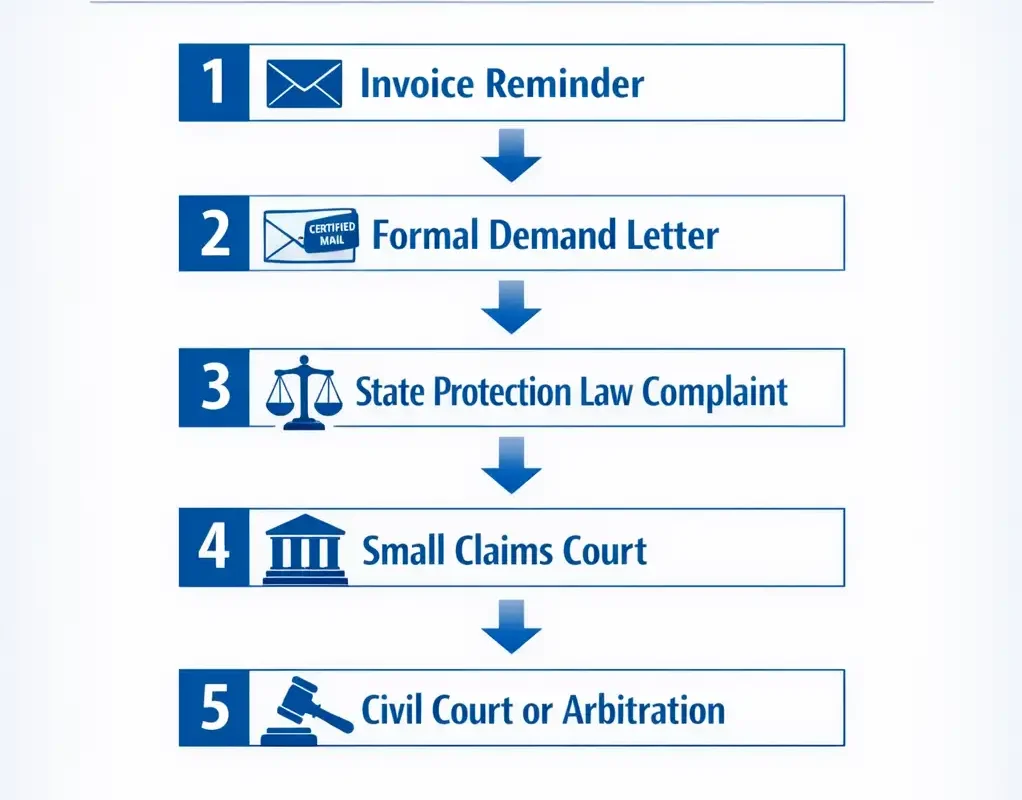
to pay your freelance invoice.
For a step-by-step walkthrough of each stage, our guide on legal steps to take when a client refuses to pay your invoice covers everything from the first reminder to the courtroom. Our freelancer unpaid invoice recovery guide and our complete unpaid invoice resource both provide additional documentation templates and state-specific filing instructions.
Tip 11: Use NDAs to Protect Confidential Client Information
A non-disclosure agreement in the context of freelancing is a legally binding contract provision or standalone document that prohibits either party from sharing confidential business information, proprietary processes, or trade secrets obtained during the working relationship. NDAs protect both freelancers and clients, but freelancers must read the NDA terms carefully to ensure the confidentiality obligations do not prevent them from listing the work in their portfolio or referencing the client in future business development.
NDAs get misread constantly. A freelancer signs a client’s NDA without reading it closely, then later discovers the agreement prevents them from using that project as a portfolio sample, listing the client as a reference, or even mentioning the engagement in a pitch to future clients.
That kind of NDA is not inherently illegal, but it has real business consequences for freelancers who rely on portfolio work to attract new clients. Before signing any NDA, verify:
- Whether the confidentiality obligation prevents portfolio display
- How long does the NDA remain in effect
- Whether it covers work product, business information, or both
- What the penalty clause specifies for breach
Our breakdown of common NDA mistakes freelancers make covers the three most costly NDA errors and how to negotiate around them. And if you need to execute agreements remotely, our guide on how to digitally sign freelance agreements explains digital signature certificate requirements for binding contract execution.
The Electronic Signatures in Global and National Commerce Act (ESIGN) confirms that digital signatures are legally equivalent to handwritten signatures for most U.S. commercial agreements including freelance contracts and NDAs.
Tip 12: Choose the Right Legal Structure for Your Freelance Business
The best legal structure for a freelancer depends on income level, liability exposure, and state of operation. Sole proprietorships are simpler and less expensive to maintain but offer no personal liability protection. Limited Liability Companies provide a legal separation between personal and business assets and may offer tax advantages at higher income levels, making the LLC the recommended structure for freelancers earning above $50,000 in annual net income.
Most freelancers start as sole proprietors without even realizing it. If you earn money doing freelance work and have not registered a business entity, you are automatically a sole proprietor in the eyes of the IRS and your state. That is fine at low income levels. The moment your freelance business carries meaningful liability exposure, client disputes, IP claims, and contract breaches, the sole proprietorship becomes a significant vulnerability.
An LLC changes that. It creates a legal entity separate from you personally, so a client who sues your business is suing the LLC, not you as an individual. Your personal bank account, home, and assets stay protected as long as you maintain the corporate separation described in Tip 9.
The tax treatment also shifts at higher income levels. LLC members can elect S-Corp taxation, which allows you to split income between salary and distributions and potentially reduce your overall self-employment tax burden. This is a conversation worth having with a CPA once your net freelance income consistently exceeds $50,000 annually.
For the practical steps involved in setting up and maintaining an LLC as a freelancer, our guide on setting up your LLC as a freelancer covers registered agent requirements, state filing fees, and annual maintenance obligations. And our resource on EIN mistakes freelancers must avoid is required reading before you apply for a federal Employer Identification Number a step that trips up a surprising number of first-time LLC owners.
When to Consider Hiring a Freelance Lawyer for Legal Review
A freelance lawyer is a licensed attorney who provides legal services on a project or contract basis rather than as a full-time employee of a law firm. Freelance lawyers are available for contract drafting, legal review, dispute correspondence, and intellectual property registration typically at significantly lower hourly rates than traditional law firm associates. Freelancers should consider hiring a freelance attorney for any contract valued at $5,000 or more, any agreement involving IP ownership transfer, or any situation involving threatened or active litigation.
I want to be direct about this: the twelve tips in this guide are not a substitute for legal advice from a licensed attorney. They are a foundation. They will protect you in the vast majority of everyday freelance situations. But there are moments when you need a real lawyer, not a guide.
When I audit freelance agreements submitted by readers, the ones that include genuinely dangerous language clauses waiving rights, imposing unlimited liability, or stripping ownership of work created before the engagement are almost always in contracts sent by larger clients with in-house legal teams. Those clients know what the contract says. The freelancer often does not.
A freelance lawyer reviewing a high-value contract typically charges $150 to $400 per hour, and most contract reviews take one to three hours. That is a small cost relative to the value of a $10,000 project and a substantial protection against clause language designed to favor the client entirely.
When looking for freelance legal professionals, watch for the same red flags you would in any professional service relationship. Our guide on red flags when hiring freelance professionals applies broadly to vetting any contract-based service provider, including legal ones.
Frequently Asked Questions About Freelancing Legal Tips
Do freelancers need a lawyer to write a contract?
Freelancers are not legally required to hire a lawyer to write a contract, though legal review is recommended for high-value projects. Freelancers can use legally reviewed template contracts from sources such as the Freelancers Union, AIGA, or licensed legal document platforms and customize them to fit each project’s specific scope, payment terms, and intellectual property provisions.
A solid template, properly customized, covers the majority of freelance engagements. The situations where a lawyer becomes genuinely valuable are high-value projects, contracts sent by clients with sophisticated legal teams, and any situation involving IP ownership, exclusivity, or non-compete clauses.
Is a verbal agreement legally binding for freelance work?
A verbal agreement for freelance work can be legally binding in most U.S. states, but verbal agreements are extremely difficult to enforce because there is no written documentation of the agreed-upon terms. Courts generally require clear evidence of offer, acceptance, and consideration, the three core elements of contract formation, and those elements are nearly impossible to prove without a written record signed by both parties.
Even if a verbal agreement technically holds up in court, proving what was actually agreed to becomes a dispute of competing memories. Written contracts eliminate that ambiguity entirely.
What is the statute of limitations for freelance contract disputes?
The statute of limitations for freelance contract disputes is the legally defined window of time within which a freelancer must file a lawsuit or arbitration claim to recover unpaid fees or enforce contract terms. Written contract disputes typically carry a limitations period of 4 to 6 years in most U.S. states, while oral contract disputes are generally limited to 2 to 3 years from the date the dispute arose.
Missing the statute of limitations deadline permanently extinguishes your right to legal recovery, regardless of how strong your underlying claim is. If a client has owed you money for years, check your state’s limitations period before assuming the opportunity to file has passed.
Can a client legally use my work without paying me?
A client generally cannot legally use a freelancer’s work without paying if the freelance contract specifies that copyright transfers only upon receipt of full payment. Under U.S. copyright law, using unpaid-for creative work without the creator’s authorization may constitute copyright infringement, which carries statutory damages up to $150,000 per work for willful violations, plus attorney’s fees and court costs.
This is one of the most powerful protections available to freelancers under existing U.S. law and most freelancers have never heard of it. If you want to understand how to enforce it, our guide on how to file a DMCA takedown notice walks through the process step by step.
What legal structure is best for a freelancer sole proprietor or LLC?
The best legal structure for a freelancer depends on income level, liability exposure, and state of operation. Sole proprietorships require no registration and are inexpensive to maintain but provide no personal liability protection. LLCs create a legal separation between personal and business assets, protect personal property from business-related legal claims, and may offer self-employment tax advantages at income levels above $50,000 annually making the LLC the recommended structure for freelancers whose income has grown beyond the entry level.
The decision is not permanent. Many freelancers start as sole proprietors and convert to an LLC once their income and client roster justify the additional administrative requirements.
Have a freelance legal question? Visit our Freelance Legal Contact page or explore our full library of freelance contract resources and guides for starting a freelance business.