

Here is an example of how a cancellation without a clause can hurt.
For example, consider a Tuesday afternoon: a freelancer receives an email from a client. Let us call her Sandra. She was going in a different direction.
No big deal, right? Freelancers deal with this constantly.
Except here is the thing. Sandra had a launch date. A very specific, very critical launch date. She had hired the freelancer to build out her entire e-commerce copy. Product descriptions, email sequences, the homepage, all of it. Twelve weeks of work. The freelancer had turned down two other projects to commit to hers exclusively, because she had made a big deal about needing someone fully dedicated.
She bailed. Four weeks before launch. With half the work done.
She paid what was technically in the contract. But the contract said nothing about early termination penalties. Nothing about what happens when someone pulls the plug mid project. Nothing that gave the freelancer any real leverage.
A paralegal friend mentioned it offhand: the freelancer should have had a liquidated damages clause in the contract.
That is how many freelancers first learn what the clause means and how it applies to them — by researching contracts, talking to other freelancers, consulting a lawyer, and rewriting their templates.
That is what this article is about. (Liquidated Damages Clause Freelance Contracts)
What a Liquidated Damages Clause Actually Means (Without the Legal Fog)
Most people hear the phrase liquidated damages clause and immediately picture Fortune 500 lawyers arguing in a boardroom. I get why. It carries that heavy legal-industry weight.
But the actual concept is straightforward once you drop the terminology.
A liquidated damages clause in a freelance contract is a provision where both parties agree, before work begins, on a specific dollar amount that gets paid if one side does not hold up their end of the deal.
That is the entire idea. You are essentially saying: if you do X, or fail to do X, you owe Y dollars. The number is decided before anything goes wrong. Everyone signs knowing exactly what the stakes are. That is pre-agreed compensation, not a penalty invented after the fact.
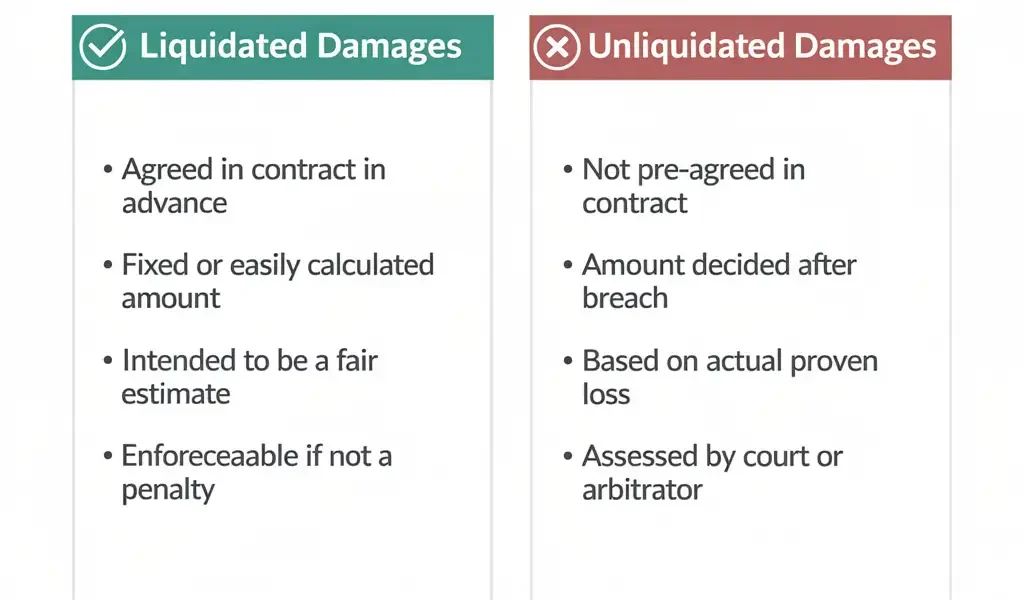
The word liquidated has nothing to do with liquidating assets or a company shutting down. It comes from the Latin word liquidare, which means to make clear or to settle. So liquidated damages are literally made-clear damages. Pre-agreed. Not calculated after a dispute erupts.
The alternative is what lawyers call unliquidated damages. That is where the injured party has to prove in court exactly what they lost. Which is messy, expensive, disputed, and genuinely uncertain in most cases. The distinction between actual vs stipulated damages is exactly what makes the pre-agreed approach so valuable for both sides.
Liquidated damages clauses appear in professional contracts across most industries. Construction projects use them. Licensing agreements use them. Consulting contracts and advertising deals have used them for decades. As gig economy contracts have multiplied, the need for these provisions in freelance work has grown significantly. Freelancers have just been slow to adopt them.
And I think that has cost a lot of us real money.
Why These Clauses Exist (And Why the Logic Matters for Freelancers)
Here is why the clause exists in the first place.
When something goes wrong in a contract, the injured party has the right to seek civil damages. That is just the legal term for money owed as compensation for the harm suffered. But figuring out how much money that actually is can be a genuine nightmare.
Say a client hires you to write a white paper for a major industry conference. The conference is March 15th. You promised delivery by March 1st. You miss it. You deliver on March 20th.
The conference already happened.
What are the actual damages? Did they miss it entirely? Did they show up with nothing and lose a client? Did they find a workaround? Can you even prove that your late delivery directly caused their financial loss? This question sits at the heart of a landmark contract breach remedy case: Hadley v Baxendale (1854), which established that damages for breach of contract must be foreseeable at the time of signing. The lesson for freelancers is concrete. If your freelance service agreement does not define what happens when a missed deadline penalty applies, proving the financial impact in a dispute later is an uphill battle in almost every court.
A liquidated damages clause cuts through much of that. Take this hypothetical example, not a real contract: suppose a $10,000 white-paper project at a $500 day rate, where the parties estimate the client’s loss at about $500 for each day of delay, so the $500-per-day rate is about 1 times the estimated daily loss. The parties could agree ahead of time: if the white paper is not delivered by March 1st, the freelancer owes the client $500 per day of delay, capped at $2,000 (20% of the hypothetical $10,000 project fee). That daily amount runs only for delay caused by the freelancer; delay caused by the client, such as late materials or approvals, pauses the clock. Everyone already agreed on the number, so there is less to argue about if a delay happens, but the same loss cannot be recovered twice.
And this is the part most freelancers never realize. The clause can work in both directions. It does not only cover what you owe a client when something goes wrong. A well-drafted clause also sets pre-agreed damages for what clients owe you when they are the ones who breach. In cases where proving actual damages would be nearly impossible, courts sometimes look to equitable remedy principles. The liquidated damages clause exists specifically to avoid reaching that point.
That bidirectional version is where I want to spend the most time.
How This Clause Actually Protects You
After a situation like Sandra’s, the lesson is clear: in most freelance situations, the freelancer is the one with more to lose.
Think about what actually happens when you freelance. You turn down other work to commit to one client. You block out calendar time that cannot be filled back up once it is gone. You do preparatory work, research, and planning before a single billable hour starts. You build your entire workflow around someone else’s timeline. Sometimes you buy tools or licenses specifically for one project. And if a client bails on your freelance service agreement, or significantly changes the scope, or drags the project past the agreed timeline, you bear real costs.
Without a liquidated damages clause in your freelance contract, proving exactly how much those costs were in a dispute is nearly impossible.
Here is what I started building into my contracts.
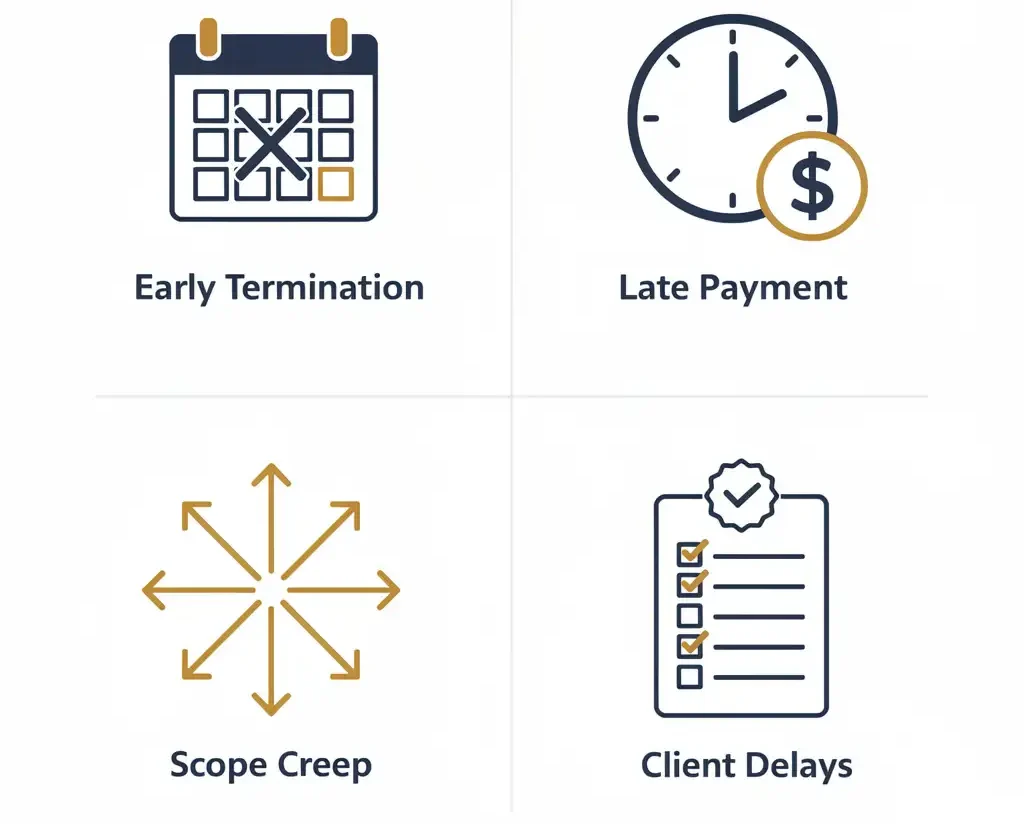
Early Termination Penalties
This is the one that matters most. If a client cancels mid project, they do not just owe you for work already done. They owe you something for the disruption itself.
A liquidated damages clause can specify that if a client defaults on the project agreement, terminating before completion without valid cause, they owe a predetermined amount. In creative industries, this is sometimes called a kill fee, and it has been standard in photography and publishing for decades.
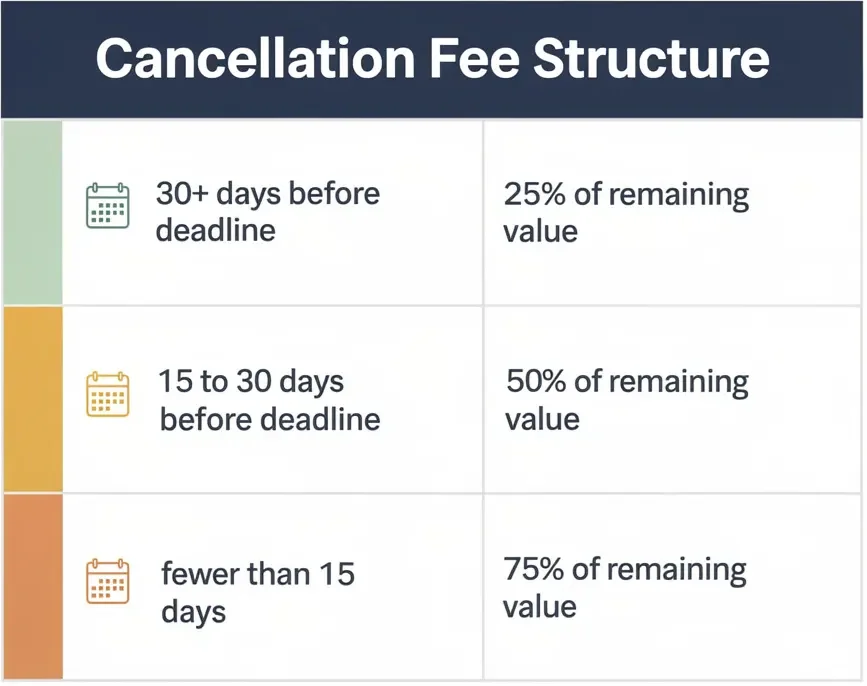
My current contracts use a tiered structure:
For example, a cancellation tier structure could look like this: If canceled more than 30 days before the deadline: 25% of the total project fee. If canceled 15 to 30 days before the deadline: 50% of the total project fee. If canceled fewer than 15 days before the deadline: 75% of the total project fee. Any deposit or milestone amount already paid counts toward (is credited against) that total, so the client does not pay the tier amount on top of amounts already paid for the same work. Set your own tiers in the contract — these percentages are an example, not a legal standard.
Is this always easy to enforce? Honestly, no. But having it in writing means clients think twice before pulling the plug on a whim. And if a dispute happens, I have a specific, pre-agreed number to point to rather than a vague claim about lost opportunity. That specificity changes everything in a negotiation.
Late Payment Penalties
Late payments are the part of freelancing that nobody warned me about when I started. You finish the work. You send the freelance invoice with clear invoice terms stating payment due in 14 days. And then nothing. Weeks go by. You send polite follow-ups. You get a “we are processing it” email that means absolutely nothing.
A late-payment clause is simple: invoices unpaid after a specified number of days begin accruing a daily, weekly, or monthly late fee of a set dollar amount or percentage. That late fee (in some cases treated as late interest) is a different tool from liquidated damages for a missed deadline or cancellation; the comparison below explains the difference.
For example, this guide uses 1.5% per month on unpaid balances. Whether that rate is proportional and defensible depends on the actual likely loss and the governing law; it is not automatically non-punitive just because it is written down. Check your state’s rules before you use any late-fee rate — there is no single US-wide standard. The exact number matters less than the fact that it is specified in writing before anyone signs anything.
A written late-fee clause can do more for cash flow than any other single change. Not because late fees are constantly collected, but because clients know the clock is running. And that urgency changes behavior in a way that a polite email never will.
Note: Late payment rate legality varies by state and country. Always verify the maximum permitted rate in your jurisdiction before including a specific percentage.
Scope Creep Penalties
This one is less common, but I have seen it work effectively for a freelance designer or developer especially.
Scope creep is where a project gradually expands beyond the agreed statement of work, and it is one of the most financially damaging patterns a freelancer can fall into. I have a specific story about this later in the article that I am still annoyed about years later. I will flag it now so you know it is coming.
Some freelancers include a clause specifying that any work outside the agreed scope of work, if not formally rejected, will be billed at a set rate. Revisions beyond a specified number get billed at an hourly rate. This uses the same mechanism as a traditional liquidated damages clause, which is pre-agreed dollar amounts for specific behaviors, even if courts might classify it differently.
Delayed Client Approvals
Here is one I never thought about until a web developer friend mentioned it. She works on projects where she literally cannot move forward without client input. They have to review drafts, approve copy or designs, provide assets. And some clients treat that approval step like it is optional.
Clients who drag their feet on approvals can completely blow up your timeline. If you have other projects lined up, or if your payment schedule is structured around deliverable milestones, those delays cost you real money. In a strict sense, a client who consistently fails to provide required materials on time may be in breach of the service agreement, even if they never intended any harm.
A clause can specify that if client approval is delayed more than a set number of business days beyond agreed deliverable milestones, the project timeline extends proportionally. If delays accumulate past a total threshold, a holding fee may apply. This accounts for the real cost of keeping project resources reserved and rescheduling other commitments around a stalled engagement.
Are Liquidated Damages Clauses Enforceable in Freelance Contracts?
This was the first question I brought to my lawyer after rewriting my contracts. And the answer is less simple than a yes or no.
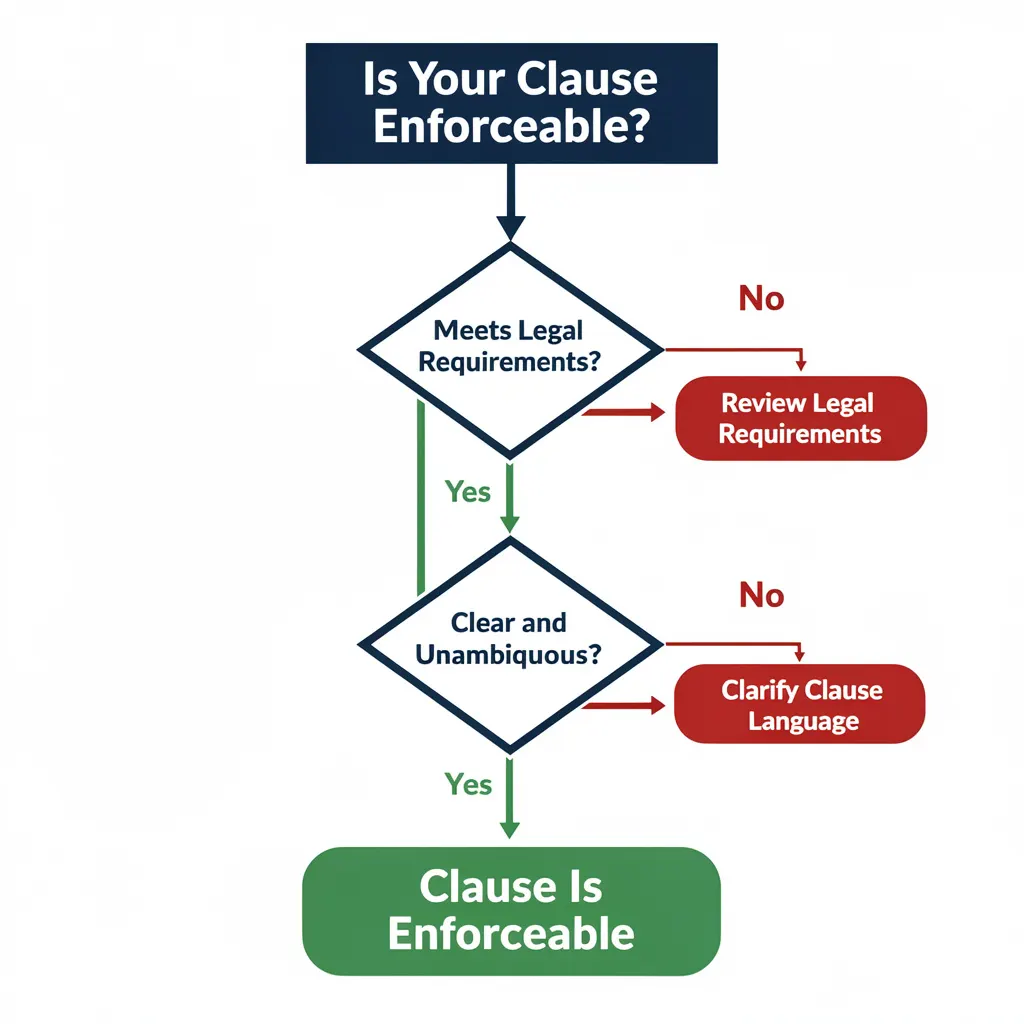
Whether a liquidated damages clause is legal and enforceable depends on the jurisdiction named as governing law in the contract and, in the United States, on state law; there is no single rule that makes such clauses enforceable in most jurisdictions. But they have to meet specific criteria, and courts have thrown them out when those criteria are not met.
The Restatement (Second) of Contracts §356 addresses this: damages for breach may be liquidated in the agreement, but only at an amount that is reasonable in light of the anticipated or actual loss caused by the breach. A term fixing an unreasonably large amount is unenforceable as a penalty. Cornell’s Legal Information Institute liquidated damages overview summarizes the related limit this way: “Courts will not impose liquidated damages if the clause is punitive, illegal, unconscionable, or contrary to public policy.”
For US freelancers, the core test most courts apply breaks down into two parts:
Test 1: Were the actual damages genuinely hard to calculate at the time of signing?
If the damages from a breach are obvious and easy to calculate after the fact, a court may find the clause is really a penalty clause rather than a genuine damage estimate. And unenforceable penalty clauses get thrown out. The good news for freelancers is that a lot of what we lose, lost opportunity costs, disrupted client pipelines, time that cannot be recovered, is genuinely uncertain. That uncertainty is exactly what makes a pre-agreed estimate legally reasonable.
Test 2: Is the amount compensatory damages rather than a punishment?
Your liquidated damages amount has to be proportional. If your day rate is $500 and you specify a $5,000 per day late payment penalty, a court is going to view that as punitive, because $5,000 is 10 times the $500 day rate. But a late payment fee of 1.5% per month on an unpaid invoice may be proportional and defensible if it reflects the actual likely loss and the governing law allows it.
A note on specific jurisdictions: Some states have rules that go beyond these two tests. New York City’s Freelance Isn’t Free Act (Local Law 140 of 2016, effective May 15, 2017, per the City’s own page) is a city law; it is not the same as New York State’s separate Freelance Isn’t Free Act, and the two should not be confused. The City act adds specific protections including mandatory written contracts for projects over $800. California has its own freelancer protection framework as well (California Freelance Worker Protection Act, in effect since January 1, 2025). That California framework is cited here by name and date only; it does not by itself validate any particular liquidated-damages amount. Your liquidated damages clause exists within that additional legal context, so know what already applies to you before you draft.
One more thing I want to be clear about. I am a freelancer who has done significant research on this topic, not a lawyer. Laws vary by state and country. If you are adding liquidated damages clauses to contracts for significant amounts, get a lawyer to review them. That investment has paid for itself many times over in my own business.
Why Don’t More Freelancers Use These Clauses?
I have asked this question across a lot of freelancer communities. Reddit threads, Facebook groups, Discord servers, in-person meetups. The answers are pretty consistent.
“I was worried it would scare clients away.”
I understand why this one comes up so often. I had the exact same fear two years into freelancing. The worry is that professional contracts signal distrust, and distrust drives clients away. What I found, over and over, is that it is almost the opposite.
And this matters: the clients who pull back hardest from basic contractual accountability are often giving you early information about how they will behave when an invoice comes due. Pay attention to that signal. Losing that client is not a loss. It is information.
“I did not know this was even a thing for freelancers.”
Yes. That was me too. There is plenty of content about building portfolios, finding clients, and setting rates. Contract clauses that protect you specifically? Almost nothing. The gig worker model has grown faster than the contract education that should accompany it.
“My contracts are one-page agreements. I did not want to complicate them.”
You can add a liquidated damages clause to a one-page contract. One clear paragraph. It does not become a legal document just because it contains a specific number and a triggering condition.
“I tried it once and a client pushed back hard.”
That happens. Negotiation is part of contracts. Pushback does not mean surrender. It means conversation. Adjust the numbers, change the triggering conditions, find something both parties can actually live with. The goal is a signed contract, not a standoff.
Examples for Freelance Contracts
Here are actual examples. Plain language versions I have used myself or seen used by other freelancers. These are illustrative and not legal advice. Adapt and review them with a professional before you use them.
The Late Invoice Scenario
“Payment is due within 14 days of invoice date. Invoices not paid within 14 days of the due date will accrue a late fee of 1.5% of the outstanding balance per month (or the maximum rate permitted by applicable law, whichever is less). The parties agree that these fees reflect the actual cost to the freelancer of delayed payment, including time spent on follow-up communications and the effective loss of use of those funds during the delay period.”
Why the last sentence? Because you are establishing this as a genuine damage estimate, not a penalty. That distinction is what courts look for.
The Client Who Walks Away
“In the event that Client terminates this Agreement without cause before project completion, Client agrees to pay a termination fee as follows: (a) if terminated more than 30 days before the agreed completion date, 25% of the total project fee; (b) if terminated 15 to 30 days before the agreed completion date, 50% of the total project fee; (c) if terminated fewer than 15 days before the agreed completion date, 75% of the total project fee. Any deposit or milestone payment already paid is credited against the termination fee, so amounts already paid are not charged again. In no event will the total termination fee under this clause exceed 75% of the total project fee, after that credit. The parties acknowledge that the actual damages to Freelancer from early termination, including lost opportunity costs and schedule disruption, are difficult to calculate precisely, and these fees represent a reasonable pre-estimate of such damages.” Cap note: the 75% of total project fee ceiling above is the cap for this sample clause.
The Approval Bottleneck
“Client agrees to provide feedback, approvals, and required materials within 5 business days of each deliverable milestone. In the event that Client delays beyond this window, the project timeline will extend by the number of days of delay at no cost to Client. If delays accumulate to more than 15 business days total across the project, Freelancer reserves the right to charge a delay fee of $[X] per day for each day beyond the 15-day threshold, as this reflects the cost of holding project resources and rescheduling other commitments.” Causation limit: delay amounts run only for delay caused by the party charged. Delay caused by the freelancer does not trigger a freelancer delay charge against the client, and time lost because the client was late providing materials or approvals pauses the clock. No double recovery: the same delay or loss is paid for once, not again under another clause for the same loss.
The Expanding Scope
“The project deliverables described in Schedule A constitute the full extent of services to be provided under this Agreement. Any additional work requested by Client beyond this scope will be quoted separately and requires written agreement before work begins. Revisions beyond [X] rounds per deliverable will be billed at Freelancer’s standard rate of $[X] per hour. Unauthorized requests for additional work that proceed without written approval will be billed at 1.5 times the standard hourly rate, as this rate accounts for the disruption to Freelancer’s schedule and workflow.”
Look at what all four examples have in common. Plain language. An explanation of why the damages are pre-estimated rather than calculated after the fact. Specific numbers and timeframes. And none of them are punitive.
That last point is not just ethical. It is what keeps them legally enforceable.
Four Ways These Payments Differ
Liquidated damages: a pre-agreed amount for a specified breach, such as a missed deadline or early cancellation, used where the actual loss was genuinely hard to calculate at signing. It must still pass the two tests above and be compensatory, not a penalty.
Late fee / late interest: a charge for late payment, such as the 1.5% per month example in this guide. It is not a liquidated-damages amount for a missed deadline or cancellation, and it must be proportional and allowed under the governing law.
Deposit: money paid upfront. It counts toward amounts owed and is credited against the total, so it is not an extra charge on top of work already paid for.
Kill fee: a specific type of liquidated damages for early cancellation by the client, as described in the tiered examples above.
When a project ends early, work out what is owed as: earned amount for work done + kill fee if provided − deposit already paid, no double recovery. The same work or loss is paid for once, not again under another clause for the same loss.
How to Actually Add This to Your Contracts: A Step-by-Step Walkthrough
Okay. Here is how I would approach this, especially if you have never done it before.
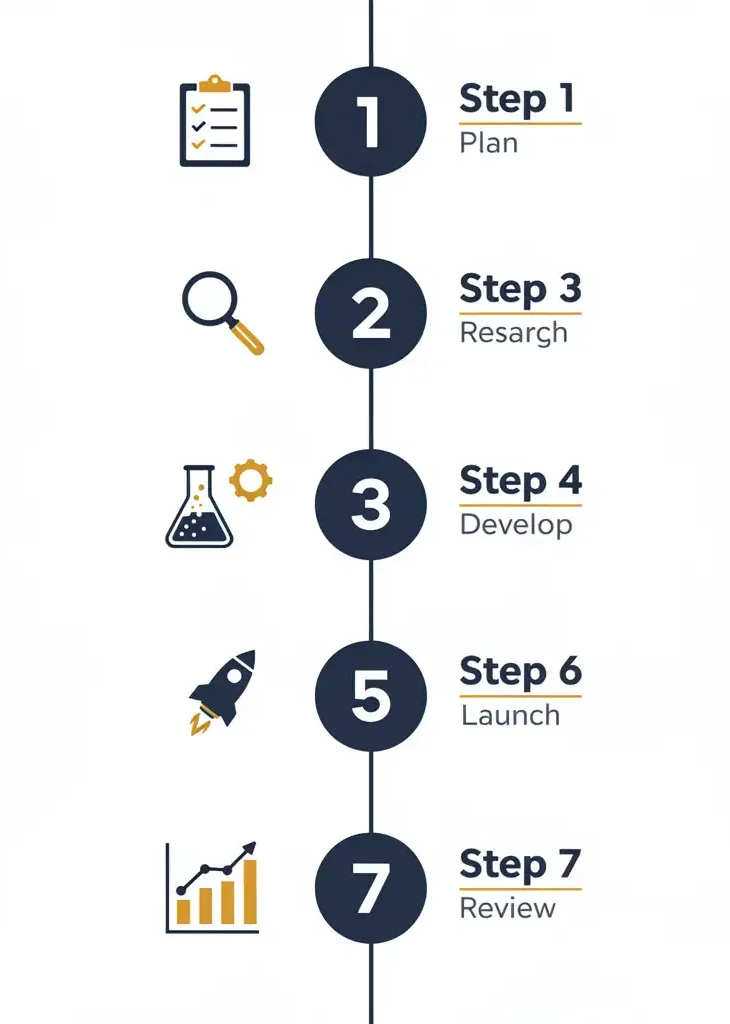
Step 1: Pull Up Your Existing Freelance Contract Template and Read It Honestly
Ask four questions and do not move on until you have answered all of them.
What happens if the client bails mid project? What happens if they do not pay on time? What happens if they drag out approvals for weeks? What happens if they keep asking for changes that were never in the original scope?
If the answer to any of those is “nothing specific,” you have found your gap. Write it down.
Step 2: Think Through the Risks That Are Actually Real for Your Business
Not every freelancer needs every clause.
If you take long exclusive projects, early termination is your biggest risk. If you are a designer who goes through lots of revision rounds, scope limits matter most. If you often wait on client feedback before you can proceed, client delay clauses are your friend. If you deal with slow-paying clients regularly, late payment clauses are non-negotiable.
Focus on the risks that are genuinely yours.
Step 3: Research What Numbers Are Reasonable in Your Field
Numbers matter. Your liquidated damages amounts have to be defensible in court if it ever comes to that.
Late-fee rates vary; check your state’s limit. Talk to other people in your field. Communities like r/freelance on Reddit are surprisingly open about contract terms.
Step 4: Write the Clauses in Plain Language Before You Try to Sound Legal
Write what you actually want in a simple sentence first.
“If they cancel the project in the last two weeks before the deadline, they owe me 75% of the total project fee, less any deposit or milestone amount already paid.”
That is your starting point. Then refine the language. Starting in plain language forces you to get clear on what you actually want before the legal wording buries the intent.
Step 5: Get It Reviewed
Not optional. Not for me, at least the first time.
A one-hour legal consultation with a small business attorney can vary widely in price; get a quote before you book. It may still be far less than the cost of an unenforceable clause when you actually need it. Specialized resources like Kiffanie Stahle’s contracts for creative freelancers are designed specifically for people in our line of work. The Graphic Artists Guild Handbook also covers contract guidance for creative professionals. UK freelancers can check IPSE, the Independent Professional and Self-Employed trade body, for contract resources and referrals.
Do not copy clauses from random articles online. Including this one.
Step 6: Build It Into Your Standard Freelance Contract Template
Once you have language you are confident in, do not treat it as something you add only for risky clients. Make it part of your standard template so it appears in every engagement automatically.
When these clauses are just how you do business, they feel less like you are suspicious of a particular client. Because it is.
Step 7: Be Able to Explain Each Clause Clearly When Clients Ask
Have a prepared, calm response ready.
“That clause is pretty standard in professional service contracts. It just means that if an invoice goes past the due date, a small fee begins accruing. It rarely comes into play, but it keeps both of us accountable to the schedule we agreed to.”
Matter of fact. No apology. Framed as protecting the professional relationship, not as something adversarial.
Real Scenarios Where This Would Have Made a Huge Difference
Let me walk through some scenarios. Some from my own experience, some from stories I have heard from other freelancers.
The Ghost Client
A freelance developer I know spent six weeks building a custom web application for a startup. They paid the initial deposit, provided detailed specs, approved the first milestone. Then silence. No response to emails. No response to messages. The founder eventually surfaced to say the startup was pivoting and they did not need the product anymore.
They paid what was technically owed for work completed. Roughly $4,000. But the developer had blocked out six weeks and was now looking at zero pipeline for the following month.
With an early termination clause, that client would have owed an additional payment for the disruption. My friend would have had something specific to negotiate with rather than just being left holding nothing.
The Endless Revision Nightmare
A graphic designer I know got hired to create a brand identity package. Her contract said unlimited revisions, which she included because she thought it would attract clients. It did. The wrong ones.
One client spent seven months in revision rounds. Going in circles. Changing their mind constantly. The designer finally ended the relationship. She had been paid the flat fee agreed upon at the start. For seven months of work.
Now she has a clause specifying that revisions means addressing feedback on the same core concept, and that full concept changes restart the billing clock at her hourly rate. The first time she used it, a client who had been doing exactly the same thing stopped the behavior immediately. The clause did not even need to be enforced. It just needed to exist.
The Late-Paying Nightmare Client
I know a content strategist who completed a large project for a mid-sized retail company. A $15,000 contract. She delivered everything on time and then waited four months for payment. The company’s accounts payable team required three separate approval signatures for any invoice over $10,000, a fact nobody mentioned when she signed the contract.
She finally got paid. In those four months, she had put business expenses on a credit card, paying interest. She had turned down a smaller project assuming this one would close on time.
With a late payment clause at 1.5% per month, she would have been owed an additional $900 in late fees on that invoice. She might not have collected every cent. But she would have had something real to negotiate with.
The Scope That Ate My Life
And then there is my own experience. Not the Sandra situation. A different one.
I took on a content project scoped as ten blog posts. Clear. Defined.
Over the course of the engagement, the client kept layering things on. Can you also write social captions for each one? Sure. Can you do email versions? Fine. We need short summaries too. Of course. I said yes to all of it because I wanted to be helpful and I did not want to seem difficult.
For example, a ten-post project that turns into roughly 25 pieces of content for the same flat fee can push a freelancer’s effective hourly rate down to about $18.
That is what scope creep does to the economics of something that looked perfectly reasonable on paper.
Now my contracts specify exactly what deliverables are included, what constitutes a revision versus a new piece, and what the additional rate is for out-of-scope work. Every “can you also” conversation now starts with “sure, let me pull up our rate for that additional scope.”
That change alone recovered thousands of dollars in a single year.
Common Mistakes to Avoid
Let me save you from some of the moments I have watched freelancers walk directly into.
Mistake 1: Setting Unreasonably High Numbers
For example, a freelancer who puts a $1,000 per day late payment fee in a contract for a $3,000 project is setting a figure that is almost certainly not enforceable.
Even if a client signed it, that is almost certainly not enforceable. Courts will not uphold a clause that is clearly punitive. And that amount relative to the contract value is a clear punishment, not a damage estimate. You would likely lose in court and lose clients just by proposing it. Keep your numbers proportional. Some freelancers also include a damages cap, an upper limit on total liability in either direction, which actually strengthens the enforceability argument.
Mistake 2: Vague Triggering Conditions
“If the client is late with payment, they will owe additional fees” is too vague. What counts as late? When does the clock start? How are the fees calculated?
Be specific: “Invoices unpaid 14 calendar days after the invoice date will accrue a fee of 1.5% of the unpaid balance per month, calculated from the invoice date.”
Mistake 3: Not Explaining the Clause to Clients Before They Sign
If you just email a contract and hope clients sign without questions, you are setting yourself up for a dispute later where they claim they did not understand what they agreed to. When you send the contract, briefly flag any clause the client is likely to notice. “You will see there is a late payment clause and an early termination provision. Happy to walk through those if you have questions.” This builds trust. It shows you are transparent, not hiding anything.
Mistake 4: Having the Clause But Not Being Willing to Enforce It
This one I fell into myself in my second year of freelancing. I had a late payment clause. A client was 45 days overdue. I said nothing about the fee because I was afraid of damaging the relationship. She paid eventually. I never mentioned the late fee. And she was slow again on the next invoice, because she had learned there were no real consequences.
If you consistently fail to enforce your clauses, they are decoration. When you send a payment reminder, include: “As a reminder, our agreement includes a late payment fee that has begun accruing. Happy to discuss if you have questions.” Matter of fact, no aggression.
Mistake 5: Copy-Pasting Clauses Without Understanding Them
A clause designed for a US freelancer may not be appropriate for someone in the UK or Australia. A legal template for freelancers working on long-term retainers may not make sense for project-by-project work. Understand what you are agreeing to and what you are asking clients to agree to. If a clause confuses you, ask a lawyer to explain it before you start using it.
Mistake 6: Signing a One-Sided Client Contract Without Adding Reciprocal Protections
Some clients will hand you their standard contract. Corporate clients especially. These often include liquidated damages clauses that protect the client. That is fine. But if you sign without adding any protections running the other direction, you are in a one-sided situation.
Always read every clause carefully. Do not be afraid to negotiate additions.
Mistake 7: Forgetting That the Clause Needs to Be Balanced
In some jurisdictions, a clause that only benefits one party can be challenged in court. If you have a late payment clause that charges the client fees but nothing corresponding that covers consequences if you are late on deliverables, a court may see that as one-sided.
Include consequences for your own lateness too. Proportional and tied to factors within your control. Something like: “In the event of delay due to factors within Freelancer’s control, Client will receive a credit of $[X] per day of delay, to a maximum of [Y]% of the project value.” This is good faith. And it makes your contract stronger overall.
The Bigger Picture: Why This Is About Respect, Not Just Money
I want to step back for a moment because I think there is a framing problem with how freelancers think about protective contract clauses.
We often treat them as adversarial moves. Like we are expecting the client to betray us and loading up our legal arsenal in advance. Then we feel guilty about it, or we worry the client will read it as distrust.
That framing is wrong.
Liquidated damages clauses are not about distrust. They are about clarity.
When you specify in advance what happens if things go sideways, you are doing the client a genuine favor. If they know exactly what early termination will cost, they can make an informed decision about whether to commit at all. If they know there is a late payment fee, they have a real reason to prioritize your invoice rather than letting it sit.
The best professional relationships I have had are built on exactly that kind of clarity. A contract with clean, specific terms, including what happens when things go wrong, is something both parties should want going in.
And clients who see a freelancer with professional, thoughtful contracts tend to read it correctly. This person runs a real operation.
What If a Client Refuses to Sign a Contract with This Clause?
This happens. Some clients push back on protective clauses. Here is how I think about it.
First, understand why they are pushing back. Is it a principled objection, a financial concern, or a relationship concern? Each of those has a different resolution.
For principled objections: explain the logic. These clauses are not penalties. They are pre-agreed estimates of actual harm. Professional contracts in every industry use them.
For financial concerns: you might be able to offer flexibility in the triggering conditions. Instead of fees starting on day 15, maybe day 30. Or a smaller amount. You are negotiating, not surrendering.
For relationship concerns: frame it as standard professional practice, not personal suspicion.
Second, know your limits. Late payment consequences, for me, are non-negotiable. I have had too many slow-paying clients to simply trust the goodwill of someone I have not worked with before. If someone refuses to agree to any consequences for non-payment, that is a real flag. Pay attention to it.
Third, recognize that a client who fights every protective clause may be a client you do not want. This sounds scary when you need the work. I get it. But the clients who push back hardest against basic accountability in contracts are often giving you exactly the information you need about how they will behave when an invoice is due.
Tools and Resources That Help
Here are practical tools that help many freelancers manage contracts and invoicing.
HoneyBook. A client management platform that many freelancers use. You can build your liquidated damages clauses directly into your contract template and have them pre-populate for every new project. Not free, but the professional presentation and time savings are worth it at full-time freelance scale.
Dubsado. Similar to HoneyBook. More customizable in some areas, steeper learning curve. Strong choice if your service offerings are more complex or layered.
Bonsai contract tools are built specifically for freelancers. Contract templates, invoicing, and time tracking in one place. Their Bonsai contract templates are more freelancer-specific than generic business contract software.
Adobe Acrobat Sign or DocuSign. For legally binding electronic signatures. Whatever platform you use for contracts, electronic signing creates a clear, timestamped record. That record matters if a dispute ever comes up.
Wave. Free invoicing. It lets you clearly state your payment terms on every invoice, including that late fees apply. When a freelance invoice visibly states “Payment due in 14 days, late fees apply starting day 15,” it functions very differently than a casual payment request.
Google Docs. Do not underestimate it. A well-organized Google Docs contract exported as a PDF for signing with DocuSign is completely professional. You do not need expensive software to protect yourself.
What About International Freelancing?
If you are a US-based freelancer working under a contractor agreement with a client in Germany, Australia, or the UK, things get more complicated fast. Which country’s laws govern the contract? Where would a dispute be resolved?
Your contract should include a governing law clause specifying which jurisdiction’s laws apply and where disputes would be resolved. Pair this with your liquidated damages clauses so that if you ever need to enforce anything, everyone knows the rules from day one.
Most freelancers default to their own jurisdiction for governing law, which makes practical sense. You are not flying to Frankfurt to resolve a $3,000 project dispute.
A few specific notes:
If you do significant business in any specific country, get your contract reviewed by a lawyer familiar with that country’s laws. This guide does not rely on any specific UK or Australian court decision, and the rules in those countries should be checked for the governing law you name.
And always specify currency in your damage amounts. An invoice in US dollars means something very different to a client paying in British pounds.
What I Reasoned From a Lawyer Conversation About These Clauses
One point from a single lawyer conversation, as I understood it, is worth sharing, because it changed how I think about this. This is my reasoning from that conversation, not a sourced legal rule.
The question is: do these clauses actually hold up? If a freelancer has to sue someone, will a judge enforce them?
The explanation goes something like this: in my experience, many contract disputes between freelancers and clients are resolved without reaching a judge. The cost and time of litigation is prohibitive for most of these amounts. What these clauses really do is change the conversation before anyone goes anywhere near a courtroom.
Here is what that looks like in practice.
Without a liquidated damages clause: You: “I lost income because you bailed. I want $5,000.” Client: “Prove it.” Result: Stalemate.
With a liquidated damages clause: You: “Per section 4.2 of our contract, the termination fee is $5,000.” Client: “Can we negotiate?” Result: Conversation.
The clause gives you a pre-agreed number to start from. Not a number you invented after the fact. Not a vague claim of damages. A number both parties already agreed to in writing.
Another point, as I reasoned it: a clause that might not be fully enforceable in court may still affect a negotiation, because the other side may prefer to settle rather than test it. That is not a guarantee, and it does not make an unenforceable clause enforceable. You do not need a judge to rule in your favor if nobody ever goes before a judge.
That reframe changes how a freelancer should approach every contract conversation. It is not about what happens in small claims court contract disputes. It is about what never has to get there.
Building a Contract Practice That Grows With You
When you are first starting out, you might be doing $500 or $1,000 projects. Adding formal clauses to small engagements feels disproportionate. I know. But the contract habits you build early carry forward.
Start with a kill fee. That is the single most protective clause for project-based work.
A kill fee is simply a liquidated damages clause for early cancellation, specifically for when the client is the one who pulls out through no fault of yours. It has been standard in photography and publishing for decades. Call it a termination fee, a cancellation provision, whatever fits your professional context.
My current kill fee is tiered, as a percentage of the total project fee, less any deposit or milestone amount already paid: 25% of the total project fee if canceled more than 30 days out. 50% at 15 to 30 days. 75% at fewer than 15 days.
Once that is in place, add late payment penalties. Then scope limits. Then client delay provisions. Build one clause at a time, get each one reviewed, and let the freelance contract template grow alongside your business.
For the first few years, I went through my template at the start of every new year. Every time something went sideways that my contract did not address, I added a line. And the document that exists today looks almost nothing like the one I had when the Sandra situation happened.
That is exactly how it should work.
What a Strong Freelance Contract Includes
Here is a general overview of protective provisions a strong contract includes. All of these function as or alongside liquidated damages concepts.
Late payment fee (example): 1.5% per month on overdue balances, starting 14 days after invoice date.
Cancellation fee: Tiered, as described above. 25%/50%/75% of the total project fee depending on timing, less any deposit or milestone amount already paid.
Client approval delay provision: If client delays exceed 10 cumulative business days, a daily holding fee kicks in.
Revision limits: Specified number of revision rounds per deliverable, with an explicit hourly rate for additional revisions beyond that.
Scope change protocol: Any out-of-scope requests are quoted in writing before proceeding. Unauthorized scope additions are billed at 1.5 times standard rate.
Governing law clause: My state, my jurisdiction for disputes.
Dispute resolution: Mandatory mediation before litigation. Keeps it out of court when possible.
IP release: Tied to full payment. I retain ownership of all work product until the invoice is paid in full. That means the client cannot legally use the work, publish it, or build on it until they pay. For a client who wants to move fast, that is real urgency in a way that a polite reminder email never creates.
That last item is worth flagging if you have not seen it before. Tying IP ownership to payment completion is one of the most powerful tools in a freelance contract, and it sits alongside the liquidated damages provisions as a separate but complementary protection layer.
Wrapping This Up
Sandra’s example shows that goodwill and good work are not enough in a freelance business. You need structure.
Adding a liquidated damages clause to every freelance contract gave me that structure. Not because I spend my days chasing down late fees. But because the clauses change the dynamic before anything goes wrong. Clients take deadlines more seriously when there are agreed consequences. Invoices get prioritized when a clock is ticking. Projects get scoped more carefully when everyone knows what out-of-scope work costs.
What I have found, and this still surprises me, is that having clear, professional contracts makes me a more relaxed freelancer. I spend less mental energy worrying about what happens if a client bails or goes silent. The contract handles that. I can stay focused on doing good work.
If you have been freelancing without these protections, start with one clause. The one that addresses the risk that feels most real to you right now. Get it reviewed. Explain it calmly to your next client.
You will probably find the conversation goes just fine. Most professional clients do not blink at a late payment clause in a well-written contract. And the ones who do blink loudly at every reasonable protection in your agreement? That reaction is data. Pay attention to it.
The best time to add these protections was when you signed your first contract. The second best time is the next one you send.
Frequently Asked Questions
What is a liquidated damages clause?
A liquidated damages clause in a freelance contract is a provision where both parties agree upfront on a specific dollar amount to be paid if one side breaches the agreement. It can reduce the need to prove exact losses after the fact, but it does not eliminate that question if enforceability is challenged, and it gives both parties clarity about financial consequences before work begins.
Are liquidated damages clauses enforceable in freelance contracts?
Enforceability depends on the governing law named in the contract and, in the United States, on state law; it is not true in every jurisdiction. Where such clauses are recognized, they must meet two key criteria: the actual damages had to be genuinely hard to calculate at the time of signing, and the pre-agreed amount must be a reasonable estimate of likely losses, not a punishment. Courts will not enforce clauses that are clearly disproportionate or designed to penalize rather than compensate, and, as Cornell’s Legal Information Institute puts it, courts will not impose liquidated damages if the clause is punitive, illegal, unconscionable, or contrary to public policy.
What is the difference between a liquidated damages clause and a penalty clause?
A liquidated damages clause represents a genuine pre-estimate of the damages likely to result from a breach. A penalty clause is designed to punish the breaching party rather than compensate the other. Courts enforce liquidated damages clauses but generally will not enforce penalty clauses, making the distinction legally significant.
Should freelancers include liquidated damages in their contract?
Most freelancers benefit from including at least a late payment clause and an early termination provision in their contracts. These protect against the two most common financial disruptions: slow-paying clients and clients who cancel mid project. More specialized clauses covering scope creep and client approval delays are also worth considering depending on the type of work you do.
How much should I set for liquidated damages in a freelance agreement?
The amount must be a reasonable estimate of your actual likely loss. Late-fee rates vary; check your state’s limit. For early termination fees, percentages between 25% and 75% of the total project fee are used as examples in this guide, less any deposit or milestone amount already paid. The amount should reflect what you would genuinely lose, not what you wish you could collect.
Can a freelancer enforce liquidated damages against a client?
Yes, if the clause is properly drafted, mutually agreed to, and meets the enforceability criteria in your jurisdiction. In practice, most disputes are resolved through negotiation rather than litigation because the existence of a specific pre-agreed number changes the dynamic significantly before anyone goes to court.
When is a liquidated damages clause unenforceable?
A liquidated damages clause becomes unenforceable when courts determine it is a penalty rather than a genuine damage estimate. This happens when the pre-agreed amount is wildly disproportionate to any realistic loss, when actual damages were easy to calculate and the clause was used anyway, or in certain jurisdictions that have specific rules about enforceability conditions.
What is the difference between a liquidated damages clause and a kill fee?
A kill fee is a specific type of liquidated damages clause covering early project cancellation, typically when the client cancels through no fault of the freelancer. It has been standard in publishing, photography, and advertising for decades. The terms are sometimes used interchangeably, though kill fee is the informal industry term and liquidated damages is the legal term for the same mechanism. For a full walkthrough, see the GigLawGuide kill-fee guide.
If you’re looking for more real world insights and practical tips to level up your freelancing journey, make sure to check out our website. We regularly share simple, actionable content to help you land better clients, protect your time, and confidently grow your freelance career.
Disclaimer: This article is for informational purposes only and does not constitute legal advice. Laws vary by jurisdiction and individual circumstances differ. Please consult a qualified attorney before adding or modifying contract clauses, especially for significant contracts.
Sources
Restatement (Second) of Contracts §356 — liquidated damages, paraphrased in the enforceability section above. Cornell Legal Information Institute liquidated damages overview — linked in the enforceability section. New York City’s Freelance Isn’t Free Act — linked in the jurisdictions note. California Freelance Worker Protection Act — cited by name and date in the jurisdictions note. GigLawGuide kill-fee guide — linked in the kill-fee FAQ answer.
General information, not legal advice.


