


How long should a freelance contract be? A one-paragraph contract that says little more than the deliverable and the price leaves nothing to point to when revisions multiply, communication stops, or the final product does not match what the client imagined.
Two things matter most. A proper freelance contract matters far more than most new freelancers give it credit for. And the length of your contract has almost nothing to do with how many pages it runs. It has everything to do with whether it covers the specific situations that actually break a working relationship apart.
How Long Should a Freelance Contract Be? The Smart Range for 2026
No universal number says a freelance contract must be exactly 3 pages or 10 pages or 500 words. The right freelance contract length is the one that is long enough to cover what can go wrong, and short enough that a client will actually read it before signing.
The ranges below are editorial examples, not survey data and not a legal or industry standard — use them as a starting point and adjust for the project’s risk.
1 page: Works for small, simple, one-off projects with a clear deliverable and a client you already have history with. A quick logo refresh. A single 500 word blog post for a repeat client. The kind of project where the scope fits on an index card.
2 to 3 pages: a common editorial starting point. Covers the core sections without making a client feel like they are filing for incorporation before they hire someone to write a landing page.
4 to 5 pages: Appropriate for larger, more complex scopes. Website builds, brand identity packages, anything involving multiple phases or significant dollar amounts. Retainers run 3–5 pages depending on monthly scope and renewal/pause terms: a simple monthly retainer sits at the low end, while a multi-service retainer sits at the high end. This is an editorial starting point, not a standard.
6 pages and above: This is corporate territory. Agency level work, complex legal requirements, or ongoing arrangements with auto-renewal freelance contract terms built in. At this level, a legal review is genuinely worth the investment.
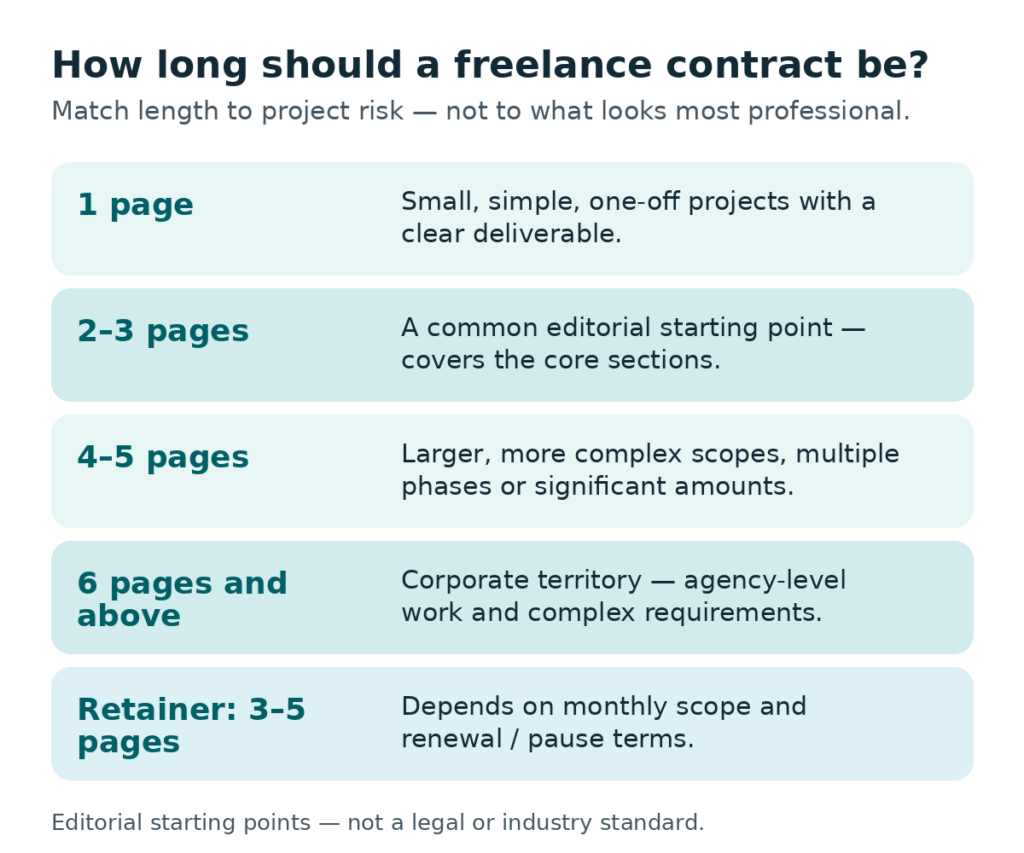
not to what looks most professional.
A 2 page base contract for most projects, with clauses added as the work demands, is a structure that holds up well when it is actually needed.
How Many Pages Should a Freelance Contract Be?
The page count question is one freelancers ask constantly, and the reason is understandable. It feels like there should be a clean answer.
There is not. But there is a practical rule: the contract should match the risk. A $150 logo concept does not need the same document as a $12,000 website build with six phases, two rounds of stakeholder review, and a go-live date attached to a product launch.
What matters more than page count is clause count. A tight, well-written 2 page contract with clear scope, payment terms, a revision policy, and a termination clause will almost always outperform a vague 6 page document.
The Sections That Actually Matter
For a $200 writing assignment, half those clauses are unnecessary overhead. For a $15,000 development contract, the same list might leave out something that matters. The freelance contract clauses below are organized by what they actually protect you from, not by what looks impressive in a template.
Project Scope: The Most Important Section
If your contract has exactly one section, this is the one it needs to be.
The scope of work defines precisely what you are delivering. Not vaguely. Not “a website.” Specifically: how many pages, what functionality is included, whether copywriting is in scope, how many revision rounds are allowed, what file formats you will deliver, and what is explicitly not covered in the price.
Freelance scope creep, the gradual expansion of project requirements beyond what was originally agreed, is a common source of freelance disputes. And it often traces back to a scope section written too loosely. Someone finds a gray area in the language and pushes on it.
Write this section as if the person reading it will look for every possible way to stretch its meaning. Because occasionally, they will.
Here is the difference between a weak scope statement and a strong one:
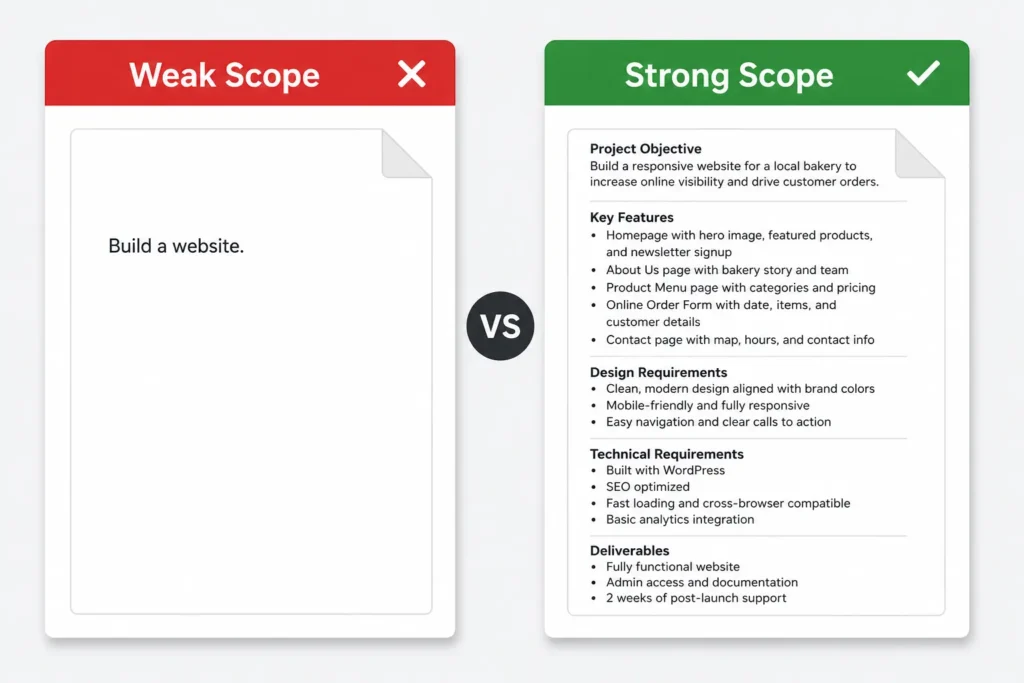
most freelance disputes begin.
Weak: “Freelancer will design a website for the client.”
Strong: “Freelancer will design a 5 page WordPress website including Home, About, Services, Blog, and Contact pages. Project includes 2 rounds of design revisions. Copywriting, SEO setup, and third party plugin costs are not included. Any additional pages will be quoted separately.”
That gap between those two statements is where most freelance disputes get started.
Payment Terms: Get Specific About Every Dollar
This section needs to cover three things without ambiguity: how much you are owed, when you get paid, and what happens if the client does not pay on time.
A common payment structure for most projects looks like this:
A deposit is often agreed upfront — for example 30 to 50 percent is a commonly suggested starting point, not a rule; agree the percentage in writing for each project. A milestone-based contract payment midway through on larger projects, tied to a specific approved deliverable. And final payment before I hand over source files or push anything live.
That last point is the one that matters most. Nothing should leave your possession until the full invoice clears. Releasing final files only after payment protects against a client accepting completed work and then going silent.
Your payment terms section should also cover:
Payment method, whether bank transfer, PayPal, Stripe, Wise, or another platform your client prefers. Invoice due date, Net 7, Net 14, or Net 30 depending on what you agree to. Late payment fees. A late fee of 1–1.5% per month, or the legal maximum, whichever is lower, on overdue invoices is an example rate — check the maximum permitted by applicable law before using it, since the lawful cap varies by jurisdiction. This is an illustrative example only, not a recommended rate.
Digital invoicing is widely used and creates a paper trail that can matter if a dispute escalates. Tools like Bonsai, HoneyBook, and Wave handle this automatically.
Revision Policy: Because Just One More Change Can Be Infinite
Define what a revision is. This is not optional.
A revision is a targeted, minor modification within the scope you both agreed on. A request for a completely new design direction, a different concept, or a color palette overhaul after the client already approved one: none of that is a revision. That is a new scope of work, and it gets quoted and billed as one.
The contract language for this reads:
“This project includes 2 rounds of revisions. A revision is defined as minor modifications to the approved design direction. Structural changes, new concepts, or scope additions will be quoted and billed separately.”
That clause can help prevent runaway revision cycles. Without it, “just one more small thing” becomes a full repaint of the project with no additional compensation. Leaving this section vague rarely ends without bad feelings on both sides.
Timeline and Deadlines: Both Yours and Theirs
Many freelance contracts specify only the freelancer’s delivery deadlines. That omission can become costly if client feedback deadlines are left out.
Client delays are a common reason projects run past their original completion date. If a client takes three weeks to provide feedback that was due in three days, that delay is not your fault. But without a timeline clause in your contract, it quietly becomes your problem when they return urgent and expecting everything done by the end of the week.
Your timeline section should include:
Your delivery schedule with specific milestone dates where the project warrants it. Client feedback deadlines, for example: “Client agrees to provide feedback within 5 business days of each submitted deliverable.” And a clause stating that delays caused by the client will extend the overall project timeline accordingly.
When a client goes silent for a full month and comes back expecting immediate reprioritisation, the timeline clause gives both sides a written basis for agreeing new dates.
Ownership and Intellectual Property Rights
Who owns the work once the project wraps up?
This is one of the most consistently overlooked sections in freelance contracts, particularly for designers and writers. Ownership usually depends on what the contract says in writing. In many jurisdictions the creator initially owns the work, but commissioned-work rules differ by country and work type, so relying on an assumption without spelling it out in the contract is a risk not worth taking.
Your intellectual property rights freelance clause should clearly state three things:
Ownership transfers to the client upon receipt of full payment. You retain the right to display the work in your portfolio unless both parties agree otherwise in writing. If a client requests a full IP waiver that includes portfolio rights, that is an additional cost, not a standard inclusion.
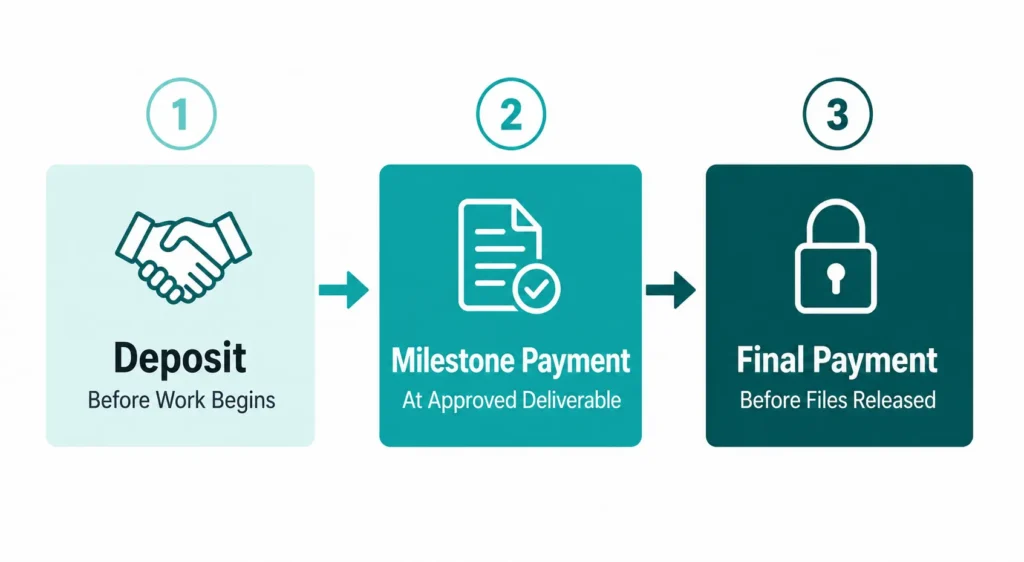
clears — this structure supports that: only release final files once the last payment clears.
That last point is worth emphasizing. Some corporate clients will ask you to sign away every right to the work, including any public display. That is a reasonable request to honor. But it should always come with a rate adjustment. You are giving up something of real professional value, and your pricing needs to reflect that.
Note: Intellectual property rules vary by country and by the specific type of work. In some jurisdictions, commissioned work may automatically transfer ownership to the client by default. If you regularly work with international clients, a one-time consultation with a contract attorney is worth the cost.
Termination Clause: What Happens When Things Go South
Projects get cancelled. Sometimes the client’s situation changes. Sometimes the working relationship stops functioning. Regardless of the reason, your contract needs to spell out what happens when a project ends before completion.
A reasonable termination clause covers three things:
Either party may end the contract period with 7 to 14 days written notice. The client pays for all work completed up to the termination date. The deposit is stated as nonrefundable if the client ends the contract without cause. Note: a nonrefundable deposit should be reasonable and expressly agreed, and its enforceability varies by jurisdiction — a deposit that looks like an unfair penalty can be challenged.
The kill fee is worth mentioning separately. If a client cancels after you have already turned down other work to take their project, a kill fee — a commonly suggested range is 25 to 50 percent of the remaining contract value — can compensate for lost opportunity if the parties agree it in writing. Consider it for retainer agreements and larger projects, and state the trigger and calculation expressly; the percentage is negotiable and its enforceability varies by jurisdiction. In practice, having a kill fee clause in writing tends to make clients think considerably more carefully before walking away from a commitment casually.
Supporting Clauses Worth Adding
Two shorter additions that belong in most freelance contracts:
Confidentiality: If you are handling sensitive client information such as internal strategy documents, unreleased product details, or private business data, include a paragraph stating that both parties agree not to share confidential information with outside third parties. Freelance NDA length does not need to be extensive. One clear paragraph may be enough for routine confidentiality, but unusually sensitive engagements may need a standalone NDA — the right form depends on what is being shared.
Governing law: If a dispute ever arises, which country or state’s laws apply? Add a governing-law sentence naming the law you agree (for example “This agreement shall be governed by the laws of [Your State or Country].”), and note that jurisdiction, venue and mandatory local rules are separate questions — take advice for cross-border work. One sentence that does a lot of quiet work, especially when you are working with clients across borders.
Clause-Coverage Matrix: What to Include by Project Type
Use this matrix as a coverage check, not as a page-count rule. What matters more than pages is whether the clauses below are covered for the project in front of you.
| Clause | Short one-off | Retainer | Complex build |
|---|---|---|---|
| Scope | include | include | add detail |
| Payment | include | include | add detail |
| Revisions | include briefly | include | add detail |
| Timeline | include briefly | include | add detail |
| IP | include | include | add detail |
| Termination | include briefly | include | add detail |
| Confidentiality | include briefly | include | add detail |
| Governing law | include briefly | include | include |
For a worked example for writers, see the full writing-contract template.
A Short Annotated Example
Example, in 1-page style: “Freelancer will deliver one article on the agreed topic by the agreed date. The client will pay the agreed fee in two parts: a deposit before work starts and the balance before final files are released. The client will provide feedback within 5 business days. Ownership transfers to the client on receipt of full payment. Either party may end the agreement with written notice, and the client will pay for work completed up to that date.”
- Note 1 — Scope: the deliverable, topic and date are named, so there is less room for scope creep.
- Note 2 — Payment: the deposit, balance and file-release point are stated, so payment is tied to a clear trigger.
- Note 3 — IP: ownership moves only on full payment, which protects the freelancer until the work is paid for.
- Note 4 — Termination: an exit route and payment for completed work are included, even in a short agreement.
Freelance Contract Length by Industry and Project Type
As a starting reference point (not an industry standard): writing 1–2 pages; design/development 3–5 pages; graphic design 2–3 pages; consulting and marketing 3–5 pages. These are illustrative ranges, not rules — a complex writing retainer can properly run longer than a simple design job.
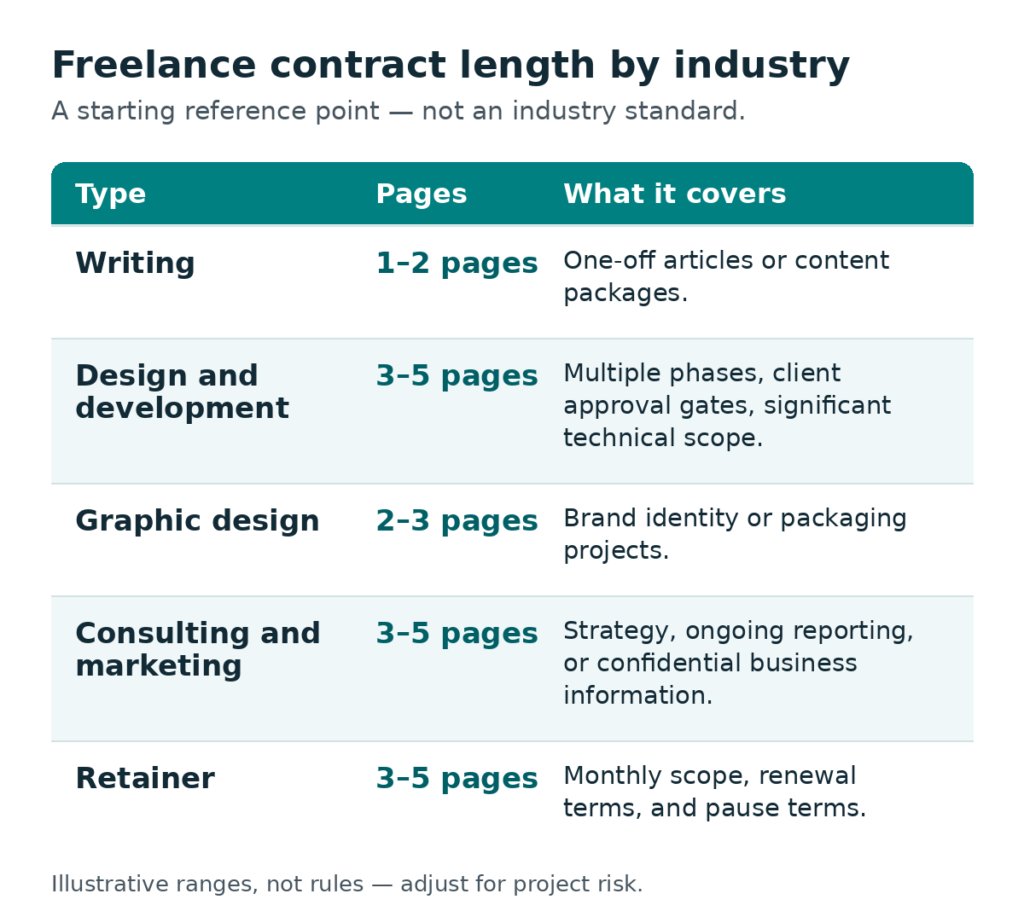
use this as your starting reference point.
Freelance writing contracts: 1 to 2 pages for one-off articles or content packages. Retainer writing agreements covering ongoing monthly deliverables need clear monthly scope definitions.
Web design and development contracts: 3 to 5 pages. These projects involve multiple phases, client approval gates, and significant technical scope, so the additional length is earned.
Graphic design contracts: 2 to 3 pages for brand identity or packaging projects. Shorter for single-asset jobs. The revision policy section is especially important here.
Consulting and marketing contracts: 3 to 5 pages, particularly if the engagement involves strategy, ongoing reporting, or access to confidential business information.
Freelance retainer contract length: Retainers run 3–5 pages depending on monthly scope and renewal/pause terms: a simple monthly retainer sits at the low end, while a multi-service retainer sits at the high end. This is an editorial starting point, not a standard. The contract needs to cover the monthly deliverable scope, renewal terms, the notice period for exiting, and what happens if either party needs to pause the arrangement.
Common Mistakes Freelancers Make With Contracts
These are the mistakes that actually cost people money, not the theoretical ones from legal guides.
No contract at all. Still common among new freelancers, especially for smaller projects. Small projects produce small problems too, and small problems are still worth protecting yourself from.
Copy-pasting a contract from the internet without reading it. Freelancers sometimes use contracts with clauses written for an entirely different country’s legal system, with provisions that did not apply to their situation at all. A template is a starting point, not a finished product.
Making the contract too complex for the job. If a client feels like they are signing a legal treaty in exchange for a $200 blog post, they will either walk away or sign it with resentment. Keep the length proportionate to the scope and the dollar amount involved.
Not keeping a signed copy. Use the tools section below for options for collecting and storing signed contracts. An email reply saying “sounds good” may not be enough to form a binding agreement, especially if key terms are missing or unclear. Conversely, an email exchange can form a binding agreement if key terms are clear and both sides show agreement, while a bare “sounds good” alone is unreliable.
Never updating your contract template. Every unexpected situation on a project is free feedback. Ask yourself after each one: would my contract have protected me here? If the answer is no, that is your next clause.
Tools That Make Contract Management Way Easier
E-signature tools are usually faster and easier to track than emailing Word documents.
No tool here is endorsed. What each tool is for is described below, and pricing and features must be checked on the vendor’s current page.
HoneyBook: An all-in-one platform for freelancers. Proposals, contracts, invoices, and client payments live under one roof.
Bonsai: Contract templates designed for designers, writers, developers, and marketers.
DocuSign or Dropbox Sign: If you already have a contract you are satisfied with and just need an e-signature tool. DocuSign and Dropbox Sign are e-signature tools that can produce a signed record with an audit trail; whether a signature is enforceable depends on your jurisdiction and on intent, consent, attribution and record-keeping — see the ESIGN Act / UETA requirements — not on the tool alone.
Google Docs with Google Workspace eSignature: Google Docs with Google Workspace eSignature (included at no extra cost on eligible Workspace plans such as Business Standard and Plus and Workspace Individual, where your admin enables it — not on Business Starter or on a free personal Docs account) or Docs paired with a third-party e-signature tool. In either case, keep the signed record with its audit trail; do not treat an email reply as your legal record.
As an illustration only, setting up a first template may take well under an hour, and later contracts can be sent in minutes once the base template exists — actual time depends on the tool and the project.
One Last Thing Worth Saying
A contract is not only a legal document. It functions as a communication tool at exactly the same time.
When a client reads your agreement and sees that you have clearly thought through scope, revisions, timelines, and ownership, that tells them something real about how you operate. That reaction is not accidental. It comes from a document that actually covers the right ground.
Start simple if you need to. A 2 page contract covering the sections in this guide will handle most of the situations you face. Refine it as you go. Every time a project catches you off guard, ask whether your contract would have helped. If not, that gap is your next clause.
And please, for the love of everything, stop sending one paragraph contracts. Your future self will be genuinely grateful.
Frequently Asked Questions About Freelance Contract Length
How long should a freelance contract be in pages?
See the editorial starting points at the start of this guide. The right length depends on project risk and clause coverage, not a fixed rule.
How long should a freelance contract last in terms of duration?
Short projects often run for the length of the project itself; retainers are often agreed for a fixed initial term (for example 3 months) with renewal by agreement — the term is whatever the parties agree and write down.
Should a freelance contract have an end date?
Yes. Every freelance contract should include a clear contract start date and an expected end date or completion milestone. For open-ended retainers, include an auto-renewal clause that specifies the notice period required to end the agreement: state the notice period you agree (for example 30 days) — there is no default 30-day rule. Without an end date or renewal clause, it is ambiguous when obligations conclude and how either party exits — always include a specific end date or a completion milestone.
Can a freelance contract be just one page?
Yes, for the right project. A one-page freelance contract works well for small, low-risk, single-deliverable jobs with a client you already have a working relationship with. It should still include the core sections: scope, payment terms, and a basic termination clause. Skipping those because the contract is short is what creates problems.
How long should a freelance retainer agreement be?
Retainers run 3–5 pages depending on monthly scope and renewal/pause terms: a simple monthly retainer sits at the low end, while a multi-service retainer sits at the high end. This is an editorial starting point, not a standard. The document needs to cover the monthly scope of deliverables, the retainer fee and payment schedule, the renewal terms, and the notice period both parties must give to exit the arrangement.
What happens if a freelance contract has no end date?
A contract without an end date creates ambiguity about when obligations conclude, when ownership fully transfers, and how either party exits the arrangement. In practice, this means disputes about whether the project is “finished” are harder to resolve. Always include either a specific end date or a completion milestone that triggers the contract’s conclusion.
Does a freelance contract need an expiration date?
See “Should a freelance contract have an end date?” above: every contract should define when the working relationship formally ends or renews, so renewal is a deliberate choice rather than an indefinite default.
How many pages is a standard freelance contract for a small project?
See the 1-page and 2-to-3-page starting points at the start of this guide. Include at minimum scope of work, payment terms, revision limits, and a termination clause.
What is the minimum a freelance service contract must include?
See “The Sections That Actually Matter” above: what is being delivered, how much is being paid and when, what happens if the client requests changes beyond the original scope, and how either party can end the agreement early.
How long does a freelance contract take to put together?
As an illustration only, setting up a first template may take well under an hour, and later contracts can be sent in minutes once the base template exists — actual time depends on the tool and the project.
Got a contract horror story, or a clause that is not covered here? Drop it in the comments.
