

For example, consider a freelance web developer with three years of solid work behind him. He signs a six month contract with a startup to build its entire ecommerce platform. Four months in, the startup’s main investor pulls out. The founder calls the next day and says four words: “We are invoking force majeure.” Buried in the contract is a clause that lets the client walk away without paying for two months of completed work. In this example, that is $4,800 of completed work left unpaid — not because the work was bad, but because the contract did not say what happens to work already done when force majeure is invoked.
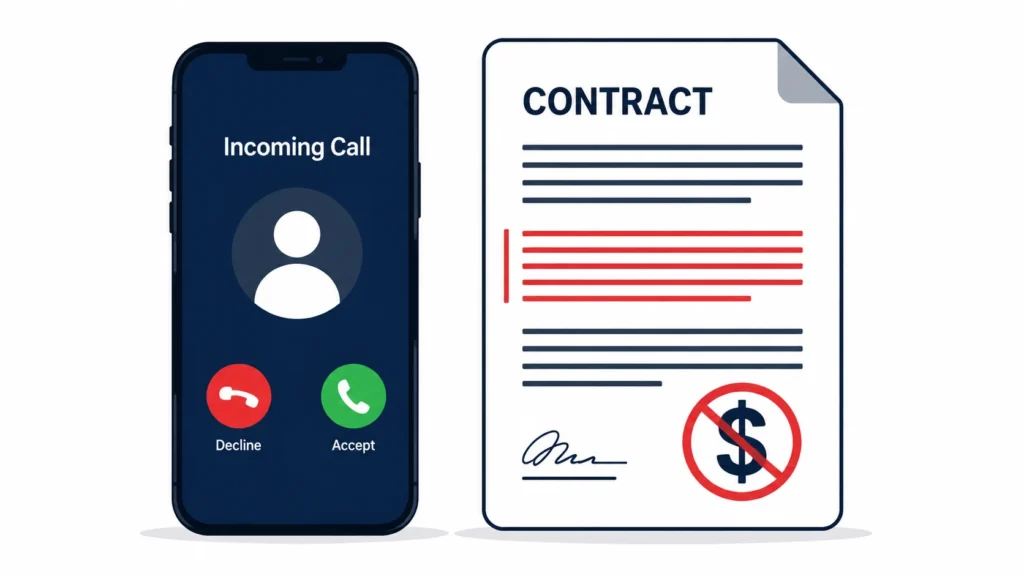
Force majeure clauses are usually written by the client’s side, so read them as if they were written to protect the company, not you. What follows is what to look for in the clause before you sign — not what you learn after things fall apart.
What Does Force Majeure Language Actually Mean?
“Force majeure” comes from French. It means “superior force.” At its simplest, it describes events that nobody planned for, nobody could have prevented, and that made it genuinely impossible to complete the work that was promised.
In a force majeure freelance agreement or any other service contract, this provision addresses what happens when those events hit. Natural disasters. Declared public health emergencies. Armed conflict. Government mandated shutdowns that prevent work from physically happening. Major infrastructure failures that knock out power grids or internet access across a region.
The core idea is this: when something genuinely uncontrollable and unforeseeable stops you from finishing your contractual obligation, neither party should face a breach of contract claim because of it.
That part makes sense. Understanding freelance contract legal terms like this one is the difference between having real protection and having nothing when things go wrong.
But here is where it gets complicated. And this complication has real financial consequences.
Why a Vague Force Majeure Clause Puts Your Income at Risk
The problem is not the concept. The problem is who writes it and what they write.
In most freelance situations, especially when you are working with a larger company or a funded startup, they draft the contract. Their legal team writes every single clause to protect the company. Not you. That is their job and they do it well.
Some force majeure clauses are written so broadly that a client could technically use them to avoid payment after a single bad revenue quarter. One example of this is a clause that lists “economic downturns” as a qualifying event. That is not force majeure. That is just a bad quarter dressed up in language designed to look legal.
A vague clause does almost nothing for the contract protection freelancers actually need when a real dispute happens. Most freelancers do not know their freelancer legal rights in that situation. And the client’s legal team is counting on that being the case.
Because clients have lawyers, time, and budget for disputes. Most freelancers do not. That asymmetry is the real problem.
What a Freelancer-Friendly Force Majeure Clause Must Actually Contain
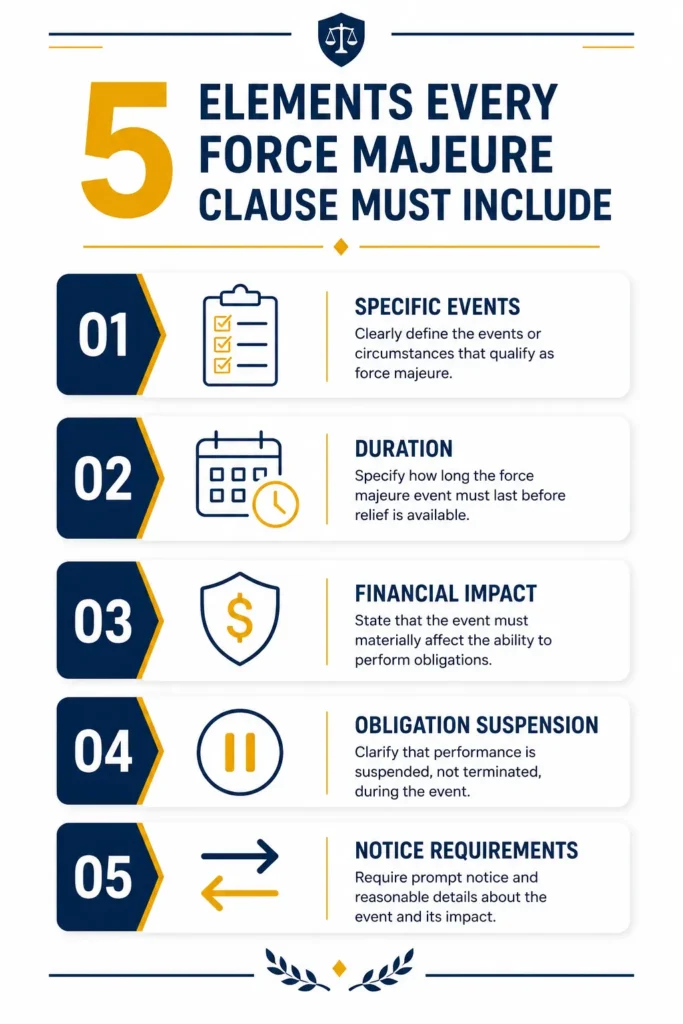
five elements, you have a gap in your financial
protection.
Of all the freelance contract provisions you will encounter, these five elements inside the force majeure clause matter most. Get these right and you have real protection. Miss them and the clause is just decorative text on page seven.
After an example like that, the research steps are clear: consult a contract attorney who handles freelance and independent contractor disputes, review templates from contract platforms, and read legal guides from Nolo and the Freelancers Union resource library. Five things kept appearing in every source worth trusting.
Risk management for freelance professionals does not have to be complicated. But it does require reading what you sign.
1. A Specific List of Events and Not a Catch All Phrase
A good clause does not say “events beyond our control.” Full stop. That phrase is too vague to be useful in an actual dispute.
Some contracts use the older phrase acts of god clause freelance agreements have relied on for decades, though modern legal drafting is moving away from that language toward explicit event-by-event lists. And for good reason. “Acts of God” alone is genuinely ambiguous in a courtroom.
Name the events you are covering. Write them out. Natural disasters meeting a defined severity threshold. Declared public health emergencies at the national or regional level. Acts of war or armed conflict. Government mandated shutdowns that directly prevent the work. Major infrastructure failure including power grid collapse or regional internet outage that extends beyond a specified number of days.
If the clause just says “any unforeseen circumstances,” push back. That phrase can swallow almost anything a creative legal team wants it to cover.
2. A Clear Notification Window
There should be a specific time window written into the clause, usually between seven and fourteen business days, during which the affected party must notify the other in writing that they are invoking force majeure.
This matters more than most freelancers realize. Without a deadline, a client can claim force majeure three months after things fell apart, retroactively covering a period you thought was normal work.
The clause should state clearly: “The affected party must provide written notice to the other party within [X] business days of the qualifying event occurring.” That is not a complicated sentence to add. But its absence is a very expensive gap.
3. Payment Protection for Work Already Done
This is the most critical element of freelance force majeure protection and it is missing from a shocking number of standard contracts.
When a force majeure event occurs and the contract is suspended or terminated, that does not mean your completed work disappears. You did the work. You get paid for the work. Full stop.
A solid clause includes language that says: “All compensation owed for work completed and submitted prior to the qualifying event shall remain due and payable within the original payment window.”
For example, Bonsai’s attorney-reviewed templates include this payment protection language as a standard element. Even so, check the language every time before sending a contract to a new client, because the specifics vary and no template knows your work better than you do.
Note: Before using any platform’s template language, verify with the platform directly that their terms have been reviewed by licensed attorneys in your specific country. Legal standards vary significantly across jurisdictions.
4. A Suspension Period and Not Automatic Termination
A force majeure event should suspend the contract for a defined period, typically 30 to 60 days, while both parties figure out whether the situation will resolve.
Automatic termination the moment something unexpected happens is not a reasonable or balanced approach. Life gets complicated. A flood might clear in a week. A government shutdown might lift in a month. Both parties need time to assess.
Write it this way: if the force majeure condition continues beyond 60 days, either party may terminate the agreement with written notice, and all payment for completed work remains due. That gives both sides a fair runway without locking either one into an impossible situation indefinitely.
5. Mutual Application for Both Parties
The clause needs to protect you and the client. Equally. A provision that only lets the client invoke force majeure is not a force majeure clause. It is a one-sided escape hatch.
The clause should provide client contract protection and freelancer protection in identical terms because both parties face real risk when unforeseeable events occur.
For example, a contract may list only events that allow the client to suspend payment, with no equivalent protection for the freelancer. In that case, the clause should be rewritten to be mutual. If a client refuses to make the clause mutual, walking away from the project is a reasonable option.
Real Force Majeure Situations That Actually Happen
These three scenarios come up more often than most freelancers expect. And each one plays out very differently depending on how the clause is written.
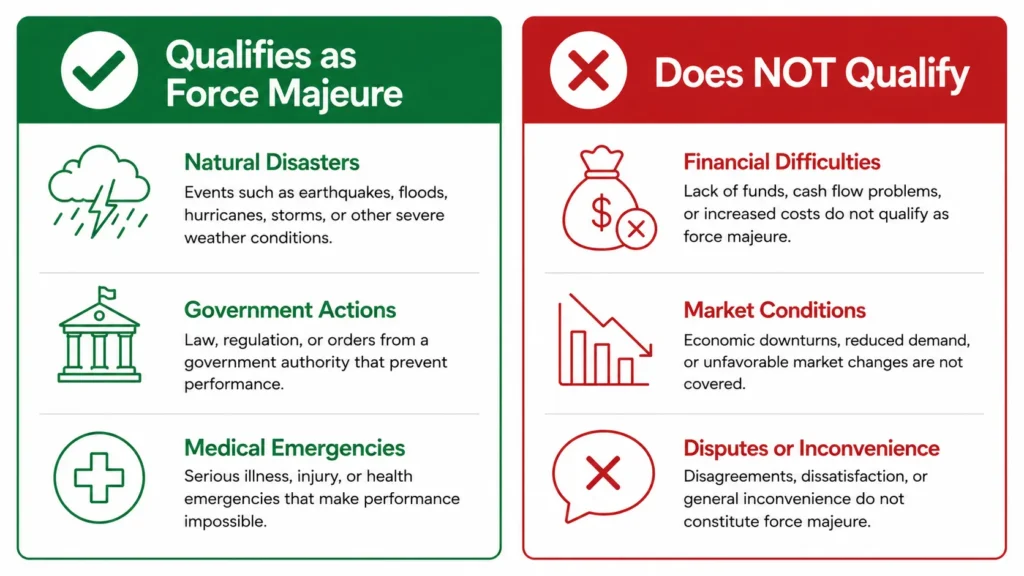
what your client’s lawyer calls it.
COVID 19 and the 2020 lockdowns
When lockdowns hit in 2020, dozens of clients across every industry tried to use their freelance contract pandemic clause to cancel agreements and stop payment. Some of those claims were completely legitimate. A business physically unable to operate due to a government mandated shutdown had a reasonable force majeure argument in most jurisdictions.
But many were not legitimate. Companies used the clause as a financial exit ramp when they wanted to cut costs. Force majeure disputes rose sharply during COVID, and COVID-19 exposed just how many freelance contracts had no clear force majeure language at all. Freelancers with specific, detailed clauses had options. Those without them had almost none.
The startup funding collapse
This happens more frequently now than it did five years ago and a freelance project cancellation triggered by an investor walking away is not a force majeure event no matter what the client calls it.
A startup loses its Series A. An early backer exits unexpectedly. The founder calls and says they are invoking force majeure. Unless the contract specifically lists “loss of investor funding” as a qualifying event, that claim has no legal standing. And it should not. Running out of money is a business risk, not a natural disaster.
Government regulatory changes
For example, a freelance social media manager may have a contract to run campaigns on a platform that gets temporarily banned in her client’s country due to new national legislation. Neither party sees it coming. Neither party can control it. If her contract’s clause covers government mandated shutdowns specifically, both parties can walk away without dispute because the clause does exactly what it was supposed to do.
Five Mistakes to Avoid
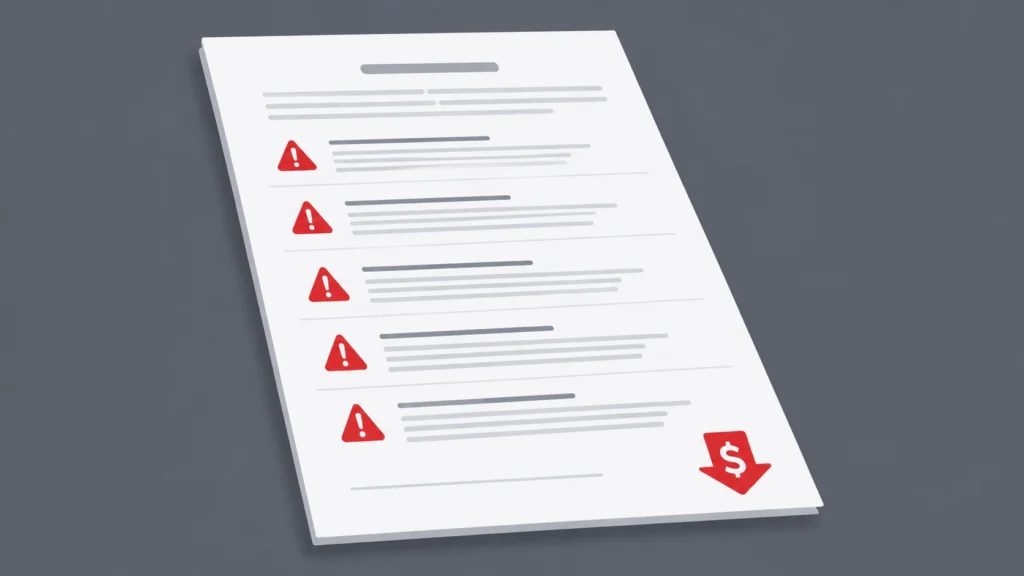
but only if you catch them before signing.
Mistake 1: Signing the contract without reading the force majeure section
This is the one I see most often. The project looks exciting. The client seems trustworthy. You want to get started. So you skim the contract, sign it, and file it away.
Then something goes wrong. And you find out on page seven that you have no protection at all.
Read every clause before signing. Every single one. Those 20 minutes of reading are cheaper than any dispute you will ever face.
Mistake 2: Assuming force majeure only protects you
It does not. The clause runs in both directions. A client can invoke it against you just as easily as you can use it against them. The language needs to be fair and balanced for both parties, which is exactly why you need to read it before signing rather than after something goes wrong.
Mistake 3: Leaving payment terms out of the force majeure section
This is where most of the real financial losses happen. The clause says the contract is suspended or terminated but says absolutely nothing about invoices for work already completed. Always add explicit freelance legal protection language for completed work. This is not negotiable. Do not skip it.
Mistake 4: Working without any written contract at all
I have met freelancers still working on nothing more than email threads and verbal agreements. If a dispute arises, you have almost no legal standing. Even a basic document created in Google Docs is better than nothing. Tools like Bonsai or HoneyBook have templates that take about 15 minutes to set up and include reviewed language as a starting point. The gig economy legal protection landscape is more complex now than it has ever been, and a handshake is not enough.
Mistake 5: Using a generic template without reading or customizing it
Templates are starting points. Not finished products. A clause written for a US based graphic designer working with domestic clients is not automatically correct for a UK based software developer working with international companies. Customize every clause for your specific type of work, your country, and your client type.
How to Add Force Majeure Language Step by Step
If you are writing your own contract:
Use plain language. Short, clear sentences are harder to argue against in a real dispute than dense legal paragraphs. You do not need to sound like a lawyer. You need to be understood.
List specific triggering events by name. Natural disasters. Declared public health emergencies. Government mandated shutdowns. Major infrastructure failures. Acts of war. Do not use catch-all phrases.
- Add explicit payment protection for completed work. Do not leave this to interpretation or implication.
- Set a notification deadline. Seven to fourteen business days is the standard. Require written notification.
- Define a suspension period before termination is allowed. Thirty to sixty days covers most situations.
Make every protection mutual. Also cross-check the limitation of liability clause in the same contract to make sure the two sections do not contradict each other. While you are reviewing that section, look at the indemnification clause nearby as well because it often interacts directly with force majeure protections in ways that are not immediately obvious.
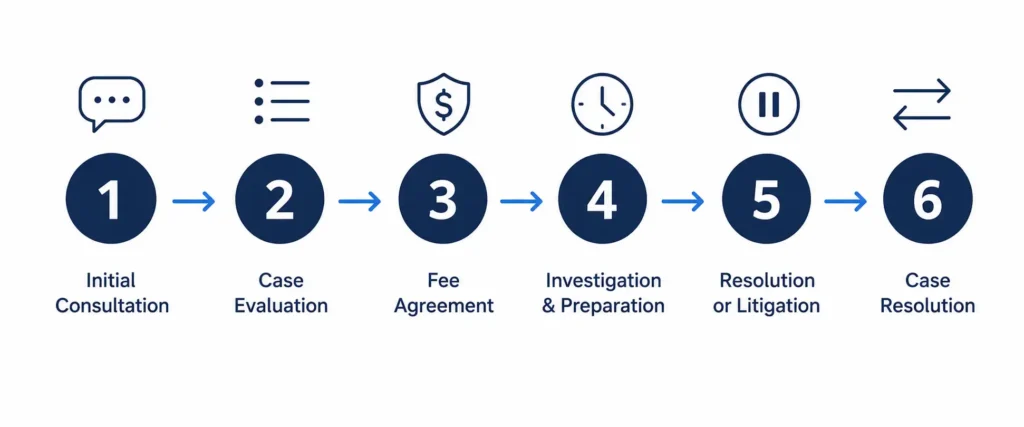
a client’s legal team can walk through.
If a client sends you a contract with a problematic clause:
Mark the specific section. Write your proposed edits. Send it back with a professional note: “I reviewed the force majeure section and made a small revision to ensure it covers both parties fairly. Please let me know your thoughts.”
When a client refuses to make the clause mutual or refuses to add payment protection language, I treat that as a serious red flag about how they will handle a real dispute. I document that refusal and proceed very carefully with everything else in the engagement. Sometimes I walk away entirely.
Sample Force Majeure Clause Template Free to Copy
Copy this clause, customize it to your situation, and have a contract attorney review it before sending it to a client. This is a starting point, not a finished legal document.
“This Agreement does not hold either party responsible for delays or missed deliverables when those failures result from events that were not foreseeable and not within either party’s ability to control, specifically including but not limited to: natural disasters meeting defined regional severity criteria, acts of war or armed conflict, public health emergencies as declared by relevant national or regional authorities, government mandated restrictions that directly prevent performance, and major infrastructure failures including sustained regional power or internet outages. The affected party must notify the other party in writing within 10 business days of the qualifying event occurring. This Agreement shall be suspended for up to 60 days while both parties assess the situation. All compensation owed for work completed and submitted prior to the event shall remain due and payable within the original payment window. If the qualifying event continues beyond 60 days, either party may terminate this Agreement with 5 business days written notice. Full payment for all completed work remains due upon termination regardless of circumstances.”
For additional free resources on freelance contract protections, the Freelancers Union publishes a regularly updated guide to independent contractor legal rights, and Nolo.com provides plain-language explanations of contract law by jurisdiction. Both are genuinely worth bookmarking.
The Real Lesson From Every Force Majeure Dispute
Most freelancers treat contracts like a formality. You sign them, file them away, and never think about them again until something goes wrong.
In that example, the freelancer eventually recovered a partial payment after weeks of going back and forth with the former client. He did not get everything he was owed. But he got something, mostly because he had email documentation showing exactly how much work he had submitted before the contract fell apart.
In that example, the freelancer now uses a lawyer-reviewed contract template for every project. Not because of paranoia, but because learning this lesson the hard way costs far more than reading the clause before signing.
Every force majeure situation for an independent contractor plays out the same way. The freelancer who read their contract had options. The one who did not is still waiting.
Every force majeure clause freelance contract situation comes down to one moment: did you read that clause before signing? Because reading it after something goes wrong is always too late.
Read the clause. If there is no clause, add one. If the existing language is one-sided, negotiate it. And if a client flatly refuses to make it mutual, that tells you exactly what kind of partner they will be when things actually go sideways.
You can find a free attorney-reviewed freelance contract checklist at the Freelancers Union website or through Nolo’s contract law section. Reading that checklist now costs you 20 minutes. Not reading it could cost you thousands of dollars and weeks of stress.
Have a force majeure situation of your own or a question about a specific contract clause? Drop it in the comments below and I will do my best to point you in the right direction.
If you’re looking for more real world insights and practical tips to level up your freelancing journey, make sure to check out our website. We regularly share simple, actionable content to help you land better clients, protect your time, and confidently grow your freelance career.
If There Is No Clause at All
If a contract has no force majeure clause at all, common-law doctrines like impracticability or frustration of purpose may apply, but they are narrow, hard to prove, and depend on your state. Courts generally do not excuse performance just because it became more expensive or less profitable. That is why a written clause, with payment protection for work already done, is far more reliable than relying on a common-law argument after the fact.
Frequently Asked Questions
What is a force majeure clause?
It is the clause that says what happens when an event nobody planned for — a natural disaster, war, pandemic or government action — stops the work. It should say which party does what, what happens to payment, and whether the contract pauses or ends.
Can a client use force majeure to avoid paying for work already done?
Only if the clause says so. If the clause does not mention payment for completed work, that is the biggest risk — which is why the contract should say clearly that payment for completed work remains due even when force majeure is invoked.
Does COVID-19 still count as force majeure?
It is now hard to call COVID-19 unforeseeable, because it is a known risk. If the clause does not name pandemics, do not rely on it for a COVID-related delay.
How much notice should the clause require?
The clause should say that the affected party must give written notice within a set number of days, and what that notice must explain — the event, its impact, and how long the delay is expected to last.
What should I add to a force majeure clause before signing?
A clear definition of the event, a notice period, payment for completed work, the difference between pausing and terminating the contract, and how disputes will be handled.
Updated October 2026: sources and wording reviewed.
Sources
Freelancers Union and Nolo contract resources are linked in the body above. Related GigLawGuide guides linked in the body cover client cancellations and freelance contracts in more detail. No specific statistics are cited in this post after the October 2026 review, so no external source links are added for figures.
Last reviewed: October 2026. General information, not legal advice.


