It was 11 o’clock at night. My coffee had gone completely cold. I was staring at an email on my laptop screen and my stomach had just dropped through the floor.
“Hey, we have decided to go in a different direction. We won’t be needing the rest of the project. Thanks for your work so far.”
That was all. No phone call. No warning. No conversation. Six weeks into a twelve week web development contract and a client I had trusted just killed the whole thing in a single paragraph. I had poured hundreds of hours into that project. Real hours. Late nights, weekends, multiple revision rounds based on their feedback.
And right at that moment, sitting there at 11pm, I had absolutely no idea what I was owed. I did not know if I could keep my deposit. I had no clue who legally owned the code I had written. So I panicked. And then I made several expensive mistakes that cost me even more money.
That one experience forced me to learn everything about what happens when a client cancels freelance project mid way rights apply, and how to actually use those rights before the situation slips further out of your hands. If you are reading this right now because something similar just happened to you, or you want to bullet-proof yourself before it ever does, every answer you need is in this article.
Client Cancels Freelance Project Mid Way Rights: You Are Not Helpless
The very first thing I wish someone had said to me that night is also the most important thing in this entire article.
Stop. Do not reply yet.
When a project gets cancelled, the two worst things most freelancers do are either go completely silent and accept whatever crumbs the client throws at them, or fire off an emotional email making demands they cannot back up. I have done both at different points in my career. Neither one works. Both made my situations considerably harder to resolve.
The reality is you almost certainly have real legal protections standing behind you right now, even if your contract was imperfect. How strong those protections are depends on four things: whether you had a written contract, what that contract actually said, how much documented work you completed, and which platform or arrangement you were working under.
Let us walk through each situation so you know exactly where you stand.
If You Had a Written Contract: You Are in a Strong Position
This is the best place to be. Pull out your contract right now and look for these three things before you do anything else.
The Termination Clause: Your First Line of Defense
Most professional freelance contracts include a freelance contract termination clause. This is the section that spells out exactly what happens when either party decides to end the relationship early. If yours has one, read it carefully right now because that clause is your contract’s most important paragraph in this moment.Kill fee language:A kill fee is a pre-agreed amount you receive when the client terminates without cause. Mine currently sits at 50 percent of all remaining unpaid milestones. If yours specifies a kill fee, that number is non-negotiable.Payment for work completed to date:Almost every solid contract includes a line stating the client is responsible for payment of all work completed up to the date of termination. That phrase is your invoice authority.Notice period requirements:Some contracts require 14 or 30 days written notice before a cancellation becomes official. If your client cancelled without giving proper notice, they may already be in breach regardless of the reason they gave.
💡 What to Do Right Now if You Have a Contract
Send a formal invoice for all work completed plus the kill fee your contract specifies. Reference the exact section of your contract. Set a payment deadline of 10 to 14 business days. Most clients will pay without further argument the moment they realize you know your contract inside and out.
It genuinely changes the dynamic. I have watched clients who were being completely unresponsive suddenly get very cooperative the moment they received a professional invoice with contract clauses cited line by line. It signals that you are not the kind of freelancer they can push around.
Freelancer Rights When Client Cancels and You Had No Contract
Alright. I know. If you are sitting here without a signed contract, this section is for you and I am going to be straight with you because I have been in this exact spot.
Early in my freelancing days I took on a logo design project for what felt like a “quick job.” Our entire agreement lived in a WhatsApp thread. No formal document. No signatures. Just messages back and forth agreeing on a price and a rough timeline.
When that client disappeared mid project, I thought I had nothing. But that was wrong.
Verbal and Written Communication Can Still Protect You
Email exchanges, Slack messages, WhatsApp conversations, even voice notes in some jurisdictions can constitute a binding agreement under contract law. It is messier to enforce than a signed document, but it is far from nothing. The legal principle that covers you here is called quantum meruit, which means roughly “what one deserves.” In plain language, if you performed work and the client received a benefit from that work, you are entitled to reasonable compensation for it regardless of whether a formal contract exists.
⚖ What to Collect Immediately if You Have No Contract
Every email about scope and pricing. Screenshots of all chat conversations. Any invoices you sent at any point. Work files with timestamps showing when you created and modified them. Bank records showing any payments received. These form your paper trail and they matter enormously if this escalates.
This trail will not get you a kill fee because you never agreed to one. But it absolutely can support a freelancer non-payment dispute claim for compensation covering the hours you actually worked. And courts and arbitration panels take documented work evidence seriously.
Going forward, please use a proper contract for every project. Tools like Bonsai, HoneyBook, and And.co all offer freelance specific contract templates that take under 30 minutes to set up. Free templates are also available through HelloSign and DocuSign. Set it up once and you will never face this exact situation again.
Intellectual Property Rights Freelance Cancellation: Who Actually Owns the Work
This is the part that surprises almost every freelancer I talk to. It surprised me enormously when I first learned it.
“Unless your contract explicitly transfers copyright to the client, you own the work you created. Even if they paid for it. Even if it was built entirely from their brief.”
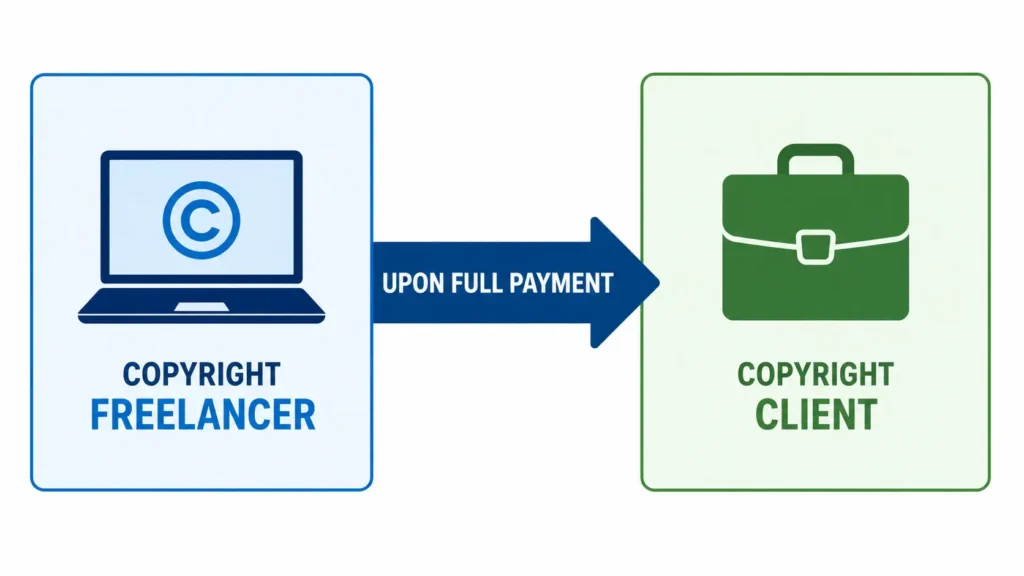
Under copyright ownership work in progress law in most countries including the United States, the United Kingdom, Australia, and most of the European Union, copyright belongs to the creator by default. The client does not automatically own what you made simply because they paid you. Paying for work gives them a license to use it. It does not transfer ownership unless your contract says it does.
What This Means Practically When a Client Cancels
If a client cancels your project mid way and then refuses to pay what you are owed, they cannot legally use any of the work you produced. They cannot hand your code to another developer to finish. They cannot publish your designs. They cannot use your written content. Not without your explicit permission, which normally comes attached to full payment.
This is not just a technicality. It is a real and enforceable position. The work for hire doctrine in US law means work created by employees of a company automatically belongs to the employer. But independent contractors and freelancers are not employees. You are the creator. The copyright is yours until you transfer it.
📋 The Contract Clause That Changes Everything
Add this to every freelance contract going forward: “All intellectual property rights in the work remain with the contractor until payment is received in full. Upon receipt of final payment, copyright transfers to the client.” That single clause turns your IP into a negotiating instrument. Pay what you owe or you cannot legally use what I built.
Platform Specific Rules on Upwork and Fiverr
If your project ran through a platform, the IP rules layer on top of the platform’s own terms of service.
| Platform | How Cancellation Works | IP Protection | Your Best Move |
|---|---|---|---|
| Upwork (Fixed Price) | Client must release escrow or dispute through Upwork | Funded milestones are releasable to you | Check escrow balance before accepting any cancellation |
| Upwork (Hourly) | Hours logged with tracker are protected automatically | Payment Protection covers tracked hours | Always use the Upwork desktop tracker for hourly contracts |
| Fiverr | Buyers cannot cancel unilaterally once work is delivered | Customer Support evaluates delivered work | Submit your completed work before they can request cancellation |
| Direct Contract | Governed entirely by your written agreement | Full control through your contract clauses | Use a proper contract with IP retention and kill fee clauses |
Always check what is sitting in escrow before you click accept on any cancellation request on Upwork. Once you accept, those funds may not be recoverable. This is a one-way door and I have watched freelancers walk through it by accident.
Client Cancels Freelance Project Mid Way Rights: Your Step by Step Action Plan
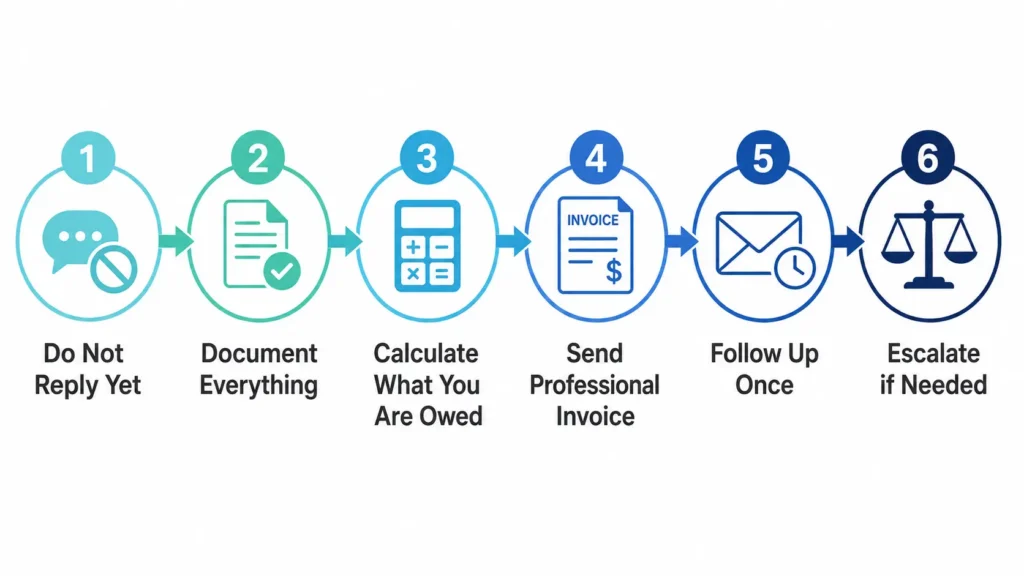
Here is the exact sequence I now follow every single time a project cancellation happens. And yes, it still happens occasionally even with solid contracts in place. That is just freelancing.
- Do Not Reply Immediately: Give yourself at minimum one hour. Ideally sleep on it overnight. Emotional replies almost always create new problems on top of the existing ones. I have sent exactly two angry emails in my career about cancelled projects. Both made the situation more expensive and more exhausting to resolve. The 24 hours you wait costs you nothing. The email you send in anger can cost you everything.
- Document Everything Before You Do Anything Else: Screenshot or export every conversation. Save every email chain to a PDF. Export your work files with timestamps clearly visible. Do this before you reply, before you invoice, before anything. If this situation escalates to a formal dispute or small claims court, documentation is the single most important thing you will have. Storage costs almost nothing. Regret is expensive.
- Calculate Exactly What You Are Owed: Work out the precise number. Hours worked multiplied by your rate, plus any out-of-pocket expenses you incurred, plus any kill fee your contract specifies. Then write it all out line by line in a spreadsheet. Clients are far less likely to dispute a detailed breakdown than they are to push back on a lump sum number that appears out of nowhere. Specificity is credibility.
- Send a Professional Invoice Referencing Your Contract: Keep the tone completely neutral and factual. Something along these lines works well: “As per Section 7 of our agreement dated [date], I am invoicing for work completed to date and the applicable cancellation fee totaling [amount]. Payment is due within 10 business days.” Nothing more. No guilt. No threats. Just the facts and the deadline. Professionalism in writing is your strongest tool.
- Follow Up Once if They Do Not Respond: One follow up email after the payment deadline passes. Same neutral professional tone. Reference the original invoice. State clearly that you are prepared to pursue the matter further if payment is not received within five additional business days. One follow up. Not three. Not five. One.
- Escalate Through the Right Channel if They Still Do Not Pay: Your options at this stage include a formal demand letter (free templates at LegalTemplates.net work well for this), small claims court for amounts under your local jurisdiction limit (typically 5,000 to 10,000 dollars in the United States), platform dispute resolution if you worked through Upwork or Fiverr, or a debt collections service for larger amounts. For freelancers in New York specifically, the Freelance Isn’t Free Act provides double damages for non-payment and attorney fee recovery. That is an extraordinarily powerful law worth knowing about.
The Mistakes That Cost Me Money (So You Don’t Have To Make Them)
I am going to be direct about the things I got completely wrong, because the real lessons in freelancing almost never come from the smooth projects.
Mistake 1: Accepting the Lowball Offer Out of Sheer Stress
When my client offered me 20 percent of what I was actually owed just to settle it quickly, I came within one single email of accepting it. The stress of the unpaid invoice, the uncertainty, the back and forth messages were all wearing me down and I just wanted it over. Do not do this. Know your number based on your contract and your documented hours. Hold that number. The client is counting on you being more exhausted than they are.
Mistake 2: Continuing to Work After the Cancellation Hoping Things Would Change
After one client said they were “pausing” rather than cancelling, I kept checking in regularly and even did additional prep work to demonstrate goodwill and keep the door open. That project never came back. Those extra hours were completely uncompensated. When a client uses the word pause without a specific restart date and a written commitment, treat it as a cancellation and protect yourself accordingly from that moment.
Mistake 3: Starting Projects Without a Deposit
I now require 30 to 50 percent upfront before a single hour of work begins on any new project. If a client pushes back hard on paying a deposit, that reaction tells you something genuinely important about how they will behave when things get complicated. A deposit also gives you real negotiating leverage if things go sideways later. It is not just about the money. It is about qualifying the client before you commit your time.
Mistake 4: Trying to Handle Platform Disputes Directly Instead of Filing Formally
I once spent three full weeks going back and forth with a difficult client on Upwork trying to resolve a cancellation dispute through direct messages. Going in circles, getting nowhere, losing sleep over it. The moment I filed a formal dispute through Upwork’s Resolution Center, it was resolved in four days. Platform dispute systems exist for exactly this situation. Use them early rather than burning weeks trying to negotiate around them.
Mistake 5: Ignoring the Scope Creep That Led to the Cancellation
Looking back at one particular project, I can see clearly that the cancellation was actually a symptom of unchecked scope creep that had built up over weeks. The client kept adding requests. I kept saying yes without adjusting the contract or the timeline. By week six, they felt like they were not getting what they originally envisioned because what they originally envisioned had quietly become something much bigger than what was ever written down. A clear statement of work from day one prevents this pattern entirely.
Why Staying Professional Protects You More Than Anything Else
Even when a client treats you badly. Even when they ghost your invoices, try to use your work without paying for it, or send messages that make you furious. It almost always pays to stay completely professional in every single piece of written communication you send.
Here is why this matters practically, not just philosophically.
Screenshots of your measured, reasonable, professional emails are your strongest asset if this situation ever reaches small claims court, a platform dispute panel, or a formal arbitration. They establish you as the reasonable party acting in good faith. Screenshots of you losing your temper are the client’s strongest asset. They shift the narrative away from your unpaid invoice and toward your behavior.
And beyond the legal dimension, the freelance world is genuinely smaller than most people realize. Clients know other clients. Agencies refer work to freelancers they trust. A reputation for handling difficult situations with composure and professionalism is worth more over a five year career than any single unpaid invoice. That is not an abstract principle. It is something I have watched play out in my own network repeatedly.
👍 The Professional Tone Formula That Works Every Time
State the fact. Reference the contract section. State the amount owed. State the deadline. State the next step if the deadline is missed. Nothing else. No emotional language. No mentions of how hard you worked. No explanations of your personal financial situation. Just clean professional facts. That email is a document now, not a conversation.
How to Protect Yourself Before the Next Client Cancels
Prevention is genuinely the better strategy here. Every clause below costs you nothing to add and potentially saves you thousands.
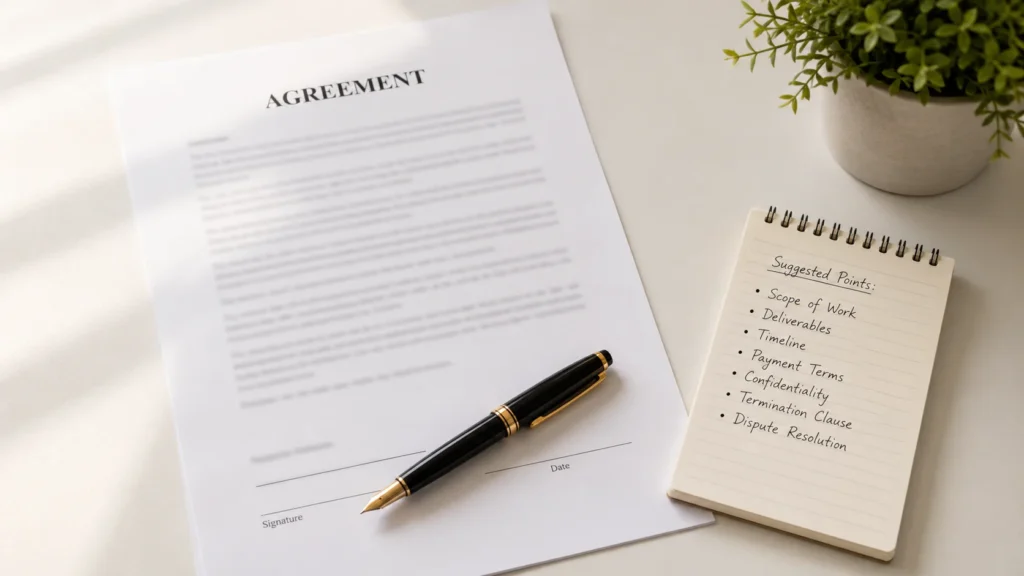
The Five Contract Clauses Every Freelancer Needs
Termination clause with kill fee: State explicitly that if the client terminates without cause before project completion, they owe a kill fee equal to a specific percentage of the remaining unpaid contract value. 25 to 50 percent is industry standard depending on your field.
Payment for work completed: Write in clear language that the client is responsible for full payment of all work completed and delivered up to the date of any termination notice.
IP retention clause: Intellectual property in all work created remains with the contractor until final payment is received in full. Copyright transfers upon receipt of final payment.
Notice period requirement: Either party must provide 14 or 30 days written notice before terminating the engagement. Failure to provide proper notice constitutes a breach.
Deposit requirement: State that work will not commence until a non-refundable deposit of a specific percentage is received. The deposit compensates for opportunity cost and project initiation work.
Tools like Bonsai, HoneyBook, and Dubsado all include contract templates with these clauses pre-written and customizable. HelloSign and DocuSign handle the signing process digitally. The entire setup takes one afternoon. That afternoon is one of the best investments you will make in your freelance business.
The Milestone Payment Structure That Eliminates Most Risk
Beyond the contract clauses, structuring your payment schedule correctly removes most of your financial exposure from any cancellation scenario. A milestone payment structure that ties payments to deliverables rather than calendar dates means you are never far ahead of your payment at any given point in the project.
My current standard structure is 30 percent upfront before work begins, 40 percent at the midpoint deliverable review, and 30 percent upon final delivery. If a client cancels at any point in that structure, my maximum unpaid exposure is roughly 30 percent of the total contract value. That is a manageable number. It is not a catastrophe.
Client Cancels Freelance Project Mid Way Rights: Frequently Asked Questions
What are my legal rights when a client cancels a freelance project mid way?
You have the right to invoice for all work completed and documented up to the date of cancellation. You have the right to keep any upfront deposit received. You retain intellectual property rights to all work created until full payment is received. If your contract specifies a kill fee, you have the right to collect that amount. If the client did not follow the notice period in your contract, they may be in breach regardless of their reason for cancelling.
Can a client cancel a freelance project without paying anything?
Not legally if work has been completed. Even without a formal written contract, the legal principle of quantum meruit entitles you to reasonable compensation for work performed where the client received a benefit. With a proper contract including payment for work completed to date, the client is contractually obligated to pay for all documented work regardless of their reason for cancelling.
Who owns the intellectual property when a client cancels a freelance project?
Under copyright law in most countries, the freelancer retains intellectual property rights to all work created until full payment is received. The client paying for work does not automatically transfer copyright ownership to them. If your contract includes an IP retention clause tied to final payment, this protection is even clearer and legally enforceable. The client cannot legally use, publish, or distribute your unfinished work without your permission.
What is a kill fee in a freelance contract and how does it work?
A kill fee is a pre-agreed cancellation penalty written into your freelance contract. It compensates you for the income you expected from completing the project and for turning down other opportunities while committed to this one. Kill fees typically range from 25 to 50 percent of the remaining unpaid contract value. They are completely standard practice in creative, design, writing, and development industries. If a client agrees to your contract, they have agreed to the kill fee.
What should I do if a client refuses to pay after cancelling?
Start with a formal demand letter referencing your contract and the specific amount owed with a clear payment deadline. If that does not produce payment, small claims court is available for amounts under your local jurisdiction limit, typically 5,000 to 10,000 dollars in the United States. Upwork and Fiverr both have formal dispute resolution processes that are often faster and less expensive than court. For amounts over 10,000 dollars, a collections agency or an attorney consultation is worth considering. New York freelancers specifically have access to the Freelance Isn’t Free Act which provides double damages for non-payment.
Do I have to return the deposit if a client cancels a freelance project?
Generally no, provided your contract specifies the deposit as non-refundable. A deposit compensates you for opportunity cost, meaning the other work you turned down to commit to this project, plus any initiation and planning work you completed before the main project began. If your contract does not specify the refund policy on deposits, this becomes a negotiable grey area. Which is exactly why your contract should always address this explicitly.
The Bigger Truth About What Client Cancels Freelance Project Mid Way Rights Actually Means
A project cancellation feels deeply personal when you are inside it. You invested real time, real creativity, late nights and sometimes weekends. The relationship felt solid. And then it just ended via a short paragraph in your inbox.
It stings. That is genuinely true and I am not going to pretend otherwise.
But here is the thing I had to learn the hard way and have now watched play out across hundreds of freelancer conversations over the years. Most cancellations are not actually personal. Businesses change direction constantly. Budgets disappear mid quarter. Internal priorities shift after leadership changes. The clients who handle cancellations with integrity will communicate honestly and pay what they owe. The ones who do not were going to create problems eventually regardless of how perfectly you delivered the work.
Every cancellation you navigate cleanly makes you a smarter, more protected freelancer going forward. The contract clauses you add after your first bad experience prevent the second one. The milestone structure you build after getting burned once means the third cancellation costs you almost nothing financially.
The best version of your freelance business has three things locked down before any project starts: a clear written contract with a termination clause, kill fee, and IP retention language; a deposit in your account before you open your laptop; and a calm documented process for when things go sideways, because they will go sideways at some point for everyone.
With those three things in place, the next time a client sends you that 11 pm cancellation email, you will know exactly what you are owed, exactly what you own, and exactly what to do next. That knowledge is worth more than any single project you will ever complete.
Has a client ever cancelled a project on you mid way? Drop your story in the comments below including what worked, what didn’t, and what you would do differently now. The best lessons in freelancing come from the community, not from any blog post.
If you’re looking for more real world insights and practical tips to level up your freelancing journey, make sure to check out our website. We regularly share simple, actionable content to help you land better clients, protect your time, and confidently grow your freelance career.