
DMCA is the U.S. law that shapes how copyright works online: it gives copyright owners a notice process for infringing material, and it gives qualifying platforms and hosts a conditional shield from monetary liability for their users’ infringements. It does not decide every dispute, remove every copy, or guarantee a particular outcome.
The Digital Millennium Copyright Act is a U.S. federal law enacted in 1998. It created the notice-and-takedown system and the conditional safe-harbor framework in 17 U.S.C. § 512 that freelancers encounter when their work is copied online, and when they are accused of copying someone else’s work.
This post explains the concepts behind the DMCA: what counts as copyright infringement, what safe harbor does and does not protect, how counter-notices work, and where the DMCA stops. It is not a filing manual. For the full step-by-step workflow, see the companion guide: How to File a DMCA Takedown Notice.
What Does DMCA Stand For?
DMCA stands for the Digital Millennium Copyright Act. It is a U.S. copyright law enacted on October 28, 1998, that updated existing copyright protections for the digital age and created a legal framework for handling infringement on online platforms.
The full name is the Digital Millennium Copyright Act. You will sometimes see it referenced in legal documents simply as “the Act” or by its statutory location at 17 U.S.C. § 512.
Congress passed it because the internet had created a massive problem. Copyright law in 1997 was built for physical media. Books. Records. Cassette tapes. It was not built for a world where a single person could copy a 300 page book and distribute it to a million people in under an hour.
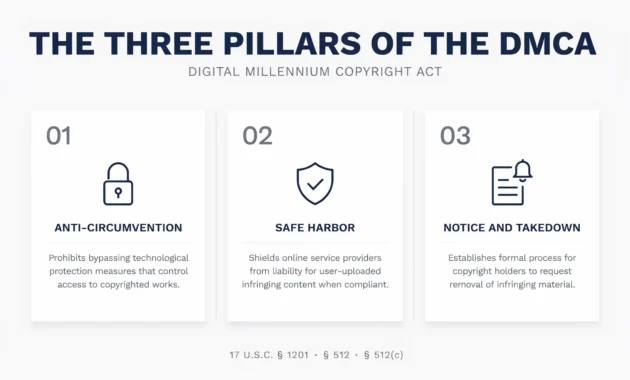
The DMCA tried to fix that by doing three main things.
First, it made it illegal to bypass digital protection systems. This includes cracking the DRM on a DVD or circumventing copy protection on software. That falls under the anti circumvention provisions.
Second, it created the safe harbor provision that limits legal liability for online platforms when their users post infringing content. Without this, platforms like YouTube, Reddit, and web hosting companies would be legally responsible for everything their users upload.
Third, and most relevant for creators, it created the notice and takedown process. This is the mechanism that turns copyright ownership from an abstract legal right into an actual enforceable tool you can use yourself, for free, without a lawyer.
The Electronic Frontier Foundation (EFF) has documented extensively how the DMCA has both helped and sometimes hurt creators depending on how it gets applied. That tension is real and worth understanding.
How the DMCA Takedown Notice Process Works
In outline, the process is: a copyright owner sends a valid notice to the service provider’s designated agent; the provider, to preserve its conditional safe harbor, acts expeditiously to remove or disable access to the identified material; the provider notifies the user who posted it; and that user may send a counter-notice. If a valid counter-notice is received, the provider restores the material not less than 10, nor more than 14, business days following receipt, unless its designated agent first receives notice that a court action has been filed. A notice to a search provider under 17 U.S.C. § 512(d) (information location tools) removes a link or reference, not the source page itself.
How Long Does a DMCA Takedown Take?
The statute sets no specific removal deadline. Under 17 U.S.C. § 512(c)(1)(C) and § 512(d)(3), a qualifying provider must act expeditiously to remove or disable access to material after receiving a valid notice, in order to preserve its safe harbor.
The word “expeditiously” is the key term in 17 U.S.C. § 512. What counts as expeditious depends on the facts, the provider, and the material at issue.
Smaller hosting providers vary enormously in how they handle notices, and some do not respond at all, which is why the search-delisting concept in § 512(d) matters as a separate question.
DMCA Copyright Infringement: What Actually Qualifies?
DMCA copyright infringement is the unauthorized use, reproduction, or distribution of someone else’s copyrighted work online. To qualify for DMCA protection, your content must be original and exist in a fixed, tangible form.
The range of protected content types is broader than most people realize.
Written content is fully covered. Blog posts, articles, newsletters, ebooks, social media captions you authored, even detailed forum comments. The moment I published that stolen article, it was protected.
Photography is covered. Every photo you take is your copyrighted work, whether shot on a Sony A7 or your phone camera. This is a huge deal for photographers who find their images lifted and used on commercial websites without a license or credit.
Video content is covered. Your YouTube videos, TikToks, Instagram Reels, Vimeo uploads. The footage you shot and edited is yours.
Music and audio recordings are covered. There are actually two separate copyrights in most music: one for the underlying composition and one for the specific sound recording. Both can be protected under the DMCA framework.
Illustrations, digital art, and graphic designs are covered. Logo designs, infographics, character art, wallpapers.
Podcasts and spoken word recordings are covered. The audio file of your podcast episode is a copyrightable work.
Code and software can be covered. Original source code has copyright protection, though the functional aspects of code are harder to protect than purely expressive works.
What is not protected matters just as much.
Ideas and concepts are not protected. Facts are not protected. Titles and short phrases are generally not protected on their own. Content that is already in the public domain cannot be reclaimed. And if you reproduced someone else’s work without adding genuine original creative expression, you cannot claim copyright in the original portions.
| Situation | Decision |
|---|---|
| Infringement | Unauthorized use of original copyrighted work: a DMCA notice may be sent to the provider’s designated agent. |
| Licensed use | Use within the scope of the license: not infringement; check the license terms before acting. |
| Possible fair use | Use that may qualify as fair use: weigh the four factors; a takedown is not automatic. |
| Trademark complaint | A dispute about a brand name or logo: not a copyright issue, so it is not a DMCA copyright notice. |
| Non-U.S. issue | Material hosted outside U.S. jurisdiction or by a non-U.S. provider: the DMCA framework may not reach it; consider local law and search delisting under § 512(d). |
DMCA Safe Harbor: What Platforms Are and Are Not Responsible For
DMCA safe harbor is a conditional shield from monetary liability for qualifying online platforms and hosting providers for their users’ infringing content. It is not a blanket immunity: a provider that does not meet the conditions risks losing the shield for that material.
The safe harbor provision lives in Section 512 of the DMCA, which is why you will sometimes see it referenced as “Section 512 safe harbor” in legal discussions.
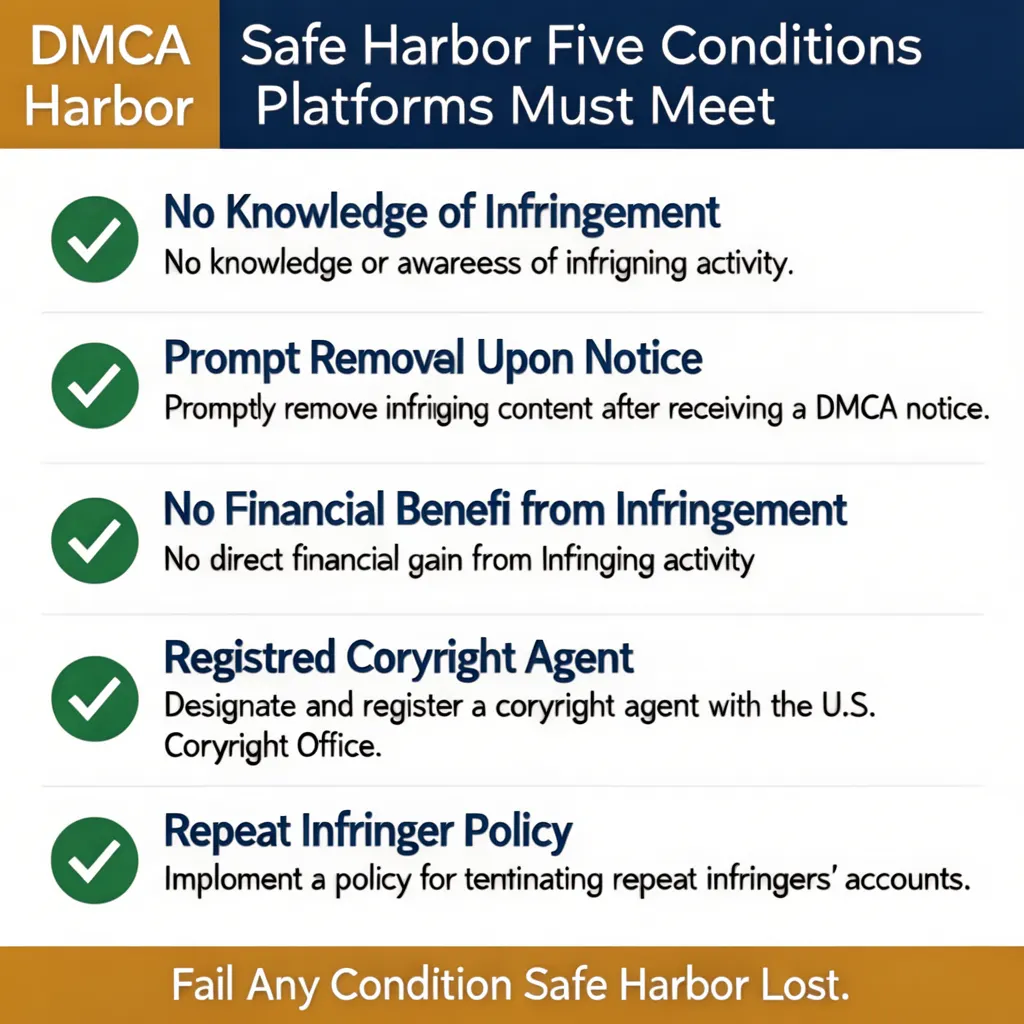
For a platform to maintain safe harbor protection, it must meet several conditions. Two further conditions matter for the shield: the provider must not be aware of facts or circumstances that make infringing activity apparent (red-flag awareness), and it must accommodate standard technical measures used by copyright owners to identify or protect their works.
- It must not have actual knowledge of specific infringing content on its servers.
- It must act promptly to remove or disable access to infringing material once it receives a valid notice.
- It must not financially benefit directly from the infringement in a situation where it has the right and ability to control it.
- It must have a designated copyright agent registered with the U.S. Copyright Office.
- It must have a repeat infringer policy and terminate users who repeatedly violate copyright.
This is the entire reason platforms respond to your DMCA notices. Not because they are deeply committed to protecting your rights as a creator, though some care more than others. But because responding promptly is what keeps them legally shielded from massive copyright liability.
If a platform consistently ignores valid DMCA notices, it risks losing safe harbor status and becoming directly liable for its users’ infringement. That is an enormous financial exposure. No serious platform wants to take that risk.
What safe harbor does NOT do is make platforms immune to everything. It protects them from monetary damages when they respond correctly. It does not protect them if they have actual knowledge of infringement and choose to look the other way for financial gain, or if they fail to terminate repeat infringers despite having a policy to do so.
In case law, Lenz v. Universal Music Corp., also called the “Dancing Baby” case, held that copyright holders must consider whether a use might qualify as fair use before sending a DMCA takedown notice. Filing a takedown without considering fair use can expose the filer to liability under Section 512(f). This is a court decision, not a rule stated in the text of § 512 itself.
DMCA YouTube: How Copyright Works on Video Platforms
DMCA on YouTube operates through two parallel systems: the automated Content ID system used by major rights holders, and the formal DMCA removal request process available to any copyright owner. These are separate mechanisms with different outcomes.
YouTube’s Content ID system is a fingerprinting technology that major rights holders, primarily large record labels, movie studios, and sports organizations, use to automatically scan every video uploaded to YouTube for matches to content in their registered databases.
When a match is detected, the rights holder can choose to block the video globally, mute the audio in the video, restrict it to certain countries, or claim the monetization revenue from the video.
This is the system that catches creators who have even a few seconds of copyrighted music playing in the background of their content. For example, a video with a few seconds of copyrighted music playing in the background can be caught by this system and demonetized shortly after upload.
Content ID is not available to most individual creators. It is reserved for major rights holders who have entered into agreements with YouTube. If someone reuploads your video, you generally cannot use Content ID yourself.
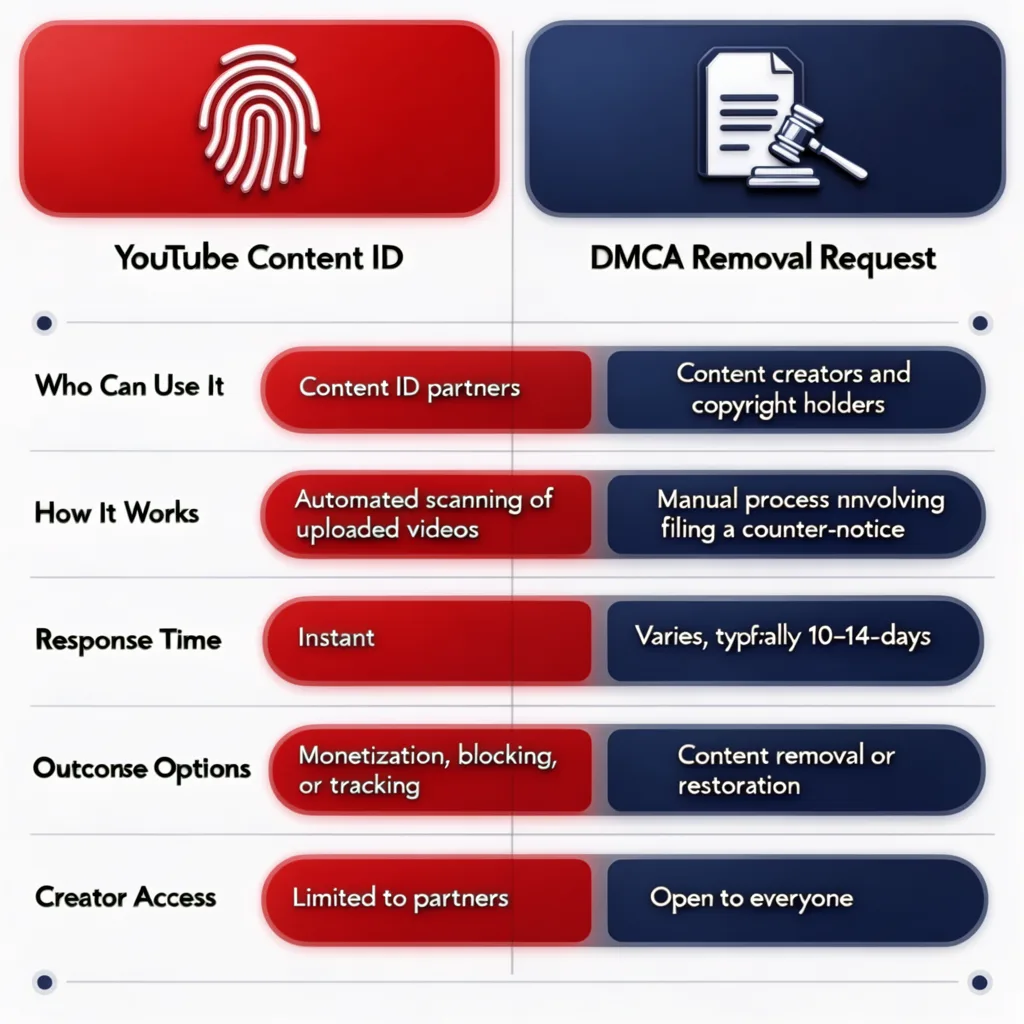
The formal DMCA process on YouTube is what individual creators use. You go to YouTube’s copyright center and submit a copyright removal request. If your claim is valid, YouTube will remove the video. The uploader receives a copyright strike on their account.
Under YouTube platform policy, not the statute, three copyright strikes lead to account termination. That is YouTube’s repeat-infringer policy in action.
YouTube also has a copyright match tool that is available to some creators. It scans YouTube for reuploads of your videos and lets you take action directly from your dashboard. Access to this tool has been gradually expanding, so it is worth checking whether your account qualifies.
DMCA YouTube: Filing a Removal Request
On YouTube, a formal removal request is submitted through the platform’s own copyright reporting process; the form and its steps are platform procedure, not a statutory form.
The DMCA Counter Notice: How to Fight Back If You Are Wrongly Accused
A DMCA counter notice is a formal legal response you send to a platform when a DMCA takedown was filed against your content incorrectly. Under 17 U.S.C. § 512(g)(2)(C), a provider that receives a valid counter notice must restore the material not less than 10, nor more than 14, business days following receipt, unless its designated agent first receives notice that a court action has been filed seeking to restrain the subscriber from engaging in infringing activity.
This is the defensive side of the DMCA process. And it is critically important to understand it, because DMCA abuse is real and documented.
Reddit discussions, Amazon Seller Central forums, and Shopify community threads are full of stories from creators and sellers who have had valid content taken down by competitors filing bad faith DMCA claims. On Amazon Seller Central, there are documented cases of sellers filing identical false copyright complaints against competitors during peak sales periods like Prime Day specifically to suppress their listings at the worst possible time.
That is weaponized DMCA. And it happens more than people realize.
What Goes into a Valid DMCA Counter Notice
In short, a counter notice identifies the removed material and its former location, states under penalty of perjury a good-faith belief that the removal was a mistake or misidentification, gives the subscriber’s contact information, consents to the jurisdiction of the relevant federal district court, states that the subscriber will accept service of process from the person who submitted the original notice, and is signed by the subscriber.
Once you submit a valid counter notice to the platform, the platform is required to notify the original filer that a counter notice has been received. The original filer then has 10 to 14 business days to file a lawsuit seeking a court order to prevent the reinstatement of the content.
If they do not file that lawsuit within the window, the platform should restore your content.
When Should You File a Counter Notice
File a counter notice when you have a genuine, legitimate basis for believing the takedown was wrong.
Examples include: the content is entirely your own original work and you have clear evidence of that. Your use of the content qualifies as fair use under the four factor test. You hold a valid license for the content that the filer failed to verify before filing. The notice was filed by someone who does not actually own the copyright they claimed.
Do not file a counter notice if the original takedown was valid and you know it. Filing a false counter notice carries the same legal risk as filing a false original notice.
Section 512(f) and the Consequences of DMCA Abuse
Section 512(f) of the DMCA makes it illegal to knowingly and materially misrepresent in a takedown notice that material is infringing, or in a counter notice that material was removed by mistake. Violations can result in significant damages including attorney’s fees.
Courts have awarded real damages under 512(f) in cases of documented DMCA abuse. The EFF has pursued several of these cases, including Lenz v. Universal, specifically to establish accountability for bad faith filings.
If you are on the receiving end of what looks like a deliberately false DMCA claim, document everything carefully and consult with an intellectual property attorney. You may have grounds for a 512(f) claim of your own.
DMCA Protection: How to Protect Your Content Online
DMCA protection in practical terms means actively monitoring your content for unauthorized use and having a clear process ready to enforce your copyright when violations occur. The law gives you the rights. You have to exercise them.
There is a persistent myth that putting a “DMCA Protected” badge on your website magically shields your content. It does not. The badge is a deterrent for casual thieves and signals that you know your rights. That is all.
Real protection comes from monitoring, documentation, and enforcement.
Tools for Content Monitoring
Copyscape is the standard for text plagiarism detection on the web. The free version gives you limited searches per day. Copyscape Premium, which runs around a few dollars per month for basic use, lets you run batch searches, set up automatic alerts for new copies of your content, and get more detailed match reports.
Google Search Console shows you which websites link to your content. When a content scraper copies your article, they often inadvertently include a link back to your original. A sudden link from a domain you have never heard of is worth investigating.
TinEye is a reverse image search engine specifically designed to find copies of images across the web. You upload your image or paste its URL and TinEye searches its indexed database for visual matches.
Google Lens and Google Images reverse search have become significantly more powerful in recent years. For photos and illustrations, running your most important work through a reverse search every few months is a genuinely useful habit.
Web monitoring services like DMCA.com offer automated monitoring, takedown handling, and record keeping for a monthly fee. For high volume creators who publish constantly across multiple platforms, the automation is worth the cost. For occasional publishers, the free tools plus manual checks are usually sufficient.
Practical Prevention Habits
Keep clear records of when you created everything. File metadata timestamps your work automatically. Publication dates are recorded by your CMS. These records matter enormously if your ownership is ever disputed.
Register your most valuable works with the U.S. Copyright Office. This is not required for copyright protection, but it is required to pursue statutory damages in a copyright lawsuit. Under U.S. copyright law, if your work is registered before infringement occurs (or within three months of first publication), you can pursue statutory damages of up to $150,000 per work for willful infringement, plus attorney’s fees. If your work is not registered, you are limited to actual damages, which are harder to prove and often far less significant financially.
Registration costs between $45 and $65 per work through the Copyright Office’s online eCO system. For your most commercially valuable content, it is a smart investment.
Use watermarks on visual content. Visible watermarks deter casual theft and make attribution visible even when images are shared without context. Invisible metadata watermarks can prove ownership even after a thief removes the visible mark.
Include a copyright notice on your site. Something like “© 2026 [Your Name]. All rights reserved.” at the footer of your pages establishes your claim and removes the “I did not know it was copyrighted” defense. It is not legally required but it is professionally useful.
DMCA Violation: What Are the Consequences?
A DMCA violation can result in content removal, account suspension, and in serious cases, significant financial damages including statutory damages up to $150,000 per work for willful infringement. The consequences scale with the severity and willfulness of the violation.
Most DMCA violations at the individual creator level resolve at the platform level with content removal. The infringer’s content gets taken down. If they are on YouTube, they get a copyright strike. Repeat strikes lead to channel termination.
For more deliberate, commercial infringement, the legal consequences become more serious.
Under U.S. copyright law, a rights holder who has registered their copyright can pursue statutory damages in federal court. The range is $750 to $30,000 per work infringed, with escalation up to $150,000 per work if the infringement is proven willful.
Willful infringement means the infringer knew they were violating copyright and did it anyway. Courts have found willful infringement in cases where someone received a DMCA notice, took the content down, and then reposted the same stolen content under a different URL.
Criminal penalties also exist for severe, commercial scale infringement. We are talking about operations that deliberately distribute copyrighted content for financial gain at large scale. Individual bloggers who scrape an article are not typically the target of criminal enforcement, but it is worth knowing the upper limits of the law.
DMCA Violation Consequences on Specific Platforms (Platform Policy, Not Statute)
On YouTube, one copyright strike restricts certain account features. Two strikes add more restrictions. Three strikes within 90 days result in permanent channel termination. Appeals are possible but the bar for a successful appeal is whether the claim was genuinely invalid.
On Instagram and Facebook, repeated copyright violations can result in account restriction or permanent suspension. Meta takes repeated infringement seriously because of their own safe harbor obligations.
On Amazon Seller Central, false copyright claims and documented DMCA abuse have resulted in both seller account restrictions and, in some cases, legal action from affected sellers under Section 512(f).
On Twitch, copyright strikes from music during live streams are common and result in muted VODs. Repeated violations can lead to channel suspension.
DMCA Exemptions: Fair Use and Other Legal Defenses
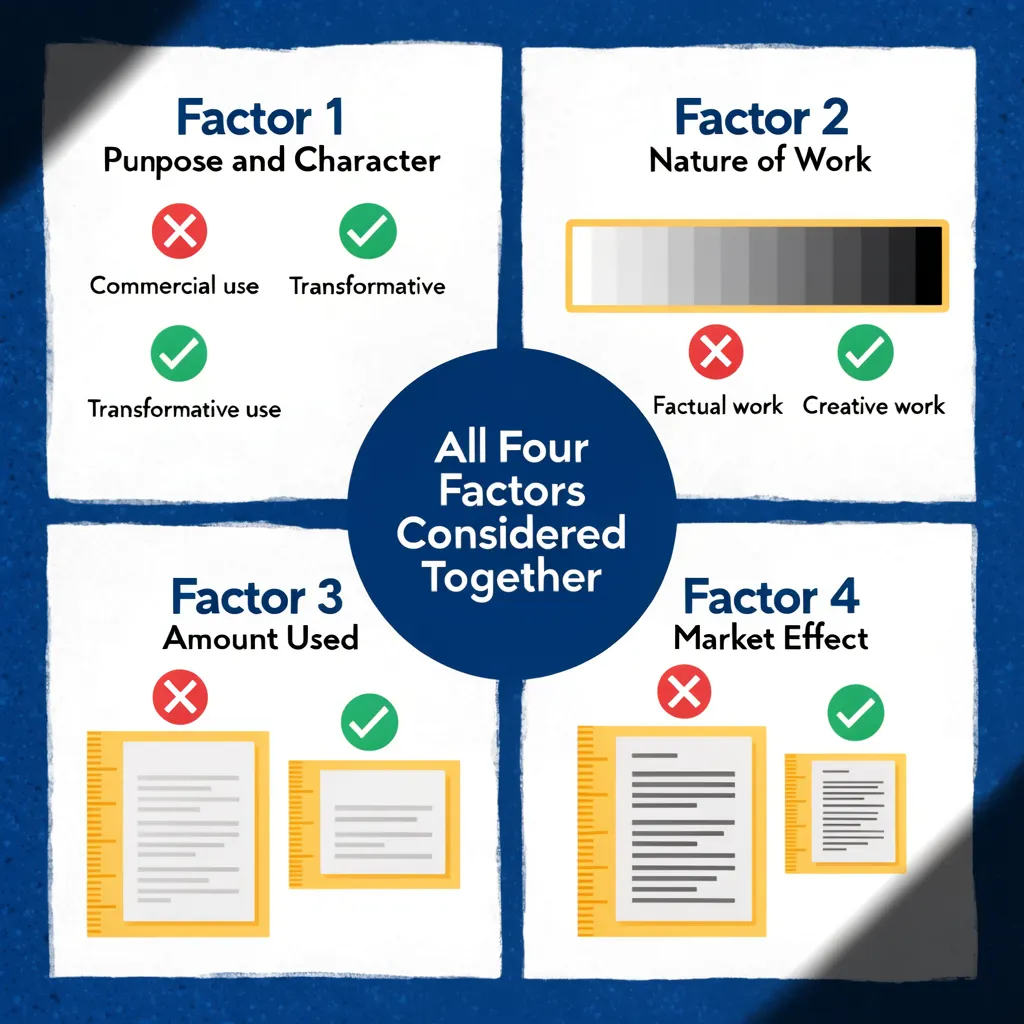
DMCA exemptions and fair use are the primary legal defenses someone can raise against a DMCA takedown claim. Fair use allows limited use of copyrighted material without permission under specific circumstances evaluated through a four factor test.
Fair use is the defense that comes up in virtually every conversation about DMCA. It is real, it is important, and it is almost universally misunderstood.
Fair use is not a blanket exemption. It is a legal defense evaluated by courts on a case by case basis using four factors from Section 107 of the Copyright Act.
Factor one: The purpose and character of the use. Is the use commercial or educational? Is it transformative? Transformative use means you added new meaning, new expression, or new commentary to the original rather than simply reproducing it. Parody, criticism, and commentary tend to score well here.
Factor two: The nature of the copyrighted work. Using a small portion of a factual work (like a news article) weighs more favorably toward fair use than using an equivalent portion of a highly creative work (like a novel or a song).
Factor three: The amount and substantiality of the portion used. Both quantity and quality matter. Using a four line excerpt from a 3,000 word article is very different from reproducing the entire thing. But courts have also found that using even a small amount of a work can tip against fair use if that small amount was the “heart” of the work.
Factor four: The effect on the market for the original. If your use would compete with or replace the original, harm the copyright owner’s ability to profit from their work, or undermine the market for licensing the original, this factor weighs heavily against fair use.
No single factor is decisive. Courts look at all four together.
Common Fair Use Misconceptions
Attribution does not create fair use. Copying someone’s full article and adding “credit to [author]” at the bottom is still infringement. Credit is respectful. It is sometimes legally required for other reasons. But it does not cure unauthorized reproduction.
“Educational” does not automatically mean fair use. Education is a factor that courts weigh positively, but a teacher who photocopies and distributes an entire textbook to avoid purchasing it is not automatically protected just because it is for educational purposes.
“I found it on the internet so it is free to use” is not fair use. As one Reddit commenter put it clearly in a copyright discussion: “As soon as a work is created, it is automatically protected, regardless of whether it’s shared publicly or is behind some kind of paywall.” This is one of the most persistent misconceptions that gets people into serious trouble.
Adding a few words or a different intro does not make a copied article transformative. Transformation requires genuinely new expression or commentary, not superficial modification.
Other DMCA Exemptions Worth Knowing
Beyond fair use, there are formal DMCA exemptions that the Library of Congress grants periodically under Section 1201. These are exemptions from the anti circumvention rules. For example, there are exemptions for security research, for accessibility modifications, for certain educational uses, and for vehicle repair diagnostics.
The Library of Congress reviews and renews these exemptions every three years through a formal rulemaking process. If you are in a field where anti circumvention is relevant, the EFF’s website tracks these exemptions in detail.
Does DMCA Apply Outside the United States?
DMCA is a U.S. law, but it applies to any platform or hosting provider based in the United States regardless of where the infringing content was posted or where the infringer is located. Non U.S. creators can and regularly do file DMCA notices successfully.
This question comes up constantly in creator forums and the answer is more practical than most people expect.
The key is not the nationality of either party. The key is the jurisdiction of the platform or server.
If your content was stolen and reposted on a YouTube channel operated by someone in Russia, you can still file a DMCA notice with YouTube because YouTube is a U.S.-based service provider. To preserve its conditional safe harbor, a qualifying provider must act expeditiously on a valid notice; the statute does not impose an absolute duty to respond in every case regardless of location.
If your article was copied onto a website hosted by a U.S. based web host like Bluehost or HostGator, you file your notice with that hosting provider. They are subject to U.S. law and must respond.
Where DMCA gets genuinely difficult is when the infringing website is hosted on servers located entirely outside U.S. jurisdiction by a company that has no legal presence in the United States. Some hosting providers in Russia, China, and certain Eastern European countries have no obligation to respond to DMCA notices and often simply ignore them.
In those cases, Google’s deindex process becomes your most powerful available tool. Even if you cannot get the infringing content removed from the source server, you can ask Google to remove those specific URLs from its search results. Google publishes every request in its Transparency Report, and valid requests get processed.
Bing has its own content removal process that works similarly.
DMCA Equivalents in Other Countries
Other countries have their own copyright enforcement frameworks, some modeled on the DMCA and some taking a different approach.
The European Union’s Article 17 (formerly Article 13) of the EU Copyright Directive requires online platforms to take proactive steps to prevent unauthorized use of copyrighted material, which goes further than the reactive notice and takedown model of the DMCA. This has been controversial and implementation varies by EU member state.
The United Kingdom has its own copyright framework under the Copyright, Designs and Patents Act 1988, updated by subsequent regulations. The UK’s framework operates differently from both the DMCA and the EU model.
For a freelancer or content creator based in Canada, Australia, or the UK, filing a DMCA notice against a U.S. based platform is entirely possible and often more effective than going through your own country’s legal system. The platforms respond to DMCA.
DMCA Protection Services: Are They Worth Paying For?
DMCA protection services like DMCA.com provide automated content monitoring, official badge licensing, and managed takedown handling for a monthly fee. They are worth it for high volume creators and generally unnecessary for smaller publishers who can monitor manually.
What these services actually do:
The DMCA protection badge that you see on many websites is licensed from DMCA.com and similar services. It signals that you know your rights and are actively monitoring. It deters casual content scrapers who see the badge and decide the risk is not worth it. But a determined, professional content thief ignores it completely.
The monitoring features are where real value exists for busy creators. These services scan the web regularly for copies of your registered content and alert you when matches are found. If you are publishing five articles a week across multiple sites and running a photo portfolio, manual monitoring is genuinely time consuming. Automation pays for itself in saved hours.
Managed takedown services handle the notice writing, submission, and follow up for you. For photographers who deal with frequent image theft, having someone else handle the administrative burden is worth the cost.
For a freelancer who publishes occasionally and has not experienced significant theft, the free tools cover most needs: Copyscape for text, TinEye and Google reverse image search for photos, and manual Google Alert monitoring for distinctive phrases from your most important work.
These services do not give you any legal protection beyond what copyright law already provides. The protection is in the law. The services help you enforce it more efficiently.
When DMCA Is Ignored: What to Do When Takedowns Are Not Working
When a notice is ignored, the remaining options are conceptually limited: follow up with the provider, ask a search provider under § 512(d) to remove the link or reference (which does not remove the source page), or seek legal advice about a court claim. The DMCA itself does not guarantee removal.
DMCA Compliance: What Website Owners and Businesses Need to Know
DMCA compliance for website owners means having a designated copyright agent registered with the U.S. Copyright Office, a published DMCA policy, and a clear process for handling takedown notices. Businesses that host user generated content need this to maintain safe harbor protection.
If you run a website where users can upload or post content, whether that is a forum, a marketplace, a portfolio platform, or a social community, you are in safe harbor territory.
Here is what you need to have in place.
Register a designated DMCA agent with the U.S. Copyright Office. This is done through the DMCA Designated Agent Directory at copyright.gov. The registration fee is currently $6 per agent designation for a three year period. Without a registered agent, you do not qualify for safe harbor under Section 512(c).
Publish your DMCA policy on your website. This should clearly state how copyright owners can submit a takedown notice, who the designated agent is and how to contact them, how you handle counter notices, and that you have a repeat infringer policy.
Implement a repeat infringer policy and enforce it. Platforms that knowingly allow repeat infringers to continue operating on their platform risk losing safe harbor protection. The policy needs to exist and be applied consistently.
Respond to valid notices expeditiously. A qualifying provider that does not act expeditiously on a valid DMCA notice risks losing the conditional § 512 safe harbor for that material. Remove or disable access to the identified content, notify the user who posted it, and record the action for your compliance documentation.
Many website owners skip these steps because they assume they are too small to need them. That is a mistake. If your site hosts any user generated content and you receive a DMCA notice, your response and your legal posture matters.
DMCA and Freelancers: A Practical Guide for Independent Creators
For freelancers and independent creators, DMCA is both an offensive tool to protect original work and a defensive framework to understand when clients, platforms, or competitors challenge your rights. Understanding both sides of the equation is essential for anyone earning a living through creative work.
The freelance context adds a layer of complexity that most general DMCA guides completely ignore.
Copyright ownership in freelance contracts. When you create work for a client, who owns the copyright? In the United States, the default rule is that the creator owns the copyright. But there are exceptions. Work made for hire, under a formal employment relationship, belongs to the employer.
For freelance work specifically, a project is considered work for hire only if it falls into specific categories defined by copyright law AND there is a written agreement between the parties explicitly designating it as work for hire. If neither condition is met, you as the freelancer retain the copyright, even if the client paid you.
This matters enormously for DMCA purposes. If a client reuses your work beyond the scope of what you agreed to, or if they share it with others, you may have a valid DMCA claim against the unauthorized use. Conversely, understanding your rights helps you negotiate better contract terms that reflect the actual value of what you are transferring.
The Freelance Isn’t Free Act, passed in New York City in 2017 and increasingly replicated in other jurisdictions, addresses payment protections for freelancers. While it is not directly a copyright law, it connects to the broader legal landscape of rights protection for independent creators. Knowing your legal protections across multiple frameworks is part of operating professionally as a freelancer.
When clients misuse licensed work. If you licensed specific use of your photography or writing to a client and they use it beyond the agreed scope, that is copyright infringement you can address through the DMCA process if it involves online publication. Document your original licensing agreement carefully and compare it to the unauthorized use when building your notice.
Trending FAQs About DMCA
What does DMCA stand for?
DMCA stands for the Digital Millennium Copyright Act. It is a U.S. federal law enacted on October 28, 1998, that created the notice and takedown system allowing copyright owners to request removal of infringing online content. It also established safe harbor protections for online platforms.
How long does a DMCA takedown take?
The statute sets no specific removal deadline. Under 17 U.S.C. § 512(c)(1)(C) and § 512(d)(3), a qualifying provider must act expeditiously to remove or disable access to material after receiving a valid notice, in order to preserve its safe harbor. What counts as expeditious depends on the facts, the provider, and the material at issue.
Is DMCA only for the United States?
DMCA is a U.S. law, but it applies to any platform or hosting provider based in the United States regardless of where the infringer or the copyright owner is located. Non U.S. creators file DMCA notices successfully every day. When content is hosted on servers entirely outside U.S. jurisdiction, standard DMCA notices may not be effective.
Can I file a DMCA notice for free?
Yes. Filing a DMCA takedown notice is completely free. You do not need a lawyer or a paid service. You write the notice yourself and submit it to the platform’s designated agent or through their web form. Paid services exist for monitoring and automation but are not required for the filing process itself.
What happens if you file a false DMCA notice?
Filing a knowingly false or bad faith DMCA notice can expose you to significant legal liability under Section 512(f) of the DMCA. Courts have awarded damages including attorney’s fees against parties who filed abusive takedown notices. The Lenz v. Universal case is the most well known precedent on this point.
What is a DMCA counter notice?
A DMCA counter notice is a formal legal response you file with a platform when a DMCA takedown was filed against your content incorrectly. It must meet specific requirements under 17 U.S.C. § 512(g) and include sworn statements. After a valid counter notice, platforms must restore your content within 10 to 14 business days unless the original filer takes legal action to stop them.
Can you ignore a DMCA notice?
You can technically ignore a DMCA notice if it was sent directly to you rather than to a platform. But if it was sent to your hosting provider or a platform where your content lives, ignoring it usually means the platform will remove your content anyway to protect their own safe harbor status. If the notice is valid and you ignore it, you remain liable for the infringement.
What happens if you get a DMCA notice on your YouTube channel?
If YouTube receives a valid DMCA copyright removal request against a video on your channel, YouTube will remove the video and issue you a copyright strike. One strike restricts some features. Two strikes add more restrictions. Three strikes within 90 days result in permanent channel termination. You can appeal if you believe the strike was filed in error.
How do I respond to a DMCA takedown I believe is wrong?
If you believe a DMCA takedown against your content was filed in error, you have three main options. You can attempt to reach the filer directly to resolve the issue. You can wait and repost the content if the underlying copyright issue is genuinely resolved. Or you can file a formal DMCA counter notice, which triggers a 10 to 14 business day window during which the filer must file a lawsuit to prevent restoration, or your content is reinstated.
What is DMCA safe harbor for websites?
DMCA safe harbor is the legal protection that shields website owners and hosting providers from copyright liability for content posted by their users, as long as those platforms respond promptly to valid DMCA takedown notices, have a registered copyright agent, and enforce a repeat infringer policy. Without safe harbor, platforms like YouTube, Reddit, and web hosts would be directly liable for their users’ copyright violations.
How do I protect my blog from DMCA violations?
To protect your blog, publish original content you genuinely created, use properly licensed or original images rather than images you found through Google image search, attribute quotes and referenced material correctly, understand the scope of any stock photo or music licenses you purchase, and include a clear copyright notice on your site. If you receive a DMCA notice for content you posted, read it carefully and verify whether the claim has merit before deciding how to respond.
Is a DMCA takedown notice legally binding?
A DMCA takedown notice is not a court order. It is a legal document that triggers a specific process under federal law. The platform is not legally required by a court to remove content in response to a notice, but platforms do so because their safe harbor protection depends on acting on valid notices promptly. The notice itself creates legal obligations and legal risk for the filer under penalty of perjury requirements.
What does DMCA protected mean on a website?
When a website displays a “DMCA Protected” badge, it signals that the site owner is aware of their copyright rights under the Digital Millennium Copyright Act and is actively monitoring for unauthorized use of their content. It does not mean any government agency has officially certified or protected the content. The legal protection comes from copyright law itself, which applies automatically to all original works.
How do I send a DMCA notice to Google?
To send a DMCA notice to Google, use Google’s legal troubleshooter at google.com/webmasters/tools/legal and navigate to the copyright removal section. You can report content on Google’s own platforms or request deindexing of specific URLs from Google search results. Google processes these requests through their legal team and publishes the outcomes in their Transparency Report.
This article explains the concepts behind the DMCA for informational purposes only and is not legal advice. For complex situations involving significant financial stakes or formal legal disputes, consult a qualified intellectual property attorney. For official DMCA information, visit the U.S. Copyright Office at copyright.gov or review the statutory text at 17 U.S.C. § 512.


4 Comments on “What the DMCA Does—and Does Not Do—for Freelancers”