

Freelancer blacklisting client reputation is one of those topics nobody warns you about when you first go independent. You spend months building your skills, landing clients, and delivering great work. Then one day, the proposals stop getting replies. The referrals dry up. And you have no idea why.
Hypothetical example: imagine a freelancer who, after four unanswered proposals in a row to the same content agency, hears from a former colleague that the agency is circulating a shared spreadsheet flagging freelancers. In this hypothetical, the freelancer had asked for clarification on a vague brief three times before starting a project eighteen months earlier. This guide uses hypothetical examples like this one, not personal stories, to explain how informal blacklisting can work.
This kind of hypothetical shows how informal blacklisting can work. This guide sets out practical steps you can take, whether or not you can prove what happened.
What Freelancer Blacklisting Client Reputation Actually Means
Most people imagine something dramatic when they hear the word blacklisting. A secret government registry. A formal Do Not Hire council. Some official system that brands you permanently.
The reality is far more ordinary and far more dangerous.
Freelancer blacklisting, in practice, is one person deciding not to hire you again and then telling others the same thing. No process. No notice. No right of reply. It just spreads, quietly, through professional networks you cannot see.
Here is how it actually shows up in real life:
- An editor passes your name to a friend at another publication with a casual warning
- A client leaves a carefully worded review on Upwork that frames normal professional behavior as problematic
- A content agency adds your profile to an internal spreadsheet shared across their partner sites
- A marketing director drops your name in a Slack channel with a single negative comment attached
None of these require anything official. None of them let you respond in time. You find out weeks later, or sometimes never at all.
And here is the part that matters for your income: these conversations happen in the same channels where hiring decisions get made.
The Two Types Every Freelancer Actually Faces
Freelancer blacklisting client reputation damage splits into two very different situations. They feel different, they come from different places, and they need different solutions.
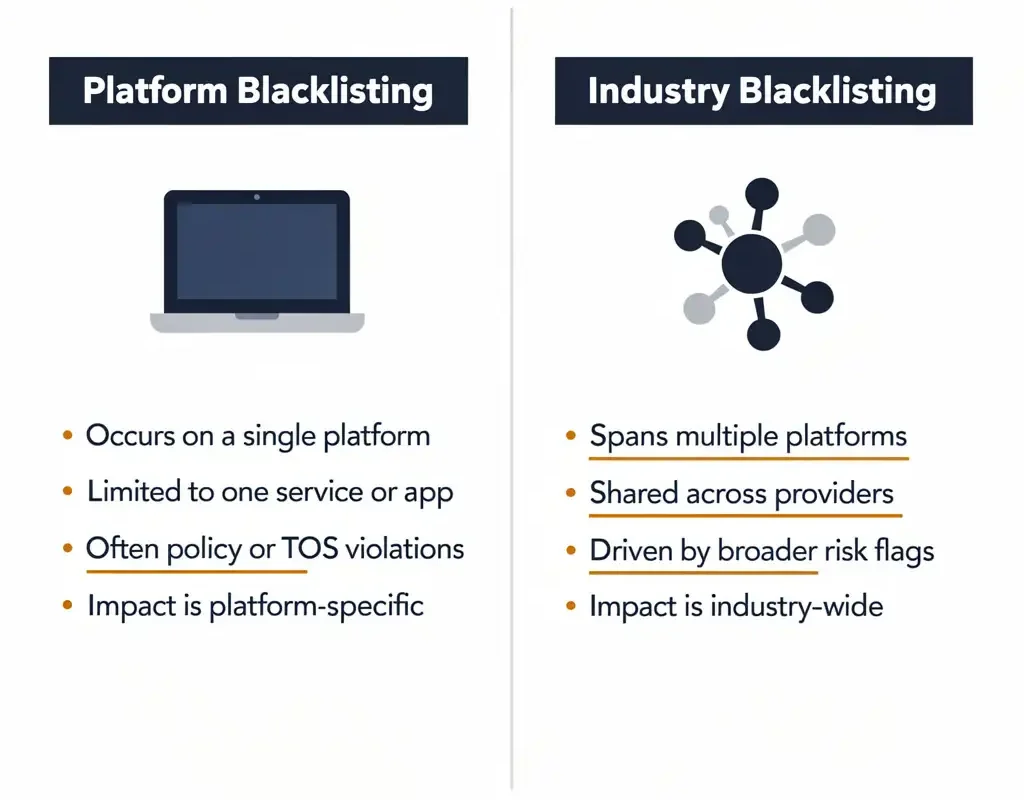
Industry blacklisting is invisible and far harder to reverse.
Type One: Platform Level Actions
If you work on Upwork, Fiverr, Freelancer.com, Toptal, or any major freelance marketplace, you are already inside a reputation system whether you think about it or not.
These platforms have formal mechanisms: account warnings, suspensions, bans. But they also have softer, less visible ones. Clients can block you from applying to future contracts. They can leave feedback that buries your profile in search results. They can report you to Trust and Safety teams for behavior that is actually completely legitimate.
The one upside of platform level blacklisting is visibility. You can see your Job Success Score drop. You can see a negative review on your profile. You have something concrete to respond to, even when the process feels unfair.
What most freelancers completely miss is that the system runs both ways. Clients have profiles too. Experienced freelancers check a client’s hire rate, their payment history, and their aggregate feedback from previous contractors before accepting any project. A client with a pattern of disputes and no completed reviews is a warning sign, no matter how appealing the job post looks.
Hypothetical example: a freelancer takes on a client whose three previous contracts with writers all closed with no review left. A missing review alone proves nothing. Clients may simply run out of time or choose not to leave feedback, and a contract can close without feedback for many reasons. Treat a pattern of missing reviews as a prompt to ask more questions, not as proof that both parties were unhappy.
Type Two: Industry Level Reputation Damage
This one is harder to see, harder to prove, and far more damaging over the long term.
Industry level blacklisting is entirely informal. It travels through social networks, editorial Slacks, professional Facebook groups, and private email threads. It operates completely outside any platform’s terms of service.
A client tells a colleague you were “not a good fit.” An editor mentions your name with a grimacing emoji in a newsletter team’s Slack. A marketing director posts in a private group asking if others have had issues with you, and suddenly ten people who have never met you have formed an opinion.
This version is most dangerous in tight industries. Freelance journalism. Niche tech development. City specific creative work. In these spaces, the people who hire contractors genuinely know each other. If your name comes up, it travels fast and stays longer than it should.
Why Freelancer Blacklisting Happens: The Honest Version
Here is the uncomfortable truth: not every blacklisting is unfair.
Sometimes a freelancer really was difficult to work with. Missed multiple deadlines and shifted the blame. Delivered work far below what was promised and then argued about revisions. In those cases, clients warning each other is not malicious. It is just practical self preservation.
But a huge portion of blacklisting is completely unjust. And the reasons often have nothing to do with work quality.
You pushed back professionally. You asked for a written contract before starting. You declined an unpaid test task. You pointed out that a revision request was actually scope creep and should be billed separately. In certain circles, particularly low paying content mills and some marketing agencies, any of this can earn you the label “difficult.”
You became a convenient scapegoat. A client mismanages a project, sends unclear briefs, approves work, and then changes direction entirely. When results disappoint, they need a story that does not make them look bad internally. You are the easiest target and you have no platform in that organization to defend yourself.
You talked publicly about what they paid. The Wrap’s 2025 reporting on Valnet described a spreadsheet titled “2025 Blacklisted Freelancers” listing more than 400 freelancers. But proving that a particular decision about you was retaliation is nearly impossible.
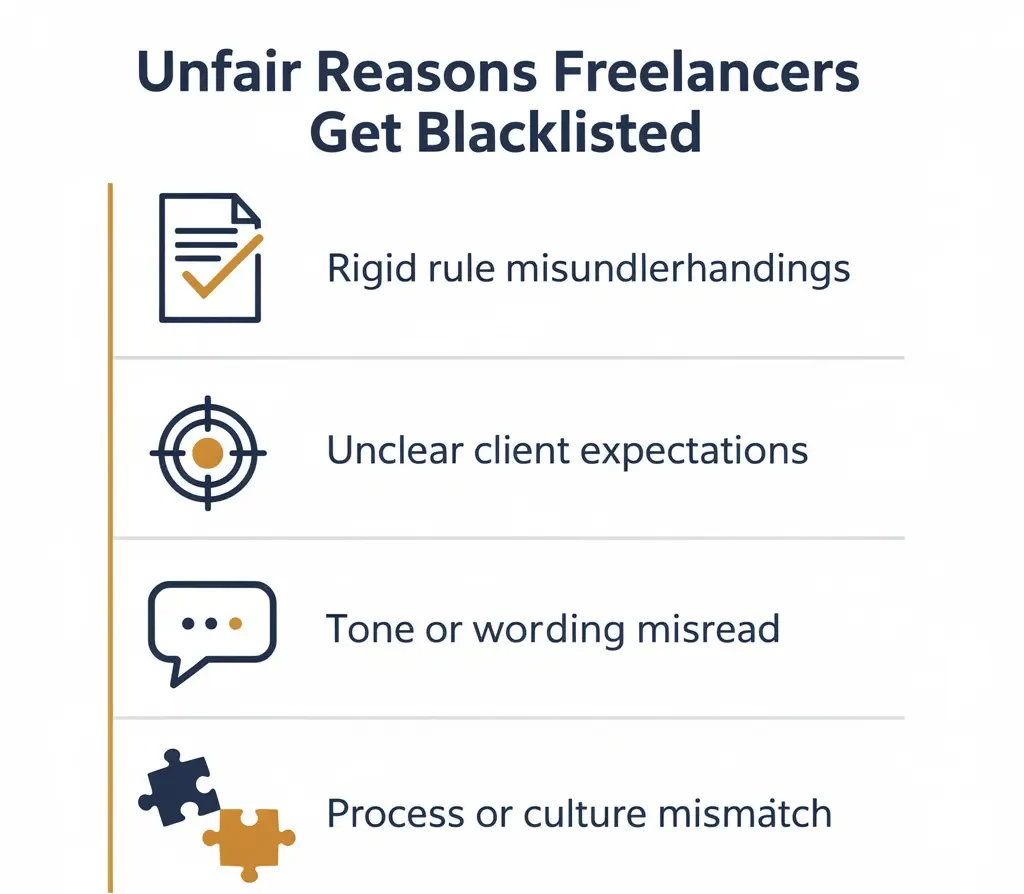
your work — and everything to do with power dynamics.
You simply did not click. Professional incompatibility is real. But “we did not mesh well” never travels through a network that way. It gets reframed as something more concrete and more damaging.
How to Tell If It Might Be Happening to You
The worst part of informal blacklisting is that you usually cannot confirm it. You just notice patterns that feel wrong.
Proposal acceptance rates drop without explanation. Referrals that used to come regularly stop arriving. Former enthusiastic clients go quiet on check in emails. The rejections become vaguer and more frequent from sources that used to give you real feedback.
None of this is proof. But all of it is worth paying attention to.
More specific signals to watch for:
A review that does not match the work. If you receive a low rating and cannot connect it to any actual failing on your part, look at the client’s history. Have they had disputes with other freelancers? Did they close the contract abruptly without communication? Weaponized reviews are a real tactic, and platforms do not catch all of them.
Word through your network. Someone you trust hears something and tells you directly. That is actionable information, even though it is not proof. Take it seriously and stay calm.
Being blocked after an apparently successful project. A client who seemed satisfied during the work and then ignores all future contact or actively blocks you has had a shift in their perception. It might be nothing to do with you. Or it might be worth a gentle, professional inquiry.
A change in tone during a call. On a discovery call, a prospect may ask an oddly specific question, such as whether you have worked with a particular company before, and the conversation may cool afterwards. That alone does not prove blacklisting: tone can change for many reasons, including budget, timing, or a poor fit. Note what happened, check it against other signals, and do not treat a single awkward call as proof.
How to Protect Your Reputation: What Actually Works
Most freelancing advice gives you the obvious guidance. Deliver great work. Communicate clearly. Hit your deadlines. That is all correct. It is also not enough on its own.
Here is what actually makes the difference.
Step One: Build Your Paper Trail From Day One
The most effective reputation protection I know is also the simplest: document everything on every project, regardless of how casual the client seems.
Before work starts, get scope confirmed in writing. Not a seventeen clause contract. Just a clear message thread where you have confirmed: what you are delivering, how many revisions are included, the timeline, and the rate. Save it. Screenshot it. Put it in cloud storage.
During the project, every time a client asks for something outside the original scope, acknowledge it in writing immediately. Something like: “Happy to add this. Just to confirm, this falls outside the original brief, so I will send an updated quote for your approval.” Send that even if they verbally agreed on a phone call. Especially when they verbally agreed on a phone call.
When the project closes, send a brief wrap up message confirming delivery and approval. This creates a written record that the relationship ended positively.
This documentation does not stop a client from bad mouthing you in private. But it gives you concrete evidence to reference if a dispute escalates on a platform, in a legal context, or in a professional conversation where you need to defend your account of events.
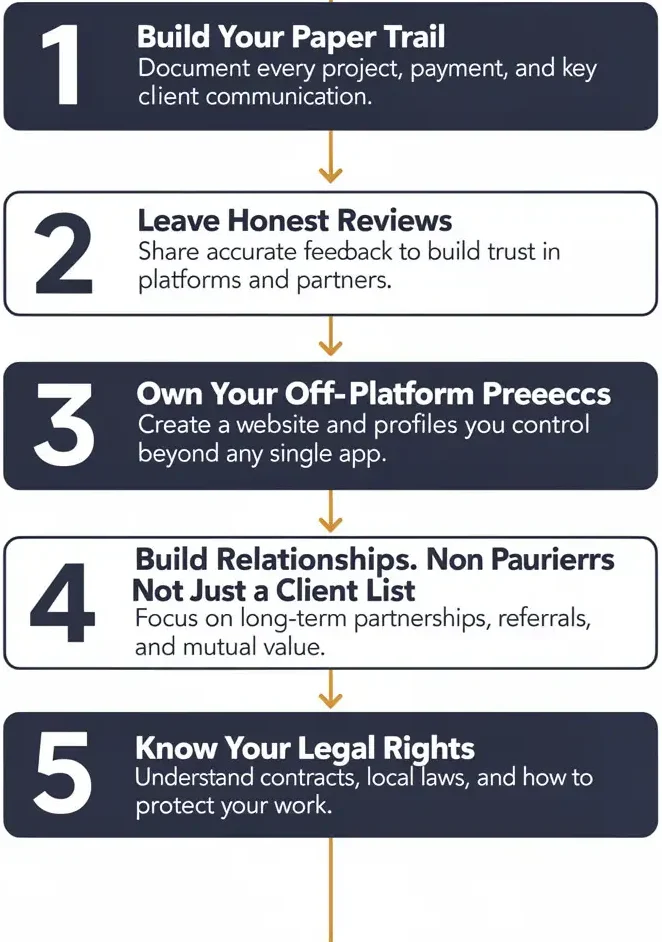
with Step 1 before your next project begins.
Step Two: Leave Honest Reviews, Even Uncomfortable Ones
On platforms with mutual review systems, your feedback for clients matters more than most freelancers realize.
Upwork uses client reviews from multiple contractors to identify problematic patterns. A client who repeatedly mistreats freelancers will eventually accumulate enough signals that the platform notices. Your honest review contributes to that system.
More immediately: when you leave a fair but specific negative review, you protect the next freelancer who looks at that client’s profile. The freelance community is genuinely interconnected. Collective reputation data is one of the most useful tools we have.
The anxiety about retaliation is real. On Upwork, the system is designed so that both parties submit their reviews before either one can see what the other wrote. That reduces the risk considerably, though it does not eliminate it entirely.
The reviews that help the most are specific and factual. Not “this client was terrible.” Instead: “Client changed scope three times after written approvals and disputed the final invoice when I referenced the original brief. Communication was inconsistent throughout. Would not recommend for freelancers who need clear direction.”
That kind of review is hard to dispute, genuinely useful to others, and demonstrates professionalism even while delivering criticism.
Step Three: Own Your Off Platform Presence
When a potential client hears something negative about you and goes to look you up, what do they find?
A strong independent presence is one of the most powerful reputation buffers available. Not because it erases bad information, but because it gives anyone researching you a full picture instead of a one sided one.
Maintain a professional website with a real bio, work samples, and genuine testimonials. Keep a LinkedIn profile detailed enough to show your actual work history and professional engagement. Be visible in your industry through publications, forums, or social platforms in your niche.
When someone searches your name and finds a well maintained, active professional presence, any informal negative chatter gets contextualized. It does not disappear. But it has to compete with real evidence about who you are.
Compare this to a freelancer with no independent presence at all. If something negative circulates about them, there is nothing to push back against it. The gossip becomes the entire story.
Step Four: Build Relationships, Not Just a Client List
Five clients who would enthusiastically defend you are worth more than fifty who would call you “fine.”
Active reputation defense is social. The people who protect your name in conversations you will never hear are the clients, collaborators, and peers who genuinely care about you professionally. They correct misinformation when they encounter it. They recommend you in the private channels where real hiring decisions happen.
Building those relationships requires going beyond transactional delivery. Share articles that are actually useful to them. Congratulate them on things they share publicly. Introduce two people in your network who should know each other. Refer work when you are too busy or when something is not your specialty.
This is not networking strategy. It is the difference between being a vendor and being a colleague. Vendors get replaced. Colleagues get defended.
Step Five: Understand Your Legal Rights
Depending on where you live, you may have more legal protection against retaliatory blacklisting than you expect.
In New York City, the Freelance Isn’t Free Act specifically prohibits hiring parties from retaliating against freelancers who exercise their rights, including denying future work as punishment for a legitimate non payment complaint.
Protections outside New York City vary by place and by the exact law relied on. This guide does not rely on a general claim about other states, cities, or federal protections, so check the law that applies to your own situation before acting.
False statements of fact shared with third parties may in some places give rise to a defamation claim, but rules, defences, and remedies differ by jurisdiction and the bar is high. This guide does not set out UK or EU defamation law.
Knowing your rights changes how you carry yourself in disputes. You do not need to be aggressive to be firm. But understanding what is legally off limits to a client changes the conversation entirely.
When Freelancers Blacklist Clients: The Side Nobody Discusses
The freelance community maintains informal client blacklists too. They always have. This part of the conversation deserves just as much attention.
Private Slack groups for freelance writers share warnings about publications that routinely pay late or kill pieces without the contracted kill fee. Discord servers for freelance developers flag clients who steal code, dispute invoices after delivery, or demand unlimited revisions. Subreddits for virtual assistants identify agencies that market themselves as agencies but operate as content mills paying below minimum wage.
Community-maintained lists also circulate in niche professional groups. Treat any such list as unverified unless you can check the underlying facts yourself, and do not repeat a claim you cannot support.
If you participate in this ecosystem, do it thoughtfully.
Be factual, not emotional. “This client paid 90 days late despite a 30 day contract term and stopped responding to follow up emails” is genuinely useful information. “This client is a nightmare and you should never work with them” is noise that helps nobody.
Distinguish a bad client from a bad fit. Some clients are genuinely problematic across every contractor they work with. Others are simply a mismatch for specific working styles. Be honest about which category your experience falls into.
Use closed communities where your credibility is established. Posting a client warning in a private industry Slack where people know your work is fundamentally different from a public Twitter post. In the former, you are contributing to a community knowledge base. In the latter, you are creating potential legal exposure depending on exactly what you say.
Be ready to back it up. The strength of your warning is only as good as the specificity behind it. If you are going to warn colleagues, make sure you can document what happened.
Platform by Platform: How the Reputation Game Actually Works
Freelancer Blacklisting Client Reputation on Upwork
Upwork has the most sophisticated reputation ecosystem in freelancing. Your Job Success Score responds to contract outcomes, public and private client feedback, and platform activity. Clients can leave public feedback you can see and respond to, but they can also leave private feedback that affects your score without you knowing exactly what they said.
This feels unfair. Sometimes it is. Upwork says feedback is the other person’s opinion and that, in most cases, it cannot edit feedback or decide whether it is accurate. Removal is limited to specific cases, such as manipulation or extortion, abusive language, irrelevant feedback, insider feedback, and confirmed fraud.
If you believe feedback should be removed, gather your documentation and use Upwork’s Report feedback route: go to your Job Success Insights page, find the job, and select Report feedback. Upwork says a piece of feedback can only be reported once, so include detailed information and any supporting documentation in that single report. Do not use a Resolution Center dispute for feedback removal. See Upwork’s current guidance: Respond to or report feedback and When can Upwork remove feedback I’ve received?.
The most important thing to know about Upwork’s system: respond to every negative review you receive. Your response is visible to every future client who reads your profile. A calm, professional, specific response often does more for your reputation than the absence of the bad review would. Emotional or defensive responses do far more damage than the original one star.
Also worth noting: if a client threatens to leave a bad review unless you issue a refund, that is extortion, and it violates Upwork’s Terms of Service. Report it immediately with the message thread as documentation.
Fiverr and Bad Client Blacklisting
Fiverr’s reputation system gives buyer feedback considerable weight. Reviews and ratings are visible on a seller’s profile, and performance measures affect how a seller is presented on the platform. Check Fiverr’s current Help Center pages for how reviews, cancellations, and performance scores work now, because platform rules change.
Buyers can request order cancellations, and cancellations can affect a seller’s Order Completion Rate, which is part of the overall Success Score, not a separate seller level. The effect depends on the situation: Fiverr says an order canceled by the client before requirements are submitted has no Order Completion Rate impact, while a very late order force-canceled by the client, or a cancellation requested by the freelancer, can affect it. Cancellation through the Resolution Center gives the client 48 hours to accept or decline, after which it is automatically canceled. Because cancellations can carry a cost, treat them as a last resort and check Fiverr’s current Help Center guidance on cancellations before requesting or accepting one.
Some sellers also share buyer warnings in Fiverr forums and external groups. Treat such warnings as unverified community reports, not as confirmed findings, and check the facts before relying on them.
LinkedIn and Professional Reputation
LinkedIn does not have a formal review system for freelancers. But it is where much of the industry level reputation activity actually lives.
Recommendations on LinkedIn matter. Not because everyone reads every recommendation in detail. Because the presence or absence of recommendations is a signal. A freelancer with two dozen detailed, specific recommendations from recognizable names in their field is hard to dismiss based on informal gossip.
Equally important: LinkedIn is where potential clients research you before the first contact. A well maintained profile with a clear work history, endorsements, and genuine activity in your niche is probably the most effective single reputation building tool outside of your actual work quality.
Your LinkedIn profile often appears when someone searches your name. This is worth knowing when you think about the story you want your public presence to tell.
Reddit and Community Based Client Reputation
r/freelance, r/upwork, r/forhire, and dozens of niche subreddits are where freelancers actually talk honestly about clients, platforms, and industry problems.
When you face a dispute or a genuinely strange client situation, searching Reddit for that company’s name or a similar scenario is often the fastest way to determine whether your experience is isolated or part of a documented pattern. Plenty of problematic clients and agencies have threads going back years with consistent complaints from multiple independent contractors.
This cuts both ways. If a client is researching you and finds a negative post about you in one of these communities, it exists, it is indexed, and it shows up in search results. The internet has a long memory.
Common Mistakes That Make Everything Worse
These are common mistakes that can turn a manageable reputation problem into a serious one.
Going public before exhausting private options. When something goes wrong, the impulse to post about it immediately on Reddit or social media is understandable. Sometimes it is even appropriate. But doing it before you have tried direct resolution almost always escalates the situation, gives the client a reason to get defensive, and can create legal exposure depending on what you say.
Responding emotionally to negative reviews. Defensive essays and, in extreme cases, personal attacks in response to a bad review do lasting damage. The review might hurt your profile. The response will destroy it. Whatever you feel privately, your public response to any negative feedback must be calm, brief, factual, and professional. Nothing more.
Burning the exit. How you leave a bad client relationship matters enormously. A clean, professional disengagement leaves the door open and closes the gossip loop. An explosive exit gives the client material for a narrative about you that travels through their professional network for years.
Ignoring the early red flags. Every freelancer has taken on a client they knew was going to be a problem because the pay was good or they needed the income. It almost never ends well. The clients who showed warning signs in the vetting stage became the clients who created reputation problems later. The early signals are worth trusting.
Assuming platform ToS protects you fully. Platforms have rules that technically protect you from certain client behaviors. But enforcement is inconsistent, appeals processes are slow, and the algorithmic damage often happens before any human review occurs. Platforms are tools. They are not shields.
When You Have Already Been Blacklisted: A Real Action Plan
If you are reading this because you think it is already happening, here is a practical path forward.
First, get clear on the scope. Is this a platform issue, a specific industry level problem, or both? They require different responses.
For platform issues: Respond professionally to all visible negative feedback. On Upwork, if feedback meets one of the removal grounds, report it once through Job Success Insights and Report feedback, with full documentation. Put your energy into generating strong, recent positive reviews from current clients to counterbalance the damage.
For industry level damage: Try to identify where the information originated. If it came from one specific client relationship, consider whether a direct, calm, adult conversation with that person is possible. Not to demand a retraction. Just to understand their perspective and, if appropriate, share yours. One honest conversation sometimes changes the entire narrative.
Rebuild in a different context if you have to. If a specific platform or professional community has become genuinely hostile to your presence, you do not have to keep operating there. Move to a different platform. Build a client base in a different vertical. This is not running away. It is making a strategic decision about where your energy creates the most value.
Get professional help if the financial damage is real. If you can document specific false statements by a specific person that caused measurable income loss, consider getting legal advice before acting. The bar for a viable case is high. For a starting point, see the American Bar Association’s Find Legal Help directory or the Freelancers Union Legal Clinic, which offers free, one-on-one legal guidance for freelancers.
Point your energy forward. Every month of excellent work, every strong new client relationship, every piece of professional content you create moves you further away from whatever happened. Reputations are not fixed. They are continuously built and rebuilt through consistent behavior over time.
What to Do When a Platform Review Feels Wrong
This specific situation sends more freelancers into anxiety spirals than almost anything else in this industry. Let me walk through what actually works.
Do Not Respond Right Away
Responses written within an hour of a review appearing are often the weakest ones. Write your response in a notes app first. Let it sit for 24 hours. Reread it with fresh eyes. Then revise before posting. Emotional responses always read as emotional, regardless of how justified the emotion is.
Know What Qualifies as a Policy Violation
On Upwork specifically, feedback is treated as opinion, and Upwork says it cannot edit it or make determinations about its accuracy in most cases. Removal is not available simply because you believe a statement is false. The cases Upwork lists are manipulation or extortion of the feedback system, abusive or offensive language, feedback unrelated to the contract, insider feedback or a conflict of interest, and feedback from a customer involved in confirmed fraud. Before submitting, check Upwork’s current help pages and cite the specific ground that applies, rather than arguing only that the review feels unfair.
Document Everything Before Filing a Dispute
Gather your message history, the original brief, any scope change requests, written approvals, and the full timeline of events. Disputes submitted with concrete documentation get taken far more seriously than disputes that read like emotional venting. Platform support teams handle enormous volumes. The ones with clear evidence get prioritized.
Write Your Response for Future Clients, Not the One Who Left the Review
Every word of your public response is being read by the next hundred potential clients who visit your profile. Address the specific claim briefly and factually. Then pivot to demonstrating your professional standards for future clients. Keep the response under 150 words.
Here is the kind of response structure that actually works:
“Thank you for the feedback. The project scope and deliverables were confirmed in our initial exchange, and all work was completed within those agreed parameters. The revision requests that followed after final approval fell outside the original brief. My standard is clarity upfront and quality throughout. Future clients are welcome to review my complete profile history and reach out directly with any questions.”
That response does not attack. It does not grovel. It shows future clients exactly how you handle conflict, which is more valuable to them than the absence of the negative review itself.
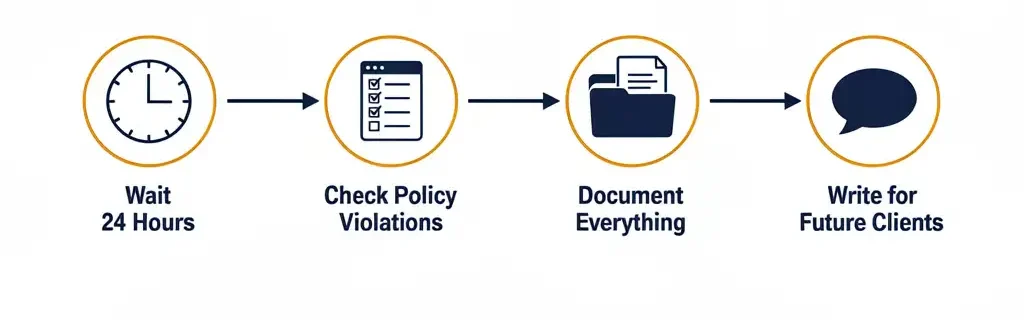
hundred potential clients — write it for them, not the
reviewer.
Prioritize Getting Strong New Reviews
After a bad review hits, the most effective thing you can do is get two or three excellent new reviews from solid clients quickly. This dilutes the weight of the negative review in platform algorithms and in the visual impression it creates for profile visitors.
The Mental Health Side That Nobody Writes About

you — but it can feel that way, and that feeling is worth
taking seriously.
Reputation damage is psychologically disproportionate to the practical problem it creates. I want to say that plainly because most freelance articles do not go here.
There is something uniquely destabilizing about this kind of damage. You do not know exactly what was said. You do not know who heard it. You cannot measure it or fix it the way you would fix a technical problem. And because your professional reputation is directly tied to your ability to earn, the anxiety touches something visceral.
Freelancers are particularly exposed to this specific kind of anxiety because there is no institutional buffer. When something attacks your professional reputation, it attacks you directly. There is no HR department, no manager, no PR team. It is just you.
Hypothetical example: a freelancer checks a platform dashboard several times in a day, watching a score like a stock ticker, drafts messages to clients suspected of saying something, then deletes them, and turns down projects out of anxiety about new exposure. Avoiding new work out of anxiety is not a solution on its own.
If you are in that anxious spiral right now, here is what I want you to hear.
The silence is almost never a coordinated campaign against you. Markets shift. Budgets change. Companies go through internal restructuring. The quiet you are experiencing might have everything to do with forces entirely outside your control.
Your professional identity is larger than any platform score. An Upwork JSS number is a data point about algorithmic interactions with a subset of your client relationships. It is not a measure of your talent, your character, or your value.
Isolation makes this dramatically worse. Find your community. A local coworking space. An online Slack group for your niche. A small group of trusted peers you can be honest with. Hearing that other freelancers have recovered after a difficult period can make the whole experience feel survivable.
If anxiety is persistent and significantly affecting your ability to work, take that seriously and consider speaking to a qualified professional or a support service in your area. Finding this hard does not make you weak. It makes you human.
The Bigger Picture: A Power Imbalance That Needs to Change
I want to say something larger before we wrap up, because I think freelancers often frame reputation entirely as their own individual problem to manage. It is not.
The power dynamics in client to freelancer relationships are genuinely uneven. Companies and agencies have institutional authority, professional social capital, and legal resources that individual freelancers typically lack. When a company’s marketing director says something negative about a freelancer in a professional network, people believe it, even when the claim is false, even when it is motivated by the client’s own failures. The freelancer has no equivalent channel.
This is changing, slowly. The Freelancers Union, the National Writers Union, and dozens of industry specific advocacy organizations are pushing for better protections. The Freelance Isn’t Free Act is a real step forward. Cultural awareness that gig workers deserve professional respect and legal protection has grown meaningfully in recent years.
But it is not enough yet. In the meantime, individual freelancers have to navigate an uneven landscape and protect themselves as best they can.
What I have found is that the best protection is not defensiveness. It is visibility. Community. Documentation. Treating your professional reputation the way any business treats its brand: as a long term asset worth investing in continuously, not just a thing to defend when it comes under attack.
The freelancers who thrive long term are not the ones who never have problems with clients. Every freelancer does eventually. The ones who thrive are the ones who have built something substantial enough that no single problem can bring it down.
Practical Tools That Are Actually Worth Using
For Documentation and Contracts
Bonsai offers freelance contract templates and invoice tracking that can help make agreements formal without requiring a lawyer.
HelloSign and DocuSign both handle client signature collection. If a client needs to sign something, make it a signed document.
Google Docs and Notion work well for keeping project notes and correspondence in a searchable format you can reference months later.
Your own email account, used consistently with a BCC to a separate address, creates a searchable record of every client interaction that lives outside any platform’s ecosystem.
For Vetting Clients Before You Start
Glassdoor carries reviews from former employees and contractors for many companies.
Trustpilot is useful for agencies and smaller companies that have enough volume to generate public reviews.
Google search combining the company name with the word “freelancer” or “contractor review” takes five minutes and regularly surfaces Reddit threads and forum posts you would never have thought to look for otherwise.
LinkedIn is valuable for reviewing a company’s staff turnover patterns, their historical job posting frequency, and any connections in common who can give you a candid reference.
For Community Intelligence
r/freelance, r/upwork, r/forhire and your industry specific subreddits are where freelancers speak most candidly about client experiences.
Industry specific Facebook groups (search your niche plus the word “freelancers”) often have active communities where client warnings circulate informally.
Private Discords and Slacks require you to be plugged in to benefit from them, but they carry the most candid, current, and specific intelligence available anywhere.
For Formal Issues
DCWP (NYC Department of Consumer and Worker Protection) handles Freelance Isn’t Free Act complaints for New York City based freelancers.
The Freelancers Union offers free legal aid resources for members and advocates collectively for independent worker rights.
Small claims court is faster and less intimidating than most freelancers expect for payment disputes under the relevant threshold in your state.
A Final Thought on Where This Leaves You
Freelancer blacklisting client reputation damage is real. It happens more than most clients would admit and in forms that are far more varied and informal than most freelancers expect. It can affect your income, your opportunities, and your sense of professional security in ways that feel genuinely serious.
But it is not a conspiracy, and it is not something you are powerless against.
The best version of reputation defense is reputation offense. Build something so solid, so documented, so supported by real relationships that no single bad actor can take it down. That is not a quick fix. It is a practice built project by project, decision by decision, relationship by relationship.
What changed how I approached this, honestly, was realizing I had more power than I thought. Not the power to prevent every bad client encounter or to survive every unfair review without any damage. But the power to build something that outlasts individual setbacks. To document my professional behavior clearly enough to defend it when needed. To invest in relationships that created real advocates.
That is the work. Start there, and you are already ahead.
Incident and Evidence Log and Verified Appeal Checklist
Keep four things separate: a private hiring decision, such as a client simply choosing not to hire you; a platform sanction, such as a warning, suspension, or ban under platform rules; an opinion in feedback, which Upwork says it will not edit or judge in most cases; and a false statement of fact, which is a different question and depends on the law that applies. Do not treat one category as proof of another.
Incident and evidence log template. For each incident, record the date, the client or platform, what happened in factual terms, the evidence kept, such as messages, contracts, scope documents, and delivery records, who else was involved, and the outcome you are seeking. Keep the original messages and documents, and add a short, dated note of what you observed, rather than a conclusion about motive.
Verified appeal checklist. Wait at least 24 hours before responding publicly, and write the response for future clients, keeping it calm, brief, and factual. Check whether a specific Upwork removal ground applies, such as manipulation or extortion, abusive language, irrelevant feedback, insider feedback, or confirmed fraud, and remember that a review that is simply unfair is not on its own a removal ground. Gather your documentation, then report it once through Job Success Insights and Report feedback, with detailed information and supporting documentation. After that, focus on strong, recent positive reviews from current clients.
Trending FAQs: Freelancer Blacklisting Client Reputation
Q: What is freelancer blacklisting client reputation and why does it matter?
Freelancer blacklisting client reputation refers to the informal and formal systems through which clients flag freelancers as people they will not hire again and share that information with others in their network. It matters because it can restrict future work opportunities without your knowledge or any formal process.
Q: Can a client legally blacklist a freelancer?
Clients can legally choose not to hire someone again. Keep four things separate: a private hiring decision, such as a client simply choosing not to rehire you; a platform sanction, such as a warning, suspension, or ban under platform rules; an opinion in feedback, which Upwork says it will not edit or judge in most cases; and a false statement of fact, which is a different question and depends on the law that applies. Spreading false information that damages a freelancer’s reputation, or retaliating against a freelancer for exercising legal rights like filing a non payment complaint, can be illegal depending on your jurisdiction. The Freelance Isn’t Free Act in New York City specifically prohibits retaliation.
Q: Is there a database of bad freelance clients?
There is no single official database, but several community resources serve a similar function. These include industry specific Slack groups, subreddits like r/freelance, private Discord communities, and community-maintained lists in niche professional groups. Treat any such list as unverified unless you can check the underlying facts yourself, and do not repeat a claim you cannot support.
Q: How do I check a client’s reputation before accepting a freelance project?
On platforms like Upwork, check the client’s hire rate, average hourly paid, review history from previous contractors, and their overall feedback score. Off platform, search the company name plus the word “freelancer” on Google, check Glassdoor and Trustpilot, and search relevant subreddits for past contractor experiences.
Q: What are the biggest warning signs of a bad freelance client?
The most reliable warning signs include: vague payment terms or resistance to discussing payment clearly, requests for extensive unpaid sample work, pressure to start without a signed contract or written scope agreement, unrealistic deadlines with no flexibility, referencing previous freelancers in negative terms during the vetting conversation, and changing agreed rates or scope after the project has started.
Q: How do I report a bad client on Upwork?
On Upwork, you can leave honest public feedback after a contract closes, and report extortion or fraudulent behavior directly to Trust and Safety. For feedback removal, do not use a Resolution Center dispute: go to Job Success Insights, find the job, and select Report feedback. A piece of feedback can only be reported once, so include detailed information and supporting documentation, and cite a specific removal ground, such as manipulation or extortion, abusive language, irrelevant feedback, insider feedback, or confirmed fraud. Feedback that is simply unfair, or that you believe is false, is not on its own a removal ground. Document everything before submitting any report.
Q: What should I do if I receive an unfair review on a freelance platform?
Wait at least 24 hours before responding to allow your emotions to settle. Write a response for the next hundred potential clients who will read it, not for the client who left the review. Address the specific claim briefly and factually, then pivot to describing your professional standards. Keep the response under 150 words. Simultaneously, contact ongoing clients and ask for strong new reviews to counterbalance the negative one. On Upwork, removal is a separate question: Upwork treats feedback as opinion and will not edit it or judge its accuracy in most cases, and a review that is simply unfair is not on its own a removal ground. If a listed ground applies, such as manipulation or extortion, abusive language, irrelevant feedback, insider feedback, or confirmed fraud, report it once through Job Success Insights and Report feedback, with detailed information and supporting documentation.
Q: Can one random bad client actually ruin my freelance career?
Almost never, though it can feel that way in the moment. A single bad review or informal complaint from one client is rarely enough to override a solid body of work and genuine professional relationships unless the freelancer’s reputation was already fragile.
Q: What is the Freelance Isn’t Free Act and what does it protect?
The Freelance Isn’t Free Act is a New York City law that requires written contracts for freelance work over a certain value and prohibits hiring parties from retaliating against freelancers who exercise their legal rights, including the right to file complaints about non payment. This guide covers the New York City law only. For the most current information, see NYC 311’s Freelance Worker and Hiring Party Assistance page.
Q: How do freelancers protect themselves from client reputation damage long term?
The most effective long term protections are: maintaining thorough written documentation on every project, building a strong independent professional presence off any single platform, cultivating genuine relationships with clients who will advocate for you, leaving honest reviews for both good and bad clients, and knowing your legal rights in your jurisdiction. The goal is not to avoid every bad client encounter but to build something solid enough that no single encounter can undermine it.
If you’re looking for more real world insights and practical tips to level up your freelancing journey, make sure to check out our website. We regularly share simple, actionable content to help you land better clients, protect your time, and confidently grow your freelance career.
For freelancers dealing with active platform disputes: Upwork’s Resolution Center, Fiverr’s customer support, and your platform’s Trust and Safety team are the first formal resources for disputes generally. For Upwork feedback removal specifically, use Job Success Insights and Report feedback, not a Resolution Center dispute. For legal questions about independent contractor rights in the US, the Freelancers Union offers guidance and member referrals. Outside the US, your country’s equivalent of a labor rights organization or a local attorney handling employment or commercial contracts is the right starting point.


3 Comments on “Handling Client Reputation Problems and Platform Reviews as a Freelancer”