
You delivered the work. You sent the invoice. And then… nothing.
No payment. No response. Just the uncomfortable silence of a client who owes you money and apparently has no intention of paying it.
If you are a freelancer or small business owner in the USA, this is not uncommon. According to a 2024 report by Atradius, 55% of all B2B invoices issued in North America are paid late, and roughly 8% are never paid. That means for every $100,000 in invoices you send out annually, you could be writing off $8,000 in pure lost revenue before the year even ends.
The frustrating part is not just losing the money. It is the time you spend chasing it. The awkward emails. The ignored phone calls. The creeping uncertainty about whether you should push harder or just let it go.
This guide does not give you generic advice. It gives you a complete, field-tested system for collecting unpaid invoices at every stage, whether they are one week late or six months overdue. You will get real email templates, a demand letter you can send today, and a clear breakdown of your legal options when a client simply refuses to pay.
Let us get into it.
To collect unpaid invoices, send a professional reminder email within the first seven days past due, escalate to a direct phone call by day 15 to 30, issue a formal demand letter at 60 days, and engage a collection agency or attorney if the account reaches 90 days with no resolution.
1. Why Clients Don’t Pay Invoices And What It’s Actually Costing You
Clients fail to pay invoices for reasons ranging from genuine cash flow problems to deliberate bad faith. Understanding which type of non-payer you are dealing with determines your entire strategy and how quickly you can recover what you are owed.
Most guides on this topic tell you to “send a reminder” without ever explaining why invoices go unpaid in the first place. That is a critical gap. If you treat every late client the same way, you will either come on too strong with a loyal client who simply forgot, or too soft with a chronic delayer who is counting on your patience.
The Real Cash Flow Damage Unpaid Invoices Cause
Here is a number worth sitting with: the U.S. Bank research found that 82% of small business failures trace back to poor cash flow management, not a lack of profitability.
An unpaid invoice is not just an accounting entry. It is a direct hit to your working capital. When a client sits on a $3,000 invoice for 90 days, you have already delivered the work, absorbed the costs, and paid your own bills out of pocket. You are essentially acting as an interest-free lender for your client.
Think of it this way: unpaid invoices are an invisible tax on your business. You pay it with your time, your stress, and your opportunity cost. Every hour you spend chasing a delinquent account is an hour you are not spending on billable work or growing your client base.
Your Days Sales Outstanding (DSO) is the metric that makes this concrete. DSO measures the average number of days it takes you to collect payment after a sale. If your payment terms are Net 30 but your actual average collection time is 52 days, your effective DSO is 52. That 22-day gap represents cash sitting in someone else’s bank account instead of yours.
Reducing your DSO by even 10 days can free up thousands of dollars in working capital for a freelancer billing $100,000 per year. That is not a small detail. That is the difference between covering payroll and missing it.
The Real Reasons Clients Don’t Pay Beyond “They Forgot”
Not every late client is a bad actor. But not every late client is innocent either. The fastest way to choose the right collection strategy is to identify which category your client falls into.
The Forgetter: Genuinely busy, disorganized, or relying on a slow accounts payable department. A single firm reminder resolves this 90% of the time. These clients are not a problem. They are an administrative gap.
The Cash-Strapped Client: They want to pay but cannot right now. You will recognize this type because they respond quickly, apologize sincerely, and usually propose a payment plan. Working with them on a structured schedule is often your best move because forcing the issue could cost you both the relationship and the recovery.
The Chronic Delayer: This client always has an excuse. The check is being processed. The owner is traveling. The accounting system had an issue. They are not lying to you, exactly, but they are not prioritizing you either. This type responds only to firm, documented escalation with clear consequences.
The Dispute Invoker: This client suddenly “has concerns” about the work the moment you follow up for payment. The dispute may or may not be genuine. Either way, you need to address the underlying issue in writing before pursuing the debt, or you lose credibility in court if it gets that far.
The Bad-Faith Non-Payer: They received the work, they know they owe you, and they have made a calculated decision not to pay. This is the rarest type but the one that requires the most decisive action. Do not waste soft communication on this client. Move quickly to formal channels.
What’s the Difference Between Accounts Receivable and Collections?
Accounts receivable (AR) is the internal management of money owed to your business. It includes tracking invoice due dates, sending reminders, and following up with clients. Collections is what happens when AR management fails and you hand the account off to a third party or pursue legal recovery.
The line between the two matters because crossing it changes the tools available to you, the laws that apply, and the costs involved. Understanding where you sit on that line tells you what your next move should be.
Think of AR as playing offense on your own terms. Collections is calling in the defense after the offense has stalled. (what Net 30 payment terms mean for freelancers)
How Payment Disputes Differ from Outright Non-Payment
This distinction trips up many freelancers and small business owners, and it matters legally.
A payment dispute means the client contests the invoice itself. They are claiming the work was not delivered, the quality was not acceptable, or the amount is incorrect. Non-payment means the client acknowledges the debt but is simply not paying it.
Your strategy depends entirely on the situation you are in. If there is a genuine dispute, you need to resolve it in writing before you can legally pursue collections. Moving to a collection agency or filing in small claims court while a legitimate dispute is pending can actually backfire and expose you to a counterclaim.
If there is no dispute and the client just is not paying, you can escalate immediately through the full collection process described in this guide.
When a client suddenly raises a dispute only after you follow up for payment, treat that with appropriate skepticism. Document your original deliverables, the client’s approvals, and all correspondence. That paper trail is your strongest asset. (Statement of work vs scope of work for freelancers)
2. The Step-by-Step Process to Collect Unpaid Invoices
The most effective unpaid invoice collection process follows a tiered escalation model. Start with professional email reminders, escalate to phone contact with a specific payment commitment, formalize the demand in writing, and then move to legal or third-party recovery if internal efforts fail.
This is not a one-size-fits-all script. It is a decision tree. At each stage, you are gathering information about your client’s intent, building a paper trail, and making them progressively more uncomfortable ignoring you.
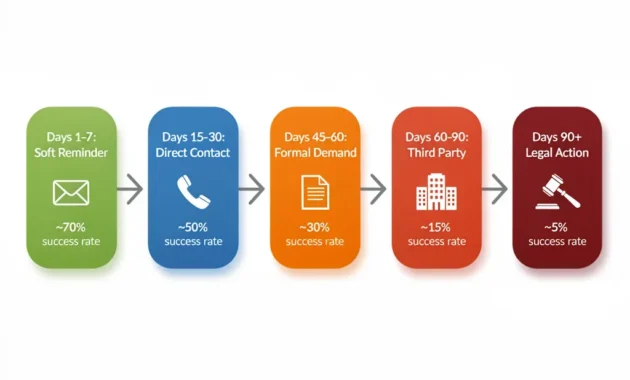
while preserving client relationships where possible.
Before You Chase: Verify Your Own Invoice First
Before you send a single follow-up, run through this checklist. Collection agencies and courts both require clean documentation, and more than a few “non-paying” clients are actually responding to a genuine error on the invoice itself.
The Pre-Chase Verification Checklist:
Was the invoice sent to the right person and the right email address? Many companies have a dedicated accounts payable contact that is different from your day-to-day project contact. Sending an invoice to the wrong person may mean it never reaches the payment queue.
Does the invoice match the agreed scope and amount? If your contract said $4,500 for a website redesign and your invoice says $5,200, expect a dispute. Verify the math and the scope before assuming non-payment is bad faith.
Is there a signed contract or at minimum a written agreement confirming the work and the price? Without this, collecting becomes significantly harder. An email chain confirming the project scope is not ideal, but it is better than nothing. (freelance writing contract template)
Did you specify a due date clearly on the invoice? “Due upon receipt” is vague. “Payment due by July 15, 2026” is enforceable.
Do you have proof that the client received the invoice? If you sent it by email, check your delivery receipts. Invoicing platforms like QuickBooks and FreshBooks show exactly when an invoice was viewed.
If all five boxes check out, you have a clean claim and you can escalate with confidence.
Step 1: Send a Professional Payment Reminder Email (Days 1 to 7)
Your first reminder should go out within 24 to 48 hours of the due date passing. Not two weeks later. Not after you have already stewed about it for a month.
At this stage, your tone is friendly and businesslike. You are not accusing anyone of anything. You are simply making it easy for them to pay.
What to include in your Day 1 to 7 reminder:
A clear subject line that references the invoice number and amount. Something like “Invoice #1042 for $2,500 Due Date Passed” works. It is direct without being aggressive.
A short, professional message that includes the invoice number, amount, original due date, and a direct link to pay. Do not attach a 12-paragraph email. Three to four sentences maximum.
A one-click payment link. This is the single biggest friction-reducer you can offer. Platforms like Stripe, FreshBooks, and QuickBooks all allow you to embed a direct payment link in your invoice emails. Research consistently shows invoices with online payment options get paid significantly faster than those without. (Best invoicing software for freelancers in 2026)
A polite acknowledgment that this may simply be an oversight. This keeps the tone collaborative and leaves the client a graceful exit from the situation.
Step 2: Make a Direct Phone Call and Get a Commitment (Days 15 to 30)
Email is easy to ignore. A phone call is not.
If your invoice is 15 days past due and you haven’t responded, pick up the phone. This step makes most freelancers and small business owners uncomfortable, but it is consistently the most effective tool in the early-to-mid stage of collection.
The goal of this call is not to vent your frustration. It is to obtain one specific thing: a firm, verbal commitment to pay by a specific date.
Here is how that conversation goes:
“Hi [Client Name], this is [Your Name]. I’m following up on invoice #1042 for $2,500 that was due on [date]. I just want to make sure everything is okay on your end and confirm when I can expect payment.”
Then stop talking. Let them respond.
If they give you a date, confirm it clearly: “So I can expect payment by [date]. I’ll send a quick email to confirm that so we are both on the same page.” Then do exactly that, immediately after hanging up.
If they give you a vague answer like “soon” or “we’re processing it,” push gently: “I want to make sure I’m noting the right timeline in my records. What specific date should I expect it by?”
If they do not answer, leave a concise voicemail and follow up with an email on the same day. The email creates a written record of your attempt to contact them.
Document every call. Note the date, the time, who you spoke to, what they said, and what commitment they made. This log becomes evidence if the situation escalates.
How to Follow Up Without Damaging the Client Relationship
This is one of the most asked questions in freelancer communities, and the answer is more nuanced than most guides let on.
The core principle: You can be firm without being hostile. Professionalism is not the same as being a pushover, and maintaining dignity in your communication actually strengthens your position, not weakens it.
The first thing to recognize is that the framing of “damaging the relationship” often works against you. If a client is not paying you, the relationship is already damaged. You are not at risk of ruining something that is currently working well. You are trying to salvage a business transaction.
That said, approach matters.
For long-term clients with a clean payment history, offer a payment plan before escalating to formal demand language. A client who has paid reliably for three years and is suddenly two months late is a different situation from a new client who ghosted you after the first invoice.
For newer clients or clients with prior payment issues, stick to the documented escalation timeline without making exceptions. Being consistent is not being cold. It is being professional.
The language that preserves relationships while maintaining firmness:
“I understand business cash flow can be unpredictable. I want to work with you on this. Here are two options: you can pay the full balance of $2,500 by [date], or we can set up a payment plan of $850 over three months. Let me know which works better for you and I will send over a payment agreement today.”
This approach gives the client agency, moves the conversation toward resolution, and keeps your tone collaborative without surrendering your position. (How to invoice a client who ignores you)
How to Handle a Client Who Ignores Payment Requests Entirely
Client silence is not neutral. Legally and strategically, it works in your favor if you document it correctly.
Every unanswered email, every ignored voicemail, every certified letter with a confirmed delivery that receives no reply becomes part of your documented collection timeline. This timeline is what you present to a collection agency, a judge, or the client’s own management if you need to escalate the pressure.
When a client goes completely silent, shift your communication from email only to multiple channels. Send a physical letter by certified mail with a return receipt requested. This creates a legally recognized record that the client received your notice, regardless of whether they respond.
Follow up that letter with a brief email referencing it: “I sent a certified letter on [date] regarding invoice #1042. Please confirm receipt and provide a payment date.”
If there is still no response after 30 days of documented contact attempts, you have built a paper trail that supports moving to a formal demand letter or third-party collection without any ambiguity about your good-faith efforts to resolve the matter directly.
Customer Promises to Pay but Never Does: Your Recourse
This is the situation that frustrates business owners most. The client is not ignoring you. They are actively stringing you along.
“Payment is coming this Friday.” Friday passes. “Sorry, our accounting system had an issue. Next week for sure.” Next week comes and goes.
Every broken promise should be documented with a timestamp. When a client commits to a payment date verbally or in writing and then misses it, that missed commitment strengthens your legal position significantly. It demonstrates a pattern of behavior, not an isolated oversight.
After two broken promises, stop accepting verbal commitments. Require a written payment agreement. A simple document stating the client acknowledges the debt, agrees to pay a specific amount by a specific date, and understands that failure to do so will result in formal collection action. Get it signed. (liquidated damages clause in a freelance contract)
If they refuse to sign even a basic acknowledgment of the debt, that refusal itself is a signal. At that point, you move to a formal demand letter and begin the legal escalation process described later in this guide.
How to Handle Partial Payments on an Overdue Invoice
A client who offers a partial payment when they owe you the full amount puts you in a genuine strategic dilemma.
On one hand, some money is better than none. On the other hand, if you accept a partial payment without carefully documenting the arrangement, you may inadvertently create legal ambiguity about the remaining balance.
The key risk: some clients send a partial payment with a note saying “payment in full” or “in satisfaction of all amounts owed.” In certain jurisdictions, accepting and depositing that check can be construed as agreeing to accept less than the full amount. This is called an “accord and satisfaction” defense, and it has been used successfully by debtors to avoid paying the remaining balance.
To protect yourself, take these steps when you receive a partial payment:
Accept the payment but respond immediately in writing: “Thank you for the payment of $1,000 received on [date]. Please note this is applied toward the outstanding balance of $3,500 on invoice #1042. The remaining balance of $2,500 is still due. I will follow up on the remaining balance on [date].”
Send this response by email with a read receipt and keep a copy. This written acknowledgment makes it clear that the debt is not settled and protects you from the accord and satisfaction argument.
Then set a new firm deadline for the remaining balance and treat the account accordingly.
How to Collect on Multiple Unpaid Invoices from One Client
When one client owes you money across several invoices, the psychology and the strategy both shift.
The first step is to consolidate everything into a single Statement of Account. This document lists every outstanding invoice by number, amount, and due date, along with any accrued late fees, and shows the total balance owed. It is cleaner, more professional, and harder to dispute than a pile of individual invoices.
Presenting one clear total also creates negotiating leverage. A client who owes you $7,800 across four invoices may be more motivated to resolve everything at once when they see the cumulative figure.
Your options at this point:
Offer a lump-sum settlement for immediate payment. If the client is genuinely struggling, settling for 85% of the total received immediately may be better than fighting for 100% over the next six months.
Negotiate a structured payment schedule with a written agreement. Divide the total into three or four monthly payments, and make it clear that missing a payment will trigger immediate legal action. (What happens when a client cancels a freelance project mid-way)
Proceed with full formal collection if the client refuses to engage. At this point, all four invoices are consolidated into one claim, which strengthens your case for small claims court or a collection agency.
My Invoice Is 6 Months Overdue: What Are My Options?
Let us be honest about the numbers first. A survey by the Commercial Collection Agency Association found that the probability of recovering a debt drops to around 57% after 6 months past due, compared to approximately 89% in the first 30 days. Time is not on your side.
That said, six months overdue does not mean uncollectable. It means you need to stop using soft tactics and act decisively.
At this stage, your three realistic options are:
Option 1: Negotiate a settlement. Reach out with a concrete offer: pay 70% of the total within 14 days and the matter is closed. Many clients will accept a discounted settlement to avoid the hassle of collections or court.
Option 2: Engage a collection agency immediately. The longer you wait, the lower the agency’s recovery rate and the higher their fee. Act now rather than waiting another 90 days.
Option 3: File in small claims court. If the amount is within your state’s limit and you have solid documentation, small claims court is relatively fast and inexpensive, and you do not need an attorney.
What you should not do at six months overdue is keep sending the same polite reminder emails you sent in month one. The approach that worked (or should have worked) in the first 30 days has zero traction at month six. Escalate decisively.
Client Owes Me Thousands: How Do I Collect Large Amounts?
For invoices above $5,000, the collection playbook looks different from what you would use for a $500 job.
Large balances justify different tools because the stakes justify the cost. An attorney who charges $300 to draft a pre-suit demand letter is a worthwhile investment when you are trying to recover $15,000. The same attorney for a $600 invoice makes no economic sense.
For amounts between $5,000 and $15,000:
Start with a formal demand letter drafted by an attorney. A letter on a law firm letterhead carries significantly more weight than one you write yourself. Many clients who ignored your emails for weeks pay within days of receiving a legal demand. The attorney’s fee for this service typically ranges from $150 to $500, which is a small cost relative to the recovery.
If the demand letter produces no result within 10 to 14 days, proceed to filing in civil court. In most states, amounts of $10,000 to $25,000 can be handled in a limited-jurisdiction civil court without complex litigation.
For amounts above $15,000:
Retain a commercial collections attorney and let them drive the process. The pre-suit demand, the filing strategy, and ultimately the judgment enforcement all require legal expertise at this level.
Do not negotiate from weakness. At these amounts, the client knows what is at stake. A credible threat of legal action backed by actual legal representation is your strongest lever.
My Small Business Has $10,000+ in Unpaid Invoices. Now What?
First, triage. Not all unpaid invoices deserve equal attention or urgency.
Sort your outstanding AR by three factors: balance size, days overdue, and client relationship value. A $4,000 invoice that is 45 days late from a client you have worked with for two years gets a different approach than a $4,000 invoice that is 45 days late from a brand-new client who has been difficult to reach since day one.
Your immediate priorities:
Invoices over $2,000 that are more than 30 days past due need direct phone contact this week, not next week.
Invoices from clients who have gone completely silent need a formal demand letter within the next 7 days.
Invoices approaching the 90-day mark need to be sent to a collection agency or your attorney for evaluation immediately.
While you are working through the collection process, address your cash flow gap separately. Invoice factoring allows you to sell your outstanding receivables to a factoring company at a discount (typically 2% to 5% of face value) and receive cash within 24 to 48 hours. It is not free money, but it keeps your business operating while the collection process runs its course.
How to Negotiate Payment on a Very Overdue Invoice
Negotiating a settlement on an old invoice feels like losing. It is not. It is a strategic business decision about the time value of money.
Here is the framework:
Calculate what the invoice is actually worth to you right now, accounting for the time you have already spent chasing it, the probability of full recovery, and the cost of further collection efforts.
A $3,000 invoice that is eight months overdue, with two rounds of collection calls, a demand letter, and a client who keeps stalling, might be worth $1,800 to you in immediate cash today versus another three to six months of chasing the full amount. (What is a kill fee in freelancing and when to use it)
When you make a settlement offer, present it as a time-limited option, not an ongoing negotiation:
“I am prepared to resolve this matter for a one-time payment of $2,100, which represents 70% of the outstanding balance. This offer is available through [specific date, 10 to 14 days out]. After that date, I will proceed with formal collection action for the full amount plus accrued fees.”
Get any settlement agreement in writing before you accept a single dollar. The agreement should state the original debt amount, the agreed settlement amount, the payment date, and clear language that the payment satisfies the full obligation.
3. Invoice Collection Email Templates: Copy, Use, and Send Today
Your invoice collection emails need to shift in tone at each stage. Start friendly and frictionless, move to firm and factual, and finish with a clear legal consequence. Use the templates below exactly, customizing only the details in brackets.
Most collection email templates you find online are so generic as to be useless. The ones below are calibrated to the psychology of each stage of non-payment. Every line has a purpose.
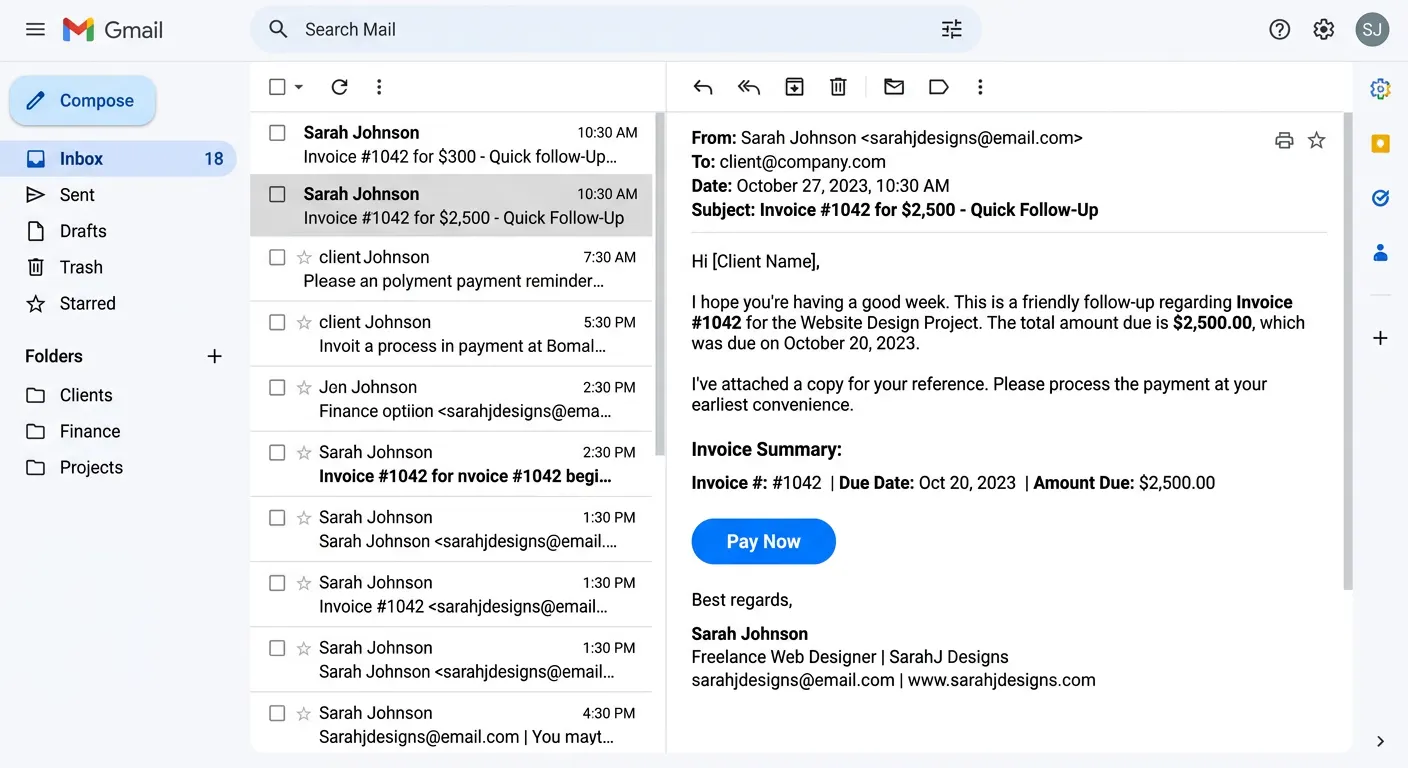
collection process.
First Reminder Email Template (Days 1 to 7 Past Due)
Subject Line: Invoice #[NUMBER] for $[AMOUNT] Quick Follow-Up
Hi [Client Name],
I hope you are doing well. I wanted to send a quick note because invoice #[NUMBER] for $[AMOUNT] had a due date of [DATE] and I do not yet see a payment recorded on my end.
This is likely just an oversight, so I wanted to make it easy. You can pay directly here: [PAYMENT LINK]
If you have any questions about the invoice or need anything from me to process it, just reply and I will take care of it right away.
Thanks very much, and I look forward to hearing from you.
[Your Name]
Why this works: The tone assumes good faith. It removes friction by giving a one-click payment option. It offers to help with any processing issues, which disarms defensive clients. And it is short enough that the client actually reads it.
Second Reminder Email Template (Days 15 to 30 Past Due)
Subject Line: Invoice #[NUMBER] $[AMOUNT] Now [X] Days Past Due
Hi [Client Name],
I am following up again on invoice #[NUMBER] for $[AMOUNT], which was due on [DATE] and is now [X] days past due.
I have attached the invoice for your reference. Per our agreement, a late fee of [AMOUNT or PERCENTAGE] has been applied, bringing the current balance to $[UPDATED AMOUNT].
Please arrange payment by [SPECIFIC DATE, 7 DAYS FROM NOW]. If there is an issue with the invoice or any delay I should be aware of, please reach out directly so we can resolve it quickly.
Payment can be made here: [PAYMENT LINK]
[Your Name]
Why this works: The tone is now firm and factual. It references the late fee, which signals you are tracking this seriously. It provides a specific deadline rather than a vague request. And it still leaves the door open for communication without being soft about the expectation.
Final Demand Email Template (Days 45 to 60: Before Legal Action)
Subject Line: Final Notice: Invoice #[NUMBER] for $[AMOUNT] Action Required by [DATE]
Dear [Client Name / Company Name],
This is my final notice regarding invoice #[NUMBER] for the original amount of $[AMOUNT], issued on [DATE] for [brief description of services].
Despite [X] prior communications on [list dates], I have not received payment or a satisfactory response. The current balance, including accrued late fees, is $[TOTAL AMOUNT].
Payment in full is required by [DATE, 10 DAYS FROM NOW].
If I do not receive payment by this date, I will proceed without further notice with formal debt collection action, which may include referral to a commercial collections agency, a formal demand letter from legal counsel, and/or filing in [your state] civil court. Any resulting collection costs and legal fees may be added to the balance owed.
To avoid further action, please pay immediately here: [PAYMENT LINK]
If you wish to discuss a payment arrangement, contact me directly at [PHONE/EMAIL] before the above deadline.
[Your Name]
[Business Name]
[Contact Information]
Why this works: This email is a legal notice, not just a reminder. It documents your prior contact attempts by date, which matters if this becomes a court case. It states clear consequences without emotional language. And it still offers a path to resolution through a payment plan, which gives a genuine debtor a way out and signals your good faith.
4. How to Write a Demand Letter for Unpaid Invoices
What a Demand Letter Actually Does Legally
A formal demand letter is not just a strongly worded email. It is a legal document that creates a timestamped, documented record of your claim and gives the debtor formal notice that you intend to pursue legal remedies if they do not pay.
In many states, sending a demand letter before filing in civil court is either required or strongly recommended. Some state courts will ask you directly whether you made a formal demand before filing. Answering “no” weakens your standing and can delay your case.
Sending your demand by certified mail with a return receipt requested creates a legally recognized delivery record. The client’s signature on the return receipt proves they received the notice. If they refuse to sign, the post office documents that refusal, which is equally useful.
Trackable email (via services like DocuSign or certified email platforms) is acceptable in many jurisdictions as a supplement to physical mail, but should not replace it for high-value claims.
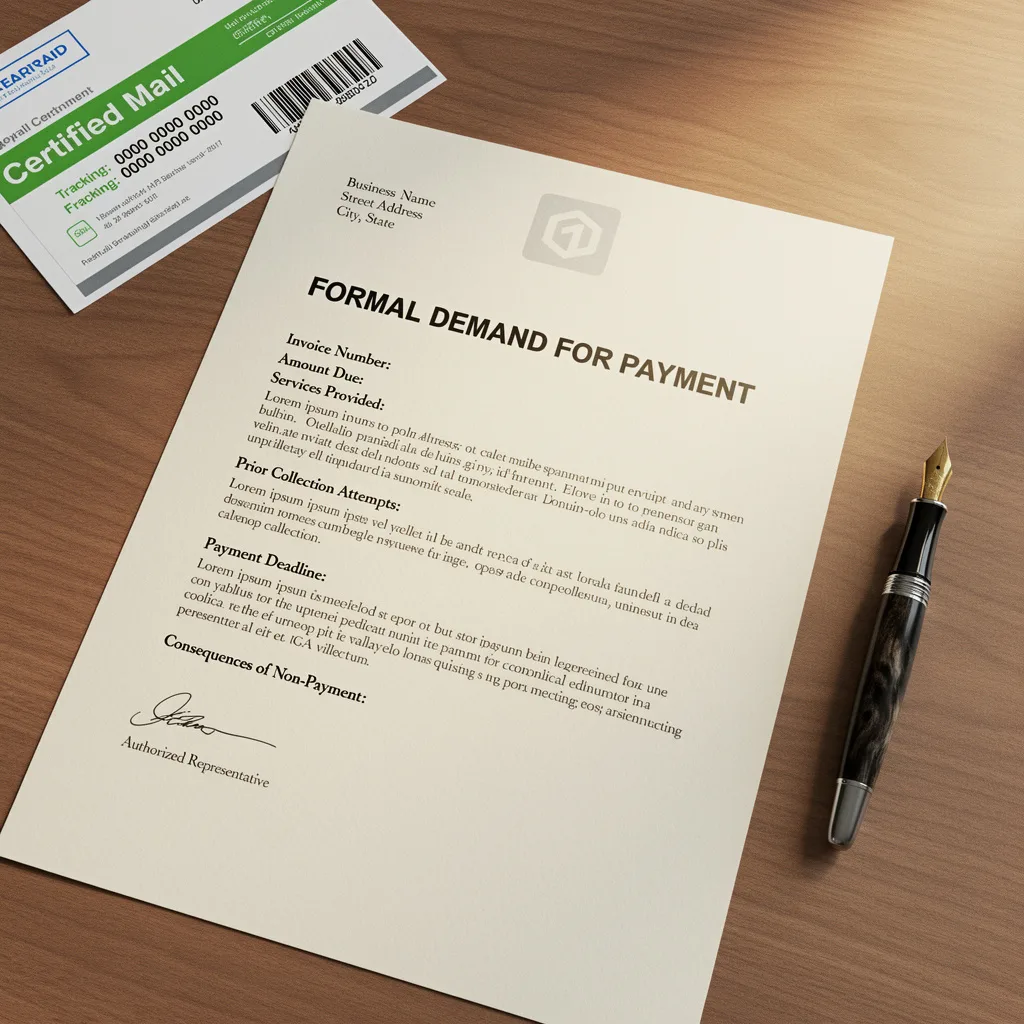
you’re serious about collecting what you’re owed.
What to Include in a Payment Demand Letter
Your demand letter needs these elements to be legally effective:
Your full legal name and business name, along with your complete address and contact information.
The client’s full legal name and business name, along with their address. If they are a corporation or LLC, use the registered business name, not just the contact person’s name.
The invoice number or numbers, the original amount, the date issued, and the current balance including any accrued late fees or interest.
A brief, factual description of the services provided and when they were delivered. One or two sentences. You are not writing a project summary. You are establishing that the debt is legitimate and specific.
A complete timeline of your prior collection attempts, including dates of emails sent, phone calls made, and any responses received. This demonstrates good faith and establishes that the debt is not disputed due to lack of notice.
A clear, firm payment deadline. Ten to fourteen days from the date of the letter is standard. “Please pay immediately” is not a deadline. “Payment is required by August 15, 2026” is.
A clear statement of consequences. If payment is not received by the deadline, you will take specific action. Name the action: referral to a collection agency, filing in small claims court, or both. Do not make threats you are not prepared to follow through on, and do not threaten anything that is not legally permissible.
What to leave out: Emotional language, personal accusations, vague threats like “we will take this further,” and anything that sounds like harassment. Keep it clinical, factual, and professional.
Free Demand Letter Template: Ready to Send
[YOUR FULL NAME OR BUSINESS NAME]
[ADDRESS]
[CITY, STATE, ZIP]
[EMAIL]
[PHONE]
[DATE]
[CLIENT FULL LEGAL NAME OR BUSINESS NAME]
[ADDRESS]
[CITY, STATE, ZIP]
RE: Formal Demand for Payment: Invoice #[NUMBER] Total Amount Due: $[AMOUNT]
Dear [Client Name],
This letter constitutes a formal demand for payment of the outstanding balance owed to [Your Business Name] for professional services rendered.
Services Provided:
[Brief description e.g., “Web design services as agreed upon in the contract dated [DATE]”]
Invoice Details:
Invoice Number: [NUMBER]
Invoice Date: [DATE]
Original Amount: $[AMOUNT]
Accrued Late Fees: $[AMOUNT]
Total Currently Due: $[TOTAL]
Prior Collection Attempts:
I have made the following documented attempts to collect this balance:
Email sent on [DATE]
Email sent on [DATE]
Phone call on [DATE] [note outcome or no response]
Certified letter sent on [DATE]
Payment Deadline:
You are hereby required to pay the full balance of $[TOTAL] no later than [DATE, 10 to 14 days from letter date].
Consequences of Non-Payment:
If I do not receive full payment by the above deadline, I will proceed without further notice to pursue all available legal remedies, including but not limited to referral to a commercial debt collection agency, filing a civil claim in [STATE] court, and seeking recovery of court costs and any applicable attorneys’ fees as permitted by law.
To arrange payment or discuss a payment arrangement before this deadline, contact me directly at [PHONE/EMAIL].
Sincerely,
[YOUR SIGNATURE]
[YOUR PRINTED NAME]
[YOUR TITLE / BUSINESS NAME]
State-Specific Note: If your client is in California, Texas, New York, or Florida, certain specific statutory references may strengthen your letter. Consider having a local attorney review the language for high-value claims.
5. Legal Options to Collect Unpaid Invoices
Your legal options to collect an unpaid invoice include sending a formal demand letter, filing in small claims court, hiring a collection attorney, or using a debt collection agency. The right choice depends on the amount of the debt, how old the debt is, and whether the client disputes it.
How Does the Collections Process Actually Work: Start to Finish?
Here is the complete lifecycle of an unpaid invoice, from the moment it goes past due to the moment it is either collected or written off:
Stage 1: Internal AR Management (Days 1 to 60):
You handle everything yourself. Reminder emails, phone calls, follow-up letters. This stage has the highest recovery rate and zero cost, but requires your time.
Stage 2: Formal Demand (Days 45 to 90):
You send a formal demand letter, either written yourself or by an attorney. Success rate drops compared to Stage 1, but a well-written demand letter resolves a significant percentage of accounts before legal action is needed.
Stage 3: Third-Party Collection (Days 60 to 90+):
You refer the account to a collection agency. They pursue the debt on your behalf, typically keeping 25% to 40% of whatever they recover. You invest no additional time, but you accept a reduced recovery.
Stage 4: Legal Action (Days 90+):
You file in small claims court (for smaller amounts) or hire an attorney to pursue a civil judgment (for larger amounts). If you win, you receive a court judgment. Note that a judgment does not automatically mean you get paid. You may need to enforce it through wage garnishment, bank account levies, or property liens.
Stage 5: Judgment Enforcement:
The often-overlooked final step. A judgment is a legal right to collect, not an automatic payment. You may need to take additional legal steps to recover money from the debtor, including court filings and legal fees.
Stage 6: Write-Off:
If collection costs exceed the recovery value, or the debtor genuinely has no assets, you write the debt off as a business loss. This has tax implications that can partially offset your losses.
When Should You Send an Invoice to Collections?
The general industry standard is 60 to 90 days past due before referring an account to a collection agency. But the right timing depends on more than just the calendar.
Move earlier than 60 days if:
The client has gone completely unresponsive despite multiple documented contact attempts.
The client has made and broken two or more payment commitments.
You have credible evidence that the client is in financial distress (laying off staff, closing locations, or the business is visibly struggling).
The client has explicitly disputed the invoice in bad faith (inventing problems with the work after the fact).
Keep trying internally past 90 days if:
The client has a long, reliable payment history and is communicating actively about a temporary cash issue.
A signed payment plan is in place and the client is making partial payments, even if behind schedule.
How Long Can You Wait Before Sending an Invoice to Collections?
Legally, the statute of limitations on written contracts ranges from 3 to 10 years depending on your state. For oral agreements, it is typically 2 to 5 years.
This limit applies to your right to file a lawsuit. Collection agencies can still attempt to collect a debt after the statute of limitations has expired, but they cannot threaten legal action on a time-barred debt, as doing so would violate the Fair Debt Collection Practices Act (FDCPA).
Practically speaking, waiting longer than 12 months dramatically reduces your recovery probability regardless of the legal time limit. The client may become harder to locate, the business may close, or the debt may become commercially unviable to pursue.
The statute of limitations clock typically starts on the date the invoice was due, not the date it was issued. Some states restart the clock if the debtor makes a partial payment or provides a written acknowledgment of the debt, which is another reason to document partial payments carefully.
How Many Months Before an Invoice Becomes Uncollectible?
Legally, invoices are rarely “uncollectable” within the first several years due to statute-of-limitations protections. Practically, the picture is different.
Here are the realistic recovery probability estimates by age:
0 to 30 days past due: 90 to 95% recovery rate with diligent internal follow-up.
31 to 60 days past due: 80 to 90% recovery rate.
61 to 90 days past due: 70 to 80% recovery rate, declining sharply if no response has been received.
90 to 180 days past due: 55 to 70% recovery rate, typically requiring third-party assistance.
6 months to 1 year past due: 40 to 55% recovery rate.
Over 1 year past due: Below 25% recovery rate in most cases.
These numbers are not reasons to give up. There are reasons to act faster.
Should I Hire a Debt Collector or a Lawyer for Unpaid Invoices?
Use this decision framework:
Choose a collection agency when:
The invoice is under $5,000.
The client is unresponsive but the debt is not actively disputed.
You want to invest no additional time in the process.
The account is 60 to 90 days past due.
Choose a collection attorney when:
The invoice is over $5,000.
The client disputes the debt or has threatened counterclaims.
You want the option of filing a lawsuit if the initial demand fails.
The client is a business with known assets that can be pursued through a judgment.
Consider both when:
The debt is between $2,000 and $5,000 and the client has been completely unresponsive for 60+ days. Some attorneys handle smaller commercial claims on a flat-fee basis, and the cost may be justified by the leverage a legal letter provides.
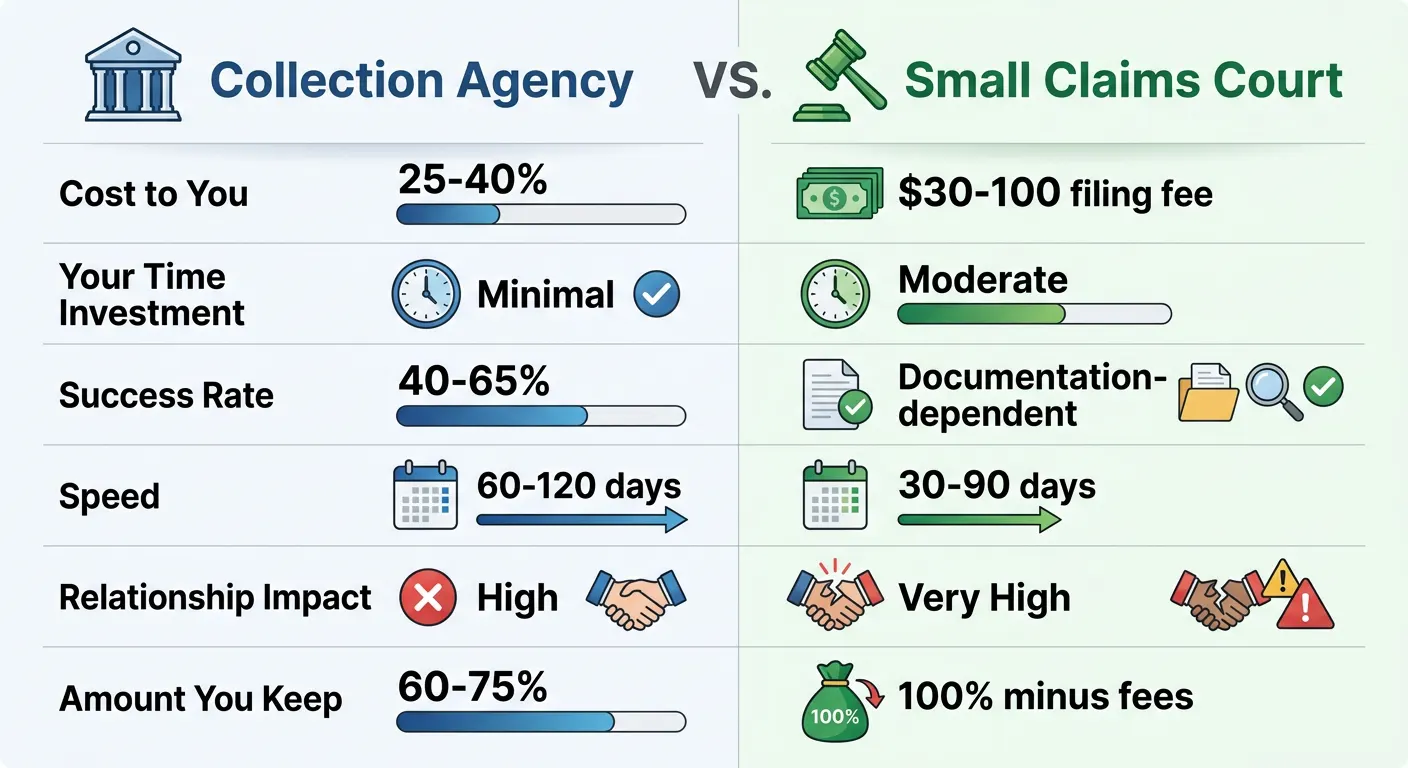
and your available time.
Collection Agency vs. Small Claims Court: Which Is Better?
These two options are often treated as interchangeable. They are not.
| Factor | Collection Agency | Small Claims Court |
|---|---|---|
| Cost to You | 25% to 40% of recovery | Filing fee only ($30 to $100) |
| Your Time Investment | Minimal | Moderate (prepare and appear) |
| Success Rate | 40 to 65% | Dependent on documentation |
| Speed | 60 to 120 days | 30 to 90 days |
| Relationship Impact | High | Very high |
| Amount You Keep | 60 to 75% of recovery | 100% (minus filing fee) |
| Legal Complexity | None | Low to moderate |
State Small Claims Limits (2026):
California: $12,500 for individuals / $6,250 for businesses
Texas: $20,000
New York: $10,000
Florida: $8,000
Illinois: $10,000
The straightforward answer: if the amount is within your state’s small claims limit and you have solid documentation, small claims court is almost always the better financial option. You keep everything you win and the process is designed for non-lawyers.
Use a collection agency when the debt is complex, you want to invest zero time, or you have already missed the small claims filing window due to statute-of-limitations concerns.
Can You Sue Someone for Not Paying an Invoice?
Yes. An unpaid invoice constitutes a breach of contract in virtually every U.S. jurisdiction, provided you have a valid agreement (written or demonstrated) and you fulfilled your obligations under it.
To file a lawsuit for an unpaid invoice, you need:
Evidence of the agreement: a signed contract, a written estimate accepted in writing, or at a minimum an email thread confirming the scope and price.
Evidence of delivery: proof that you completed and delivered the work as agreed.
Evidence of non-payment: the invoice itself, your bank records showing no payment received, and your communication history.
The process for small claims court typically involves downloading and completing a plaintiff’s claim form from your county court’s website, paying a filing fee, and attending a hearing where both parties present their case. Judgments in small claims court are typically issued the same day.
If you win a judgment and the client still does not pay, you can enforce the judgment through wage garnishment, a bank account levy, or a lien on property. These enforcement tools require additional legal steps but are available to you in every state.
Is It Worth Hiring a Collections Agency for Small Amounts?
This comes down to a simple break-even calculation.
A collection agency typically takes 25% to 40% of what it recovers. On a $500 invoice, that means you receive $300 to $375 if they collect 100% of the balance.
The question is whether $300 to $375 is worth more to you than the time you would spend handling it yourself through small claims court. For most business owners, the answer for amounts under $500 is no. The filing fee, the preparation time, and the court appearance represent a higher practical cost than simply writing off the debt and factoring it into your bad debt reserve.
For amounts between $500 and $2,000, a collection agency that charges a flat fee rather than a percentage can make good economic sense. Agencies like Rocket Receivables and IC System offer flat-fee collection options that change the math considerably.
For amounts under $300, realistically evaluate whether collection is worth pursuing at all, or whether writing the debt off and severing the client relationship is preferable.
What Documents Do You Need to Send to Collections?
Before you hand an account to a collection agency or file in court, gather this documentation:
Required documentation:
The original signed contract or written agreement confirming scope and price.
All invoices related to the debt, with invoice numbers, amounts, and due dates.
Proof of delivery or completion of the work (emails, signed delivery confirmations, project acceptance notes, or client-approved deliverables).
A complete record of all payment communications: emails sent and received, voicemail logs, notes from phone calls with dates and times, and any certified mail receipts.
Any written acknowledgment from the client that the debt exists (even an email saying “I know I owe you, I will pay next week” is valuable).
Any partial payments received, with dates and amounts.
Highly useful but not always available:
A signed payment agreement or payment plan document.
Correspondence from the client disputing the invoice (to show any dispute was resolved or was not raised in good faith).
Using a Debt Collection Agency: What to Expect
When you refer an account to a collection agency, here is what actually happens:
The agency verifies your claim and reviews your documentation. This is why having the complete documentation described above is so important. Agencies reject poorly documented claims.
The agency contacts the debtor directly, typically by phone and letter. They are required to follow the Fair Debt Collection Practices Act (FDCPA), which governs when they can call, what they can say, and what they are prohibited from doing. Note that the FDCPA technically covers consumer debts. For B2B debts, fewer restrictions apply, giving agencies greater flexibility.
If the agency collects, it deducts its fee and remits the balance to you. If they do not collect, you owe nothing on a contingency-basis agreement.
Collection agencies do report commercial debts to business credit bureaus in many cases, which can affect your client’s ability to obtain credit in the future.
Hiring a Collections Attorney: When and How
A collections attorney is your strongest legal lever for high-value invoices.
The most effective use of a collections attorney before you actually file a lawsuit is the pre-suit demand letter. A letter on legal letterhead that clearly states the amount owed and threatens imminent legal action resolves a remarkable percentage of commercial disputes. Clients who ignored your emails for months frequently pay within days of receiving attorney correspondence.
The cost of a pre-suit demand letter typically ranges from $150 to $500 depending on the attorney and the complexity of the claim. For invoices over $3,000, this is almost always a worthwhile investment.
If the demand letter does not result in payment, the attorney can proceed with filing a civil complaint. Many commercial collections attorneys work on a contingency basis for larger claims (typically 25% to 33% of recovery) or on a flat-fee basis for specific court filings.
6. Freelancer and Small Business Invoice Collection: Your Specific Situation
How Freelancers Can Collect Unpaid Invoices Without a Lawyer
Freelancers face a specific challenge that larger businesses do not: you are usually working without a dedicated accounts receivable department, a legal team, or the bandwidth to chase multiple late invoices simultaneously.
The good news is that the U.S. legal system actually provides strong tools for individual claimants. Small claims court, in particular, is designed for exactly this situation. You do not need an attorney. You need organized documentation and a willingness to show up.
The practical self-help collection playbook for freelancers:
Start with the tiered email escalation sequence described in this guide and use the templates provided above.
At 30 days, make a direct phone call and document the outcome.
At 45 to 60 days, send a formal demand letter by certified mail.
At 60 to 90 days, file in small claims court. Download the plaintiff’s claim form from your county court website, complete it, pay the filing fee (typically $30 to $100), and serve it on the client.
At the hearing, bring your signed contract, all invoices, your complete email record, and any evidence of delivery. Present your case calmly and factually. Small claims judges are experienced with exactly this type of dispute.
Freelancers who go through this process even once typically find it far less intimidating than expected, and the judgment in your favor is a powerful incentive for clients to pay before a hearing ever happens.
Small Business Invoice Collection: Strategies at Scale
When you run a small business with multiple clients and multiple invoices in your AR aging report at any given time, a system matters more than individual tactics.
Build a weekly AR review into your schedule. Every Monday (or whatever day works for your operations), pull your AR aging report and look at every invoice sorted into three buckets:
1 to 30 days past due: One email reminder sent this week.
31 to 60 days past due: Phone call made this week, outcome documented.
60+ days past due: Demand letter sent or collection agency engaged this week.
Do not let invoices age quietly past these thresholds while you are busy with current client work. The probability of recovery drops with every week you delay.
Platforms like QuickBooks, Xero, and FreshBooks all have built-in AR aging reports that automatically sort outstanding invoices by age. Use this tool every single week.
Collecting Invoices from Out-of-State or Remote Clients
This is one of the most common and under-addressed pain points in freelancer and small business forums. The Practical Machinist community thread about a $7,500 invoice from an out-of-state client with no response is representative of thousands of similar situations.
The first legal question to resolve: which state’s law applies?
Generally, courts look at where the contract was signed, where the services were delivered or performed, and what the contract itself says about governing jurisdiction. If your contract includes a “governing law” clause naming your home state, that clause is typically enforceable and simplifies your options considerably.
If your contract specifies your state: File in your local small claims court. You can typically serve the out-of-state defendant by certified mail under your state’s rules for service on non-residents.
If there is no governing law clause: You may have to file in the client’s state, which adds complexity and cost. For amounts under $5,000, engaging a nationally operating collection agency is often more practical than navigating interstate court filings.
If the amount justifies it: A collections attorney in your state can advise on the most effective jurisdiction strategy and handle service of process on out-of-state defendants.
B2B Invoice Recovery: When Your Client Is Another Business
Business-to-business invoice collection operates under different rules than consumer debt collection.
The most important distinction: the FDCPA does not apply to commercial debts. The Fair Debt Collection Practices Act only covers debts incurred for personal, family, or household purposes. When you are collecting a business invoice from another business, collection agencies and attorneys have significantly more flexibility in their contact methods and frequency.
This matters because B2B collection agencies are not restricted to calling only between 8 am and 9 pm, and they face fewer limitations on contact frequency. This makes B2B collection agencies more aggressive and often more effective for commercial debts.
The unique leverage points in B2B recovery:
Business credit reporting: Reporting the unpaid debt to Dun & Bradstreet or Experian Business can affect your client’s ability to obtain credit from suppliers and lenders. Many businesses pay the moment they realize their commercial credit is at risk.
Industry reputation: In tight-knit industries, a client’s reputation for non-payment can spread through professional networks. A discreet word in the right community is sometimes more motivating than a formal demand letter.
Supply chain pressure: If your client is also a customer of businesses with whom you have relationships, those shared connections can create informal pressure to resolve the matter.
7. Best Tools and Software for Invoice Collection in 2026
Automated AR Management Tools: The 2026 Stack
The right invoicing software does not just generate invoices. It follows up on them, tracks when they are viewed, automatically applies late fees, and gives you a clear picture of your AR aging at any time. Here is how the major platforms compare for invoice collection specifically:
QuickBooks Online: The gold standard for small businesses. Its AR aging report is excellent, and the automated payment reminder feature lets you configure up to 5 reminder emails at custom intervals. The integrated payment portal (QuickBooks Payments) accepts credit cards and ACH and notifies you the moment an invoice is paid. Best for: established small businesses with multiple clients and moderate to high monthly invoice volume.
FreshBooks: Built with freelancers in mind. Its late payment fee automation is particularly strong. You can configure FreshBooks to automatically add a percentage fee to any invoice that passes the due date, and the client sees the updated amount the next time they view the invoice. Best for: solo freelancers and small creative agencies.
Xero: Excellent for teams and businesses operating in multiple currencies. The batch invoice follow-up feature allows you to send reminders to multiple clients simultaneously. Best for: small to mid-sized businesses with international clients.
HoneyBook: Designed for creative freelancers and service-based businesses. HoneyBook wraps the entire client workflow from proposal through contract through invoice into one platform, which means payment issues are easier to trace back to the original agreement terms. Best for: photographers, designers, event planners, and similar creative professionals.
Zoho Invoice: The strongest free-tier option available. Zoho Invoice offers automated reminders, client portals, and late fee automation at no cost, making it a strong choice for freelancers who are not yet generating enough revenue to justify paid software. Best for: new freelancers and very small businesses.
Bill.com: Built specifically for B2B payment workflows. Supports ACH, check, and virtual card payments. Integrates deeply with QuickBooks and Xero. Best for: small businesses with high invoice volumes and multiple vendors or contractors.
Invoice Factoring as an Alternative to Collections
Invoice factoring is fundamentally different from collections. You are not pursuing the debtor for payment. You are selling the receivable to a third party (the factor) and receiving immediate cash in exchange for a small fee.
Here is how it works in practice:
You issue an invoice for $10,000 with Net 30 terms. Instead of waiting 30 to 90 days for payment, you sell that invoice to a factoring company. The factoring company advances you 80% to 90% of the invoice value immediately ($8,000 to $9,000). They then collect directly from your client. When your client pays, the factor remits the remaining balance to you minus their fee (typically 1% to 5% of the invoice face value).
Recourse vs. non-recourse factoring: This is the critical distinction that most articles fail to explain clearly. In a recourse factoring arrangement, if your client does not pay the factoring company, you are required to buy back the invoice. You bear the credit risk. In a non-recourse arrangement, the factor absorbs the loss if your client defaults. Non-recourse factoring costs more but provides genuine protection against bad debt.
Invoice factoring is not a collection tool. It is a cash flow tool. Use it to maintain operations while your AR ages, not as an alternative to pursuing non-paying clients through the collection process.
Digital Payment Solutions That Prevent Collection Problems
The single most underutilized prevention tool in invoice collection is removing friction from the payment process itself.
An invoice that requires a client to manually write a check, address an envelope, locate a stamp, and mail it to your address creates multiple points of failure. Any one of those steps can cause a delay. The check never gets written. The envelope sits on a desk. The payment slips through the cracks.
An invoice with an embedded “Pay Now” button that opens a secure payment page accepting credit cards and ACH transfers eliminates all of those friction points. The client clicks, enters their card number, and you receive a payment notification within minutes.
Research from FreshBooks and QuickBooks both indicates that invoices with online payment options are paid significantly faster than those requiring manual payment methods. The difference is not trivial. For a freelancer sending 20 invoices per month, this can represent thousands of dollars in faster cash collection.
Platforms that integrate easily:
Stripe: Embeds directly into most invoicing software and websites. Low transaction fees. Strong for freelancers.
PayPal Business: Widely trusted by clients. Slightly higher fees but zero friction for clients who already have a PayPal account.
Square: Good for service businesses. Strong for in-person and remote payment collection.
8. How to Prevent Unpaid Invoices: Stop the Problem Before It Starts
The most effective way to prevent unpaid invoices is to establish clear payment terms in every contract, collect a deposit before beginning work, automate your invoice reminders, and screen new clients before extending credit terms.
How to Set Payment Terms That Dramatically Reduce Non-Payment Risk
Your payment terms are not just a formality on the invoice. They are the primary legal and behavioral structures governing when you get paid.
Net 30 vs. Net 15 vs. Due on Receipt:
Net 30 is the most common payment term in the U.S., but it may not be the right choice for freelancers and small businesses. Net 30 means 30 days from the invoice date, but in practice it can easily drift to 45 or 60 days when clients do not prioritize timely payment.
Switching to Net 15 roughly halves your average collection time compared to Net 30, and most clients accept Net 15 terms without friction when communicated clearly upfront.
Due on Receipt is appropriate for smaller project invoices, new clients, and any situation where you want immediate payment. It is standard in many creative and professional service contexts.
Late payment penalty clause: Your contract should specify a monthly interest rate applied to any overdue balance. The standard range is 1% to 2% per month (12% to 24% annually). State laws govern the maximum allowable rate, so verify your state’s limit. Even if you never enforce the late fee, its presence in your contract signals that you take payment terms seriously.
Requiring Deposits and Signed Contracts: The Non-Negotiable Setup
A deposit does two things simultaneously. It provides partial cash before you invest your time, and it filters out clients who are not serious about paying for your work.
Clients who pay a 30% to 50% deposit upfront have demonstrated a willingness to transfer money to you. That is a meaningfully different behavioral commitment than a client who agrees to pay upon completion. In the freelance and small-business context, requiring deposits is one of the highest-leverage single actions you can take to reduce payment problems.
Your contract needs to accomplish three things to make your invoices legally enforceable:
Define the scope: Exactly what work are you providing? What does “complete” mean? A vague scope is the most common source of invoice disputes.
Define the price and payment schedule: Specific amounts, specific due dates, and specific consequences for non-payment.
Establish your right to pause or terminate services for non-payment: If a client owes you money on invoice two, you should not be obligated to continue delivering work on invoice three. A termination clause for non-payment protects you from the escalating debt trap where you keep working while the client keeps not paying.

deposits, and payment terms protect you before work begins.
How to Create an Unpaid Invoice Policy for Your Business
A formal invoice policy is something most freelancers and small businesses skip because it feels bureaucratic. It is not. It is the single document that communicates your professionalism and sets clear expectations before any dispute arises.
Your invoice policy should contain four components:
Payment terms: Your standard due date (Net 15, Net 30, etc.) and any project-specific variations.
Late fee schedule: The percentage charged per month on overdue balances, effective immediately after the due date passes.
Escalation timeline: What happens at 30 days, 60 days, and 90 days past due. “At 60 days past due, accounts are referred to our collections process” is a complete and professional statement.
Write-off threshold: The minimum balance at which you will pursue collection versus writing the debt off. This is an internal guideline, not something you necessarily share with clients, but having it defined prevents you from making emotional decisions about small balances.
Present this policy to new clients as part of your onboarding. Include it in your contract as a reference document or appendix. When a client signs your contract, they have acknowledged your policy. That acknowledgment is useful if a dispute ever arises about whether they understood your terms.
Using Automated Invoice Reminders: Set It and Forget It
Every hour you spend manually following up on late invoices is an hour of billable time lost. Automated reminder sequences eliminate that cost entirely.
The optimal reminder schedule, based on AR best practices:
3 days before due date: A friendly “heads-up” reminder that the invoice is due soon. This catches clients who need a few days to process payment internally.
Day 1 past due: The first reminder. Polite, with a payment link.
Day 7 past due: The second reminder. Slightly firmer in tone, referencing the accrued late fee.
Day 14 past due: Third reminder. Firm and factual. Mentions that continued non-payment will trigger escalation.
Day 30 past due: This is where automated reminders end and manual escalation begins. Pick up the phone.
QuickBooks, FreshBooks, and Xero all support automated reminder sequences that you configure once and apply to all invoices automatically. You can customize the language, the timing, and the escalation tone within the platform.
When to Stop Trying to Collect and Write Off Bad Debt
Not every unpaid invoice is worth pursuing indefinitely. At some point, the cost of collection (in time, legal fees, and mental energy) exceeds the value of the debt, and writing it off becomes the financially rational decision.
The IRS allows small businesses to deduct bad debts as business losses under specific rules. For accrual-basis taxpayers, a bad debt deduction is available when a receivable becomes partially or wholly uncollectable and you have made a genuine effort to collect. For cash-basis taxpayers, bad debt deductions generally do not apply because you only recognize income when it is received.
The practical write-off decision framework:
If the cost of additional collection effort (attorney fees, agency fees, your time at your hourly rate) exceeds 30% of the outstanding balance, consider writing it off seriously.
If the client’s business has closed, they have filed for bankruptcy, or they are clearly judgment-proof (no assets you could collect against even with a court order), write the debt off and document why.
When you write off a bad debt, record it properly in your accounting software. In QuickBooks, this involves creating a bad-debt expense account and applying it to the outstanding invoice. In Xero, the process is similar. Your accountant can verify the correct method for your specific tax situation.
Credit Checks and Retainer Agreements: Advanced Prevention
Before extending Net 30 or Net 60 terms to a new client, especially one with a large contract value, run a basic business credit check. Services like Dun & Bradstreet, Experian Business, and Creditsafe provide business credit reports that show payment history with other vendors, any public filings (lawsuits, liens, bankruptcies), and an overall risk score.
A client with a history of slow payments or outstanding judgments from other vendors is statistically likely to create payment problems for you too. Adjusting your terms upfront (requiring a larger deposit, shortening payment terms, or requiring prepayment) is far easier than chasing a bad debt after the work is delivered.
Retainer agreements provide the strongest cash flow protection available to freelancers and service businesses. Under a retainer structure, the client pays a fixed monthly amount in advance, and you draw down the retainer based on your actual hours or deliverables. You are never in the position of having delivered significant work before receiving any payment.
Not every client relationship is structured for a retainer, but for ongoing services (monthly content creation, bookkeeping, social media management, legal retainers), it is almost always the superior payment arrangement.
9. Trending FAQs About Collecting Unpaid Invoices
How Much Does It Cost to Send Someone to Collections?
Sending an invoice to a collection agency costs you nothing upfront. Agencies operate on a contingency basis, taking 25% to 40% of whatever they successfully recover. If they collect nothing, you pay nothing. For flat-fee agency models, expect to pay $15 to $35 per account, regardless of outcome.
What’s the Polite Way to Ask for Overdue Payment?
The most effective polite approach is brief, non-accusatory, and action-oriented. Reference the invoice number, the amount, and the due date in one or two sentences, then provide a direct payment link. Assume it is an oversight, not intentional. The email template in the Day 1 to 7 section of this guide is exactly this approach.
Do Collection Agencies Actually Get Results?
Yes, but with realistic expectations. According to the Commercial Collection Agency Association, contingency agencies recover payment on approximately 20% to 40% of the accounts they are referred. The recovery rate drops significantly for older debts and increases for accounts referred within 60 to 90 days of the due date. Agencies are most effective when you provide complete documentation and refer accounts before they age past six months.
What Happens When You Don’t Pay an Invoice?
For the debtor, the consequences escalate from a damaged business relationship to a formal collections process, potential credit bureau reporting, and ultimately a civil court judgment that can be enforced through wage garnishment or asset liens. In most commercial disputes, the debtor also becomes responsible for collection costs and, in some jurisdictions, attorneys’ fees if the contract includes a fee-shifting clause.
Can I Add Interest to an Overdue Invoice?
Yes, provided your contract or invoice specifies the interest rate upfront. You cannot retroactively add interest to an invoice that had no interest clause. Most states allow 1% to 2% per month on commercial debts. Check your state’s maximum allowable rate and include the specific rate in every contract you sign going forward.
How to Tell a Client Their Invoice Is Past Due
Be direct and professional. Call or email with the invoice number, the amount, and the number of days past due. Do not hint or soften the message to the point of ambiguity. “Invoice #1042 for $2,500 is now 14 days past due. Please let me know when I can expect payment or if there is an issue I can help resolve.”
What’s a Reasonable Timeline for Invoice Payment?
Net 30 is the U.S. standard for most B2B services. Net 15 is increasingly common for freelancers and smaller service businesses. Net 60 and Net 90 are typical in larger enterprises and government contracts. For short-term or low-value projects, due on receipt or prepayment is entirely reasonable and should be your default for new clients.
How Much Commission Do Collection Agencies Take?
Standard contingency rates range from 25% to 40% of the recovered amount. Older debts, smaller balances, and accounts with incomplete documentation command higher rates. Flat-fee models are available from some agencies for lower-value accounts and typically cost $15 to $50 per account.
How to Prevent Unpaid Invoices Before They Happen
Require a deposit (30% to 50%) before starting work. Use clear, written contracts with specific due dates and late fee clauses. Send invoices the same day work is delivered. Automate your payment reminders. Accept online payments to reduce friction. Screen new clients with a basic business credit check before extending Net 30 or longer terms.
Customer Says They’ll Pay Later When Should I Follow Up?
Follow up within 48 hours of the promised payment date if payment has not arrived. Do not wait a week to see if it comes through. If a client says “I’ll pay Friday” and Friday passes without payment, contact them Saturday or Monday morning. Every day you wait after a broken promise is a day the client learns they can delay further.
What Should Be Included in a Payment Reminder Email?
Every payment reminder needs: the invoice number, the original amount, the current balance (including any late fees), the number of days past due, a direct payment link, and a specific payment deadline. Keep the email to three to five sentences maximum. Long emails get skimmed or ignored.
Do I Need a Lawyer to Collect an Unpaid Invoice?
Not always. For invoices under $10,000 to $20,000 (depending on your state’s small claims limit), you can file in small claims court without an attorney and represent yourself effectively. A lawyer becomes necessary when the debt is large (over $10,000 to $15,000), when the client is disputing the invoice aggressively, or when you need to enforce a judgment against a client who has assets in multiple states.
How to Get Paid Faster: Invoice Payment Best Practices
Send invoices immediately upon project completion, not days or weeks later. Use Net 15 or Net 14 terms instead of Net 30. Include a direct online payment link. Offer a 2% early payment discount for payment within 7 days (this “2/10 Net 30” structure is widely used in B2B). Automate your reminder sequence. Require upfront deposits for all new projects.
Does a Collection Agency Report to Credit Bureaus?
Yes. Commercial collection agencies typically report unpaid business debts to business credit bureaus including Dun & Bradstreet, Experian Business, and Equifax Business. For consumer-related invoices (which are less common for the typical freelancer but applicable in some service contexts), agencies may also report to personal credit bureaus. Credit reporting is one of the most effective leverage tools a collection agency has.
How Long Does It Take a Collection Agency to Collect?
Most agencies make their first contact within 5 to 10 business days of receiving the account. The full collection process, from referral to payment, typically takes 60 to 120 days for successful recoveries. Some accounts resolve within weeks of the first agency contact. Others require months of follow-up or escalation to legal channels within the agency’s network.
Is sending an Invoice to Collections Worth It for $500?
Marginally, depending on the agency model. On a $500 invoice at 30% contingency, you receive $350 if the agency collects. If you have a flat-fee agency option for $25, the math is better. For most freelancers, a $500 invoice is better handled through small claims court (filing fees of $30 to $75, and you keep everything you win) or written off if collection costs exceed the recovery value.
Should I Offer an Early Payment Discount?
Yes, strategically. A 2% discount for payment within 7 to 10 days (known as “2/10 Net 30”) is a widely used B2B tool that accelerates cash flow. For a $5,000 invoice, that is a $100 discount in exchange for receiving payment three weeks earlier. For most small businesses, the cash flow benefit of early payment outweighs the small discount cost.
What Digital Payment Tools Reduce Late Payments?
Stripe, QuickBooks Payments, FreshBooks, PayPal Business, and Square all offer embedded invoice payment links. Choosing any one of them over manual payment methods (checks, bank transfers via a separate login) measurably reduces your average payment time. Stripe and QuickBooks are the most widely trusted in the U.S. market for business invoice payments.
Should I Run a Credit Check Before Extending Payment Terms?
Yes, for any new client requesting Net 30 or longer terms on a contract over $2,000. Dun & Bradstreet, Experian Business, and Creditsafe all offer business credit reports. The cost (typically $10 to $50 per report) is trivial compared to the cost of pursuing a non-paying client after the fact.
Retainer vs. Invoice-Based Billing: Which Is Safer?
Retainers are safer every time for ongoing services. You receive payment before delivering the work, eliminating the core non-payment risk entirely. The trade-off is that some clients resist retainer arrangements. For project-based work that is not ongoing, invoice-based billing with a deposit is the practical alternative.
When Should I Stop Doing Business with a Non-Paying Client?
The moment a second invoice from the same client goes past 30 days without explanation, pause all new work. A client who owes you money and is receiving ongoing service from you has every incentive to delay payment. Stopping work is your most powerful immediate leverage. Resume work only when the outstanding balance is paid in full or a signed payment agreement is in place.
What Self-Help Steps Can I Take Before Hiring an Agency?
In order: send a formal demand letter by certified mail, make direct phone contact and document the outcome, send a final demand email with a 10-day payment deadline, offer a settlement or payment plan in writing, and file in small claims court if the amount is within your state’s limit. Only after exhausting these steps does hiring a collection agency make financial sense for most freelancers and small businesses.
Your Action Plan Starts Today
You now have everything you need to collect unpaid invoices at any stage, whether the account is 1 week or 6 months past due. The system works when you apply it consistently and escalate decisively.
Do not let unpaid invoices age quietly while you hope a client will eventually come through. Use the email templates today. Send the demand letter this week. Know your legal options before you need them.
For freelancers, the single highest-impact thing you can do right now is review your existing contracts and invoicing setup to close the gaps that allow payment problems to develop in the first place. A well-drafted contract, clear payment terms, and automated reminders prevent the majority of collection problems before they ever start.
If you are dealing with a specific situation and need guidance beyond what this guide covers, the resources at giglawguide.com are built specifically for freelancers and small business owners navigating exactly these issues.
This guide is intended for informational purposes only and does not constitute legal advice. For specific legal questions about your situation, consult a licensed attorney in your jurisdiction.