
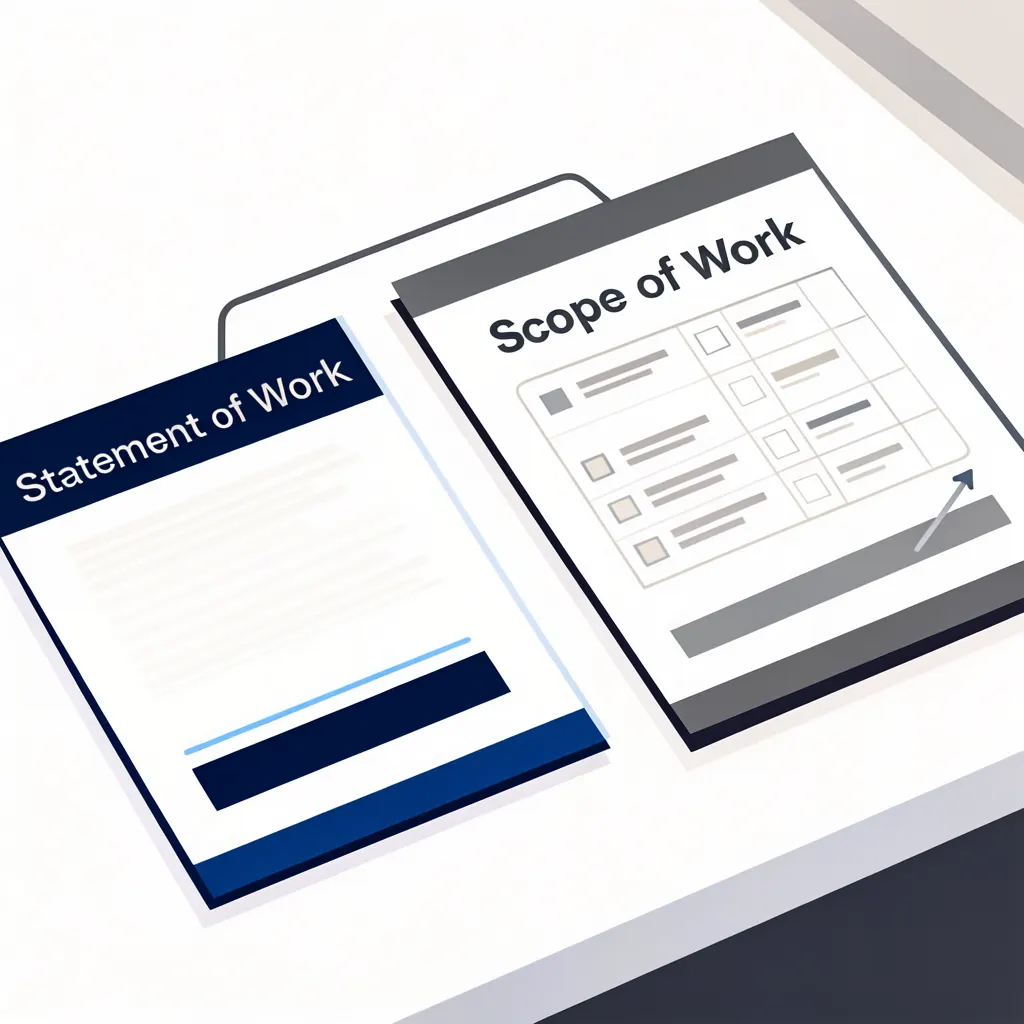
Statement of Work vs Scope of Work is one of those distinctions that sounds like boring legal fine print right up until the moment it costs you three weeks of unpaid labor, a client dispute that drags on for months, or a project that spirals so far outside its original boundaries that you can barely remember what you originally agreed to do. I know this because I lived it. And I am going to make sure you never have to.
I am an SEO content writer who is also juggling a 4-year LLB program, which means I read contracts the way most people read news articles: constantly, critically, and with a very personal stake in understanding exactly what every clause means. Early in my freelance career, before I connected those contract law lectures with my actual business practices, I operated on casual email agreements and good faith handshakes. The results were predictably painful.
One client turned a straightforward batch of blog posts into a months-long content management project. Another expected unlimited revision rounds because, in their words, “we’re just tweaking.” None of this was malicious. It was the natural consequence of unclear documentation.
The moment I started treating my paperwork as seriously as my writing, everything changed. My income stabilized. Client relationships became smoother. And the projects I took on actually matched the projects I got paid for.
This guide breaks down the full picture: what each document is, how they work together, when to use each one, and how to write both of them properly for your freelance business or your corporate projects. I cover real industry examples across construction, IT, consulting, and government contracting. And I answer every common question I see circulating in project management forums on ProjectManagement.com, Reddit’s r/pmp community, and Quora threads where professionals are still genuinely confused about which document does what.
Let’s build this from the ground up.
What Is a Statement of Work? The Full Definition You Actually Need
A Statement of Work is the comprehensive, legally binding contract document that governs the entire working relationship between a client and a contractor or vendor. Full stop.
It covers everything from payment terms to intellectual property rights, from dispute resolution to confidentiality obligations. Think of it as the rulebook for your professional relationship, the document that answers the big governing question: “How exactly are we going to work together?”
Project managers in PMI-certified environments sometimes encounter the term “scope statement” being used loosely in place of a Statement of Work. That is a common misconception. According to the Project Management Institute’s PMBOK Guide, a scope statement focuses purely on defining project boundaries and deliverables. A Statement of Work zooms out much further to cover the entire legal and operational framework around those deliverables.
So what goes inside a proper SOW?
Key Components of a Statement of Work
1. Project Purpose and Background
This section explains why the project exists in the first place. It gives context. A new client reading this section should understand the business problem being solved without needing a separate briefing document.
2. Project Deliverables
These are the specific outputs the contractor will produce. Not general descriptions. Specific ones. “Four SEO-optimized blog posts, each between 1,200 and 1,500 words, delivered in Google Docs format.” That is a deliverable. “Good content” is not.
3. Project Timeline and Milestones
The SOW should map out the major phases of the project with specific dates attached to each one. A project milestone is not just a deadline. It is a checkpoint that both parties have formally agreed to, and it connects directly to the payment schedule.
4. Payment Terms
This is where the SOW earns its keep. How much is the contractor being paid? When is each payment due? What happens if an invoice goes unpaid? Are there late fees? Is there a deposit required upfront? Every single one of these questions needs a clear answer written into the document. The Society for Human Resource Management notes that unclear payment terms are one of the most common sources of contractor-client disputes, and I have seen this play out personally more times than I care to count.
5. Intellectual Property and Copyright
Who owns the work once it is delivered? For freelance writers, designers, developers, and consultants, this question is enormous. If the SOW does not address it explicitly, default copyright law in the United States generally means the creator retains ownership. Many clients assume they automatically own everything they commission. Getting this in writing protects both parties.
6. Confidentiality and NDA Provisions
If you are working with sensitive business information, internal data, unreleased products, or proprietary strategies, the SOW should contain confidentiality clauses that protect the client and establish clear boundaries around what you can and cannot share.
7. Governance and Communication Protocol
Who is the main point of contact? Who has the authority to approve deliverables? How are changes to the project scope requested and approved? A well-written SOW answers all of these questions so there is no ambiguity about who makes decisions.
8. Dispute Resolution
If something goes wrong, how does it get resolved? Mediation? Arbitration? Which state’s laws govern the agreement? This section might feel unnecessary when you are starting a project on good terms with a client. Contract disputes often arise when precisely this section is missing.
9. Termination Conditions
Under what circumstances can either party terminate the agreement? What notice is required? What happens to work already completed and invoices already sent? Defining this upfront prevents a messy, emotionally charged exit if the relationship breaks down.
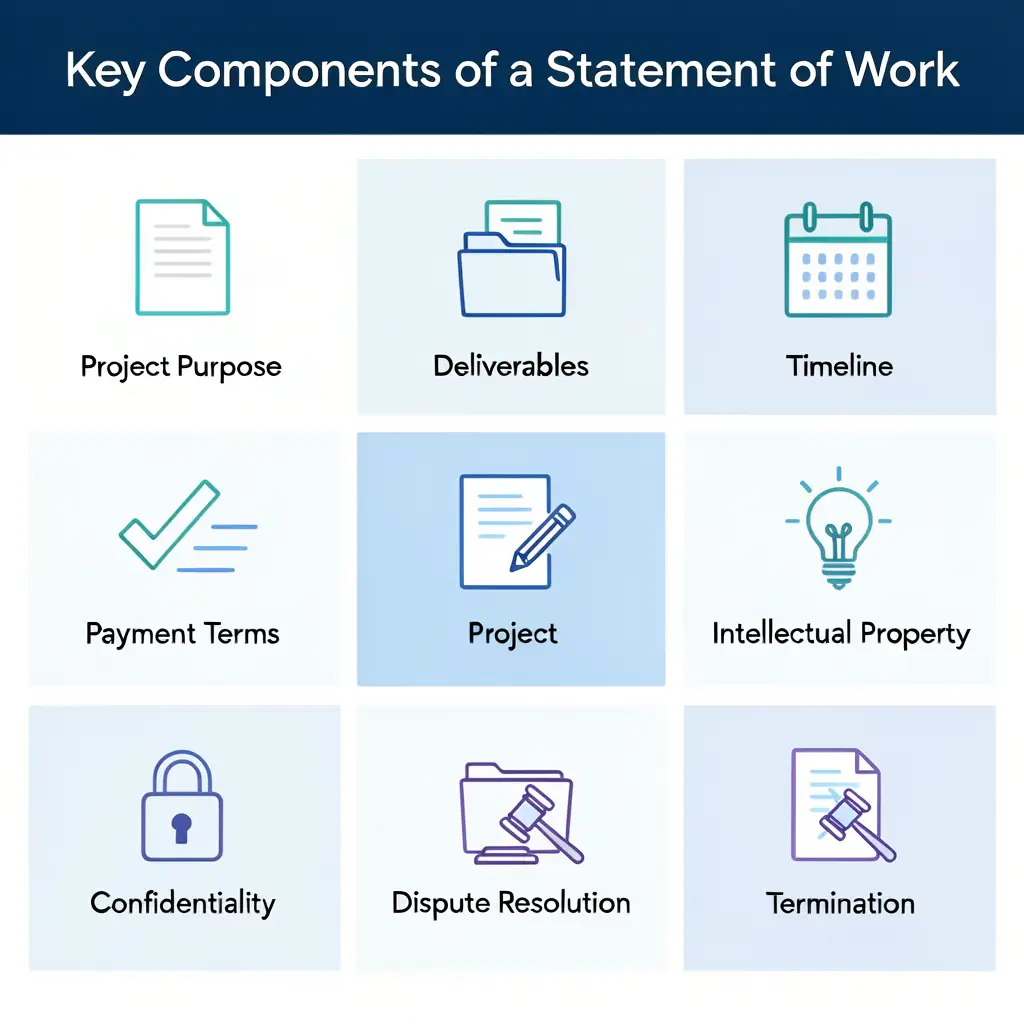
nine of these areas — skip one and you
leave yourself exposed.
Statement of Work Example: What One Looks Like in Practice
Imagine you are a freelance SEO content writer. You sign on with a marketing agency to produce content on a recurring basis. Your SOW might look something like this at a high level:
Parties: [Your Name], Contractor, and [Agency Name], Client.
Project Purpose: The Contractor will provide SEO content writing services to support the Client’s content marketing strategy across multiple client accounts.
Payment Terms: The Contractor will submit invoices on the 1st of each month for work completed in the prior month. Invoices are due within 14 days of receipt. A late fee of 1.5% per month applies to overdue balances.
Intellectual Property: Upon receipt of full payment, all work product produced under this agreement becomes the sole property of the Client. Prior to full payment, the Contractor retains all copyright.
Confidentiality: The Contractor agrees not to disclose any client business information, campaign data, or proprietary strategies for a period of two years following the termination of this agreement.
Governance: All project communications will be conducted via email. The Contractor is available Monday through Friday, 9 AM to 5 PM EST. Any meeting requests require 48 hours advance notice.
Termination: Either party may terminate this agreement with 14 days written notice. Work completed up to the termination date will be invoiced and paid within the standard payment terms.
Notice that this document does not say a single word about specific articles, deadlines for individual pieces, or the number of revisions included. That is by design. The SOW is the big picture framework. The project-level details live somewhere else entirely.
What Is a Scope of Work? The Document That Defines Exactly What You Will Do
A Scope of Work is the ultra-specific, project-level document that spells out exactly what work will be performed, when it will be delivered, and what falls explicitly outside the boundaries of the project.
It answers a completely different question than the SOW. Where the Statement of Work asks “How are we going to work together?”, the Scope of Work asks: “What exactly are we doing right now, on this specific project?”
A Scope of Work is often attached as an appendix to the main Statement of Work. It can also stand alone as a separate document for simpler engagements. Either way, it is the document your client will read most carefully before signing, because it tells them precisely what they are getting for their money.
Key Elements of a Scope of Work
1. Project Title and Overview
A brief, plain-language description of the specific project. One or two sentences. Enough to identify the project clearly without confusion if multiple scopes are in play simultaneously.
2. Specific Deliverables
This is the heart of the document. List every single deliverable with enough specificity that there is zero room for interpretation. “Four blog posts” is not specific enough. “Four SEO-optimized blog posts, each between 1,000 and 1,200 words, targeting the keywords provided in the attached keyword research document, delivered in Google Docs with tracked changes enabled” is specific.
3. Timeline and Milestone Dates
Attach a real date to every deliverable and every review round. First draft of all four posts by [date]. Client feedback due by [date]. Final revisions delivered by [date]. No vague timelines. Real calendar dates.
4. Revision Policy
This one element alone has saved me more hours of unpaid work than anything else. Define exactly how many rounds of revisions are included and what constitutes a revision. My personal standard is one round of minor revisions per deliverable. If a client wants to restructure an article from scratch after delivery, that is a new deliverable, not a revision.
5. Explicit Exclusions
This is the most important part of any Scope of Work and the section that most freelancers skip entirely. Write out in plain language every service that is NOT included in this project. No assumptions. No implied services. Spell it out.
If you are a writer, your exclusions might include: “This scope does not include graphic design, image sourcing, CMS uploading, technical SEO audits, social media copy, or email newsletter adaptation of any content produced.”
6. Acceptance Criteria
How will both parties know the work is officially complete and ready for handover? What standards must the deliverables meet? For a content writer, this might be: “Deliverables are considered complete when they meet the agreed word count, incorporate the specified target keywords, pass a standard plagiarism check, and receive written approval from the Client’s designated reviewer.”
7. Project Cost and Payment Milestone
The Scope of Work should reference the specific price for this particular project, even if the payment terms and late fee structure live in the overarching SOW. Connecting the payment to the scope milestone is what prevents payment disputes later.
Scope of Work Example: Making It Real
Using the same freelance SEO writer scenario, a Scope of Work attached to the SOW above might read like this:
Appendix A: Scope of Work | Project: Q3 Content Campaign
Deliverables: Four SEO-optimized blog posts, each between 1,200 and 1,500 words, targeting keywords to be supplied by the Client no later than five business days before the project start date.
Timeline:
- First drafts of all four posts: [Date]
- Client feedback due: [Date, 7 days after draft delivery]
- Final revisions delivered: [Date, 5 business days after feedback receipt]
Revisions: This scope includes one round of minor revisions per post. Minor revisions are defined as changes that do not alter the core structure, argument, or length of the post by more than 10%. Structural rewrites are billed at the Contractor’s standard hourly rate of $75.
Exclusions: This scope does not include image sourcing, graphic design, CMS uploading, social media adaptation, email newsletter repurposing, technical SEO auditing, or keyword research.
Acceptance Criteria: Posts are accepted upon written confirmation from the Client’s designated content manager.
Project Fee: $1,200 (four posts at $300 each). Invoiced upon delivery of final approved drafts per payment terms in the Master SOW.
Short. Specific. Airtight.
Statement of Work vs Scope of Work: The Key Differences That Change Everything
A Statement of Work is the legal framework. A Scope of Work is the project blueprint. They serve different purposes, target different audiences, and carry different levels of legal weight even when they appear in the same document.
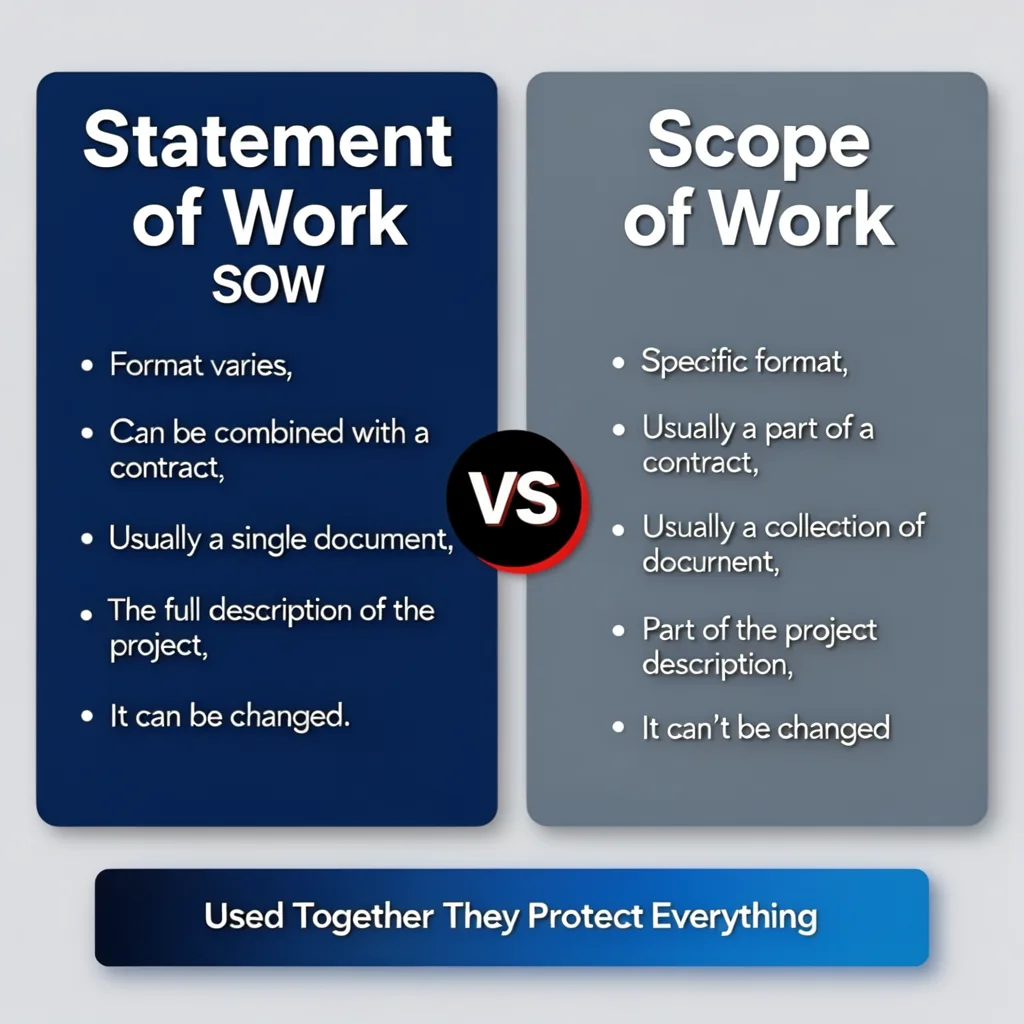
governs the project. You genuinely need both.
Here is a direct comparison of the two:
| Feature | Statement of Work (SOW) | Scope of Work |
|---|---|---|
| Primary Question Answered | How will we work together? | What will be done on this project? |
| Document Type | Comprehensive legal contract | Detailed project task document |
| Primary Focus | Business terms, legal protections, payment | Deliverables, timeline, exclusions |
| Audience | Legal teams, stakeholders, procurement officers | Project managers, execution teams, clients |
| Legal Status | Formally binding on its own | Binding when attached to a signed contract |
| How Often Signed | Once per client relationship | Once per individual project |
| Includes Pricing? | Yes, payment terms and schedule | Yes, project-specific fee only |
| Includes Exclusions? | Generally not | Yes, critical element |
| Includes IP Rights? | Yes | No |
| Includes Revision Policy? | Generally not | Yes |
| Related to MSA? | Often functions as one | Often an appendix to the SOW |
When to Use a Statement of Work
Use a Statement of Work at the very beginning of a new client relationship, before any project-specific work begins. Sign it once. Keep it broad enough to cover all future projects with that client.
You also need a SOW when:
- You are entering a vendor agreement with another business
- You are working under a Master Services Agreement (MSA) structure
- You are a government contractor required to submit formal procurement documents
- The project involves intellectual property, sensitive data, or complex payment arrangements
- You want legal protection that holds up if the relationship breaks down
When to Use a Scope of Work
Use a Scope of Work every single time you start a new project, even with an existing client you have worked with for years. The relationship rules stay consistent across the SOW. But every project is different, and every project needs its own scope.
You also need a dedicated Scope of Work when:
- You are responding to a Request for Proposal (RFP) from a client or institution
- A project involves multiple phases or complex deliverables
- You want to explicitly define what is and is not included before work begins
- Your client has a history of adding “small” extra requests mid-project
Statement of Work vs Scope of Work in Different Industries
The core principles stay consistent across every industry. But the way these documents look in practice varies significantly depending on the sector. I want to walk through four major industries where I see the most confusion and the most costly mistakes.

here is how each industry uses them.
Statement of Work vs Scope of Work in IT and Software Development Projects
In IT and software environments, the Statement of Work is often a substantial document that governs a complex, multi-month or multi-year vendor relationship. It covers service level agreements (SLAs), uptime guarantees, data security obligations, and software licensing terms. The SOW in a software development context is rarely a one-page document. It can run to dozens of pages for enterprise-level engagements.
The Scope of Work in IT is where the real technical detail lives. It specifies exactly which features or modules will be built in a given development sprint or release cycle. A properly written IT Scope of Work will include:
- Functional requirements (what the software will do)
- Technical requirements (what technology stack will be used)
- Testing and quality assurance criteria
- Deployment scope (which environments will receive the update)
- What is explicitly out of scope for this phase
Contract disputes often arise when IT scope documents are vague about which features belong in which phase. A client who sees “user authentication module” in the project scope and expects that to include single sign-on, two-factor authentication, and social login integration is going to be very surprised when the developer delivers a basic username and password system. Specificity prevents this.
For a real statement of work example in a software development context, a well-structured SOW might include a clause specifying that any feature requests outside the approved backlog will follow a formal change request process, require a written Scope amendment, and carry an additional fee.
Statement of Work vs Scope of Work in Construction Projects
Construction is probably the industry where the difference between a Statement of Work and a Scope of Work has the most dramatic financial consequences. A poorly scoped construction project can result in cost overruns that run into the millions of dollars on large builds.
In construction, the Statement of Work functions as the prime contract or subcontract. It covers:
- General contractor and subcontractor responsibilities
- Payment schedule tied to project phases (draws)
- Insurance and bonding requirements
- Change order procedures
- Warranty obligations
- Dispute resolution (often mandatory arbitration in construction contracts)
The Scope of Work in construction is attached to the main contract and specifies exactly what work will be performed within a defined area of the build. A scope of work for a commercial plumbing subcontractor, for example, would specify:
- Which floors and units are included in the scope
- What pipe materials and specifications are required
- Which fixtures are included versus supplied by others
- Rough-in only or finish work included
- What permits the subcontractor is responsible for obtaining
The exclusions section in a construction Scope of Work is absolutely critical. It prevents the general contractor from assuming the plumber will also do gas line work, drainage tiling, or irrigation just because those tasks are related to plumbing. Every exclusion is a protection against scope creep and unpaid labor.
Statement of Work vs Scope of Work for Consulting Engagements
Consulting is a field where the difference between a vague agreement and a tight Scope of Work can mean the difference between a profitable engagement and three months of scope creep masquerading as “client service.”
A consulting Statement of Work typically covers:
- The nature of the consulting relationship (advisory only versus implementation)
- Confidentiality and non-disclosure terms
- Non-solicitation clauses (the consultant agrees not to poach client staff)
- Liability limitations
- Fee structure (retainer versus hourly versus project-based)
The Scope of Work for a consulting engagement is where the client gets a clear picture of what they are actually buying. A strategy consultant brought in to help a company improve its customer retention should have a Scope that specifies:
- Exactly which business units or product lines are included in the analysis
- What data the client will provide and by when
- How many stakeholder interviews are included
- What format the final deliverable will take (written report, presentation, working sessions, or all three)
- What is explicitly excluded (for example, implementation support, staff training, or ongoing advisory beyond the defined engagement period)
The consulting engagement letter, as some firms call it, is essentially the SOW and Scope of Work combined into one professional document. Many boutique consulting firms use this format because it presents a polished, client-facing package rather than two separate documents that clients sometimes find confusing.
Statement of Work vs Scope of Work in Government Contracting
Government contracting is probably the most formal environment in which these documents operate, and the terminology is extremely precise. Federal acquisition regulations in the United States (governed by the Federal Acquisition Regulation, or FAR) have very specific requirements for what must appear in a government Statement of Work.
In the federal contracting world, the SOW is a mandatory procurement document submitted as part of the solicitation process. It defines the government’s requirements for a product or service with enough specificity that contractors can submit accurate, competitive bids. According to federal procurement standards, a government SOW must be clear, complete, and unambiguous, because any vagueness in the scope can lead to protests from losing bidders who argue the solicitation was unfair.
The Scope of Work in government contracting is the contractor’s response to the government’s SOW. It is the contractor’s specific plan for meeting the stated requirements, and it forms the basis of the executed contract.
One critical distinction in government contracting that often confuses people from the private sector: the Scope of Work in a government contract is not just a planning document. It is a legally binding performance standard. Failure to meet the scope as written can result in contract termination, financial penalties, and disqualification from future bidding opportunities.
The 5 Concrete Wins You Get When You Master Both Documents
Let me be direct. Getting these documents right is not about being thorough for thoroughness’s sake. It produces specific, measurable outcomes in your freelance business or your project management practice. Here are the five that matter most.
Win 1: Eliminating Scope Creep Before It Starts
Scope creep is the single biggest silent threat to freelance profitability, and a detailed Scope of Work is the only reliable defense against it.
Project scope creep is rarely aggressive or intentional. Most clients who add extra requests genuinely believe they are asking for small favors. They do not understand that sourcing 30 custom images for a blog post series takes four to six hours of billable time. They do not realize that uploading content to a CMS and formatting it properly is a separate skill set from writing it.
When your Scope of Work explicitly lists what is excluded, you have an objective, impartial document you can reference without the conversation becoming personal. I once had a client ask me mid-project to “just run a quick full technical SEO audit” on their site. Because my Scope clearly stated that technical SEO audits were outside the boundaries of the content writing engagement, the conversation was simple and factual.
I responded: “A technical audit sits outside our current scope. I can absolutely take that on. Let me put together a separate Scope and pricing for you. Want me to send that over?”
The client agreed immediately, paid for the additional work, and thanked me for being organized. That is the practical power of a well-written Scope of Work. It does not shut conversations down. It redirects them into profitable territory.
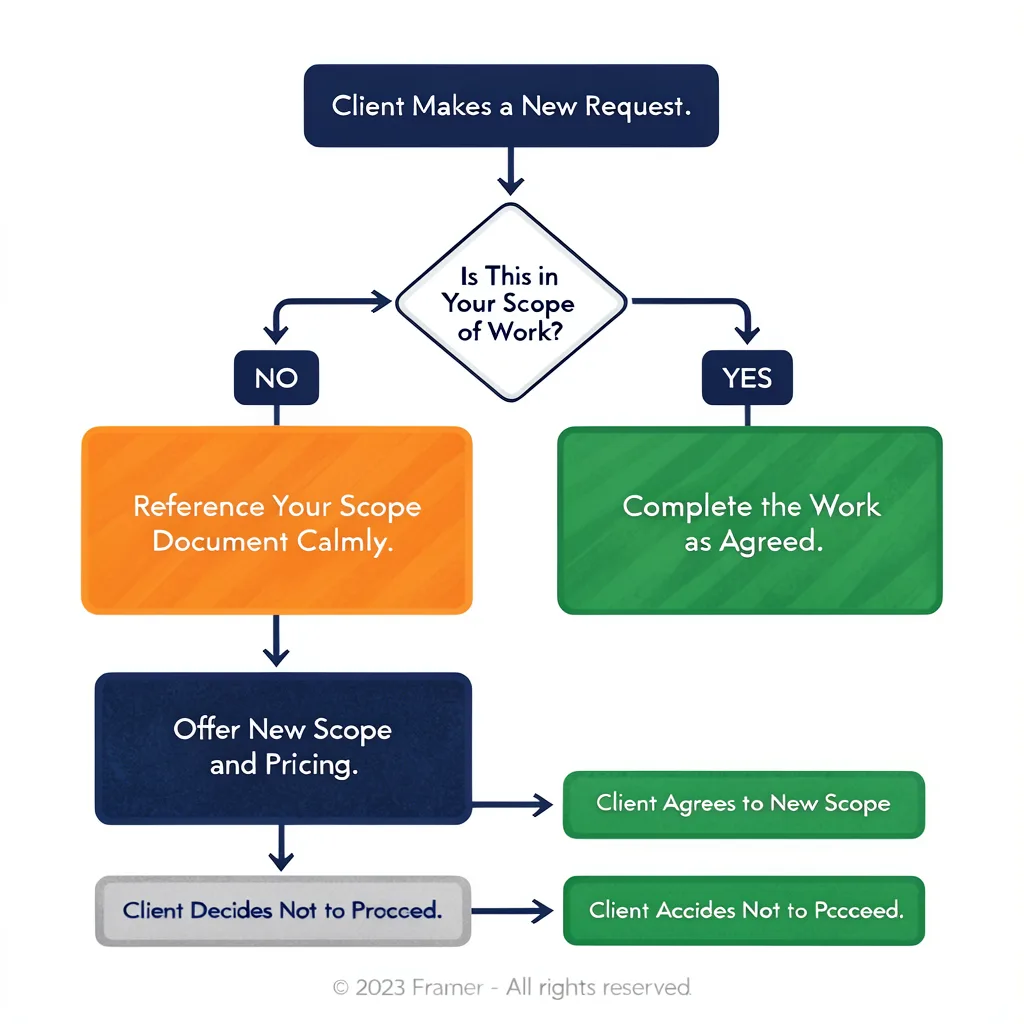
They are opportunities — if your Scope
document is doing its job.
Win 2: Getting Paid Faster with Zero Ambiguity
Payment disputes almost always trace back to unclear documentation. When both parties agree in advance on what “completion” means and when payment becomes due, there is no room for a client to claim the project is not finished.
Your Statement of Work should define payment terms with precision: the payment amount, the due date, the invoice submission process, and the consequences of late payment. Your Scope of Work should tie each payment milestone to a specific deliverable or project phase.
When these two documents work together, an invoice is not a request. It is a contractually triggered event. The first draft was delivered on [date]. Per our Scope of Work, that milestone triggers the second payment installment. Per our Statement of Work, that invoice is due within 14 days of receipt.
There is no gray area. And gray area is exactly what difficult clients weaponize to delay payment.
Win 3: Setting and Enforcing Professional Boundaries
Boundaries in freelancing are not just emotional health strategies. They are business architecture. And the right place to build them is inside your Statement of Work.
Add a simple Communications Protocol clause to your SOW that specifies your available hours, your preferred communication channels, and your policy on unscheduled calls. It might look like this:
“All project communications will be conducted via email or the designated project management tool. The Contractor is available for correspondence Monday through Friday, 9 AM to 5 PM EST. Meetings require 48 hours advance notice and must be agreed upon in writing. Weekend and emergency contact is available at the Contractor’s discretion and may carry an additional fee.”
This clause does something that no amount of personal assertiveness training can do on its own: it makes your boundaries part of the legal agreement before the relationship even starts. You are not enforcing boundaries in the moment and hoping the client respects them. You built them into the contract from day one.
Win 4: Positioning Yourself as a Premium Service Provider
There is a version of you that responds to a project inquiry with: “Sounds great, my rate is $X, just send me the details.”
And there is a version of you that responds with: “Excellent. I will put together a Statement of Work covering our general terms, along with a detailed Scope of Work for this specific project. Once you review and sign both, I will send the deposit invoice and we can schedule the kickoff.”
Only one of those versions commands premium rates. And it is not the first one.
When you use proper documentation, you signal professional maturity. Established businesses, especially mid-size and enterprise clients in the US, UK, and Australia, are accustomed to formal B2B processes. When a freelancer hands them clear, organized contracts that match the documentation standards they use internally, it builds instant confidence. You stop looking like a gig worker and start looking like an agency. And agencies charge significantly more than gig workers for the same quality of output.
Win 5: Building a Scalable System That Runs on Autopilot
Here is the part nobody talks about enough. Once you have a solid Master Statement of Work template, you only write it once. Every client signs the same foundational document. The legal protections, payment terms, and professional boundaries are locked in from the first conversation.
The Scope of Work is the only document that changes with each project. And a good Scope template is a one-page checklist: project title, deliverables, timeline, revisions, exclusions, fee. Fill in the blanks, send it for signature via DocuSign or PandaDoc, and get to work. The entire onboarding process takes under 10 minutes once your templates are in place.
When a client returns for a second or third project, you do not issue a new SOW. You create Appendix B or Appendix C to the existing agreement. The master terms stay in place. The new scope gets attached. Your paperwork admin time shrinks with every repeat project, while your legal protection remains exactly as strong as it was on day one.
How to Write a Statement of Work: A Step-by-Step Process
Writing a Statement of Work from scratch feels intimidating until you have done it once. After that first one, you will wonder why you ever operated without one.
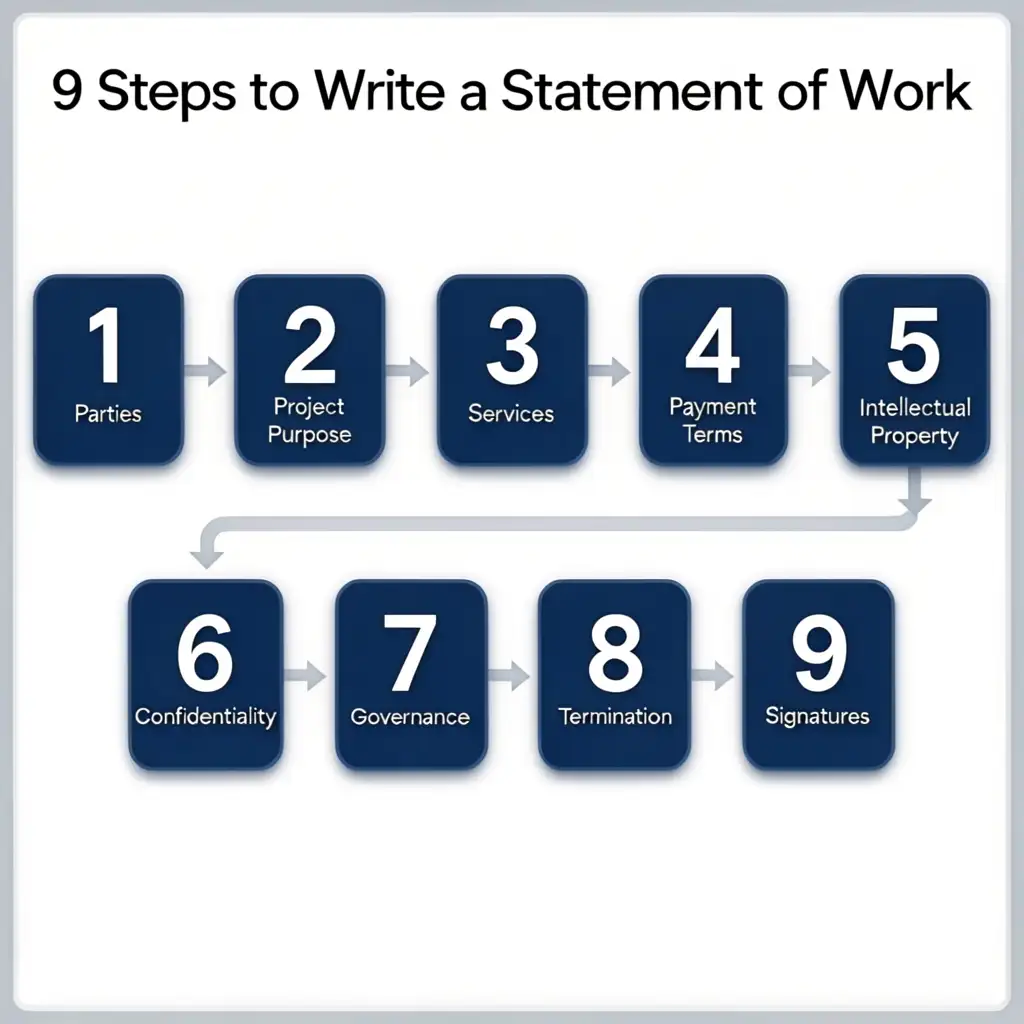
one of them and you leave a gap in your
legal protection.
Step 1: Start with the Parties
Identify yourself and your client clearly. Use legal names, not trade names or nicknames. If you operate under a business name, use that. Include addresses, email addresses, and the date the agreement becomes effective.
Step 2: Write the Project Purpose
Two to three sentences explaining why this working relationship exists. What problem does the client need solved? What service are you providing at a high level?
Step 3: Define Your Deliverable Categories
At the SOW level, you do not list specific articles or design files. You define the categories of work you will perform. “The Contractor will provide SEO content writing services.” That is it at this level. The specifics come in the Scope of Work.
Step 4: Write Your Payment Terms
This is where precision matters most. Define:
- Your rate (per project, per hour, per word, or monthly retainer)
- Your invoicing schedule
- Your payment due date (Net 14 and Net 30 are standard)
- Your late fee structure
- Your deposit requirement (I recommend 50% upfront for new clients)
- Your policy on payment disputes
Step 5: Address Intellectual Property
Who owns the work? When does ownership transfer? I use a simple clause: “Upon receipt of full and final payment, all work product produced under this agreement transfers to the Client. Prior to receipt of full payment, the Contractor retains all intellectual property rights.”
Step 6: Add Confidentiality Provisions
Protect the client’s information. And protect yourself. Specify the duration of the confidentiality obligation and what types of information are covered.
Step 7: Define Governance and Communication
Who approves work? Who is the main point of contact? What is the turnaround time for client feedback? Answering these questions in the SOW prevents the slow, frustrating delays that come from unclear approval chains.
Step 8: Include Termination and Dispute Resolution
State the notice period for termination and the process for resolving disputes. Specifying the governing state law is important for freelancers working with clients across state lines or internationally.
Step 9: Get Signatures
Your SOW is not legally effective until both parties sign it. Use an e-signature platform like DocuSign, PandaDoc, or HelloSign to formalize the agreement and create a timestamped record. The Freelancers Union offers contract templates and resources for independent contractors who want a solid starting point before customizing for their specific practice. Explore Freelancers Union contract resources here.
How to Write a Scope of Work: A Practical Walkthrough
Once your Master SOW is signed, every new project starts with a fresh Scope of Work. Here is the process I use every single time.
Step 1: Write the Project Title and Reference
Give the project a clear name and reference the overarching SOW it falls under. “Appendix A: Scope of Work | Project: Q3 SEO Blog Series | Reference: Master Statement of Work, signed [date].”
Step 2: List Every Deliverable in Exact Detail
No vague descriptions. Every deliverable gets:
- A specific format (“delivered in Google Docs, not Word”)
- A specific quantity (“four posts, not a batch”)
- A specific length or size (“1,200 to 1,500 words each”)
- A specific standard (“optimized for the target keywords listed in Attachment 1”)
Step 3: Attach Real Dates
Every milestone gets a real calendar date. First draft, feedback window, revision delivery, final approval. Real dates. Not “approximately 2 weeks from kickoff.”
Step 4: Write Your Revision Policy
One of the most valuable sentences you will ever put in a contract: “This scope includes one round of minor revisions, defined as changes that do not alter the core structure or argument of the deliverable. Additional revisions are billed at [rate] per hour.”
Step 5: Write Your Exclusions
This is the section that prevents scope creep before it begins. List every related service you are NOT providing. Be specific. Be thorough. A little extra time here saves hours of boundary enforcement conversations later.
Step 6: Specify the Acceptance Criteria
How will both parties know the project is officially done? Write it out. “Deliverables are accepted upon written confirmation from [Client Contact Name] that all final revisions have been incorporated and the content meets the agreed specifications.”
Step 7: State the Project Fee
Reference the payment terms in the master SOW, then specify the exact fee for this project. “Total project fee: $1,200. Invoiced upon delivery of final approved drafts, payable within 14 days per the Master SOW payment terms.”
SOW vs Related Documents: Clearing Up the Confusion Once and for All
A question that surfaces constantly in project management forums is how the SOW and Scope of Work relate to other common project documents. Let me address the most important comparisons directly.
Statement of Work vs Contract: Are They the Same Thing?
Not exactly. A Statement of Work is a type of contract, but not all contracts are Statements of Work.
A basic contract might simply say “Party A agrees to pay Party B $X for services rendered.” A Statement of Work goes much further. It defines the nature of those services, the standards they must meet, the timeline for delivery, the conditions under which payment is triggered, and the legal protections for both parties.
In practice, many freelancers use their SOW as their primary contract document. In corporate and enterprise environments, the SOW is typically an exhibit or attachment to a broader Master Services Agreement (MSA). The MSA governs the overall vendor relationship at the highest level. The SOW governs specific projects under that MSA. The Scope of Work then governs individual deliverable packages within each SOW.
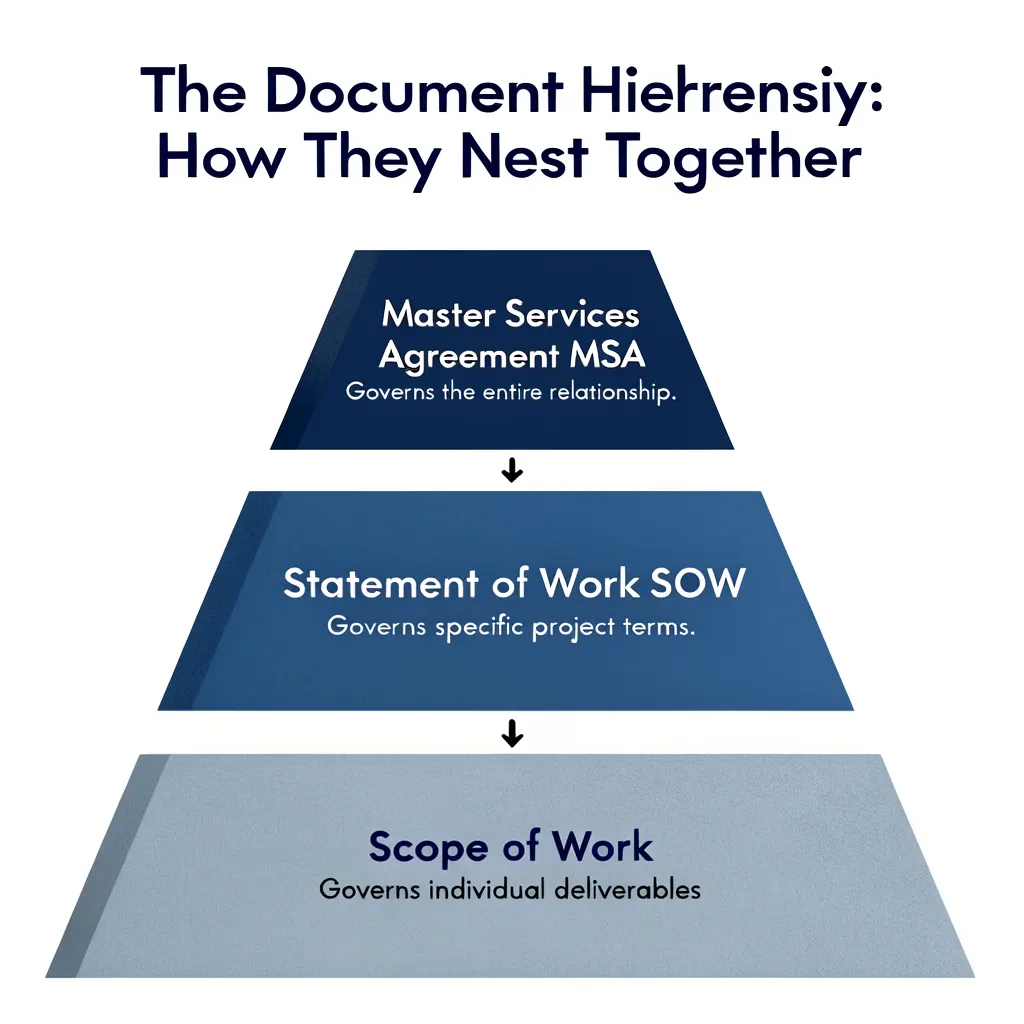
the project. The Scope specifies the work.
Each layer depends on the one above it.
Scope of Work vs Project Charter: Two Very Different Documents
The project charter is an internal project management document that formally authorizes a project to exist within an organization. It names the project sponsor, establishes the project manager’s authority, and aligns the project with organizational strategy.
A Scope of Work is an external-facing agreement between a client and a contractor. It defines what the contractor will produce. A project charter defines who has authority over the project internally.
In the Reddit r/pmp community, I frequently see this comparison come up. As one experienced project manager explained in a forum thread, “The charter is the 10,000-foot story and the final goal. The SOW is the detailed roadmap.” That framing is exactly right. You would not send a client a project charter. You would not use a Scope of Work to authorize internal resources.
Scope of Work vs Work Breakdown Structure (WBS)
A Work Breakdown Structure is an internal planning tool that decomposes the project into progressively smaller tasks and subtasks. It is a visual or hierarchical map of every piece of work the project team needs to complete.
A Scope of Work is a client-facing document that defines deliverables and boundaries. It does not get into the internal task-level detail of how those deliverables will be produced.
The Scope of Work feeds the WBS. Once you know what you are producing (defined in the scope), you can map out how you will produce it (the WBS). The two documents work in sequence. You would not use a WBS in place of a Scope of Work in a client agreement.
Scope of Work vs Terms of Reference
Terms of Reference (TOR) is a document used primarily in international development, government, and NGO contexts. It is functionally similar to a Scope of Work in that it defines the objectives, tasks, and expected outputs of an assignment. The key difference is that TORs are typically used for advisory or consultancy assignments within organizations, while a Scope of Work is broader and is used in formal contractor-client procurement relationships.
If a development organization or NGO sends you a TOR, treat it as you would a Scope of Work. Respond with your own Scope document that confirms your understanding of the requirements and lays out your proposed approach, timeline, and deliverables.
Common Mistakes Freelancers and Project Managers Make With These Documents
I have made most of these mistakes myself. And I have seen every one of them come up in forum discussions, client horror stories shared in freelance communities, and the real-world contract disputes that occasionally end in legal proceedings.
Mistake 1: Using One Document When You Need Two
The most common mistake. Freelancers write a detailed Scope of Work with deliverables and timelines but never establish the overarching legal framework of the SOW. When a client delays payment or disputes ownership of the work, there is no contract governing those issues.
Or the opposite: a lawyer drafts a rock-solid Statement of Work, but the individual project engagements are defined so vaguely that scope creep is practically guaranteed.
You need both. They serve different functions and protect you at different levels.
Mistake 2: Writing Vague Deliverables
“Content writing services” is not a deliverable. It is a category. Write specifics every single time. The more specific you are, the less room there is for a client to claim you did not deliver what they expected.
Mistake 3: Skipping the Exclusions Section
This is the mistake that costs the most money in unpaid labor. If you do not explicitly say what you are NOT doing, a reasonable client might assume it is included. Write out every related service you are not providing. Every single one.
Mistake 4: Using Casual Language in Legal Documents
Your SOW is a legal document. “I’ll try to get it done by end of month” is not a timeline. “First draft delivery: [specific date]” is a timeline. Write every commitment as a specific, measurable statement, not a general intention.
Mistake 5: Not Updating Your Templates
Your Master SOW and your Scope of Work template should evolve over time. Every difficult client interaction is a signal that your documents need a new clause. I review and update my Master SOW at least twice a year, and some of my most protective language came directly from situations I had not anticipated when I first wrote the document.
Mistake 6: Forgetting That Signatures Matter
An unsigned contract is not a contract. It is a draft. Make sure both parties sign before any work begins. No exceptions.
Free Statement of Work Template and Scope of Work Template: What to Include
I am going to give you the core structure of both templates right here so you can build your own versions from scratch. These are the frameworks I use in my own freelance practice, refined over several years of contract writing and legal study.
Statement of Work Template Structure
Section 1: Parties and Effective Date
[Contractor Name, Business Name, Address, Email] and [Client Name, Business Name, Address, Email]. Effective date: [Date].
Section 2: Services
The Contractor will provide [general service category] services to the Client on a project-by-project basis, as defined in individual Scopes of Work issued under this agreement.
Section 3: Payment Terms
Rate: [rate structure]. Invoicing: [frequency]. Payment due: [Net X days]. Late fee: [percentage per month]. Deposit: [amount or percentage] due before work begins on any new project.
Section 4: Intellectual Property
Upon receipt of full payment, all work product transfers to the Client. Prior to full payment, all rights remain with the Contractor.
Section 5: Confidentiality
Both parties agree to maintain the confidentiality of the other’s proprietary information for [duration] following the termination of this agreement.
Section 6: Communications Protocol
Available hours, preferred channels, meeting notice requirements.
Section 7: Revisions and Changes
Process for requesting scope changes. How changes are documented and priced.
Section 8: Termination
Notice period. Treatment of work in progress. Final invoice process.
Section 9: Dispute Resolution
Governing law (specify your state). Preferred dispute resolution method (mediation, arbitration).
Section 10: Signatures
[Contractor signature, printed name, date] and [Client signature, printed name, title, date].
Scope of Work Template Structure
Header: Appendix [X]: Scope of Work | Project: [Title] | Reference: [SOW Date]
Project Overview: [2-3 sentence description of the specific project]
Deliverables:
- [Deliverable 1 with full specifications]
- [Deliverable 2 with full specifications]
- [Continue as needed]
Timeline:
Revisions: [Exact revision policy]
Exclusions: This scope does not include: [list every exclusion]
Acceptance Criteria: [How completion is defined]
Project Fee: [Amount and connection to payment terms in master SOW]
Signatures: [Both parties sign each new Scope of Work]
For those who prefer pre-built formats, both DocuSign and PandaDoc offer template libraries that include SOW and Scope structures you can adapt for your specific situation. Microsoft Word SOW templates are also widely available through the Microsoft 365 template gallery, which is particularly useful if your clients are enterprise users accustomed to .docx format deliverables.
Statement of Work vs Scope of Work in Agile Project Management
Agile environments present a unique challenge for traditional documentation because Agile methodology is built around iterative, flexible delivery rather than fixed upfront scope definitions. So how do these documents work in an Agile context?
The short answer: carefully, and with deliberate adaptations.
In Agile, the Statement of Work still governs the overall engagement. It defines the commercial terms, payment structure (often time and materials rather than fixed price in Agile), intellectual property terms, and the governance framework for the relationship. None of those elements change just because the project uses sprints instead of phases.
The Scope of Work in Agile is where the difference between SOW and project scope in Agile becomes meaningful. Rather than a fixed, upfront scope that locks in every feature and deliverable from day one, the Agile scope is defined at the sprint or release level. Each sprint has its own mini scope: specific user stories or features to be developed, acceptance criteria for each story, and a defined delivery date (end of sprint).
The key protection for Agile project managers and contractors is a well-written change management clause in the overarching SOW that defines how backlog items outside the approved sprint scope are handled. Without this clause, an Agile engagement can devolve into unlimited scope expansion driven by stakeholder demands, with no mechanism for pricing or pushing back on additional work.
The difference between SOW and project scope in Agile is essentially the difference between the commercial contract that governs the engagement and the iterative backlog management that defines what gets built when.
Trending FAQs: Every Question You Actually Have About These Documents
Is a Scope of Work legally binding?
A Scope of Work becomes legally binding when it is signed by both parties and attached to a valid contract or Statement of Work. On its own, as an unsigned planning document, it is not enforceable. Signed, it carries the same legal weight as any other contractual document.
Can a Scope of Work replace a Statement of Work?
Not in most professional or legal contexts. A Scope of Work defines what work will be performed. A Statement of Work governs how the business relationship operates, including payment terms, IP rights, and dispute resolution. Using a Scope alone leaves major legal gaps. The Sirion legal resource library notes clearly that a Scope of Work does not replace an SOW because it lacks the commercial and legal provisions necessary to protect both parties.
What comes first, the Statement of Work or the Scope of Work?
The Statement of Work comes first. You establish the overarching legal framework before you define the specifics of any individual project. Think of it like agreeing on the rules of a game before you start playing a specific match. The SOW is the rulebook. The Scope of Work is the game plan for today’s match.
Which is more detailed, a Statement of Work or a Scope of Work?
They are detailed in different ways. The Statement of Work is more comprehensive in legal and commercial terms. The Scope of Work is more detailed in operational and deliverable terms. A well-written Scope of Work will have more granular specificity about what work is being performed, what format it takes, and what exact timeline applies. The SOW will have more complex legal language around rights, obligations, and remedies.
Do I need both a SOW and a Scope of` Work?
Yes. For any professional engagement that involves significant time, money, or creative output, you need both. The SOW protects the relationship. The Scope of Work protects the project. Using only one leaves you exposed at one level or the other.
What is SOW meaning in business?
In business, SOW stands for Statement of Work. It refers to the formal document that defines the scope of services, project deliverables, timeline, payment terms, and legal conditions governing a contractor-client relationship. SOW is used across industries from IT and consulting to construction and government contracting.
Is a scope of work the same as a statement of work?
No. They are related but distinct documents. A Scope of Work defines specifically what work will be performed on a project. A Statement of Work is the broader legal agreement that governs the entire working relationship and includes the scope of work as one of its components. The common misconception is that the terms are interchangeable. They are not.
What is the difference between a scope statement and a statement of work in project management?
In formal project management contexts, a scope statement (sometimes called a project scope statement) is an internal document that defines the project boundaries, deliverables, and constraints from the organization’s perspective. A Statement of Work is a formal, external-facing contract document issued to a vendor or contractor. A scope statement might be created during project planning. A SOW is issued during procurement.
How do I handle scope creep if I have a Scope of Work in place?
Point back to the document calmly and professionally. When a client requests work that falls outside the defined scope, acknowledge the request positively, reference the relevant exclusion in the scope, and offer to create a new Scope of Work for the additional work with updated pricing. This approach keeps the relationship intact while protecting your time and income.
What should be excluded from a Scope of Work?
Every service that is related to the project but not explicitly included in the deliverables should appear in the exclusions section. For a content writer, this includes image sourcing, graphic design, video production, social media posting, CMS uploading, keyword research, and technical SEO. For a software developer, this might include user testing, documentation, training, or ongoing maintenance. The rule is simple: if you are not doing it, write it down.
Can I use the same Statement of Work for multiple clients?
Yes, with modifications. Your Master SOW template can serve as the foundation for every client relationship. Customize the parties section, adjust the rate and payment terms if needed, and confirm that the governing law clause reflects your preferred jurisdiction. The core protective clauses around IP, confidentiality, and dispute resolution can remain consistent across all client agreements.
How do I write a Scope of Work for a construction project?
Start with a clear description of the specific area of work (for example, electrical work on floors 3 and 4 of a commercial building). List every specific task included, referencing the plans and specifications by document number. Define the materials and standards that apply. List every task explicitly excluded. Set a completion milestone tied to payment. Include a change order procedure. Have all parties sign before mobilization begins.
What is the difference between a SOW and a work breakdown structure?
A SOW is a client-facing contract document that defines what will be delivered and under what terms. A Work Breakdown Structure (WBS) is an internal planning tool that decomposes the project into individual work packages and tasks. The SOW defines the what. The WBS helps the project team figure out the how. You would share a SOW with your client. You would use a WBS internally with your project team.
What is the difference between a statement of work and a project plan?
A Statement of Work is a legal and commercial agreement. A project plan is an operational document used internally to manage the execution of a project. The project plan typically includes the project schedule, resource allocations, risk register, and communication plan. It is built after the SOW and Scope of Work are finalized. You would not use a project plan in place of a contract.
How often should I update my Statement of Work template?
At minimum, once a year. In practice, I update mine whenever a client situation reveals a gap in my existing protections. New clauses worth considering include: a feedback turnaround requirement (the client must provide feedback within X days or the timeline shifts), a kill fee clause (if the client cancels a project midway, they owe a percentage of the total fee), and a communication surcharge clause (for clients who consistently contact outside agreed hours).
A Final Word on Treating Your Paperwork Like a Business Partner
Statement of Work vs Scope of Work stops being an abstract distinction the moment you face your first payment dispute, your first scope creep situation, or your first client who conveniently cannot remember what they agreed to.
I spend a lot of time on contract mechanics because my LLB coursework has shown me exactly how much weight these documents carry in the real world. A clearly written Scope of Work is not bureaucratic overhead. It is the legal foundation of a professional relationship. And a well-crafted Statement of Work is not a sign that you do not trust a client. It is a sign that you respect both of you enough to define the relationship properly from day one.
The freelancers and project managers who earn the most are not necessarily the ones with the deepest technical skills. They are the ones who run their businesses with clarity, consistency, and the kind of professionalism that makes clients feel safe investing in them.
Start with your Master SOW. Build your Scope template. Send clean, specific paperwork with every engagement. Then get to work.
That is how you stop scrambling and start operating like the professional you actually are.
Have a question about your own contract situation or a scope creep story you want to share? Drop it in the comments below. I read every single one, and some of the best questions have made their way into my contract updates.