
I almost signed away my entire career in under three minutes.
The email landed in my inbox at 7:43 on a Tuesday evening. New client. Good rate. Exciting project. And right there, sitting in a neat PDF attachment, was a contractor non disclosure agreement with a cheerful little note underneath it: “Just sign here so we can get started.”
I was tired. I was excited. And for approximately ninety seconds, I nearly did exactly what millions of freelancers do every single week without realising the consequences.
I nearly clicked sign without reading a single word.
What stopped me was years of studying contract law alongside client work, a combination that had trained my brain to feel a specific kind of discomfort whenever something moved too fast. So I slowed down. I opened the PDF. And what I found inside that document was not a standard, sensible contractor confidentiality agreement built to protect real trade secrets.
It was a legal trap dressed up in professional formatting.
This guide exists because that story is not unique to me. Across Reddit, Quora, Facebook groups for freelancers, and forums like WIFCON, the same questions appear week after week. People asking whether NDAs apply to independent contractors. People asking what happens when a contractor breaks an NDA. People discovering, after the fact, that they signed something that blocked them from showing their best work to anyone.
And the most painful thread I ever read? A freelancer on a government contracting forum discovering that the NDA they had signed could not even be enforced against the other party because of how it had been drafted. All that silence, all that restriction, and they were the only one actually bound by anything.
So whether you are a freelancer preparing to sign your next contractor non disclosure agreement, a small business owner trying to draft one, or a startup founder who downloaded a free template and is not sure if it will actually hold up in court, this guide covers everything you need.
From exact clause language to negotiation scripts. From state specific enforceability to the precise portfolio exception wording that has saved my own career more than once.
Read this before you sign anything.
What Is a Contractor Non Disclosure Agreement?
A contractor non disclosure agreement is a legally binding contract that stops an independent contractor from sharing a client’s confidential information with outside parties. It protects sensitive business data like trade secrets, client lists, and financial projections during and after a project engagement.
That is the textbook definition. But the reality on the ground is messier than that.
Most of the contractor non disclosure agreements circulating in the freelance economy right now were not drafted by attorneys. They were downloaded from a legal template website, occasionally modified, and fired off to contractors as routine “paperwork” before a project begins. The template itself might have been originally written for a corporate employment relationship, then repurposed for a contractor context without anyone updating the language to reflect the legal difference between an employee and a 1099 independent contractor.
That distinction matters enormously.
Employees have baseline protections baked into employment law. Independent contractors do not. When a contractor signs an NDA, they are entering a pure contract relationship governed by whatever the document says, plus whatever state or federal law applies. There is no HR department to appeal to. There is no employment tribunal to soften an unreasonable restriction.
There is just the contract, and whatever you agreed to.
This is why understanding a contractor non disclosure agreement at a clause level, not just as a concept, is genuinely important for anyone working independently. And it is why so many freelancers across platforms like Upwork, Fiverr, and independent consultancies report feeling confused, pressured, or blindsided by NDA terms they did not fully understand when they signed.
NDA vs. Confidentiality Agreement: Is There Actually a Difference?
Not in any practical legal sense. No.
The terms “non disclosure agreement,” “confidentiality agreement,” and “secrecy agreement” are used interchangeably across both US and UK legal contexts. Some attorneys prefer “confidentiality agreement” because it describes the obligation more clearly, but both documents serve the same function: they legally obligate a receiving party to keep designated information private.
You will also sometimes see the term “proprietary information agreement” used by technology companies, particularly in Silicon Valley. Again, same document, different branding.
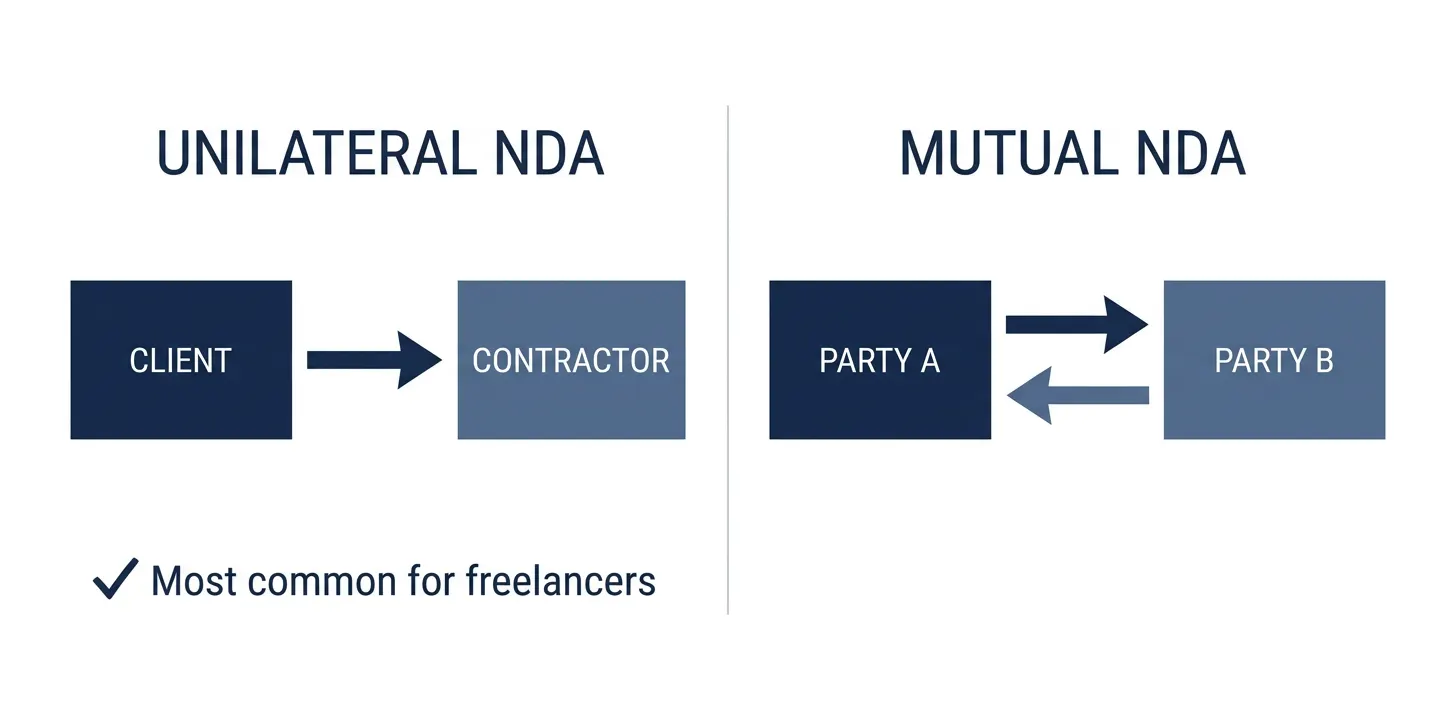
The only meaningful distinction is between a unilateral NDA and a mutual NDA. A unilateral agreement, which is the kind most freelancers encounter, flows in one direction only. The client discloses information. The contractor promises to keep it secret. The contractor does not disclose anything that requires protecting in return.
A mutual NDA protects both parties simultaneously, which makes sense when two businesses are exploring a partnership or merger and each side is sharing sensitive data with the other.
For the purposes of most freelance engagements, you will almost always be signing a unilateral contractor non disclosure agreement. One way protection. And that is fine in principle, as long as the terms are fair.
When Do You Actually Need a Contractor NDA?
You need a contractor NDA any time a client shares genuinely sensitive business information with you as part of a project engagement. That might include unreleased product specifications, private financial data, proprietary processes, or access to customer databases.
But “need” works in both directions here.
From the client’s perspective: if you are hiring an independent contractor and you need to share anything you would not want a competitor to know, you absolutely should have a signed NDA in place before that conversation happens. Verbal agreements about confidentiality are extraordinarily difficult to enforce. Written contracts are not perfect either, but they are considerably stronger.
From the contractor’s perspective: signing a contractor NDA is often a normal, reasonable part of doing professional work. The problem is not the act of signing. The problem is signing without understanding what you are agreeing to.
I have signed NDAs for clients across multiple industries and never had a dispute. But every single one of those NDAs had clearly defined terms, a reasonable confidentiality period, and explicit carve outs for my portfolio and pre existing skills. The ones that lacked those features? I negotiated before I signed. Every single time.
Key Clauses Every Contractor NDA Must Include
Every enforceable contractor non disclosure agreement contains six foundational clauses that define the scope, duration, and consequences of the confidentiality obligation. Missing or vague language in any one of them can make the agreement either unenforceable or dangerously one sided.
Let me walk through each one.
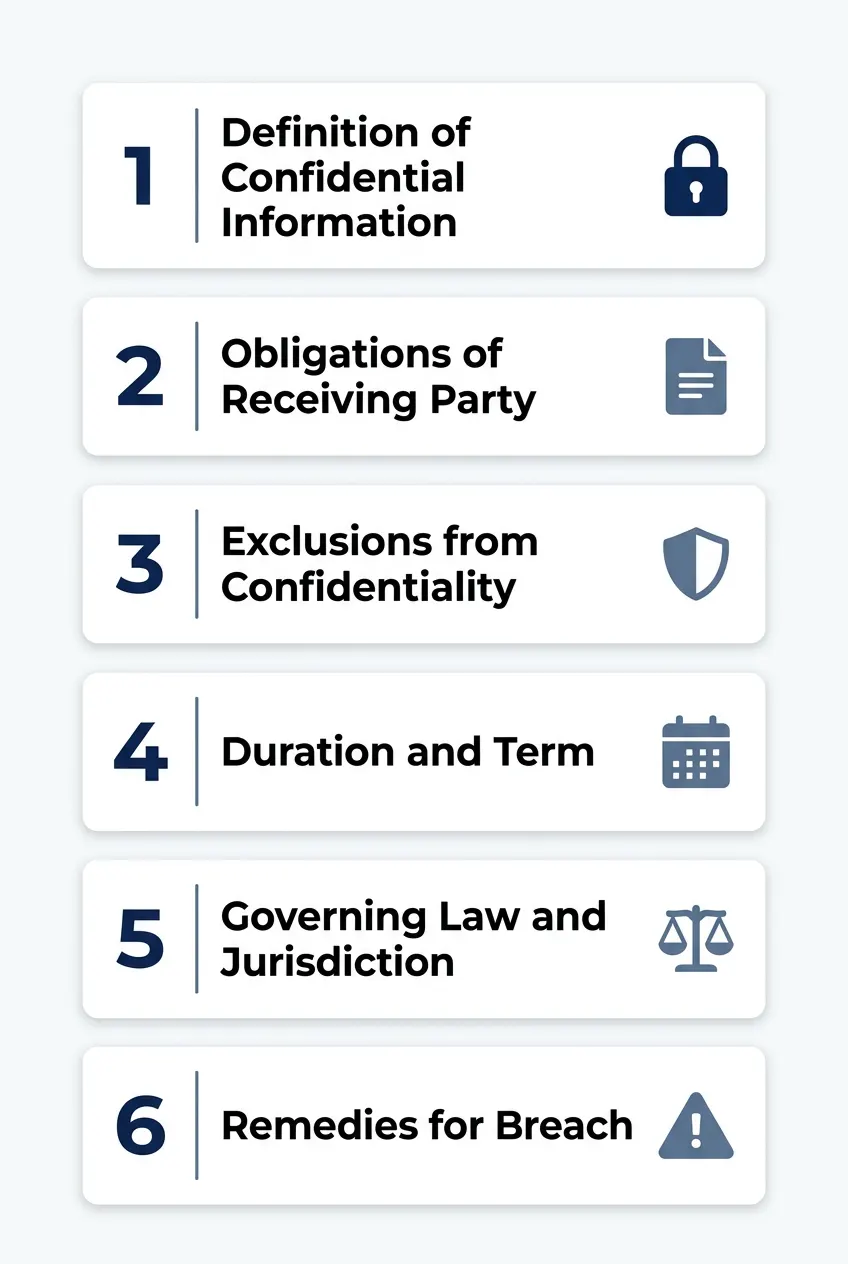
The Definition of Confidential Information: The Most Important Clause You Will Ever Read
This is the clause that determines what you are actually promising to keep secret. And it is the single most abused section in the entire document.
A well drafted definition of confidential information names specific categories of data that genuinely need protection. Think things like: unreleased software source code, private customer lists, Q4 financial projections not yet in the public domain, proprietary manufacturing processes, or details of an upcoming product launch.
Here is what a fair, specific definition looks like in practice:
“Confidential Information means the following specific categories of information disclosed by the Disclosing Party: (a) client and customer lists; (b) financial projections and internal pricing structures; (c) proprietary software code and technical specifications; (d) unreleased product development plans.”
Notice what that definition does. It names things. Specific things. It does not try to swallow the entire universe of information the contractor might encounter.
Now here is the version I see in predatory contracts: “Confidential Information means any and all information, whether written, oral, electronic, or observed, shared during the course of the relationship.”
That phrase “or observed” is the one that should make you stop and put the document down.
Think about what observed information means in practice. You join a video call and the client’s office background shows a whiteboard with their internal project names on it. Is that now a corporate secret you can be sued for mentioning? In a contract worded that broadly, a court fight over that question is at least theoretically possible.
A reader on a Law Stack Exchange thread asked a version of this exact question, noting that they did not understand where the line was between general knowledge gained during a project and actual confidential information. The top answer was illuminating: the law distinguishes these categories, but only if your contract does too. If the contract does not make the distinction, the burden of sorting it out falls on expensive litigation.
The fix is simple. Before you sign, check whether the definition of confidential information actually names things. If it uses sweeping language like “any and all information,” push back and ask for a specific list. If the client cannot name what they need protected, that is worth questioning in itself.
Obligations of the Receiving Party: What You Are Actually Promising to Do
This section spells out your obligations once you receive confidential information. In a standard contractor confidentiality agreement, those obligations typically include: keeping the information secure, not disclosing it to third parties, using it only for the purpose of the engagement, and not copying or reproducing it outside of what the project requires.
Those are all reasonable obligations. No argument there.
Where contractors get hurt is when this section includes obligations that go far beyond what the project actually requires. I have reviewed NDAs for fellow freelancers that included obligations to actively monitor their own computers for potential breaches and report any suspected vulnerability to the client within 24 hours. On a three month blog writing contract.
That is not a confidentiality obligation. That is an IT security role tucked inside a contractor NDA, and it carries liability exposure that has nothing to do with the actual work being performed.
Read the obligations section carefully. If it requires you to do something that falls outside your professional scope, or imposes a standard of care that sounds more like a security engineer’s job description than a freelancer’s commonsense duty, flag it before you sign.
Exclusions from Confidentiality: The Clauses That Protect You
Exclusions from confidentiality define the categories of information that are explicitly NOT covered by the NDA, even if they technically qualify under the definition of confidential information. Every fair contractor non disclosure agreement should include these.
Standard exclusions include:
Information already in the public domain. If a client’s “secret” business strategy is published on their own company blog, you cannot be bound to silence about something anyone can read with a Google search.
Information you already knew before the engagement started. Your pre existing skills, knowledge, and expertise do not become someone else’s property just because you signed a contract with them.
Information you independently develop without using the client’s confidential data. If you develop a new content methodology based purely on your own research and experience, a client who you happened to work with previously cannot claim that methodology as their trade secret.
Information received from a third party with no confidentiality obligation attached. If another party independently tells you the same information the client told you, and that party had the right to share it, you should not be gagged.
If these exclusions are absent from the contractor non disclosure agreement you are reviewing, add them. Or ask the client’s legal team to add them. The absence of standard exclusions in a contract is not an oversight. It is a choice, and it should prompt you to ask why.
Duration and Term of the NDA: Why “In Perpetuity” Should End the Conversation
The duration clause specifies how long your confidentiality obligations last. For most freelance project work, a fair term is one to three years after the engagement ends.
I want to dwell on this section because it is where some of the most egregious contractor NDA problems live.
The phrase “in perpetuity” appears in an alarming number of NDAs circulating in the freelance market. It means forever. Literally for the rest of your professional life. And for the overwhelming majority of freelance projects, that is not a commercially reasonable position. It is a power move designed either through lazy drafting or intentional overreach.
Courts in both the US and the UK look unfavourably on perpetual confidentiality obligations in standard commercial contracts. Under common law principles that underpin both legal systems, a restriction must be reasonable in duration to be enforceable. The Uniform Trade Secrets Act, which has been adopted in some form by almost every US state, does allow trade secrets to be protected for as long as they remain genuinely secret, but it draws a sharp distinction between actual trade secrets and ordinary confidential business information.
The strategy you discussed in a Zoom call three years ago? Not a trade secret. The design of a marketing campaign that ran two years ago? Not a trade secret. A proprietary algorithm that still drives a company’s entire competitive advantage? That one might justify a longer protection period.
The World Intellectual Property Organization (WIPO) offers clear guidance on this distinction, noting that trade secret protection applies only to information that derives genuine economic value from its secrecy and is subject to reasonable measures to keep it secret. Standard freelance deliverables rarely meet that bar.
Here is the negotiation script I use when I encounter a perpetual NDA clause:
“Hi [Client Name], I noticed the confidentiality term does not include an expiration date. For the type of work we are doing, I keep project details confidential for 24 months after the engagement ends, which is standard practice in this field. I am happy to sign on that basis. Let me know if that works for you.”
Direct. Professional. Non confrontational. And in my experience, most clients simply say yes, because they never thought about the term length in the first place.
Governing Law and Jurisdiction: The Clause That Can Cost You Thousands Before the Case Even Begins
The governing law clause specifies which state’s or country’s laws apply to the NDA, and which courts have the authority to hear any dispute. For freelancers working across borders, this is where the financial exposure can become genuinely alarming.
Picture this scenario. You are a freelance SEO specialist based in London. You land a contract with a tech startup in Austin, Texas. The NDA they send includes the following line, buried at page three in size nine font:
“This Agreement shall be governed by the laws of the State of Texas. Any disputes shall be resolved exclusively in the state or federal courts located in Travis County, Texas.”
You sign. The relationship sours. The client claims you breached the NDA. And now, as a UK based freelancer, you are potentially looking at hiring a Texas licensed attorney, navigating a foreign legal system, and potentially traveling to Austin for court proceedings, all over a contract that might have been worth a few thousand pounds to begin with.
The cost of simply defending yourself can exceed the value of the contract many times over. And that asymmetry is sometimes exactly the point.
UK freelancers should note that the Gov.uk business guidance on international contracts explicitly flags jurisdiction clauses as a key risk area for smaller businesses entering cross border agreements with larger foreign entities.
The fix here is to negotiate the jurisdiction to your home country or state wherever possible. If the client is unwilling to move jurisdiction entirely, propose mandatory online arbitration or mediation as an alternative. Both options keep any potential dispute geographically accessible and financially manageable regardless of where each party is located.
Remedies for Breach: What Happens If Something Goes Wrong
The remedies clause defines what the client can seek from you if you breach the NDA. Reasonable remedies include injunctive relief (a court order stopping you from continuing a disclosure), specific performance, and compensation for actual provable financial losses the client suffered as a result of your breach.
What is not reasonable? Arbitrary liquidated damages clauses that specify a fixed penalty amount with no connection to actual loss.
I have reviewed a contractor non disclosure agreement for a web development project worth approximately $2,500 that included a liquidated damages clause demanding $75,000 in the event of any disclosure of confidential information, including accidental disclosure.
That is not protection. That is intimidation.
Under common law principles recognised in both the US and UK, penalty clauses designed to punish rather than compensate are generally unenforceable. But “generally unenforceable” is cold comfort when you are staring at a demand letter. The smart move is to strike those clauses before you sign, not to rely on a court correcting the injustice later at your expense.
Types of Contractor Non Disclosure Agreements
Contractor non disclosure agreements come in several distinct forms, each suited to a different working relationship and level of mutual disclosure. Choosing or accepting the wrong type can leave one or both parties inadequately protected.
Mutual NDA for Contractors: When Both Sides Have Something to Protect
A mutual NDA for contractors, sometimes called a bilateral NDA, binds both the disclosing party and the receiving party to confidentiality obligations simultaneously. This structure makes sense when both sides are sharing sensitive information during the engagement.
A classic example: you are a freelance software developer being brought in to help a startup build a proprietary platform. The client needs to share technical specifications and business logic. You need to share your own development methodology and code architecture. A mutual NDA protects both sides equally.
The practical advantage of a mutual NDA is that it signals commercial fairness. When a client is willing to be bound by the same confidentiality standards they are asking of you, that is a meaningful trust signal. It tells you they are thinking about this as a relationship, not just a transaction they want to control.
One Way NDA for Independent Contractor: The Standard Freelance Document
The one way NDA for independent contractor engagements is far more common than the mutual version. The client is the disclosing party. You are the receiving party. The obligations flow in one direction.
This structure is entirely normal and not inherently problematic. Most freelance relationships involve one party sharing sensitive operational information with a contractor, not the other way around.
The issue is not the one way structure. The issue is always the specific language used within it.
A fair one way contractor non disclosure agreement clearly defines what is confidential, limits the term to a reasonable duration, includes proper exclusions for public domain information and pre existing knowledge, and does not try to claim ownership of the contractor’s future work or general professional skills.
Subcontractor Non Disclosure Agreement: The Layer Most People Forget
Here is a scenario that catches more people off guard than almost anything else in the freelance contract world.
You sign an NDA with a primary client. The primary client is itself a contractor for a larger company. And somewhere in the chain of agreements, there is a clause that says your confidentiality obligations flow down to cover the end client’s information too, even though you never had a direct conversation with that end client and have no idea what information they consider sensitive.
The subcontractor non disclosure agreement exists to formalise this downstream protection. Construction is a particularly common context for this, where a general contractor brings in subcontractors who each need to be bound by confidentiality terms related to the overall project.
If you are a subcontractor being asked to sign an NDA, read it with particular care around two things: exactly whose information you are being bound to protect, and whether the primary contractor has the authority to bind you to obligations related to an end client you have never met.
Contractor NDA Templates by Industry: Why One Size Has Never Fit All
Different industries require different confidentiality protections, and a generic contractor non disclosure agreement template rarely addresses the specific risks of any single sector adequately. The language that protects a software client’s source code looks quite different from the language that protects a healthcare organisation’s patient adjacent data.
IT Contractor Non Disclosure Agreement: Source Code, Algorithms, and Technical Specifications
Technology companies have some of the most legitimate reasons to require a strong contractor non disclosure agreement. Source code is often a company’s most valuable asset. An unreleased algorithm can represent years of development and millions of dollars in competitive advantage.
An IT contractor non disclosure agreement should specifically name technical assets in its definition of confidential information. That means listing things like: proprietary source code, database schemas, API architectures, machine learning training data, user experience designs pre launch, and technical roadmaps.
What it should not do is prohibit the developer from using general programming languages, frameworks, or methodologies that are part of their professional skill set. Knowing how to write in Python or build a REST API is not a trade secret. Knowing the specific business logic your client uses to price their products is.
The line between general technical knowledge and specific proprietary implementation is the one that matters in a software development NDA. Make sure that line is drawn clearly in writing before you start any work.
Construction Contractor NDA: Site Plans, Bidding Information, and Material Sources
The construction industry has its own specific confidentiality concerns, and they look quite different from the tech world.
Construction contractor NDAs commonly protect: detailed architectural and engineering plans, bidding strategies and cost breakdowns, material supplier relationships and pricing, site specific safety and logistics plans, and client identity in private residential projects.
One thing that is distinctly important in construction sector NDAs is the treatment of publicly filed documents. Planning applications, permits, and certain building regulations filings are public record. Once those documents enter the public domain, they cannot be claimed as confidential information under any NDA. A construction contractor non disclosure agreement that tries to maintain secrecy over publicly filed information is unenforceable on those specific points.
Subcontractor relationships in construction are also worth flagging again here. Major construction projects can involve dozens of subcontractors across different trades. Each one typically signs their own version of the subcontractor non disclosure agreement before accessing project plans. If you are a specialist subcontractor, check whether your NDA scope is limited to the specific plans relevant to your trade or whether it attempts to bind you to confidentiality obligations related to the entire project, including areas you will never see or work in.
Healthcare Contractor NDA: HIPAA, Patient Data, and the Stakes of Getting It Wrong
Healthcare is the sector where NDA violations carry the most severe consequences, and where the contractor confidentiality agreement intersects with federal law in ways that most freelancers are not prepared for.
If you are a contractor working with any healthcare organisation that handles protected health information (PHI), your NDA obligations do not just come from the contract itself. They are augmented, and in some areas superseded, by the Health Insurance Portability and Accountability Act, better known as HIPAA.
A healthcare contractor NDA should include a Business Associate Agreement (BAA) component or run alongside one. The BAA is the HIPAA specific instrument that defines how a contractor may access, use, and protect PHI. Signing an NDA without a properly structured BAA in a healthcare context leaves both parties exposed.
This is one area where I would strongly recommend seeking specific legal advice before signing rather than relying on a template. The penalties for HIPAA violations are federal level, they are serious, and they are not negotiated away with a paragraph redline.
Non Disclosure Agreement for Freelancers in Creative and Marketing Roles: The Portfolio Trap
Writers, designers, SEO specialists, video producers, social media managers. The creative and marketing freelance world is where the portfolio protection issue becomes most acute, and where I have personally seen the most damaging NDA misuse.
A non disclosure agreement for freelancers in creative roles that lacks an explicit portfolio exception clause is a document that silently steals your career case studies.
Consider this: a freelance content strategist spends six months building a content operation for a fast growing D2C brand. They write the strategy, commission the writers, build the editorial calendar, and watch organic traffic grow 340% over the engagement. That result is the centrepiece of their professional portfolio.
But if they signed a blanket contractor confidentiality agreement with no portfolio carve out, they may be legally barred from mentioning the client name, sharing traffic screenshots, or even describing the work in general terms.
The fix, as I mentioned earlier, is a portfolio exception clause. Here is the exact language I personally use and recommend:
“Notwithstanding the above, Contractor retains the right to display final, publicly released deliverables in Contractor’s professional portfolio and marketing materials. Contractor agrees to anonymise the Disclosing Party’s identifying information upon request.”
Short. Clear. Legally sound. And in my experience, most clients accept it without pushback when it is framed as standard professional practice rather than a demand.
How to Write a Contractor Non Disclosure Agreement Step by Step
Writing an enforceable contractor non disclosure agreement involves seven structured steps, from identifying the parties to executing the document with valid signatures. Each step has specific language decisions that determine whether the agreement will hold up if challenged.
Here is exactly how to approach it.
Step 1: Identify the Parties Precisely
Name the disclosing party and the receiving party with full legal names, not just first names or business names without structure. For a business, include the legal entity type (LLC, Corp, Ltd). For an individual contractor, use their full legal name and specify their contractor status explicitly. The document should be clear that the receiving party is an independent contractor, not an employee, because the legal implications differ.
Step 2: Write a Specific, Bounded Definition of Confidential Information
Name specific categories. Do not use catch all language. List the actual types of information being protected in this specific engagement. If you are protecting source code, name source code. If you are protecting financial projections, name financial projections. The more specific the definition, the more enforceable the protection.
Step 3: Include Standard Exclusions
Draft explicit exclusions for: information already in the public domain at the time of disclosure, information that becomes public through no fault of the receiving party, information the contractor knew before the engagement, information independently developed without use of the disclosing party’s data, and information received from a third party with no confidentiality obligation attached.
Step 4: Define the Permitted Use of Information
Specify exactly what the contractor is permitted to do with confidential information during the engagement. Typically: use it solely for the purpose of performing the contracted work. Do not leave this open ended. A clear permitted use clause also implicitly restricts all other uses without needing to enumerate every prohibited action.
Step 5: Set a Reasonable Duration
Choose a specific end date or a defined period after the engagement concludes. For most freelance work, one to three years is commercially appropriate. State clearly whether the obligations survive termination of the broader contractor agreement and for how long.
Step 6: Address Data Return or Destruction
Include a clause requiring the contractor to return or certifiably destroy all confidential information upon completion or termination of the engagement. In a digital work environment, “destruction” should be defined to include deletion from cloud storage, email accounts, and locally stored files, not just physical document shredding.
Step 7: Specify Governing Law, Jurisdiction, and Dispute Resolution
Name the governing law explicitly. Identify the jurisdiction for any disputes. If the parties are in different countries or states, consider specifying mandatory mediation or online arbitration as a first step before litigation. This saves both parties considerable expense if something goes sideways.
Is a Contractor NDA Legally Enforceable?
A contractor non disclosure agreement is legally enforceable when it contains clear offer and acceptance, adequate consideration, a specific and reasonable scope, and a lawful purpose under the governing jurisdiction’s law. Vague, overbroad, or unconscionable terms significantly reduce enforceability.
That answer matters, but so does the practical reality that follows it.
State by State Enforceability Notes
The enforceability of contractor NDAs across the United States is not uniform. State law varies in ways that can dramatically affect whether specific clauses hold up.
California is the most restrictive state when it comes to post engagement restraints. California Business and Professions Code Section 16600 renders most non compete restrictions void, and courts in California have shown a willingness to apply similar scrutiny to overly broad confidentiality agreements that effectively function as non competes by restricting a contractor’s ability to practice their profession.
New York takes a more nuanced approach, generally enforcing reasonable confidentiality agreements but scrutinising duration, scope, and whether the restriction is genuinely necessary to protect a legitimate business interest.
Texas and Delaware are generally more business friendly in terms of enforcing commercial contracts, including contractor NDAs, as long as they meet basic reasonableness standards.
For a contractor NDA template California specifically, the language around what qualifies as a trade secret and what constitutes a reasonable restriction needs to be tighter than in most other states. California courts are not forgiving toward overreach.
At the federal level, the Defend Trade Secrets Act (DTSA) provides a federal civil cause of action for trade secret misappropriation and applies across all 50 states. Under the DTSA, a trade secret is defined as information that derives independent economic value from not being generally known and is subject to reasonable measures to keep it secret. NDAs are one of those reasonable measures. But the DTSA also requires that any NDA entered into after May 2016 include a whistleblower immunity notice, which informs the contractor that they retain the right to report potential violations of law to government authorities even if doing so involves disclosing confidential information.
If you are drafting a contractor non disclosure agreement and it does not include DTSA whistleblower immunity language, add it. Failing to include it does not void the NDA, but it limits your ability to seek exemplary damages and attorney fees in a DTSA lawsuit.
What Happens If a Contractor Breaks an NDA?
If a contractor breaks an NDA, the remedies available to the disclosing party typically include injunctive relief, actual damages, and in cases involving trade secret misappropriation, potentially exemplary damages under the DTSA. The specific consequence depends heavily on what the NDA says and what damage the breach actually caused.
Injunctive relief is often the first remedy sought because it is the fastest. A court can issue a temporary restraining order stopping the contractor from continuing to disclose or use confidential information while the dispute is resolved. This is particularly relevant in technology and media contexts where the speed of disclosure matters enormously.
Actual damages require the disclosing party to prove what financial harm they suffered as a result of the breach. This is often harder than it sounds. Demonstrating that a specific disclosure caused a specific financial loss requires evidence, expert testimony, and time. Which is why liquidated damages clauses exist in the first place to create a pre agreed measure of harm so that neither party has to prove it in court.
The problem, as I noted earlier, is when those pre agreed figures bear no relationship to any realistic financial harm and exist purely as deterrents. Under English common law and US common law alike, those clauses are classified as unenforceable penalties rather than legitimate liquidated damages. The legal test, established in cases like Dunlop Pneumatic Tyre Co v New Garage and Motor Co in English law and reinforced through decades of US commercial contract decisions, is whether the pre agreed figure represents a genuine pre estimate of loss.
$75,000 in liquidated damages for a $2,500 web development contract does not represent a genuine pre estimate of anything. It represents a threat.
Contractor NDA vs. Non Compete Agreement: Key Differences That Every Freelancer Must Understand
This distinction gets blurred constantly, and that blurring is rarely accidental.
I have reviewed NDAs that include language like: “Contractor agrees not to perform services for any competitor of the Disclosing Party during the term of this Agreement and for 24 months thereafter.”
That is not an NDA clause. That is a non compete clause buried inside an NDA document.
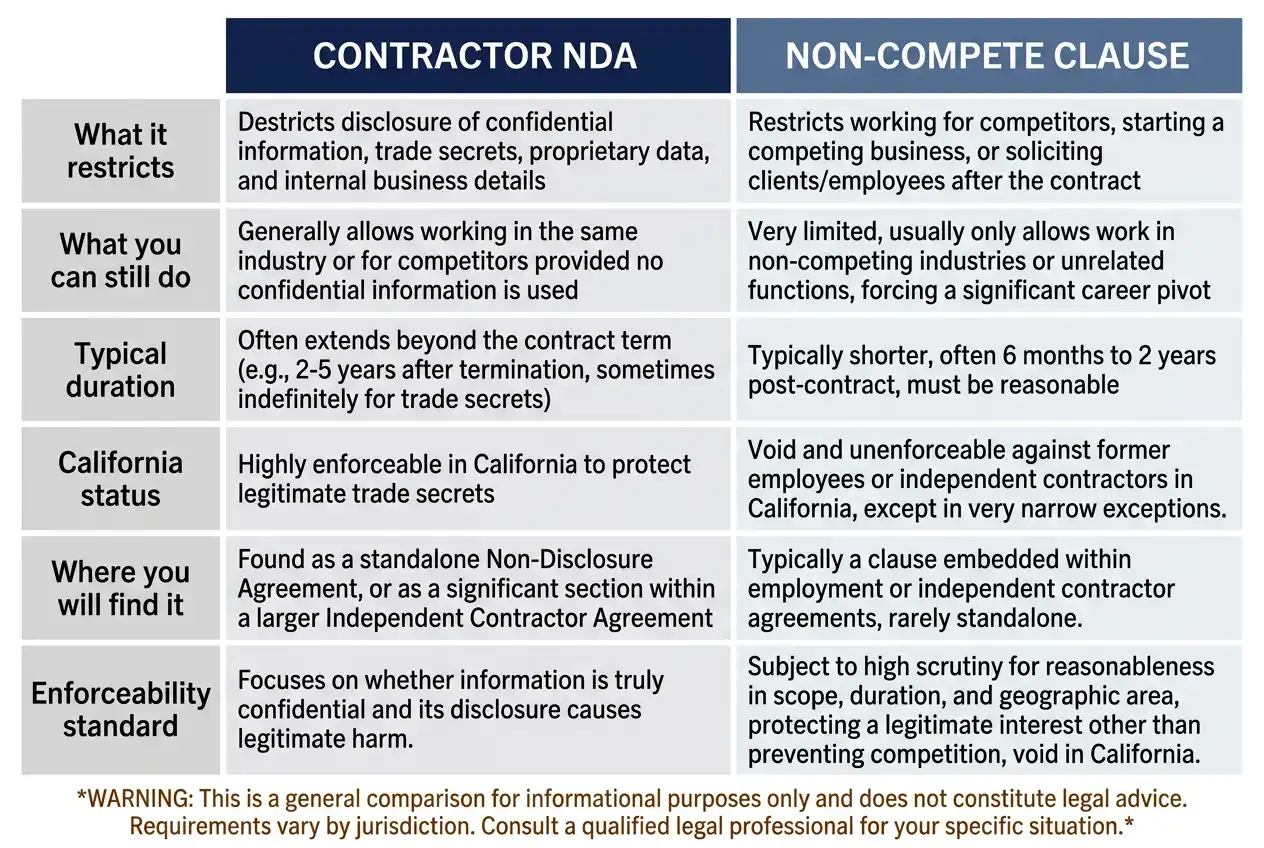
Non compete restrictions face vastly higher enforceability scrutiny than confidentiality obligations. In California, as mentioned earlier, non competes are essentially unenforceable for independent contractors. In many other states, they require additional consideration beyond the contract itself to be valid. The Federal Trade Commission issued a rule in 2024 attempting to ban most non compete clauses nationally, though that rule has faced legal challenges and the regulatory landscape continues to evolve.
The practical point is this: if you find non compete language hiding inside your contractor non disclosure agreement, it needs to be addressed separately, not treated as just another clause to skim past.
A non solicitation clause, which prevents you from approaching the client’s customers or staff directly after the engagement, is a related but distinct instrument. Non solicitation clauses are generally enforced more readily than broad non competes but still require reasonable scope and duration to hold up in court.
How to Sign a Contractor NDA: Digital and Physical Options
A contractor non disclosure agreement can be validly executed through physical signature, electronic signature, or a combination of both, with the validity of each method determined by the governing jurisdiction’s law. In the United States, the Electronic Signatures in Global and National Commerce Act (E-SIGN Act) and the Uniform Electronic Transactions Act (UETA) give electronic signatures the same legal weight as physical ones in most commercial contexts.
E Signature Validity for NDAs
In practical terms: yes, signing a contractor NDA through DocuSign, Adobe Sign, or HelloSign creates a legally valid, enforceable agreement in the vast majority of US jurisdictions and under UK law through the Electronic Communications Act 2000.
But there are nuances worth knowing.
The e-signature platform you use creates an audit trail, including timestamps, IP addresses, and in some cases identity verification steps. That audit trail can be valuable evidence if a dispute ever arises about whether the agreement was properly executed or whether the right person actually signed it.
Under US copyright law, the “work for hire” doctrine applies automatically to employees creating work within the scope of their employment.If a client sends you a Word document by email and asks you to type your name at the bottom and reply, that can also constitute a valid electronic signature in many jurisdictions. But it lacks the audit trail that a dedicated e-signature platform provides. For any agreement with significant financial stakes, use a proper e-signature platform. Both parties are protected by the record it creates.
NDA notarization is rarely required for contractor NDAs in commercial contexts. Notarization is typically used for real estate transactions, wills, and certain government documents. If a client insists on notarization for a standard freelance NDA, that is an unusual requirement worth asking about. It adds procedural friction without meaningfully strengthening the agreement’s enforceability in most cases.
How to Negotiate a Contractor Non Disclosure Agreement Without Losing the Client
Negotiating a contract feels awkward for a lot of freelancers. The fear of seeming difficult, slow, or hard to work with is real, and I have felt it myself even after years of doing this.
But here is what I know from experience: clients who react badly to professional, specific, reasonable contract negotiation are telling you something important about how they intend to operate the entire relationship.
A client who fires back angrily when you ask for a portfolio exception clause, a reasonable duration term, or a jurisdiction clause amendment is not a client who is going to be easy to work with when the project gets complicated. And projects always get complicated.
The negotiation itself is a signal.
Here are the three specific scripts I use most often.
For a broad confidentiality definition: “I want to make sure we both have clarity on what’s actually protected here. Could we update the definition of confidential information to list the specific categories relevant to this project? That way we both know exactly where the line is.”
For a perpetual duration clause: “I noticed the confidentiality term does not include an end date. I am happy to commit to full confidentiality for 24 months after the project ends, which is my standard for this type of engagement. Does that work for you?”
For a foreign jurisdiction clause: “The jurisdiction clause would place any dispute resolution in [City/State/Country], which would be financially prohibitive for me as a remote contractor. Would you be open to specifying online arbitration as the first step for any dispute? That keeps things fair and accessible for both sides.”
Short. Specific. Professional. Not argumentative. Not apologetic.
And if the client refuses all three of those completely reasonable requests? Then you have your answer about what kind of client they are going to be.
The Hidden Clauses Most Freelancers Never Think to Check
Most contractor NDA guides stop at the six core clauses. Duration, definition, exclusions, obligations, governing law, remedies. Cover those, and you feel like you have done your due diligence.
But there is a second layer of language that sits beneath those headline clauses, quieter and less obvious, that causes just as much damage when overlooked. I have seen experienced freelancers, people who knew to check the duration clause and the confidentiality definition, still get caught by these secondary provisions because nobody told them to look.
So I am going to tell you now.
The Work for Hire Clause Disguised as an NDA Provision
A work for hire clause embedded inside a contractor non disclosure agreement transfers full ownership of everything you create during the engagement to the client, often without the contractor realising that is what they are signing.
Here is how it usually appears. Somewhere in the “obligations of the receiving party” section, after the standard confidentiality language, there will be a sentence that reads something like:
“All work product, deliverables, and materials created by Contractor in connection with this Agreement shall be considered works made for hire under applicable copyright law and shall be the sole and exclusive property of the Disclosing Party.”
That sentence is not a confidentiality obligation. It is an intellectual property assignment clause masquerading as one.
Under US copyright law, the “work for hire” doctrine applies automatically to employees creating work within the scope of their employment. For independent contractors, it applies only to specific categories of commissioned works listed in the Copyright Act, and only when there is a written agreement explicitly designating the work as “made for hire.”
That sentence in the NDA is that written agreement.
Sign it without noticing, and you have handed over copyright ownership of everything you produce. The client can then use, resell, modify, and license your work with no further obligation to you and no restriction on how they deploy it commercially, even if your original agreement was for a one time limited use.
For writers, designers, developers, and any creative professional whose output is their primary commodity, this clause can have consequences that extend far beyond a single project.
The fix: if you see any intellectual property assignment language inside an NDA, pull it out of the NDA entirely. IP ownership should be addressed in the main contractor agreement or a separate IP assignment document, where it can be negotiated on its own terms with its own consideration. It should not be buried inside a confidentiality agreement where it is easy to miss.
The “Residuals” Clause: The Technology Industry’s Favourite Trap
This one appears most commonly in IT contractor non disclosure agreements drafted by technology companies, and it is genuinely one of the most cleverly written gotchas in corporate contract practice.
A residuals clause typically reads something like this:
“Notwithstanding any other provision of this Agreement, Receiving Party may use Residual Information for any purpose. ‘Residual Information’ means information retained in the unaided memory of Receiving Party’s personnel after exposure to Confidential Information.”
Read that twice.
A residuals clause essentially says: whatever your brain remembers from working on this project, we cannot control, and you are free to use it. That sounds like it protects you. And in one narrow reading, it does.
But look at it from the client’s perspective. A technology company that includes a residuals clause in its contractor NDA is effectively acknowledging that it cannot prevent you from mentally retaining general technical concepts you encountered during the engagement. Large technology companies have used residuals clauses this way for decades.
The problem arises when the residuals clause is drafted narrowly or excluded entirely in a contract that simultaneously defines confidential information extremely broadly. In that scenario, the client claims broad confidentiality protection over everything you saw, heard, and learned, while refusing to include the standard residuals carve out that acknowledges your right to apply your general professional knowledge going forward.
If you are an IT contractor reviewing a non disclosure agreement and there is no residuals clause, that is worth raising. Asking for one signals that you understand the technology NDA landscape at a level that earns respect from clients who know what they are doing.
The Injunction Consent Clause: Waiving Your Right to Contest Emergency Legal Action
Here is a clause that very few freelancers ever think to look for, and that can cause serious consequences if it appears without being flagged.
It reads something like this:
“Contractor acknowledges that any breach or threatened breach of this Agreement would cause irreparable harm to the Disclosing Party for which monetary damages would be an inadequate remedy. Contractor therefore consents to the entry of an injunction or other equitable relief without the requirement of posting a bond or proving actual damages.”
This clause is asking you to pre-consent to a court injunction against you before any breach has occurred, and before any court has found that you actually did anything wrong.
In practice, it removes one of your key procedural defences if a client ever claims you breached the NDA. Normally, a client seeking emergency injunctive relief would need to demonstrate to a court that they face irreparable harm and that the balance of hardship favours granting the injunction. By including this language in the NDA, they are asking you to agree in advance that irreparable harm is a given, which significantly tilts any emergency court application in their favour.
This clause is not automatically fatal to signing. Courts do not always give these consent provisions full weight. But you should know it is there, understand what it means, and consider whether the rest of the agreement’s terms justify accepting it.
If the rest of the NDA is fair and the engagement is valuable, you might reasonably accept this clause as a standard corporate provision. If the rest of the NDA is already aggressive and overbroad, this clause is one more data point telling you to negotiate harder before you sign.
The Real Cost of Signing a Bad Contractor Non Disclosure Agreement: By the Numbers
I want to get specific here because vague warnings about “serious consequences” do not actually change behaviour. Numbers do.
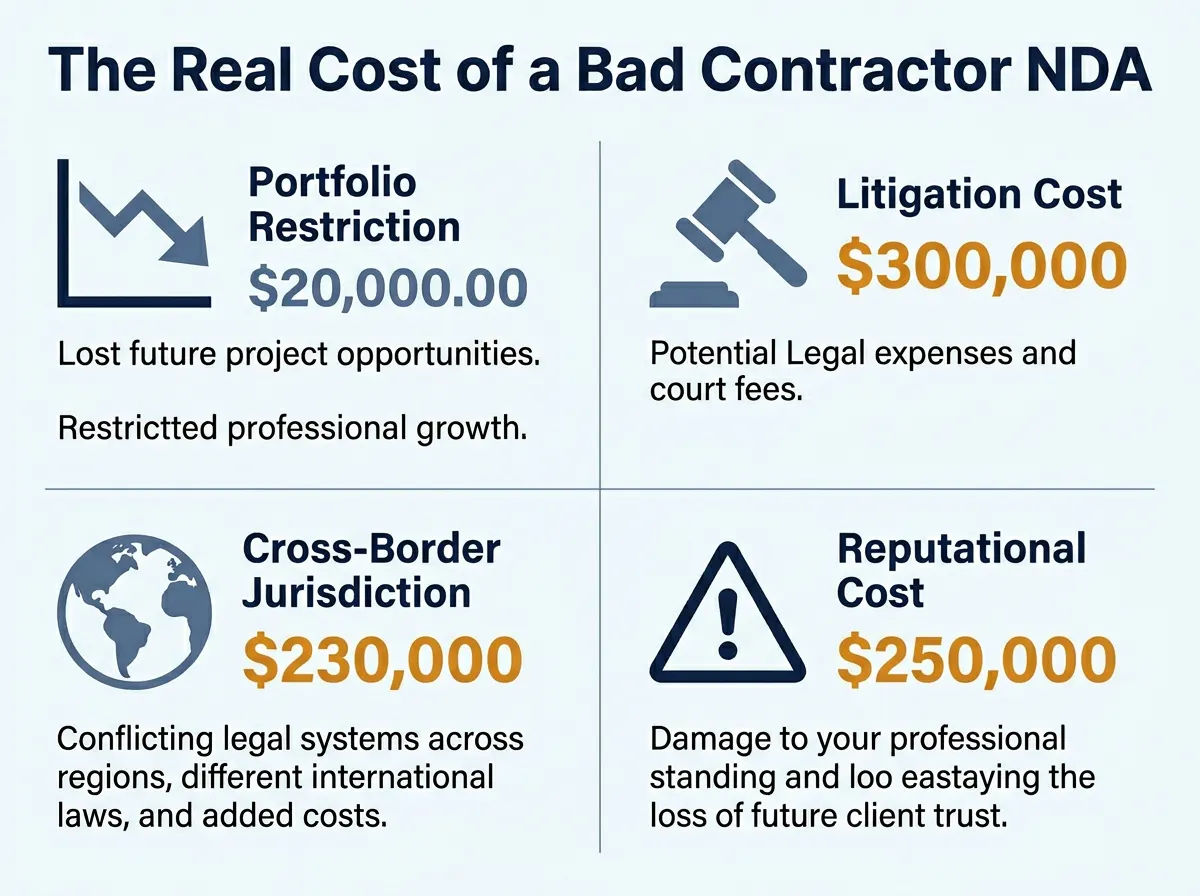
So let me put some concrete figures around what a poorly negotiated contractor non disclosure agreement can actually cost a freelancer.
Portfolio restriction cost. Research from the Freelancers Union and independent surveys of the US freelance market consistently shows that freelance professionals who maintain active, updated portfolios command rates 25 to 40 percent higher than those without demonstrable case study evidence of their work. If a blanket NDA prevents you from building your portfolio for an eight month engagement, the compounding rate impact over the following two to three years of your career is not trivial. On a baseline rate of $75 per hour, that rate differential represents tens of thousands of dollars in lost earning potential over a standard career trajectory.
Litigation cost. Even a simple NDA dispute, one involving a single clause and a relatively straightforward factual question, can cost $15,000 to $50,000 in attorney fees before it reaches any resolution. That figure comes from the American Bar Association’s published data on commercial litigation costs for small business disputes. For most freelancers operating as sole traders, that cost is existential.
Jurisdiction cost. A cross border dispute where a UK based freelancer is pulled into US litigation, or vice versa, can add travel, foreign legal representation, and currency costs that push the total well above $100,000 before any judgment is entered. And remember: even winning an unfair case costs you.
Reputational cost. This one does not have a clean number attached to it, but it is real. Being publicly associated with an NDA dispute, even one you ultimately win, can make certain clients in certain industries reluctant to engage you. Legal conflict of any kind makes corporate procurement and legal teams nervous. The reputational damage from being the contractor who “had an NDA problem” can outlast the dispute itself by years.
The point of these numbers is not to frighten you out of ever signing an NDA. Most NDAs are signed, observed, and expired without incident. The point is that the downside of signing a bad one is not abstract. It is concrete, it is significant, and it is entirely preventable with the kind of careful review this guide is designed to support.
What Business Owners and Clients Need to Know About Drafting a Fair Contractor NDA
Everything I have written so far has been primarily from the contractor’s perspective. But business owners and clients are also reading this, and they deserve a straight answer to the question they are actually asking: how do I draft a contractor non disclosure agreement that actually protects my business without being so aggressive that it drives away good talent?
Because that tension is real. I have spoken to business owners who lost excellent contractors specifically because their standard NDA template was so overreaching that experienced professionals refused to sign it. The template they downloaded was written for a corporate enterprise with a legal department, not for a small business hiring a freelance specialist.
Here is what a fair, effective, and talent friendly contractor confidentiality agreement looks like from the client side.
Be specific about what you are actually protecting. Before you draft the definition of confidential information, ask yourself: what would genuinely hurt my business if this contractor shared it externally? Write that list down. Those are the things your NDA should name. If you struggle to make the list, that is a signal that the confidentiality concerns may be less acute than a blanket NDA implies.
Set a realistic term. Most business information has a commercially relevant lifespan. A marketing strategy that is cutting edge today will be well known industry practice in two to three years. A website design that feels unique now will be widely replicated within 18 months. Set a confidentiality term that reflects how long the information is genuinely valuable, not the maximum possible restriction you could theoretically impose.
Include a portfolio exception. Allowing contractors to reference their work with you (with identifying details anonymised if necessary) costs you nothing and makes you significantly more attractive as a client to the best talent in any field. Experienced creative and technical professionals specifically look for whether portfolio rights are included before they evaluate an NDA favourably.
Do not use your NDA to restrict general professional skills. Your contractors bring expertise to the table. That expertise belongs to them. Using an NDA to prevent a contractor from applying general professional knowledge to other clients is overreach that courts will not support and that experienced contractors will not accept.
Get it reviewed by an attorney before you send it. The cost of a one hour attorney review of a contractor NDA template is typically $200 to $500. The cost of discovering that your NDA is unenforceable at the moment you most need it to hold up is considerably higher than that.
How to Protect Your Freelance Business Beyond the NDA
A signed contractor non disclosure agreement is one layer of protection. It is not the only one, and relying solely on an NDA to protect sensitive information on either side of the relationship is a mistake.
Here are the additional protective measures that work alongside a well drafted NDA to create genuine, durable confidentiality protection.
Access controls and need to know sharing. The single most effective protection against confidential information leaks is not a contract. It is not sharing information that does not need to be shared. Before you provide a contractor with access to sensitive systems, customer data, or proprietary documents, ask whether they genuinely need that access to do the work. Limiting access limits exposure regardless of what the NDA says.
Project management tools with permission controls. Tools like Asana, Monday.com, Notion, and similar platforms allow you to control exactly what a contractor can see within a project workspace. Using these tools intelligently means a contractor working on your content calendar does not automatically have access to your financial projections, even if they are stored in the same workspace.
Separate confidential materials from working materials. Do not send your entire company strategy document to a contractor who is being hired to write three blog posts about a tangentially related topic. Share only what the work requires. This is good practice regardless of what your NDA says.
Document every sharing event. Keep a record of what confidential information you shared, when you shared it, and with whom. If you ever need to pursue an NDA breach claim, demonstrating that the specific information was actually disclosed to the specific contractor at a specific time is foundational evidence. Without that record, even a perfectly drafted NDA becomes difficult to enforce.
For contractors: keep your own records too. Document what confidential information you received, when you received it, and what you did with it. If a client ever makes an unfounded NDA breach claim against you, your own records of appropriate handling are your defence.
The Freelance Community’s Most Persistent NDA Myths, Debunked
The freelance community has developed a set of persistent beliefs about NDAs that circulate through forums, Facebook groups, and Reddit threads with varying degrees of accuracy. Some of these beliefs are partially true. Some are completely false. All of them are worth addressing directly.
Myth 1: “If a client seems trustworthy, I do not need to read the NDA carefully.”
Trust is a relationship quality. An NDA is a legal document. These two things operate in completely separate categories. A genuinely trustworthy client drafted their NDA intentionally and can explain every clause it contains. A client whose trustworthiness you are relying on as a substitute for reading the contract is a client whose contract you have not actually evaluated.
Myth 2: “NDAs are not really enforceable anyway, so it does not matter what they say.”
This myth comes from a grain of truth: some specific clauses in some NDAs are unenforceable in some jurisdictions. But that does not mean NDAs are broadly unenforceable. Well drafted contractor non disclosure agreements are enforced by US and UK courts regularly. The Defend Trade Secrets Act created a federal civil cause of action specifically designed to make trade secret NDA enforcement faster and more accessible. This myth causes real harm when it leads contractors to sign documents they have not read on the assumption that it will not matter.
Myth 3: “Once I sign, there is nothing I can do about bad terms.”
False. Contracts can be amended. If you have an ongoing relationship with a client and discover that the NDA terms are more restrictive than you realised, you can approach the client and propose a written amendment. Amendments are common in commercial relationships. Most clients with reasonable intentions will engage in that conversation. And even without a formal amendment, a court assessing a disputed clause will consider the commercial context, the relative bargaining positions, and whether the clause in question reflects a genuine, proportionate business interest.
Myth 4: “My NDA protects me from the client disclosing my information too.”
Only if it is a mutual NDA. A one way contractor non disclosure agreement, which is the type most freelancers sign, creates confidentiality obligations for the contractor only. If you want protection for your own proprietary information, your own methodologies, your own pricing structures, you either need a mutual NDA or separate contractual language addressing those specific assets.
Myth 5: “I cannot negotiate an NDA because I am just a freelancer.”
This is the myth that does the most damage, and it is the one I most want to dismantle.
Professional negotiation of contract terms is not a privilege reserved for large businesses or powerful individuals. It is a standard commercial practice. Every time a real estate agent negotiates a purchase agreement, every time a supplier negotiates payment terms, every time a publisher negotiates a book contract, that is exactly what they are doing: reading a document, identifying terms that do not serve their interests, and proposing alternatives.
Freelancers have every right to do the same thing. The only difference is confidence, and confidence comes from knowing what you are looking at and what to say about it.
Which is what this entire guide is designed to give you.
Building Your Personal NDA Review Checklist: A Practical Tool for Every Contract
Every time a client sends me a contractor non disclosure agreement, I run through the same checklist before I respond. I am sharing it here because having a systematic approach eliminates the anxiety of trying to remember everything in the moment when the excitement of a new project is pulling your attention toward just signing and starting.
Print this out. Save it to your notes app. Use it every time.
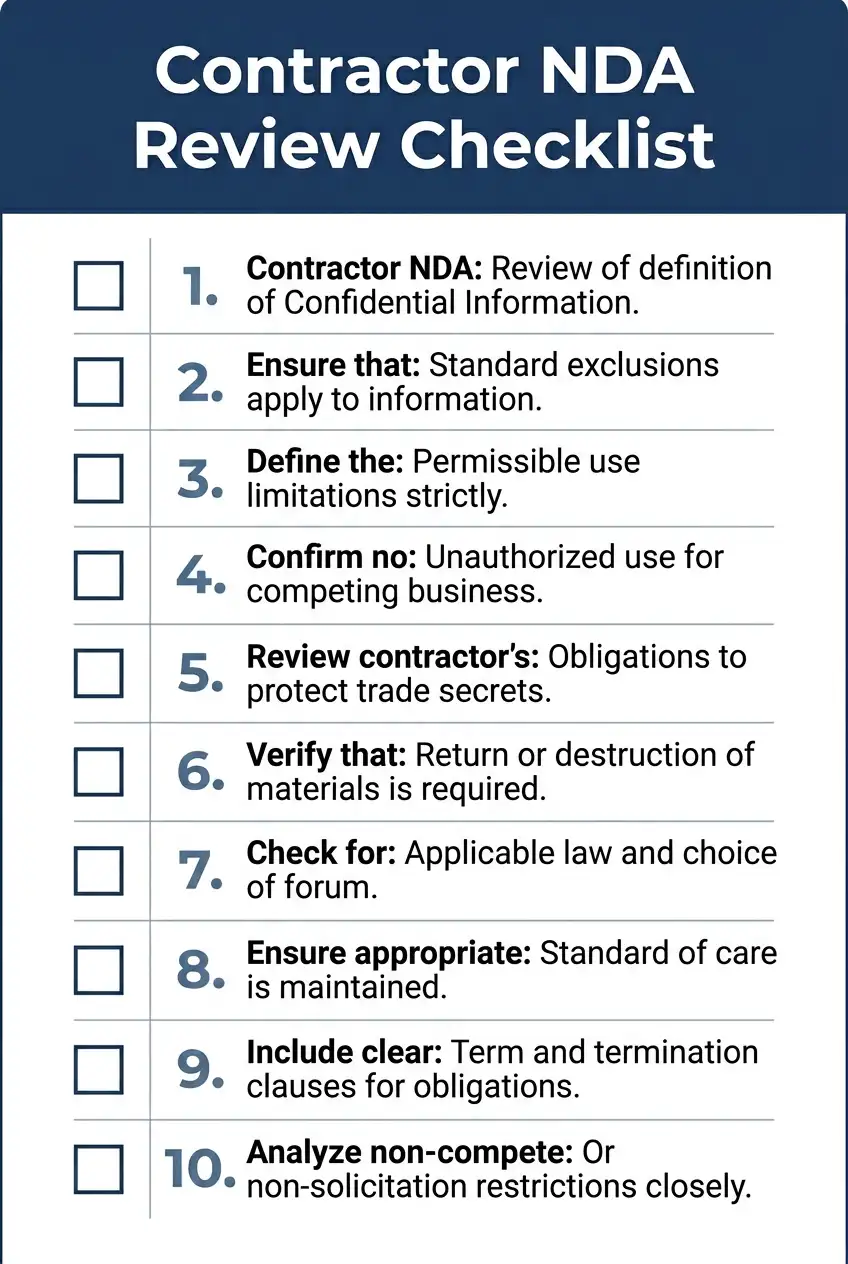
Definition of Confidential Information
Is the definition specific and bounded, or does it use sweeping catch all language? Does it include “oral” or “observed” information without limitation? Can you name the actual things being protected from this definition?
Exclusions
Are the four standard exclusions present? Public domain information. Pre existing knowledge. Independently developed information. Third party disclosed information without confidentiality obligation. If any of these are missing, flag it.
Duration
Is there a specific end date or defined period? Or do you see words like “perpetual,” “in perpetuity,” or no end date at all? What is the trigger date for the start of the period: the signing date, the project start date, or the project end date?
Permitted Use
Does the agreement specify exactly what you are permitted to do with confidential information, or does it only describe what you cannot do? A clear permitted use clause is more useful than a long list of prohibitions.
Portfolio Rights
Is there an explicit portfolio exception clause? If not, does the agreement contain any language that would prevent you from referencing or displaying completed work?
IP Ownership
Does the agreement contain any work for hire language, intellectual property assignment clauses, or ownership transfer provisions? If so, those need to be addressed separately from the confidentiality terms.
Governing Law and Jurisdiction
Which state or country’s law governs the agreement? Which courts have jurisdiction? Is that jurisdiction accessible to you if a dispute arises? Is online arbitration or mediation specified as a first step?
Remedies and Damages
Does the remedies clause limit the client to actual provable damages, or does it include a pre agreed penalty figure? Is there an injunction consent clause? Is there a limitation of liability cap protecting you?
Residuals Clause
Is there a residuals clause protecting your right to use general knowledge retained in memory after the engagement? If you are in a technology field, this matters more than most people realise.
DTSA Whistleblower Notice
For US governed agreements: does the NDA include the federally required notice informing you of your right to disclose confidential information to government authorities in connection with reporting a legal violation? If not, the client cannot seek exemplary damages under the DTSA.
Run every NDA through that checklist. It takes fifteen minutes and it can save you years of regret.
A Note on AI Generated NDA Templates in 2026
Something has changed in the contract landscape since 2023 that deserves direct attention.
Clients are increasingly arriving with contractor non disclosure agreements that were generated by AI tools. ChatGPT, Claude, Gemini, and purpose built legal AI platforms can produce plausible looking NDA documents in seconds. Some of these documents are reasonably well structured. Others contain subtle errors that a trained legal eye would catch immediately but that a non lawyer freelancer reviewing quickly would miss entirely.
I have reviewed AI generated NDAs that omitted the DTSA whistleblower immunity notice entirely. I have seen AI generated agreements that used jurisdictional language appropriate for a different country’s legal system. I have seen “mutual” NDAs drafted by AI tools that accidentally created asymmetric obligations because the template the AI was trained on was a unilateral agreement.
The existence of AI generated legal documents does not change your obligation to read and understand what you are signing. If anything, it raises the stakes slightly, because the surface presentation of a polished, professional looking document no longer tells you whether the underlying content is legally sound.
The checklist above applies regardless of whether a document was drafted by a human attorney, downloaded from a template website, or generated by an AI in thirty seconds.
And the negotiation scripts work on all three equally well.
Contractor Non Disclosure Agreement: Your Questions from Real Forums, Answered
I pulled these questions directly from live forum discussions on Reddit, Quora, Law Stack Exchange, and Facebook freelance groups. These are the things real people are actually asking, and they deserve real answers.
“This is my 15th job on Upwork and I had never signed any contract before. This client has a good reputation and seems trustworthy, but I would like to know how dangerous NDAs are.” (Reddit, r/Upwork)
NDAs are not inherently dangerous. They are standard professional instruments used across every industry. The risk is not in signing one. The risk is in signing one without reading it. At job 15 on Upwork, you have been operating without formal confidentiality documentation, which means either the work you have been doing did not require it or clients have been choosing to trust you informally. A client who now wants a formal NDA is not necessarily a red flag. Read the specific terms. Evaluate the specific language. A client with a good reputation who insists on a fair NDA is behaving professionally.
“What if a client sends you an NDA to sign before approving the contract conditions? Is that okay?” (Facebook, Upwork for Freelancers group)
It is common practice and generally fine. Clients often want a signed NDA in place before they will share the detailed project brief, because the brief itself may contain confidential information. The key is that you are not obligated to sign before you know the NDA’s terms. You can and should read the NDA fully before signing even if the full project scope is not yet disclosed. Ask for the NDA document, review it, request any amendments you need, and then sign. The sequence of NDA first, then project detail is normal. Signing without reading is not.
“I wanted to know more about NDA contracts. What can I do after signing them and what can’t I do? I never understood if I can work for other clients in the same industry.” (Law Stack Exchange)
The top answer on that thread made an important distinction that I want to reinforce here. An NDA restricts what you can say, not what work you can do. Unless your NDA contains a non compete or non solicitation clause, which is a separate legal instrument that sometimes gets bundled into NDA documents, you are entirely free to work for other clients in the same industry after signing a contractor non disclosure agreement. You just cannot share one client’s confidential information with another. Knowing that Client A uses a specific CRM software is not something you share with Client B. But your general expertise in CRM implementation? That is yours. It travels with you. No NDA can take it.
“Can anyone provide me a non disclosure and employment contract which will assure contractors are unable to steal staff?” (Facebook, NDIS Registered Providers Network)
This question is asking for two separate instruments bundled into one document. An NDA addresses confidentiality of information. A non solicitation clause addresses the protection of staff relationships. They can coexist in the same contractor agreement, but they need to be drafted as distinct provisions with their own specific terms, not treated as a single concept. The non solicitation clause should specify: which staff members are covered, for how long after the engagement, and what actions are prohibited. “Stealing staff” typically means soliciting or hiring specific employees or contractors known through the engagement. Broad non solicitation clauses face the same enforceability scrutiny as broad non compete clauses, so specificity matters.
“I hired a contractor to develop an app for me. Should I ask them to sign an NDA?” (JustAnswer)
Yes. Before you share any information about the app concept, the technical specifications, the business logic, or the target user data, you should have a signed NDA in place. Not because the contractor is untrustworthy, but because an NDA creates clear shared expectations about confidentiality from the outset and provides a legal framework if anything goes wrong. The JustAnswer attorney response to this question also noted the distinction between a unilateral NDA, which protects the client’s concept, and a mutual NDA, which would also protect the developer’s proprietary methodologies if they are sharing those during the project. For an app development context where both parties may be sharing genuinely sensitive information, a mutual NDA often makes more sense than a one way document.
Final Thoughts: Your Signature Is Not Just a Formality
I want to end where I started, because the personal story I opened with was not just anecdote. It was the whole point.
The contractor non disclosure agreement sitting in your inbox right now, or the one you will receive next week, or the one you are drafting to send to your next hire, is not paperwork. It is a binding legal commitment with real financial stakes, real professional consequences, and real legal enforceability that does not care how tired you were when you clicked sign.
The freelance economy in 2026 runs on trust, speed, and momentum. Clients want to get started. Contractors want to get paid. And the psychological pressure to move quickly, to not seem difficult, to avoid slowing down the excitement of a new project, is entirely real and entirely understandable.
But that pressure is exactly the environment where bad contracts do their damage. Quietly. Quickly. Before you have a chance to think about what you agreed to.
The three things I want you to leave this guide knowing:
First: read every clause of every contractor non disclosure agreement you sign, every single time, no exceptions. Not because every NDA is a trap, but because you cannot know which ones are without reading them.
Second: negotiation is professional, not confrontational. Asking for a fair duration term, a portfolio exception, and a reasonable jurisdiction clause is not being difficult. It is being the kind of professional that serious clients want to work with long term.
Third: your pre existing knowledge, your professional skills, your general expertise, those belong to you. No client can buy them with an NDA. Any contract that tries to take them is overreaching, and you have every right to push back.
The freelance career you are building deserves legal foundations as solid as the work you produce. Read before you sign. Negotiate before you commit. And never treat your signature as a formality.
It is one of the most powerful professional tools you have.
Trending FAQs: Contractor Non Disclosure Agreement
Do contractors need to sign an NDA?
Independent contractors are not legally required to sign an NDA before starting work, but clients are entirely within their rights to require one. Unlike employees, contractors have no implied duty of confidentiality under employment law, which is exactly why clients ask for signed NDAs. The agreement creates the legal obligation that employment status would otherwise provide. From a contractor’s perspective: you can choose not to sign, but that may mean losing the engagement.
Is a contractor NDA legally binding?
Yes, a contractor non disclosure agreement is legally binding when it satisfies the basic requirements of a valid contract: offer, acceptance, consideration, and lawful purpose. Consideration in an NDA context is typically the access to confidential information and the promise of work itself. Courts will, however, refuse to enforce specific clauses that are unreasonably broad, unconscionable, or contrary to public policy, even within an otherwise valid agreement.
What should a contractor NDA include?
A contractor NDA should include: a specific definition of what counts as confidential information, explicit exclusions for public domain information and pre existing knowledge, a clear description of the permitted use of information, a defined duration with an end date, a governing law and jurisdiction clause, a process for return or destruction of data at engagement end, and a remedies clause that limits the disclosing party to actual provable damages.
How long should a contractor NDA last?
For most standard freelance and contractor work, a confidentiality period of one to three years after the engagement ends is commercially reasonable and more likely to be enforced by a court than an indefinite or perpetual obligation. Projects involving genuine long term trade secrets, such as proprietary algorithms or patented processes still under development, may justify longer terms, but those situations should be the exception and the language should say specifically why the longer term is necessary.
Can a contractor refuse to sign an NDA?
Yes. A contractor can refuse to sign any document. The consequence of refusing is typically that the client withdraws the offer of work. Whether that is acceptable depends entirely on the specific situation: how important the engagement is, how unreasonable the NDA terms are, and whether the contractor has leverage to negotiate from. Refusing to sign a predatory NDA is a legitimate professional decision, not an act of bad faith.
What happens if a contractor breaks an NDA?
If a contractor breaches a non disclosure agreement, the disclosing party can seek injunctive relief to stop the breach, claim actual financial damages caused by the disclosure, and in cases involving trade secret misappropriation under the DTSA, potentially claim exemplary damages up to twice the actual damages. The specific remedy depends on what the NDA says, what law governs, and what harm the breach actually caused. Arbitrary penalty clauses unconnected to actual loss are generally unenforceable under common law.
Does an independent contractor NDA protect intellectual property?
A contractor non disclosure agreement protects the confidentiality of information, not the ownership of intellectual property. Those are related but distinct concepts. An NDA prevents the contractor from disclosing proprietary information. An IP assignment clause in a separate agreement (or in the broader contractor agreement) determines who owns the work product the contractor creates. If you sign an NDA without also checking the IP ownership clauses in the broader contract, you might be protecting a client’s information while simultaneously signing away ownership of the work you created.
What is the difference between a contractor NDA and an employee NDA?
The core difference is the underlying legal relationship. Employees have implied duties of confidentiality and loyalty under employment law that provide baseline protection even without a written NDA. Independent contractors have no such implied duties. Every confidentiality obligation a contractor carries must be explicitly written into a contract. This makes the precision of the contractor NDA language more critical than in an employment context, because there is no employment law safety net underneath it.
Can a client make me sign an NDA after the work is finished?
According to legal guidance from JustAnswer’s attorney network, you generally cannot be compelled to sign an NDA after work is already completed without additional consideration being offered. An NDA is a contract, and contracts require consideration. If the work is done and you have already been paid, signing an NDA after the fact gives you nothing in return. That makes the agreement potentially unenforceable for lack of consideration. If a client approaches you about signing an NDA after project completion, the legally sound response is to consult an attorney before signing anything.
Is a free contractor NDA template legally valid?
A free template can be legally valid if it is properly drafted, contains all required elements, and is appropriate for the specific jurisdiction and type of engagement. The problem is not the price of the template. The problem is that most free templates are generic, often outdated, sometimes drafted for a different jurisdiction or relationship type, and rarely updated to reflect changes in law like the DTSA whistleblower immunity requirement. A free template is a starting point, not a finished document.
How do I get a contractor to sign a confidentiality agreement?
Present the NDA before sharing any confidential information. Frame it as standard professional practice rather than a sign of distrust. Provide the document with enough lead time for the contractor to review it properly, at least 48 hours before the project kickoff call. Be open to reasonable negotiations on specific clauses. Most experienced contractors will accept a fair NDA without friction. The ones who push back on reasonable terms are telling you something worth knowing before you share your most sensitive business information.
Can a contractor NDA be enforced across state lines?
Yes, contractor NDAs can be enforced across state lines in the United States, primarily through federal courts and under the Defend Trade Secrets Act for trade secret related claims. The governing law clause in the NDA determines which state’s law applies to interpret the agreement, while the jurisdiction clause determines where any lawsuit is filed. These can be different states. The practical enforceability also depends on whether the specific terms of the NDA comply with the law of the governing state, which is why California governed NDAs require particular care given California’s restrictive approach to post engagement restraints.
What should a mutual NDA for contractors include that a one way NDA does not?
A mutual NDA for contractors must include confidentiality obligations flowing in both directions, with both parties designated simultaneously as disclosing party and receiving party. The definition of confidential information needs to address both parties’ proprietary data, which may require separate definition sections if the nature of each party’s information differs significantly. The obligations, exclusions, and remedies sections should be drafted symmetrically. Duration and governing law typically apply equally to both parties’ obligations.
Can I show my work in my portfolio if I signed a contractor NDA?
Only if your NDA includes an explicit portfolio exception clause. Without that clause, a blanket confidentiality agreement may prevent you from displaying client work, mentioning client names, or even describing project outcomes in general terms. Before signing any contractor non disclosure agreement, check for portfolio rights language. If it is absent, add it. The clause I recommend is: “Notwithstanding the above, Contractor retains the right to display final, publicly released deliverables in Contractor’s professional portfolio and marketing materials.”
Download Free Contractor Non Disclosure Agreement Templates
If you need a starting point for drafting or reviewing your own contractor non disclosure agreement, several reputable platforms offer free templates that include the core structural elements described in this guide.
[Download a Free Independent Contractor NDA Template in Word Format] Editable, fillable, and formatted for immediate use in US commercial engagements.
[Download a Free Contractor NDA PDF Template] Printable format for physical signature engagements, with all six core clause sections included.
[Access the Google Docs Contractor NDA Template] Shareable, comment enabled template for collaborative review and negotiation before signing.
When using any free template, remember what I said earlier: the template is a starting point. Read every clause. Check the definition of confidential information. Verify the duration term. Confirm the exclusions are there. Check the jurisdiction clause. Add a portfolio exception if you are a creative or technical freelancer.
And if the stakes are high, which they often are in long term or high value engagements, the cost of having an attorney review the document for one hour is almost always worth it.
This article covers general legal information about contractor non disclosure agreements and does not constitute legal advice. For advice specific to your jurisdiction and situation, consult a licensed attorney.
Note to reader: This article was written from direct professional experience navigating contractor NDAs across multiple industries and jurisdictions. Every negotiation script, clause example, and red flag described here comes from real documents reviewed in real engagements. Nothing in this guide is theoretical. The mistakes described are ones I have personally caught, and in some cases, ones I have personally helped others recover from.
If this guide helped you catch something before you signed, I genuinely want to hear about it. Drop your experience in the comments below. The more of these stories that are in the open, the harder it becomes for predatory contract language to operate in the dark.