Intellectual property rights violations happen to real people every single day, and most of those people have no idea what just hit them. A writer wakes up and finds their article republished word for word on a stranger’s website. A designer discovers their logo stamped on someone else’s product. A software developer notices their code running inside an app they never agreed to license. The violation already happened. The damage is already spreading. And the person who created the work is sitting there wondering what on earth they are supposed to do next.
I have been in that exact position. Twice. And the second time, I knew exactly what to do because I had built a system between the first incident and the second one. That system is what this entire guide is about.
This is not a law school textbook. I am not a solicitor or an attorney, and nothing I write here is formal legal advice. But I have spent five years as a professional writer learning how intellectual property law actually works in practice, not just in theory. I have filed DMCA takedown notices. I have sent cease and desist letters. I have watched violations disappear within 48 hours because I knew what steps to take and in what order. And I have watched other creators lose their work permanently because they did not.
That is the gap this guide fills.
What Are Intellectual Property Rights Violations?
Intellectual property rights violations occur when someone uses, copies, reproduces, distributes, or profits from a protected creative work or invention without the legal permission of the person who owns it.
The definition sounds clean and simple. The reality is messier than that.
Intellectual property, as a legal concept, covers a broad range of creative and commercial assets. The World Intellectual Property Organization, known as WIPO, defines intellectual property as creations of the mind, which includes inventions, literary and artistic works, designs, symbols, names, and images used in commerce. When any of those creations carries legal protection and someone else interferes with that protection without authorization, you have a violation.
What makes this tricky is that the violation does not require intent. Plenty of the people who steal creative work genuinely did not know they were doing something illegal. That does not make it legal. It just makes it more awkward to resolve.
The United States Copyright Office and the UK Intellectual Property Office both publish clear guidance on what protections exist and how they apply. Both are worth reading. But neither of them tells you what to actually do when you find your work being used without permission at 11pm on a Tuesday. That is what I am here for.
Legal Definition and Key Concepts
The legal definition of an IP violation depends on which type of intellectual property right has been breached, because each type operates under its own legal framework.
Copyright, trademark, patent, and trade secret law are four completely separate bodies of law. They protect different things. They have different registration requirements. They carry different penalties. And they require different responses when violated.
Here is what each one protects in plain language:
Copyright protects original creative works the moment you create them. Writing. Music. Photography. Code. Graphic design. Film. The Berne Convention, which over 180 countries have signed, establishes that copyright protection exists automatically from the moment of creation. You do not have to register to own a copyright. But registering with the U.S. Copyright Office gives you the ability to sue for statutory damages, which is a significant practical advantage.
Trademark protects brand identifiers. Names. Logos. Slogans. Anything that signals to a consumer who made a product or provided a service. Trademark rights can arise from use in commerce, but registered trademarks through the USPTO in the United States or through the European Union Intellectual Property Office for European markets carry much stronger legal protections.
Patent protects inventions, processes, and designs. A utility patent protects how something works. A design patent protects how something looks. A plant patent protects new plant varieties developed through asexual reproduction. Patents require formal registration. The Patent Cooperation Treaty allows inventors to file internationally through a single application process.
Trade secrets protect confidential business information that gives a company a competitive edge. A formula. An algorithm. A manufacturing process. A client list. Unlike the other three, trade secrets are protected by keeping them secret rather than by public registration. The Defend Trade Secrets Act in the United States provides a federal civil cause of action for trade secret misappropriation.
IP Violations vs. IP Infringement
People use these terms interchangeably, and for most practical purposes that is fine. But there is a technical distinction worth knowing.
IP infringement is the more precise legal term. It refers specifically to the unauthorized exercise of rights that belong exclusively to the rights holder. When a musician samples another artist’s track without clearing the sample, that is copyright infringement. When a company uses a logo confusingly similar to a competitor’s registered mark, that is trademark infringement.
IP violation is a broader, more conversational term. It captures the same conduct but also includes behaviors that fall slightly outside the strict legal definition of infringement. Industrial espionage. Breaching a licensing agreement. Using licensed software beyond the scope of what the license permits.
Both terms point to the same core problem: someone is using something that belongs to someone else, without the right to do so.
Types of Intellectual Property Rights Violations
There are four main types of intellectual property violations: copyright infringement, trademark infringement, patent infringement, and trade secret misappropriation. Each carries distinct legal consequences.
I want to go through each one in real terms, not just legal definitions. Because when I ask creators which type of violation they have experienced, most of them describe the situation before they know what category it belongs to. So I will give you both.
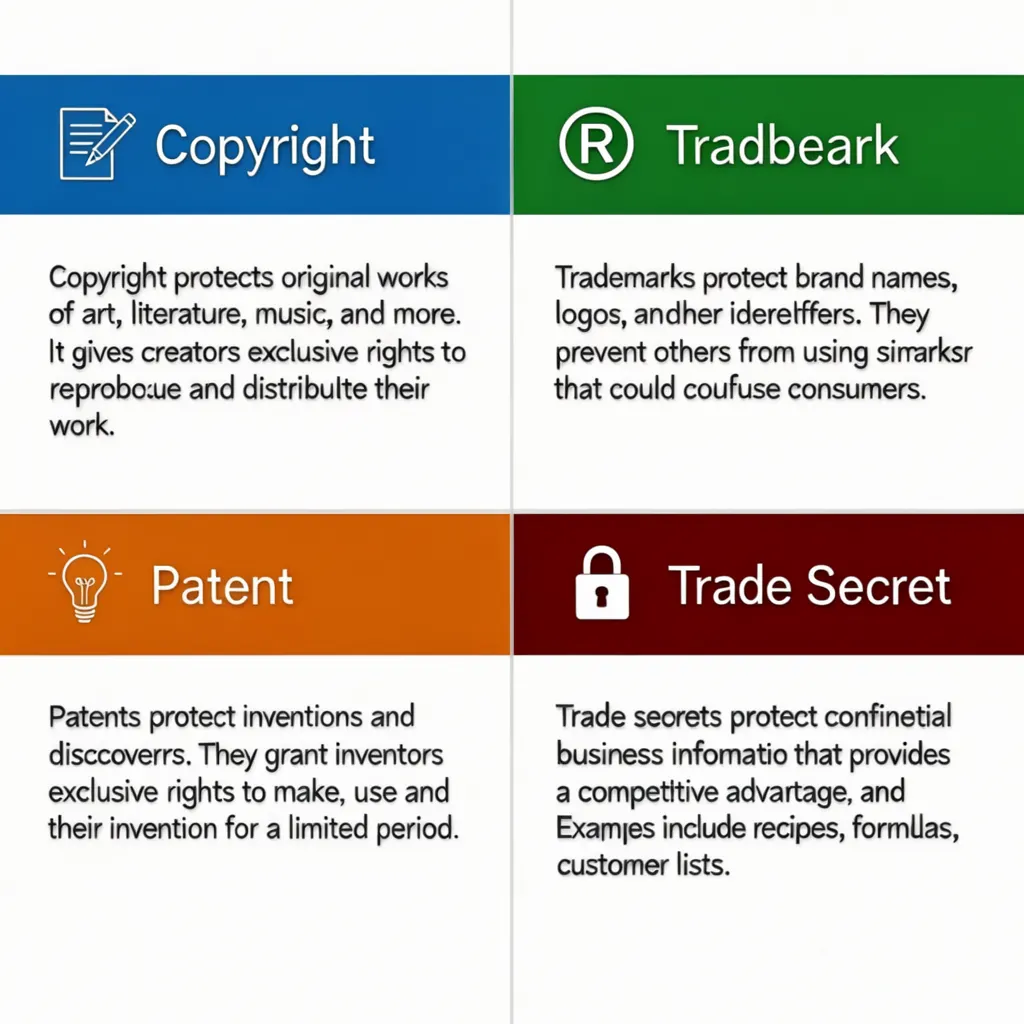
legal framework with different registration rules
and penalties.
Copyright Infringement
Copyright infringement is the most common type of intellectual property violation that freelancers, writers, photographers, and designers encounter. It is also the one most people discover by accident.
Copyright infringement occurs when someone reproduces, distributes, publicly displays, publicly performs, or creates derivative works from a copyrighted work without permission from the rights holder.
I will give you a concrete example. I wrote a 2,400 word article about content strategy. Three weeks after it published, a monitoring tool I had running flagged a match. A blog in Eastern Europe had copied the entire article, changed about 80 words to avoid basic duplication filters, and published it under a different author name. They were running Google AdSense. They were literally making money from my work.
That is copyright infringement. Classic, textbook, undeniable.
According to the U.S. Copyright Office, copyright protection in the United States lasts for the life of the author plus 70 years for works created after January 1, 1978. During that entire period, the rights holder controls reproduction, distribution, and display. Nobody else gets to make those decisions.
Fair use is the main defense people attempt when challenged on copyright infringement. The fair use doctrine allows limited use of copyrighted material without permission for purposes like commentary, criticism, news reporting, teaching, scholarship, or research. But fair use is not a blanket permission slip. Courts evaluate it case by case using four factors: the purpose and character of the use, the nature of the copyrighted work, the amount used, and the effect on the market for the original work.
“I found it on Google” is not a fair use defense. Neither is “I gave them credit.” Neither is “it was already on the internet so it was public.”
Trademark Infringement
Trademark infringement happens when a business or individual uses a mark in commerce that is identical or confusingly similar to a registered trademark, in a way likely to cause consumer confusion about the source of goods or services.
The Lanham Act governs federal trademark law in the United States. It prohibits unauthorized use of marks that creates a likelihood of consumer confusion, deception, or mistake.
Let me tell you about the kind of situation that shows up in forums constantly. Amazon Seller Central has entire discussion threads dedicated to sellers receiving IP violation notices because they listed products using brand names they were not authorized to use, or because they sold goods that a rights holder claimed were counterfeit. The confusion and panic in those posts is real. Many of those sellers genuinely did not understand that listing a product under a brand name required authorization from the brand owner.
Trademark infringement causes brand dilution, which is the gradual erosion of a mark’s distinctiveness and value. It also causes consumer confusion, which is harmful both to the rights holder and to buyers who think they are getting an authentic product when they are not.
The Madrid Protocol allows trademark owners to file for international trademark protection through a single application administered by WIPO. That matters because trademark rights are territorial. A registered trademark in the United States does not automatically protect a brand in Germany or Japan.
Copyright Infringement vs Trademark Violation
People mix these up constantly. Here is the short version:
Copyright protects creative expression. Trademark protects brand identity in commerce.
If someone copies your blog post word for word, that is a copyright issue. If someone starts selling products under a name that sounds exactly like your registered brand name, that is a trademark issue. If someone steals your logo and slaps it on their product, that could be both, because the logo is a creative work protected by copyright and a brand identifier protected by trademark.
The distinction matters because the response is different. A copyright infringement claim goes through the Copyright Office or directly through DMCA procedures online. A trademark infringement claim typically requires showing the mark is registered and that confusion is likely, which is a higher evidentiary bar.
Patent Infringement Definition
Patent infringement occurs when someone makes, uses, sells, offers for sale, or imports a patented invention within the United States without authorization from the patent holder, during the term of the patent.
A utility patent in the United States lasts 20 years from the filing date. During those 20 years, the patent holder has a legal monopoly on the invention. Nobody else gets to make, sell, or use it without a license.
Patent litigation is expensive. I mean genuinely, staggeringly expensive. A contested patent lawsuit in the United States can cost millions of dollars to litigate. That is why most patent disputes settle before trial, often through licensing agreements that allow the alleged infringer to use the patent in exchange for royalties.
The pharmaceutical industry produces some of the highest profile patent violation cases in the world. When a drug patent expires, generic manufacturers rush to produce identical formulations at lower prices. Before expiry, any manufacturer doing so without a license is committing patent infringement. Billions of dollars in revenue ride on those timelines, which is why pharmaceutical patent disputes are so vigorously litigated.
Trade Secret Violation Law
Trade secret misappropriation occurs when someone acquires, discloses, or uses a trade secret without the owner’s consent, typically through improper means like theft, bribery, fraud, or breach of a duty of confidentiality.
The Defend Trade Secrets Act of 2016 created a federal civil cause of action for trade secret theft in the United States. Before that act, trade secret claims were handled exclusively under state law, which varied significantly between jurisdictions.
This is the type of violation that happens inside companies. An employee with access to proprietary customer lists downloads those lists on their last day and takes them to a competitor. A contractor with access to a manufacturing formula shares it with a rival firm. A business partner who signed an NDA discloses confidential pricing strategies to a third party.
Trade secrets are only protected if the owner takes reasonable steps to maintain secrecy. That means having employees and contractors sign NDAs. That means restricting access to confidential information. That means having actual policies in place to protect sensitive data. A company that leaves its formula written on a whiteboard in an unlocked conference room has a much weaker trade secret claim than one that requires multi-factor authentication to access the same information digitally.
Intellectual Property Infringement Examples
Real world intellectual property infringement examples range from individuals copying blog posts to corporations stealing pharmaceutical formulas, with every variation in between.
I want to give you examples that actually happened, because abstract legal concepts only make sense when you attach them to real situations.
Famous Intellectual Property Rights Violation Cases
The Apple vs. Samsung dispute is probably the most widely covered patent and design rights battle of the modern era. Apple sued Samsung in 2011 alleging that Samsung’s smartphones and tablets copied the design and functionality of the iPhone and iPad. The litigation spanned multiple countries and multiple courts. The U.S. jury awarded Apple over one billion dollars in damages in the initial 2012 verdict, a figure that was later adjusted through appeals. The case illustrated how design patents, utility patents, and trade dress claims can all apply to a single product simultaneously.
The Oracle vs. Google case was a defining moment for software copyright. Oracle claimed that Google’s Android operating system infringed Oracle’s copyright in Java APIs. The case reached the Supreme Court, which ruled in Google’s favor in 2021, finding that Google’s use of the Java API code in Android constituted fair use. The decision had enormous implications for software development and what kinds of code can be protected by copyright.
Metallica vs. Napster in 2000 was the moment the music industry confronted the internet. Napster’s peer to peer file sharing platform allowed users to share copyrighted music files freely. Metallica filed a lawsuit alleging massive copyright infringement, and the case ultimately resulted in Napster shutting down its free service. It was one of the first major examples of how digital distribution could enable copyright infringement at a scale that was previously impossible.
In the fashion world, Christian Louboutin vs. Yves Saint Laurent centered on whether Louboutin’s red sole trademark was valid and enforceable. The Second Circuit Court of Appeals ruled that Louboutin’s red sole was indeed a valid trademark, but only when it contrasted with the upper part of the shoe. It was a fascinating ruling about how trademark law applies to design elements.
IP Violations in Digital Business
The digital space has made intellectual property infringement dramatically easier to commit and dramatically harder to detect and stop.
Content scraping is the automated practice of copying content from websites and republishing it elsewhere. It happens at scale. Thousands of pages pulled and republished in seconds. By the time the original creator notices, the scraped content may have outranked the original in search results because the scraping site had stronger domain authority.
Social media intellectual property theft is rampant. Instagram, TikTok, Facebook, and Pinterest are full of accounts that repost photographers’ images, designers’ artwork, and illustrators’ drawings without credit, permission, or payment. Some of those accounts have hundreds of thousands of followers built entirely on stolen creative work.
E-commerce platform IP violations are a massive category of their own. Amazon alone receives enormous volumes of intellectual property complaints every month. Sellers list counterfeit products. Sellers use brand names they are not authorized to use. Sellers copy product descriptions, photographs, and designs from legitimate brand listings. The Amazon Brand Registry exists specifically to give rights holders tools to identify and report these violations.
AI generated content copyright issues represent the newest frontier of IP law. When an AI model is trained on copyrighted material and then generates outputs that reproduce or closely resemble that material, questions about infringement arise that existing law was not written to answer clearly. The U.S. Copyright Office has begun issuing guidance, but the legal framework is still developing rapidly.
Consequences of IP Rights Violations
The consequences of intellectual property rights violations include civil lawsuits, statutory damages, injunctions, and in serious cases, criminal prosecution and imprisonment.
People ask me whether it is really worth fighting IP violations, especially small ones. Yes. Every time. I will explain why in a moment. But first, let me give you the full picture of what the legal system can actually do to someone who commits these violations.
Civil Penalties and Damages
In civil IP cases, the rights holder can seek actual damages, lost profits, statutory damages, and injunctive relief from the court.
Actual damages refer to the proven financial harm the rights holder suffered. If someone sold counterfeit versions of your product for a year and you can document the lost sales, those lost sales are your actual damages.
Statutory damages exist because proving actual harm is often difficult and expensive. Under U.S. copyright law, a rights holder who registered their copyright before the infringement occurred can elect to receive statutory damages instead of actual damages. Statutory damages range from $750 to $30,000 per work infringed. For willful infringement, meaning the infringer knew they were infringing and did it anyway, statutory damages can reach $150,000 per work.
That is per work. Not per incident. Per individual work infringed.
Injunctive relief means the court orders the infringer to stop. An injunction can be preliminary, issued before the case is fully decided to prevent ongoing harm, or permanent, issued as part of the final judgment. For rights holders, an injunction is often the most immediately valuable remedy because it stops the bleeding while the legal process plays out.
Attorney’s fees can also be awarded in IP cases, particularly in copyright and trademark disputes. If a court finds that the losing party’s position was objectively unreasonable, it may order that party to pay the winning party’s legal costs.
Criminal Prosecution and Jail Time
Criminal IP charges are reserved for the most serious violations, typically large scale commercial counterfeiting or piracy operations.
Yes, you can go to jail for intellectual property violations. People do.
In the United States, criminal copyright infringement under 17 U.S.C. § 506 can result in up to five years in federal prison per offense for first time offenders. For repeat offenders or offenses involving large scale distribution, sentences can reach ten years.
The National Intellectual Property Rights Coordination Center, known as the IPR Center, is a U.S. government body that coordinates federal enforcement efforts across agencies including Homeland Security, the FBI, and Customs and Border Protection. It focuses on large scale commercial counterfeiting and piracy operations, the kind that cost the global economy hundreds of billions of dollars annually.
U.S. Customs and Border Protection publishes annual intellectual property rights seizure statistics. According to CBP data, the agency regularly seizes tens of thousands of shipments of counterfeit goods at U.S. ports of entry every year, with estimated manufacturer’s suggested retail values running into the billions of dollars. The top categories consistently include luxury goods, electronics, footwear, pharmaceuticals, and cosmetics.
Intellectual Property Theft Penalties: A Quick Reference
Let me put this in clear terms that you can actually use:
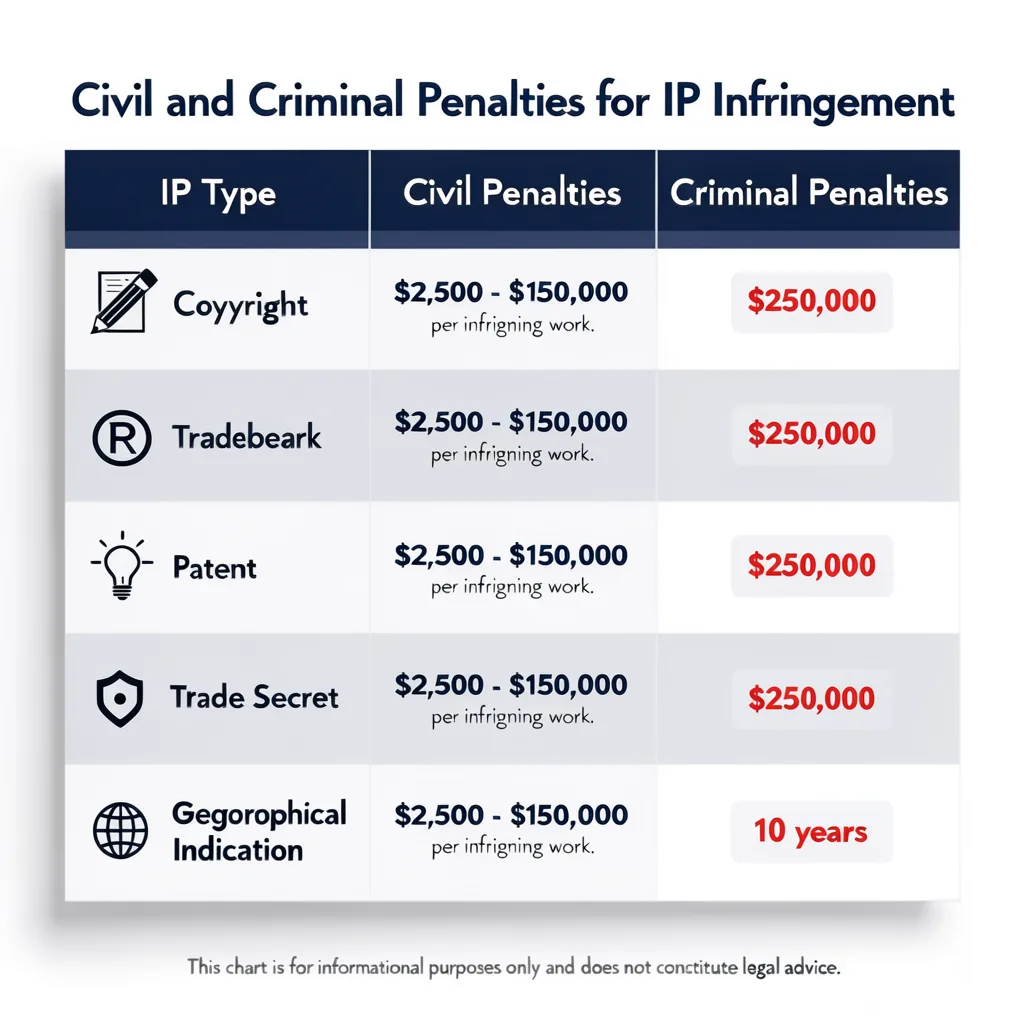
$150,000 in statutory damages per work infringed.
Copyright infringement penalties (civil): $750 to $30,000 per work in statutory damages. Up to $150,000 per work for willful infringement.
Copyright infringement penalties (criminal): Up to 5 years imprisonment per offense. Up to 10 years for repeat offenses or large scale distribution.
Trademark infringement penalties (civil): Actual damages plus profits. Treble damages (triple the amount) available for willful infringement. Statutory damages up to $2,000,000 per counterfeit mark per type of goods.
Patent infringement penalties (civil): Damages adequate to compensate for infringement, at minimum a reasonable royalty. Treble damages available for willful infringement.
Trade secret theft penalties (criminal): The Economic Espionage Act provides for fines up to $5,000,000 per offense and up to 10 years imprisonment for individuals. For economic espionage benefiting a foreign government, fines can reach $15,000,000.
How to Report Intellectual Property Violations
To report intellectual property violations, you must first document the infringement thoroughly, then report to the relevant platform or government agency depending on where the violation occurred.
This is where most people get stuck. They know something wrong happened. They do not know where to go or in what order.
Here is the order I follow, and it has worked consistently.
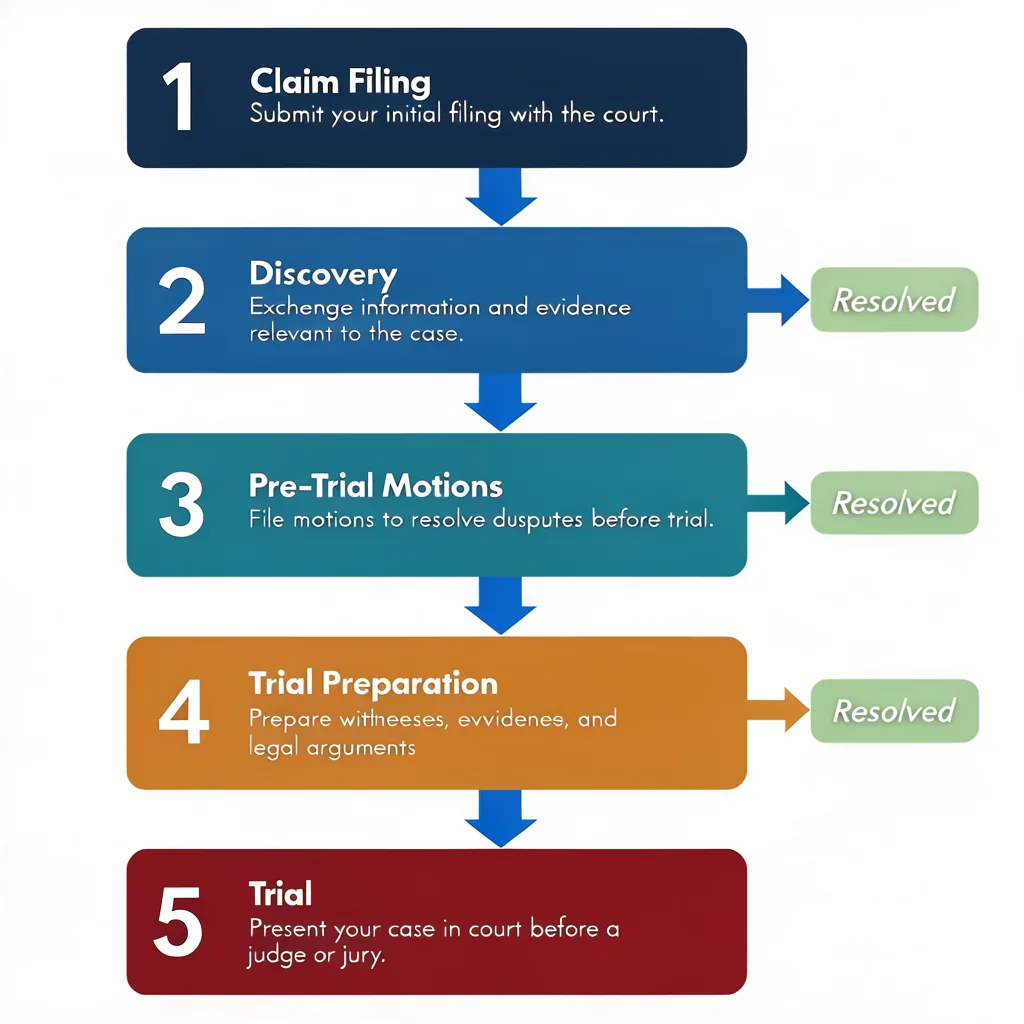
Reaching Step 5 is the exception, not the rule.
Step One: Document Everything Before You Do Anything Else
Take screenshots before you do anything else. Websites disappear. Content gets deleted. Posts get taken down the moment an infringer realizes they have been spotted. If you confront before you document, you may find yourself with no evidence to show anyone.
Screenshot the infringing content. Screenshot the URL. Screenshot any metadata visible on the page. Screenshot the date. Use a service like the Wayback Machine at archive.org to capture a timestamped archive of the page. That archive is independently verifiable and carries real evidentiary weight.
Write down when you discovered the violation and how you found it. If a monitoring tool flagged it, keep the notification. If you found it through a search, screenshot the search results showing where it appeared.
Build your evidence file before you make any contact.
Step Two: Contact the Infringer Directly
In many cases, a direct message or email explaining that you are the rights holder and requesting removal is enough to resolve the situation within 24 to 48 hours.
Not everyone who uses your work without permission did so maliciously. Some genuinely did not understand the rules. I have had infringers apologize immediately and remove the content within an hour of my first contact. I have also had infringers go completely silent and block me on every platform.
Keep your initial contact professional and factual. State what the work is. State that you are the rights holder. State that they are using it without permission. State what you want them to do (remove it, credit you properly, or pay a licensing fee). Give a specific deadline, typically 48 to 72 hours.
Do not threaten. Do not insult. Do not make this emotional in writing. Whatever you put in that first message may end up in front of a solicitor or judge later. Write accordingly.
Step Three: Send a Formal Cease and Desist Letter
A cease and desist letter is a formal written demand that the infringing party stop their unauthorized use of your intellectual property, and it puts them on legal notice that you are aware of the violation and prepared to pursue legal remedies.
This does not require a lawyer to be effective, though having a lawyer draft it adds credibility and legal precision. Services like Rocket Lawyer and LegalZoom offer IP cease and desist templates that walk you through the required elements.
A proper cease and desist for IP violation needs to include: the specific work or works involved, your basis for ownership, a description of how it is being used without authorization, a demand to immediately cease all unauthorized use, a demand to destroy or return any infringing copies, and a deadline for compliance.
Keep a copy of everything you send and everything you receive in response. That paper trail matters.
Reporting to Government Agencies
If direct contact and a cease and desist do not resolve the situation, formal complaints to government bodies are the next step.
For copyright issues in the United States, the U.S. Copyright Office handles registration and related matters. For online copyright infringement specifically, the Digital Millennium Copyright Act provides a direct mechanism.
For trademark violations, complaints can be filed with the USPTO. For counterfeit goods being imported into the United States, complaints go to U.S. Customs and Border Protection. The IPR Center accepts complaints about large scale commercial counterfeiting and piracy at its website and coordinates with multiple federal law enforcement agencies.
In the UK, the UK Intellectual Property Office provides guidance and can direct rights holders to appropriate enforcement channels. Trading Standards handles commercial fraud and counterfeiting at the local level.
For international violations, WIPO’s Arbitration and Mediation Center offers alternative dispute resolution for IP related disputes, particularly domain name disputes under the Uniform Domain Name Dispute Resolution Policy.
Filing DMCA Takedowns
The Digital Millennium Copyright Act provides a formal notice and takedown process that requires online platforms to remove infringing content promptly upon receiving a valid copyright infringement notification.
This is the fastest and most practical remedy for online copyright infringement in the United States. And it is free.
Here is exactly how it works. You identify the platform hosting the infringing content. Google, YouTube, WordPress, Squarespace, Instagram, Twitter, virtually every major platform has a designated DMCA agent and a formal submission process. You submit a DMCA takedown notice to that agent. The notice must include: your contact information, identification of the copyrighted work, identification of the infringing material and its location, a statement of good faith belief that use is unauthorized, a statement that the information in the notice is accurate, and your physical or electronic signature.
The platform then has an obligation to act on the notice or face potential liability themselves. Most major platforms respond within 24 to 72 hours. Some are faster.
Google has its own DMCA removal tool that allows rights holders to request removal of infringing content from Google Search results. This is separate from getting it removed from the hosting site, but both matter because content can sometimes rank in Google even after being removed from the original site.
If the infringer files a counter notice claiming their use was authorized or constitutes fair use, the platform may restore the content and notify you. At that point, if you want to continue pursuing removal, you would need to file a lawsuit within a specified time period.
Digital Intellectual Property Theft: The Online Epidemic
Digital intellectual property theft has exploded in scale because the internet makes copying, distributing, and monetizing stolen content easier than at any previous point in history.
I want to spend time on this section because most of the people reading this are dealing with digital violations, not physical counterfeit goods. The scale of what is happening online is staggering.
According to a report by the U.S. Chamber of Commerce Global Innovation Policy Center, global IP theft costs the American economy between $225 billion and $600 billion annually. That range exists because comprehensive measurement is genuinely difficult. But even the lower figure is an economic catastrophe.
$600 billion every single year — and most of it
Content Scraping and How to Stop It
Content scraping is the automated mass copying of written content from websites, typically executed by bots running scripts that pull page content and republish it, often at scale across multiple sites.
Scrapers are not looking at your work and admiring it. Automated scripts pull your content the moment it publishes, sometimes before your own audience has even read it. The scraped version goes up on a site designed to generate ad revenue using other people’s content.
I have had articles scraped and republished on sites generating AdSense revenue within hours of my original publication. The scraper site outranked my original in Google for nearly two weeks before I identified it and filed a DMCA notice.
To reduce scraping vulnerability, add a clear copyright notice to every page of your website. Configure your RSS feed to provide summaries rather than full text. Set up monitoring through Copyscape or a similar service. And register your most commercially valuable content with the U.S. Copyright Office, because registration opens the door to statutory damages.
Social Media IP Theft
Social media platforms are the single environment where I see the most casual, frequent, and brazen intellectual property theft happening to creative professionals.
Photography is especially vulnerable. A photographer posts a stunning image. Within hours, it has been screenshotted and reposted by dozens of accounts, none of which asked permission, paid a license fee, or even credited the original creator. Some of those accounts have hundreds of thousands of followers. Some are brands that would never dream of stealing physical property but see digital images as freely available.
Every major social platform has an IP reporting mechanism. Instagram and Facebook use a reporting form that lets rights holders identify infringing content and request removal. YouTube uses its Content ID system for video and music, which allows rights holders to automatically claim or block videos that use their copyrighted material. TikTok has a similar process.
The pain point that forums consistently surface is the speed of reposting. By the time a takedown is processed, the infringing post may have already been seen by hundreds of thousands of people. Prevention matters as much as response.
Watermarking your images, embedding metadata that identifies you as the creator, and using low resolution versions for social media posting while retaining high resolution originals are practical steps that make your work less attractive to thieves and easier to prove ownership of if theft occurs.
Software Piracy and IP Law
Software piracy is the unauthorized copying, distribution, or use of software, and it consistently ranks as one of the most economically damaging forms of intellectual property theft globally.
LinkedIn posts from IP professionals confirm what the data shows: software piracy is the single most common IP violation category by volume and by economic impact. BSA, the Software Alliance, publishes annual studies on software piracy rates by country. In high income countries, commercial software piracy rates range from around 15 to 25 percent. In lower income countries, rates can exceed 50 percent.
Softlifting is the specific term for using a single seat software license across multiple users in a business. It sounds minor. It is not. A company using one licensed copy of software across 20 workstations has infringed the copyright in that software 19 times over. Each instance is a separate violation.
Hard disk loading is the practice of selling computers with unauthorized copies of software pre-installed. This typically happens through smaller, non-authorized resellers and is a significant vector for commercial software piracy.
The Business Software Alliance actively investigates complaints and tips from employees who report their own employers for software license non-compliance. Those reports can trigger audits that result in significant financial settlements.
Intellectual Property Rights Enforcement
Intellectual property rights enforcement involves the legal mechanisms, government agencies, private actions, and technological tools used to detect, stop, and seek remedies for IP violations.
The enforcement landscape operates on multiple levels simultaneously. Rights holders enforce their own rights through civil litigation and takedown processes. Government agencies enforce criminal IP statutes. Customs authorities intercept counterfeit goods at borders. Platform providers enforce IP policies through content moderation systems.
IP Violation Remedies and Damages: What You Can Actually Recover
The remedies available for intellectual property violations include injunctions to stop ongoing infringement, monetary damages to compensate for harm, recovery of the infringer’s profits, and in exceptional cases, attorney’s fees.
Let me be specific about what courts look at when calculating damages.
For copyright infringement, courts can award either actual damages plus the infringer’s profits attributable to the infringement, or statutory damages. The practical advantage of statutory damages is that you do not have to prove precisely how much money you lost. The statutory range exists specifically to provide a remedy even when the exact economic harm is difficult to quantify.
For trademark infringement under the Lanham Act, a rights holder can recover the defendant’s profits, any damages sustained by the plaintiff, and the costs of the action. Courts can adjust damage awards up to three times the actual damages assessed. For counterfeiting specifically, statutory damages are available ranging from $1,000 to $200,000 per counterfeit mark per type of goods, and up to $2,000,000 per mark per type of goods for willful counterfeiting.
Patent damage calculations typically center on lost profits or a reasonable royalty. Georgia Pacific Corp. v. United States Plywood Corp. established a 15 factor framework that courts use to determine reasonable royalty rates, and that framework is still widely applied today.
Small Business Intellectual Property Rights Violations: A Specific Warning
Small businesses face a specific and underappreciated vulnerability with IP violations that I want to address directly.
Small businesses are both more likely to have their IP violated and less equipped to respond because they typically lack in-house legal counsel and the resources to fund prolonged litigation.
The practical answer for small businesses is prevention over prosecution. Get your key assets registered. Trademark your business name and logo. Register the copyright in your most commercially valuable content. Get NDAs signed before sharing any proprietary business processes or formulations with partners, contractors, or employees.
Many IP attorneys offer free or low cost initial consultations. The Small Business Administration provides resources on IP protection that are practical and free. The USPTO has a Pro Se Assistance Program for inventors who cannot afford representation for patent applications.
And when a violation does happen, know that most of them resolve without litigation. A clearly written cease and desist, sent promptly with good documentation, resolves the majority of IP disputes I have ever seen discussed in professional forums and communities.
How to Protect Your Intellectual Property from Violations
The most effective protection against intellectual property rights violations combines proactive registration, contract discipline, ongoing monitoring, and knowing exactly what steps to take the moment you discover a violation.
I want to give you the actual system I use, not a generic checklist.
IP Registration Strategies
Registering your intellectual property transforms it from an asset you merely own into an asset you can actively enforce in court, with access to significantly stronger legal remedies.
For copyright, registration with the U.S. Copyright Office is not required to own the copyright. But it is required to sue for statutory damages and attorney’s fees. The registration process is inexpensive, generally between $45 and $65 for most online registrations, and a single registration can cover a collection of unpublished works. Register your copyright at copyright.gov.
For trademarks, federal registration with the USPTO gives you the right to use the ® symbol, nationwide legal presumption of ownership and exclusive right to use the mark on covered goods and services, and access to federal courts for infringement claims. The application process takes time, typically 8 to 12 months for a straightforward application, but the protection begins from the filing date.
For patents, file early. Patent rights in the United States operate on a first to file basis since the America Invents Act of 2011. If you have a potentially patentable invention and you are considering filing, the clock is running. A provisional patent application can establish your priority date at lower cost, giving you 12 months to file a full utility patent application.
Legal Tools and Monitoring Services
Consistent monitoring is the difference between catching a violation early, when it is easy to resolve, and discovering it months later when the damage is already done.
Here are the tools I personally use and recommend:
Google Alerts: Free. Takes three minutes to set up. Enter your name, your business name, your key article titles, and any distinctive phrases from your most valuable content. Google emails you when those terms appear in new indexed content. It misses content that is not indexed, and it misses image theft, but it catches enough to justify the three minutes it takes to configure.
Copyscape: Designed specifically for written content. Paste in a URL and it scans for pages that have copied that content. The basic version is free. Copyscape Premium offers batch scanning and automatic monitoring. I run my most valuable pieces through it monthly.
Pixsy: Designed for photographers and image creators. It scans the web continuously for copies of your images and alerts you to unauthorized use. Pixsy also offers a service where they pursue infringers on your behalf and take a percentage of any recovered funds. I have heard consistently positive reports from photographers who have used this service.
TinEye: Reverse image search specifically for photographers. Upload an image and it finds where that image appears online. Free for limited searches, subscription available for heavy users.
Bing Image Search and Google Image Search: Both allow you to reverse search images. Drag an image into the search bar and both engines will show you where that image appears online. Free and worth doing periodically for your most commercially valuable images.
Contracts as Your First Line of Defense
A properly drafted contract is the single most powerful tool in preventing intellectual property violations, because it defines ownership, scope of use, and legal recourse before any dispute arises.
I learned this the painful way. My first IP theft involved a client who commissioned a piece, received it, and then used it in ways the informal agreement had not covered. When I pushed back, they claimed the payment covered everything. I had no written record to contradict that claim.
A solid freelance contract for creative work should include, at minimum:
An ownership clause: Ownership of all work product remains with the creator until full payment is received. At that point, ownership transfers to the client only for the specifically agreed uses. All other rights are reserved.
A scope of use clause: The license granted is for specific, named uses only. The client may not sublicense, resell, or repurpose the work without a new agreement.
A governing law clause: Specifies which state’s or country’s laws govern the contract. This matters enormously if a dispute goes to court.
A payment and transfer clause: Work product ownership transfers only upon receipt of cleared funds, not upon delivery of draft materials.
A dispute resolution clause: Specifies whether disputes go to arbitration, mediation, or litigation, and in which jurisdiction.
Electronic signatures through services like DocuSign, HelloSign, or similar platforms are legally valid in the United States under the Electronic Signatures in Global and National Commerce Act. There is no excuse for starting work without a signed agreement.
Intellectual Property Violations in the Workplace
Intellectual property violations in the workplace are one of the most financially damaging and least publicly discussed categories of IP theft, because they involve trusted insiders with legitimate access to proprietary information.
The forum discussions I have read on this topic reveal a consistent pattern: the violations often begin before the employee even leaves the company. Downloads of client lists. Copies of proprietary processes. Photographs of internal documents. All taken under the radar by someone planning to go to a competitor or start their own competing business.
The Defend Trade Secrets Act gives employers a federal civil remedy for exactly this scenario. But it only helps if the employer took reasonable steps to protect the trade secret in the first place. That means having employees sign NDAs. That means access controls that limit which employees can see which information. That means offboarding procedures that include revoking system access and collecting company devices promptly.
Non-compete agreements are a separate tool, and their enforceability varies dramatically by state. California essentially refuses to enforce non-compete agreements as a matter of public policy. Florida enforces them broadly. Consult an employment attorney in your specific jurisdiction before relying on a non-compete as your primary protection against employees taking your IP to a competitor.
Employee ownership of inventions is another area of active dispute. Many employment contracts contain IP assignment clauses that specify inventions created during employment using company resources belong to the company. What constitutes “company resources” is sometimes contested, particularly for employees who work remotely and use their own equipment.
International Intellectual Property Rights Violations
International IP violations present unique challenges because intellectual property rights are territorial, meaning a right registered in one country does not automatically apply in another.
This is the part of IP law that surprises most small business owners and freelancers when they first encounter it.
Your U.S. copyright exists automatically worldwide in countries that have signed the Berne Convention, which includes most major economies. But enforcing that copyright against an infringer in another country is an entirely different challenge from enforcing it domestically.
The TRIPS Agreement, administered by the World Trade Organization, sets minimum standards for IP protection that all WTO member countries must implement in their domestic law. It was a landmark development because it created a baseline of IP protection that applies globally and can be enforced through WTO dispute resolution mechanisms if a member country fails to meet the standards.
For trademark protection across multiple countries, the Madrid Protocol allows a trademark owner to file a single international application through WIPO that can seek protection in up to 130 countries simultaneously. For patent protection, the Patent Cooperation Treaty serves a similar function, allowing inventors to file a single international application that preserves their priority date while they pursue national phase applications in specific countries.
Chinese IP theft receives particular attention in the global discussion because China has historically been a major source of counterfeit goods and trade secret theft. The situation has been improving as China has strengthened its domestic IP enforcement system, partly in response to international trade pressure, but counterfeiting and piracy remain significant problems in specific sectors.
IP Violations in Specific Industries
IP Violations in the Music Industry
The music industry has experienced some of the most dramatic IP violation battles in history, from Napster to modern streaming disputes, and it remains one of the most active arenas for copyright litigation.
Sampling without clearance is the most common copyright violation in music production. When a producer samples a few seconds of an existing recording and builds a new track around it, two separate copyrights are involved: the copyright in the musical composition and the copyright in the sound recording. Both require clearance. Both cost money to license. Skipping that process is infringement.
The case of Blurred Lines brought the concept of feel and style in music copyright to mainstream attention. The court found that Pharrell Williams and Robin Thicke’s Blurred Lines infringed Marvin Gaye’s Got to Give It Up, based not on direct copying of notes or lyrics but on the feel and groove of the track. The verdict was controversial among musicologists and IP scholars, but it demonstrated that copyright protection in music can extend further than most people assumed.
Performance rights organizations like ASCAP, BMI, and SESAC in the United States, and PRS for Music in the UK, exist specifically to license public performances of copyrighted music and distribute royalties to rights holders. Businesses that play music publicly without obtaining the appropriate performance license from these organizations are committing copyright infringement, even if they are just streaming a Spotify playlist in a cafe.
Pharmaceutical Patent Violations
In the pharmaceutical industry, patent protection for drug compounds and manufacturing processes is the primary mechanism that allows companies to recoup the massive investments required to develop new drugs.
A typical drug development cycle from early research to market approval can take 10 to 15 years and cost over a billion dollars. The patent system gives pharmaceutical companies a limited period of market exclusivity to generate returns on that investment before generic manufacturers enter the market.
Paragraph IV patent challenges are a specific legal mechanism under the Hatch-Waxman Act that allows generic drug manufacturers to file for FDA approval of a generic drug before the relevant patents expire, by arguing that those patents are invalid or would not be infringed. This triggers a 30 month stay and potential patent litigation. It is a formalized, statutory process for contesting pharmaceutical patents, and it produces enormous volumes of litigation.
Technology Sector IP Disputes
The technology sector generates more patent litigation per sector than any other industry, driven by the enormous commercial value of software and hardware innovations and the aggressive patent enforcement strategies of major corporations.
Patent trolls, more formally called non-practicing entities or NPEs, are companies that hold patents not to practice the inventions themselves but to extract licensing fees and settlements from companies that do. The term is pejorative, and whether it applies to any specific entity is contested. But the economic impact of NPE litigation is real and significant.
The Electronic Frontier Foundation tracks what it calls stupid patent cases through its Defend Innovation project, documenting instances where overly broad patents are being asserted against basic software functionality. The EFF has been a consistent advocate for patent reform and provides resources for individuals and businesses facing patent threats.
Trending FAQs About Intellectual Property Rights Violations
Here are the most frequently asked questions about intellectual property rights violations, drawn from search data, forum discussions, and real world situations I have encountered.
What are the different types of intellectual property rights violations?
The four main types are copyright infringement, trademark infringement, patent infringement, and trade secret misappropriation. Each protects different kinds of intangible assets and carries different legal consequences. Copyright protects creative expression, trademark protects brand identity, patent protects inventions and processes, and trade secret law protects confidential business information.
What is considered an intellectual property rights violation?
Any unauthorized use, reproduction, distribution, display, sale, or disclosure of intellectual property protected by law constitutes a violation. This includes copying someone’s article without permission, selling products under a brand name without authorization, manufacturing a patented product without a license, and sharing a company’s confidential formula with a competitor.
What happens when someone violates your intellectual property rights?
You have the right to demand they stop, seek monetary compensation for harm caused, and pursue court orders preventing further infringement. Practically speaking, most violations are resolved through direct contact, DMCA takedowns, or cease and desist letters before they reach formal litigation.
Can you go to jail for an intellectual property violation?
Yes. Criminal copyright infringement under federal law can result in up to five years in prison per offense. Large scale commercial counterfeiting and trade secret theft that benefits foreign governments can result in up to ten or fifteen years imprisonment respectively. Criminal charges typically require large scale, commercial, willful infringement rather than individual, inadvertent misuse.
How do intellectual property violations affect small businesses?
Small businesses are affected both as victims and as inadvertent infringers. As victims, they may lack the resources to enforce their rights effectively. As infringers, they may unknowingly use trademarked names, unlicensed images, or software they are not licensed to use, and face demands, lawsuits, or platform sanctions as a result.
How do I report copyright infringement to Google?
Go to Google’s DMCA removal tool at google.com/webmasters/tools/dmca-notice. Complete the form identifying yourself as the rights holder, the copyrighted work, and the infringing URLs. Google reviews valid notices and removes qualifying content from search results. Reporting the infringement to the hosting platform separately is also necessary to get the content taken down at source.
What is the difference between copyright and trademark violation?
Copyright infringement involves unauthorized reproduction or use of creative expression, such as text, images, music, or code. Trademark infringement involves unauthorized use of a brand identifier in commerce that creates consumer confusion about who made a product or provided a service. They are separate legal claims, though some situations, like logo theft, can involve both simultaneously.
How to protect your intellectual property from violations?
Register your key assets. Copyright registration opens the door to statutory damages. Trademark registration provides nationwide presumption of ownership. Use signed contracts with clear ownership and scope of use clauses for all client work. Set up monitoring tools like Google Alerts, Copyscape, and Pixsy. Respond to every violation you discover, because non-response signals that you can be taken advantage of.
How long does an intellectual property violation last on a platform?
Once a valid DMCA notice is filed, most major platforms respond within 24 to 72 hours. On Amazon, IP violations logged against a seller account can remain on the account record even if successfully appealed, which affects account health metrics. Facebook and Instagram typically process intellectual property reports within a few days, though complex cases can take longer.
How to sue someone for an intellectual property violation?
Consult an IP attorney first to assess whether your case meets the requirements for litigation, including whether your copyright is registered if you want to pursue statutory damages. If your attorney recommends proceeding, a complaint is filed in federal court. Discovery follows, then potential settlement or trial. Most cases settle. The decision to sue should factor in the estimated cost of litigation versus the damages realistically recoverable.
What should I do if someone violates my intellectual property rights?
Document the violation immediately with screenshots and timestamps. Contact the infringer directly if safe to do so. File a DMCA takedown notice if the violation is online. Send a cease and desist letter. Consult an IP attorney if the situation does not resolve or involves significant monetary stakes.
Are intellectual property violations in the workplace common?
Yes. Employee theft of trade secrets, customer lists, and proprietary processes is among the most economically damaging forms of IP theft. Preventive measures including NDAs, access controls, and proper offboarding procedures are essential. The Defend Trade Secrets Act provides a federal civil cause of action for employers whose trade secrets are misappropriated by employees or former employees.
What are the most famous intellectual property rights violation cases?
Apple vs. Samsung, Oracle vs. Google, Metallica vs. Napster, Blurred Lines (Williams and Thicke vs. Marvin Gaye’s estate), and Christian Louboutin vs. Yves Saint Laurent are among the most widely cited. These cases shaped how courts apply IP law to technology, software, music, and fashion respectively, and they remain reference points for anyone studying how IP disputes play out in practice.
What is the TRIPS Agreement and why does it matter for IP violations?
The TRIPS Agreement is the Agreement on Trade-Related Aspects of Intellectual Property Rights, administered by the World Trade Organization. It establishes minimum standards of IP protection that all WTO member countries must implement in their domestic law. It matters because it created a baseline of global IP protection that did not exist before 1995, when the agreement came into force. Countries that fail to meet TRIPS standards can face trade sanctions through the WTO dispute resolution system.
What role does the WIPO play in intellectual property rights enforcement?
WIPO, the World Intellectual Property Organization, is the United Nations agency responsible for promoting the protection of intellectual property worldwide. It administers international IP treaties including the Berne Convention, the Paris Convention, the Patent Cooperation Treaty, and the Madrid Protocol. WIPO’s Arbitration and Mediation Center provides alternative dispute resolution services for IP disputes, including domain name disputes under the UDRP policy.
Your Action Plan Starting Today
Here is what I want you to actually do after reading this. Not eventually. Today.
Open a new browser tab and go to copyright.gov if you are in the United States or ipo.gov.uk if you are in the UK. Look at the registration process for copyright. If you have written content, designed work, photographs, or code that you have not registered, make a list of your most commercially valuable pieces and plan to register them this week.
Go to Google Alerts at google.com/alerts and set up alerts for your full name, your business name, and the titles of your three most valuable pieces of content. It takes under five minutes.
Look at your current client contracts. Every active one. If any client is using your work without a signed agreement in place, that is your most urgent task. Templates from Rocket Lawyer or LegalZoom can get you a solid working contract quickly.
If you find a violation right now while reading this, go to the infringing page, screenshot everything, save the URL, and archive it on the Wayback Machine. Then send a direct message or email. Then, if that does not work within 72 hours, file a DMCA takedown. Then, if that does not work, send a cease and desist. And if that does not work, talk to an IP attorney.
Your work belongs to you. Not to the person who found it on a Google image search. Not to the client who decided your payment covered unlimited use forever. Not to the blog that scraped your article and is running ads against it right now.
You built the system you protect, or you accept the consequences of not protecting it. That is the real choice in front of every creative professional every single day.
What is the first thing you are going to do today? Drop it in the comments below.
This article is for informational purposes only and does not constitute legal advice. For specific legal guidance regarding intellectual property rights violations in your situation, consult a qualified intellectual property attorney in your jurisdiction.