
The Invoice I Sent With Shaking Hands
Net 15 payment terms changed how I run my entire freelance business. That sentence sounds dramatic. But it is completely true.
I still remember the first time I typed those four words onto an invoice. I had just finished a massive content project for a digital marketing agency. The work was good. I knew it was good. I attached the PDF to an email, wrote “Net 15 Payment Terms” at the very top of the document, and hit send.
Then I waited.
And waited.
Day fifteen came. My banking app showed the same number it had shown on day one.
That experience sent me on a research spiral that lasted weeks. I read Reddit forum threads where freelancers passionately argued about net 30, net 15, and due on receipt. I watched QuickBooks community posts where small business owners struggled to set up net due dates correctly. I found a Quora thread where a brand new contractor genuinely did not know whether to send one invoice per week or one invoice before the term ended. Real people. Real confusion. Real financial stress.
What I found was that almost everyone using net 15 payment terms was doing it wrong in at least one critical way. Not because they were bad at business. Because nobody had sat down and explained the whole picture clearly, from the actual definition all the way through to enforcement strategies that actually work.
This guide is that explanation.
I am going to walk you through exactly what net 15 payment terms mean, how the clock really works, how to write them on your invoice correctly, and how to stop late payers before they ever become a problem. I will also show you precisely when net 15 beats net 30 and when it does not, plus give you the calculation formula, real examples, and a complete FAQ section that answers the questions I see asked over and over across every freelance forum on the internet.
By the end of this post, you will never stare at an empty bank account wondering what went wrong with your invoice again.
What Does Net 15 Mean in Business?
Net 15 payment terms mean the buyer must pay the full invoice amount within 15 calendar days of the invoice date.
That is the core definition. Simple. Clean. But the reality of how it works in practice has so many layers that most people only understand about half of it.
The word “net” in this context does not mean anything tricky. It simply refers to the total amount due after any discounts, returns, or adjustments. So “net 15” literally translates to: the net amount is due within 15 days. Nothing more than that.
Net 15 Payment Terms Meaning and Definition
Here is what separates net 15 from every other payment term on the market. It is one of the shortest standard credit periods in B2B transactions. Most industries default to net 30 or even net 60. Net 15 is the aggressive option. It says, in plain language, “I expect to be paid fast.”
According to Stripe’s official guide on net payment terms, businesses use shorter terms like net 10 or net 15 when they need to accelerate cash flow or when the goods and services they deliver are quickly consumed or resold. That matches exactly what I see in the freelance world. Writers, designers, SEO specialists, and consultants typically deliver work that the client starts using or publishing almost immediately. The logical argument for asking to be paid fast is genuinely strong.
What Is Net 15 on an Invoice?
On an invoice, net 15 appears as a line item in the payment terms section. It usually looks like this:
Payment Terms: Net 15
Some invoices write it out as “Payment Due Within 15 Days of Invoice Date.” Both mean exactly the same thing. The clearer version reduces confusion, so I personally recommend writing the full sentence. I will explain exactly how to format this in the invoice writing section below.
The key entity on the invoice is always the invoice date, not the date the client opens the email, not the date they download the PDF, and definitely not the date their accounting team gets around to looking at it. The invoice date is day zero. Day fifteen is the payment deadline.
How Net Payment Terms Work
Net payment terms work by establishing a specific credit period between the seller and the buyer, during which the buyer holds the seller’s money interest free.
Think of it as a short term loan you give your client without charging any interest. You deliver the work. They receive value immediately. You give them a window to process the payment. After that window closes, the money belongs in your account.
This system exists because of how B2B transactions evolved historically. Large companies in manufacturing, wholesale, and distribution needed time to sell goods before they could pay their suppliers. That logic created the concept of trade credit, which is the formal financial term for what net payment terms represent.
How to Calculate Net 15 Due Dates
The calculation is genuinely simple. Most people overcomplicate it.
Step 1: Find the invoice date. That is day zero.
Step 2: Count forward 15 calendar days.
Step 3: That final date is the payment deadline.
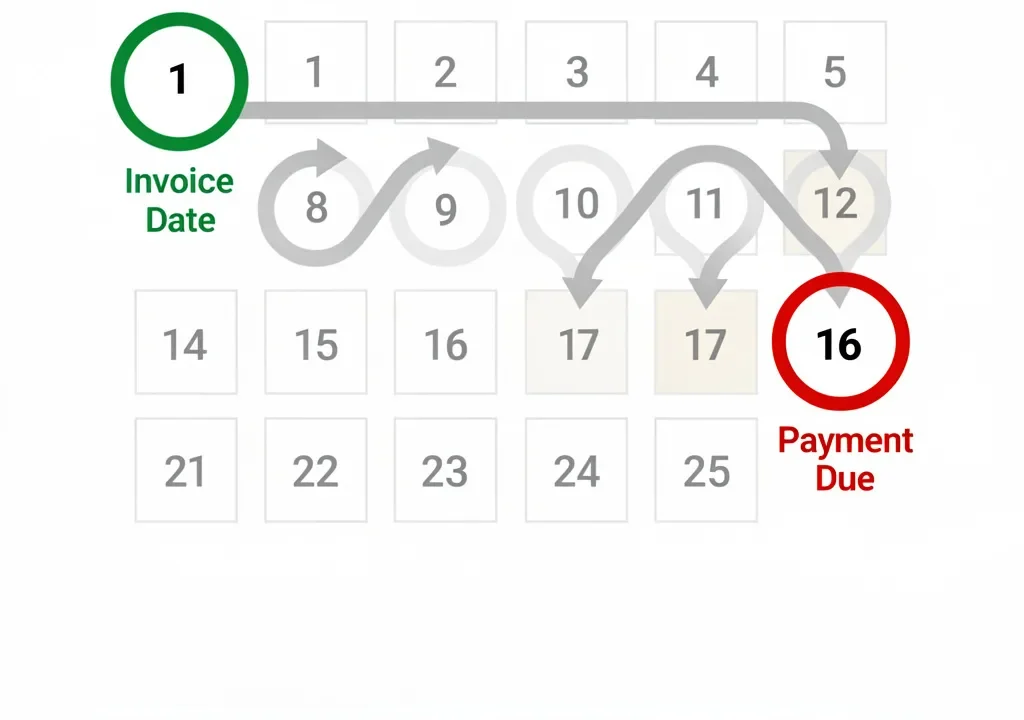
Real example: You issue an invoice on June 1st. Count forward 15 days. Payment is due by June 16th.
Another example: Invoice date is November 20th. Count forward 15 calendar days. Payment is due by December 5th.
That is it. No complicated math. No special formula. Just 15 days forward from the invoice date.
But here is where people get burned. The default interpretation is 15 calendar days, which includes weekends and public holidays. Saturday counts. Sunday counts. Thanksgiving counts. If you issue an invoice on the Wednesday before a long holiday weekend, those holiday days still eat into your 15 day window from the client’s perspective on when they need to process the payment internally.
If you want to exclude weekends and public holidays, you must write “Net 15 Business Days” explicitly on your invoice. That small change extends the effective waiting period significantly and is a completely different agreement.
When Is a Net 15 Invoice Due?
A net 15 invoice is due exactly 15 calendar days after the invoice date, unless the terms specifically state “business days.”
Does net 15 include weekends? Yes. Unless you write “business days” explicitly, every calendar day counts toward the 15 day window.
This trips up a lot of freelancers. I have seen Reddit threads where someone sends an invoice on a Friday and then gets confused when the client’s accounting team says the 15 day clock should “really start on Monday.” It should not. The invoice date is the invoice date. The clock starts ticking the moment you date that document.
Net 15 Payment Terms Meaning: Business Days vs. Calendar Days
This distinction deserves its own section because it causes so much real world confusion.
Calendar days include every single day on the calendar. Weekends, bank holidays, national holidays, everything. This is the default interpretation of net 15 unless stated otherwise.
Business days exclude weekends and officially recognized public holidays. A net 15 business days agreement could effectively give the client 21 or more calendar days to pay, depending on how many weekends and holidays fall within that window.
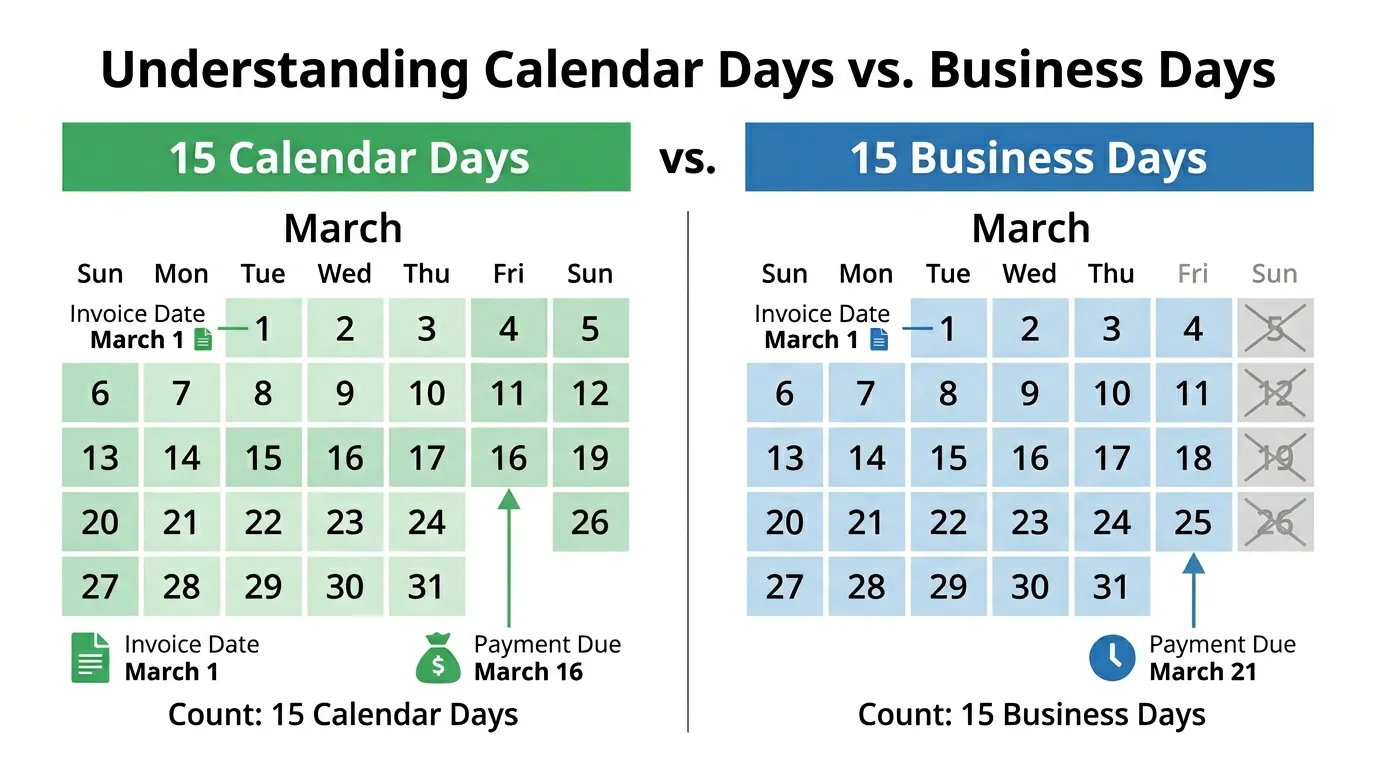
From a cash flow management perspective, always specify which type of days you mean. Write it clearly. Do not assume the client will interpret it the same way you do.
A lawn care forum I found during research showed an interesting real world example. A business owner invoiced on the 30th of each month for that month’s services, with payments due by the 15th of the following month for clients not on autopay. That is technically a variation of net 15 but calculated differently, using a fixed calendar date rather than counting forward from the invoice date. That approach is sometimes called EOM Net 15, which I will explain in full later in this guide.
What Does Net 15 Mean on an Invoice: A Real Example
Let me walk through a complete, real world scenario so this clicks permanently.
The Scenario: I am an SEO content writer. I finish a batch of 8 articles for a client. My rate is $150 per article. Total invoice amount: $1,200.
The Invoice Details:
- Invoice Date: Monday, March 3rd, 2026
- Payment Terms: Net 15
- Payment Due Date: Tuesday, March 18th, 2026
I send the invoice by email. The client receives it. Their accounts payable team processes it. By March 18th, $1,200 should land in my bank account.
That is a clean net 15 transaction. Simple. Professional. Clear.
But what happens in reality? Sometimes the client does not start the 15 day clock on March 3rd. Sometimes they start it on the day their manager approves the invoice. Sometimes they start it on the day their accounting software logs the document. These discrepancies are real. I experienced them personally. And they are the root cause of most net 15 payment disputes.
The fix is to address this in your contract before work begins. State explicitly: “The 15 day payment period begins on the date printed on the invoice, regardless of internal approval timelines.” That sentence has saved me significant stress on multiple occasions.
Net 15 vs. Net 30: Key Differences Explained
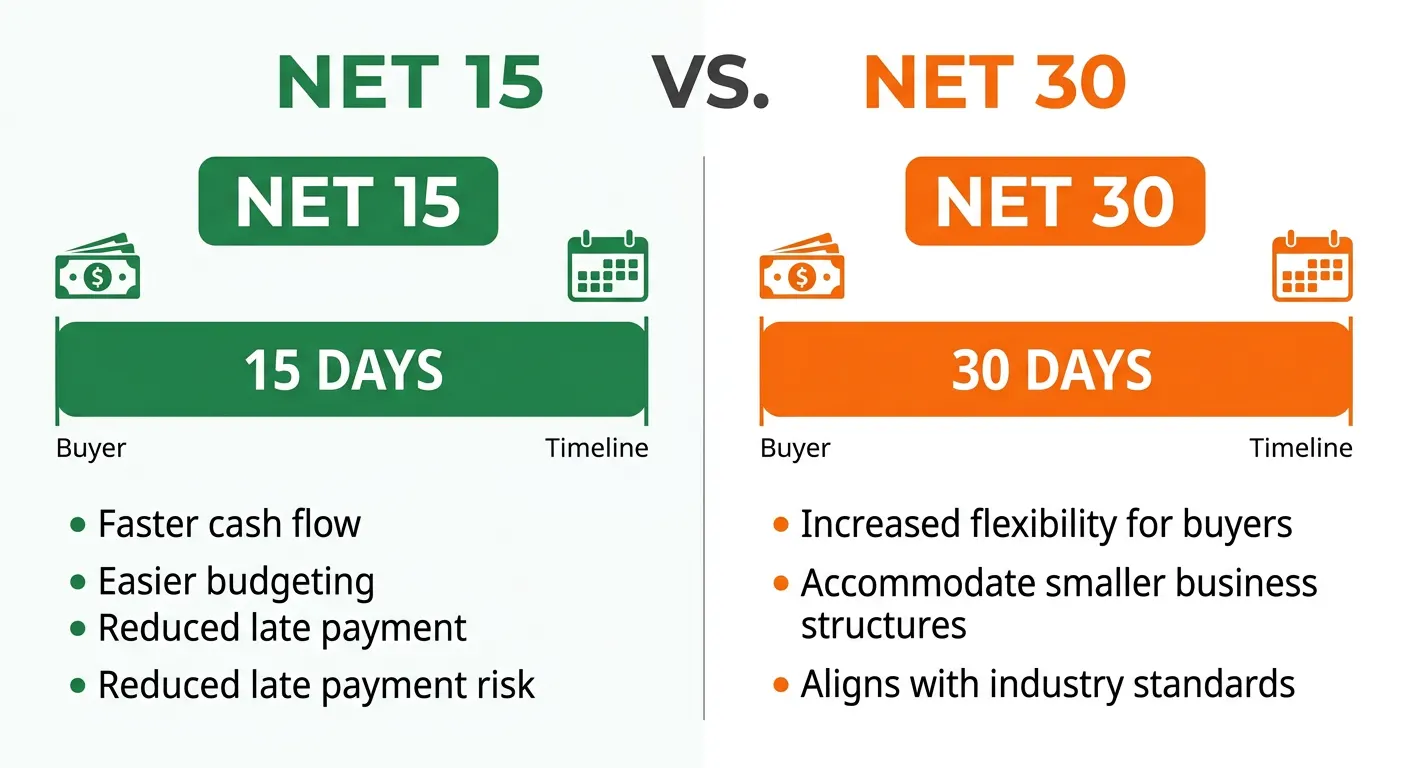
Net 15 requires payment within 15 days of the invoice date, while net 30 gives the buyer 30 full days. Net 15 accelerates cash flow; net 30 is the standard in most B2B industries.
This is the comparison that most freelancers and small business owners care about most. And the answer is not as straightforward as you might hope.
According to Bill.com’s official guide on net terms, net 30 is the most common B2B payment term in use across the United States. It is the default. Most large companies have their accounts payable systems configured around a 30 day cycle. Asking for net 15 from a large corporation sometimes creates friction because you are asking them to step outside their standard operating procedure.
That does not mean you should not ask. It means you should understand what you are asking for.
| Feature | Net 15 | Net 30 |
|---|---|---|
| Payment Deadline | 15 days from invoice date | 30 days from invoice date |
| Cash Flow Speed | Fast | Standard |
| Best For | Freelancers, small agencies, fast turnaround work | Corporate clients, large B2B orders |
| Risk Level for Seller | Lower | Moderate |
| Buyer Flexibility | Lower | Higher |
| Common Variation | 2/15 Net 30, EOM Net 15 | 2/10 Net 30 |
When Net 15 Beats Net 30 Every Single Time
I use net 15 for every new client relationship. Not because I am difficult to work with. Because new clients are an unknown variable. I have no data on whether they pay on time. I have no relationship history to draw on. Starting with net 15 gives me faster cash flow and signals clearly that I run a real, professional business with structured payment policies.
According to the research compiled from LedgerUp’s payment terms glossary, net 15 is specifically used when vendors need faster cash flow or when the buyer and seller relationship already supports shorter terms. Both of those conditions apply to most freelance arrangements from day one.
When Net 30 Makes More Strategic Sense
If you are working with a Fortune 500 company, a well funded startup, or any organization that has clearly communicated a 30 day payment cycle in their vendor onboarding documents, fighting for net 15 might cost you the contract. In those cases, net 30 is the trade you make for access to a larger, more reliable client.
The real world Reddit discussion I found from the digital marketing subreddit makes this point well. Freelancers with multiple revenue streams and healthy savings can afford to wait 30 days. Those working month to month genuinely cannot. Your financial situation should inform your payment term negotiation strategy just as much as industry norms do.
Net 15 vs. Net 60, Net 90, and Due on Receipt
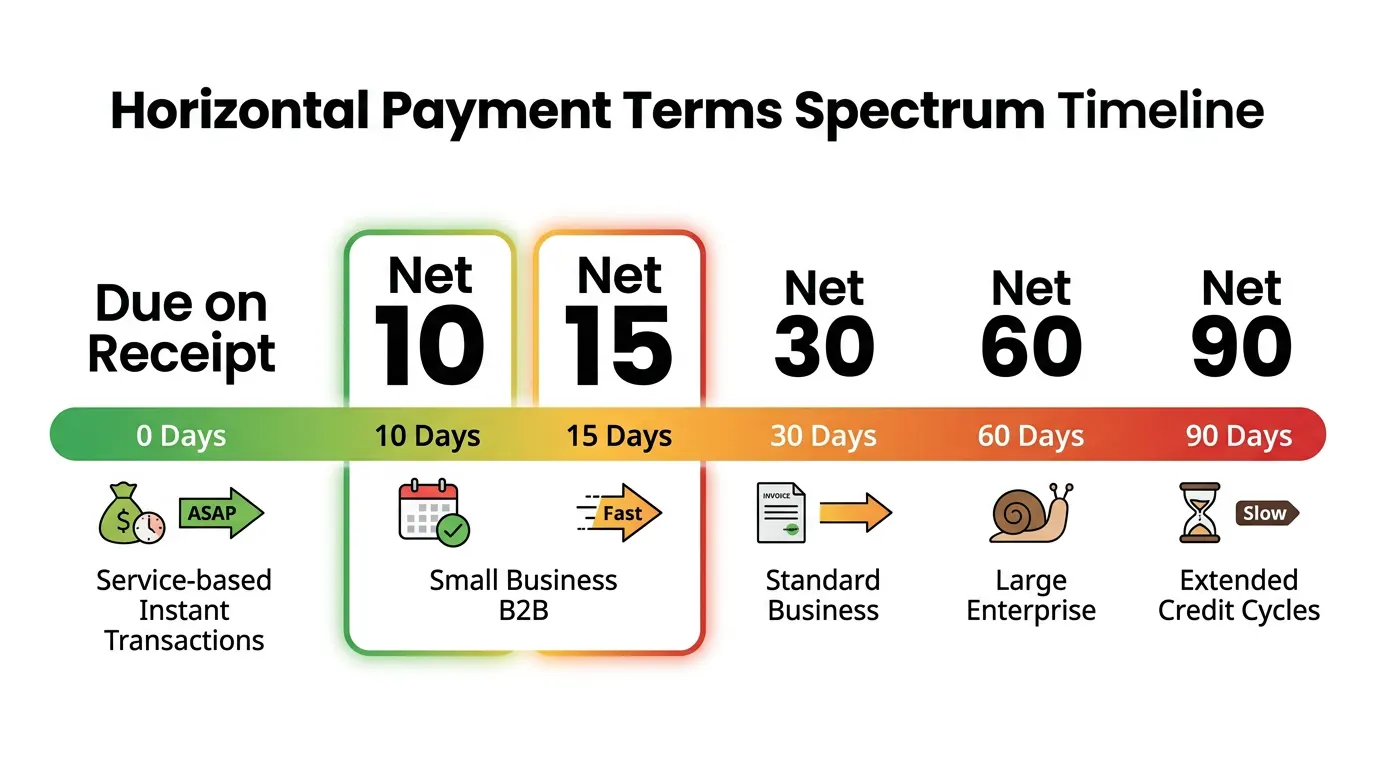
The full spectrum of invoice payment terms spans from immediate payment all the way to 90 or even 120 days. Here is how net 15 compares across that entire range.
Due on Receipt (Net 0): Payment is expected the moment the client receives the invoice. This is the fastest possible option. Rare in B2B but common in retail and some service industries. It signals low trust in the buyer relationship.
Net 10: Payment due in 10 days. Even faster than net 15. Used almost exclusively for very small transactions or established relationships with strong trust on both sides.
Net 15: Payment due in 15 days. Fast. Professional. Excellent for freelancers and small service businesses.
Net 30: The industry standard for most B2B transactions. Gives buyers time to manage their accounts payable cycle without disrupting operations.
Net 45: Less common. Used in some manufacturing and wholesale industries where supply chains create natural payment delays.
Net 60: Common in large enterprise environments and government contracts. Two full months of waiting before you see your money.
Net 90: The extreme end. Typically reserved for very large orders or industries with extended production timelines. From a cash flow management perspective, net 90 is genuinely painful for small businesses.
As a freelancer or small business owner, every extra day you grant beyond net 15 is essentially a free loan to your client. You already did the work. You already spent the time. The money is yours. Every additional day you wait costs you opportunity.
How to Write a Net 15 Invoice Correctly
A correctly written net 15 invoice includes the invoice date, a clearly labeled payment terms section stating “Net 15,” and a calculated due date shown in plain numbers.
Most invoicing mistakes happen not in the work itself but in the documentation. A vague invoice is an invitation for late payment. A clear invoice removes every possible excuse.
What Is Net 15 on an Invoice: The Exact Format
Here is the exact information your net 15 invoice must include:
Required Invoice Fields:
- Your full name or business name
- Your contact information and address
- Client name and billing address
- Unique invoice number
- Invoice date (this is the start of the 15 day clock)
- Itemized list of services with individual prices
- Subtotal, any applicable taxes, and total amount due
- Payment Terms: Net 15
- Payment Due Date: [specific date, written out in full]
- Accepted payment methods
- Late fee policy (I will cover this in detail shortly)
The single most important addition most freelancers forget is the specific due date written out in plain numbers. “Net 15” is the policy statement. “Payment Due: March 18th, 2026” is the clear instruction. Both should appear together on every invoice you send.
How to Add Net 15 Terms to an Invoice
Adding net 15 terms to an invoice is a straightforward process in any modern invoicing platform.
In QuickBooks, you navigate to the payment terms settings and either select an existing net 15 option or create a custom term. The QuickBooks community forum shows that some businesses set up terms as “net due the 15th of the following month,” which is a different calculation entirely and can cause confusion. Always double check that your software is calculating the due date correctly as 15 calendar days from the invoice date, not as the 15th of the next calendar month.
In FreshBooks, net terms are set at the client level or the invoice level. You can set net 15 as your default so every new invoice automatically carries those terms.
In Wave, the free invoicing tool popular with freelancers, you can enter custom payment terms in the invoice notes section if a dropdown option is not available for your specific term length.
In Xero and Zoho Invoice, net payment terms are configured in the settings panel and applied automatically based on your client or invoice type.
Regardless of which invoicing software you use, the principle is identical. Set the term. Verify the calculated due date. Include both pieces of information visibly on the invoice itself.
How to Add Net 15 Terms to an Invoice: The Professional Language to Use
Words matter more than most freelancers realize. Here are three different ways to phrase your net 15 terms, ranked from least to most effective.
Option 1 (Basic): “Net 15”
Clear but minimal. Requires the client to know what net 15 means. Acceptable for experienced B2B clients.
Option 2 (Better): “Payment due within 15 days of invoice date.”
Plain language. No jargon. Works for any client at any experience level.
Option 3 (Best): “Payment Terms: Net 15. Full payment of $[amount] is due by [specific date]. A late fee of [X]% will apply to invoices unpaid after [specific date].”
Complete. Unambiguous. Includes the consequence of non-payment. This is the version I use on every single invoice.
Early Payment Discounts and Net 15
An early payment discount on a net 15 invoice offers the buyer a small percentage reduction in the total amount if they pay before the 15 day deadline, typically within 5 to 10 days.
The most common early payment discount structure you will see paired with net 15 is written as 2/5 Net 15. Breaking that down: the buyer gets a 2% discount if they pay within 5 days; otherwise, the full amount is due within 15 days.
This structure comes directly from the broader family of discount terms in B2B invoicing. The famous 2/10 Net 30 structure (2% discount for payment within 10 days, full amount due in 30 days) inspired many shorter variations including 2/5 Net 15 and 1/5 Net 15.
Should You Offer Early Payment Discounts With Net 15?
Honestly, for most freelancers, I do not recommend it. Net 15 is already a fast payment term. Offering a discount on top of an already short window reduces your revenue without necessarily improving your cash flow timeline in a meaningful way.
Where early payment discounts make more sense is in wholesale or manufacturing contexts where the invoice amounts are large enough that even a 1% or 2% discount represents significant money to the buyer. For a $500 freelance invoice, a 2% discount saves the client $10. That is not a compelling motivator for a corporate accounts payable team.
If you work with larger clients on projects totalling $5,000 or more, an early payment discount becomes a more interesting tool. A 1% discount on $5,000 saves the client $50 and might genuinely accelerate the approval and payment process inside their organization.
What Does Net 15 Days Mean in Different Contexts
The phrase “net 15 days” means exactly the same thing as “net 15 payment terms” in most business contexts. Both refer to a 15 calendar day payment window from the invoice date.
But context changes the application in a few specific situations worth knowing.
What Does Net 15 EOM Mean?
Net 15 EOM means that the invoice is due 15 days after the end of the month in which it was issued.
EOM stands for End of Month. This is a completely different calculation from standard net 15.
Real example: You issue an invoice on March 5th. Under standard net 15, payment is due March 20th. Under net 15 EOM, payment is due April 15th (15 days after March 31st). That is a 41 day wait instead of a 15 day wait.
The lawn care business example I mentioned earlier used a version of this approach. They invoiced on the 30th of each month and required payment by the 15th of the following month. That structure works well for recurring service businesses with monthly billing cycles but is significantly slower than standard net 15 from a cash flow perspective.
Net 15 for Recurring Monthly Invoices
If you bill clients on a monthly retainer, you have two clean options. You can use standard net 15 (payment due 15 days after each monthly invoice date) or you can use a fixed date system (all invoices due on the 15th of the month following the service period). The second option simplifies your own bookkeeping but usually extends your actual wait time.
Advantages of Using Net 15 Payment Terms
The primary advantages of net 15 payment terms are faster cash flow, lower risk of unpaid invoices, and a professional signal that you run a structured business.
Let me break each of these down because they are not equally obvious.
Is Net 15 Right for Your Small Business?
For most small businesses and freelancers, the answer is yes. Here is the specific reasoning.
Faster cash flow: This is the most obvious benefit. Getting paid in 15 days instead of 30 days cuts your cash flow cycle in half. For a business billing $5,000 per month, that means $5,000 in your account two weeks earlier. Over twelve months, that timing difference has a real compounding impact on your ability to invest in your own growth, cover personal expenses, and avoid debt.
Lower bad debt risk: According to research cited by altLINE (a banking and invoice financing company), shorter payment windows statistically correlate with lower rates of unpaid invoices. The longer you wait for payment, the more time a client has to encounter financial difficulty, change priorities, or simply forget. Fifteen days is short enough that most clients are still fully engaged in the project and relationship.
Professional credibility: This one surprises people. Setting net 15 terms does not make you look demanding. It makes you look established. Businesses that know their value set clear terms. Clients who have worked with professional service providers before recognize and respect structured payment policies immediately.
Simplified accounting: Shorter payment cycles make your accounts receivable management cleaner. Fewer invoices sit in an outstanding state for extended periods. Your books are easier to reconcile. Your tax preparation is simpler. These operational benefits are small individually but they add up meaningfully over a year of business.
Net 15 Terms for Freelancers
Net 15 is arguably the single best default payment term for freelancers. Here is my personal reasoning.
As a freelancer, you are typically working on multiple projects simultaneously. You have no guaranteed monthly salary. Your income is directly tied to the invoices you collect. Waiting 30 or 60 days for payment from any single client creates real financial stress that can affect the quality of your work for other clients.
Net 15 breaks that cycle. When you collect faster, you breathe easier. When you breathe easier, you work better. The entire chain of your business performance improves when your cash flow is predictable and fast.
The Reddit discussions I reviewed across multiple subreddits including r/digital_marketing and r/agency consistently showed that the most financially stable freelancers had either adopted net 15 terms, required upfront deposits, or both. The financially stressed freelancers were the ones accepting net 30 or net 45 from every client without negotiation.
The Disadvantages of Net 15 Payment Terms You Need to Know
Not all roads lead to net 15. There are real situations where these terms create more problems than they solve.
Client friction with large companies: Enterprise clients, government agencies, and large corporations often have accounts payable cycles that are simply not designed for 15 day payment. Their internal approval workflows, purchase order matching processes, and payment authorization chains can take longer than 15 days to complete even when everyone is acting in good faith. Insisting on net 15 with these clients can create tension that damages the relationship unnecessarily.
Competitive disadvantage in some industries: If every other vendor in your space offers net 30 and you demand net 15, some clients will choose a competitor. This is a real trade-off. Know your market before you set your terms.
How to Enforce Net 15 Payment Terms
Enforcing net 15 payment terms requires a combination of a signed contract, a clear late fee policy stated on every invoice, and a consistent follow-up system starting on day 16.
This is where the rubber meets the road. The terms are the policy. Enforcement is the practice.
Protect Your Net 15 Payment Terms With Late Fees
A late fee is the single most effective enforcement tool available to freelancers and small businesses. It works not because clients fear the fee itself (though some do) but because it signals that you take your payment terms seriously and will not silently absorb non-payment.
The standard approach is a percentage based monthly late fee. Common rates range from 1.5% to 2% per month on the outstanding balance. Some freelancers prefer a flat fee per week of delay. Both work. The key is that the fee must be disclosed before the work begins, written into the contract, and printed clearly on every invoice.
Here is the exact language I use on my invoices:
“A late fee of 1.5% per month will be applied to any invoice balance unpaid after the payment due date.”
Simple. Clear. Non-threatening in tone but completely firm in intent.
The Deposit Strategy for Net 15 Payment Terms
Collecting a partial payment upfront before work begins is one of the smartest financial decisions a freelancer can make. A 30% to 50% deposit accomplishes several things simultaneously.
First, it gives you immediate cash to cover your working expenses during the project. Second, it proves the client has real funds available and is genuinely committed to the project. Third, it reduces the total amount at risk if a client disappears after delivery.
When you combine an upfront deposit with net 15 terms for the remaining balance, you build a payment structure that is genuinely robust. The deposit protects you during the work phase. The net 15 term protects you after delivery. Even if a difficult client pushes back on the final payment, you have already collected a meaningful portion of your fee.
What to Do When a Net 15 Invoice Goes Unpaid
Day 16 arrives. No payment. Your first move should always be a calm, professional reminder email. Not angry. Not passive aggressive. Direct.
Here is a simple template:
Subject: Invoice #[number] Past Due
Body: “Hi [client name], I am following up on Invoice #[number] for $[amount], which was due on [date]. Please let me know if you need a copy of the invoice or have any questions about the payment. I appreciate your prompt attention to this.”
Send that on day 16. If you get no response by day 20, follow up again and mention the late fee that is now accumulating. If you get no response by day 30, consider escalating to a phone call or formal written notice depending on the size of the invoice.
For invoices above $1,000 that remain unpaid past 45 days, I personally recommend consulting resources from small claims court guidelines or speaking with a small business attorney. Many countries and US states have straightforward small claims processes for invoice disputes under specific dollar thresholds. Learn more about small claims court procedures for unpaid invoices on the official USA Courts website so you understand your options before you ever need them.
How to Negotiate Net 15 Payment Terms With Clients
Negotiating net 15 payment terms successfully requires presenting the request early in the client relationship, framing it as standard business practice, and being prepared with a clear rationale if the client pushes back.
I negotiate payment terms on every single new client engagement. This is not optional for me. It is a business practice I hold non-negotiable.
Here is exactly how I approach it.
Step 1: Raise payment terms during the proposal or contract discussion phase, before any work begins.
Step 2: Present it as a standard practice: “My standard payment terms are net 15, meaning full payment is due 15 days from the invoice date. Does that work with your accounting cycle?”
Step 3: If they say yes, write it into the contract immediately.
Step 4: If they push back and request net 30, ask what their internal approval process looks like. Sometimes a client says “net 30” but actually pays faster when an invoice is submitted correctly.
Step 5: If net 30 is their absolute limit and the project is valuable enough, accept net 30 but require a 30% to 50% upfront deposit to compensate for the longer wait.
The goal is not to win an argument. The goal is to protect your cash flow while keeping the client relationship healthy. Net 15 is your ideal outcome. A deposit plus net 30 is an acceptable alternative for the right client and project.
Net 15 Payment Terms for Different Business Types
Net 15 for Small Business Owners
Small business owners face the same cash flow math that freelancers do but often with higher operating costs. Rent, utilities, employee wages, and material costs create financial obligations that do not pause because a client is slow to pay.
For small businesses, net 15 payment terms on service invoices make excellent sense. For product businesses, the calculation is more complex because you have inventory costs and delivery timelines to consider. Many small product businesses use net 30 as a baseline with early payment discounts like 2/10 net 30 to incentivize faster payment from buyers who can manage it.
Net 15 for Contractors
Contractors, whether in construction, IT, or consulting, often work on larger project values where payment timing has serious consequences. A general contractor waiting 60 days for a $50,000 payment while subcontractors need to be paid in 30 days is essentially financing their client’s project out of pocket.
Net 15 is aggressive but defensible for contractors, particularly for milestone based invoices. Billing 30% upfront, 40% at a midpoint milestone with net 15 terms, and 30% upon project completion with net 15 terms creates a steady cash flow stream throughout a longer project without requiring clients to pay the full amount before delivery is complete.
Net 15 in B2B Transactions
The B2B payment terms landscape, as documented by sources including Stripe and Bill.com, shows that net 30 dominates most industries. Net 15 is most common in the following B2B contexts:
- Digital services and content creation
- Consulting and professional services
- Small order manufacturing and custom fabrication
- Independent agency and freelance relationships
- Vendor relationships where the seller has significant leverage
In B2B contexts, the key to getting net 15 accepted is demonstrating the value of your work clearly and consistently. Clients who rely heavily on your specific skills or outputs are far more willing to accept shorter payment terms than clients who view you as a replaceable commodity.
How Net 15 Is Recorded in Accounting
In accounting, a net 15 invoice is recorded as accounts receivable on the seller’s books and accounts payable on the buyer’s books, with the due date noted as 15 calendar days from the invoice date.
Understanding the accounting treatment helps you communicate more effectively with clients whose finance teams are the ones processing your payment.
Seller’s Accounting Entry (Accounts Receivable)
When you issue a net 15 invoice, your accounting software should create a record that looks like this:
- Date: Invoice date
- Account: Accounts Receivable (debit)
- Revenue Account: Service Revenue (credit)
- Amount: Full invoice amount
- Due Date: 15 days from invoice date
When payment arrives, the accounts receivable balance is reduced (credited) and your cash account increases (debited).
Buyer’s Accounting Entry (Accounts Payable)
On the buyer’s side, receiving your net 15 invoice creates an accounts payable entry:
- Date: Date invoice is received or approved (this is where disputes about the clock starting arise)
- Account: Expense Account (debit)
- Accounts Payable: (credit)
- Amount: Full invoice amount
- Due Date: 15 days from invoice date per your terms
The disconnect between “invoice received date” and “invoice approved date” that I mentioned earlier is visible in this accounting entry. If the buyer’s team logs the invoice on the approval date rather than the invoice date, their internal system calculates a different due date than yours. This is why your contract must specify the clock start date explicitly.
Days Sales Outstanding and Net 15
Days Sales Outstanding (DSO) is a financial metric that measures how long, on average, it takes you to collect payment after issuing an invoice. A business using net 15 terms should theoretically have a DSO near 15. If your DSO is 30 or higher while offering net 15 terms, your enforcement system needs significant work.
Tracking DSO monthly gives you a clear picture of whether your payment terms are actually functioning as intended or just serving as decorative text on a PDF that clients ignore.
What Is 2/10 Net 15: The Early Payment Discount Formula
2/10 Net 15 means the buyer earns a 2% discount on the invoice total if they pay within 10 days; otherwise, the full amount is due within 15 days.
This is a specific discount term structure. The first number (2) is the discount percentage. The second number (10) is the early payment deadline in days. The final number (15) is the standard payment deadline.
Example: Invoice total is $2,000. Under 2/10 Net 15, the client can pay $1,960 by day 10 and take the 2% discount. If they do not pay by day 10, the full $2,000 is due by day 15.
This structure gives buyers a financial incentive to pay early. It costs you 2% of the invoice amount in exchange for potentially getting paid even faster than your standard 15 day term. For high volume businesses with tight cash flow needs, that trade-off can be worth it.
For most independent freelancers, I think 2/10 Net 15 is unnecessary complexity. Net 15 alone is a strong enough term. Adding early payment discounts to an already short window rarely provides enough behavioral change to justify the revenue reduction.
Net 15 Payment Terms Template: What to Include
A solid net 15 payment terms template covers every piece of information needed to eliminate ambiguity, protect your interests legally, and communicate professionally.
Here is the complete template structure I recommend:
INVOICE
From: [Your Full Name / Business Name]
[Address] | [Email] | [Phone]
To: [Client Name / Business Name]
[Client Address]
Invoice Number: [Unique Number]
Invoice Date: [Date]
Payment Due Date: [Invoice Date + 15 Calendar Days]
Services Rendered:
| Description | Quantity | Rate | Total |
|---|---|---|---|
| [Service Name] | [X] | $[Rate] | $[Amount] |
Subtotal: $[Amount]
Tax ([X]%): $[Amount]
Total Amount Due: $[Amount]
Payment Terms: Net 15. Full payment of $[Total Amount] is due by [specific due date].
Late Fee Policy: Invoices unpaid after [due date] will incur a late fee of 1.5% per month on the outstanding balance.
Accepted Payment Methods: [Bank Transfer / PayPal / Check / Online Payment Link]
Questions? Contact [your email or phone].
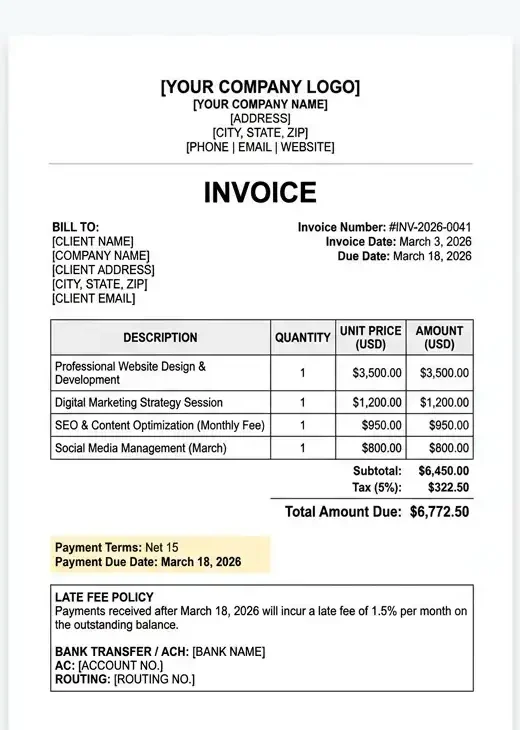
This template covers the invoice date, the due date calculation, the explicit payment terms language, and the late fee policy. Every box is checked. Every ambiguity is removed.
Common Mistakes That Sabotage Your Net 15 Payment Terms
I have made most of these mistakes personally. Learning from them cost me money and stress. Learning them from this guide costs you nothing.
Mistake 1: Not specifying the clock start date in your contract.
Always state that the 15 day period begins on the invoice date printed on the document. Do not leave this undefined.
Mistake 2: Sending the invoice to the wrong person.
Sending your invoice to your day-to-day project contact instead of the accounts payable department adds days of internal forwarding time to your payment cycle. Always ask, during the project kickoff phase, who should receive invoices and what information they need on the document.
Mistake 3: Missing required information on the invoice.
Many corporate clients will not process an invoice that is missing a purchase order number, vendor ID, or other specific internal reference. Find out what they require before you send the invoice. Receiving a request for missing information on day 12 of your 15 day window is genuinely frustrating.
Mistake 4: No late fee policy.
An invoice without a late fee policy is a document without consequences. It communicates that late payment is acceptable. It is not.
Mistake 5: Only following up once.
One reminder email after the due date is not an enforcement strategy. It is a hope. Build a follow-up sequence: day 16 email, day 20 email plus phone call, day 30 formal notice with late fee calculation, day 45 escalation decision.
Mistake 6: Accepting verbal agreements on payment terms.
If it is not in writing, it does not exist. Every payment term agreement must be in a signed contract or at minimum confirmed in writing by email before any work begins.
Net 15 Payment Terms and Your Cash Flow Management Strategy
Cash flow is the oxygen of any small business. You can be profitable on paper and still go bankrupt if your cash flow timing is wrong. Net 15 payment terms are one piece of a larger cash flow management puzzle.
The complete picture looks like this:
Layer 1: Upfront deposits. Collect 30% to 50% before work begins. This is immediate cash with zero waiting.
Layer 2: Net 15 terms for remaining balance. Collect the remainder within 15 days of delivery. This is predictable, fast cash.
Layer 3: Late fee policy. This creates a financial consequence for non-payment and motivates timely collection.
Layer 4: Multiple clients. Never rely on a single client for more than 40% of your monthly income. If that one client pays late, your entire operation suffers.
Layer 5: A cash reserve. Even with perfect net 15 terms, unexpected delays happen. A 30 to 60 day cash reserve protects you from the occasional slow payment without creating panic.
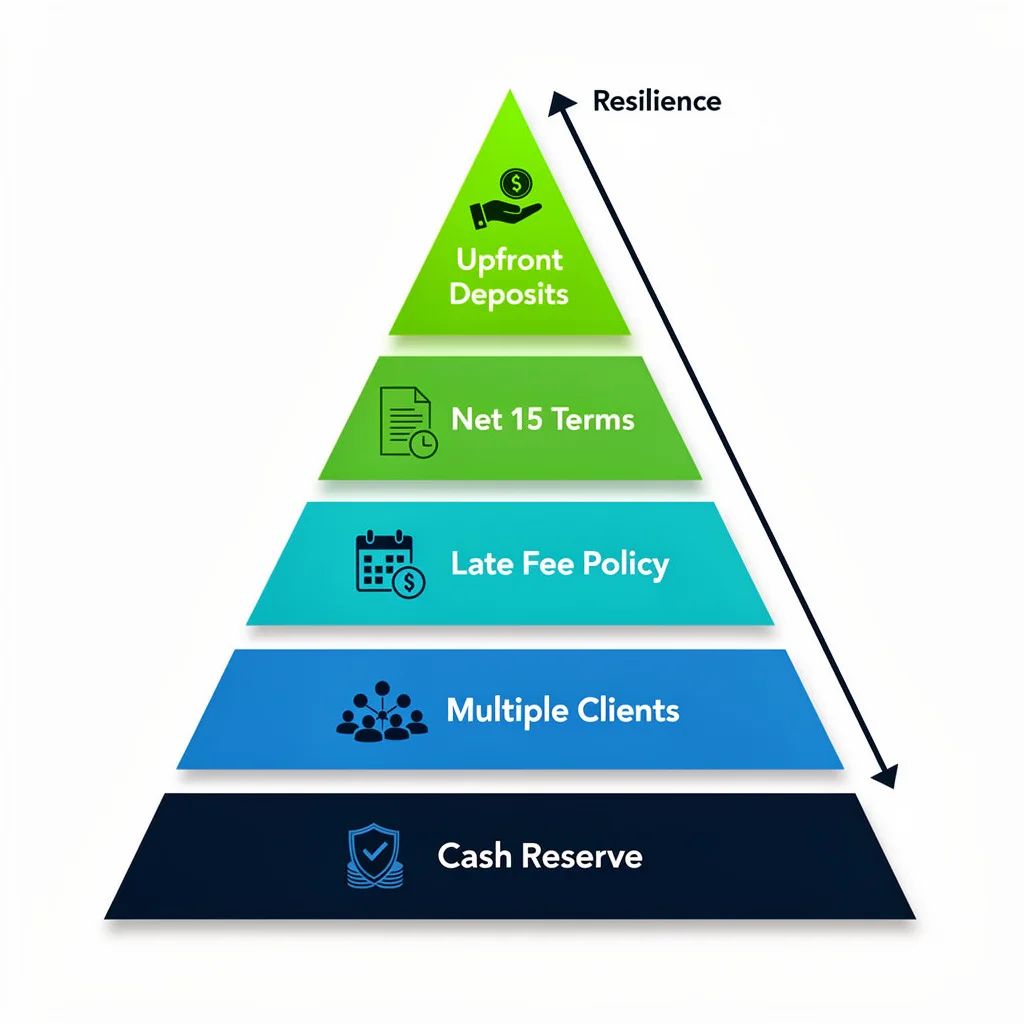
When these five layers work together, your business is financially resilient. Net 15 terms alone are useful. Net 15 terms as part of a complete cash flow strategy are genuinely powerful.
Trending FAQs: Net 15 Payment Terms
What does net 15 mean on an invoice?
Net 15 on an invoice means the full payment is due within 15 calendar days of the invoice date. It is a short term credit period given to the buyer.
How do I calculate a net 15 due date?
Count forward 15 calendar days from your invoice date. That final date is your payment deadline. If your invoice is dated June 1st, payment is due June 16th.
Does net 15 include weekends?
Yes. Unless your terms specifically state “net 15 business days,” weekends and public holidays count toward the 15 day window.
What is the difference between net 15 and net 30?
Net 15 requires payment in half the time of net 30. Net 15 accelerates your cash flow but may create friction with clients on 30 day payment cycles.
Is net 15 standard for freelancers?
Net 15 is increasingly standard among professional freelancers, though net 30 remains more common in larger B2B environments. Net 15 works especially well when combined with an upfront deposit.
Can I charge a late fee on a net 15 invoice?
Yes. As long as your late fee policy is disclosed in your contract and printed on the invoice before the work begins, you can legally charge late fees in most jurisdictions. Always verify local laws for specific rates and notification requirements.
What does net 15 EOM mean?
Net 15 EOM means payment is due 15 days after the end of the month in which the invoice was issued. For an invoice dated March 5th, payment would be due April 15th under EOM terms.
How should I handle an international client who misses net 15 because of a holiday?
Communicate proactively. Before sending the invoice, note any upcoming holidays that might affect their internal processing timeline. Build a one or two day buffer into your follow-up schedule for international clients while still maintaining the official payment deadline stated on the invoice.
What is 2/10 net 15?
2/10 net 15 is a discount term offering a 2% reduction on the invoice total if the buyer pays within 10 days. The full invoice amount is due within 15 days if the early payment discount is not taken.
Should I use net 15 for a large corporate client?
It depends. Large corporations often have rigid 30 day payment cycles built into their accounting systems. Evaluate whether the client relationship is valuable enough to justify accepting net 30. If so, require a meaningful upfront deposit to offset the longer waiting period.
What happens if I do not specify “calendar days” or “business days” on my net 15 invoice?
The default interpretation in most business contexts is calendar days. But to eliminate any ambiguity entirely, write it out explicitly on your invoice: “Payment due within 15 calendar days of invoice date.”
How do I set up net 15 terms in QuickBooks?
In QuickBooks, go to the Lists menu, select Customer and Vendor Profile Lists, then Payment Terms List. Click New, enter the term name as “Net 15,” set the due date to 15 days after invoice date, and save. Apply this term to client profiles or individual invoices as needed.
Does net 15 help with days sales outstanding (DSO)?
Yes. Consistently applied net 15 terms, when actually enforced, should drive your DSO toward 15 or below. If your DSO remains high despite offering net 15 terms, the problem is enforcement, not the terms themselves.
What is the best invoicing software for net 15 payment terms?
QuickBooks, FreshBooks, Wave, Xero, and Zoho Invoice all support net 15 payment terms. The best choice depends on your budget and the complexity of your invoicing needs. Wave is free and excellent for solo freelancers. QuickBooks and Xero offer more robust accounting integration for growing businesses.
Can a client refuse to pay a late fee on a net 15 invoice?
They can try. But if the late fee policy was disclosed in the signed contract and printed on the invoice before work began, you have a legally documented agreement. For disputed late fees on smaller invoices, small claims court is a practical option. For larger disputes, consult a small business attorney.
Your Final Action Plan: Implementing Net 15 Payment Terms Starting Today
Reading this entire guide is the first step. Taking action today is the second.
Here is exactly what to do in the next 30 minutes:
Action 1: Open your invoice template right now. Add a clear “Payment Terms: Net 15” line if it is not already there. Add the specific due date calculation. Add a late fee policy sentence.
Action 2: Open your standard client contract. Find the payment terms section. Add language specifying that the 15 day clock starts on the invoice date printed on the document, regardless of internal approval timelines.
Action 3: Create three email templates in your email system: a standard invoice delivery email, a day 16 polite reminder, and a day 30 formal notice with late fee calculation. Save all three so they are ready to send at a moment’s notice.
Action 4: Review your current active client list. Identify any client operating under terms longer than net 15. At the next natural contract renewal point, propose a shift to net 15 terms or at minimum negotiate an upfront deposit requirement.
Action 5: Set up a recurring calendar reminder every Friday afternoon to review your outstanding invoices and identify any that are past due. Consistent monitoring prevents small delays from becoming large problems.
Net 15 payment terms are not a magic solution. No piece of text on a PDF will force a difficult client to pay on time. But clear terms, combined with a signed contract, a late fee policy, an upfront deposit habit, and a consistent follow-up process, create a system that protects your cash flow in ways that surprise most freelancers the first time they see it working properly.
I built this system after the empty bank account moment I described at the start of this guide. It took a few months to fully implement. But within one full quarter of running it consistently, my average payment collection time dropped from 28 days to under 18 days. The occasional late payer still exists. But they are now the exception in a system built to handle them, not the rule in a system built to hope for the best.
Your business deserves better than hope. It deserves a real payment system. Net 15 is a great place to start building one.
This guide reflects current best practices as of 2026. Payment term laws and invoicing regulations vary by country and state. Always consult a qualified accountant or attorney for advice specific to your business situation.