
Consider a common freelancer scenario: a complete website redesign is delivered on time, with every revision the client requested. The $3,200 invoice goes unpaid past its due date. Three reminder emails go out, each more uncomfortable than the last, and come back with “we’re processing it,” “our accounts team is on it,” and “Did we not already send that?” They had not. When payment finally lands, 61 days after the due date, there is no apology — just a bank notification and silence. That kind of experience is exactly why a late payment fee clause belongs in every contract from the start. Putting the clause in writing does most of the work before a single invoice even goes out.
What follows is a practical guide to late payment fees for freelancer invoices, including how to use them without burning relationships you’ve spent years building.
Why Late Payments Keep Happening (And What You Can Actually Do About It)
Here’s the thing almost nobody in freelance communities will say out loud: Many late payments trace back to the payment system, not to dishonesty. Not because you did bad work. But because the payment system you built gave them no financial reason to pay on time.
The reasons late payments happen come down to the same four problems almost every time.
Terms that were never real. “Payment within a reasonable time” is not a payment term, and neither is “standard net 30” if the client never confirmed they read it. Clients often assume they have 60 days when the invoice said net 30, simply because nobody made them sign off on that number.
Invoice timing that works against you. Send a bill to a small business owner on the 29th when their billing cycle closes on the 1st, and you have accidentally pushed yourself into next month’s processing run. Not bad intent — just calendar math that nobody explained.
No consequence for waiting. Your client has twelve vendor invoices this month, and the two without penalties hit the bottom of the stack. Humans and organizations respond to incentives, and no penalty means your invoice carries no urgency.
The friendship trap. A client becomes someone you genuinely like, the relationship gets casual, and invoices go out with the energy of “no rush on this one!” — and then 75 days pass. That situation is built by the freelancer, not the client.
Once you see these as system design failures rather than character failures yours or the client’s you can fix them. And a properly disclosed late payment fee clause on a freelancer invoice is the most effective single fix in the toolkit.
Unformalised payment terms are a common reason freelancers go unpaid or underpaid for long periods. Not stolen. Not disputed. Just never enforced because the system didn’t require it.
What a Late Payment Fee Actually Is (and What It Isn’t)
A lot of freelancers assume that adding a late fee to an invoice signals distrust or aggression. It doesn’t. A late payment fee also called a finance charge, interest charge, or overdue payment penalty is an additional amount owed when a client doesn’t pay by the agreed date. Your electric company charges one. Your credit card charges one. Your building charges one. You charging one is not a personality trait. It’s a billing standard, and it belongs in every written agreement covering payment terms.
From a practical standpoint, a late fee on a freelancer invoice does two specific things.
It is a deterrent. When a client knows that waiting another 30 days costs them money, your invoice gets prioritized over the ones sitting next to it without penalty language. A disclosed late fee gives an accounts department a reason to prioritise your invoice.
It is compensation. A client sitting on $3,200 of your money for 61 days is taking an interest-free loan at your expense. A late fee partially closes the gap between what you are owed and what you actually have available.
What a late fee is not: a surprise you spring on a client, a retroactive penalty you bolt onto an existing invoice, or a clause you can create after the work is finished and call it a written agreement on the payment penalty. Any of those approaches creates legal problems and destroys relationships simultaneously.
The clause has to exist in writing before the work starts. That’s not negotiable.
Late Payment Fee Rates: What to Actually Charge
A workable approach is to answer the central question directly: “What percentage should I actually charge?” There’s a real answer, not a hedge.
The Percentage Route
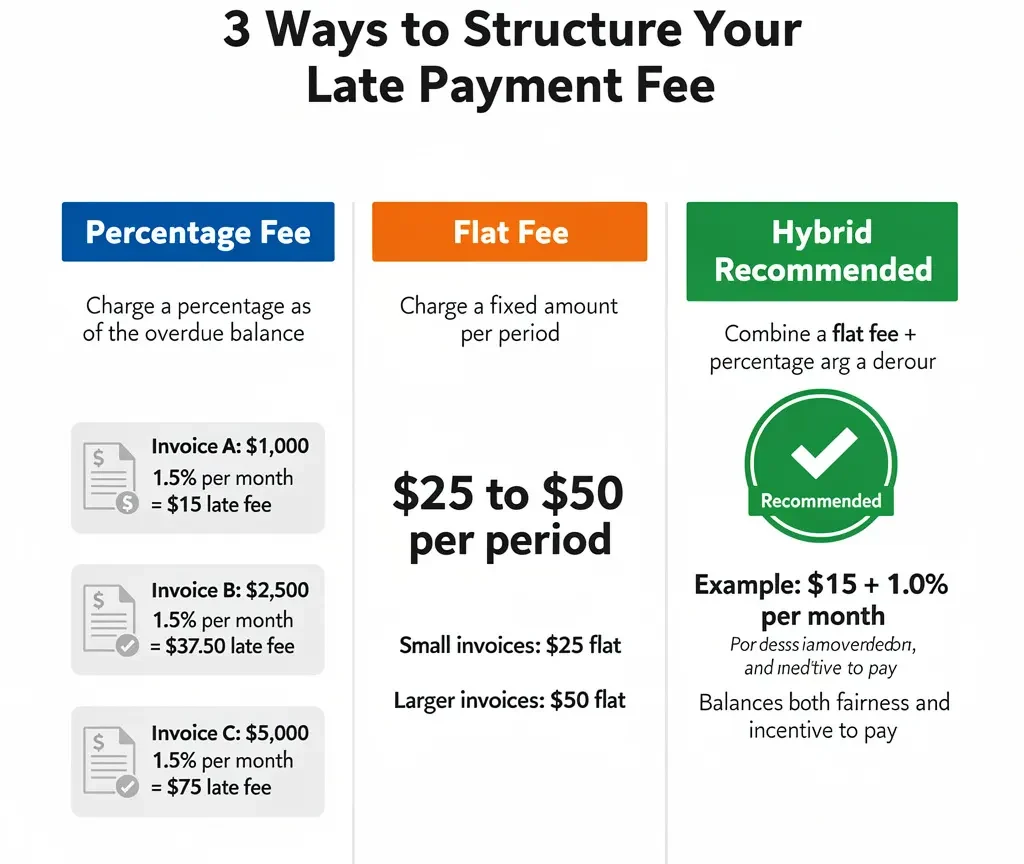
The industry standard in professional services is 1% to 1.5% per month on the outstanding balance that’s 12% to 18% annually (12% to 18% annually on a simple, non-compounding basis). That 1% to 1.5% monthly range creates real urgency without crossing into territory that feels punitive or that might breach late payment legislation in your state.
Here’s what this actually looks like on a real invoice:
- $1,000 invoice at 1.5% per month = $15 per month overdue
- $3,500 invoice at 1.5% per month = $52.50 per month overdue
- $10,000 invoice at 1.5% per month = $150 per month overdue
If you want to skip the manual calculation entirely, free late fee calculators are available online — enter your invoice total, rate, and number of days overdue to estimate the amount.
On larger projects, $150 per month is real money to a client. On a $300 article, 1.5% is $4.50 which motivates nobody. That’s where the flat fee makes more sense.
The Flat Fee Route
A flat fee of $25 to $50 per month overdue, not per invoice in total, protects you better on small invoices where a percentage produces a meaningless number. A $35 penalty on a $300 invoice is noticeable. It’s also still entirely reasonable from where the client sits. Note that a repeated flat fee can exceed the legal maximum on small invoices, e.g. $35/month on a $300 invoice is 11.7% per month.
The Hybrid Approach
A hybrid setup: charge whichever is greater between the percentage and a flat minimum. The clause language looks like this: “A late fee of 1.5% per month or $50, whichever is greater, up to the maximum permitted by applicable law, will apply to any balance outstanding after the due date.” Small invoices get real protection. Large ones scale naturally.
Legal Limits by State (US)
This is the section most people skip and then discover they’ve written a clause that doesn’t hold up because it violates late payment legislation in their state.
- California: California usury law is complex and turns on whether the charge is treated as interest on a loan or forbearance at all. The general non-consumer loan formula in Article XV, § 1 is the greater of 10% per annum or 5% plus the applicable federal discount rate, with many exemptions. Do not treat any single percentage in this guide as a California safe harbour for a late fee — use the lesser of your contract rate or the maximum permitted by applicable law, and get state-specific advice before charging above 1% per month (12% per year) in California.
- New York: Around 16% annually is commonly cited for commercial transactions, but the applicable cap depends on the parties and the transaction.
- Texas: Around 18% annually is commonly cited as a ceiling for most commercial debts, subject to the contract and transaction type.
- Florida: 18% annually is generally cited as the maximum, subject to the transaction type. These figures are general guides, not legal advice for your specific contract — check your state’s usury and contract law before setting a rate.
The 1% to 1.5% monthly standard is commonly cited for commercial transactions, but 1.5% monthly equals 18% annually, which exceeds some states’ ceilings — always use the lesser of your rate or the legal maximum. The problem only shows up when frustrated freelancers write “5% per month” into a contract in a moment of genuine anger. That clause may not survive a challenge.
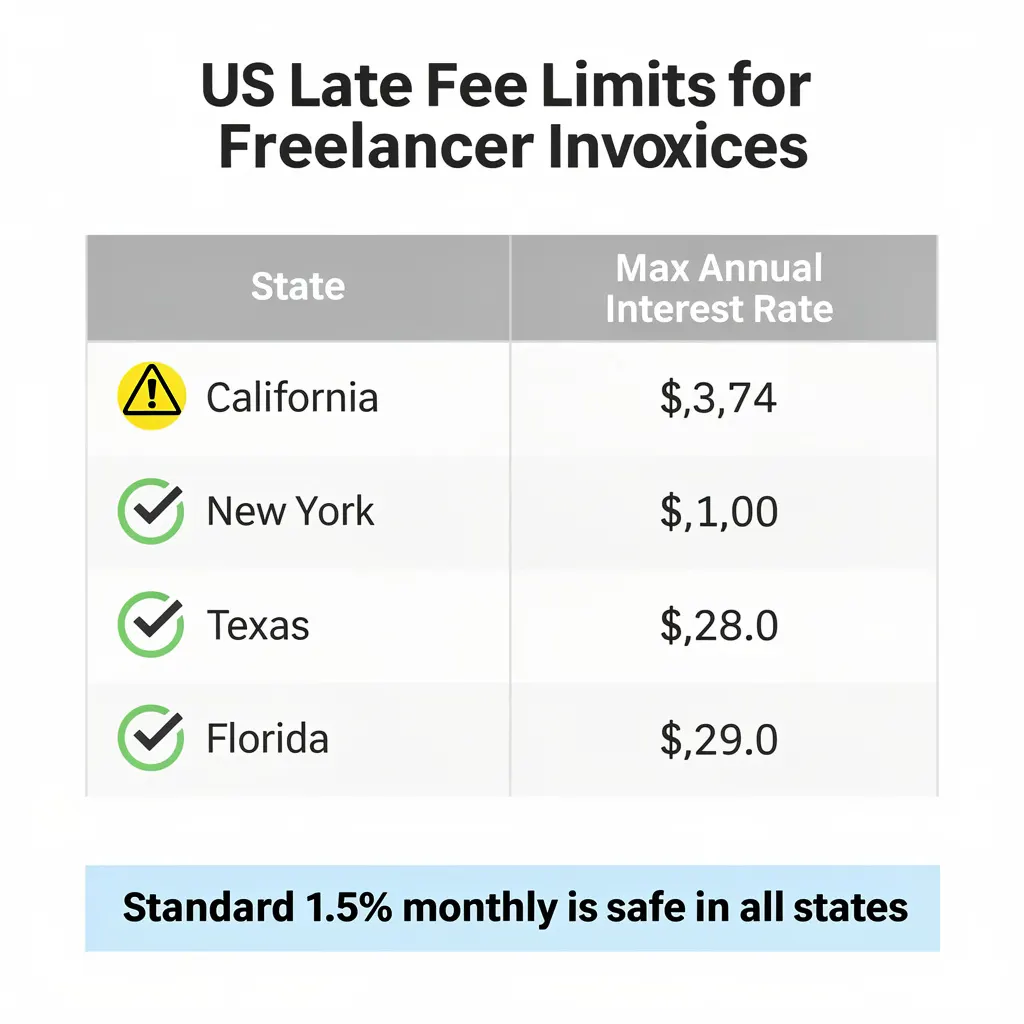
These figures come from loan-usury law, which may not govern a late charge on an unpaid invoice at all, and each has amount and party exemptions (for example, New York’s 16% civil cap applies to loans under $250,000). Treat them as a reason to cap your rate at the legal maximum in your contract, not as permission to charge up to the figure shown.
For New York freelancers: the Freelance Isn’t Free Act requires a written contract where the value of services is $800 or more, either on a single engagement or aggregated with the same hiring party over a 120-day period. The New York City law took effect May 15, 2017; the New York State law took effect August 28, 2024. If no payment date is specified, payment is due within 30 days of completion unless another period is agreed. Remedies can include statutory damages for non-payment. Worth knowing if you work in that market.
UK Freelancers: Statutory Protections You’re Probably Not Using
Under the Late Payment of Commercial Debts (Interest) Act 1998, UK freelancers are legally entitled to charge statutory interest on overdue B2B invoices at 8 percentage points above the Bank of England base rate. For debts falling due in the second half of 2026 the reference base rate is 3.75%, giving a statutory rate of 11.75% per year (simple, not compound). The rate is set by the half-year reference period, so check the rate in force on 30 June or 31 December for the period in which the debt fell due. This right applies automatically to B2B contracts unless the contract already provides a substantial remedy for late payment. It does not apply to consumer clients.
Here’s what surprises most people: you don’t even need a late fee clause in your contract for this right to apply. It’s automatic on business-to-business transactions under UK law. You can also claim fixed-sum compensation for debt recovery costs: £40 for invoices under £1,000, £70 for invoices between £1,000 and £9,999, and £100 for anything larger.
Putting the statutory fee reference at the bottom of every invoice is worth doing — not to charge it every time, but because the mention alone can accelerate payment.
Most freelancers never claim this, often because they’re unsure it fits within professional invoice etiquette. It does. The right exists precisely so that claiming it is standard, not aggressive.
One thing that doesn’t come up often enough: For a sole proprietor, late fee income you actually collect is generally taxable as ordinary self-employment income — a $100 late fee payment goes on Schedule C like any other payment. If you operate through another entity type, confirm where it is reported. Keep it as a separate line item in your invoicing system so it reconciles cleanly at tax time.
How to Set Up a Late Payment Fee Policy for Freelancer Invoices
Set aside an afternoon once. Then it runs on its own for the rest of your freelance career.
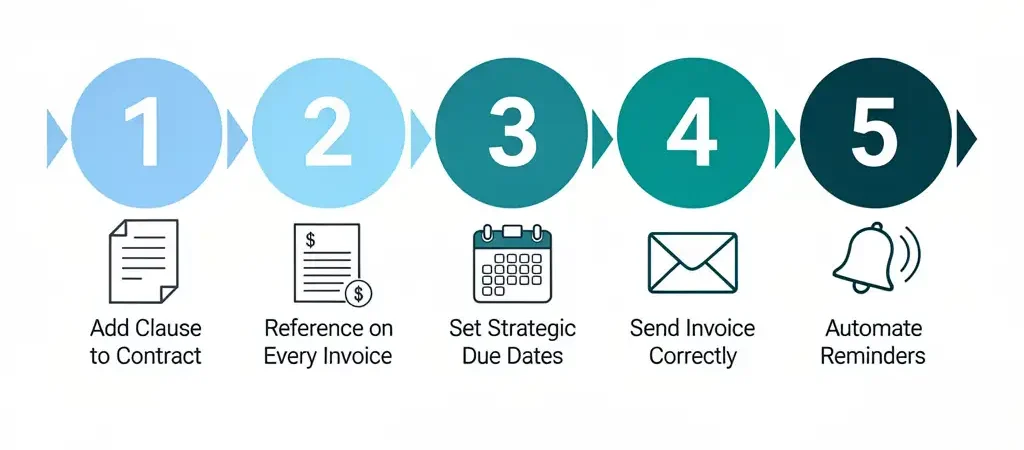
Step 1: The Clause Goes in the Contract Not Just the Invoice
The late fee clause has to live in your contract. Not on a sticky note. Not just on the invoice footer. Not mentioned verbally during a kickoff call. If it’s not in a signed written agreement, a client can argue they weren’t aware of it before agreeing to hire you and that argument tends to hold up.
If you don’t have a formal contract yet, at minimum the clause needs to be in a signed proposal or written agreement that both parties confirm before work starts. Here is a clause you can use:
“Payment is due within [X] days of invoice date. Any balance unpaid after the due date will accrue a late payment fee of 1.5% per month (or the maximum permitted by applicable law, whichever is less) on the outstanding amount. Late fees will be added to the next invoice issued.” The fee accrues monthly in full for each month or part of a month after the grace period ends (non-compounding, on the original amount only).
For the hybrid version:
“Any balance remaining unpaid after [X] days from invoice date is subject to a late payment fee of 1.5% of the outstanding balance per month, or $50, whichever is greater, up to the maximum permitted by applicable law. This fee will accrue monthly until the balance is paid in full.”
Short. Specific. Leave nothing open to interpretation.
Step 2: Reference It on Every Invoice
Once the contract has the clause, add a single-line reminder at the bottom of every invoice: “Payment due by [date]. Late payments are subject to a 1.5% monthly fee per our signed agreement.”
This serves two purposes. It reminds the client the policy exists they may have signed the contract months ago and genuinely forgotten. And it creates a documented paper trail showing both parties were informed, which matters if things ever escalate to a formal dispute.
Most invoicing platforms let you save this as a fixed note on your template. Set it once and it appears automatically on every invoice you send.
Step 3: Match Your Due Date to the Project Type
Net 30 is a corporate standard designed for organizations with full accounts payable departments. As a solo freelancer, you often don’t need to give that much runway and giving it unnecessarily just delays your cash.
A common setup:
- Net 7 or Net 14 for small projects under $500
- Net 15 for ongoing monthly work or mid-range projects
- Net 30 for large corporate clients whose AP cycle genuinely needs it
- Due on receipt for small invoices or first-time clients with unknown payment history
For longer engagements, consider a milestone payment structure rather than a single payment on completion it keeps your cash flow moving and reduces the risk of a large unpaid balance building up.
One thing that can cut late payments noticeably: ask regular clients when their billing cycle closes each month, then send the invoice three days before that date. That puts me in the current processing run instead of the next one.
Step 4: Send It Right
The invoice needs a specific calendar date as the due date “Due: [specific calendar date],” not “Net 30 from invoice date.” Clients are busy. Make the math invisible.
Always confirm who should receive the invoice before you send it. A payment can easily sit unread for weeks because it landed in a generic “accounts@” inbox. One question — “Who handles invoices on your end?” — prevents that.
List every accepted payment method. Bank transfer, PayPal, Stripe, credit card. Friction at the payment step is a payment delay.
And always ask new clients whether they need a Purchase Order number before you can invoice them. Companies that require a PO number cannot process an invoice without one, and finding out after you’ve already sent the invoice costs you weeks.
Step 5: Automate the Reminders
Chasing invoices manually is emotionally exhausting. It puts you in a position where you sometimes don’t follow up because you don’t want to seem difficult and that discomfort is exactly how a 30-day overdue invoice quietly becomes 75 days overdue.
The automated reminder sequence that handles most routine situations without a single personal email:
- 5 to 7 days before the due date: heads-up reminder.
- On the due date: due-today reminder.
- 7 days after: second automated reminder.
- 14 days after: personal email.
- 21 days after: updated invoice with the late fee applied as its own line item.
- 30 to 45 days after: escalation decision (demand letter, collections, or small claims).
FreshBooks and Bonsai support automatic late fee calculation and application. Zoho Books supports native late fee configuration (percentage or fixed amount); if you use the standalone Zoho Invoice free product, confirm late fee support on Zoho’s current docs before relying on it. Wave supports payment reminders but requires a manual late fee line item.
Best Invoicing Software for Automating Late Payment Fees
FreshBooks is a commonly used option for this, though plans and pricing change, so check current pricing. The late fee automation is the useful feature: you set your percentage once in settings, define the trigger date, and the software calculates and applies the fee to overdue invoices automatically.
Bonsai is the better call if you want contracts, proposals, time tracking, and invoicing living in one place. Check whether its contract templates include late fee language before relying on them.
Wave offers a free tier. It doesn’t have native late fee automation, so you’d manually add a late fee line item when the time comes but the payment reminders work and the price is hard to argue with.
Zoho Books supports native late fee configuration (percentage or fixed amount); if you use the standalone Zoho Invoice free product, confirm late fee support on Zoho’s current docs before relying on it.
HoneyBook makes the most sense for designers, photographers, and event planners who want the full client pipeline, first inquiry through final payment, in one place. If you are already paying separately for CRM and contract tools, the consolidation often pays for itself.
QuickBooks is worth mentioning because many freelancers already use it for accounting. Late fee support exists in QuickBooks, but the setup is clunkier than FreshBooks, and if invoicing is your primary reason for choosing a platform, QuickBooks is not the best starting point.
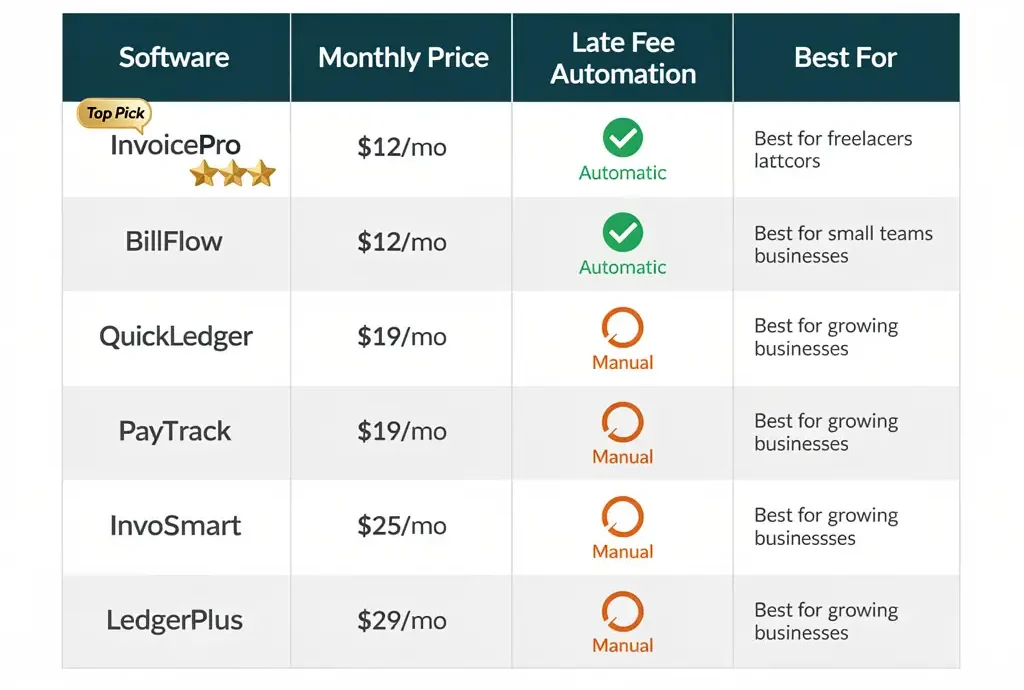
Stop tracking payment status in a spreadsheet. Stop sending manual chase emails when you feel emotionally ready for the awkwardness. That system guarantees delays because you will sometimes be too uncomfortable to follow up, and that discomfort is exactly how an invoice goes from 30 days overdue to 90.
If you work through platforms like Upwork or Fiverr, this entire system applies only to direct client relationships under your own contracts. Those platforms manage their own payment processing and dispute resolution late fee clauses don’t extend into the platform’s jurisdiction.
Does Charging a Late Fee Damage Client Relationships? Here’s the Truth
Freelancers usually frame this question the same way: “Won’t they think I don’t trust them?” “What if it scares someone off?” “It feels confrontational.”
A workable approach is to treat a client’s reaction as information: a client who bristles at a standard, pre-disclosed late payment fee clause is giving you information. That reaction is data about how they plan to manage your invoices. Use it.
But delivery matters. A workable approach in each situation is as follows.
With New Clients
Include the payment terms and late fee clause in the contract where it needs to be for legal reasons anyway and mention it once during the proposal stage: “My standard terms are net 15, with a 1.5% monthly late fee on anything overdue. Pretty standard any questions before we move forward?”
The easiest way to introduce this is to make it structural rather than conversational. It lives in the contract. You mention it once. You don’t make it a negotiation. Most clients match your energy on this, and the ones who bristle are revealing something worth knowing before you commit to the project.
With Existing Clients You’re Updating
You can’t slip a new clause into the next invoice and call that disclosed. If you’ve worked with someone for a year without a late fee clause and want to add one now, tell them directly: “Hey [Name], I’m tightening up my contracts adding a net 15 term and a 1.5% monthly late fee going forward. Wanted to give you a heads-up before I send the updated contract.”
Good clients say “sounds fine” without a second thought. The ones with a strong reaction are showing you something about their payment habits.
With a Client Who Is Currently Late
Don’t try to retroactively attach a fee to an invoice sent without the clause. The contract didn’t include it, so the fee doesn’t apply to this invoice legally or practically. Trying to enforce a fee that was never agreed to turns a payment problem into a relationship problem. Now you’re fighting on two fronts simultaneously.
What you can do: send a firm professional follow-up on the existing invoice, get it paid, and update your contract for the next engagement. Consider also adding a deposit before work begins on future projects that one change alone eliminates an entire category of non-payment risk.
How to Actually Enforce a Late Payment Fee When Someone Goes Silent
The invoice is 21 days past due. Two automated reminders went out. Nothing came back. Here is the sequence.
Day 1 after the due date: First automated reminder fires from the invoicing software. No action is needed, and the impersonal delivery is an advantage — it feels like a system notification, not a confrontation.
Day 7: Second automated reminder. Still nothing from me.
Day 14: A personal email. One short, warm, direct email:
“Hi [Name], just checking in on invoice #104 from [date] for $X. The automated reminders may have gotten lost. Could you give me an update on when to expect payment? Thanks.”
No accusations. No heavy language. At this stage, most clients respond something was missed, AP needs a document from me, the invoice landed in the wrong inbox. Fix whatever the actual obstacle is.
Day 21: If Day 14’s email gets no response, I send an updated invoice with the late fee applied as its own line item, along with a brief note:
“Per our agreement, a late payment fee of 1.5% ($X) has been added to the outstanding balance. Total now due: $X. Let me know if you have any questions.”
Calm. Matter-of-fact. This is exactly what the contract said would happen. There is nothing to apologize for.
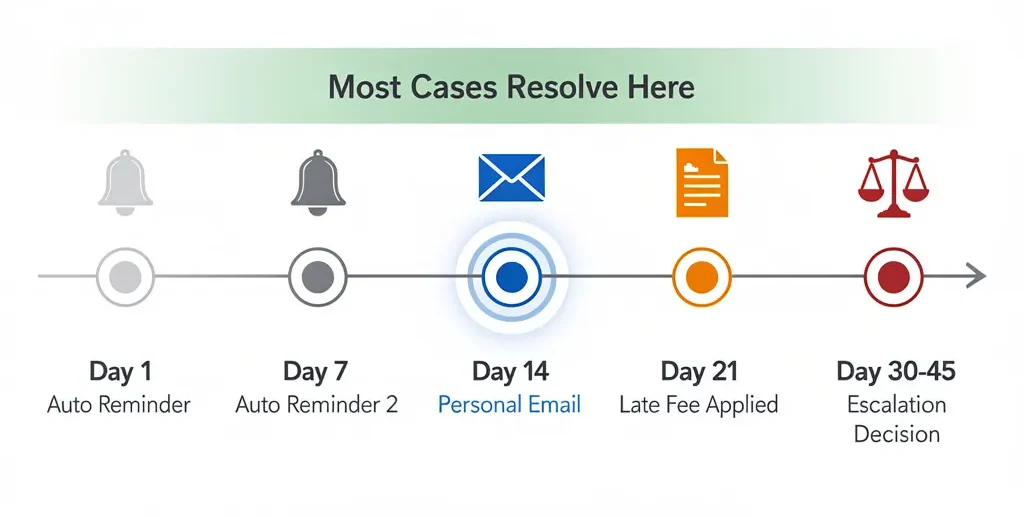
Day 30 to 45: Now a real decision is required based on the amount and the relationship.
For amounts under $500 with an otherwise solid client, a workable approach is to keep following up directly and weigh whether the fee dispute creates more friction than the relationship is worth.
For larger unpaid invoice balances with a non-responsive client, the options in escalation order: a formal demand letter citing the contract clause (the formality alone tends to move things draft one yourself, no lawyer required for the first round), a debt collection agency (they typically take 25% to 40% of recovered amounts, so this math only works for invoices above roughly $1,000), or small claims court (filing fees typically run $30 to $100 depending on the state and claim amount, no lawyer required, timelines vary by court).
In practice, a reminder sequence plus one personal email often resolves a routine overdue invoice before escalation is needed — but there is no guarantee, and the escalation path exists for the cases that do not resolve. Knowing it exists changes how you approach the conversation. But most of the time, you won’t need it.
Example Scenarios: How This Plays Out in Practice
Consider four typical situations, to see what this actually looks like rather than just how it’s supposed to work in theory.
Example 1: The Forgetful Client
Consider a web developer who sends an invoice to a long-standing client — someone he has worked with for three years without a single issue. Suppose sixty days pass with no payment. He finally calls after two awkward email attempts that got one-line replies and learns the client’s bookkeeper has changed. The new person has not set him up as an approved vendor yet. The original invoice has been sitting in a queue for six weeks.
In this kind of scenario, none of that would be malice. It would be operational chaos inside a company that had changed staff without updating their vendor list. Automated reminders could surface the problem in week two. A late fee clause on the freelancer invoice could give someone in that accounts department a financial reason to track down the issue faster.
Example 2: The Deliberate Delay
Consider a copywriter working with a marketing agency that pays 45 to 60 days late on every engagement, despite having signed net 30 terms. No late fee clause exists. The agency’s approach may rely on stretching payment timelines to every vendor it works with — the copywriter would not be the only one.
Suppose she adds a 1.5% monthly late fee clause to her next contract. The agency pushes back and asks her to remove it. She does not. The clause would not just address the behavior; it would reveal something about that agency she needs to know. Clients who push back hard on a standard late fee clause often already know they have a payment problem.
Example 3: The New Client Who Needed It
Consider a graphic designer, nervous about including a late fee clause in her first contract with a new brand client, a mid-size company with a real accounts payable department. She almost removes it to seem “easy to work with.” She keeps it in — the clause itself signals a structured business, whether or not any single invoice is paid early.
Professional clients the kind who work with contractors regularly generally expect late fee clauses. They do not find them unusual. In this kind of case, the clause would signal a structured business, and a professional client would be expected to respond in kind.
Example 4: When the Clause Is Enforced
Consider a $1,800 content strategy invoice: Day 30 comes and goes, an updated invoice goes out with a $27 late fee (1.5% on $1,800) as its own line item, and the client replies that they thought they’d approved it — payment goes out the same day.
In another typical case, a client says they don’t remember agreeing to the clause; forwarding the signed contract resolves it, and the clarity about the relationship comes fast instead of slow.
Mistakes Freelancers Make With Late Payment Fees
These mistakes are common, and they usually become a bigger problem than they needed to be.
Putting the clause only on the invoice. In the US, a late fee is generally enforceable only if it was disclosed in a written agreement before the work began. (Exception: UK B2B statutory interest under the 1998 Act applies even without a clause, unless the contract already provides a substantial remedy — see the UK section.) An invoice is a billing document, while a contract is a legal agreement. Only the contract protects you when a client contests a fee.
Setting it up and never automating it. If you have to manually remember to add a late fee to an overdue invoice, you will forget sometimes — or feel too awkward to add it. Automate it so the software applies the fee on schedule and the decision is already made for you.
Enforcing it inconsistently. Waive the fee for one client and enforce it for another and you now have a fairness problem on top of a payment problem. If you want to waive it as a genuine goodwill gesture for an excellent long-standing client, do it but make it explicit and deliberate, not a quiet failure of nerve.
Apologizing for it. You delivered the work, invoiced correctly, and are applying a clause both parties agreed to before the project started. There is no apology that belongs in that email.
Making the rate punitive. 5% per month feels satisfying when you are angry at a client who has ignored four reminders, but it may be unenforceable in your state and reads as predatory rather than professional. Stick to 1% to 1.5% and let the policy do the work.
Skipping the grace period. Give clients a 5 to 7 day grace period before the fee kicks in — a commonly used practice, not a legal requirement — since banking delays, holidays, and weekends do not reflect bad intent. The grace period signals you are reasonable, and the fee that kicks in after it signals you mean business.
Adding fees after the fact. In the US, you generally can’t attach a late payment fee to work invoiced under a contract with no late fee clause. (Exception: UK B2B statutory interest under the 1998 Act applies even without a clause, unless the contract already provides a substantial remedy — see the UK section.) That argument won’t hold up legally, and attempting it transforms a payment dispute into a relationship dispute simultaneously.
Ignoring the international layer. If you work across borders, wire transfer delays, currency conversion windows, and different banking holidays mean a client paying promptly by their local standards can appear late by yours. Build a slightly wider due date into international invoices, specify the exact currency you expect, and include your banking details clearly to eliminate processing friction.
In the EU, Directive 2011/7/EU gives a creditor statutory interest at the ECB reference rate plus at least 8 percentage points, with a fixed minimum compensation of €40 for recovery costs; the default B2B payment period is 30 days, and an agreed B2B period of up to 60 days is permitted if not grossly unfair.
Late Fees vs. Raising Your Rates: These Are Two Different Decisions
Here’s something I wish someone had framed for me earlier: a late payment fee on your freelancer invoice and your base hourly or project rate fix two entirely different problems. Mixing them up usually means neither gets properly fixed.
Some freelancers who’ve been burned by chronic late payers start quoting $110 per hour instead of $100 to “cover” the risk of waiting 45 days for the money. The logic is understandable. But it doesn’t fix the problem it just makes you marginally more expensive while leaving the same slow-pay incentive structure completely intact. The payment still arrives 45 days late. It’s just bigger.
A late payment fee fixes the actual problem by creating a financial consequence for waiting. Your base rate should reflect your skills, your market, and what your time is genuinely worth. The late fee policy is the mechanism that gets that money to you on the timeline it was supposed to arrive.
Raising your rate without adding a late fee clause does not fix slow payment — the payment still arrives late, just bigger. Adding the clause without changing the rate is what changes payment behaviour, because it creates a financial consequence for waiting. The rate change did nothing to the payment behavior. The clause changed it immediately.
Raise your rates for the right reasons because your work is worth more and the market supports it. Build the late fee structure for a different reason because your business cash flow deserves the protection. These are separate decisions made with separate logic, and making one doesn’t substitute for making the other.
What to Do When a Client Refuses to Pay the Late Fee Itself
You’ve applied the late fee. The client pays the original invoice amount and ignores or explicitly rejects the fee portion. Now what?
First, decide whether it’s worth pursuing. If the fee is $18 and the client is otherwise excellent, you might decide the relationship outweighs the amount. Make that call consciously not out of awkwardness.
If you decide to pursue it, send a clear, brief email: “Thanks for the payment I’ve noted the remaining balance of $[fee amount] from our agreement’s late fee clause. I’ll include this on the next invoice.”
If they contest it, your options in order of formality:
- Negotiation: sometimes a client will split the fee as a compromise that’s a reasonable outcome
- Demand letter: a formal letter citing the contract clause shifts the seriousness level noticeably; you can draft this yourself
- Small claims court: for amounts over a few hundred dollars you’re committed to recovering, this is genuinely accessible without a lawyer in most US jurisdictions
A documented, contract-backed fee is less likely to be disputed than an undocumented one. The clause is in writing. The contract was signed. When you’re calm, documented, and clear about the remaining balance, they pay usually without further argument. The clients who don’t are typically the same ones who were already showing you signs the relationship needed to end. The fee just makes that clarity arrive faster.
Does a Late Fee Policy Make You Look Unprofessional? (The Real Answer)
A late payment fee clause in a freelancer invoice does not signal distrust. It signals that you run a real business.
Your plumber has a late fee policy. Your accountant has one. Every subscription service you’ve ever used has one. Every building lease you’ve ever signed has one. The entire business world operates on disclosed payment penalties and the notion that freelancers should be exempt from this because they want to seem “easy to work with” has cost the profession enormous amounts of money that was genuinely owed.
Systematised payment processes are a feature of well-run freelance businesses: explicitly worded contracts, defined due dates, late fee clauses, and automated reminders. Their clients respect them. Not despite those structures because of them.
And the clients who push back on a standard, pre-disclosed late fee clause are not pushing back on the clause. They’re showing you something about how they manage their finances and their vendor relationships. That information is genuinely valuable especially before you commit months of work to a project with them.
A late fee clause reveals more about which clients are worth keeping than years without one. Not because the fee changed anyone’s character. Because it removed the ambiguity about what professional expectations looked like and shows clearly who meets them.
Your Complete Late Payment System: The Framework to Set Up This Week
Here’s the complete system, broken into three tiers that matter. Do the foundation once and it’s done. Use the per-project checklist at every engagement start. Run the per-invoice routine on autopilot.
The Foundation One-Time Setup
Update your contract template first: late fee clause at 1.5% monthly or $50 minimum, 5 to 7 day grace period, specific due date language. Then configure your invoicing software FreshBooks, Bonsai, Wave, or Zoho with your payment terms and the automated reminder sequence. Create your invoice template with the late fee reference note at the bottom. Decide your default payment terms by project type: net 7 for small quick jobs, net 15 for regular ongoing work, net 30 for large corporate clients.
One afternoon. Done permanently.
Per-Project Checklist
Before work starts on any engagement: send the contract with payment terms visible, not buried on page 4. Get it signed. Confirm the invoicing contact name, email, and any vendor setup requirements W-9 in the US, PO numbers, vendor portal registration. Confirm the client’s billing cycle closing date if relevant to your invoice timing. For longer projects, build in milestone payments rather than waiting for a single completion payment.
Per-Invoice Routine
Send the invoice the day work is delivered. Set a calendar reminder to check payment status three days before the due date. Let the automated reminders run. At Day 14 post-due date: personal email. At Day 21 post-due date: updated invoice with late fee applied as a separate line item.
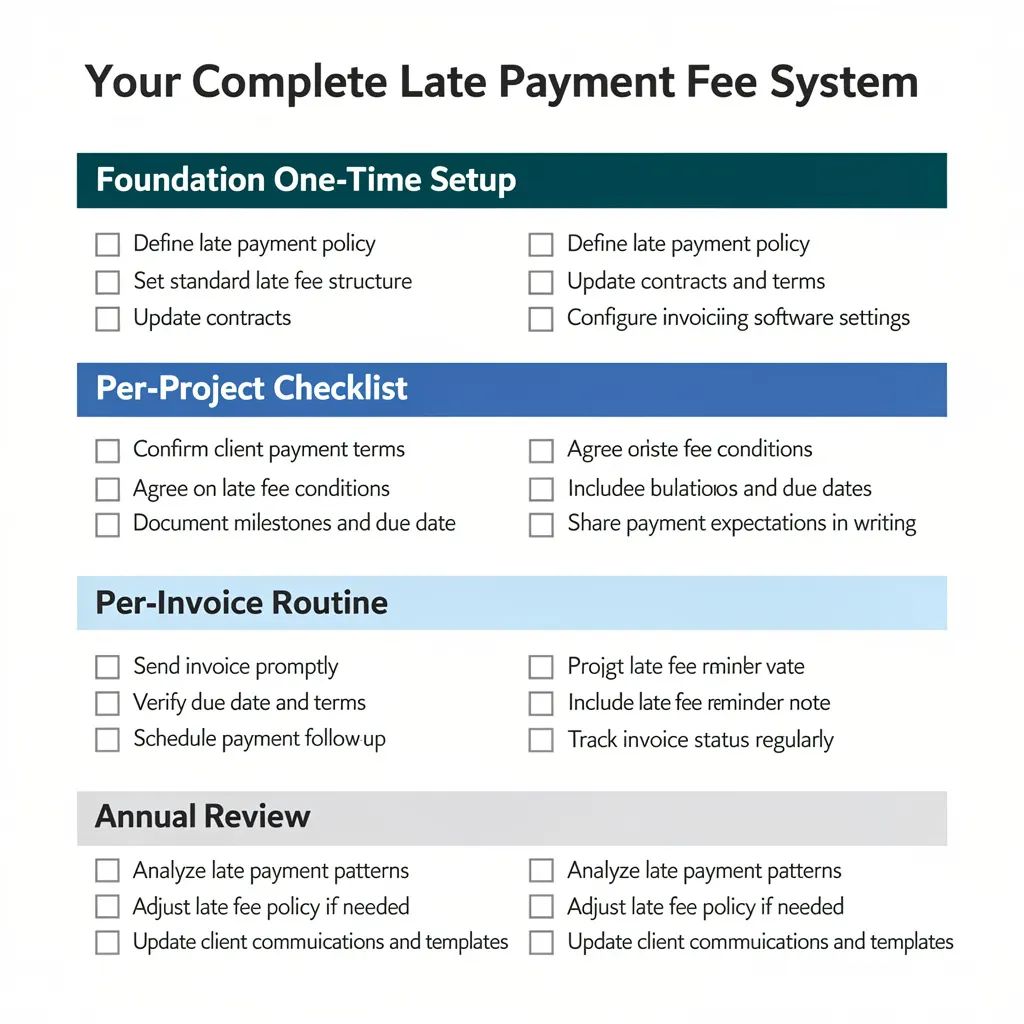
Also worth doing annually: review your accounts receivable as a freelancer which clients were consistently late, which invoices took more than 45 days, which relationships cost more in follow-up time than they returned in income. That data tells you where to adjust your pricing, tighten your terms, or end a client relationship that isn’t working financially.
The Early Payment Discount Alternative
Since we’re on payment incentives, there’s a flip side worth naming: early payment discounts. They’re less common in freelancing than late fees, but they solve a related problem.
The idea: offer the client a small discount typically 1% to 2% if they pay within a shortened window. The standard shorthand is “2/10 Net 30” a 2% discount if paid within 10 days, with the full amount due at 30 days otherwise. For freelancers, this might look like: “Pay within 7 days and take 2% off the invoice.”
The logic is that for cash-flow-sensitive freelancers, getting paid faster is sometimes worth slightly less money. You give up 2% to guarantee you’re not waiting 45 days.
Early payment discounts or invoice factoring are not for everyone: some freelancers would rather enforce the full amount with a solid late fee structure than discount their rate to compensate for a client process problem. But other freelancers rely on them, particularly those doing regular work with large companies where the AP chain is long and a financial nudge is the only realistic way to get prioritized before the billing cycle closes. If that describes your client mix, it’s worth adding to your toolkit.
Why Clients Pay Some Invoices Before Others (The Payment Priority Problem Nobody Explains)
Most “how to charge late fees” articles skip this entirely and it’s the thing that actually explains why the late fee clause works.
In most small and mid-size businesses, invoices from vendors get paid in rough priority order based on factors that have almost nothing to do with ethics. Understanding those factors tells you exactly where the late fee fits into the system.
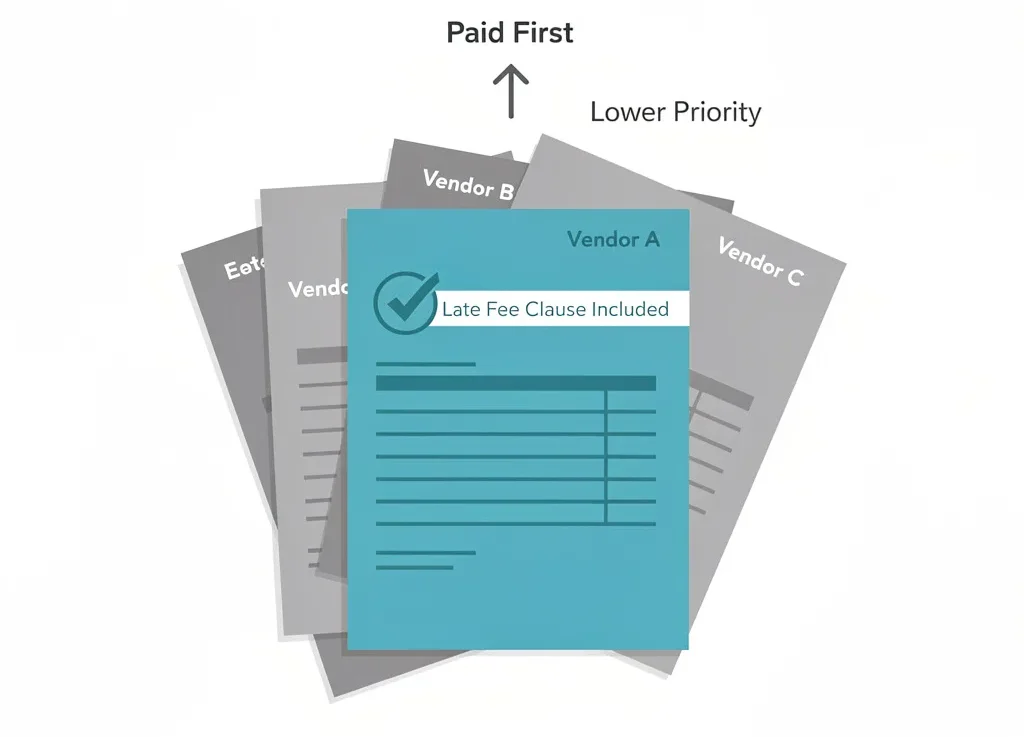
Vendor size. Big suppliers — software companies, building landlords, major equipment providers — get paid first because they have real leverage. A late fee clause on your freelancer invoice partially closes that gap by attaching a financial consequence to deprioritizing you.
Invoice clarity. A confusing invoice, one addressed to the wrong person, or one missing a required Tax ID or PO number gets stuck in a review queue that can add weeks. An invoice can sit stuck for weeks simply because the Tax ID number was missing from it.
Relationship proximity. When the person who hired you is also the person approving payment, things move fast. When there are three layers between your contact and the AP department, things slow down for reasons that have nothing to do with intentions, so building even a brief direct connection with whoever processes payments can cut timelines meaningfully.
Urgency signals. “Due: August 15, 2026” creates urgency, while “Net 30 from invoice date” creates none and requires math, and a late fee clause signals quietly and professionally that waiting has real financial consequences.
Stack all of these correctly and your invoice moves up the priority queue on its own. That’s why a late fee clause is not just about recovering money if someone pays late. It’s about repositioning your invoice in a competitive priority system that exists whether you acknowledge it or not.
The Confidence Factor
One more element worth naming: your own confidence in asking for payment affects whether you get paid on time. This sounds abstract. It isn’t.
Freelancers who apologize for sending invoices, who hedge their payment terms with “whenever you get a chance” language, who delay sending the invoice because they “don’t want to seem pushy” these freelancers get paid late more often. Not because clients are predators. Because the signals they’re sending communicate: this payment is not urgent, and this person won’t escalate.
Contrast that with a freelancer who sends the invoice the day work is delivered, sets a specific due date, runs a professional reminder sequence, and has a late fee clause in the signed contract. Every element of that system communicates: this is a professional transaction with defined expectations and real consequences.
A 1.5% late fee enforced consistently where every reminder goes out on schedule, every late invoice gets the updated notice, every client is treated the same way protects your income far more than a 5% clause you’re too uncomfortable to follow through on. The number on the clause isn’t the deterrent. Your willingness to apply it consistently is.
Handling the “We Can’t Afford It Right Now” Conversation
Here’s a scenario that doesn’t show up in most late payment guides, probably because it’s genuinely uncomfortable: what happens when a client tells you honestly that they can’t pay right now?
This happens. A business hits a rough patch, a big client falls through, cash gets tight and suddenly you’re the vendor they can’t pay. The client isn’t necessarily a bad actor. They’re in a hard place.
How you handle it has real practical implications for whether you eventually get paid.
Verify the situation. “We’re having cash flow issues” is sometimes true and sometimes a negotiation tactic. Ask for a specific date: a specific date is a commitment, while vague assurances are not.
Get any agreement in writing. If you agree to extend the due date or set up a payment plan, confirm it by email with the schedule and a request for confirmation. This is not hostile — it is documentation that protects both sides.
Decide on the late fee. Some freelancers waive it when a client is genuinely struggling, while others apply it because the fee compensates for cash flow impact regardless of the cause. What matters is making the decision consciously and communicating it clearly.
Protect your future work. If a client cannot pay the existing balance and also has future work they want from you, pause — delivering more work to someone who has not paid is how a $1,500 balance becomes a $4,000 balance. Say you would love to continue once the current balance is settled, and talk about what comes next.
What Good Late Payment Fee Contract Language Actually Looks Like
The basic clause language appeared earlier in this piece; here is a deeper version, because vague language often does not hold up in the situations where it matters most.
A solid payment clause needs five elements:
1. The due date or payment window. “Payment is due within 15 days of invoice date” is clear, while “Payment due promptly” is not enforceable.
2. The late fee rate, stated specifically. “A late payment fee of 1.5% per month on the outstanding balance” is clear, and non-compounding means calculated on the original amount only, which is more common, more defensible, and easier to calculate. “A reasonable late fee may apply” is not enforceable.
3. When the fee kicks in. “After the due date” is the minimum, while “After a 7-day grace period following the due date” is better: it protects you from minor processing delays and shows the client you are reasonable.
4. Whether the fee compounds. A non-compounding fee is calculated on the original invoice amount each month. A compounding fee is calculated on the growing total balance, which increases faster and can raise legal questions in some states, so non-compounding is the safer default.
5. What happens if the client pays. Most clauses say the late fee is waived if the original balance is settled, while others say the fee stands regardless. Either is valid, but be explicit in the language so there is no room for dispute.
Here is a complete clause to start with:
“Payment is due within fifteen (15) calendar days of invoice date. After a seven (7) day grace period, any unpaid balance will accrue a non-compounding late fee of 1.5% per month (18% per annum, or the maximum rate permitted by applicable law, whichever is less) on the original outstanding amount. Late fees will be itemized and added to subsequent invoices. Continued non-payment may result in the suspension of services and/or referral to a collections process.”
The final sentence is doing more work than it might appear. It tells the client that there’s a real escalation path not just a fee that grows quietly each month, but a process that eventually moves outside the one-on-one relationship. Most clients never reach that point. But naming it in the contract changes how seriously they treat the clause from the start.
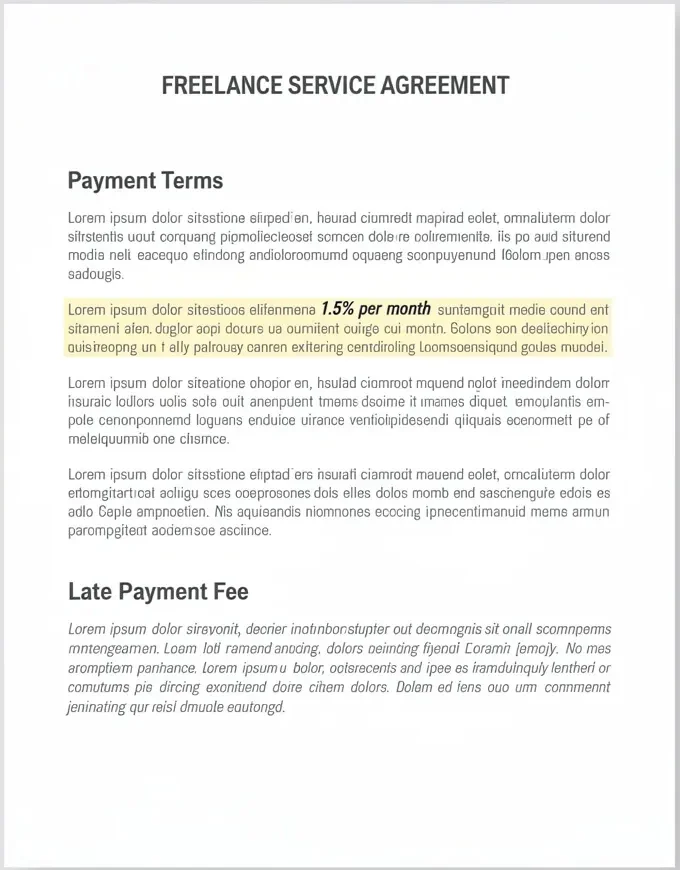
Important: contract language requirements vary by state and country. The template above is a strong starting point, not legal advice. For contracts above $5,000 or with international clients, having a freelance-specialized attorney review your payment clause is a one-time investment worth making.
Know When the Client Relationship Itself Is the Problem
This whole article is about protecting your income while maintaining client relationships. But sometimes those two goals stop being compatible.
If a client pays late consistently despite your clause, ignores reminders systematically, disputes fees they agreed to in writing, and treats each payment like a favor they’re doing you that’s not a late payment problem. That’s a client problem. The clause didn’t fail. The clause gave you clear, documented evidence of exactly who you’re dealing with.
A late payment fee on a freelancer invoice is a screening tool as much as a financial one. Good clients barely notice it. Problematic clients reveal themselves almost immediately when it appears in the contract.
Quick Reference: Late Payment Fee Cheat Sheet
For anyone who wants the summary to bookmark and return to:
- Standard rate: 1% to 1.5% per month (12% to 18% annually)
- Flat fee alternative: $25 to $50 per overdue period for small invoices
- Hybrid (recommended): 1.5% monthly or $50, whichever is greater, up to the legal maximum
- Grace period: 5 to 7 days is commonly used and signals reasonable intent
- Where to put it: Contract (required) + invoice payment terms note
- When to disclose it: Before work begins never retroactively
- Tools to automate it: FreshBooks, Bonsai, Zoho Invoice, Wave
- Reminder sequence: Day -5 before due, Day 0, Day +7, Day +14 personal, Day +21 fee applied
- UK statutory rate: 8% plus Bank of England base rate (applies automatically to B2B invoices by law)
- US legal limits: roughly 12% to 18% annually depending on state and transaction type — 1.5% per month is within that range in most cases, but check your state’s rules
Frequently Asked Questions About Late Payment Fees
What is the standard late fee percentage for a freelancer invoice?
The industry standard for freelancer invoices is 1.5% per month on the outstanding balance, which equals 18% annually on a simple, non-compounding basis. Some freelancers use a flat fee of $25 to $50 instead for smaller invoices, or a hybrid approach whichever is greater between the flat fee and the percentage. The key is that the rate is disclosed in writing before work begins.
Is it legal to charge a late payment fee on a freelancer invoice?
Yes, late fees on freelance invoices are generally legal in the US and the UK, provided the fee was disclosed in a written agreement before the work started. Rules in other countries vary — check local law. In the US, many states cap commercial interest rates between roughly 12% and 18% annually, depending on the transaction — the standard 1.5% per month falls within that range in most cases, but check your state’s rules. In the UK, the Late Payment of Commercial Debts Act 1998 gives freelancers a statutory right to charge interest on overdue B2B invoices even without a contract clause.
What happens if a client refuses to pay a late payment fee?
If a client pays the original invoice but refuses the late fee, you have several options: send a follow-up email noting the remaining balance with reference to the contract clause, negotiate a partial payment as a compromise, send a formal demand letter citing the signed agreement, or file a small claims court case for amounts over a few hundred dollars. Most documented late fee disputes resolve before they reach formal legal proceedings.
Do I need to warn clients about late fees before I can charge them?
Yes. In the US, a late payment fee on a freelancer invoice is generally enforceable only if it was disclosed in a written agreement before the work began. (Exception: UK B2B statutory interest under the 1998 Act applies even without a clause, unless the contract already provides a substantial remedy — see the UK section.) You cannot retroactively add a fee to an invoice issued under a contract that had no late fee clause. The clause must exist in the signed contract, and referencing it on the invoice itself is best practice.
How do I add a late fee to an existing overdue invoice?
If your contract already includes a late fee clause, issue a new invoice to the client that itemizes the original outstanding balance and the late fee as a separate line item, clearly labeled. Include a brief note referencing the contract clause. If your original contract had no late fee clause, you cannot charge a retroactive fee update your contract for future engagements instead.
What invoicing software automatically applies late fees to freelancer invoices?
You set the percentage and trigger date once in settings, and the software applies the fee to overdue invoices without manual intervention. Wave supports payment reminders but requires manual late fee entry as a line item.
Can I charge a late fee without a formal contract?
Technically you can include a late fee clause in a signed proposal or written project agreement rather than a formal contract but something in writing that both parties have confirmed before work begins is required for enforceability. A verbal mention of a late fee policy, or a note added only to the invoice after work starts, is not sufficient. If you work without any written agreement, your ability to enforce a late fee clause is significantly limited.
If you have built a late fee system that looks different from this one — different tools, different rates, different escalation paths — it can still work well if the terms are clear. The freelance payment situation varies enough across industries and client types that there’s no single universal answer. Drop what’s worked for you in the comments.
If you’re looking for more real world insights and practical tips to level up your freelancing journey, make sure to check out our website. We regularly share simple, actionable content to help you land better clients, protect your time, and confidently grow your freelance career.
Sources
Sources used for the rules in this guide: the UK Late Payment of Commercial Debts (Interest) Act 1998 (8 percentage points above the Bank of England base rate and fixed-sum compensation); the New York Freelance Isn’t Free Act — the New York City law took effect May 15, 2017 and the New York State law took effect August 28, 2024 (written-contract threshold of $800 or more); and IRS Schedule C treatment of late-fee income as ordinary income. State usury caps and commercial interest limits vary by state and transaction type — check your state’s rules before setting a rate.


One Comment on “Late Payment Fees on Freelance Invoices: How Much to Charge and How to Enforce Them”