

The Wake-Up Call Nobody Warns You About
Freelance income arrives with no tax withheld. A client payment is the full gross amount, and the tax on that income still has to be calculated and paid by the freelancer, on a quarterly schedule. That shift from automatic withholding to self-managed payments is the core of estimated tax. For the full beginner overview, see the beginner hub post: Freelance Taxes for Beginners.
Quick Note: This article covers US freelancers specifically. The rates, forms, and deadlines are all American. If you are outside the US, the exact numbers differ, but the core logic of setting money aside and paying on a schedule applies almost everywhere. This article is for informational purposes only. For advice specific to your situation, consult a licensed CPA or enrolled agent.
How Freelance Taxes Actually Work
First: you pay two separate taxes. Regular income tax, the same one every working American pays, plus a self-employment tax that covers Social Security and Medicare.
Second: you pay four times a year. The IRS runs on a pay as you go system. You send estimated payments throughout the year, not just in April. If you expect to owe $1,000 or more in federal tax, quarterly estimated payments are required.
Third: you generally report it on Schedule C, the form where self-employed people report business income and subtract business expenses, as part of your annual Form 1040. That applies to sole proprietors and to single-member LLCs that have not elected corporate treatment. The $400 net-earnings rule governs whether SE tax applies; hobby or one-off non-business income follows different rules. For the full beginner overview, see the beginner hub post: Freelance Taxes for Beginners.
Also worth knowing: most clients who paid you $2,000 or more in 2026 will send a 1099-NEC form in January (the threshold was $600 for payments made in earlier years). Whether or not you receive a form, all of the income is still taxable and must be reported.
The Self-Employment Tax
When you worked a regular job, your employer paid half your Social Security and Medicare taxes. When you are self-employed, you pay both halves. That is the self-employment tax, and the IRS sets it at 15.3% of your net earnings subject to SE tax — 92.35% of your Schedule C net profit. It is composed of 12.4% covering Social Security and 2.9% covering Medicare. One-half of your SE tax is deductible for income tax (it does not reduce the SE tax itself). For the full beginner overview, see the beginner hub post: Freelance Taxes for Beginners.
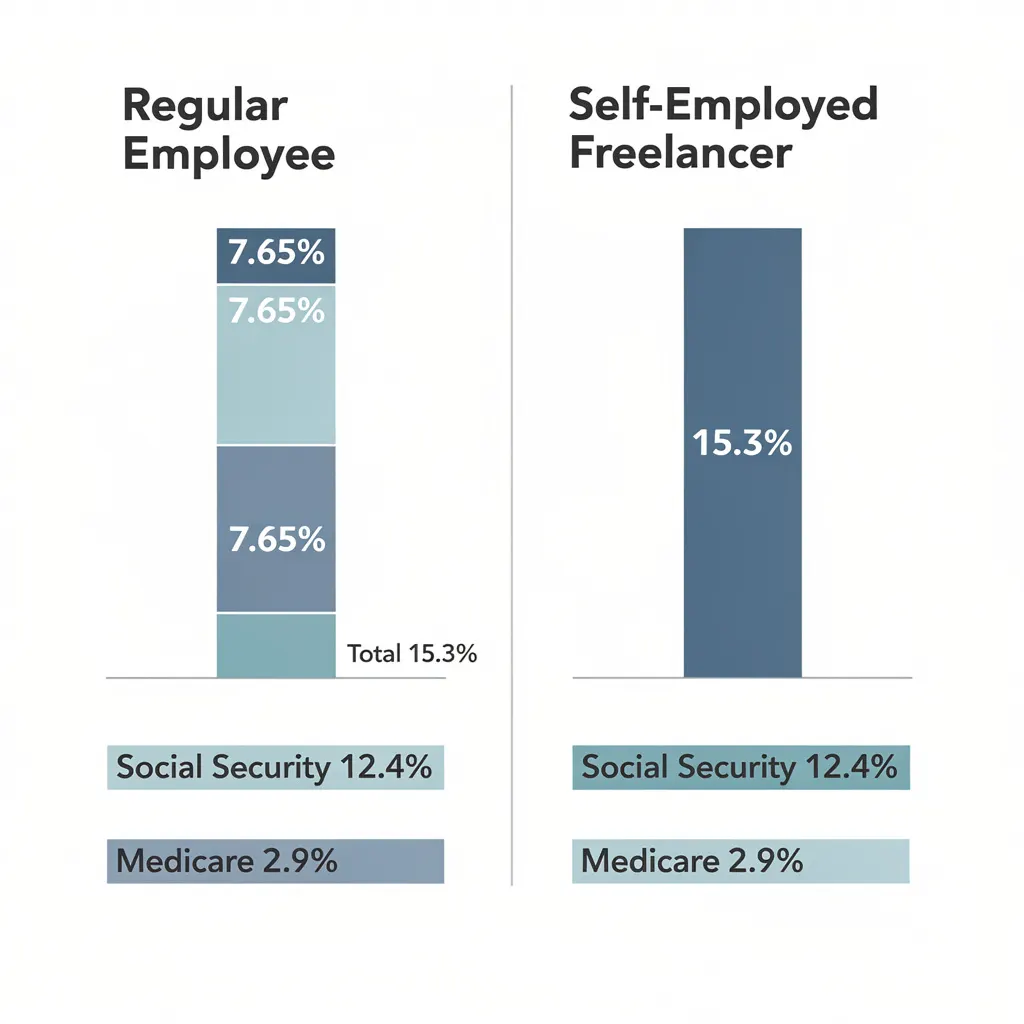
The 12.4% Social Security portion only applies to the first $184,500 of Social Security-taxable earnings in 2026 (net self-employment earnings after the 92.35% adjustment, combined with any W-2 wages, which use up the cap first). Above that amount, you only pay the 2.9% Medicare portion (plus the additional Medicare tax if you are over its threshold — see below).
Separately, the 0.9% additional Medicare tax applies to self-employment income above $200,000 ($250,000 if married filing jointly; $125,000 if married filing separately), with no cap.
Say you earned $60,000 net from freelance work in 2026. Your self-employment tax would be about $8,478: 92.35% × $60,000 = $55,410 of earnings subject to SE tax, and 15.3% × $55,410 = $8,477.73. Half of that SE tax ($4,239) is deductible for income tax. For a single filer taking the 2026 standard deduction ($16,100), taxable income would be about $60,000 − $4,239 − $16,100 = $39,661, giving federal income tax of about $4,511 at 2026 single rates — for a federal total of about $12,989 before state tax and before any credits or other income. Your own figure will differ with filing status, deductions, credits, and other income; work it through Form 1040-ES rather than relying on a rule-of-thumb range.
Quarterly Taxes: The System That Trips Everyone Up
Missing required quarterly payments can trigger an underpayment penalty — an interest-based charge on the amount underpaid, for the period it went unpaid. It is usually avoidable with four timely payments, and it may be waived for a casualty, disaster, or other unusual circumstance, or for retirement (after age 62) or disability. Use Form 2210 to work out whether you owe it.
To calculate your quarterly amounts, you can use Form 1040-ES, which walks through the estimation math and includes payment vouchers. One Form 1040-ES payment covers BOTH income tax and SE tax combined. Then you send the actual payment at irs.gov/payments through IRS Direct Pay, free, with a confirmation number. EFTPS.gov is an alternative payment system.
The 2026 deadlines are April 15, 2026 for Q1, June 15, 2026 for Q2, September 15, 2026 for Q3, and January 15, 2027 for Q4. Q2 covers only two months instead of three, April 1 through May 31. Put all four dates in your calendar with two-week reminders in front of each one.
2026 Payment Calendar
| Installment | Period covered | Due date |
|---|---|---|
| Q1 | January 1 – March 31, 2026 | April 15, 2026 |
| Q2 | April 1 – May 31, 2026 | June 15, 2026 |
| Q3 | June 1 – August 31, 2026 | September 15, 2026 |
| Q4 | September 1 – December 31, 2026 | January 15, 2027 |
Note: Q2 only covers two months — April and May. That catches most first-year freelancers off guard, and Q4 is the longest period, at four months from September 1 to December 31.
Form 1040-ES Worksheet Walkthrough
Work through the Form 1040-ES Estimated Tax Worksheet in this order. First, estimate your total income for the year, including your Schedule C net profit after business deductions. Second, figure your adjusted gross income, subtract the standard deduction or itemized deductions, and work out your taxable income and the income tax on it. Third, add your self-employment tax, figured at 15.3% of your net earnings subject to SE tax, plus any other taxes that apply. Fourth, subtract tax already withheld and any credits. The result is your required annual estimated tax. Divide that annual figure as the worksheet directs to get your quarterly installment, and if your income changes during the year, rework the worksheet and adjust the remaining installments rather than continuing with the original figure.
The Safe Harbor Rule
You generally avoid an underpayment penalty if your withholding plus estimated payments total at least the smaller of (a) 90% of this year’s tax, or (b) 100% of last year’s tax — 110% of last year’s tax if your prior-year adjusted gross income was over $150,000 ($75,000 if married filing separately) — paid in four timely, equal installments. Example: prior-year tax bill $12,000 and prior-year AGI under $150,000? Send $3,000 each quarter. You still owe any remaining balance when you file; the safe harbor protects you from the underpayment penalty, not from the tax itself. In your very first year, with no prior-year return, use the 90%-of-current-year route or the annualized method below instead.
If your income arrives unevenly — a big quarter followed by quiet months — the annualized income installment method (Form 2210, Schedule AI) lets you base each installment on the income actually received so far in the year, annualized, instead of four equal payments. That is different from simply re-projecting your annual total each quarter; use the Form 1040-ES worksheet or Schedule AI for the calculation.
The estimate-as-you-go approach works better in years when income is running very differently from the prior year. Each quarter, look at real earnings, project the annual total, calculate roughly what will be owed, and send a quarter of that. It is more precise but requires bookkeeping that is actually current.
If You Also Have a W-2 Job
Withholding from a W-2 job counts toward the same safe harbor as estimated payments. If withholding covers 90% of current-year tax or 100%/110% of prior-year tax, separate estimated payments may be unnecessary. Adjust withholding by submitting a new Form W-4 to your employer.
How Much Should You Actually Set Aside?
Here is the working number: 25 to 30 cents out of every dollar, moved the same day the payment arrives, into a separate account you do not touch. The range splits based on where you live. No state income tax, think Texas, Florida, Washington, and 25% is a common starting point for federal and any local obligations — check against your Form 1040-ES figure. High-tax states push you toward the higher end of the range. This 25–30% set-aside is a savings habit, not your required payment — your actual quarterly installment comes from the Form 1040-ES calculation and may be higher or lower.
Treat that fund as money that was never yours to begin with. It is the IRS’s money sitting in custody temporarily. The moment you stop thinking of it as savings you are protecting and start thinking of it as a bill you are pre-paying, tax season becomes easier to manage.
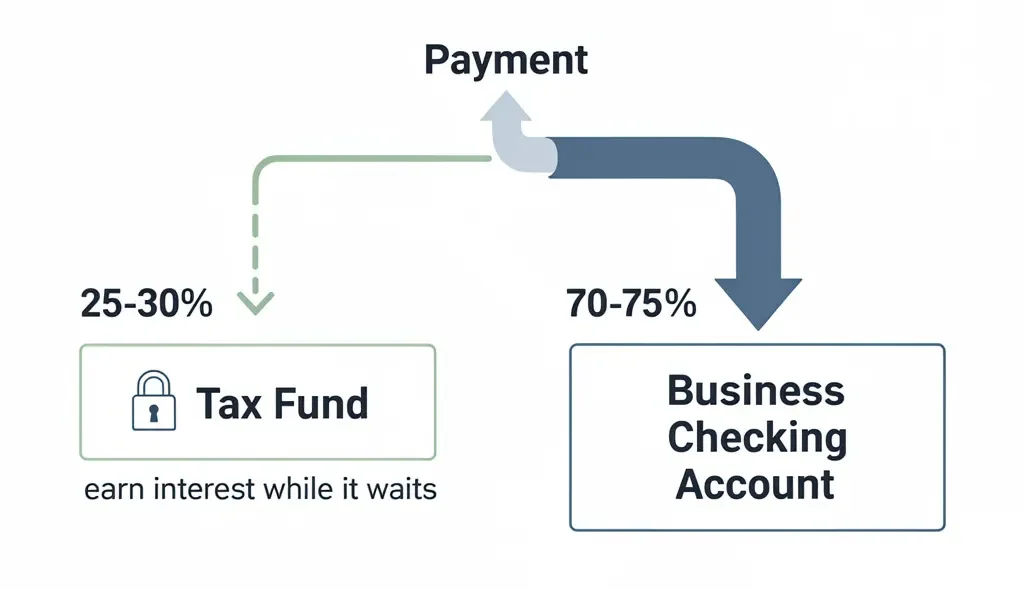
Open a separate high yield savings account and label it Tax Fund. Every payment that lands in a checking account gets a percentage transferred out the same day. One more thing worth doing: park that fund somewhere it earns interest; rates vary.
Deductions and Your Estimated-Payment Base
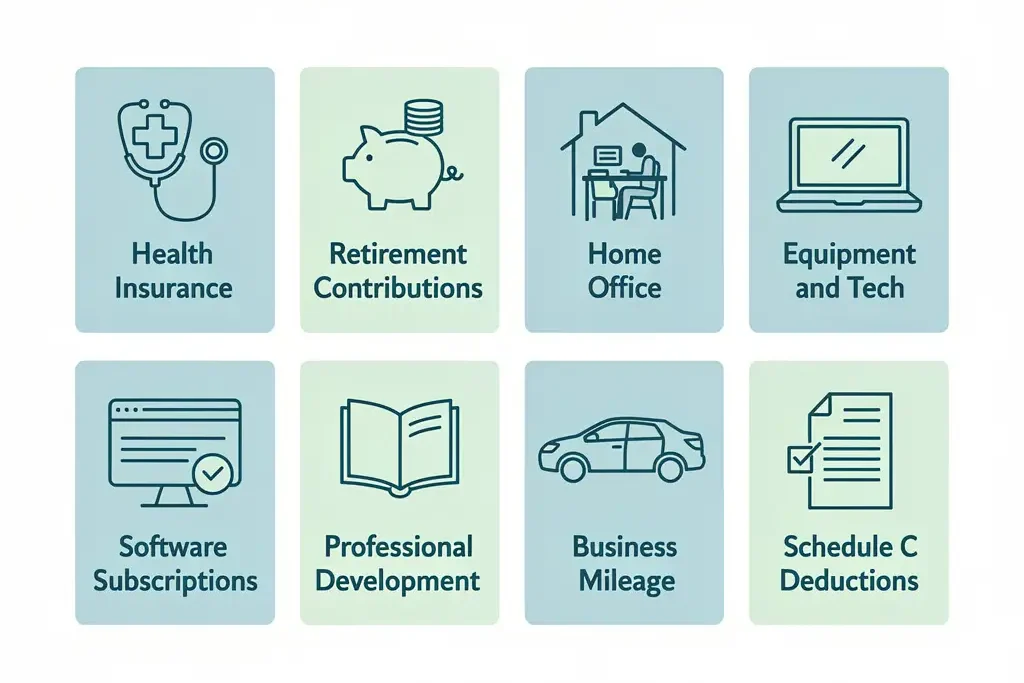
Deductions claimed on Schedule C cut your net profit, which trims both your income tax and your self-employment tax at the same time. One receipt doing two jobs worth of tax reduction. Note the exception in this list: the health-insurance deduction and retirement contributions below reduce your income tax only — they do not reduce your self-employment tax, which is figured on your Schedule C profit before those deductions. In short, Schedule C deductions lower the estimated-payment base, so a lower net profit means a lower Form 1040-ES figure. If you are not eligible for any employer-subsidized health plan (including through a spouse’s employer), you may deduct your health, dental, and qualified long-term-care premiums, up to your net profit from the business (and subject to the other Schedule 1 conditions). A SEP IRA or Solo 401(k) reduces your taxable income (for income tax) dollar for dollar, up to its limit. It does not reduce your self-employment tax. In 2026, the SEP IRA limit is the lesser of $72,000 or 25% of your net self-employment compensation (for a sole proprietor, the effective rate works out to about 20% of Schedule C net profit after the SE-tax adjustment — use the IRS worksheet rather than applying 25% directly to net profit). For home office, the actual expense method may land higher or lower — run both numbers. For professional development, courses and similar expenses that maintain or improve skills in your current work may qualify; expenses that qualify you for a new trade do not. For business mileage, the 2026 IRS standard mileage rate is 72.5 cents per mile for January 1 – June 30, 2026, and 76 cents per mile for travel on or after July 1, 2026. Use MileIQ or just maintain a running note on your phone. A hundred business miles per month is $72.50 in deductions at the first-half rate ($870 over a full year at that rate; miles driven after June 30 use the 76-cent rate). Keep documentation for every deduction: receipts, bank statements, and screenshots that prove the expense was real and business-related. For the full beginner overview, see the beginner hub post: Freelance Taxes for Beginners.
Tools for Payments and Bookkeeping
Bookkeeping for independent contractors means having a system that captures income and expenses automatically, estimates what you owe quarterly, and does not require hours on a Sunday to reconstruct. QuickBooks Self-Employed tracks income, auto-categorizes expenses, and estimates quarterly taxes. FreshBooks offers invoicing and expense tracking for freelancers managing multiple ongoing clients. MileIQ auto-detects drives and asks you to swipe right for business or left for personal, which supports mileage logs. A spreadsheet plus a filing tool at filing time is also a real system; the tool matters less than actually using it. For the full beginner overview, see the beginner hub post: Freelance Taxes for Beginners.
The Mistake to Avoid: Missing Quarterly Payments
Missing quarterly payments in the first year is a common and costly mistake. Some freelancers do not know estimated payments exist until all four deadlines have passed, and then owe a penalty on top of everything else. The penalty is avoidable with four timely payments. For the full beginner overview, see the beginner hub post: Freelance Taxes for Beginners.
When Should You Hire an Accountant?
Not everyone needs one. If freelance income is relatively straightforward, one type of work, predictable expenses, and no employees, filing software can handle a return without professional help. If income jumped significantly this year, if a home office was added, if major equipment was bought, if there is income from more than one source, or if forming a business entity is being considered, get a CPA for at least year one. When looking, find someone who specifically works with freelancers and self-employed people. Enrolled agents (EAs) are another option worth knowing about: they are federally licensed tax practitioners who specialize in IRS matters. Fees vary, so get a quote first. For the full beginner overview, see the beginner hub post: Freelance Taxes for Beginners.
You’ve Got This
Once the basic mechanics click, estimated tax becomes another quarterly item on the calendar. Send the payment, log the expense, move on. Set aside 25 to 30% from the very first payment. Pay your quarters on time. Track expenses every week. Use a tool that actually fits how you work.
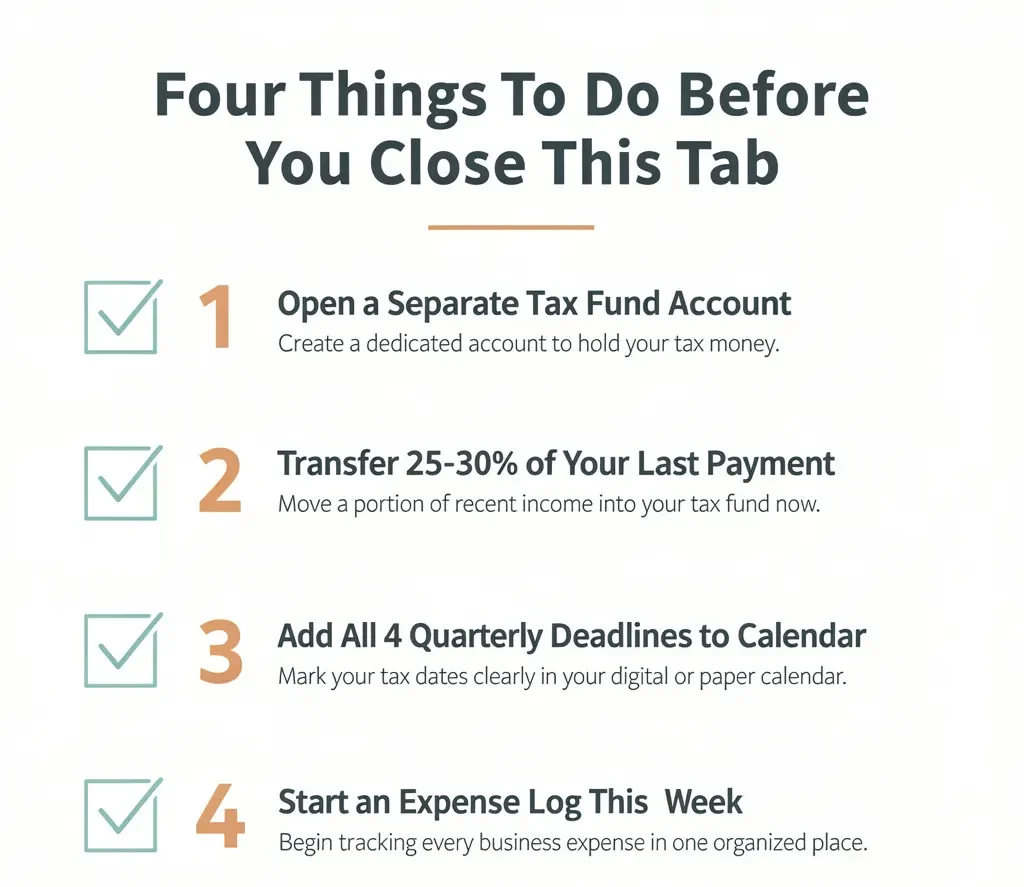
The four things to do before you close this tab:
1. Open a separate savings account today and label it Tax Fund. Do this before anything else. It is the highest-leverage single action in this entire article.
2. Transfer 25 to 30% of your most recent payment into it right now. Not at the end of the month. Right now. Build the reflex from the very first transfer.
3. Add all four quarterly due dates to your calendar with two-week advance reminders. April 15, 2026, June 15, 2026, September 15, 2026, and January 15, 2027. Set them tonight.
4. Start an expense log this week. A note on your phone, a spreadsheet, a folder in Google Drive. The format does not matter. Logging in real time does.
Frequently Asked Questions About Freelancer Taxes for Beginners
Q: Do I have to pay taxes if I only made a small amount freelancing?
Yes, if your net self-employment income was $400 or more in a calendar year, you are required to file a federal tax return and pay self-employment tax on those earnings. This threshold applies even if freelancing is a side hustle alongside a regular job.
Q: What is the self-employment tax rate in 2026?
The self-employment tax rate is 15.3%. It breaks down into 12.4% for Social Security and 2.9% for Medicare. The 12.4% Social Security portion only applies to the first $184,500 of Social Security-taxable earnings in 2026 (net self-employment earnings after the 92.35% adjustment, combined with any W-2 wages, which use up the cap first). Above that amount, you only pay the 2.9% Medicare portion (plus the additional Medicare tax if you are over its threshold — see below).
Q: How do I pay quarterly taxes as a freelancer?
Go to irs.gov/payments and use IRS Direct Pay. It is free, with a confirmation number. You can also use EFTPS.gov. Use Form 1040-ES to calculate your estimated payment amount each quarter.
Q: Do I need to pay quarterly taxes in my very first year of freelancing?
Yes, if you expect to owe $1,000 or more in federal taxes for the year, quarterly estimated payments are required even in your first year. Many first-year freelancers miss this and receive an underpayment penalty when they file their annual return.
Q: Can I deduct my laptop and phone as a freelancer?
Yes, if you use them for work. If the device is used for both personal and professional purposes, you deduct the percentage that represents actual business use. A laptop used 80% for client work? Deduct 80% of the purchase price. Keep the receipt and document the usage split when you buy it.
Q: What is Schedule C and does every freelancer need to file it?
Schedule C is the IRS form where self-employed people report business income and subtract business expenses. You generally report it on Schedule C if you earned income as a freelancer or independent contractor, including as a sole proprietor or a single-member LLC without a corporate election, as part of your annual Form 1040. The $400 net-earnings rule governs whether SE tax applies; hobby or one-off non-business income follows different rules.
Q: What happens if I skip quarterly estimated tax payments?
You may owe an underpayment penalty when you file your annual return if you underpaid required installments. The charge depends on the amount underpaid and how long it went unpaid (see Form 2210). It is avoidable with four timely payments, and it may be waived in the casualty/disaster and retirement/disability cases above.
Q: How do I know what tax bracket I am in as a freelancer?
Your federal income tax bracket is determined by your total taxable income after deductions, not your gross freelance revenue. For 2026, single filers pay 10% on the first $12,400 of taxable income, 12% up to $50,400, and 22% up to $105,700. Because taxable income is what remains after deductions (including the $16,100 standard deduction for single filers in 2026), only the portion of taxable income above $50,400 is taxed at 22% — so check your taxable income, not your gross or net freelance revenue, before assuming which bracket most of your income falls in.
Q: What is the difference between a 1099-NEC and a 1099-K?
A 1099-NEC is sent by clients who paid you $2,000 or more in 2026 (the threshold was $600 for payments made in earlier years). A 1099-K comes from payment platforms like PayPal, Venmo, or Upwork when your gross payments through that platform exceed $20,000 AND you have more than 200 transactions in the year (both conditions must be met; restored by the One Big Beautiful Bill Act, July 2025). Some states set lower thresholds, and a platform may still send a form below the federal trigger — and income below the threshold is still taxable. Both report income you are required to claim on Schedule C. You may receive both for the same income if a client paid you through a platform, so always reconcile carefully to avoid double-reporting.
Q: Is it worth hiring a CPA as a beginner freelancer?
For a simple first year with one type of income and basic expenses, TurboTax Self-Employed is a widely used option. But if your income was higher than expected, you have multiple income sources, you added a home office, or you are thinking about forming an LLC, a CPA for year one is worth considering. Fees vary, so get a quote first.
Sources
- IRS: Estimated taxes
- IRS: About Form 1040-ES, Estimated Tax for Individuals
- IRS: Publication 505, Tax Withholding and Estimated Tax
- IRS: Am I required to file a Form 1099 or other information return? (1099-NEC threshold)
- Social Security Administration: Contribution and Benefit Base (2026 wage base $184,500)
- IRS: Standard mileage rates
- IRS: SEP contribution limits
- IRS: Topic no. 560, Additional Medicare tax
- IRS: Tax inflation adjustments for tax year 2026 (brackets and standard deduction)
- IRS: Instructions for Form 2210, Underpayment of Estimated Tax
If you’re looking for more real world insights and practical tips to level up your freelancing journey, make sure to check out our website. We regularly share simple, actionable content to help you land better clients, protect your time, and confidently grow your freelance career.


8 Comments on “Estimated Tax Payments for Freelancers: When to Pay and How to Calculate”