

Setting up a separate bank account for your freelance business is honestly one of the smartest moves you can make as a self employed person. It sounds simple. It sounds boring. But the moment you actually do it, you will wonder why you waited so long.
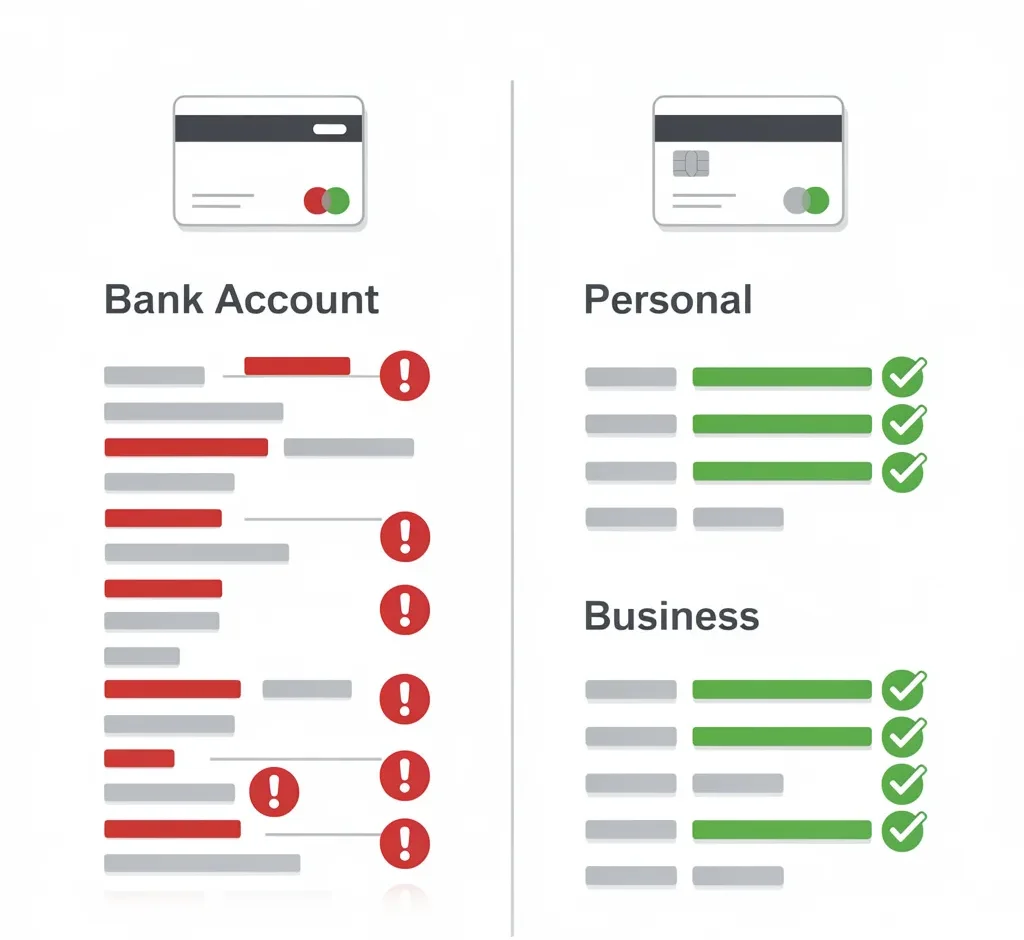
Most freelancers start out tossing everything into one personal account. Client payments come in. Netflix charges go out. DoorDash orders mix with software subscriptions. And by the time April rolls around, you are sitting at your kitchen table at 11pm trying to figure out which $14.99 charge was for a stock photo site and which one was that random streaming service you forgot to cancel.
That is a miserable way to run a business. And you do not have to do it that way.
This guide covers everything you need to know about opening a separate bank account freelance business, which accounts are actually worth your time, what documents you need, and the mistakes most freelancers make that you can completely avoid.
Why Every Freelancer Needs a Separate Bank Account for Their Business
Let’s start with the honest truth. You do not legally need a separate business bank account if you are a sole proprietor. The IRS does not require it. Nobody is going to come knocking on your door.
But here is what actually happens when you keep everything in one account.
You lose track of your income. You miss deductible expenses. You stress out every tax season. You look less professional to clients. And if you ever get audited, you are in serious trouble trying to prove what was business and what was personal.
A dedicated business bank account can help with much of that, by keeping business income and spending in one place.
You Finally Know What Your Freelance Business Is Actually Making
This seems obvious. It really is not.
When every client payment drops into your personal account, it disappears into the flow of regular life. It becomes rent money, grocery money, weekend money. You genuinely lose the signal of what your business is producing.
The moment you separate your accounts, you can open the app and see in about ten seconds exactly how much came in, what went out for business expenses, and what is left. That clarity changes how you make every financial decision going forward.
No more guessing. No more rough estimates. Just actual numbers.
Tax Season Gets Easier With Separate Records
Filing taxes as a freelancer is already more complicated than it is for salaried employees. You are dealing with self employment tax, quarterly estimated tax payments, and tracking every single deductible expense yourself.
When all of that lives inside your personal account mixed with personal spending, you are creating a massive amount of unnecessary work. Every transaction becomes a puzzle. Was this Amazon charge a business book or a birthday gift? Was this coffee a client meeting or a Tuesday morning habit?
With a clean, separate business checking account, you pull up the transactions and hand them to your accountant. Everything in that account is business related. Done.
With transactions already separated, tax preparation can become faster, though the time saved varies with how many transactions you have and how your records are kept.
If You Have an LLC, Separation Matters More
This part is important enough that it deserves its own bold statement.
If you formed an LLC, a separate business bank account is strongly recommended. That recommendation is not the same as a single legal rule. Three different things are often confused here: (1) the IRS bookkeeping recommendation, (2) a bank’s own account-opening requirements, and (3) state-law veil-piercing. A business account by itself does not establish legal separation; it is one piece of keeping business and personal finances distinct.
Here is why. An LLC gives you a legal separation between your personal assets and your business liabilities. If your business ever gets sued or runs into serious debt, that structure is supposed to protect your personal savings, your car, your home.
That protection is stronger when you maintain the separation. Running business and personal money through the same account can weaken the argument that the business is separate. Lawyers call a court’s decision to disregard that separation piercing the corporate veil. Commingling is one factor courts may weigh, and the outcome depends on state law and all the facts, not on any single transaction alone.
Mixing funds does not automatically erase that protection. It can weaken it, and whether a court disregards the separation depends on state law and all the facts.
Open the account. Keep them separate. That is the whole job.
Clients Take You More Seriously
This one might feel like a small thing. It is not.
When a client sends payment to a business account in the name of your company or your business entity, it signals something. You are running an actual operation. Not a side gig. Not a hobby with a PayPal link.
One of the freelancers in a finance community I follow mentioned that a long term corporate client specifically told them that receiving invoices from a proper business account reduced friction in their internal accounting department. The client’s accounts payable team processed it faster because it looked like a legitimate vendor transaction.
Small signal. Real impact on getting paid on time.
Banking History Is Not the Same as a Credit File
You might not care about business credit right now. That is fine.
But the day you want a business credit card, a small business loan, or a line of credit to cover a slow month, your business banking history matters. Lenders and card issuers look at how long your business account has been active and how consistently it has been used.
Every month your business account stays open and active adds to the banking history a lender can review. That is not the same as a bureau credit file: a checking account alone does not create one. A bureau credit file is built from credit accounts that report to business credit bureaus, so confirm whether any card or line you consider reports before counting on it to build credit.
Before You Open a Business Bank Account: Answer These Questions First
Most guides skip this part. That is a mistake. Answering these questions first can save you from opening the wrong account.
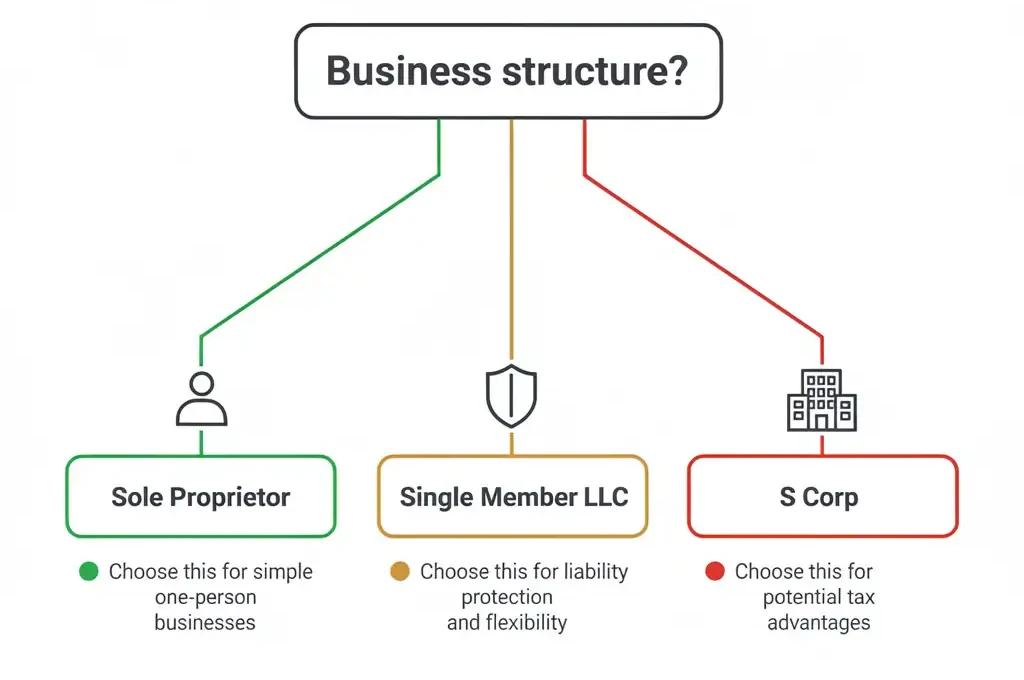
What Is Your Business Structure?
Sole Proprietor: This is the default for most freelancers who have not registered anything formally. You and your business are legally the same entity. No paperwork was required. Most freelancers are here.
As a sole proprietor, you can technically use a second personal account exclusively for business. But a free dedicated business checking account is cleaner, comes with better features, and costs nothing.
Single Member LLC: You registered an LLC. A dedicated business account is strongly recommended, because keeping business and personal money apart supports the separation the LLC is meant to create. Whether a bank requires a business account to open one, and how a court weighs commingling under your state’s law, are separate questions.
Multi Member LLC or Partnership: A dedicated business account is strongly recommended, and with more than one owner, clear records and a full accounting system matter even more. This guide is your starting point. Talk to an accountant.
S Corp: You have additional tax considerations because of how you structured things. Separate banking is strongly recommended at this level, and your bank may require a business account for an entity account. Keep business and personal money apart so the records support the structure you chose.
How Much Are You Earning Right Now?
This does not change whether you should open an account. You should regardless.
But it does affect which account makes the most sense. If you are earning under $50,000 per year, a free online business account like Lili, Novo, Found, or Relay will serve you perfectly. No branch visits needed.
If you are earning more and starting to think about separating tax savings, operating expenses, and investment funds, you want something with more structure.
Do You Work With International Clients?
Not all business accounts handle international wire transfers or multi currency payments cleanly. If clients pay you in British pounds, euros, or any currency outside of USD, you need an account that handles this without charging you a fortune in conversion fees.
Wise Business is the strongest option here. More on that below.
What Accounting Software Are You Using?
If you already use QuickBooks, FreshBooks, Wave, or any other accounting software for freelancers, look for a bank account that integrates directly with it. Most modern freelance banking apps do. That integration alone saves real time every single month.
The Different Types of Accounts You Can Open
Here is where freelancers get confused. There are several categories to understand before you choose.
A Personal Account Used Only for Business
This is the bare minimum version of separation. You open a second personal checking account and you commit to using it only for business income and expenses.
Who it works for: Sole proprietors just getting started, earning very little, who want the simplest possible arrangement.
The downsides: No business specific features. Does not look as professional. And a personal account does not support the separation an LLC is meant to maintain as well as a dedicated business account does.
It is better than mixing everything together. But it is not the best option for most people.
Free Online Business Checking Accounts
This is what I recommend for most freelancers, full stop.
Banks and fintech platforms like Novo, Lili, Found, and Relay offer free or extremely low cost business checking accounts built specifically for freelancers and solopreneurs. They include everything a solo business owner actually needs.
Here is what you typically get with these accounts:
- No monthly fees (or fees that are easily waived)
- Mobile check deposit
- Free ACH transfers
- Built in invoicing tools
- Direct integrations with QuickBooks, Xero, and FreshBooks
- Expense categorization features
- Tax savings automation on some platforms
These accounts open entirely online, with no branch visit. Fees, minimums, and paperwork vary by provider, so check the current terms for the account you choose.
If you are a solo freelancer, one of these free accounts is almost certainly all you need.
Traditional Bank Business Checking
Banks like Chase, Bank of America, and Wells Fargo all offer business checking accounts. They come with the obvious advantage of physical branches and a name people recognize.
The tradeoffs are real though. Traditional bank accounts may carry monthly fees, which some banks waive with qualifying activity or a minimum balance, and their products are often designed for businesses with employees and payroll rather than solo operators. Check the current fee schedule for the specific account you consider.
Chase Business Complete Banking is the traditional bank option discussed here for freelancers who need branch access. Its monthly service fee is $15 or $0 when waived with qualifying activity. Deposit and credit card products are provided by JPMorgan Chase Bank, N.A., Member FDIC. Each statement cycle includes up to 20 paper and teller transactions and $5,000 in-branch cash deposits; check Chase’s current fee schedule for the full waiver conditions.
But if you never deposit cash and do everything digitally, you probably do not need a traditional bank account at all.
Specialty Freelance Finance Platforms
Found and Lili deserve a special mention here because they go beyond a simple bank account. They function more like complete financial management systems built for self employed people.
Found automatically calculates your estimated quarterly tax liability every time income comes in and sets it aside. If you have ever hit April and thought “I owe how much right now,” this feature alone might be worth the switch. The free tier is fully functional, and the paid tiers (Plus $35 per month or $315 per year; Pro $80 per month or $720 per year) are competitive with what you would pay for accounting software anyway.
Lili does something similar with automatic tax savings and adds spending insights, expense tagging, and a premium tier with deeper tax optimization tools.
These platforms are genuinely useful if you are the type of person who spends first and stresses about taxes later.
Wise Business for International Freelancers
If a meaningful part of your client base pays you in currencies other than USD, Wise Business is in a completely different category.
Technically it is a Money Services Business rather than a bank, but it functions like one for almost every practical purpose. You get local bank account details in multiple currencies simultaneously. Your UK client can pay you like a standard UK bank transfer. Your European client pays via SEPA. The money arrives in the correct currency, you hold it, and you convert when you choose at Wise’s exchange rates.
Wise Business is one option for international client payments. Fees vary by route and currency, so compare them for your own payments before choosing.
How to Open a Separate Bank Account Freelance Business: Step by Step
Let’s walk through the actual process. I am going to use Novo as the main example because it is one of the most widely used free options for freelancers, but the steps are almost identical across most online business accounts.
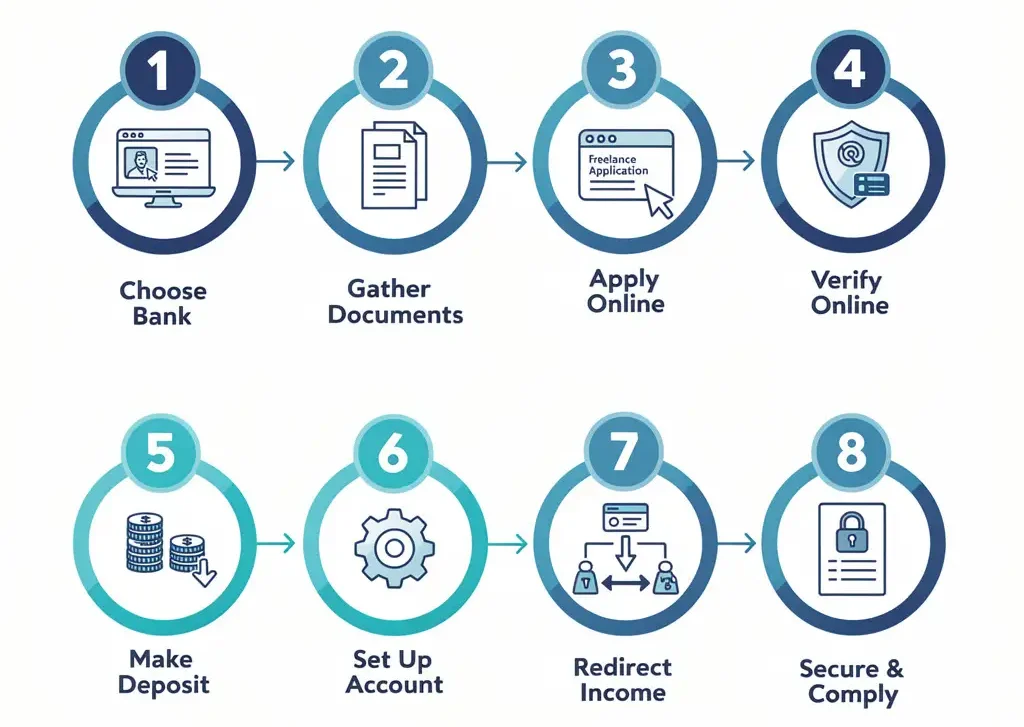
Step 1: Choose Your Account
Based on everything above, pick one account to start. If you are a sole proprietor who wants something free and clean, Novo, Lili, or Found are all solid first choices. If you need branch access, look at Chase. If you have international clients, add Wise Business to your setup.
Do not overthink this. You can always switch or add accounts later. The best account is the one you actually open today.
Step 2: Gather Your Documents
For Sole Proprietors:
- Government issued photo ID (driver’s license or passport)
- Social Security Number
- Home address
- Your DBA (Doing Business As) name if you operate under a business name that is not your own name
You typically do not need an EIN (Employer Identification Number) as a sole proprietor, though getting one is strongly recommended. It is free to apply for through the IRS, and lets you use it in place of your Social Security Number for all business purposes. Less exposure of your most sensitive identifier is always better.
For LLCs:
- Government issued photo ID
- EIN (required, not optional)
- Your LLC’s Articles of Organization
- Your operating agreement (not always required but frequently requested)
For S Corps or Corporations:
- Everything above
- Corporate resolution authorizing the account
- Certificate of good standing from your state if required
Most solo freelancers are sole proprietors. Your ID and Social Security Number are basically all you need to get started.
Step 3: Complete the Online Application
For online accounts like Novo, Lili, Found, Relay, and Bluevine, the entire process happens in a browser or their mobile app. You create your account, enter your personal and business information, upload a photo of your ID, and verify your identity.
The online application asks for your business and personal details, and the time it takes varies by provider and by whether additional verification is needed.
You will be asked for:
- Business name
- Business type (sole proprietorship, LLC, etc.)
- Industry or type of work you do
- Expected monthly deposits
- How long the business has been operating
Answer all of these honestly. There is no wrong answer for a legitimate freelance business.
Step 4: Complete Identity Verification
Most online banks use automated identity verification. You upload a photo of your ID and sometimes take a brief selfie for facial matching. This usually resolves in seconds.
Occasionally an account gets flagged for manual review, which takes a few business days. This is completely normal and nothing to worry about. It happens to legitimate applicants regularly.
Step 5: Fund the Account If Required
Some accounts require a small opening deposit of $50 to $100. Many free accounts require nothing at all.
If funding is required, you transfer a small amount via ACH from your existing personal account. Simple and fast.
Step 6: Set Up Everything Before You Use It
This is the step most guides skip entirely. Do not skip it.
Before you start routing client payments to the new account, set things up properly.
Update your invoice template with the new routing and account numbers.
Connect your accounting software right now, not later. Connecting it early can reduce manual entry over the months ahead.
Set up expense categories in the app so transactions are already organized when you go to review them.
Turn on mobile push notifications for every transaction. You want real time awareness of what is moving in and out. This also helps you catch unauthorized activity fast.
Order your debit card if the account offers one. This becomes your dedicated card for all business purchases.
Step 7: Redirect All Business Income to the New Account
Contact regular clients who pay via bank transfer and give them your new account details. Update your PayPal, Stripe, and other payment platform settings to deposit into the business account.
This transition might take a pay cycle or two to complete fully. Start early so you are not manually rerouting things under deadline pressure.
Step 8: Commit to the Business Only Rule
This is the single most important rule in the entire guide. Nothing personal ever goes through this account.
No groceries. No streaming services. No splitting dinner with a friend. Not even once as a temporary thing you will fix later.
The entire value of a separate account comes from maintaining the discipline of actual separation. The moment you start mixing transactions, you have recreated the exact problem you were trying to solve.
Keep a dedicated debit card or business credit card for all business spending. Keep everything else completely out of the business account.
Building a Complete Freelance Banking System
Once you have your main account running, many experienced freelancers eventually move to a more structured setup. You do not need this from day one. But it is worth knowing about.
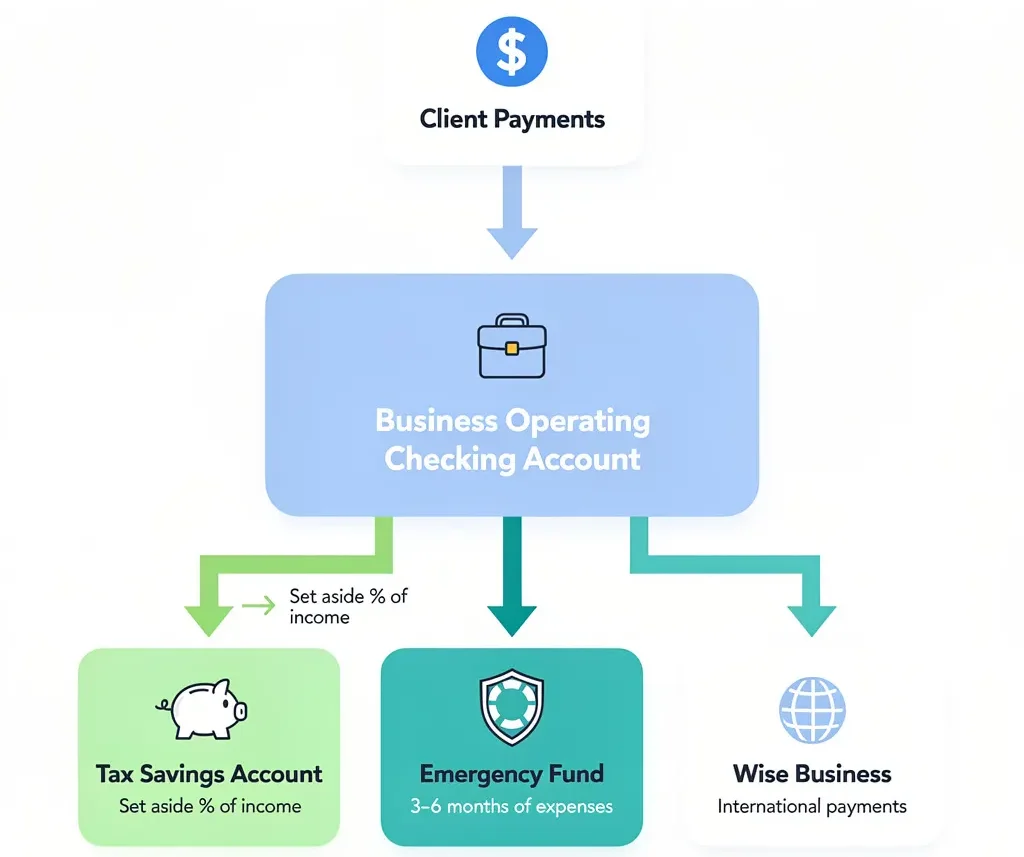
Account 1: Business Operating Checking (Novo or Relay)
This is the main account. All client income arrives here. All business expenses leave from here. Your business debit card connects to this account.
Account 2: Tax Savings Account
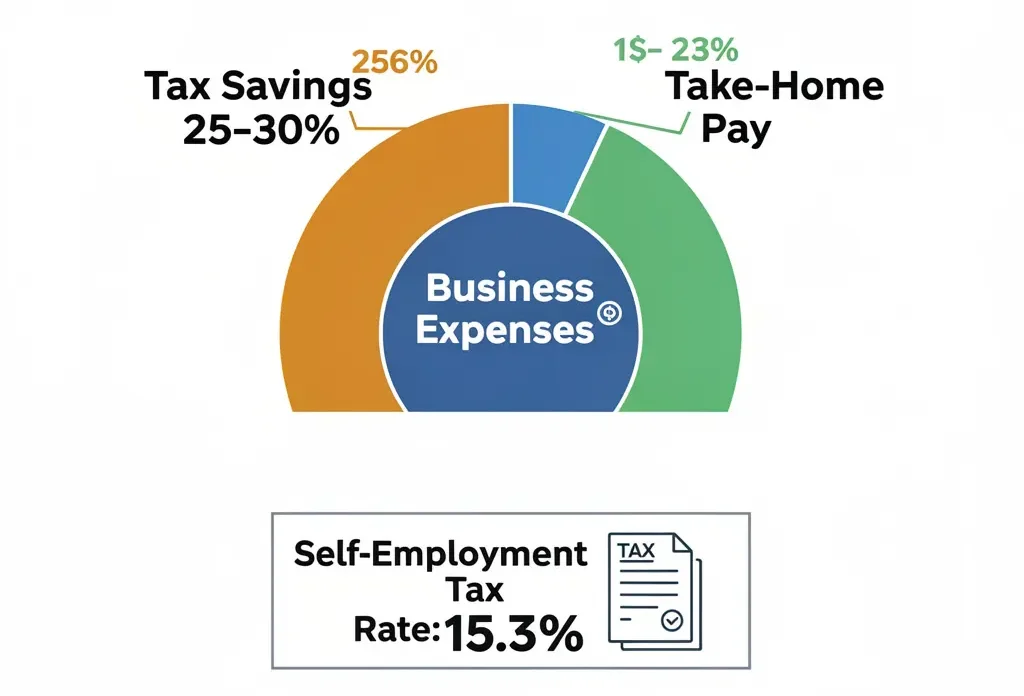
Every time client income arrives, transfer 25 to 30% into a dedicated tax savings account immediately. This money has one purpose: paying your quarterly estimated taxes and your annual tax bill.
I cannot overstate how much this single habit reduces financial stress. When April comes, you already have the money set aside. Tax season becomes a transaction rather than a crisis.
Account 3: Wise Business for International Payments
If you have clients paying in foreign currencies, they pay into your Wise Business account. You convert and transfer USD into your main operating account periodically.
Account 4: Business Emergency Fund
A high yield savings account holding two to three months of typical business expenses. Freelance income is inherently irregular. This buffer means a slow month does not become a financial emergency.
Start with Account 1. Add Account 2 as fast as you can. Build from there.
The Tax Side of Having a Separate Bank Account Freelance Business
I am not an accountant and this is not tax advice. But these are things I have learned from years of freelancing that are genuinely worth knowing.
You Are Responsible for Every Dollar of Your Taxes
When you work for an employer, they handle income tax withholding and the employer portion of Social Security and Medicare. As a freelancer, none of that happens automatically.
You pay self employment tax at 15.3% on your net self employment income, on top of your regular income tax rate. That 15.3% is made up of two parts: 12.4% Social Security tax, which applies only up to an annual earnings cap (for 2025, the first $176,100 of combined wages, tips, and net earnings), and 2.9% Medicare tax, which is not capped. An additional 0.9% Medicare tax can apply above higher income thresholds. The IRS expects quarterly estimated payments in April, June, September, and January.
Many new freelancers get completely blindsided by this the first time they file. A large unexpected bill plus potential underpayment penalties is a genuinely rough experience.
Setting aside 25 to 30% of every payment for taxes is the standard freelancer rule of thumb. Your actual rate depends on your total income, your deductions, and your state. An accountant can give you a precise number for your specific situation.
What Counts as a Deductible Business Expense?
Once your accounts are separate, you will start actually tracking business expenses for the first time. It helps to know what qualifies.
Common deductible expenses for freelancers:
- Software subscriptions you use for work (Adobe Creative Cloud, Figma, Notion, Slack, Zoom, and similar tools)
- Equipment including computers, cameras, monitors, external drives, and microphones
- Home office deduction using either the simplified or regular method
- Internet service for the business use portion
- Phone bill for the business use portion
- Professional development including online courses, books, and industry conferences
- Health insurance premiums if you pay your own
- Retirement contributions to a SEP IRA or Solo 401k
- Business insurance
- Accountant and bookkeeper fees
- Bank fees
Every expense needs to be ordinary and necessary for your specific type of work, subject to IRS conditions. A dedicated account makes reviewing all of this at tax time completely straightforward.
IRS Publication 334 Actually Recommends This
This is not just advice from personal finance bloggers. IRS Publication 334, the official Tax Guide for Small Business, puts it as a recommendation, not a legal requirement: “You should also use a proper invoicing system and keep a separate bank account for your business.” For recordkeeping in general, see the IRS guide on what kind of records to keep and Publication 583, Starting a Business and Keeping Records.
If you are ever audited, clean and separate business banking records can make it easier to support your figures. Everything is documented. Every transaction is categorized. Your accountant can walk through the entire record clearly and quickly.
For further reading on self employment taxes and proper record keeping, the IRS Small Business and Self Employed Tax Center is the most authoritative resource available on this topic.
Common Mistakes Freelancers Make With Their Business Bank Accounts
Mistake 1: Waiting Until It Feels Necessary
The most expensive mistake on this list. Every month you wait is another month of mixed records that will eventually need to be untangled. That cleanup costs time and accountant billing hours you did not budget for.
Open the account now. Even if you are just starting out. Even if it feels premature. Early setup is always cheaper than retroactive cleanup.
Mistake 2: Choosing an Account With Unexpected Fees
The first business account I ever opened came with a $15 monthly fee waivable only by maintaining a $1,500 average balance. During a slow month the balance dipped. The fee hit. I transferred money to cover it. My tax savings calculation got disrupted.
It was completely preventable. Free online accounts built specifically for freelancers exist and they are genuinely better designed for solo operator needs. For many solo freelancers, a free account avoids a monthly fee — but whether a fee is worth paying depends on the features, branch access, and cash handling you need, so compare the current fee schedule before choosing.
Mistake 3: Skipping the Tax Savings Setup
This is the one that actually hurts people financially.
When I first started freelancing, I spent what came in and told myself I would handle taxes when the time came. That time came in April of my second freelance year as a $4,000 bill that went on a credit card.
Set aside a percentage of every single payment for taxes. Open a second account specifically for this purpose. Automate it if the platform supports automation. Never touch that money for anything else.
Mistake 4: Treating the Business Account Like a Personal Slush Fund
During slow stretches it is tempting to pull from the business account to cover personal shortfalls. The plan is always to put it back when the next payment arrives.
This disrupts your tax savings allocation, muddies your records, and recreates the exact problem the separate account was supposed to solve. Business money stays in the business account. Build a personal emergency fund instead so lean months do not force these decisions.
Mistake 5: Not Reconciling Monthly
I once went four months without properly reviewing my business account. I was busy. Payments were arriving. Everything felt fine.
When I finally sat down for a real review, I found a vendor had double charged me, there was an international wire fee I had not anticipated, and a subscription I had canceled was still running.
Set a recurring calendar event on the first Friday of every month. Review every transaction. Confirm everything looks correct. This catches problems before they compound.
Worked monthly reconciliation example: Start with an operating balance of $3,500. Add client payments received during the month of $5,000, giving $8,500. Subtract business expenses paid of $1,200, giving $7,300. Subtract an owner-draw transfer of $1,500 to a personal account, giving $5,800. Record that draw as an owner draw, not as a business expense. Subtract a tax-reserve transfer of $1,250 to a separate tax savings account, giving a reconciled closing operating balance of $4,550. The tax-reserve transfer is 25 percent of the $5,000 in gross client payments for the month, not of net profit, and it is a reserve for later tax payments, not a tax payment itself. The $1,250 tax reserve is held separately, in addition to the $4,550 operating balance.
Mistake 6: Not Getting an EIN Early
For a long time I used my Social Security Number for every business related form. Every 1099. Every contractor agreement. Every vendor account.
Your Social Security Number is your most sensitive financial identifier. An EIN (Employer Identification Number) is free to get at IRS.gov. Use it for every business purpose instead of your Social Security Number. Fewer parties holding your most sensitive information means meaningfully less risk.
Real Scenarios Where a separate bank account freelance business Makes a Visible Difference
Scenario 1: A New Client Asks for a W 9
You land a new US based client and they need a W 9 form before they can process payment. The form asks for either your Social Security Number or your EIN.
With an EIN and a proper business setup, you fill it out in 30 seconds and send it back looking completely professional. Without one, you are giving your Social Security Number to a company whose data handling practices you have no visibility into.
Scenario 2: You Get Audited
Tax audits are uncommon for freelancers but they do happen, especially when income or deduction patterns look unusual. In an audit, the worst outcome is not that you made a mistake. The worst outcome is that you cannot prove you did not.
A clean, separate business bank account with consistent categories and zero personal transactions mixed in means your accountant can document every transaction clearly and completely. Without that separation, you are at a significant disadvantage even when everything you did was entirely legitimate.
Scenario 3: You Apply for a Business Credit Card
You want a no fee business credit card to earn cash back on business purchases and start building business credit history. The application asks for your business banking details and often reviews account history.
An established account with consistent transaction history makes this application straightforward. Without it, you have less banking history to show, and a card application may depend more on other credit information. Confirm whether any card you consider reports to business credit bureaus before counting on it to build credit.
Scenario 4: A Client Pays Late
A client was supposed to pay on the 15th. It is now the 22nd. You need to know quickly whether you can cover upcoming software renewals and business expenses before chasing the payment.
With a dedicated account, you check the app and have a complete answer in about ten seconds. With a mixed personal account, you are doing math across a statement full of grocery runs and coffee shops.
Scenario 5: You Bring in a Subcontractor
Your workload is growing and you want to hire another freelancer to help on a project. You need to pay them properly and you may need to issue a 1099 if you pay them more than the applicable reporting threshold in a calendar year. That threshold was $600 for payments through 2025; for reportable payments made after 2025, Publication 334 notes a $2,000 threshold. Check the current form instructions before filing.
Payments from a dedicated business account make contractor records perfectly clean. Doing this from a mixed personal account is a compliance headache you do not need.
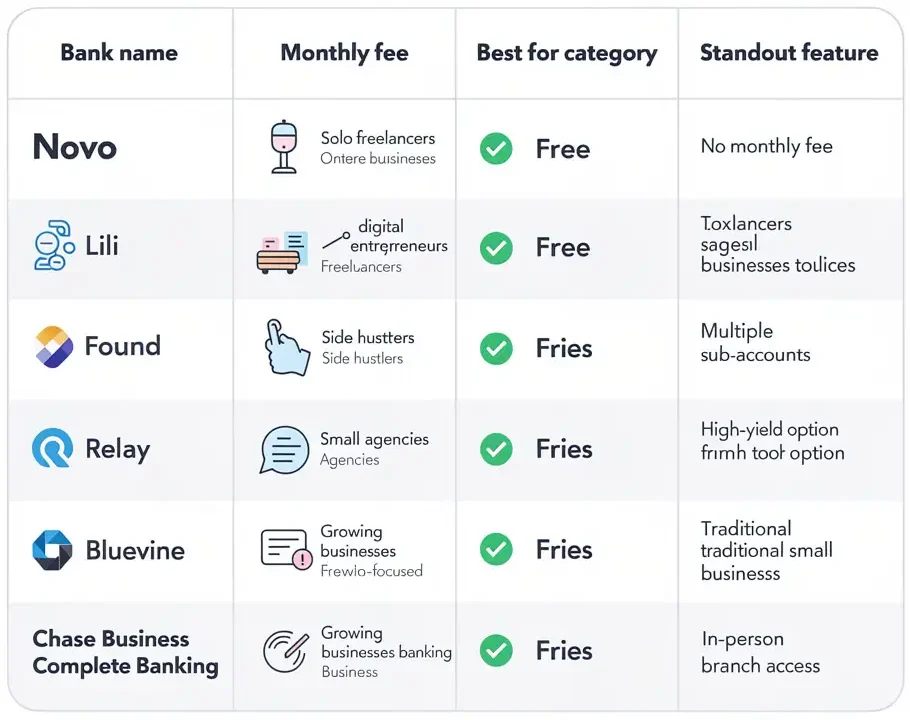
The Best Bank Accounts for Freelancers in 2026: An Honest Breakdown
Novo: Best for Simplicity and Zero Fees
Novo is completely free with no minimum balance requirements. The interface is clean and straightforward. It integrates directly with Stripe, Shopify, QuickBooks, and several other platforms. It also offers reserve accounts, which are essentially labeled sub accounts where you can earmark portions of your balance for specific purposes like taxes, a project fund, or upcoming equipment purchases. Novo is a fintech, not a bank; banking services are provided by Middlesex Federal Savings, F.A., Member FDIC. Check Novo’s current terms, fees, and cash-deposit options before choosing.
The built in invoicing tool is genuinely functional, not just a box to check.
Check Novo’s current terms for cash deposits and any interest or APY before choosing, since those features can change.
Lili: Best for Freelancers Who Want Tax Help Baked In
Lili’s free tier is genuinely solid. Where it shines is the paid tiers: Pro $15 per month, Smart $35 per month, and Premium $55 per month. These include automatic tax expense categorization, detailed expense reporting, and automatic tax savings that moves a percentage of every deposit into a dedicated tax sub account without you having to think about it. Lili is a financial technology company, not a bank; banking services are provided by Sunrise Banks, N.A., Member FDIC, and Lili states that accounts are insured up to $3M through a network of sweep program banks. Check Lili’s current pricing and terms before choosing.
If disciplined tax saving is not your natural strength, Lili essentially removes the requirement for that discipline. The system handles it automatically.
Found: Best for the Most Automated Tax Experience
Found is the most tax focused freelance banking platform on the market. It tracks deductible expenses automatically, calculates your estimated quarterly tax payments in real time as income arrives, and can generate Schedule C tax forms. The core features are free. Found Plus is $35 per month or $315 per year, and Found Pro is $80 per month or $720 per year, with higher APY on the paid tiers (Plus 1.50% APY; Pro 2.50% APY, variable and subject to terms). Found is a financial technology company, not a bank; banking services are provided by Lead Bank, Member FDIC. Check Found’s current pricing and terms before choosing.
If tax management is the part of freelancing you find most stressful, Found addresses it more directly than any other option on this list.
Relay: Best for Financially Organized Freelancers Who Want a Multi Account System
Relay lets you create up to 20 separate checking accounts under a single login, each with its own debit card and its own label. This is ideal for the multi account setup described earlier in this guide. You can have your operating account, your tax savings account, your emergency fund, and any project specific accounts all visible in one dashboard. Relay is a financial technology company and is not an FDIC-insured bank; banking services are provided by Thread Bank, Member FDIC. Relay states that deposits qualify for up to $3,000,000 in FDIC insurance coverage when Thread Bank places deposits in a sweep program, and that certain conditions must be satisfied for pass-through deposit insurance. Check Relay’s current plan terms and conditions before choosing.
The interface is clean and the integrations with QuickBooks and Xero are reliable.
Bluevine: Best for Freelancers Who Keep Larger Balances
Bluevine pays interest on business checking balances, with APY by plan: Standard 1.3% with qualifying activity, up to $250,000; Plus 1.75%; and Premier up to 3.0%. For freelancers who consistently keep larger balances in a business account, the interest can add up over time, though the amount depends on the balance and plan. Bluevine is a financial technology company, not a bank; deposits are FDIC-insured through Coastal Community Bank, Member FDIC, and program banks, up to $3,000,000 per depositor. Check Bluevine’s current plan terms and conditions before choosing.
The platform is free, stable, and includes solid invoicing and accounts receivable management tools.
Chase Business Complete Banking: Best for Freelancers Who Need Branch Access
If you deposit cash, receive payments by check, or simply prefer the reliability of a major institution, Chase is the mainstream option that holds up well for freelancers. The monthly service fee is $15 or $0 when waived with qualifying activity. Deposit and credit card products are provided by JPMorgan Chase Bank, N.A., Member FDIC. Each statement cycle includes up to 20 paper and teller transactions and $5,000 in-branch cash deposits; check Chase’s current fee schedule for the full waiver conditions.
It is not designed specifically for freelancers the way the fintech options are, but it is reliable and widely recognized.
| Provider | Status and partner bank | FDIC or sweep coverage | Fee | APY and conditions | Cash deposits |
| Novo | Fintech, not a bank; Middlesex Federal Savings, F.A., Member FDIC | Check current FDIC and sweep terms | Free; check current terms | Check current terms for interest or APY | Check current terms |
| Lili | Fintech, not a bank; Sunrise Banks, N.A., Member FDIC | Up to $3M through sweep program banks | Core $0; Pro $15; Smart $35; Premium $55 per month | Savings up to 4.00% APY up to $1M, variable | Check current terms |
| Found | Fintech, not a bank; Lead Bank, Member FDIC | Check current FDIC and sweep terms | Core free; Plus $35 per month or $315 per year; Pro $80 per month or $720 per year | Plus 1.50% APY; Pro 2.50% APY, variable, terms apply | Check current terms |
| Relay | Fintech, not an FDIC-insured bank; Thread Bank, Member FDIC | Up to $3,000,000 when Thread Bank places deposits in a sweep program; conditions apply | Check current plan terms | Check current terms for savings rates | Check current terms |
| Bluevine | Fintech, not a bank; Coastal Community Bank, Member FDIC, and program banks | Up to $3,000,000 per depositor | No monthly fees; check current terms | Standard 1.3% with qualifying activity up to $250,000; Plus 1.75%; Premier up to 3.0% | Check current terms |
| Chase Business Complete Banking | Bank; JPMorgan Chase Bank, N.A., Member FDIC | FDIC-insured bank; check current terms | $15 or $0 when waived with qualifying activity | No APY stated for checking; check current terms | Up to $5,000 in-branch cash deposits per statement cycle |
Working With International Clients: The Multi Currency Banking Solution
If clients pay you from outside the United States, this section is important.
When a UK client sends you GBP to a standard US business account, your bank receives the wire and converts the currency at its own exchange rate, and may charge an incoming wire fee. Check your own bank’s current fee schedule and exchange-rate terms before estimating what a payment will cost.
Over a year of regular international payments, those fees and conversion markups add up to real money you are simply giving away.
Wise Business solves this directly. You receive actual local banking details in multiple currencies simultaneously. Your UK client sends a standard domestic transfer in GBP. Your European client pays via SEPA in EUR. The money arrives in the original currency, you hold it, and you convert when you choose at Wise’s rates.
For freelancers with regular international clients, a multi-currency option can be worth comparing. Wise is a Money Service Business registered with FinCEN, not an FDIC-insured bank, and states that customer money is held in a safeguarded, separate account. Fees vary by route and currency, so compare them for your own payments and check eligibility before choosing.
Payoneer is another option some international freelancers use for receiving payments across countries. Availability of products is subject to eligibility and varies by region, so check Payoneer’s current fees, eligibility, and terms for your location before choosing.
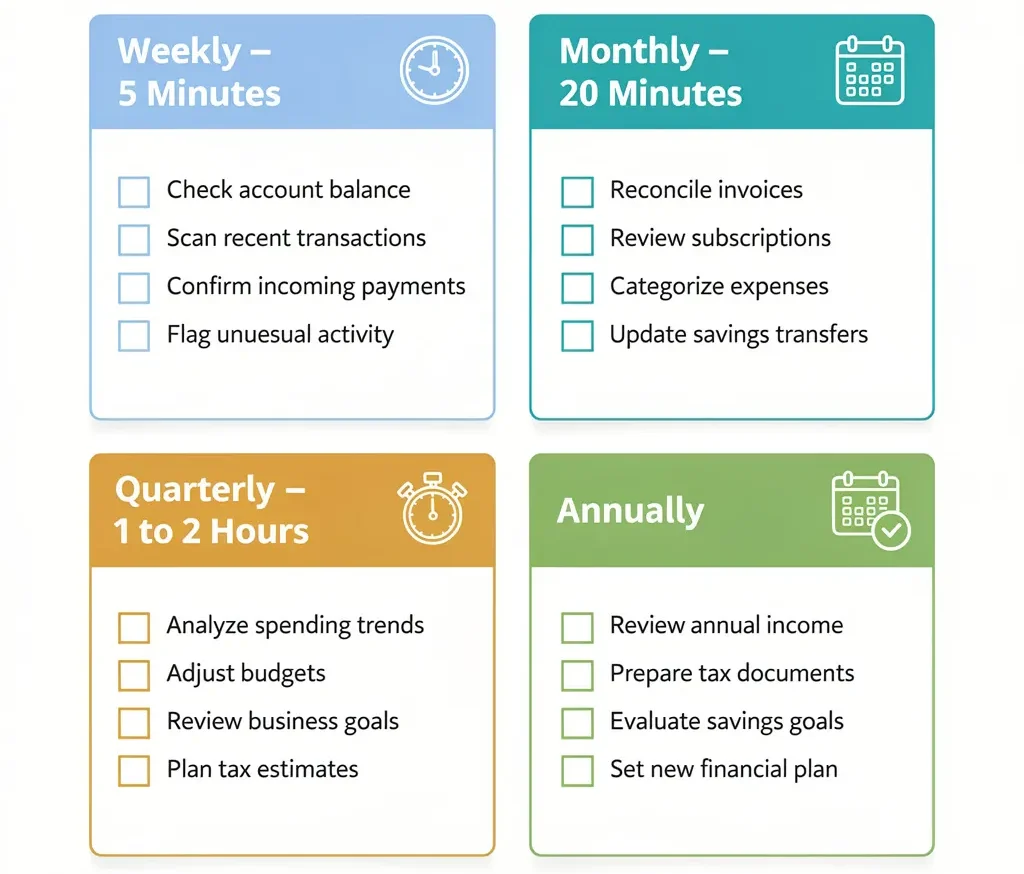
Building Good Monthly Habits After You Open the Account
Opening the account is the start. These habits are what make it actually valuable.
Weekly:
- Check your account balance
- Confirm expected client payments have arrived
- Flag any charges that look unfamiliar
Monthly:
- Review every transaction from the month
- Fix any auto categorization that landed in the wrong category
- Transfer any amount above your operating buffer to savings
- Verify your tax savings account received the correct percentage
Quarterly:
- Calculate your estimated tax payment due
- Pay it through IRS Direct Pay or EFTPS, both of which are free and fully online
- Review your income and expense patterns for the quarter
Annually:
- Full review with your accountant
- Complete your tax filing
- Assess whether your current banking setup still fits where your business is now
Business Credit Cards: The Natural Next Step
Once your business account is running smoothly, many freelancers eventually add a business credit card to the mix.
This is not the right move for everyone. Credit cards create problems when spending discipline is not strong. But for freelancers who consistently pay in full every month, the advantages are real.
A no fee business credit card lets you earn cash back or points on business purchases, provides better fraud protection than a debit card, and creates a clean record of business spending separate from your checking account. It can also contribute to a business credit file, but only if the card reports to business credit bureaus, so confirm that before counting on it to build credit.
Cards like the Chase Ink Business Cash, the Capital One Spark Cash Select, and the American Express Blue Business Cash are consistently popular in freelance communities for good reason. Spark Cash Select has a $0 annual fee and 1.5% unlimited cash back; do not confuse it with Spark Cash, which is $0 in the first year and then $95. Check the current annual fee, rewards, and bureau-reporting terms for any card before choosing.
A strong rule to follow: Pay the balance in full every single month. Never carry a balance forward if you can avoid it. The card is a tracking and rewards tool, not a credit facility.
When to Upgrade From a Free Account
Most freelancers stay on free tiers for years. That is completely appropriate.
But a few signals suggest it might be time to move to something more feature rich.
You are consistently earning over $75,000 per year. Your tax situation has real complexity now, and better tools may be worth their cost if they save you time or reduce errors. Compare the fee against what you actually gain.
You want to hire contractors regularly. You need clean payment records and the ability to issue 1099s efficiently.
You are transitioning from sole proprietor to LLC or S Corp. This is a natural moment to revisit your entire banking structure.
You are keeping significant balances in an account that earns nothing. Switching to a platform like Bluevine that pays APY on balances becomes a straightforward financial decision at meaningful balance levels.
You are spending more than an hour per month on financial administration. Investing in a paid tier or better integration may save you time, but compare the fee against the time you actually save before upgrading.
People Also Ask: Common Questions About Freelance Business Bank Accounts
Do I Need a Separate Bank Account for Freelancing?
You are not legally required to have one as a sole proprietor. But a separate account is strongly recommended. Mixing personal and business finances creates tax problems, makes deduction tracking nearly impossible, and, if you operate as an LLC, can weaken the argument that the business is separate — one factor courts may weigh, depending on state law and all the facts. Many free online options make this a low-cost decision with immediate practical benefits.
Can I Use a Personal Account for Freelance Income?
Technically yes, if you are a sole proprietor. But this is genuinely a bad idea in practice. You lose visibility into your actual business income, you create an enormous amount of unnecessary work at tax time, and you miss deductible expenses that you could have easily tracked. Just open a free business account.
What Happens if I Mix Personal and Business Money?
Several things can go wrong. You lose track of deductible expenses and pay more in taxes than you should. You create messy records that are painful to reconstruct later. If you are an LLC, mixing funds can weaken the argument that the business is separate — one factor courts may weigh, depending on state law and all the facts — rather than automatically ending your personal liability protection. And if you ever get audited, you are starting from a weaker position.
Do I Need an EIN to Open a Business Bank Account?
Most online banks do not require an EIN for sole proprietors. Your Social Security Number is typically sufficient. But getting an EIN is free, takes five minutes at IRS.gov, and removes the need to give out your Social Security Number for business purposes. Get one regardless.
How Many Bank Accounts Should a Freelancer Have?
At minimum, one dedicated business checking account completely separate from your personal finances. Ideally, two: your main operating account and a dedicated tax savings account. As your business grows, adding a high yield savings account for your emergency fund and a platform like Wise Business for international payments creates a genuinely strong financial infrastructure.
Is a Business Bank Account Worth It if I Am Only Making a Little?
Yes, completely. The free options cost nothing. There is no income level at which this stops making sense. Clean financial records and professional habits are valuable from the very first client payment you receive.
What Is the Best Free Business Bank Account for Freelancers?
Novo is the best choice for simplicity and zero fees. Found is the best for automated tax management. Lili is the best if you struggle with setting aside tax savings consistently. Relay is the best if you want a structured multi account system. The right answer depends entirely on which features match how you naturally think about money.
Can Freelancers Get Business Loans?
Yes, and having an established business banking history meaningfully improves your chances of approval. Banks and alternative lenders typically review how long your account has been open, your average monthly deposits, and the consistency of your transaction history. Starting your business account early builds this history over time.
What Is the Difference Between a Business Account and a Personal Account for Freelancers?
A business account is registered in your business name or business entity name and comes with features designed for commercial use (invoicing, expense tracking, accounting integrations). It keeps business and personal money in separate accounts, which supports — but by itself does not create — any legal separation an entity may provide. A personal account is registered in your individual name and carries none of those commercial features.
Do Freelancers Need to Pay Quarterly Taxes?
Yes. In most cases, the IRS expects quarterly estimated tax payments if you expect to owe $1,000 or more in federal taxes for the year after subtracting withholding and tax credits, and your withholding and credits are expected to be less than the smaller of 90% of the tax on your current-year return or 100% of the tax on your prior-year return. For 2026, those payments are due April 15, 2026, June 15, 2026, September 15, 2026, and January 15, 2027. A separate bank account with a dedicated tax savings sub account makes managing this straightforward instead of stressful.
Final Thoughts: Just Open the Account This Week
A separate bank account for your freelance business is not an exciting thing. It does not feel like progress. There is no moment where everything changes dramatically.
What actually happens is quieter than that.
Tax season stops being a crisis and becomes a process. Your income becomes visible instead of abstract. Your financial records stop being a source of stress and start being a source of information. The professionalism you project to clients goes up without any extra effort.
Sorting through mixed transactions every April becomes simpler when statements are already separated. The wondering whether your business is actually profitable gets replaced by simply knowing, because you can see the numbers clearly.
These are not dramatic improvements. They are quiet, cumulative ones. The kind that make a real difference over years.
If you have been putting this off, set aside time this week. Pick one account from the list above. Fill out the application. Open it.
You do not need to build the whole system today. You do not need to figure out LLC structures, quarterly taxes, and multi account setups all at once. Just get the account open, start routing your freelance business income there, and the rest builds naturally over time.
The hardest part is starting. Pick one account and take the first step.
Do it before the next tax season is the reason you finally did.
If you’re looking for more real world insights and practical tips to level up your freelancing journey, make sure to check out our website. We regularly share simple, actionable content to help you land better clients, protect your time, and confidently grow your freelance career.


10 Comments on “Separating Freelance Business Finances: Accounts, Records and Tradeoffs”