

The Problem Every Freelance Writer Knows Too Well
You finish a 3,000-word article. The client loves it. You send the invoice. Then silence. Two weeks pass. Then a month. You follow up three times, and finally get a reply: “We decided to go in a different direction.” No payment. No explanation. And nothing in writing to back you up.
This happens to thousands of freelance writers every year. Not because the clients are all bad people, but because there was no clear, legally binding agreement protecting both sides.
A solid freelance writing contract template fixes this. It sets expectations before the work starts, defines exactly what you are delivering, establishes when and how you will be paid, and provides a legal foundation if something goes wrong.
This guide walks you through every clause you need, gives you real example language you can copy directly into your own agreement, and explains what each clause actually protects you from. You will also find a free template available in Word, PDF, and Google Docs formats.
Whether you are a brand new writer landing your first client or a seasoned content professional cleaning up your paperwork, this guide covers everything.
What Is a Freelance Writing Contract?
A freelance writing contract is a legally binding written agreement between a writer and a client that defines the scope of work, payment terms, intellectual property ownership, and conditions for ending the relationship. It protects both parties by creating a clear record of what was agreed before any work begins.
A freelance writing agreement is not a formality. It is your single most important business document. Think of it the way a contractor thinks about blueprints. The blueprint does not build the house, but without it, nobody agrees on what the house is supposed to look like and who pays for what.
A content writer contract template puts the same discipline into your writing business. It answers the five questions that cause the most conflicts between writers and clients:
- What exactly am I being paid to write?
- How much will I be paid, and when?
- Who owns the finished content?
- What happens if the project gets cancelled?
- What happens if someone does not hold up their end of the deal?
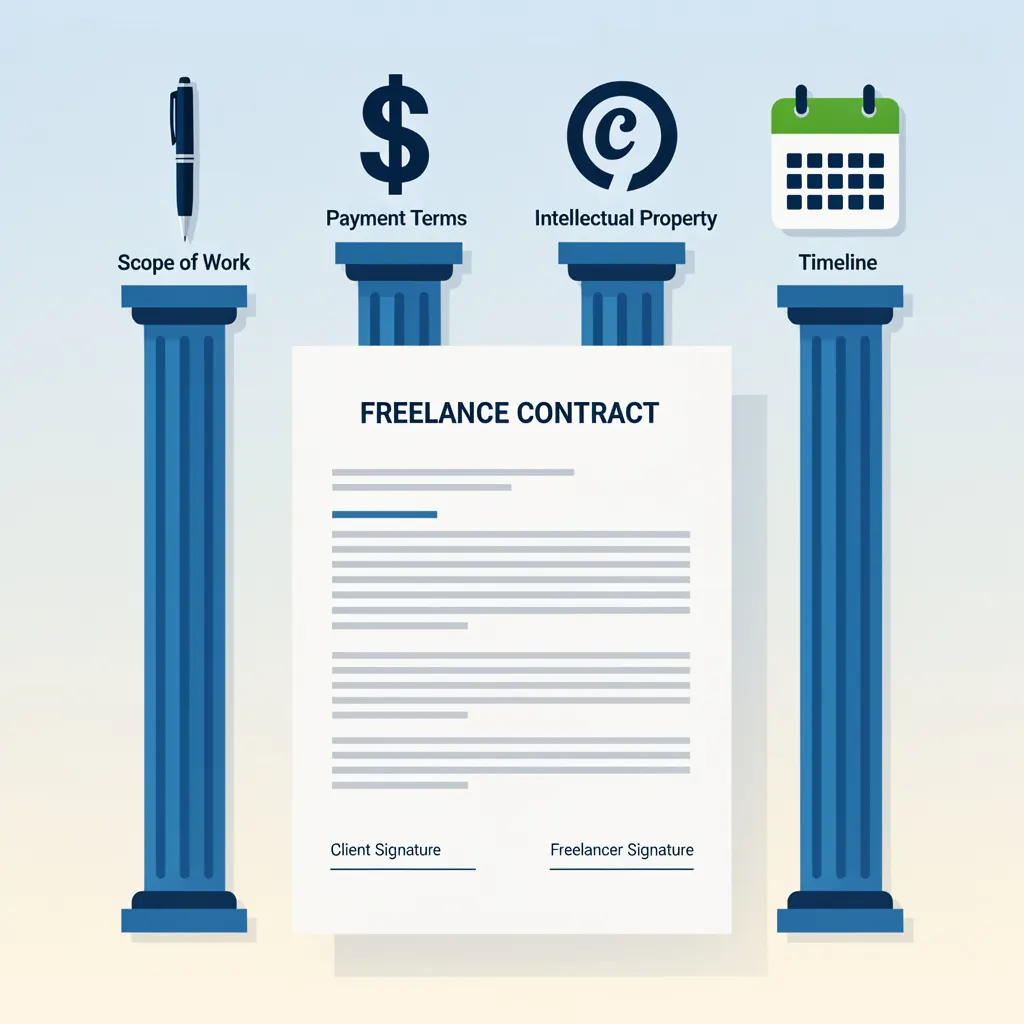
Without a written agreement, you are relying on memory, email threads, and goodwill. That is not a business strategy.
Do I Really Need a Freelance Contract Even for Small Projects?
Yes, without exception. The size of the project does not determine your risk level. In fact, small projects are often where writers lose money most frequently, precisely because they skip the paperwork thinking it is not worth the effort.
Here is what happens without a contract on a “small” job:
Scope creep becomes invisible. You agree to write a 500-word blog post. The client comes back asking for an intro video script, three social media captions, and two rounds of edits. None of that was agreed upon. Without a contract, you have no documented scope to point to.
Payment disputes become impossible to win. If a client disputes the amount owed or claims the work was never delivered, a verbal agreement is almost unenforceable. Your word against theirs.
Copyright stays murky. Without a written IP clause, courts often default to the creator retaining copyright. But that can also cause problems if the client publishes the work assuming they own it.
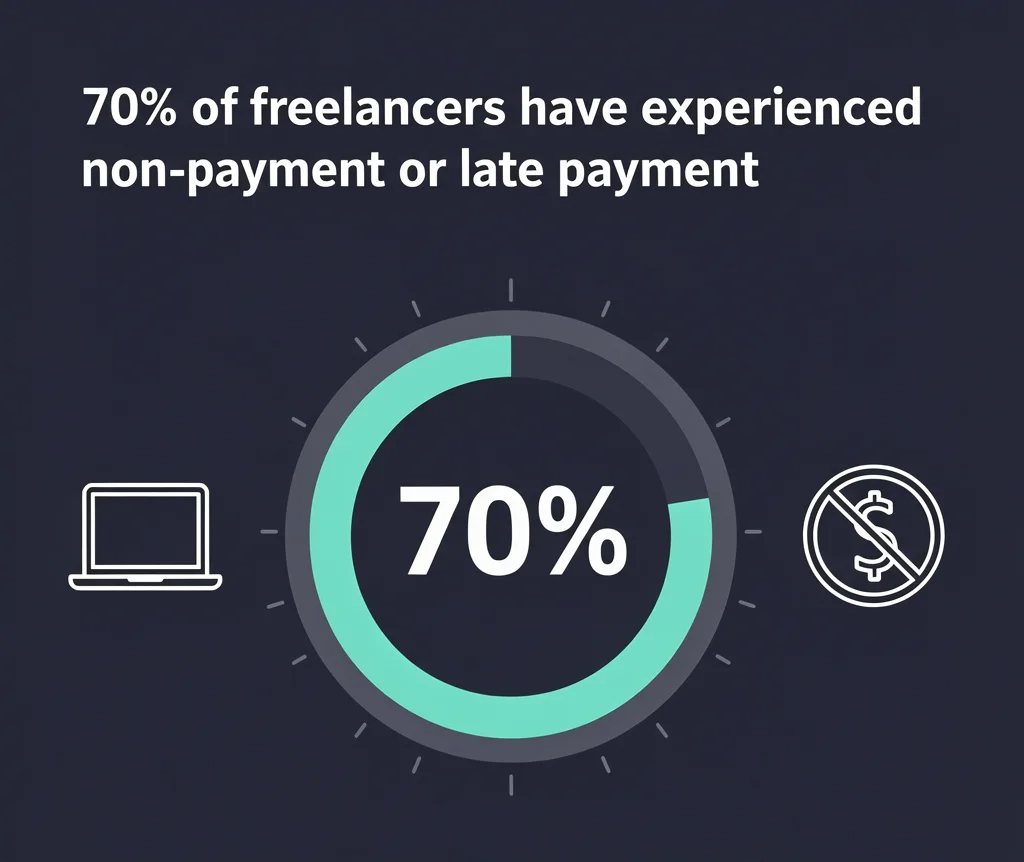
The Freelancers Union reports that over 70% of freelancers have experienced at least one instance of non-payment or late payment in their career. A contract does not eliminate bad clients, but it gives you legal standing when they show up.
For comprehensive guidance on contract fundamentals, the freelance contract essentials resource at Gig Law Guide covers additional scenarios in depth.
Is a Freelance Writing Contract Legally Binding and What About Verbal Agreements?
A written freelance writing contract is legally binding when it meets the basic requirements of contract law: offer, acceptance, and consideration (meaning something of value exchanged by both parties). A signed document that spells out the scope of work and payment amount meets all three requirements.
Verbal agreements can technically be enforceable under contract law, but proving them is a different story entirely. Without documentation, you are left arguing about what was said in a phone call six weeks ago. Courts are not sympathetic to that situation.
The Freelance Isn’t Free Act in New York City, one of the strongest freelancer protections in the country, requires written contracts for any freelance engagement worth $800 or more in a 120-day period. Violating this law exposes clients to double damages plus attorney fees. New York State passed its own version (the Freelance Worker Protection Act, effective 2024) extending similar protections statewide.
Several other states and cities have followed suit. If you are based in or working with clients in New York, California (where AB 5 reshaped contractor classification), Illinois, or Washington state, a written contract is not just smart, it may be legally required.
The practical takeaway: a signed email exchange that clearly outlines scope and payment can serve as a basic written agreement in a pinch. But a proper contract is always stronger, clearer, and faster to enforce.
Free Freelance Writing Contract Template (Word, PDF & Google Docs)
Below you will find the downloadable template in three formats. The clause-by-clause breakdown that follows this section explains every section in detail so you understand exactly what you are agreeing to and what each line protects you from.
Download the Free Freelance Writing Contract Template:
[DOWNLOAD: Freelance Writing Contract Template Word (.docx)]
[DOWNLOAD: Freelance Writing Contract Template PDF]
[DOWNLOAD: Freelance Writing Contract Template Google Docs]
(Each version is fully editable. Fill in the bracketed fields with your specific project details before sending to any client.)
Freelance Writing Contract Template for Beginners: What Your First Agreement Should Look Like
If you are sending your first contract ever, the most common mistake is overcomplicating it. A first agreement does not need to be 15 pages with 30 clauses. It needs to be clear, cover the core issues, and be written in plain English.
Your first freelance writing contract should cover exactly seven things:
- Who is involved (your name and the client’s name or business name)
- What you are writing (the deliverable, word count, format, and topic)
- When it is due (specific dates, not “within two weeks”)
- How much you will be paid (exact dollar amount, not a range)
- When you will be paid (before delivery, on delivery, or net-30 after invoice)
- Who owns the content (you, until full payment is received, then it transfers)
- How many revision rounds are included (one round is a reasonable starting point)
That is a complete, functional contract for a new freelance writer. You can use the one-page version of our template above for this exact purpose. As your business grows, you add the deeper clauses covered in the next section.
For a full walkthrough on launching your writing business on a solid legal and financial footing, the “ Become a Freelancer ” guide covers the full setup process.
Simple Freelance Writing Contract Template vs. Full Agreement: Which Do You Need?
The answer depends on three factors: the project’s dollar value, the duration of the relationship, and whether you are writing under your own byline or as a ghostwriter.
Use a simple one-page contract when:
- The project is a single article or blog post
- The client is paying less than $1,000 total
- The engagement is one-time, not recurring
- The content type is standard (no ghostwriting, no sensitive topics)
Use a full freelance writing agreement when:
- The project is a long-form content series, book, or ongoing retainer
- Payment exceeds $1,000 or spans multiple milestones
- You are writing under the client’s name (ghostwriting)
- The client is a business with their own legal team
Use a customized contract for different work types:
Different project types carry different risks. A blog writing contract template for a content marketing client should include a content calendar clause and editorial approval timeline. A ghostwriting agreement needs a strict confidentiality clause covering authorship. A white-label writing contract for an agency needs to address non-disclosure of both the end client and the agency relationship.
The same contract template does not serve all these purposes equally. That is why the full template linked above includes modular clauses you can add or remove based on the project type.
What to Include in a Freelance Writing Contract Every Essential Clause
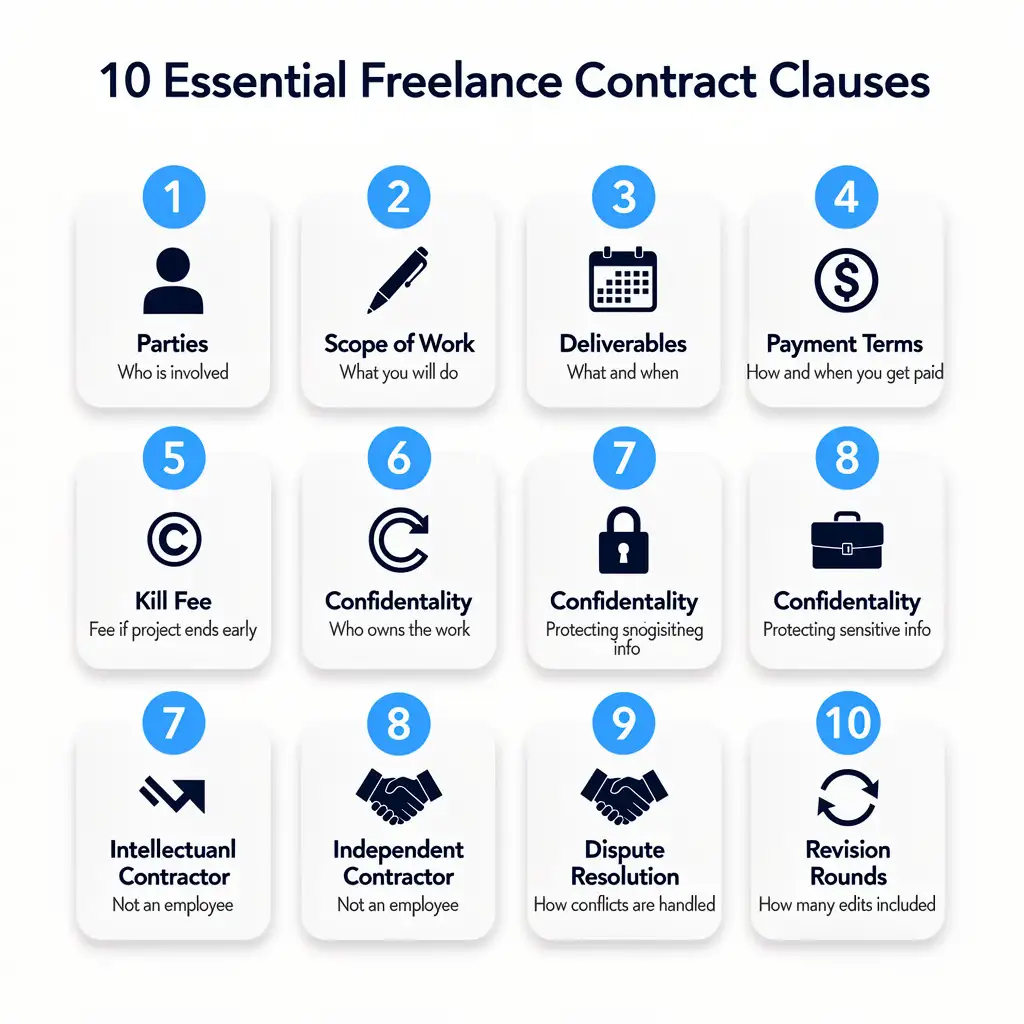
A complete freelance writing contract must include: parties’ identification, scope of work, deliverables and deadlines, payment terms, kill fee, intellectual property ownership, confidentiality terms, independent contractor status, and dispute resolution. Miss any of these and you create a gap a client can exploit.
Here is every clause explained with example language and a note on exactly what it protects you from.
1. Parties Identification and Project Description
This is the first section of any contract and it seems obvious, but writers regularly make errors here that create problems later.
What to include:
- Your full legal name (or your LLC name if you are incorporated)
- The client’s full legal name and the name of their business entity
- A one-paragraph description of the general project
Example language:
This Freelance Writing Agreement (“Agreement”) is entered into as of [Date] by and between [Your Full Name] (“Writer”) and [Client Full Legal Name / Business Name] (“Client”).
What this protects you from: If you need to take a client to small claims court, you need to know the exact legal entity you are suing. “John’s Marketing Company” is not a legal name. “Bright Digital Media LLC” is. Get the right name upfront.
2. Scope of Work: The Clause That Stops Scope Creep Dead
Scope creep is the single biggest source of unpaid work in freelance writing. It starts small. “Can you just add a short intro?” Then: “Can you also write the meta description?” Then: “We need a second version for LinkedIn.” Before long, you have done three times the work you quoted.
What to include in your scope of work clause:
- The specific deliverable (e.g., “one 1,500-word SEO blog post on [topic]”)
- The format (Google Doc, Word file, plain text)
- The research level expected (sourced from provided materials vs. independent research)
- A clear statement that additional deliverables require a separate written agreement and additional payment
Example language:
Writer will deliver one (1) SEO-optimized blog post of approximately 1,500 words on the topic of [Topic], formatted as a Google Document. Any additional content, variations, or formats not listed above constitute a change to the scope and must be agreed to in writing with adjusted compensation.
What this protects you from: Every request that falls outside this clause is a billable change order. When a client asks for that LinkedIn version, you point to the scope clause and send a new quote.
For a detailed comparison of scope documents, see the statement of work vs. scope of work guide.
How Do I Handle Scope Creep in Freelance Projects?
The moment a client requests something outside the written scope, your response is simple and professional: “Happy to do that. That falls outside our current agreement, so I will send over a quick add-on quote.” Then do it in writing, every time.
The contract makes this conversation easy rather than awkward. Without a defined scope, any pushback on extra work feels like you are being difficult. With a scope clause, you are simply enforcing what you both agreed to.
Build a change order process into your workflow from day one. Even a short email that says “Confirming we are adding X to the project for $Y, payment due alongside the original invoice” is a valid written amendment to your contract.
3. Deliverables, Deadlines and Project Milestones
Deadlines without structure create confusion. “I will deliver it next week” is not a deadline. It is a suggestion.
What to include:
- The exact delivery date (day/month/year)
- Any intermediate milestones (outline due date, first draft due date, final draft due date)
- The client’s review window (e.g., “Client has 5 business days to provide feedback”)
- A clause addressing what happens if the client delays their own feedback
Example language:
Writer will deliver a first draft no later than [Date]. Client will provide consolidated feedback within five (5) business days of delivery. If Client fails to respond within this window, the draft will be considered approved and the invoice becomes due. Rush delivery (within 48 hours of request) is available at a 25% surcharge.
What this protects you from: Without a client response window, a project can stall indefinitely because the client is slow to review. That keeps your invoice unpaid and ties up your bandwidth. The clock runs in both directions.
4. Payment Terms: Deposits, Schedules and Late Fees
This is the clause that gets you paid. Everything else in the contract protects the work. This clause protects your income.
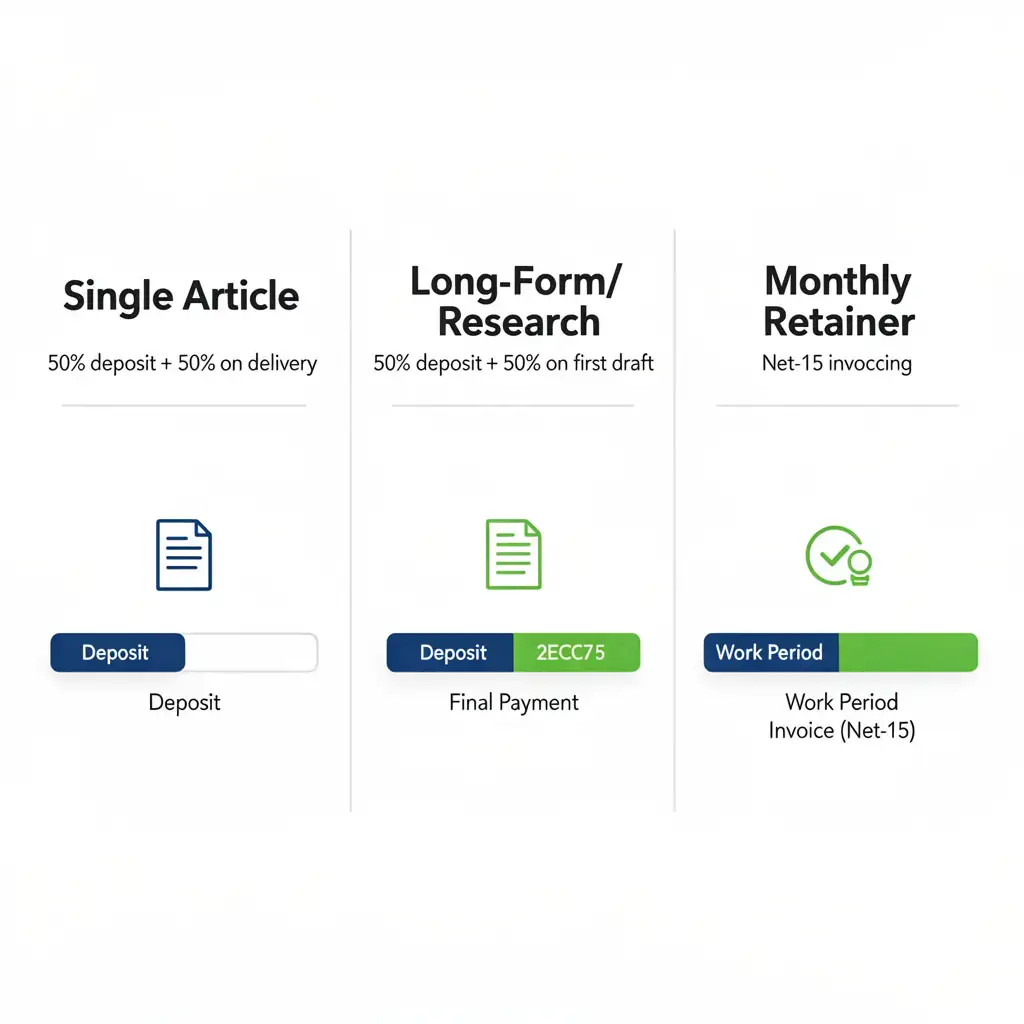
Deposit (upfront payment): Always require one. A 50% deposit before work begins is the industry standard. It confirms the client is serious and ensures you have partial compensation if the project is cancelled.
Payment schedule options:
| Project Type | Recommended Structure |
|---|---|
| Single article under $500 | 50% upfront, 50% on delivery |
| Long-form or research-heavy piece | 50% upfront, 50% on first draft submission |
| Ongoing retainer | Monthly invoice, net-15 or net-7 |
| Multi-milestone project | 33% start, 33% mid-point, 34% on final delivery |
Late payment fee: Include a specific late fee. A common structure is 1.5% per month (18% annually) on unpaid balances. State the exact number of days after the invoice due date that the fee kicks in.
Example language:
Client will pay a non-refundable deposit of 50% of the total project fee ([Amount])before Writer commences work.The remaining50[Amount])before Writer commences work.The remaining 50[Amount]) is due upon delivery of the final draft. Invoices not paid within 15 days of the due date will accrue a late fee of 1.5% per month on the outstanding balance.
For more details on structuring payment terms, see the guides on net-30 payment terms, net-15 payment terms, and late payment fees.
Should I Require a Deposit Before Starting Work?
Yes, always. A deposit serves two purposes beyond just a partial payment. First, it filters out non-serious clients. Someone unwilling to pay 50% upfront is a significant credit risk and likely to be difficult to work with throughout the project. Second, it ensures you have something in hand if the project falls apart before completion.
For projects over $2,000, consider a three-part payment structure: one-third at signing, one-third at a defined midpoint milestone, and the final third on delivery. This approach protects your cash flow on longer projects and keeps the client financially engaged throughout.
Payment Protection Strategies Beyond the Contract
Your contract defines the terms. Your behavior reinforces them. These habits protect your payment even before a dispute arises:
- Never deliver a final, publication-ready file before the final payment clears
- Deliver watermarked drafts or Google Docs with view-only access until paid
- Use invoicing software that sends automatic payment reminders
- Accept payment via methods that create a paper trail (bank transfer, PayPal Business, Stripe) rather than cash or informal peer-to-peer apps
For practical steps when payment stalls, the collect unpaid invoices guide walks through the escalation process.
5. Kill Fee and Cancellation Clause
A kill fee is a partial payment the client owes you if they cancel the project after work has begun. It exists because your time and opportunity costs are real expenses, even if the final article never gets published.
How to calculate a fair kill fee:
- Project cancelled before first draft: 25% to 50% of the total project fee
- Project cancelled after first draft delivery: 50% to 75% of the total fee
- Project cancelled after revisions: 100% of the total fee
Example language:
If Client cancels this project after work has commenced, the following kill fee applies: 50% of the total project fee if cancelled before delivery of the first draft; 75% if cancelled after first draft delivery; 100% if cancelled after revisions have been completed. The deposit paid at signing counts toward the applicable kill fee.
What this protects you from: Clients who disappear mid-project after you have turned down other work to prioritize theirs. The kill fee compensates you for the opportunity cost of the time on your calendar that was blocked.
See the detailed breakdown in the kill fee complete guide and the client cancels mid-project guide.
What Happens If My Client Wants to Terminate the Contract?
Your termination clause should give both parties a structured exit, not just the client. Include:
- A required notice period (typically 14 to 30 days for ongoing engagements)
- What happens to work completed up to the termination date (you get paid for it)
- What happens to work in progress (the kill fee structure above)
- Whether the client retains rights to any partially completed work (answer: only if they pay the kill fee for it)
A poorly written termination clause is one of the most common ways freelancers lose money on otherwise good projects. The force majeure clause guide covers the specific scenario where external events (not either party’s fault) force a project to stop.
6. Intellectual Property, Copyright and Work-for-Hire
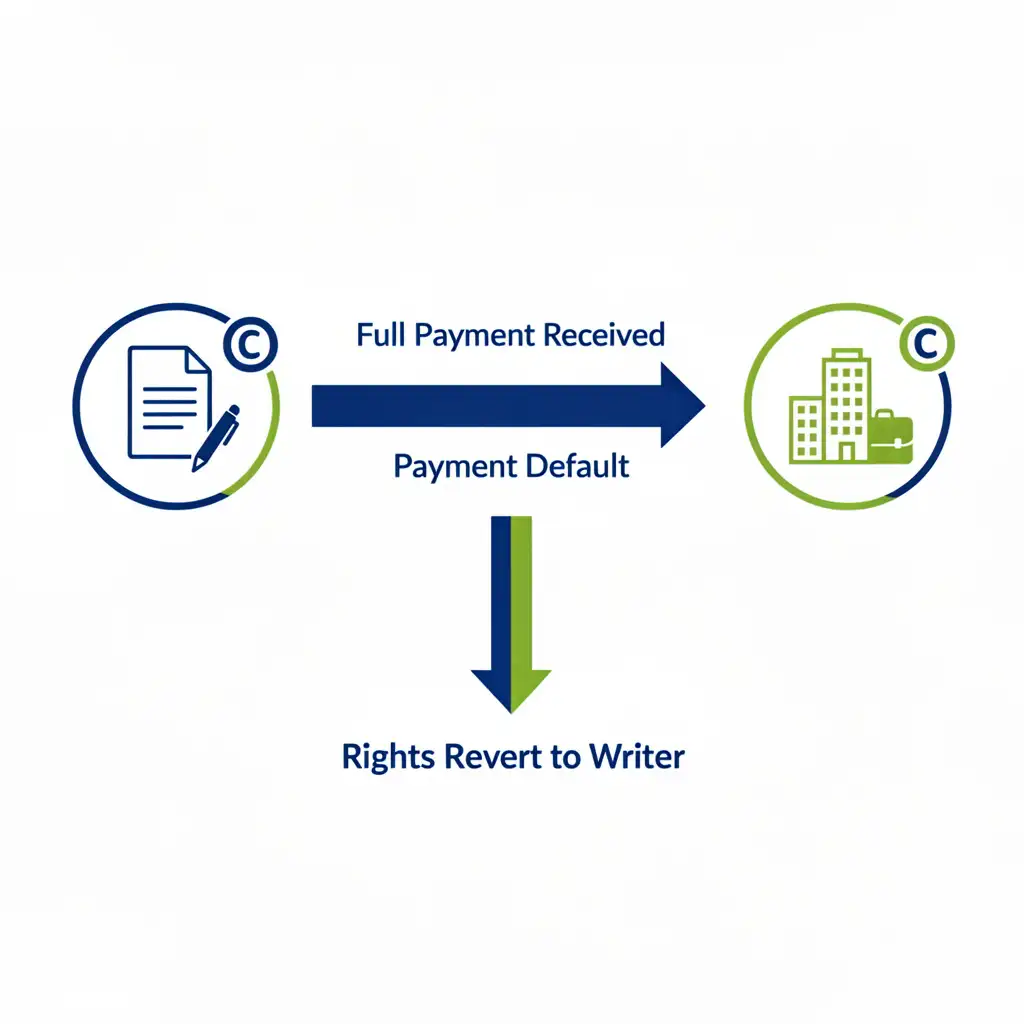
Under U.S. copyright law, you own the copyright in anything you write the moment you create it. Copyright does not transfer to the client automatically just because they paid you. It only transfers if you explicitly assign it in writing.
This is the clause most clients misunderstand and most freelancers under-negotiate.
Three possible ownership structures:
Full assignment (most common for commercial content):
The client owns all rights to the content after full payment. This is what most clients expect when they hire a content writer.
Upon receipt of full payment, Writer assigns all intellectual property rights, including copyright, in the delivered work to Client. Writer retains no rights to republish, repurpose, or license the work except as granted below.
License only (better for writers who want to retain copyright):
You retain copyright and license the client the right to publish the work. More common in journalism and academic writing.
Writer retains copyright in the delivered work and grants Client a non-exclusive, worldwide, perpetual license to publish and distribute the work. Client may not sublicense or resell the work without written permission from Writer.
Work-made-for-hire (only applies in very specific circumstances):
Under U.S. copyright law (17 U.S.C. § 101), a freelance work is legally a “work made for hire” only if it falls into one of nine specific categories AND there is a written agreement stating so. Blog posts and articles do not automatically qualify. Be cautious when clients ask you to sign a work-for-hire agreement without full compensation for the rights transfer.
Portfolio display rights: Always include a clause preserving your right to show the work in your portfolio, even if you assign copyright. Example:
Notwithstanding the above assignment, Writer retains the right to display the delivered work in Writer’s professional portfolio and to identify Client as a client, unless Client requests otherwise in writing.
Rights reversion: Include a clause that says copyright reverts to you if the client fails to make full payment.
All intellectual property rights in the work remain with Writer until Client has made full payment as specified in Section 4. Upon payment default, any license or assignment granted herein is automatically revoked.
For deeper reading on who legally owns work created by freelancers, the IP rights for freelancers section of the Gig Law Guide covers additional scenarios. The DMCA takedown guide is also worth bookmarking for situations where clients publish your work without paying.
How Do I Protect My Work From Being Used Without Payment?
Three layers of protection work together:
Layer 1: Your contract. The rights-reversion clause above is your primary tool. If they have not paid, they have no license to publish.
Layer 2: Delivery strategy: Do not send final, editable files until payment clears. Send a watermarked PDF or a Google Doc link with view-only permissions.
Layer 3: DMCA enforcement: If a client publishes your work without paying, the DMCA takedown notice process gives you a legal mechanism to have the content removed from their website through their web host.
The U.S. Copyright Office recommends registering important works for the additional protection of statutory damages (up to $150,000 per infringement for willful violations). For most freelance blog posts, this is not cost-effective, but for longer works or proprietary content, registration is worth considering.
7. Confidentiality Clause and NDA Terms
A confidentiality clause in a freelance writing contract protects information the client shares with you during the engagement: business strategy, product roadmaps, internal data, or client lists. It differs from a standalone NDA, though it serves the same core purpose.
What your confidentiality clause should cover:
- A definition of what counts as “Confidential Information”
- Your obligation not to disclose it to third parties
- Exclusions (information already publicly known, information you independently develop)
- The duration of the confidentiality obligation (commonly two to five years, or “indefinitely” for trade secrets)
Example language:
Writer agrees to keep confidential all non-public information disclosed by Client in connection with this project (“Confidential Information”) and will not disclose it to third parties without Client’s prior written consent. This obligation survives termination of this Agreement for a period of three (3) years.
Non-solicitation: Some clients also ask for a non-solicitation clause, meaning you agree not to approach their employees or customers directly. This is reasonable if narrowly defined. Be cautious of overly broad versions that restrict your ability to work in an industry.
For specific examples of what makes an NDA clause fail, the contractor NDA failures guide is a practical read before you sign anything.
8. Independent Contractor Status: Why This Clause Protects You From Misclassification
This clause explicitly states that you are an independent contractor, not an employee. It matters more than most freelancers realize.
Example language:
Writer is an independent contractor and not an employee of Client. Writer retains the right to perform services for other clients during the term of this Agreement. Client will not withhold income taxes, Social Security, or Medicare from Writer’s compensation. Writer is responsible for all applicable taxes on amounts received under this Agreement.
Tax implications: As an independent contractor, the client should issue you a Form 1099-NEC if they pay you $600 or more in a calendar year. You will need to provide a W-9 form with your Taxpayer Identification Number (TIN) before they can do this. You are then responsible for paying self-employment tax on your net earnings.
Why this clause protects you: Employee misclassification lawsuits go both ways. Some clients have tried to claim that a long-term freelancer was actually an employee and therefore entitled to back benefits, or conversely that they owe additional taxes. A clear independent contractor clause, combined with maintaining genuinely independent business practices, protects you from this scenario.
California note: Under AB 5, California applies the ABC test to determine whether a worker is a contractor. The clause alone is not sufficient in California. Your actual working arrangement must also meet the ABC test criteria.
9. Indemnification, Dispute Resolution and Governing Law
Indemnification (hold-harmless): This clause says that if your writing causes legal problems for the client (for example, you accidentally plagiarize a source), you cover the resulting legal costs. Clients will always want this clause. Limit it by adding “to the extent caused by Writer’s sole negligence” so you are not on the hook for problems that are not your fault.
Dispute resolution: Specify how disagreements will be resolved. The two main options are:
- Mediation: A neutral third party helps you reach a voluntary agreement. Lower cost, faster, and less adversarial.
- Arbitration: A neutral arbitrator makes a binding decision. Faster and cheaper than court but less flexible.
For disputes under $10,000, most freelancers are better served by small claims court, which does not require an attorney and is specifically designed for this type of commercial dispute.
Governing law/choice of law: Specify which state’s laws apply to the agreement. Use your home state.
This Agreement shall be governed by the laws of the State of [Your State], without regard to its conflict of law principles.
For situations involving significant financial harm, the liquidated damages clause guide explains how to pre-specify damages in your contract.
10. Revision Rounds: Define Exactly What You Are Agreeing To
The revision clause is where client relationships most often deteriorate. “Unlimited revisions” is not a business model; it is a liability.
Define what a “round” means in the contract:
This Agreement includes two (2) rounds of revisions. A “round” is defined as one set of consolidated written feedback submitted by Client at one time. Writer will incorporate all feedback from each round in a single revised draft. Additional revision rounds are available at $[Rate] per round.
Why “consolidated” matters: Without the word “consolidated,” a client can send one comment, then another the next day, then three more a week later, all claiming these are part of the same “round.” Requiring consolidated feedback forces the client to gather all notes in one sitting before submitting.
What to watch for: Some clients interpret “revisions” as “rewrites.” A revision is a correction or adjustment to existing content. A complete rewrite of the angle, structure, or tone is a new deliverable. Explicitly define this distinction if your client is in a creative or brand-heavy industry.
The 2026 AI Clause: What Every Freelance Writing Contract Needs Now
This is the section no competitor has written properly yet. As of 2026, AI usage in freelance writing is no longer a fringe concern. It is a daily operational question, and your contract needs to address it directly.
Should You Disclose AI Usage in Your Freelance Writing Contract?
Yes, if you use AI tools in your writing process, you need to address it in your contract. Clients increasingly have explicit policies on AI-generated or AI-assisted content, and failing to disclose can be grounds for withholding payment or demanding refunds.
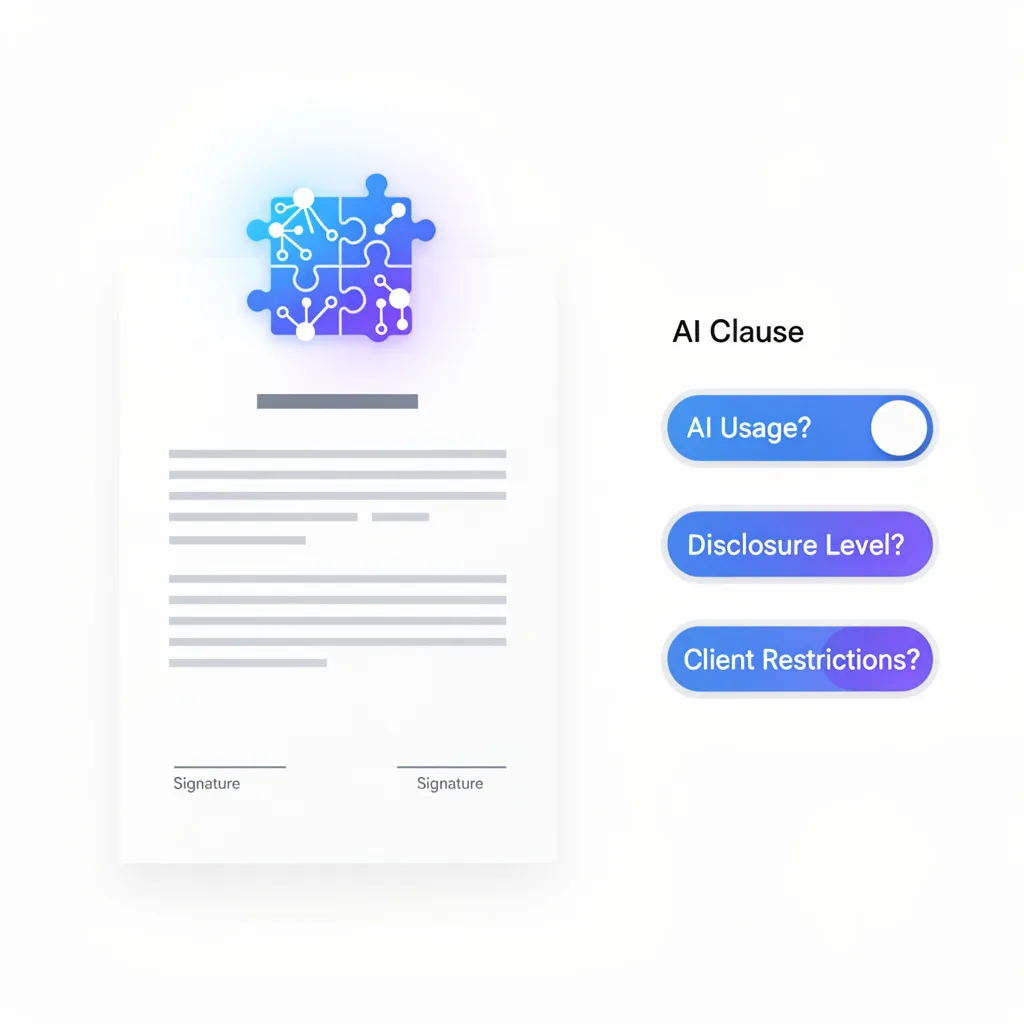
Your AI clause should answer three questions:
- Do you use AI tools (ChatGPT, Claude, Gemini, Grammarly, etc.) in your writing process?
- At what level (ideation only, outline assistance, draft generation, editing only)?
- Does the client have a policy that restricts this?
Example AI disclosure clause (for writers who use AI tools in a supporting capacity):
Writer may use AI-assisted tools for research assistance, ideation, and editing. All final written content is substantially authored, reviewed, and edited by Writer. Writer does not deliver AI-generated text as final copy without human review and significant modification. If Client has specific restrictions on AI tool usage, Client must disclose these restrictions in writing prior to the commencement of work.
Example AI restriction clause (for clients who want human-only content):
Client requires that all deliverables be substantially authored by Writer without the use of generative AI tools for draft creation. Writer agrees to this restriction and represents that the work delivered will meet this standard.
For the latest developments in AI tools that support (rather than replace) freelance writing work, the AI tools for freelancers resource covers the 2026 landscape.
Who Owns AI-Assisted Content? The Copyright Question Your Contract Must Answer
This is more complicated than most freelancers realize. The U.S. Copyright Office has issued guidance (most recently in 2023 and updated in 2024) stating that purely AI-generated content with no sufficient human creative input does not qualify for copyright protection. This means that if a client pays you for work that is largely AI-generated and lacks meaningful human authorship, they may have received content they cannot actually copyright or protect.
What this means for your contract:
- If you use AI tools heavily in drafting, the resulting work may have weaker copyright protection
- The assignment of copyright in your contract may be legally incomplete if the work does not meet the human-authorship threshold
- Clients who later discover AI-heavy content may have grounds to dispute your fee
The practical fix: Your contract should include a warranty clause stating that the delivered work contains sufficient original human authorship to qualify for copyright protection under applicable law.
Writer warrants that the delivered work contains original expression authored by Writer sufficient to qualify for copyright protection under U.S. law. Writer will disclose any material use of AI generation tools that may affect this warranty.
Ghostwriting Contract Template When Your Byline Is Not on the Work
A ghostwriting contract is a specialized freelance writing agreement in which the writer explicitly transfers authorship credit to the client. The writer is paid to produce work that the client will publish under their own name, and the arrangement is kept confidential.
What Makes a Ghostwriting Agreement Different From a Standard Freelance Writing Contract?
Three clauses become significantly more important in a ghostwriting agreement:
1. Authorship confidentiality clause: This is the defining clause of any ghostwriting arrangement.
Writer agrees to maintain strict confidentiality regarding Writer’s role in creating the work delivered under this Agreement. Writer will not publicly disclose, directly or indirectly, that Writer authored or contributed to the work without Client’s prior written consent.
2. Full IP assignment: In a ghostwriting engagement, the client almost always expects full copyright transfer. Make sure your fee reflects this. Ghostwriting commands a premium precisely because the writer gives up attribution and all associated rights.
3. Non-disparagement / non-disclosure of relationship: Some clients also want a clause preventing you from mentioning the client relationship even in general terms. This is negotiable, but common for high-profile clients.
Blog Writing Contract Template: Adapting Your Agreement for Content Marketing Clients
Content marketing retainers are a different beast from one-off article assignments. When you write regularly for a client’s blog, your contract needs to account for:
Content calendar clause: Who creates the editorial calendar? What happens if the client fails to provide topics by the agreed deadline?
Retainer structure: Define whether the retainer covers a set number of articles per month or a set number of hours. Define what happens to unused articles (do they roll over or expire?).
Brand voice and style: Include a clause saying the client is responsible for providing a brand voice guide or approving a style sample before work begins. This prevents endless “this does not sound like us” revision requests.
Approval timeline for retainer clients: Specify that articles not reviewed within a set number of business days are considered approved and invoiced.
How to Write a Freelance Writing Contract Without a Lawyer
You do not need to pay a lawyer to have a functional, enforceable freelance writing contract. Most freelance writing agreements are straightforward enough that a well-drafted template handles the job. That said, if you are entering a contract worth over $10,000, dealing with a corporate legal team, or signing a work-for-hire agreement for a major publication, getting a quick legal review is worth the cost.
Step-by-Step: Building Your Freelance Writer Contract From Scratch
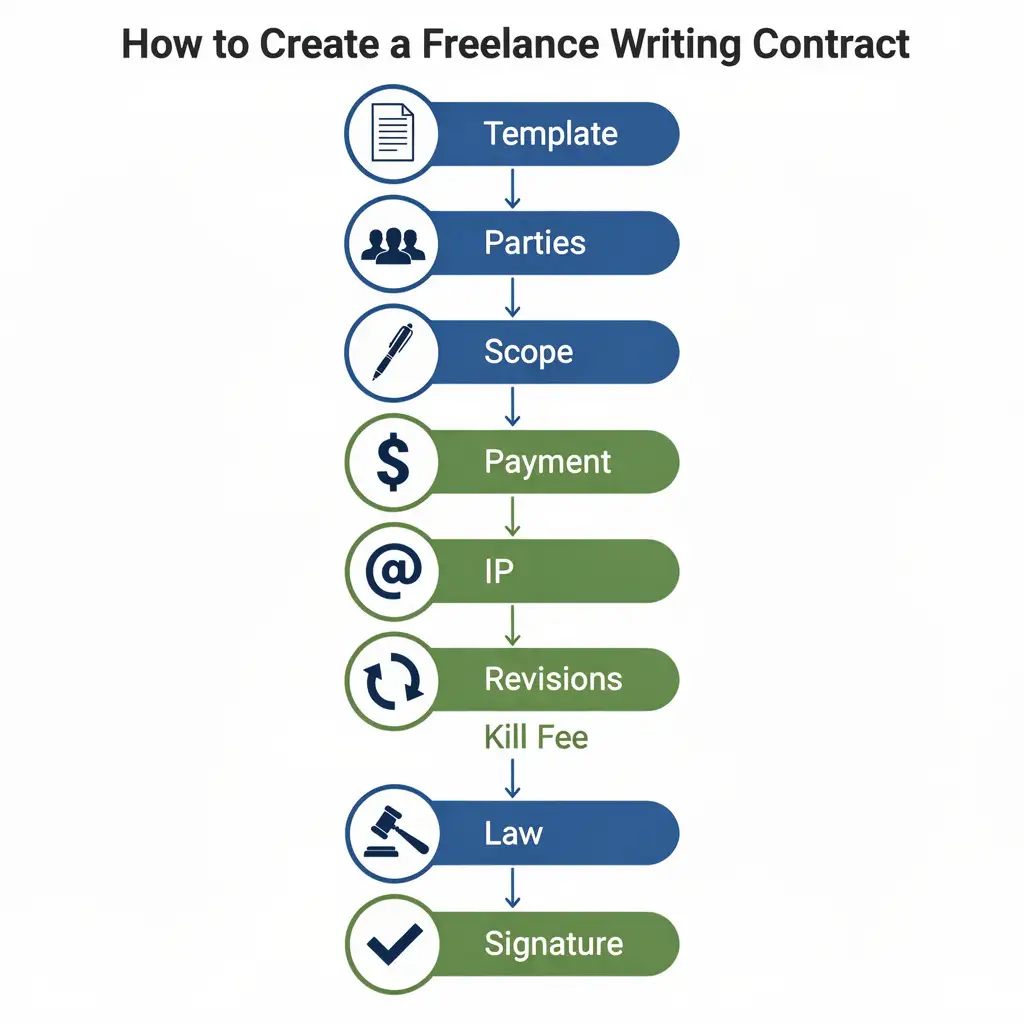
Step 1: Start with a reliable template. Use the free template linked in this guide, or one from the Freelancers Union contract creator (a free tool with writer-friendly defaults).
Step 2: Fill in the parties section accurately. Get the client’s full legal business name. Ask for it if you are unsure.
Step 3: Write the scope of work in specific, measurable terms. Word count, format, topic, research requirements, and number of drafts. The more specific, the better.
Step 4: Set payment terms and choose your payment structure. Decide on your deposit percentage, payment schedule, and late fee rate before you start negotiating.
Step 5: Choose your IP structure. Full assignment on payment, license only, or work-for-hire. Match it to the project type and your fee.
Step 6: Add your revision and deadline clauses. Specify the number of rounds, the definition of a round, and the client’s review window.
Step 7: Include your kill fee and termination clause. Do not skip this even on small projects.
Step 8: Specify governing law and dispute resolution. Your home state, and specify the small claims court for disputes under your state’s threshold.
Step 9: Get it signed before any work starts. Use a digital signature tool so there is a timestamped record.
For digital signature setup, the generate a digital signature guide walks through the technical process.
How to Present Your Contract to a New Client Without Awkwardness
The best approach is to normalize the contract as a standard part of your process from the first conversation. When a new client reaches out, your response should reference the contract naturally:
“Great, I would love to take this on. I will put together a project brief and send over my standard agreement for your review. Once that is signed and the deposit is in, I will get started.”
No apology. No “I hope this is okay.” It is part of your professional process, and treating it that way signals that you run a legitimate business.
If a client pushes back on signing a contract, that is a significant red flag. The client refuses to sign the guide, which covers how to handle this situation without walking away from every deal unnecessarily.
What to Do If a Client Refuses to Sign Your Contract
A client refusing to sign any contract is a red flag you should take seriously. A client asking to modify specific clauses is normal and professional. There is a meaningful difference between the two.
If a client refuses to sign anything in writing, you have two realistic options:
Option 1: Walk away. This is usually the right call. Clients who resist basic paperwork frequently become the ones who dispute invoices later.
Option 2: Get written confirmation of the absolute minimums via email. An email exchange in which the client confirms the scope, price, and payment terms in writing carries some legal weight, though significantly less than a signed contract.
Never start work without at least an email confirmation of price and scope. Even that is better than nothing.
Red Flags, Negotiation and Due Diligence
What Are Red Flags in a Freelance Contract a Client Sends You?
When a client sends you their own contract, read it carefully before signing anything. These are the clauses that should make you pause:
1. “Work made for hire” applied to all content without additional compensation. Work-for-hire carries a higher value because it permanently and fully extinguishes your copyright. If a client wants work-for-hire, they should pay a premium. A flat-rate content fee with a blanket work-for-hire clause is undercompensating you.
2. Unlimited revision language. Any contract that does not cap revisions is an unlimited liability. Do not sign it without adding a specific revision limit.
3. Exclusivity clauses. Some clients want exclusive rights to your services in their industry niche. Unless they are paying a substantial retainer, this is unreasonable. A blog client paying $300 per article should not be able to prevent you from writing for any other company in their space.
4. Payment on publication, not delivery. “Payment upon publication” means the client can delay payment indefinitely by simply not publishing your work. Payment should always be tied to delivery and approval, never to publication.
5. Perpetual confidentiality with no exceptions. A confidentiality clause that has no carve-out for legal requirements or publicly available information is overbroad and potentially unenforceable. Always push back on this.
6. Unilateral contract modification. Some corporate contracts include a clause saying the client can modify the terms at any time by updating a posted policy. This is not a contract; it is a blank check. Do not sign it.
How Do I Know If a Client Contract Is Fair?
A fair client contract protects both parties roughly equally. Run through this evaluation checklist:
- Does the scope of work benefit me as much as it benefits the client? (Both parties need clarity)
- Is the payment timeline reasonable and tied to delivery, not publication?
- Does the IP clause match what I have been paid? (Full assignment for a one-time low fee is unfair)
- Are revision rights capped?
- Is the termination clause mutual (either party can exit with notice, not just the client)?
- Is the governing law in my state or a neutral location?
- Is there a dispute resolution method that does not require expensive litigation?
If more than two of these answers are “no,” the contract needs negotiation before you sign.
What Should I Do Before Signing a Client’s Contract?
Due diligence steps before you sign anything:
- Verify the client’s legal business name and look them up in your state’s business registry (most are searchable online for free)
- Search the company name plus “reviews” and “complaints” online and on platforms like Glassdoor
- Ask for references from other freelancers they have worked with
- Check payment terms against your own standard terms and note every discrepancy
- Read every clause, including the ones that seem like boilerplate. The most harmful clauses are buried in the general provisions section
- If a clause is unclear, ask the client to explain it in plain English before signing
Contract Negotiation Tips: How to Push Back Without Losing the Client
Negotiating a contract is not confrontational. It is a professional exchange between two parties who both want the project to succeed. The key is to frame every push-back as a clarification or a mutual benefit:
Instead of: “I am not okay with unlimited revisions.”
Say: “To keep the project on schedule and ensure we both have clear expectations, I include two rounds of revisions. Additional rounds are available at [rate]. Want me to add that to the agreement?”
Instead of: “I need a deposit.”
Say: “My standard process is a 50% deposit before I start. This is how I keep my schedule protected for your project.”
Instead of: “I do not like this IP clause.”
Say: “The current clause assigns full IP including future derivative rights, which typically carries an additional fee. I am happy to assign all rights for the agreed rate if we add standard language limiting the assignment to the specific deliverable described.”
The freelancer blacklisting guide also addresses how to handle clients who respond negatively to basic professional requests.
Enforcing Your Freelance Writing Contract: What Happens When Things Go Wrong
What Happens If a Client Does Not Pay Me?
A signed contract transforms a payment dispute from “my word against theirs” into a documented breach of contract. Here is the escalation process:
Step 1: Friendly reminder (Day 1 past due): Send a polite email referencing the invoice number and due date.
Step 2: Formal demand (Day 7 past due): Send a written demand letter referencing the contract, the amount owed, and a final payment deadline (typically 7 to 10 days). Keep it professional, not emotional.
Step 3: Late fee notification (Per your contract): Apply the late fee specified in your payment terms and notify the client in writing.
Step 4: Final demand with legal notice (Day 21 past due): Send a final demand stating that failure to pay will result in legal action.
Step 5: Small claims court: For amounts under your state’s small claims limit (typically $5,000 to $25,000 depending on the state), file a claim. You do not need an attorney and filing fees are usually under $100.
New York advantage: Under the Freelance Isn’t Free Act, freelancers in NYC can seek double damages plus attorney fees for non-payment. This makes small claims court a powerful tool in that jurisdiction.
The Collect Unpaid Invoices and Legal Steps for Unpaid Freelancers ” guide covers the full escalation process in detail.
How Do I Collect Payment From Freelance Clients: Before It Becomes a Problem?
Prevention is cheaper than enforcement. These habits dramatically reduce payment problems:
- Send your invoice the same day you deliver the final draft
- Use invoicing software with automated reminders (the best invoicing software for freelancers guide reviews the top options for 2026)
- Build your payment portal link directly into the invoice
- Follow up within 24 hours if no acknowledgment of delivery is received
- Never begin a new project for a client who still owes you money from a previous engagement
For clients who go silent on invoices, the ” How to Invoice a Client Who Ignores You guide covers the legal steps available.
What Should I Do If a Client Wants to Change the Contract Mid-Project?
Any mid-project change to scope, timeline, or payment terms must be documented in writing. A verbal “we will figure it out” from a client is not an amendment to your contract.
The process is simple:
- Client requests a change
- You assess the impact on your time and deliverables
- You send a written change order (even a simple email works) specifying what is changing and what the additional cost is
- Client confirms in writing
- You update your invoice accordingly
The change order does not need to be a formal legal document. A clear, specific email exchange confirming the new terms is sufficient in most cases.
Common Freelance Contract Mistakes That Cost Writers Money
These are the seven mistakes that show up again and again in forum threads, Reddit discussions, and legal consultations:
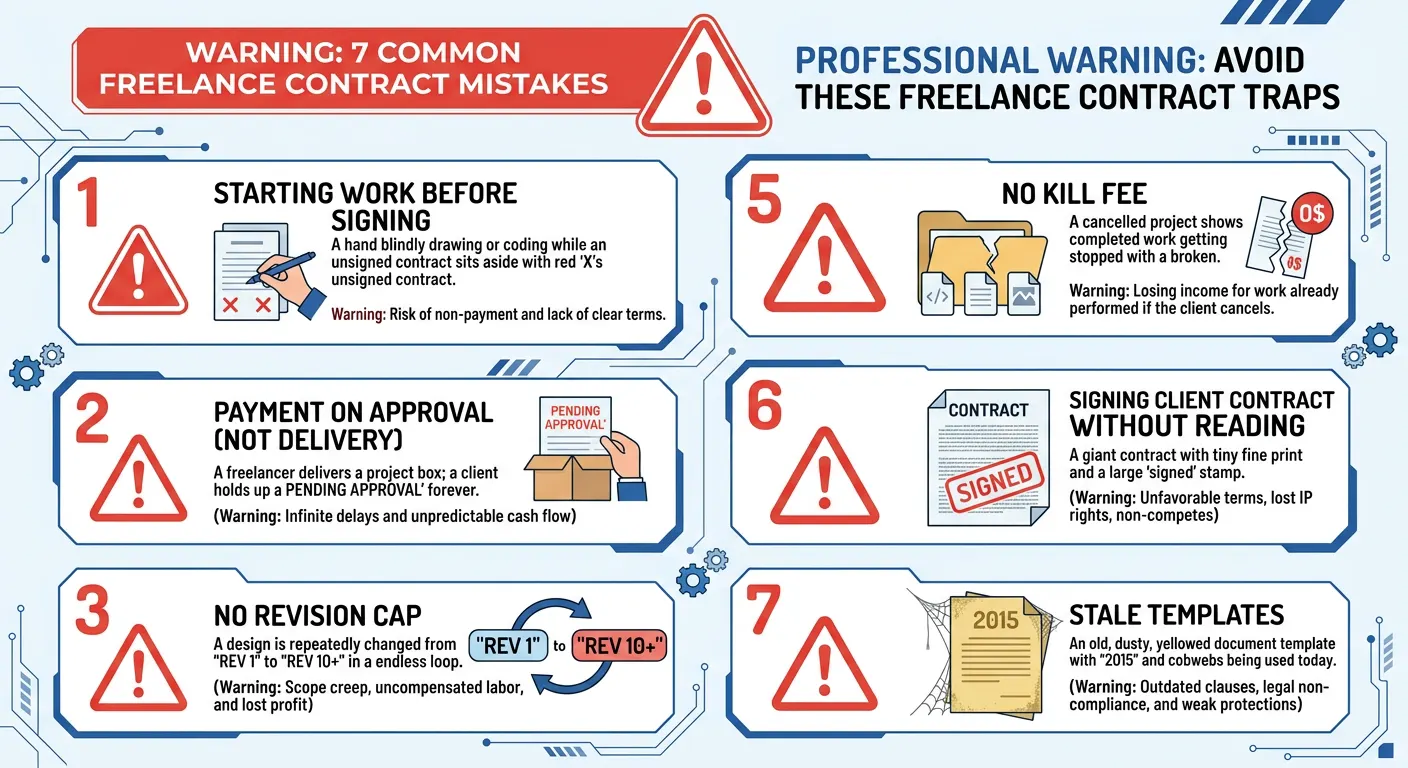
1. Starting work before the contract is signed. No exceptions. If you have already started, a client knows they have leverage over you.
2. Agreeing to “payment on approval” instead of “payment on delivery.” Subjective approval gives clients unlimited power to withhold payment.
3. Forgetting the revision cap. This is the most common and most expensive omission for content writers.
4. Not specifying the file format and ownership of source files. Does the client get the Google Doc with edit access? The raw research notes? Specify what you are delivering.
5. Skipping the kill fee. Projects get cancelled. Protect your time.
6. Using the client’s contract without reading it. Corporate contracts often contain clauses that are completely one-sided.
7. Not updating the contract for new project types. The contract that works for blog posts needs significant modification before you use it for a book project or a ghostwriting engagement.
Types of Freelance Writing Contracts: Matching the Agreement to the Project
One-Time Project Contract vs. Retainer Agreement
A one-time project contract covers a single, defined deliverable. It has a clear start point, a delivery date, and a final payment date. Once both parties perform their obligations, the agreement ends.
A retainer agreement covers ongoing services over a defined period (typically month-to-month or quarterly). It should specify:
- The monthly deliverables (e.g., four 1,000-word blog posts per month)
- The monthly retainer fee and payment date
- The notice period required to terminate the arrangement
- How unused deliverables are handled (rollover or expire)
Retainer agreements create predictable income for writers and consistent content output for clients. They require more upfront negotiation but are worth the effort for stable, reliable clients.
Independent Contractor Agreement for Writers: When You Are Working Under Someone Else’s Brand
When you write for a content agency that then resells your work to their end clients, you are in a white-label writing arrangement. Your contract in this scenario should explicitly address:
- Non-disclosure of the end client’s identity and the agency relationship
- Confirmation that you will not contact the end client directly
- Clear work-for-hire language (agencies almost always require full IP assignment)
- The specific turnaround time the agency needs to meet its own client deadlines
Writing Services Agreement for Business Clients vs. Individual Clients
Business clients (companies, agencies, publications) and individual clients (entrepreneurs, coaches, authors) have different expectations, risk profiles, and legal sophistication.
For business clients: Use formal contract language, expect them to redline your draft, and be prepared to negotiate IP and confidentiality clauses. They will have their own legal team reviewing your agreement.
For individual clients: Simpler language works better. A one-page agreement with clear, plain-English terms is more likely to be read, understood, and signed without friction.
The tone and complexity of your contract signal your professionalism. Match it to the person on the other side of the table.
Tools, Storage and Keeping Your Contracts Organized
A contract is only useful if you can find it and prove it was signed. Here is a practical system:
Digital signature tools: DocuSign and HelloSign (now Dropbox Sign) are the industry standards. Both create a legally timestamped signature record. PandaDoc is another strong option and includes contract template management. The digital signature certificate guide covers setup.
Storage: Store all signed contracts in a dedicated cloud folder (Google Drive, Dropbox, or OneDrive). Create subfolders by client name and year. Never rely solely on your email inbox to store contracts.
Contract management: If you manage more than five to ten active clients simultaneously, a simple spreadsheet tracking contract status (sent, signed, active, completed) saves significant headache. The freelance project management tools directory lists options at various price points.
Retention: Keep signed contracts for at least three years after the project ends. In some states, the statute of limitations for written contracts is 6 years.
Trending FAQs About Freelance Writing Contracts
1. Where can I find a free freelance contract template?
The free template in this guide (available in Word, PDF, and Google Docs) is a strong starting point. The Freelancers Union contract creator at freelancersunion.org is also free and writer-specific. Both are more comprehensive than generic business contract templates.
2. How much should I charge as a new freelancer?
Rates vary widely by niche, format, and experience level. A useful starting point is to calculate your needed hourly rate based on your income goals, then use the freelance hourly rate calculator to set project fees that reflect your actual time.
3. Can I make $1,000 a month freelance writing?
Yes, and many writers exceed this within their first six months. Four articles per month at $250 each achieves this target. As your portfolio grows, rates typically increase significantly, with experienced writers commonly charging $500 to $1,500 per article in competitive niches.
4. What questions should I ask before accepting a freelance project?
Ask: What is the word count and format? What is the deadline? Who is the target audience? What is the approval process? Is there a style guide? Is this a one-time project or an ongoing one? What is the payment timeline? These questions protect you from surprises after work starts.
5. How long should a freelance contract be?
For a single-project engagement, one to two pages cover everything you need. For retainer agreements or complex multi-deliverable projects, three to five pages is appropriate. Longer is not better. Clarity is better. The How Long Should a Freelance Contract Be guide covers this in more detail.
6. What is the difference between a freelance contract and a statement of work?
A freelance contract is the master agreement that governs the relationship (including payment terms, IP, and dispute resolution). A statement of work (SOW) is the project-specific document attached to the contract that describes the specific deliverables, timeline, and scope. Some writers use them as a single document for simple projects. The statement of work vs. scope of work guide explains the distinction in full.
7. Can I get paid through PayPal with a freelance contract?
Yes. Your contract can specify any payment method that both parties agree to. PayPal Business, Stripe, ACH bank transfer, and Wise are all common choices. Specify the method in your payment terms clause and confirm there are no international transfer fees if you are working with overseas clients.
8. How do I start freelancing on my own without an agency?
The process involves building a portfolio, setting your rates, creating a contract template, opening a business bank account, and finding your first clients. The 10-step freelancer guide walks through each step in detail.
9. Can I require a non-compete agreement from my clients?
You can include a clause preventing clients from hiring your subcontractors or employees directly, but you generally cannot legally require clients to agree not to hire other writers. Non-competes in freelance relationships are almost always one-directional (restricting the writer, not the client). A non-solicitation clause covering your specific business contacts is more reasonable and more enforceable.
10. What should I know before leaving my agency job to go freelance?
Check your employment agreement for any non-compete or non-solicitation clauses that restrict who you can work with. Review your IP assignment agreement to confirm what you own. Build three to six months of savings before leaving. Line up at least one client before your final day. The section on starting a freelance business in the Gig Law Guide covers the full transition.
11. How do I keep my freelance contracts organized?
Use a cloud storage folder (Google Drive or Dropbox) organized by client and year. Track contract status in a simple spreadsheet or a project management tool like Notion. The freelance project management tools directory covers the best options.
12. What is the best way to communicate contract terms to a new client?
Send the contract as a PDF with a brief cover note explaining that this is your standard agreement and inviting them to flag any questions. Do not apologize for having a contract. Frame it as part of your professional process. Use a digital signature tool so signing is a one-click action.
13. How often should I update my freelance contract template?
Review your template at least once a year and any time you start working in a new content niche, adjust your pricing significantly, or encounter a situation your current contract did not cover. The 2026 AI clause section above is an example of an update many writers need to make right now.
14. What insurance do I need as a freelancer?
Most freelance writers need general liability insurance at a minimum. If you write in high-stakes niches (financial advice, medical content, legal topics), professional liability insurance (also called errors and omissions or E&O insurance) is worth considering. The Freelancers Union offers group rates on several types of freelancer insurance.
15. How do I handle taxes as a freelancer?
As an independent contractor, you pay self-employment tax (15.3% on net earnings up to the annual threshold) plus federal and state income tax. Set aside 25% to 30% of every payment for taxes. Make quarterly estimated payments to the IRS to avoid penalties. The freelancer taxes guide and the self-employment tax deductions guide cover exactly what you owe and what you can legally deduct.
16. Where should I store my signed contracts?
Use cloud storage with automated backup (Google Drive or Dropbox). Keep a local backup on an external drive for contracts over $5,000. Never store contracts only in email. Email providers can lose data, accounts can be suspended, and searching through old email threads during a dispute is inefficient and unreliable.
17. What digital signature tools work best for freelance contracts?
DocuSign is the industry standard and provides the strongest legal audit trail. HelloSign (now Dropbox Sign) integrates well with Google Workspace. PandaDoc combines templates and signatures into a single tool and is popular with freelancers who manage multiple contract types. The digital signature guide covers setup for each option.
18. What is a client qualification checklist and do I need one?
A client qualification checklist is a set of questions you answer before accepting any new client to assess payment risk and project fit. A basic version includes: Have they worked with freelancers before? Do they have a clear budget? Can they provide a signed contract? Do they have a realistic timeline? Are there any online complaints about payment issues? Running this checklist before signing saves more time than it costs.
Your Next Step
You now have everything you need to write, customize, send, and enforce a professional freelance writing contract in 2026. The free template above handles the structure. This guide covers every clause that goes inside it, what each one means, and what each one protects you from.
Download the template. Fill in your details. Sign it before you write a single word for any client.
If you want help with a specific clause situation or need a contract reviewed by a legal professional, the Gig Law Guide legal contact page connects you with professionals who specialize in freelancer and creative services law.
And if a client has already stiffed you on a payment, the not getting paid resources section covers your next steps in detail.
A contract is not a barrier between you and good clients. It is the foundation that enables good client relationships.
Disclaimer: This article provides general legal information for educational purposes only and does not constitute legal advice. Laws vary by state and jurisdiction. For advice specific to your situation, consult a licensed attorney in your state.