


Introduction
A W-9 is a one-page IRS form that gives your client your taxpayer identification number, so the client can report what it paid you. You fill it out, sign it, and hand it to the client. You do not send it to the IRS. That is the whole job of the form, and once you understand it, it stops being intimidating.
I write this as a freelancer who remembers the first time a client asked for one. The request arrived by email, attached to a contract, with no explanation. My first thought was that I had done something wrong. I had not. A W-9 is routine paperwork, the same way an invoice is routine paperwork. Clients ask for it because they need your tax ID number on file before they can report your payments, and they usually ask before the first payment goes out. This guide walks through the form line by line, explains the choice between an SSN and an EIN, shows you what backup withholding does to a real invoice, and ends with a checklist you can run before you send the form anywhere.
What a W-9 Is and Who Asks for It
The full name of the form is Request for Taxpayer Identification Number and Certification. The IRS calls it Form W-9, and the current revision is dated March 2024. There is no separate 2025 or 2026 version of the form, so if a client sends you a form marked March 2024, that is the current one.
The form exists for one purpose. The person who pays you needs your correct taxpayer identification number, known as a TIN, so that person can file an information return with the IRS reporting the income paid to you. For freelance work, that information return is usually Form 1099-NEC, Nonemployee Compensation. The W-9 is the document that connects your name and your TIN to the payments, so the 1099-NEC the client files later has the right numbers on it.
Who asks for a W-9? Any business that pays you for services can ask. A direct client can ask. An agency that hires you for a project can ask. A platform that pays freelancers can ask. The person or business that asks is called the requester, and you, the person giving the form, are the payee. The requester keeps your completed W-9 on file. The requester does not send your W-9 to the IRS. The IRS may ask the requester for it later during an audit, but the form itself travels from you to the requester and stops there.
Here is the part that confuses new freelancers. A W-9 is not a tax return, and filling one out does not mean you owe tax on the spot. It also does not mean the client will withhold tax from your payments. In the normal case, the client pays you the full invoice amount, files a 1099-NEC at the start of the next year, and you report that income on your own tax return and pay whatever tax you owe, including self-employment tax. The W-9 only makes that reporting possible. My guide to freelance taxes for beginners explains what happens after the W-9, including the 1099-NEC, quarterly estimated taxes, and the rule that freelance income arrives untaxed so a share of it must be set aside.
One more distinction matters before we get to the lines of the form. A W-9 is for U.S. persons. If you are not a U.S. person, you do not use a W-9 at all. Foreign freelancers use a form in the W-8 series instead, and I cover that case in its own section near the end of this guide.
How to Fill Out a W-9, Line by Line
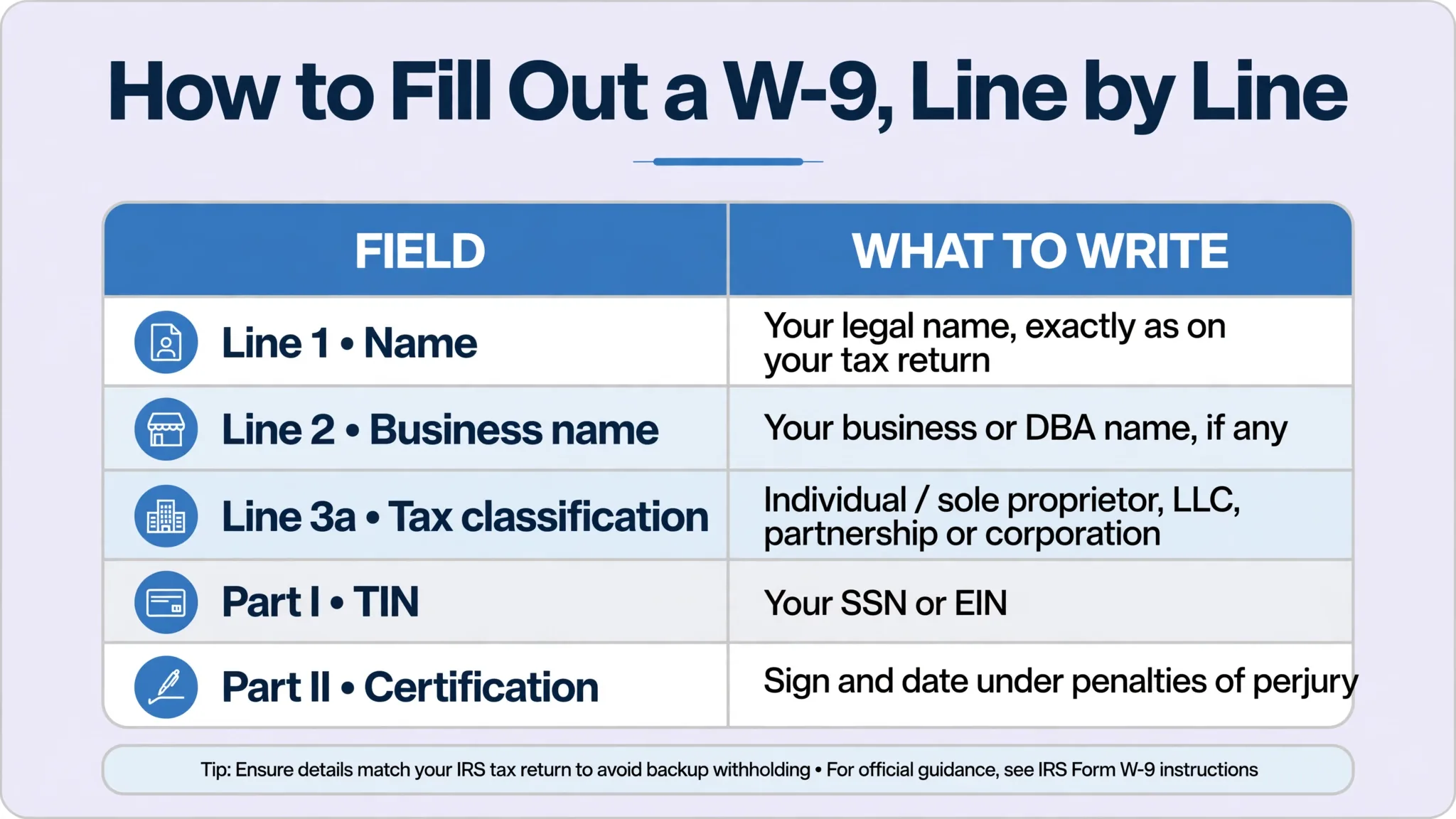
The March 2024 form has two parts. Part I is your identifying information and your TIN. Part II is the certification, which you sign under penalties of perjury. The whole form fits on one page, and most freelancers can complete it in a few minutes once they know what each line wants.
Line 1: Name
Enter the name shown on your income tax return. For a sole proprietor, that is your personal legal name, the name on your tax return, not a brand name or a nickname. If you operate under a different name, that name goes on line 2. Getting line 1 right matters more than any other line, because the IRS matches the name and the TIN together. A name that does not match the TIN is the most common reason a client comes back and asks for a corrected form.
Line 2: Business name or disregarded entity name
Enter your business name, trade name, or “doing business as” name here, if you have one. This is where a studio name, a brand name, or the name of a single-member LLC goes when the owner is an individual. If you have no business name, leave line 2 blank. A blank line 2 is perfectly fine for a sole proprietor working under their own name.
Line 3a: Federal tax classification
Check one box that describes how you are taxed. This is the line where freelancers with different business structures diverge, so read the choices carefully.
| Your situation | What to check on line 3a | What goes on line 1 |
|---|---|---|
| Individual or sole proprietor | Individual/sole proprietor or single-member LLC | Your personal legal name |
| Single-member LLC that is a disregarded entity owned by an individual | Individual/sole proprietor or single-member LLC | The owner’s personal legal name, with the LLC name on line 2 |
| LLC taxed as a C corporation | Limited liability company, and enter C on line 3b | The LLC’s legal name |
| LLC taxed as an S corporation | Limited liability company, and enter S on line 3b | The LLC’s legal name |
| LLC taxed as a partnership | Limited liability company, and enter P on line 3b | The LLC’s legal name |
| Partnership | Partnership | The partnership’s legal name |
| Corporation (C or S) | C Corporation or S Corporation | The corporation’s legal name |
Most freelancers reading this guide will check the first box. If you are a sole proprietor, or a single-member LLC that the tax rules treat as part of you rather than as a separate entity, you check “Individual/sole proprietor or single-member LLC” and your own name goes on line 1. The LLC’s name goes on line 2. If your LLC has elected to be taxed as a corporation or a partnership, check the “Limited liability company” box instead and write the right letter on line 3b: C for a corporation, S for an S corporation, or P for a partnership. The letter on line 3b tells the requester how your LLC is taxed, which decides how the payments are reported.
Line 3b: Tax classification of a limited liability company
Line 3b applies only if you checked the limited liability company box on line 3a. Enter one letter: P if the LLC is taxed as a partnership, C if it is taxed as a C corporation, or S if it is taxed as an S corporation. If you did not check the LLC box, leave line 3b blank.
Line 4: Exemptions
Line 4 has two codes, an exempt payee code and a FATCA reporting exemption code. Most freelancers leave line 4 blank. The exempt payee code applies to certain organizations, such as corporations in some situations, and the FATCA code applies when the requester asks for it. If you are an individual freelancer and nobody has told you that you are exempt, leave both spaces blank. Do not guess a code. A blank line 4 is the normal answer for a working freelancer.
Lines 5 and 6: Address
Enter your mailing address: street address, apartment or suite number, city, state, and ZIP code. Use the address where you want the client to send tax documents, because the 1099-NEC will go to the address on your W-9. If you move, send the client a new W-9 with the new address. The IRS asks the requester to use the address you give here, so keep it current.
Line 7: Account numbers
Line 7 is optional. You may list account numbers here if the requester asked for them, for example when one client has several accounts for you. Most freelancers leave line 7 blank. Nothing bad happens if you leave it empty.
Part I: Taxpayer identification number
Part I is where your TIN goes. If you are an individual or a sole proprietor, your TIN is usually your Social Security number, or SSN. If you are a business, your TIN is usually an Employer Identification Number, or EIN. A resident alien who cannot get an SSN uses an Individual Taxpayer Identification Number, or ITIN, issued on Form W-7. Enter the number in the right box: SSN in the Social Security number box, EIN in the employer identification number box. Double-check every digit before you sign. A single wrong digit is enough for the IRS to tell the client the TIN is incorrect, and that starts the backup withholding problem I explain below.
If you have applied for a TIN but do not have the number yet, write “Applied For” in Part I, then sign and date the form. The form instructions allow this, but it comes with a warning: until you give the payer your actual number, payments for services can be subject to backup withholding. So “Applied For” keeps the process moving, but it does not protect you from withholding. Get the number to the client as soon as it arrives.
Part II: Certification
Part II is the certification, and it is the part of the form with real legal weight. When you sign, you certify under penalties of perjury that the TIN you entered is correct, that you are not subject to backup withholding because you failed to report interest and dividend income, that you are a U.S. person, and that any FATCA exemption code you entered is correct. Read those words before you sign them. They are a sworn statement, not a formality.
Then sign and date the form. A W-9 without a signature and a date is not a valid W-9. The IRS instructions are clear that a valid Form W-9 must be signed and dated under penalties of perjury. An unsigned form gives the client nothing to rely on, and the client is right to send it back.
SSN or EIN: Which One Goes on the Form
The most common question I hear about the W-9 is whether to put an SSN or an EIN on it. The honest answer is that either one works, as long as it is the right TIN for you. What changes is privacy, not validity.
Your SSN is your personal tax ID number. It is tied to you as an individual, and it is the number identity thieves want most. Every time you write your SSN on a form and hand that form to someone, you are trusting that person to store it safely. With one client, that is a small risk. With twenty clients over a year, your SSN ends up in twenty filing systems, twenty email inboxes, and twenty sets of records you do not control.
An EIN is a separate tax ID number issued to a business. If you have an EIN for your freelance business, you can put the EIN on the W-9 instead of your SSN, and the client reports your payments under the EIN. Your SSN never appears on the form at all. That is the main reason freelancers get an EIN even when the law does not require one: it keeps the SSN off client paperwork. My guide to the employer identification number explains how an EIN works and how to apply for one, including the route for freelancers without an SSN.
Here is the practical rule I follow. If you are a sole proprietor and you already have an EIN for your freelance business, use the EIN on the W-9. If you do not have an EIN, your SSN is the correct number to use, and using it is normal. Do not invent an EIN, do not borrow one, and do not leave the TIN blank and hope the client does not notice. A blank TIN is the fastest route to backup withholding. And if you are a single-member LLC that is a disregarded entity, remember the line 1 rule from the walkthrough above: the owner’s name goes on line 1, and the TIN is the owner’s TIN, which is usually the owner’s SSN or the EIN issued to the owner.
One more point on this choice. An EIN does not change your tax bill. It does not turn you into a corporation, and it does not change how much self-employment tax you owe. It is only an identification number. The tax on your freelance income is the same either way, and my guide to what freelancers owe and when walks through what you actually owe and the calendar for paying it.
The 2026 Threshold Change: 600 Dollars for 2025, 2,000 Dollars for 2026
Here is the change that most guides still get wrong. The amount of money a client must pay you before it has to file a 1099-NEC has changed, and the new amount depends on the year the payment was made, not the year the form is filed.
For payments made in 2025, the old threshold still applies: a client must file Form 1099-NEC for you if it paid you at least 600 dollars in nonemployee compensation during 2025. For payments made in 2026, the threshold is 2,000 dollars. The change comes from section 70433 of the One Big Beautiful Bill Act, and it applies to payments made on or after 1 January 2026. The threshold is set to adjust for inflation from 2027. I verified this on the IRS website on 27 November 2026, in the Instructions for Forms 1099-MISC and 1099-NEC, which now say to file Form 1099-NEC for each person paid at least 2,000 dollars, while the 600 dollar figure now applies only to gross proceeds paid to an attorney and to payments made in 2025.
What does this mean for you as a freelancer? Three things. First, if a client paid you 1,500 dollars in 2026, the client is not required to file a 1099-NEC for you, because 1,500 dollars is below the 2,000 dollar threshold for 2026 payments. Second, the same 1,500 dollars paid in 2025 would have required a 1099-NEC, because it was above the 600 dollar threshold for that year. Third, and most important, the threshold decides whether the client must file the form. It does not decide whether you owe tax. All of your freelance income is taxable, whether or not a 1099-NEC is filed for it. A client that pays you 800 dollars in 2026 files no 1099-NEC, and you still report the 800 dollars.
There is also a practical point that trips people up. A client can ask you for a W-9 even when the payments will stay below the threshold. The client does not know in advance how much work it will send you over the year, and collecting the W-9 up front is cheaper than chasing it in January. So if a client asks for a W-9 for a 300 dollar job, that is not a mistake. Hand over the form, and let the client decide about the 1099-NEC later.
One deadline to know: the client must file Form 1099-NEC with the IRS by January 31. For payments made in 2026, that filing date falls on a Sunday in 2027, so the observed date is Monday, 1 February 2027. You should expect your 1099-NEC forms for 2026 payments to arrive around then. If a client has your W-9 on file with the right name and TIN, the 1099-NEC it sends you will match your own records, and your tax return will be simpler for it.
Backup Withholding: What 24 Percent Looks Like on a Real Invoice
Backup withholding is the penalty the tax system applies when the client does not have a correct TIN for you. If backup withholding applies, the client must hold back 24 percent of your payment and send it to the IRS. You still get the other 76 percent, but a quarter of the invoice disappears before it reaches you.
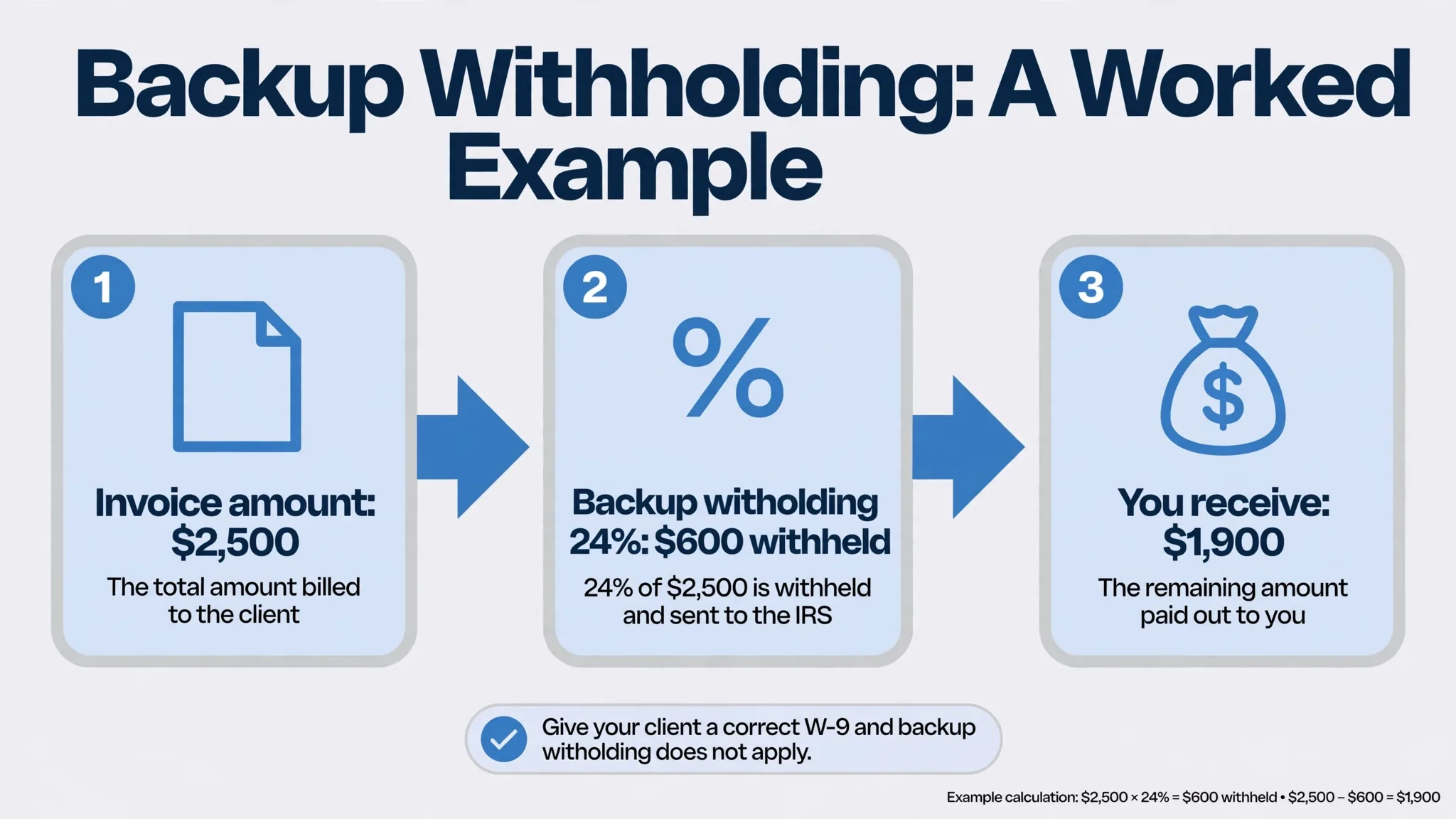
Here is what that looks like on a real invoice. Suppose you bill a client 2,500 dollars for a project, and backup withholding applies because you never gave the client a W-9. The client must withhold 24 percent of 2,500 dollars, which is 600 dollars, and send that 600 dollars to the IRS. You receive 1,900 dollars. The 600 dollars is not lost forever. It appears on the 1099-NEC as federal income tax withheld, and you report it as tax already paid when you file your return. But the money is gone from your cash flow until tax time, and on a 2,500 dollar invoice that is a real hole in the month’s budget.
Backup withholding can start for four reasons, and the IRS lists them in Topic No. 307. First, you do not give the payer your TIN in the required manner, which includes never handing over a W-9 at all. Second, the IRS notifies the payer that the TIN you gave is incorrect. Third, the IRS notifies the payer to start withholding on interest or dividends because of underreporting, and only after four notices over at least 120 days. Fourth, you fail to certify that you are not subject to backup withholding for underreporting of interest and dividend income. For freelancers, the first two reasons are the ones that actually happen: no W-9, or a W-9 with a wrong number.
Backup withholding covers payments for work done as an independent contractor. The IRS lists commissions, fees, and other payments for work performed as an independent contractor, reported on Form 1099-NEC, among the payments subject to backup withholding. So this is not a rare edge case. It is the normal consequence of a missing or wrong W-9 on freelance income.
Stopping backup withholding is straightforward: correct the reason it started. Give the payer your correct name and TIN on a signed W-9 and certify that it is correct. Once the payer has a valid W-9, withholding stops on future payments. The amounts already withheld stay with the IRS until you claim them on your tax return, so the fix protects the next invoice, not the one already paid. That is why the best time to hand over the W-9 is before the first invoice, not after the first short payment arrives.
There are also real penalties for getting the form wrong, and they are printed on the form itself. If you fail to furnish your correct TIN, the penalty is 50 dollars for each failure, unless the failure was due to reasonable cause and not wilful neglect. If you make a false statement with no reasonable basis, and that statement results in no backup withholding, the penalty is 500 dollars. If you wilfully falsify the certifications or affirmations on the form, the penalties are criminal, including fines and imprisonment. Those numbers come directly from the Penalties section of the Form W-9 PDF on the IRS website. They are the reason the signature line matters: you are certifying under penalties of perjury, and the form says so plainly.
W-9 vs W-4: The Comparison
Freelancers mix up the W-9 and the W-4 more than any other pair of forms, and the confusion is understandable, because both forms are about tax identification. They serve opposite situations. One is for employees. The other is for everyone who is not an employee.
| Question | Form W-9 | Form W-4 |
|---|---|---|
| Who fills it out? | A freelancer, independent contractor, or other non-employee payee | An employee, for their employer |
| Who is it given to? | The client or business paying you (the requester) | Your employer |
| What income does it cover? | Payments for services, reported on Form 1099-NEC | Wages, reported on Form W-2 |
| Is tax withheld from each payment? | No, you are paid in full unless backup withholding applies | Yes, tax is withheld from each paycheck |
| Who reports the income to the IRS? | The client files Form 1099-NEC | The employer files Form W-2 |
| Who pays the tax, and when? | You pay it yourself, usually through quarterly estimated taxes | Your employer withholds it from your pay as you earn |
The short version is this: a W-4 belongs to a job, and a W-9 belongs to a client relationship. If a client sends you a W-4, that is a warning sign, because it suggests the client thinks of you as an employee. If an employer sends you a W-9, the same confusion is happening in the other direction. When the form is wrong, ask which relationship the payer has in mind, and get the paperwork to match the real arrangement.
The W-9 and Your Freelance Contract: Sign Both Before Work Starts
A W-9 on its own does not protect you. It tells the client your tax ID number, and nothing else. It says nothing about what you will deliver, what you will be paid, when you will be paid, or who owns the work. All of that lives in the contract. That is why the right moment to hand over the W-9 is the same moment you sign the contract: before the work starts.
Here is the sequence I follow with a new client. First, agree on the scope, the fee, the payment schedule, and the ownership terms, and get them into a signed independent contractor agreement. Second, hand over the signed W-9 with the contract, so the client’s records are complete before the first invoice. Third, start the work. When the paperwork is done up front, there is no reason for the client to delay the first payment, and no reason for backup withholding to touch the first invoice. My independent contractor agreement template gives you a starting point for the contract side of that sequence, including the payment terms and the ownership clause that the W-9 does not cover.
There is a second reason to pair the two documents. A client that asks for a W-9 before paying you is following normal practice, and a client that pays without a contract or a W-9 is the one to worry about. The paperwork is a sign that the client runs its payments properly. A client that waves the paperwork away and promises to sort it out later is the client whose payment you will be chasing in three months. Take the five minutes to sign the contract and the W-9 together, and you remove the two most common payment problems at the same time.
Not a U.S. Person? You Use a W-8BEN, Not a W-9
The W-9 is only for U.S. persons. The IRS instructions for the requester of Form W-9 say plainly that a foreign person may not provide a Form W-9. If you are not a U.S. person, do not fill out a W-9, even if a client sends you one and asks you to complete it.
Non-U.S. freelancers use a form in the W-8 series instead. The common one for an individual freelancer is Form W-8BEN, Certificate of Foreign Status of Beneficial Owner for United States Tax Withholding and Reporting. The W-8BEN tells the client that you are a foreign person, which decides how the client treats your payments for tax purposes. Which W-8 form applies depends on your situation, and a client that works with international freelancers should know which one to send you. If a client insists on a W-9 from a non-U.S. freelancer, the client is using the wrong form, and the fix is to ask for the right W-8 form instead.
Resident aliens are a middle case worth naming. A resident alien who cannot get an SSN uses an Individual Taxpayer Identification Number, an ITIN, issued on Form W-7, and that ITIN is the TIN that goes on a W-9. The distinction is about tax residence, not citizenship alone, and if you are unsure which category you fall into, that is a question for a tax professional, not a guess on a signed certification.
Scams and Safe Sending: Your W-9 Carries Your SSN
A completed W-9 carries the two pieces of information an identity thief wants most: your legal name and your Social Security number, or your EIN. Treat the form the way you would treat a copy of your passport. Never post it publicly, never send it to an address you have not verified, and never fill one out because a stranger asked.
Real W-9 scams follow a pattern. The request arrives out of nowhere, often by email, from a company you have never worked with. It may promise a job, a payment, or a project that sounds too good to be true. It may pressure you to send the form today, before you have spoken to anyone. It may come from a free email address that does not match the company name, or from a domain that is one letter different from the real company’s domain. Sometimes the scam does not even ask for a W-9 directly: it sends a fake invoice, a fake contract, or a fake onboarding packet, and the W-9 request is buried inside it.
Before you send a W-9 to anyone, run these checks. First, confirm that you have a real working relationship with the requester, or a real offer you have verified. A W-9 request from a company you have never spoken to is a red flag on its own. Second, verify the requester through a channel you trust: call a number from the company’s real website, reply to an email thread you started, or check the request against the contract you signed. Do not trust the contact details in the request email itself, because a scammer writes those too. Third, look at what the request asks for. A real W-9 request needs the form and nothing else. If the email also asks for a copy of your ID, your bank login, a photo of your credit card, or a payment to process the form, it is not real. The IRS never charges a fee for a W-9, and no client should either.
How you send the form matters as much as who you send it to. Email is the most common route, and it is also the least secure one. If the client offers a secure portal, an encrypted upload link, or a document system, use that instead of an email attachment. If email is the only option, send it only to an address you have verified, and consider password-protecting the file and sharing the password by a separate channel, such as a phone call or a different message. Avoid sending a W-9 over public Wi-Fi, and avoid storing completed W-9s in shared folders or cloud drives that other people can open. When a client relationship ends, you cannot take the form back, so the protection has to happen before you send it.
If you think you have already sent a W-9 to a scammer, act quickly. Contact your bank and ask what protections apply to your accounts. Place a fraud alert with the credit reporting agencies and monitor your credit reports for accounts you did not open. Keep a record of what you sent, when you sent it, and to whom, because you will need those details if you report the incident. Report the scam to the IRS and to the Federal Trade Commission. Speed matters here, because the sooner a fraud alert is in place, the harder it is for someone to open credit in your name.
One more safety habit is worth building. Keep your own copy of every W-9 you send: the date, the client, and which TIN you used. If a client later says your TIN is wrong, or the IRS sends a notice about a mismatch, your copy tells you exactly what you sent and when. It takes thirty seconds to save, and it saves hours of argument later.
Before You Send: Six Steps to Run Every Time
- Check the name on line 1. It must match the name on your income tax return exactly. If you changed your name, use the current legal name and update your records with the Social Security Administration.
- Check the box on line 3a. Make sure the federal tax classification matches how you are actually taxed: sole proprietor, LLC with the right letter on line 3b, partnership, or corporation.
- Check the TIN digit by digit. Read the SSN or EIN back slowly, one digit at a time, against the card or the IRS letter that issued it. One wrong digit triggers an incorrect TIN notice and backup withholding.
- Confirm the requester is real. Verify the client through a channel you trust before you send the form, and never send a W-9 in reply to an unexpected request from a company you have never worked with.
- Sign and date the certification. An unsigned W-9 is not valid. Read the certification in Part II, sign it, and add the date.
- Send it securely and keep a copy. Use the client’s secure portal when one is available, and save your own copy with the date and the client’s name, so you can answer any later question about what you sent.
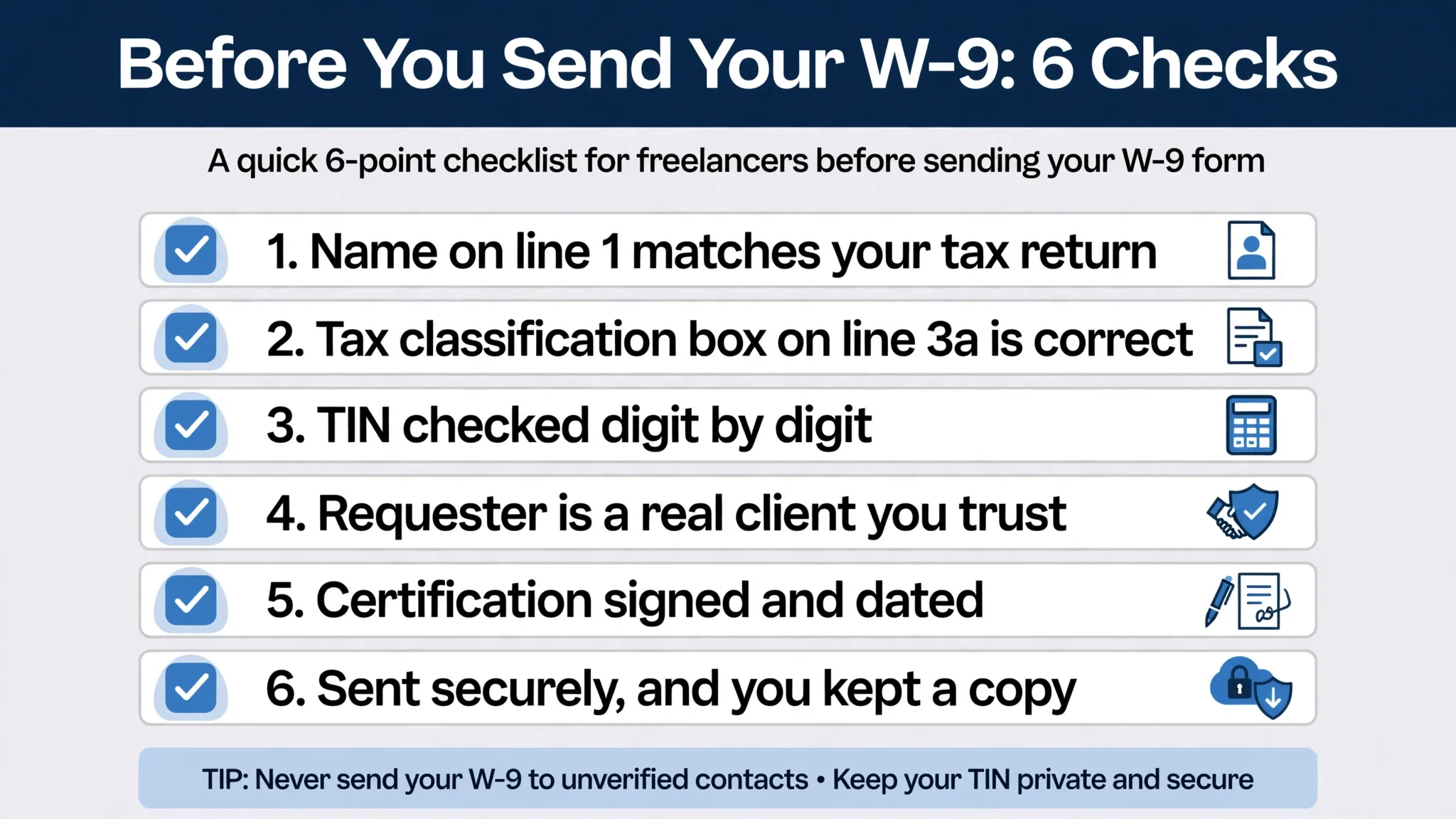
Run that list on every W-9, even when the client is familiar and the job is small. The forms that cause trouble are rarely the ones for strangers. They are the ones for regular clients, sent in a hurry, with a digit wrong or a signature missing, and discovered months later when the 1099-NEC does not match.
Frequently Asked Questions
What is a W-9 form?
A W-9 is a one-page IRS form, officially called Request for Taxpayer Identification Number and Certification. You fill it out with your name, address, and taxpayer identification number, sign it under penalties of perjury, and give it to the client or business that pays you, so the client can report your payments on Form 1099-NEC. You do not send it to the IRS.
Do freelancers need to fill out a W-9?
Yes, in practice almost every freelancer will be asked for one. Any client that pays you for services can ask for a W-9, and most clients ask before the first payment. You are not legally required to hand one over to a stranger, but refusing a real client’s request usually means the client will hold back 24 percent of your payments as backup withholding, or will not hire you at all.
How do I fill out a W-9 as a freelancer?
Put your legal name on line 1, your business name if any on line 2, check your federal tax classification on line 3a, enter your address on lines 5 and 6, put your SSN or EIN in Part I, then read the certification in Part II, sign it, and date it. Sole proprietors usually check the Individual/sole proprietor box, and an LLC taxed as a corporation or partnership checks the LLC box and enters the right letter on line 3b.
Should I put my SSN or EIN on a W-9?
Either one works if it is the right TIN for you. An EIN keeps your SSN off client paperwork, which is the main reason freelancers get one, and my EIN guide explains how to apply. If you do not have an EIN, your SSN is the correct number to use. Never leave the TIN blank, and never invent a number.
Do I send my W-9 to the IRS?
No. The completed W-9 goes to the requester, the client or business that asked for it. The requester keeps it on file and uses it to prepare your Form 1099-NEC. The IRS may ask the requester for the form later during an audit, but you never file a W-9 with the IRS yourself.
What happens if I do not fill out a W-9?
The client must apply backup withholding and hold back 24 percent of your payments, sending that money to the IRS. You also risk a 50 dollar penalty for each failure to furnish your correct TIN. The withheld money is not lost: it appears on your 1099-NEC as federal income tax withheld, and you claim it on your tax return. But it is missing from your cash flow until then.
What is backup withholding?
Backup withholding is a flat 24 percent withholding that applies to reportable payments when the payer does not have your correct TIN, when the IRS has notified the payer that your TIN is incorrect, or when you fail to certify that you are not subject to backup withholding for underreporting interest and dividend income. It covers payments for work done as an independent contractor. You stop it by giving the payer a correct, signed W-9.
What is the difference between a W-9 and a W-4?
A W-4 is the form an employee completes for an employer, so the employer can withhold tax from each paycheck, and the wages are reported on Form W-2. A W-9 is the form a freelancer or other non-employee completes for a client, no tax is withheld from the payments in the normal case, and the income is reported on Form 1099-NEC. A W-4 belongs to a job. A W-9 belongs to a client relationship.
Does a W-9 expire?
A W-9 has no set expiry date. It stays valid until something on it changes. Give the client a new one whenever your name changes, your TIN changes, your address changes, or your business structure changes, for example when a sole proprietorship becomes an LLC taxed as a corporation.
What if I am not a US person? Do I still fill out a W-9?
No. A foreign person may not provide a Form W-9. Non-U.S. freelancers use a form in the W-8 series instead, usually Form W-8BEN for an individual. If a client sends you a W-9 and you are not a U.S. person, ask for the right W-8 form instead of completing the W-9.
Sources
- IRS, About Form W-9, Request for Taxpayer Identification Number and Certification (current revision March 2024): https://www.irs.gov/forms-pubs/about-form-w-9
- IRS, Form W-9 (PDF, Rev. March 2024), including the Penalties section: https://www.irs.gov/pub/irs-pdf/fw9.pdf
- IRS, Instructions for the Requester of Form W-9 (March 2024): https://www.irs.gov/instructions/iw9
- IRS, Topic No. 307, Backup Withholding: https://www.irs.gov/taxtopics/tc307
- IRS, Instructions for Forms 1099-MISC and 1099-NEC (December 2026), 1099-NEC reporting threshold of 2,000 dollars for 2026 payments: https://www.irs.gov/instructions/i1099mec
Freelance income also brings deductions that can lower the tax you owe once the W-9 is filed and the 1099-NEC arrives, and my guide to self-employment tax deductions for freelancers walks through the fifteen I check every year. And when a client asks for a W-9, the amount on the invoice is the amount the 24 percent would be taken from, so pricing the work right matters too, and the freelance hourly rate calculator helps you set a rate that holds up after tax.
I am not a lawyer, and this post is general information, not legal advice. If a project is worth a meaningful amount of money, or a dispute has already started, talk to a licensed attorney in your state before you act.
