


Introduction
As a freelancer in the United States, you will meet seven tax forms: the W-9, the 1099-NEC, the 1099-MISC, the 1099-K, Schedule C, Schedule SE, and Form 1040-ES, all feeding into your Form 1040 tax return. You give one of them to your clients, you receive three of them from clients and payment platforms, and you file the rest yourself with your annual return. That is the whole map, and this guide is the map. If you only need the short version, it is this: give every new client a W-9, keep your own income records, check every 1099 that arrives against those records, report all of your income on Schedule C whether or not a form arrived, and pay estimated tax four times a year with Form 1040-ES.
I am writing this as a freelancer who once found the pile of forms confusing, because nobody hands you a list when you start freelancing. An employee gets a W-2 and a W-4 and the employer handles the rest. A freelancer gets a different form at every step of the year, from different people, with different deadlines, and the forms use names that sound almost the same. The 1099-NEC and the 1099-MISC look like twins until you learn what each one reports. The W-9 looks like a tax return until you learn it is not one. This guide sorts them out, one form at a time, with the current thresholds and deadlines verified on irs.gov on the day I wrote it, and with links to the deep guides on this site for the forms that deserve a full article of their own.
This post is the hub. It does not repeat the deep guides. My W-9 guide for freelancers walks through the W-9 line by line. My 1099-NEC guide for freelancers reads the form box by box from the recipient’s side. My quarterly estimated taxes guide walks the Form 1040-ES worksheet step by step with a worked example. What this post does is put all seven forms in one place, so you can see which ones apply to you, when each one is due, and what to do with each one when it arrives.
The Freelance Tax Forms Map at a Glance
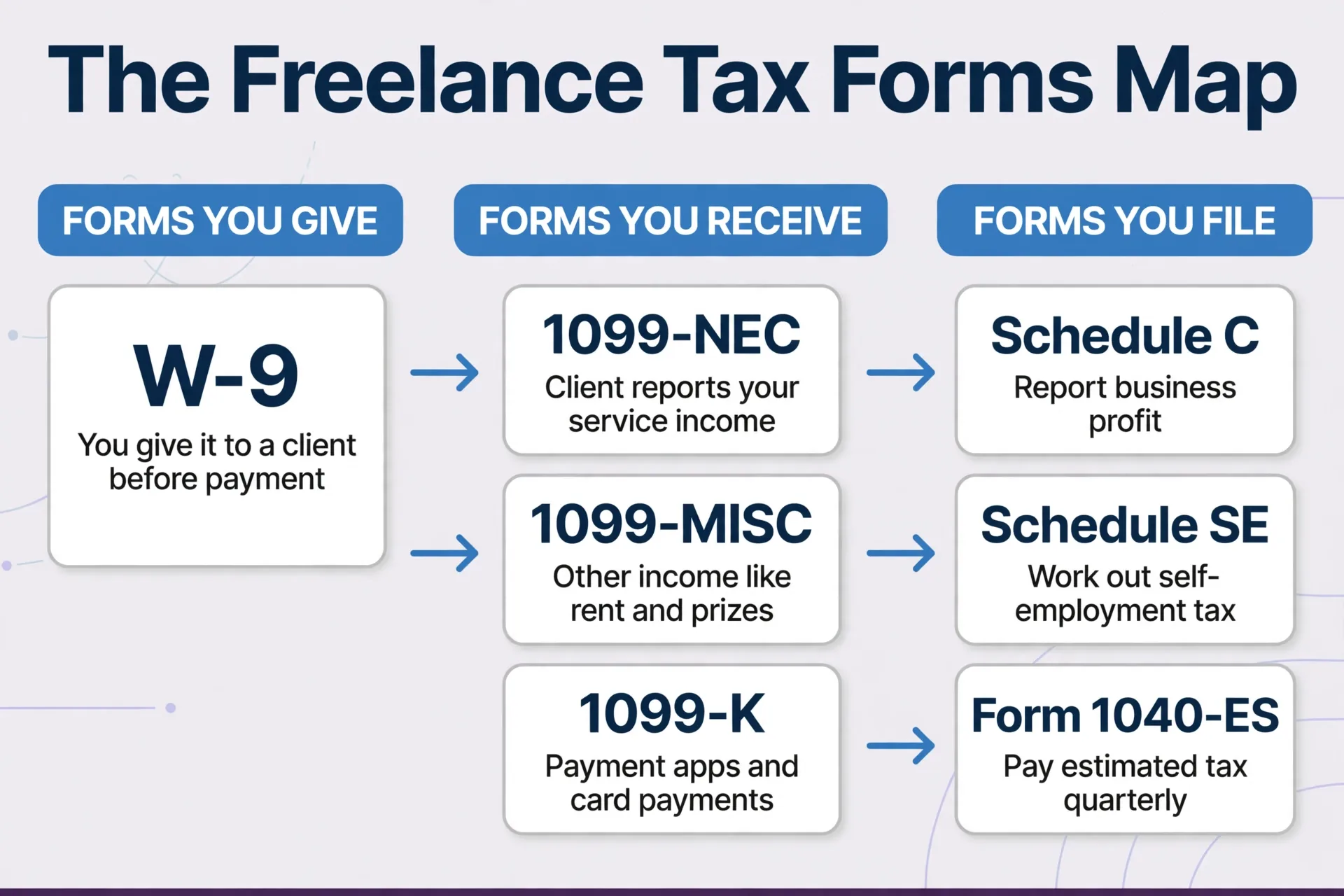
The simplest way to understand the forms is to sort them by who handles them. There are only three groups, and every form belongs to one of them.
| Group | Forms | Who handles them |
|---|---|---|
| Forms you give | Form W-9 | You complete it and give it to a client or other requester when asked |
| Forms you receive | Form 1099-NEC, Form 1099-MISC, Form 1099-K | A client, payer or payment platform sends them to you and to the IRS |
| Forms you file | Schedule C, Schedule SE, Form 1040-ES, Form 1040 | You complete them and file them with your tax return |
Notice what is not in the table: the W-2. A W-2 is the form an employer gives an employee, reporting wages and the tax withheld from each paycheck. As a freelancer you do not get a W-2 for freelance work, because nobody withholds tax from a freelance payment. If you also hold a part-time job, you will get a W-2 for that job, and your freelance work will still have its own forms and its own records. A W-2 label and a 1099 label do not by themselves settle whether someone is an employee or an independent contractor. That question turns on the facts of the working relationship, and the IRS has its own guidance on worker classification if you ever need it.
The other thing to notice is the direction the forms travel. The W-9 flows from you to the client. The 1099 forms flow from the client or the platform back to you, and to the IRS at the same time. Schedule C, Schedule SE and Form 1040 flow from you to the IRS. Once you see that flow, the forms stop looking like a random pile and start looking like a system: your details go out, the income reports come back, and your return ties them together.
Form W-9: The Form You Give Your Clients
Form W-9 is the first tax form most freelancers ever meet, and it is the simplest one in this guide. Its full name is Request for Taxpayer Identification Number and Certification. When a client hires you, the client may ask you to complete a W-9 before the first payment. You write your legal name, your business name if it is different, your entity type, your address, and your taxpayer identification number, which for most solo freelancers is a Social Security number, and you sign it under penalties of perjury. Then you give it back to the client. The client keeps it on file and uses it to prepare your Form 1099 at the end of the year.
Two facts about the W-9 surprise new freelancers. First, you do not send it to the IRS. The completed form goes to the requester, the client or business that asked for it, and the IRS only sees it later if there is an audit. Second, it is not a tax return and it does not report any income. It only tells the payer who you are for tax purposes, so the payer can report what it paid you. If you are not a United States person, you do not use a W-9 at all. Non-United States persons use a form in the W-8 series instead.
The current revision of the form is dated March 2024, and there is no separate 2025 or 2026 form. If a client refuses to pay until you hand over a W-9, that is normal, and it is not a sign of trouble. The client needs your taxpayer identification number to file its own paperwork, and it cannot file an accurate 1099 without it. The one thing to take seriously is the number itself. If you do not give the payer your correct taxpayer identification number, or if the IRS tells the payer your number is incorrect, the payer may have to withhold tax from your payments at a flat rate of 24 percent. That is called backup withholding, and it is verified on the IRS Topic No. 307 page. Giving the correct number, and giving it early, is what keeps the full payment coming to you.
There is also a safety point worth knowing. Your Social Security number is sensitive, so send the W-9 through a secure channel, not an open email thread, and give it only to a client you have actually agreed to work with. If you have an employer identification number, you can use that instead of your Social Security number, which keeps your personal number off client paperwork. My W-9 guide for freelancers walks through the form line by line for a sole proprietor and for LLC, S corporation and partnership freelancers, explains the penalties for a wrong number, and ends with a before-you-send checklist. Read it before you send your first W-9.
Form 1099-NEC: The Form That Reports Your Service Income
Form 1099-NEC is the form most freelancers wait for in January. Its full name is Nonemployee Compensation, and it is the form a business client uses to report what it paid you for services during the year. The client files one copy with the IRS and sends you a copy, and the amount on it is the amount the client reported. For you, the form is a record to check, not a form to fill out. You do not file a 1099-NEC yourself. Your client does.
The threshold for this form changed recently, and most guides on the internet still state the old figure, so read this paragraph carefully. For payments made in 2025 and earlier, a client had to report payments of $600 or more. For payments made on or after 1 January 2026, the threshold is $2,000. That change comes from section 70433 of the One Big Beautiful Bill Act, and I verified it on irs.gov on the day I wrote this guide, in the Instructions for Forms 1099-MISC and 1099-NEC dated December 2026, which say to file Form 1099-NEC for each person to whom you have paid at least $2,000 for services. The $2,000 figure may be adjusted for inflation beginning in calendar year 2027, according to the same instructions. The practical meaning for you is simple: a client who paid you $1,500 for work in 2026 does not have to send you a 1099-NEC, but you still owe tax on that $1,500. The threshold decides whether a form is sent. It never decides whether income is taxable.
The deadline matters too. The client must furnish your copy and file with the IRS by 31 January. In 2027, 31 January is a Sunday, so the deadline moves to the next business day, Monday 1 February 2027. If a 1099-NEC arrives and the amount is wrong, do not change the form yourself. Ask the client to issue a corrected form, and if the correction cannot be made before you file, report the income you actually received and keep your invoices and bank records as proof. My 1099-NEC guide for freelancers reads the form box by box, gives the January workflow for collecting and reconciling every 1099, and covers the missing-form and wrong-amount steps in full. That is the guide to read in January.
Form 1099-MISC: The Form for Other Kinds of Income
Form 1099-MISC is the form freelancers meet less often, and it causes confusion exactly because it looks like the 1099-NEC. Its full name is Miscellaneous Information, and it reports kinds of income that are not payment for your services. Before 2020, nonemployee compensation was reported in box 7 of the 1099-MISC. In 2020 the IRS split the forms, moving service payments to the 1099-NEC and leaving the 1099-MISC for everything else. The two forms were split, not replaced, and the 1099-MISC still exists.
For a freelancer, the 1099-MISC usually shows up for one of a short list of payments. The thresholds for 2026 payments, verified in the same IRS instructions I used for the 1099-NEC, are: at least $10 in royalties, at least $600 in gross proceeds paid to an attorney, and at least $2,000 in rents, prizes and awards, other income payments, medical and health care payments, crop insurance proceeds, section 409A deferrals, or nonqualified deferred compensation. A 1099-MISC must also be filed for any person from whom federal income tax was withheld under the backup withholding rules, regardless of the amount. Attorneys’ fees of $2,000 or more are reportable in box 1a of Form 1099-NEC, even when paid to a corporation, while gross proceeds paid to an attorney of $600 or more go in box 10 of the 1099-MISC.
What does that mean in practice? If a client pays you rent for using your studio space, that is a 1099-MISC payment. If you win a prize or an award, that is a 1099-MISC payment. If a client pays you for your services, that is a 1099-NEC payment, not a 1099-MISC payment, and if a client sends you the wrong form, ask for a corrected one. The box matters because the IRS uses the box to decide how the payment should be reported, so check the box and the type of payment rather than assuming any 1099 is freelance service income.
Form 1099-K: The Form From Payment Apps and Card Processors
Form 1099-K is the form that arrives from payment apps, online marketplaces and card processors, and it is the form whose threshold has changed the most often, which is why so many guides get it wrong. Its full name is Payment Card and Third Party Network Transactions. It reports payments you received for goods or services through a payment card or through a third party settlement organization, which is the IRS term for a payment app or an online marketplace.
The current rule, verified on the IRS “Understanding your Form 1099-K” page on the day I wrote this guide, is this: a payment app or online marketplace must send you a Form 1099-K when the payments you received for goods or services total over $20,000 in more than 200 transactions. Both tests must be met, in the same calendar year, on the same platform. The One Big Beautiful Bill Act, signed on 4 July 2025, retroactively reinstated this rule, which is the rule that applied before the American Rescue Plan Act of 2021. The IRS confirmed it in news release IR-2025-107 and in Fact Sheet 2025-08, both dated 23 October 2025. The lower thresholds you may have read about, $5,000 for 2024, $2,500 for 2025, and $600 for 2026, were planned steps that were repealed before they applied. Do not plan around them.
There are three exceptions worth knowing. First, direct card payments have no threshold at all. If a client pays you directly by credit, debit or gift card, your payment card processor reports those payments on a Form 1099-K no matter how small the total. Second, a platform may send you a Form 1099-K below the threshold if it chooses to, so receiving one does not mean you crossed $20,000. Third, a few states have lower state thresholds for the 1099-K, so you may receive a state form even when no federal form is due. I am not listing state figures here, because I did not verify them today, but check your state tax agency if a form arrives that you did not expect.
One more point, and it is the most important one on this form. A 1099-K reports the gross amount of payments, before fees, refunds and chargebacks. The gross amount is not your taxable profit. Reconcile the form against your own records, subtract your fees and refunds, and report your real income on Schedule C. And if you use several platforms, you may receive more than one Form 1099-K, one from each platform, covering different payments. Add them together with your direct client income and your cash income, and do not count the same payment twice if it also appears on a 1099-NEC.
Schedule C: Where Your Business Profit Is Worked Out
Schedule C is where the real tax work happens for most freelancers. Its full name is Profit or Loss From Business, and it is the schedule a sole proprietor attaches to Form 1040. On it, you add up all of your business income, subtract all of your deductible business expenses, and arrive at your net profit or loss. That one number is the most important figure in your whole return, because it flows in two directions: it flows to your Form 1040 as income, and it flows to Schedule SE to work out your self-employment tax.
Schedule C is organized into parts: income, expenses, cost of goods sold if you sell products, vehicle information, and other business details. The income part is where your 1099s land, but it is not limited to them. Every dollar you earned from freelancing goes here, including payments below the 1099 thresholds, cash payments, and payments from clients who never sent a form at all. The expenses part is where deductions live: software, equipment, internet, travel, marketing, and the rest. Every dollar of legitimate business deduction lowers your net profit, which lowers both your income tax and your self-employment tax, which is why my guide to self-employment tax deductions for freelancers belongs next to this one.
You must file Schedule C if your net earnings from self-employment are $400 or more, which is the same $400 rule that decides whether self-employment tax applies at all. If you are a single-member LLC, you generally file Schedule C too, unless you have elected to be taxed as a corporation. If your business is a partnership or a corporation, you do not use Schedule C. Those entities file their own returns.
Schedule SE: Where Self-Employment Tax Is Worked Out
Schedule SE is the schedule that works out your self-employment tax, the tax that covers Social Security and Medicare for people who work for themselves. Employees pay this tax through payroll withholding, split with their employer. Freelancers pay the whole thing themselves, which is why it surprises so many new freelancers. The rate is 15.3 percent: 12.4 percent for Social Security plus 2.9 percent for Medicare.
The calculation starts with your Schedule C net profit, and it is figured on 92.35 percent of that profit, not on the full figure. The IRS applies self-employment tax once your net earnings from self-employment reach $400, and the tax is worked out on Schedule SE. So a freelancer with $60,000 of net profit does not pay self-employment tax on the full $60,000. The tax is figured on 92.35 percent of it, which is $55,410, and 15.3 percent of that is about $8,478. The Social Security part applies only up to the wage base, which the IRS sets at $184,500 for 2026. Above that figure, only the 2.9 percent Medicare part applies, plus an additional 0.9 percent Medicare tax above $200,000 for a single filer. These figures are verified on the IRS self-employment tax page.
There is one more detail that softens the blow. You may deduct one half of your self-employment tax when working out your taxable income, which is an adjustment on your return, not a deduction on Schedule C. It does not remove the tax, but it does reduce the income tax on top of it. The full mechanics, including the set-aside percentage that covers both taxes together, are in my freelance taxes for beginners guide, which is the pillar post this hub supports.
Form 1040-ES: Paying Tax During the Year
Form 1040-ES is the form for estimated tax, and it exists because nobody withholds tax from a freelance payment. Employees pay tax as they earn, because the employer withholds it. Freelancers pay as they earn too, but they do it themselves, in four payments a year, using Form 1040-ES. The form includes a worksheet that walks you through the calculation: expected income, minus deductions including one half of self-employment tax, gives taxable income; the income tax on that figure, plus self-employment tax from Schedule SE, minus withholding and refundable credits, gives your total estimated tax for the year.
The rule for who must pay is simple to state. Individuals generally must pay estimated tax if they expect to owe $1,000 or more in tax when they file their return. That is a forecast, not a fact about the past, and it is verified on the IRS estimated taxes page. There is also an exemption that helps many first-year freelancers: you do not have to pay estimated tax for the current year if all three of these hold, you had no tax liability for the prior year, you were a United States citizen or resident alien for the whole year, and your prior tax year covered 12 months. All three must hold at the same time.
The due dates for 2026 are 15 April 2026, 15 June 2026, 15 September 2026, and 15 January 2027, verified in the 2026 Form 1040-ES itself. For 2027, the payments follow the same statutory pattern, 15 April, 15 June, 15 September, and 15 January, and a date that falls on a weekend or a federal holiday moves to the next business day. The 2027 Form 1040-ES is not yet released, so confirm the 2027 dates against it when it appears. You can pay through your IRS online account, through IRS Direct Pay, through the IRS2Go app, by phone, or by mail with the Form 1040-ES payment voucher. And there is a safe harbor rule that protects you from the underpayment penalty: you are safe if you owe less than $1,000 after withholding and credits, or if you paid at least 90 percent of the tax for the current year, or 100 percent of the tax shown on your prior-year return, whichever of the last two is smaller. If your prior-year adjusted gross income was over $150,000, the prior-year figure is 110 percent, according to Form 1040-ES. My quarterly estimated taxes guide explains all of this in depth, with a worked example and the first-year situations. Read it before your first quarterly payment.
Form 1040: The Return Everything Feeds Into
Form 1040 is the annual individual income tax return, and it is the form everything else in this guide feeds into. Schedule C attaches to it, Schedule SE attaches to it, and the estimated tax payments you made with Form 1040-ES are credited on it. The return for the 2026 tax year is due 15 April 2027, a Thursday, which is the usual filing deadline. If you need more time, you can request an extension to file, but an extension to file is not an extension to pay. The tax itself is still due on 15 April 2027.
Thinking of Form 1040 as the last step helps the whole map make sense. The year starts with the W-9 going out to clients. During the year, income arrives, some of it reported on 1099 forms and some of it not, and estimated tax goes out four times with Form 1040-ES. In January, the 1099 forms arrive. In April, Schedule C turns your income and expenses into a net profit, Schedule SE turns that profit into self-employment tax, and Form 1040 pulls it all together into one return. Every form in this guide has its place in that order, and no form is a substitute for another.
The Freelance Tax Calendar: Every Deadline in One Table

Deadlines are the part of freelance tax that causes the most stress, because each form has its own date and the dates do not line up. This table puts them together. Put the dates that are still ahead into your calendar now, with a reminder a week before each one.
| Date | Form | What happens |
|---|---|---|
| 15 January 2027 | Form 1040-ES | Fourth quarterly payment for 2026 |
| 1 February 2027 | 1099-NEC and 1099-K | Clients and platforms send your forms |
| 15 April 2027 | Form 1040 | File your 2026 tax return |
| 15 April 2027 | Form 1040-ES | First quarterly payment for 2027 |
| 15 June 2027 | Form 1040-ES | Second quarterly payment for 2027 |
Two dates in that table deserve a second look. First, 1 February 2027 is a Monday, not the usual 31 January, because 31 January 2027 is a Sunday and the deadline moves to the next business day. The same shift applies to the 1099-K, which platforms must also send by 31 January. Second, 15 April 2027 is doing double duty: it is both the day your 2026 return is due and the day your first 2027 quarterly payment is due. That is normal, and it is the reason April feels expensive for freelancers. The return settles last year, and the quarterly payment starts this year, on the same day.
There is one more date worth knowing. The 15 January 2027 quarterly payment is not required if you file your 2026 return by 1 February 2027 and pay the full balance due with the return, according to Form 1040-ES. The usual filing deadline for this rule is 31 January, but 31 January 2027 is a Sunday, so the deadline moves to Monday 1 February 2027. That gives early filers a real choice: file in January, pay the full balance, and skip the separate January estimated payment, or make the January payment and file later in the spring. If you plan to use the rule, put both dates in your calendar now, so the choice is deliberate.
Which Forms Apply to You? A Checklist
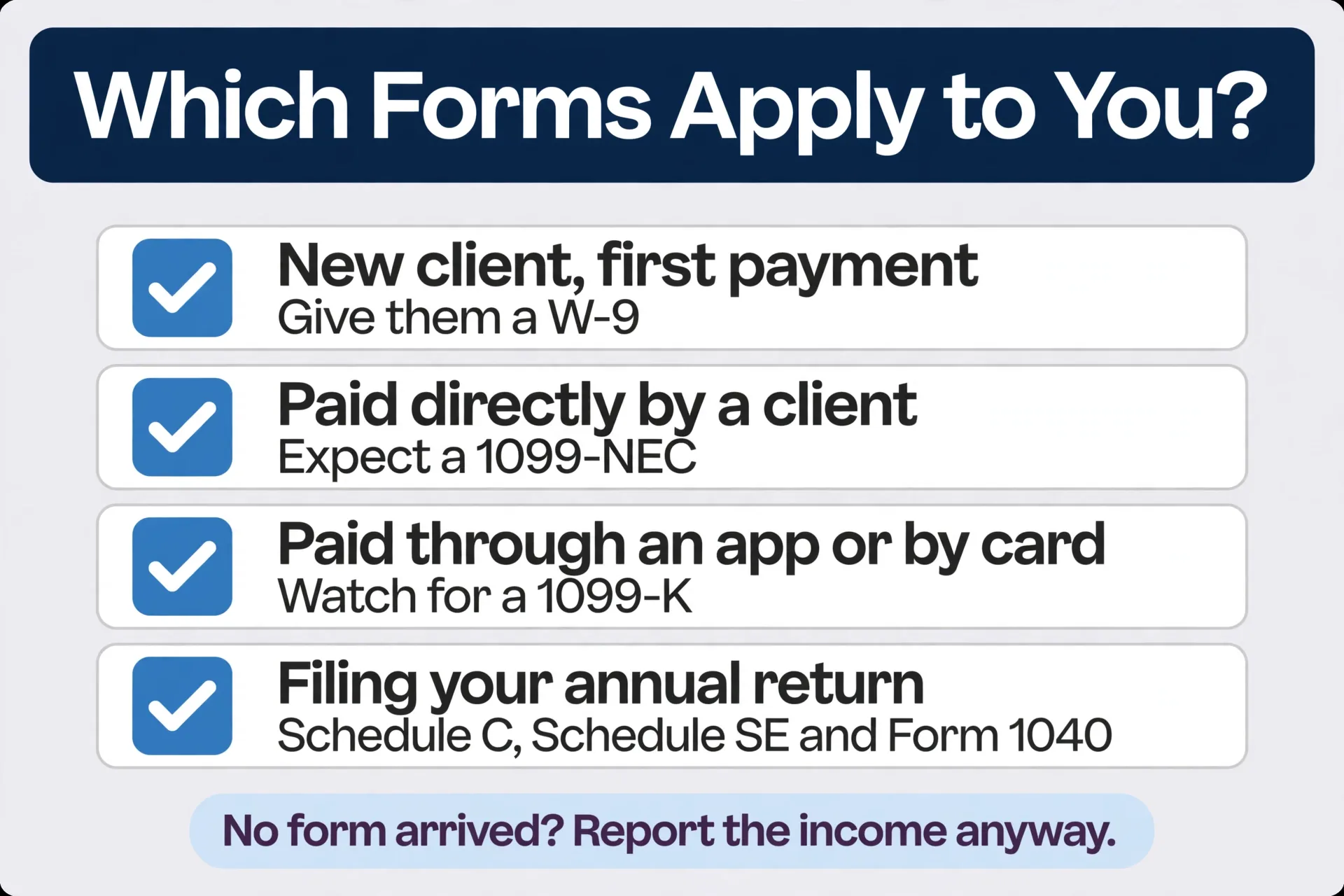
Not every freelancer meets every form. Which ones apply to you depends on how you are paid and how your business is set up. Work through these four situations and tick the ones that describe you.
- New client, first payment. Give them a W-9. If the client does not ask for one, offer it anyway, because the client will need it in January.
- Paid directly by a client. Expect a 1099-NEC if the client paid you $2,000 or more for services in 2026. Below that figure, no form is due, but the income is still taxable.
- Paid through an app or by card. Watch for a 1099-K. The platform must send one only if you received over $20,000 in more than 200 transactions on that platform, but direct card payments are reported no matter how small, and a platform may send a form below the threshold.
- Filing your annual return. Schedule C, Schedule SE and Form 1040, plus Form 1040-ES during the year. If you also had a W-2 job, that income goes on the same return.
Two more situations cover the edge cases. If you received rent, a prize, an award, or a royalty, watch for a 1099-MISC instead of a 1099-NEC. If you are not a United States person, you do not use a W-9 at all, and your client will ask for a form in the W-8 series instead. And if you are a freelancer with a business that is taxed as a corporation, the rules change: corporations generally do not receive a 1099-NEC for services, with attorneys’ fees as the main exception, and you do not file a Schedule C. Check the IRS instructions for your entity type before assuming the sole proprietor rules apply to you.
How the Forms Flow Together: One Freelancer, One Year
The forms make more sense when you watch them move through a real year. Take a freelance designer, filing as a sole proprietor, who earns $48,000 in 2026. She is paid $30,000 directly by clients, $12,000 through a freelance marketplace, and $6,000 by card payments from small clients. Her business expenses for the year come to $8,000.
In January, she gives a W-9 to every new client before the first payment. During the year, she makes four estimated tax payments with Form 1040-ES, on 15 April, 15 June, 15 September 2026, and 15 January 2027. In late January 2027, the forms arrive: 1099-NEC forms from the clients who paid her $2,000 or more directly, and a 1099-K from the marketplace and from her card processor. The marketplace payments total $12,000, which is below the $20,000 threshold, so no 1099-K is due from the marketplace, but the card processor reports the $6,000 in card payments anyway, because card payments have no threshold. She reconciles every form against her own income log, and the total she can account for is $48,000.
At filing time, she reports all $48,000 on Schedule C, subtracts her $8,000 of expenses, and arrives at a net profit of $40,000. Schedule SE works out her self-employment tax on 92.35 percent of that profit, which is $36,940, and 15.3 percent of that is about $5,652. Form 1040 pulls the profit and the tax together, credits the estimated payments she already made, and tells her what she still owes or what she is owed back. No form in that chain is optional, and no form does the job of another. The W-9 started the chain, the 1099s checked it, Schedule C and Schedule SE calculated it, and Form 1040 settled it.
The lesson of that example is the habit that holds the whole system together: keep your own income log. Invoices, bank deposits, platform statements, and a simple spreadsheet of who paid you, how much, and how. The forms are useful, but your records are the source of truth, because the forms only cover the payments that crossed a threshold, and your records cover all of them.
What to Do If a Form Is Wrong, Missing, or Never Arrives
Forms go wrong more often than anyone admits. An amount is mistyped, a form goes to an old address, a client forgets to send one, or a platform reports a gross figure that includes a refund you already gave. The fix is a short process, and it works the same way for every 1099 form.
- Check your own records first. Compare the form against your invoices, your bank deposits, and your platform statements. Work out the exact figure you received, from that payer, in that tax year, before you contact anyone.
- Contact the payer or the issuer. Tell them the figure on the form, the figure in your records, and the difference. Ask for a corrected form, and ask when it will arrive.
- Do not change the form yourself. The IRS matches your return against the copy the payer filed. If you alter your copy, the two copies will disagree, and the IRS may send you a notice asking about the difference.
- Report the income you actually received. If a correction cannot be obtained before you file, report the income you actually received on Schedule C, keep your invoices, bank records and the correspondence as proof, and file on time. Do not wait for the correction to file.
- Keep the proof. Save the original form, the corrected form if one arrives, your invoices, and the messages with the payer, in one place, for the year. If the IRS ever asks, that folder is your answer.
If no form arrives at all, the process is shorter, and the answer is the same. A missing 1099 never means the income is not taxable. Report it from your own records, on Schedule C, and move on. The IRS says plainly that taxpayers must report income even when it is not reported on an information return form, and the Gig Economy Tax Center says the same for gig and freelance income. The form is a helper, not a permission slip.
Setting Money Aside: The Habit Behind the Forms
Every form in this guide is about a tax you owe, and the habit that makes all of them painless is the same one: set money aside the day it lands. Freelance income arrives untaxed, and a share of every payment already belongs to the tax authorities, a lesson I tell in full in my freelance taxes for beginners guide. The rule of thumb used by many tax guides is 25 to 30 percent of your freelance income, set aside the day each client payment lands, in a separate account used only for tax money. Your real rate depends on your total income, your filing status, and your deductions, so refigure it each quarter against a fresh estimate.
There is one more way to make the set-aside painless, and it has nothing to do with tax forms. Build it into your rate. If you know that 25 to 30 percent of every fee goes to tax, then a project priced at $1,000 is really a project that pays you $700 to $750 after tax. Price the work on that basis, not on the gross figure. My freelance hourly rate calculator helps you work out a rate that covers your costs and your tax share together, so the set-aside is already inside the price you quote instead of something you have to find afterwards.
Do You Need to Pay State Taxes Too?
Probably, if your state has an income tax. The federal system in this guide is only half the picture for most freelancers, because most states with an income tax run their own estimated tax system alongside it, with their own due dates, their own forms, and their own thresholds. A few states have no income tax at all. Check your state tax agency’s website for its estimated tax rules, its due dates, and its safe harbor figures, and set aside money for the state bill in the same separate account as the federal money. The state payment is usually smaller than the federal one, but it is a real bill, and it is easy to forget when all your attention is on the IRS dates. If you move states during the year, check both states, because the rules can change with the move.
Frequently Asked Questions
What tax forms do freelancers need?
As a freelancer in the United States, you need seven forms: the W-9, which you give to clients; the 1099-NEC, the 1099-MISC and the 1099-K, which clients and platforms send to you; and Schedule C, Schedule SE and Form 1040-ES, which you file yourself, all feeding into your Form 1040 tax return.
Do freelancers get a W-2 or a 1099?
Freelancers get a 1099, not a W-2, for freelance work. A W-2 is for employees, and it reports wages with tax withheld. A freelancer receives a 1099-NEC from a client for service payments, or a 1099-K from a payment app or card processor, and no tax is withheld from those payments. If you also hold a part-time job, you will get a W-2 for that job alongside your freelance 1099s.
What is a 1099-NEC for freelancers?
Form 1099-NEC reports nonemployee compensation, which is what a business client paid you for services during the year. The client files it with the IRS and sends you a copy. For payments made in 2026, the client must report payments of $2,000 or more. For payments made in 2025 and earlier, the threshold was $600. You do not file the form yourself, and you still owe tax on income below the threshold.
What is the difference between a 1099-NEC and a 1099-MISC?
Form 1099-NEC reports payments for services, while Form 1099-MISC reports other kinds of income such as rents, royalties, prizes and awards, and medical and health care payments. Before 2020, service payments were reported on the 1099-MISC. In 2020 the IRS split the forms, and service payments moved to the 1099-NEC. Check the box on the form you receive, because the IRS uses the box to decide how the payment should be reported.
What is the difference between a 1099-NEC and a 1099-K?
Form 1099-NEC reports payments made directly by a client for your services. Form 1099-K reports payments made through a payment card or a third party settlement organization, such as a payment app or an online marketplace. A payment app must send a 1099-K only when you received over $20,000 in more than 200 transactions on that platform, while direct card payments are reported no matter how small. You can receive both forms in the same year, covering different payments.
Do I need a W-9 as a freelancer?
Yes, if a client asks for one, and most business clients will. The W-9 gives the client your taxpayer identification number so the client can file an accurate 1099 for you. You complete it and give it to the client, not to the IRS. If you do not give the correct number, the client may have to withhold 24 percent of your payments as backup withholding.
What is Schedule C for freelancers?
Schedule C is Profit or Loss From Business, and it is where a sole proprietor reports all business income and subtracts all deductible business expenses to arrive at a net profit or loss. That net profit flows to your Form 1040 as income and to Schedule SE to work out your self-employment tax. You must file Schedule C if your net earnings from self-employment are $400 or more.
What is Schedule SE?
Schedule SE works out your self-employment tax, which is 15.3 percent, covering Social Security at 12.4 percent and Medicare at 2.9 percent. It is figured on 92.35 percent of your Schedule C net profit, once your net earnings from self-employment reach $400. The Social Security part applies only up to the wage base, which is $184,500 for 2026.
When are freelance taxes due?
Estimated tax is due four times a year with Form 1040-ES: 15 April, 15 June and 15 September 2026, and 15 January 2027 for the 2026 tax year. Your 1099 forms for 2026 payments arrive by Monday 1 February 2027, and your 2026 tax return on Form 1040 is due 15 April 2027. For 2027, the quarterly payments follow the same pattern of 15 April, 15 June, 15 September and 15 January.
Do I still have to pay tax if I never receive a 1099?
Yes. You must report all of your freelance income on your tax return, whether or not a 1099 arrives. A missing form never means the income is not taxable. The IRS says taxpayers must report income even when it is not reported on an information return form. Report the income from your own records on Schedule C, and keep your invoices and bank records as proof.
Sources
- Internal Revenue Service, Instructions for Forms 1099-MISC and 1099-NEC (12/2026): https://www.irs.gov/instructions/i1099mec
- Internal Revenue Service, Understanding your Form 1099-K: https://www.irs.gov/businesses/understanding-your-form-1099-k
- Internal Revenue Service, Form 1099-K FAQs: General information: https://www.irs.gov/newsroom/form-1099-k-faqs-general-information
- Internal Revenue Service, Estimated Taxes: https://www.irs.gov/businesses/small-businesses-self-employed/estimated-taxes
- Internal Revenue Service, Form 1040-ES, Estimated Tax for Individuals (2026): https://www.irs.gov/pub/irs-pdf/f1040es.pdf
- Internal Revenue Service, About Form W-9: https://www.irs.gov/forms-pubs/about-form-w-9
- Internal Revenue Service, Topic No. 307, Backup withholding: https://www.irs.gov/taxtopics/tc307
- Internal Revenue Service, Self-Employment Tax: https://www.irs.gov/businesses/small-businesses-self-employed/self-employment-tax-social-security-and-medicare-taxes
- Internal Revenue Service, Gig Economy Tax Center: https://www.irs.gov/businesses/gig-economy-tax-center
I am not a lawyer, and this post is general information, not legal advice. If a project is worth a meaningful amount of money, or a dispute has already started, talk to a licensed attorney in your state before you act.
