


Introduction
No, a first-year freelancer does not always owe quarterly estimated tax. If you had no tax liability in the prior year, and you were a United States citizen or resident alien for the whole year, and your prior tax year covered 12 months, the IRS says you do not have to pay estimated tax for the current year. That three-part exemption is the single most useful fact in this guide, and it is the reason many people in their first year of freelancing can focus on finding clients instead of sending money to the IRS every few months. But the exemption is narrow. If any one of those three conditions fails, the ordinary rules apply, and you need a system for working out what you owe and paying it on time.
I am writing this as a freelancer who learned the quarterly system the hard way, by watching a good year of income turn into a stressful April. Nobody withholds tax from a freelance payment. No employer sends part of your fee to the IRS before the money reaches you. The full amount lands in your account, it feels like yours, and then the tax bill arrives later, all at once, with interest and a penalty if you waited too long. Quarterly estimated tax exists to stop that from happening. It spreads the bill across the year, in four payments, so April is a reckoning you have already prepared for instead of a surprise.
This guide is the practical companion to the tax basics I explain in my freelance taxes for beginners guide. That post covers the whole tax picture at overview level: what freelance tax is, the self-employment tax rate, the 400 dollar rule, the forms, and the deductions. This post goes deep on one thing only: the quarterly payment system. You will get the exact 2026 due dates with the income period each payment covers, the trap hidden in the uneven quarters, a step by step walk through the Form 1040-ES worksheet with a worked freelancer example, the safe harbor rule with real numbers, the three first-year situations, the annualized income method for lumpy freelance income, the IRS-confirmed ways to pay, and exactly what to do the day a payment is missed. If you are in your first year, start with the next section. If you already know you owe quarterly tax and only need the dates, the calendar table is a short scroll away.
New to freelance taxes overall? Start with our freelancer taxes for beginners guide, which covers self-employment tax, Schedule C and deductions alongside the quarterly system.
What Estimated Tax Is and Why Freelancers Pay It
The United States runs on a pay-as-you-go tax system. Employees pay as they go because their employer withholds income tax and payroll tax from every paycheck and sends it to the IRS. Freelancers have no employer and no withholding, so the IRS asks them to pay as they go in a different way: four estimated tax payments a year, made directly by the freelancer. Each payment covers the income earned in a period of the year, and each one is a down payment on the total tax bill for that year.
Estimated tax is not a separate tax. It is the same income tax and self-employment tax you would owe at filing time, paid in instalments during the year instead of in one lump sum in April. The two parts matter. The income tax part is the tax on your profit after deductions. The self-employment tax part is the 15.3 percent tax that covers Social Security and Medicare: 12.4 percent for Social Security plus 2.9 percent for Medicare. The IRS applies self-employment tax once your net earnings from self-employment reach 400 dollars, and it is figured on 92.35 percent of your net profit on Schedule SE. So a freelancer with 60,000 dollars of net profit does not pay self-employment tax on the full 60,000 dollars. The tax is figured on 92.35 percent of it, which is 55,410 dollars, and 15.3 percent of that is about 8,478 dollars. That figure will come back in the worked example later in this guide, because it is the part of the estimate that surprises first-year freelancers most.
Who has to pay? The IRS rule is simple to state. Individuals generally must pay estimated tax if they expect to owe 1,000 dollars or more in tax when they file their return. That is the threshold, verified on irs.gov. It is a forecast, not a fact about the past. You look ahead, add up the income tax and self-employment tax you expect to owe for the year, subtract any withholding and refundable credits, and if the result is 1,000 dollars or more, estimated payments are required. If you expect to owe less than 1,000 dollars, you can pay the balance when you file, though paying something during the year is still a good habit if your income is growing.
The reason the rule exists is cash flow, yours and the government’s. The government wants its revenue during the year, not in a single pile in April. You want the same thing, even if it does not feel that way when the money leaves your account. Four smaller payments are easier to absorb than one large bill, and paying on time protects you from the underpayment penalty, which the IRS computes as interest on the amount paid late, using Form 2210. I do not quote a penalty rate in this guide, because the rate changes over time and the secondary sources I checked disagreed with each other. What matters is the principle: late payments cost extra, and the cost is avoidable.
One more point before the dates. Estimated tax is a system you manage yourself, which means it rewards a small amount of routine. The freelancers who struggle with it are rarely the ones with the most complicated taxes. They are the ones with no routine: no set-aside account, no calendar reminder, no worksheet. The freelancers who handle it well are the ones who treat each payment like a bill with a fixed date and a figure worked out in advance. This guide gives you that routine.
Do First-Year Freelancers Have to Pay Quarterly Taxes?
This is the question that brings most first-year freelancers to this topic, and the answer is genuinely good news for many of them. The IRS says you do not have to pay estimated tax for the current year if all three of these conditions hold: you had no tax liability for the prior year, you were a United States citizen or resident alien for the whole year, and your prior tax year covered 12 months. No tax liability means your total tax was zero, or you did not have to file a return at all. All three conditions must hold at the same time. If even one fails, the exemption does not apply.
Think about what that means for a typical first-year freelancer. If last year you were a student with no income, or you worked only a short part-time job and owed no tax, and you meet the other two conditions, you probably do not owe estimated tax in your first freelance year. You still owe the tax itself at filing time, and you still need to set money aside for it, but the IRS will not penalize you for failing to make quarterly payments during that first year. That is a real breathing space, and it exists because the law recognizes that a person with no prior tax history has no prior-year figure to base an estimate on.
But the exemption is easy to lose by misunderstanding it. The three most common mistakes are worth naming plainly. First, having no tax liability is not the same as getting a refund. If you had tax withheld from a job last year and got it all back as a refund, your liability was still whatever the tax on your income worked out to be, and if that figure was more than zero, the exemption fails. Second, the prior year must have covered 12 months. If your first tax year as a resident was shorter than that, the exemption fails. Third, the exemption only covers the current year. In your second year of freelancing, you will have a prior-year tax figure, and the ordinary rules, including the safe harbor rules explained later in this guide, will apply in full.
There is also a practical warning that belongs here even though it is not a legal rule. Not having to pay quarterly tax is not the same as not owing tax. A first-year freelancer who spends every dollar of freelance income and then discovers a tax bill in April has not been helped by the exemption. They have only been given a later deadline for the same bill. My advice, and the habit I wish I had built in my first year, is to set money aside from every payment even in a year when quarterly payments are not required, so the April bill is already sitting in a separate account when it arrives. The set-aside system later in this guide works whether or not quarterly payments are required, and it is the single best protection a new freelancer has.
The 2026 Due Date Calendar
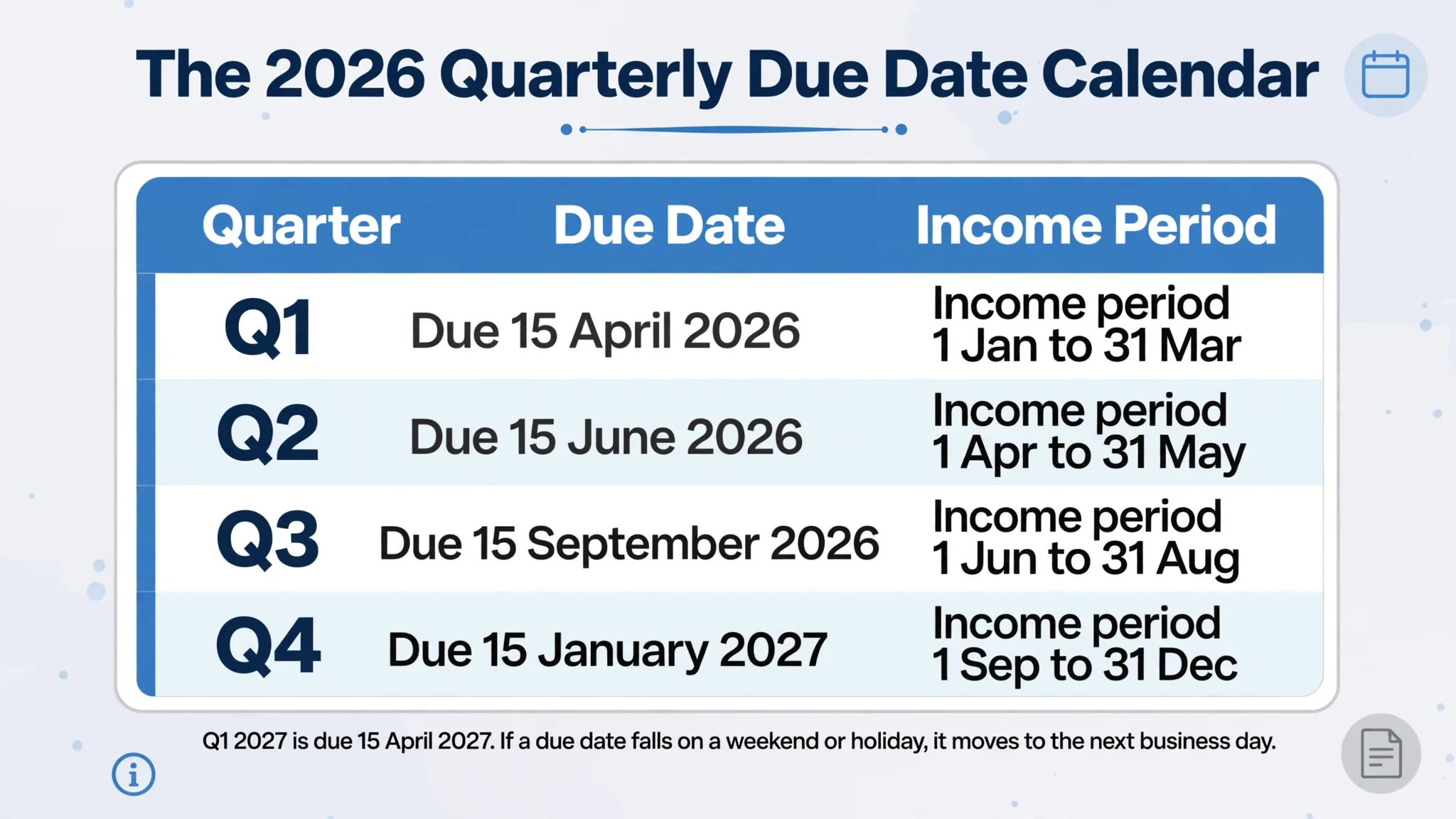
Quarterly estimated tax is due four times a year, and the dates are fixed by law: 15 April, 15 June, 15 September, and 15 January of the following year. For the 2026 tax year, the payments fall on 15 April 2026, 15 June 2026, 15 September 2026, and 15 January 2027. None of the 2026 dates falls on a weekend or a federal holiday, so none of them shifts. That is worth knowing, because in other years a due date that lands on a Saturday, Sunday, or federal holiday moves to the next business day. The 2026 calendar is clean, and you can put all four dates in your calendar now without checking for shifts.
| Payment | Due date | Income period it covers |
|---|---|---|
| First quarter | 15 April 2026 | 1 January to 31 March 2026 |
| Second quarter | 15 June 2026 | 1 April to 31 May 2026 |
| Third quarter | 15 September 2026 | 1 June to 31 August 2026 |
| Fourth quarter | 15 January 2027 | 1 September to 31 December 2026 |
The table above is the heart of this guide, and the income period column is the part most guides leave out. Each payment covers a specific slice of the year, and the slices are not equal. That inequality is the trap explained in the next section, and it is the reason a freelancer who simply divides the annual estimate by four and pays the same amount each quarter can still end up underpaid in the early part of the year.
If you are reading this guide in late November or December 2026, only one 2026 payment is still ahead of you: the fourth quarter payment, due 15 January 2027. That is the seasonal reason this guide exists now. If your freelance income grew during the year, or if you started freelancing partway through 2026 and have not made any estimated payments yet, the January payment is your chance to catch up before the filing season. Paying a larger fourth quarter payment does not erase an earlier shortfall entirely, because the penalty is figured quarter by quarter, but it reduces the balance you owe at filing and it reduces the interest that keeps building on the unpaid amount. It is always better to pay in January than to wait until April.
For 2027, the payments follow the same statutory pattern: 15 April, 15 June, 15 September, and 15 January. The 2027 Form 1040-ES is not yet released, so I am not printing a 2027 table as if it were already published by the IRS. Check the 2027 form when it appears and confirm the dates then, and remember that a date falling on a weekend or federal holiday moves to the next business day. The pattern is stable, but the confirmation step is worth doing every January.
The Uneven Quarters Trap
Here is the detail that catches even careful freelancers. The four income periods are not four equal quarters. The first payment covers three months, January through March. The second covers only two months, April and May. The third covers three months, June through August. The fourth covers four months, September through December. The June payment covers just 61 days of income, while the January payment covers 122 days. The quarters are uneven by design, because the law fixes the due dates and the income periods around them, and the result is a calendar that looks regular and behaves irregularly.
The trap works like this. Suppose you earn roughly the same amount every month. Your income for January through March is three months of earnings, and your April payment should reflect that. Your income for April and May is only two months of earnings, so your June payment should be smaller. Your income for September through December is four months of earnings, so your January payment should be the largest of the four. A freelancer who pays the same amount four times a year, dividing the annual estimate into four equal parts, will overpay in June and underpay in January, and the underpayment in the later quarters is the one that draws the penalty, because the IRS measures each quarter separately.
There are two ways to handle the trap. The simple way is to refigure your estimate before every payment instead of copying the last payment. Look at the income you actually earned in the period that just ended, work out the tax on it, and pay that amount. The more precise way, for income that arrives in lumps, is the annualized income installment method, explained later in this guide. Either way, the habit is the same: never copy last quarter’s payment without checking it against the income period it covers. My nearest-neighbour post, what freelancers owe and when they owe it, introduces the quarterly system and the set-aside idea at overview level. This guide is the deep version: the exact dates, the uneven periods, and the working method for each quarter.
A short example makes the point concrete. Imagine a freelancer who earns 5,000 dollars a month, every month, after expenses. The first quarter covers three months, so 15,000 dollars of income. The second quarter covers two months, so 10,000 dollars. The third covers three months, so 15,000 dollars again. The fourth covers four months, so 20,000 dollars. Four equal payments of the same amount would ignore that shape entirely. The right payments follow the shape of the income, and the worksheet in the next sections shows how to work them out.
How Much Should You Set Aside for Taxes?
The most common question I hear from new freelancers is not about due dates or forms. It is simpler than that: how much of each payment should I keep back for tax? The rule of thumb used by many tax guides, and by the New York City free tax preparation guide I read while researching this post, is 25 to 30 percent of your freelance income. Set aside a quarter to just under a third of every payment the day it lands, before you spend anything, and you will usually have enough to cover the income tax and the self-employment tax together. In a high-tax city, or if your income is high enough to push you into a higher bracket, 30 to 35 percent is the safer end of the range.
A percentage rule is a starting point, not a calculation. Your real rate depends on your total income, your filing status, your deductions, and whether you have other income with withholding. A freelancer earning 30,000 dollars a year will owe a smaller share than a freelancer earning 150,000 dollars a year, because the income tax part grows with income while the self-employment tax part stays at 15.3 percent on most of the profit. The 25 to 30 percent range is designed to cover the typical case, and it is far better than the two mistakes I see most often: setting aside nothing, and setting aside a fixed dollar amount that never changes when income changes.
The system that makes the percentage work is a separate account. Open a savings account that is used for nothing except tax money, and move the set-aside there the day a client pays you, not at the end of the month, and not when the quarterly payment is due. Money that sits in your spending account gets spent. Money that sits in a separate tax account gets paid to the IRS. I explain the separate-account habit in detail in my guide to a separate bank account for your freelance business, and the lesson there is the same one I keep coming back to in my beginners guide: setting money aside the day it lands is what keeps a good year from turning into a stressful April.
There is one more way to make the set-aside painless, and it has nothing to do with tax forms. Build it into your rate. If you know that 25 to 30 percent of every fee goes to tax, then a project priced at 1,000 dollars is really a project that pays you 700 to 750 dollars after tax. Price the work on that basis, not on the gross figure. My freelance hourly rate calculator helps you work out a rate that covers your costs and your tax share together, so the set-aside is already inside the price you quote instead of something you have to find afterwards. That is the tools-as-assets idea in practice: the calculator is not a gadget, it is part of the pricing that keeps the business solvent.
Finally, refigure the percentage at least twice a year. If your income jumps, the percentage that was right in January may be too low by September. If your deductions grow, because you bought equipment or took on larger business expenses, the percentage may be too high, and you are lending the government money interest-free. Check the set-aside against a fresh estimate each quarter, when you sit down to work out the payment anyway. The five minutes it takes are the cheapest tax planning a freelancer can do.
The Form 1040-ES Worksheet, Step by Step
Form 1040-ES is the IRS form for estimated tax. It is the tool the IRS provides for figuring out what you owe and paying it, and it includes a worksheet that walks you through the calculation in order. You do not need a tax professional to use it, and you do not need to understand every line of the tax code. You need your expected income for the year, your expected deductions, and the patience to work through the steps one at a time. The IRS says to refigure the estimate each quarter if your situation changes, and that advice is worth following: a worksheet done once in January and never revisited is a guess by June.
The worksheet follows a logical order. First, work out your expected total income for the year, including freelance profit, any wages, and any other income. Second, subtract your expected deductions, including the standard deduction or itemized deductions, and the deduction for one half of your self-employment tax, to reach your expected taxable income. Third, work out the income tax on that taxable income using the tax table or the tax computation worksheet in the form. Fourth, add your self-employment tax, figured on Schedule SE, and any other taxes you expect to owe. Fifth, subtract any withholding you expect from a job and any refundable credits. The result is your total estimated tax for the year. Divide it by four, and you have the quarterly amount, adjusted for the uneven income periods explained above.
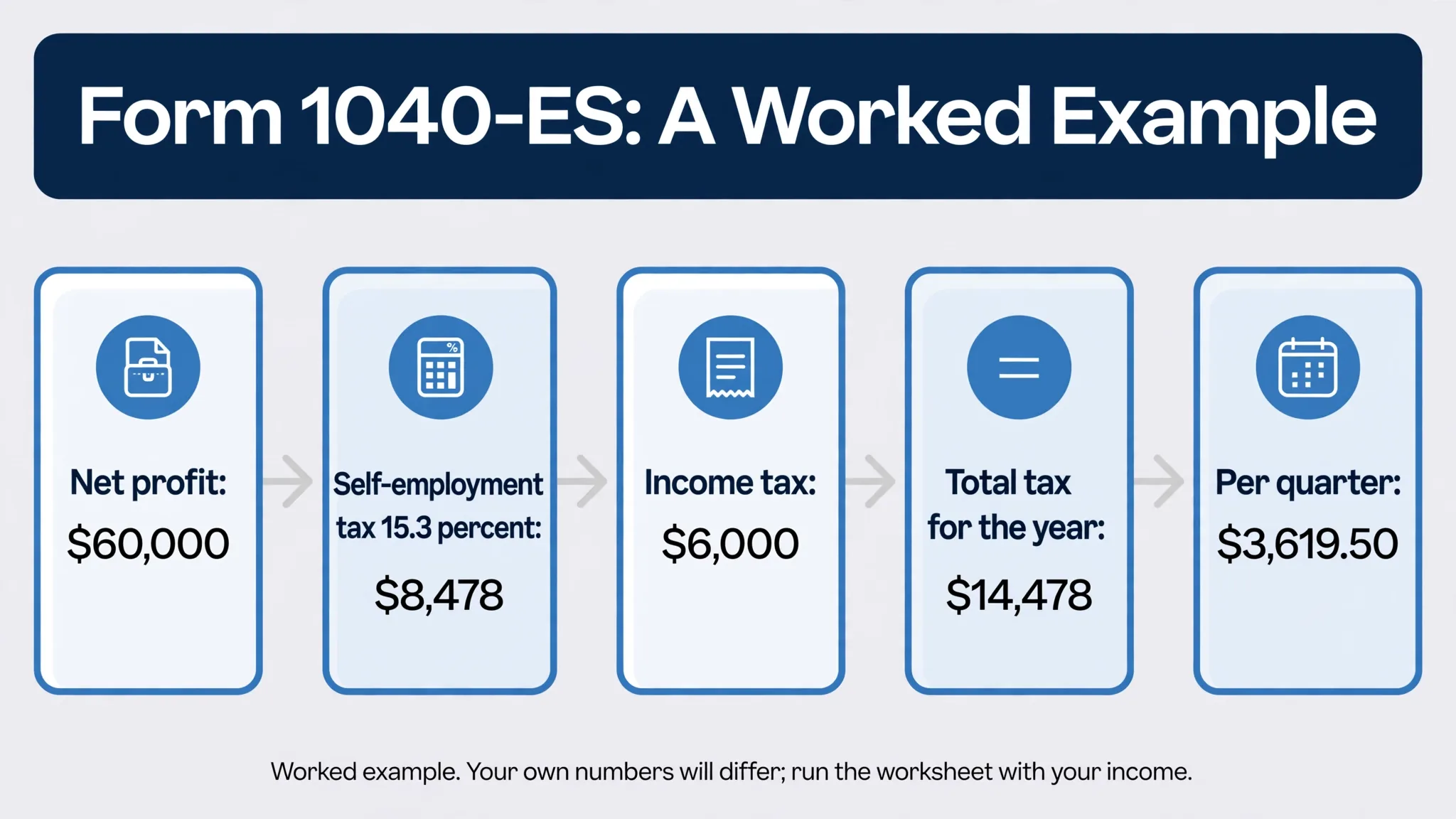
Here is a worked example, using one freelancer and following the worksheet in order. The figures are an illustration built on the verified rates in this guide, so you can see how the pieces fit together. Take a freelance writer, filing as a single person, who expects 60,000 dollars of net profit from freelancing in 2026, after business expenses, with no other income and no withholding. That net profit is her Schedule C profit, the starting point for everything else.
Step one, self-employment tax. Net earnings from self-employment are 92.35 percent of net profit, so 92.35 percent of 60,000 dollars is 55,410 dollars. Self-employment tax is 15.3 percent of that figure, which is 8,478 dollars. That is the Social Security and Medicare part, and it is the largest single piece of her estimate. Step two, the deduction for one half of self-employment tax. One half of 8,478 dollars is 4,239 dollars, and the worksheet subtracts that amount when working out taxable income, along with the standard deduction. Step three, income tax. After those deductions, her taxable income is worked out on the worksheet, and the income tax on it, using the tax table in the form, comes to 6,000 dollars in this illustration. The exact income tax figure will differ for every freelancer, because it depends on filing status and total taxable income, so treat the 6,000 dollars as her worksheet result, not as a rate you can copy.
Step four, total estimated tax. Add the income tax of 6,000 dollars to the self-employment tax of 8,478 dollars, and the total is 14,478 dollars for the year. Step five, subtract withholding and credits. She has none, so the total stays 14,478 dollars. Step six, the quarterly amount. Divide 14,478 dollars by four, and the result is 3,619 dollars and 50 cents per quarter, before adjusting for the uneven income periods. In a real year, she would not pay four identical amounts of 3,619 dollars and 50 cents. She would refigure each quarter against the income actually earned in that period, paying less for the two-month second quarter and more for the four-month fourth quarter, but the annual figure of 14,478 dollars is the anchor, and the quarterly average is the starting point for each adjustment.
Two things about that example deserve emphasis. First, the self-employment tax was more than half of the total bill, which is normal for a freelancer with no other income. Many first-year freelancers expect the income tax to dominate, and they are surprised to find that the 15.3 percent self-employment tax is the bigger piece. Second, deductions matter enormously to the estimate. Every dollar of legitimate business deduction lowers the net profit, which lowers both the income tax and the self-employment tax. That is why my guide to self-employment tax deductions for freelancers belongs next to this one: the 15 deductions in that guide are not just a list, they are the levers that bring the estimate down. Keep good records of every deductible expense, because the worksheet is only as accurate as the income and expense figures you feed into it.
The Safe Harbor Rule, With a Worked Example
Safe harbor is the rule that lets you know in advance that you will not face an underpayment penalty, even if your final tax bill turns out higher than you expected. The IRS gives you three ways to reach safe harbor, and meeting any one of them is enough. First, you owe less than 1,000 dollars after subtracting withholding and refundable credits. Second, you paid at least 90 percent of the tax for the current year. Third, you paid at least 100 percent of the tax shown on your prior-year return, whichever of the second and third figures is smaller. Those three routes are verified on irs.gov, and they are the most practical protection in the whole estimated tax system.
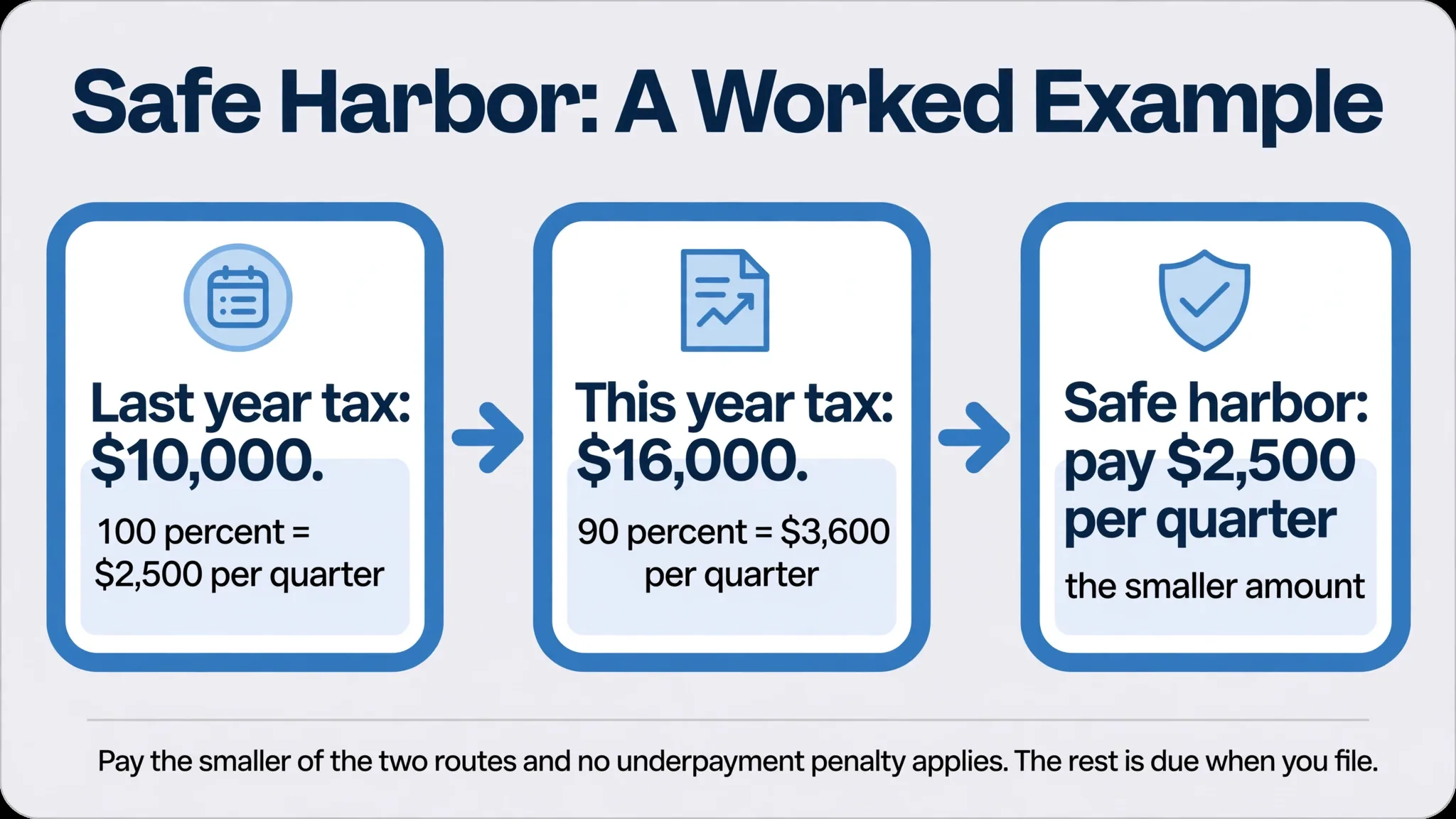
The third route, the prior-year rule, is the one most freelancers use, because it turns an uncertain forecast into a known number. If your tax last year was 10,000 dollars, then paying 10,000 dollars in estimated tax this year, in four instalments of 2,500 dollars, puts you in safe harbor even if your income doubles and your real tax bill comes to 16,000 dollars. You will still owe the extra 6,000 dollars when you file, and you will pay it then, but you will not owe an underpayment penalty on it, because you paid the full prior-year amount on time. The prior-year figure is a ceiling on the penalty risk, not on the tax itself, and that distinction is worth understanding clearly.
There is one important variation on the prior-year rule. If your prior-year adjusted gross income was over 150,000 dollars, the figure is 110 percent of the prior-year tax, not 100 percent, according to Form 1040-ES. So a freelancer whose prior-year tax was 20,000 dollars and whose prior-year adjusted gross income was over 150,000 dollars must pay 22,000 dollars during the year, or 5,500 dollars per quarter, to reach safe harbor through the prior-year route. The 110 percent figure is the Form 1040-ES figure, corroborated across the sources I checked, and it applies to the prior-year route only. It does not change the 90 percent current-year route.
Here is a worked example that compares the routes side by side. Take a freelancer whose prior-year tax was 10,000 dollars and whose current-year tax is expected to be 16,000 dollars. Under the 90 percent current-year route, safe harbor requires paying 90 percent of 16,000 dollars, which is 14,400 dollars, or 3,600 dollars per quarter. Under the 100 percent prior-year route, safe harbor requires paying 10,000 dollars, or 2,500 dollars per quarter. The smaller figure wins, so 2,500 dollars per quarter is enough for safe harbor, and she can pay that amount with confidence, knowing the remaining balance is due at filing but carries no underpayment penalty. If her income falls instead of rising, and her current-year tax turns out to be 9,000 dollars, the 90 percent route would have required only 8,100 dollars, which is less than the prior-year route, so the smaller figure would win in the other direction. The rule always lets you use whichever route costs less.
Safe harbor has limits worth knowing. It protects you from the underpayment penalty, but it does not reduce the tax you owe, and it does not excuse a payment made late. Each quarterly instalment must still arrive by its due date. Paying the full annual safe harbor amount in a single payment in December does not give you safe harbor for the earlier quarters, because the IRS measures each quarter separately. The protection also depends on the figures being right: if you rely on the prior-year route, use the tax actually shown on your prior-year return, not a rough memory of it. And remember the first-year exemption from the start of this guide: in a year when you had no prior-year liability at all, safe harbor is not the question, because no estimated tax is required in the first place.
Three First-Year Situations
First-year freelancers are not all in the same position, and the right approach depends on what last year looked like. The three situations below cover almost every case, and they come from the structure of the IRS rules, not from guesswork. Work out which one describes you, and the rest of the guide falls into place.
Situation one: you had no tax liability last year. This is the exemption case from the start of this guide. Last year your total tax was zero, or you did not have to file a return, you were a United States citizen or resident alien for the whole year, and your prior tax year covered 12 months. You do not have to pay estimated tax this year, and you will not face an underpayment penalty for not paying it. You still owe the tax on this year’s income when you file, so set money aside from every payment using the 25 to 30 percent rule, and keep records from the first client onward. This is the best first year a freelancer can have from a tax point of view, and the only mistake available is spending the set-aside money.
Situation two: you had a W-2 job last year. This is the most common first-year case. You worked as an employee last year, tax was withheld from your paychecks, and now you have gone freelance. The exemption does not apply, because you had a tax liability last year. But you do have a prior-year tax figure, and that means the safe harbor rule works for you from day one. Pay 100 percent of last year’s tax, in four quarterly instalments, and you are protected from the underpayment penalty even if your freelance income grows well beyond last year’s salary. If your prior-year adjusted gross income was over 150,000 dollars, use the 110 percent figure from Form 1040-ES instead. This is the simplest first year to manage, because the target is a known number printed on last year’s return, not a forecast.
Situation three: you did not file a return last year. This covers two different cases that behave the same way. Either you had no income and were not required to file, which is the exemption case in situation one, or you had income but did not file a return, which is a different problem entirely. If you were not required to file, the exemption applies, and you are in situation one. If you were required to file and did not, you have no prior-year tax figure to use for safe harbor, so only the 90 percent current-year route is available to you, and the unfiled return needs attention of its own. Do not guess at this one. Work out whether a return was required, and if it was, get it filed, because the estimated tax question is the smaller of the two problems.
Whichever situation you are in, write it down at the start of the year, with the figures from last year’s return next to it. That one page, your situation, your prior-year tax, your expected income, and your set-aside percentage, is the whole plan for the year. Every quarterly payment is a step in that plan, not a separate decision to agonize over four times a year.
When Your Income Is Lumpy: The Annualized Income Method
Freelance income rarely arrives in equal monthly slices. A designer might earn nothing in February and then land a 20,000 dollar project in March. A writer might have three quiet months followed by a single large invoice. A developer might be paid half upfront and half on delivery, months apart. The standard estimated tax method assumes income arrives evenly through the year, and for lumpy income it produces the wrong answer: it demands tax in a quarter when the money has not arrived yet, and it lets you underpay in the quarter when a large payment lands.
The IRS answer to this problem is the annualized income installment method, worked out on Schedule AI of Form 2210. The method is simple in concept, even though the form looks forbidding. Instead of assuming your income is spread evenly across the year, you work out the tax on the income you actually earned in each period, and you pay the tax on that period’s income by that period’s due date. A quiet quarter means a small payment. A large project landing in one period means a larger payment for that period. The total for the year is the same, but the payments follow the real shape of your income, which is exactly what the uneven quarters trap demands.
Here is how it works in practice. Suppose a freelancer earns 5,000 dollars in the first quarter and 45,000 dollars in the second quarter, because a big project pays out in May. Under the standard method, the second quarter payment would be based on an assumption that income is spread evenly, which understates the tax on the big May payment. Under the annualized method, the second quarter payment is based on the income actually earned through May, annualized to a full-year figure, and the payment is larger, matching the money that actually arrived. The method can also reduce or remove the underpayment penalty, because the IRS accepts it as proof that the income was not available earlier in the year.
Schedule AI is worth using if any of these describe you: your income varies a lot from quarter to quarter, most of your income arrives in one or two quarters, or you started freelancing partway through the year and your early quarters were small. The calculation takes longer than the standard worksheet, and many freelancers ask a tax professional or use tax software for the Schedule AI computation the first time. That is a reasonable use of professional help, because the form repays the effort: it is the difference between paying tax on money you have already received and paying tax on money you have not yet earned.
How to Pay Your First Quarterly Estimated Tax
- Work out your expected income for the year. Add up the freelance profit you expect, using your Schedule C profit after business expenses, plus any wages or other income. Use the income you have already earned plus a realistic forecast for the rest of the year, and write the figure down.
- Run the Form 1040-ES worksheet. Follow the worksheet in order: subtract deductions, including one half of your self-employment tax, work out the income tax on the result, add the self-employment tax from Schedule SE, and subtract any withholding and refundable credits. The result is your total estimated tax for the year.
- Divide the total into quarterly payments, adjusted for the income periods. Divide the annual figure by four for the average, then adjust each quarter against the income actually earned in its period, remembering that the second quarter covers only two months and the fourth covers four. Check the result against the safe harbor routes, and use the smaller safe harbor figure if it is lower than your estimate.
- Set the money aside in a separate account. Move the quarterly amount into your tax savings account as soon as you work it out, or move 25 to 30 percent of every client payment there as it lands, so the money is waiting when the due date arrives instead of needing to be found at the last minute.
- Pay by the due date using an IRS-confirmed method. Pay through your IRS online account, IRS Direct Pay, the IRS2Go app, by phone, or by mail with the Form 1040-ES payment voucher, before the due date for that quarter. Keep the confirmation number or the mailed receipt for your records.
- Record the payment and refigure the next quarter. Write down the amount, the date, and the confirmation number, then refigure the estimate before the next quarter using the income you have actually earned. If your income rose or fell, adjust the next payment instead of repeating the last one.
Run those six steps four times a year and the system becomes routine. The first time takes an hour. The second time takes half that. By the third quarter you will know your figures well enough to work them out in a single sitting, and the April filing will be a matter of confirming numbers you already know instead of discovering them.
How to Pay: The IRS-Confirmed Payment Methods
The IRS offers several ways to pay estimated tax, and this section lists only the methods confirmed on the IRS pages I checked for this guide. Paying electronically is faster, gives you an immediate confirmation, and leaves a clear record, which is why the IRS encourages electronic methods. Whichever method you choose, pay before the due date, keep the confirmation, and record the payment the same day.
Your IRS online account lets you view your balance, make a payment, and see your payment history in one place. IRS Direct Pay lets you pay directly from a bank account without setting up a full online account, and it gives you a confirmation number at the end of the payment. The IRS2Go app lets you pay from a mobile device, which is useful if you do most of your business from your phone. You can also pay by phone, following the instructions on the IRS payment pages. And you can pay by mail, sending a check or money order with the Form 1040-ES payment voucher for the quarter, to the address printed on the voucher. Mail takes longer, so send it early enough to arrive by the due date, and keep a copy of the voucher and the proof of mailing.
One practical note on payment methods. The method matters less than the date. A payment made on time by mail protects you just as well as a payment made on time online. A payment made late online is still late. Choose the method you will actually use, set a reminder a week before each due date, and treat the reminder as seriously as a client deadline. For a broader look at the tools freelancers use to manage money and payments, my freelance project management tools hub collects the tools I recommend, including the rate calculator linked earlier in this guide.
What to Do the Day You Miss a Payment
Missing a quarterly payment feels worse than it is, and the right response is simple: pay as soon as possible, and do not wait for the next quarter. The underpayment penalty is computed as interest on the amount that was paid late, for the period it was late, so every day you wait adds a little more. Paying a week late costs far less than paying three months late, and paying in the same quarter is far better than waiting until filing time. Open your IRS online account or Direct Pay, send the missed amount now, and keep the confirmation.
Then refigure the next quarter. A missed payment is often a sign that the estimate was wrong, or that the set-aside system broke down, or that a large expense arrived at the wrong time. Work out the estimate again with the income you have actually earned, adjust the next payment, and check whether the safe harbor routes still protect you. If you have paid 90 percent of the current-year tax, or 100 percent of the prior-year tax, by the end of the year, the missed quarter may not produce a penalty at all, because safe harbor is measured on the year as a whole as well as quarter by quarter. The annualized income method can also help here: if your income arrived late in the year, Schedule AI may show that the earlier payment was not actually required.
At filing time, Form 2210 is the form that works out the underpayment penalty, if any. If you think the penalty should not apply, because of a casualty, a disaster, or another unusual circumstance, or because you retired after age 62 or became disabled and had reasonable cause, the IRS allows a waiver in some cases, and Form 2210 is where you ask for it. Do not assume a penalty applies without working it out, and do not assume it does not apply either. Work through Form 2210, or let your tax software do it, and pay whatever it shows. The goal is not to avoid every dollar of interest. The goal is to stop the interest from growing and to start the next year with a system that works.
Do You Need to Pay State Estimated Taxes Too?
Probably, if your state has an income tax. The federal system in this guide is only half the picture for most freelancers, because most states with an income tax run their own estimated tax system alongside it, with their own due dates, their own forms, and their own thresholds. A few states have no income tax at all, and a few others have different rules for estimated payments. Check your state tax agency’s website for its estimated tax rules, its due dates, and its safe harbor figures, and set aside money for the state bill in the same separate account as the federal money. The state payment is usually smaller than the federal one, but it is a real bill, and it is easy to forget when all your attention is on the IRS dates. If you move states during the year, check both states, because the rules can change with the move.
The File by 1 February 2027 Rule
There is one deadline in this guide that can save you a payment entirely. The 15 January 2027 payment, the fourth quarter payment for 2026, is not required if you file your 2026 return by 1 February 2027 and pay the full balance due with the return, according to Form 1040-ES. The usual filing deadline for this rule is 31 January, but 31 January 2027 is a Sunday, so the deadline moves to Monday 1 February 2027. That gives early filers a real choice: file in January, pay the full balance, and skip the separate January estimated payment, or make the January payment and file later in the spring.
That choice is worth thinking about before January arrives. Filing early means gathering your income records, your expense records, and your deduction documents in January, which is work, but it means one payment instead of two, and it closes the tax year a month sooner. Making the January payment and filing later spreads the work out, but it means an extra transaction and an extra record to keep. Neither choice is wrong. The wrong choice is discovering the rule in February, after you have already made the January payment and could have skipped it, or worse, skipping the January payment without filing by 1 February and then owing the payment plus interest. If you plan to use the rule, put the 1 February 2027 date in your calendar now, next to the 15 January 2027 date, so the choice is deliberate.
Frequently Asked Questions
Do first-year freelancers have to pay quarterly taxes?
Not always. You do not have to pay estimated tax for the current year if all three of these hold: you had no tax liability for the prior year, you were a United States citizen or resident alien for the whole year, and your prior tax year covered 12 months. If any one of those fails, the ordinary rules apply. Even when no quarterly payment is required, you still owe the tax at filing time, so set money aside from every payment.
When are quarterly taxes due in 2026?
The 2026 quarterly estimated tax due dates are 15 April 2026, 15 June 2026, 15 September 2026, and 15 January 2027. Each payment covers a specific income period: 1 January to 31 March, 1 April to 31 May, 1 June to 31 August, and 1 September to 31 December. None of the 2026 dates falls on a weekend or federal holiday, so none of them shifts.
When is the last quarterly tax payment for 2026?
The last quarterly tax payment for 2026 is due 15 January 2027, and it covers income earned from 1 September to 31 December 2026. It is the only 2026 payment still ahead if you are reading this in late November or December 2026. You can skip it if you file your 2026 return by 1 February 2027 and pay the full balance due with the return.
How much should a freelancer set aside for taxes?
A common rule of thumb is 25 to 30 percent of your freelance income, set aside the day each client payment lands, in a separate account used only for tax money. Your real rate depends on your total income, filing status, and deductions. In a high-tax city, or at a higher income level, 30 to 35 percent is the safer end of the range. Refigure the percentage each quarter against a fresh estimate.
What is Form 1040-ES?
Form 1040-ES is the IRS form for estimated tax. It includes a worksheet that walks you through the calculation: expected income, minus deductions including one half of self-employment tax, gives taxable income; the income tax on that figure, plus self-employment tax from Schedule SE, minus withholding and refundable credits, gives your total estimated tax for the year. Divide the total by four for the quarterly amount, then adjust each quarter for the income actually earned in its period.
What is the safe harbor rule for estimated taxes?
Safe harbor protects you from the underpayment penalty if you meet any one of three tests: you owe less than 1,000 dollars after withholding and refundable credits, you paid at least 90 percent of the tax for the current year, or you paid at least 100 percent of the tax shown on your prior-year return, whichever of the last two is smaller. If your prior-year adjusted gross income was over 150,000 dollars, the prior-year figure is 110 percent, according to Form 1040-ES.
What happens if I miss a quarterly tax payment?
Pay the missed amount as soon as possible, because the underpayment penalty is computed as interest on the amount paid late, for the period it was late, using Form 2210. Then refigure the next quarter against the income you have actually earned, and check whether the safe harbor routes still protect you. If your income arrived late in the year, the annualized income method on Schedule AI may show the earlier payment was not required.
How do I calculate my quarterly estimated tax?
Work out your expected total income for the year, subtract deductions to reach taxable income, work out the income tax on that figure, add self-employment tax at 15.3 percent on 92.35 percent of your net profit, and subtract any withholding and refundable credits. Divide the total by four for the quarterly average, then adjust each quarter for the income earned in its period, remembering the second quarter covers only two months and the fourth covers four.
How do I pay estimated taxes online?
You can pay through your IRS online account, through IRS Direct Pay from a bank account, or through the IRS2Go app on a mobile device. You can also pay by phone, or by mail with the Form 1040-ES payment voucher for the quarter. Pay before the due date, keep the confirmation number or receipt, and record the payment the same day.
Do I need to pay state estimated taxes too?
Probably, if your state has an income tax. Most states with an income tax run their own estimated tax system, with their own due dates, forms, and thresholds. Check your state tax agency’s website for its rules, and set aside money for the state bill in the same separate account as the federal money. A few states have no income tax, and the rules can change if you move states during the year.
Sources
- Internal Revenue Service, Estimated Taxes: https://www.irs.gov/businesses/small-businesses-self-employed/estimated-taxes
- Internal Revenue Service, About Form 1040-ES: https://www.irs.gov/forms-pubs/about-form-1040-es
- Internal Revenue Service, Form 1040-ES, Estimated Tax for Individuals (2026): https://www.irs.gov/pub/irs-pdf/f1040es.pdf
- Internal Revenue Service, Self-Employment Tax: https://www.irs.gov/businesses/small-businesses-self-employed/self-employment-tax-social-security-and-medicare-taxes
- Internal Revenue Service, Taxpayer Advocate Service, Making Estimated Tax Payments: https://www.taxpayeradvocate.irs.gov/news/tax-tips/making-estimated-tax-payments/
I am not a lawyer, and this post is general information, not legal advice. If a project is worth a meaningful amount of money, or a dispute has already started, talk to a licensed attorney in your state before you act.
