


Introduction
A 1099-NEC is the form a client sends you to report what they paid you for your work. It is not a bill, it is not a tax return, and it does not decide how much tax you owe. It is a record. Your job as the freelancer who receives it is simple to state and easy to get wrong: check that it is right, chase it if it never arrives, and report the income on your tax return whether or not the form shows up. This guide walks through all three steps in plain English, with the 2026 rule change that most guides still get wrong.
I write this as a freelancer who has sat at a kitchen table in January with a small stack of forms and a larger stack of questions. The first year I received a 1099-NEC, I treated it like a tax bill and panicked. It is not. The form tells you and the IRS the same thing: this client paid you this amount for services this year. What you owe depends on your total income, your expenses, and your deductions, not on any single form. My guide to freelance taxes for beginners explains that bigger picture, including the surprise I ran into when I first started outsourcing work, and this post is the companion to it. It covers only the form itself: what it says, when it arrives, what changed for 2026, and what to do when it is missing or wrong.
What a 1099-NEC Is and Who Sends It
Form 1099-NEC stands for Nonemployee Compensation. A business sends it to a person it paid for services when that person is not its employee. If you are a freelance writer, designer, developer, editor, consultant, or any other independent worker, and a client paid you for your services during the year, that client is the payer and you are the recipient. The client files one copy with the IRS and sends you another copy. The two copies should match, and the IRS compares them against your return.
Four things have to be true before a client must send you one. The payment was made to someone who is not an employee. The payment was made for services in the course of the payer’s trade or business. The payment was made to an individual, partnership, estate, or in some cases a corporation. And the payment met the reporting threshold for the year. Personal payments do not count. If a friend pays you to help them move house, that is not a 1099-NEC situation, because it was not paid in the course of a trade or business. A client who hires you through their company, on the other hand, is exactly the situation the form was built for.
There is one more detail worth knowing, because it explains why some of your clients ask for paperwork before they pay you. Before a client can file a correct 1099-NEC, they need your taxpayer identification number, your legal name, and your address. That is what the W-9 is for. You fill in a W-9, hand it to the client, and the client uses the information on it to prepare your 1099-NEC at year end. If a client asks you for a W-9 in December, they are not being difficult. They are getting ready to report your payments correctly. My guide to the W-9 form for freelancers walks through every box on that form, so you can fill it in once and stop worrying about it.
The form itself has a history that explains why it exists at all. Before 1982, the IRS used Form 1099-NEC for nonemployee compensation. Then it retired the form and moved nonemployee compensation into Box 7 of Form 1099-MISC, where it stayed for decades. Beginning with tax year 2020, the IRS brought the 1099-NEC back and split the two forms again, so that nonemployee compensation has its own form and miscellaneous income stays on the 1099-MISC. If you have been freelancing for a while, you may remember getting a 1099-MISC with your pay in Box 7. That was the old system. Today, your service income arrives on a 1099-NEC.
Receiving a 1099-NEC does not by itself make you an independent contractor, and not receiving one does not make you an employee. Your worker classification depends on the facts of the working relationship, such as how much control the client has over how you do the work, not on which form arrived in the mail. The form reports payments. It does not settle your status. If your classification is ever in doubt, that is a separate question from the form, and it deserves its own look.
Reading Your 1099-NEC Box by Box
When the form arrives, do not just glance at the big number and file it away. Read it box by box. Every box has a job, and a mistake in any one of them can cause trouble later. Here is what each part of the form means for you, the person receiving it.
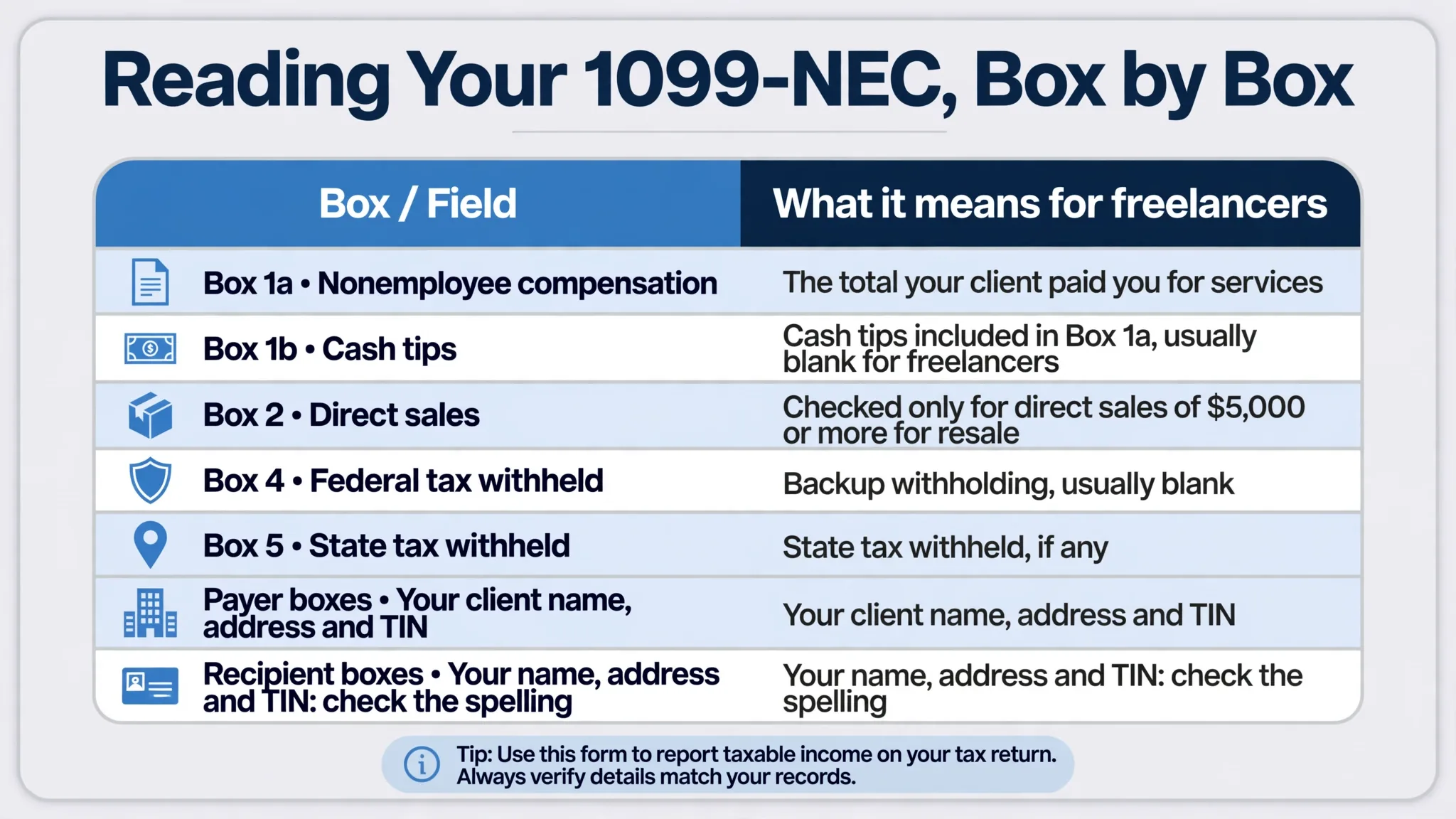
- Box 1a, Nonemployee Compensation: This is the number that matters most. It shows the total amount the client paid you for services during the year, including parts and materials. Compare this number against your own records before you do anything else. If it is wrong, the rest of the form does not matter until it is fixed.
- Box 1b, Cash Tips: This is a new box on the 2026 form. It shows cash tips included in the Box 1a amount. Most freelancers will see this box blank, because tips are rare in freelance work, but if you do work where clients tip you in cash, check that the figure matches what you actually received.
- Box 2, Payer Made Direct Sales: This box is a checkbox, not an amount. The payer checks it if they made direct sales of 5,000 dollars or more of consumer products to you for resale. It almost never applies to ordinary freelance service work. If it is checked on your form and you did not buy products from the client for resale, ask the client about it.
- Box 4, Federal Income Tax Withheld: This shows any federal income tax the payer withheld from your payments under the backup withholding rules. For most freelancers this box is blank, because clients do not normally withhold tax from contractor payments. If there is an amount here, it is tax already paid on your behalf, and it belongs on your tax return as a payment, not as income. Do not add it to your earnings.
- Box 5, State Tax Withheld: This shows any state income tax withheld from your payments. Like Box 4, it is usually blank for freelancers. If your state has an income tax and an amount appears here, keep the figure for your state return.
- Payer boxes: The payer’s name, address, and taxpayer identification number appear on the form, along with the payer’s account number if they use one. Check that the payer’s name matches the client you actually worked for. If the name looks unfamiliar, it may be the client’s parent company or a payroll service, but confirm it before you assume that.
- Recipient boxes: Your name, address, and taxpayer identification number appear here. Check the spelling of your name and your address carefully. A wrong TIN on the form can trigger backup withholding in future years and can cause the IRS to flag a mismatch. If your name or TIN is wrong, tell the payer and ask for a corrected form.
Two more boxes deserve a mention even though they rarely apply to freelancers. The 2026 form added boxes for cash tips and overtime pay, which is why the box letters look different from the form you may have received a few years ago. If your form shows amounts in boxes you do not recognize, do not guess what they mean. Ask the payer what they reported and why, and compare the answer against your own payment records. A five minute question in January is cheaper than a notice from the IRS in August.
The $2,000 Threshold: What Changed for 2026
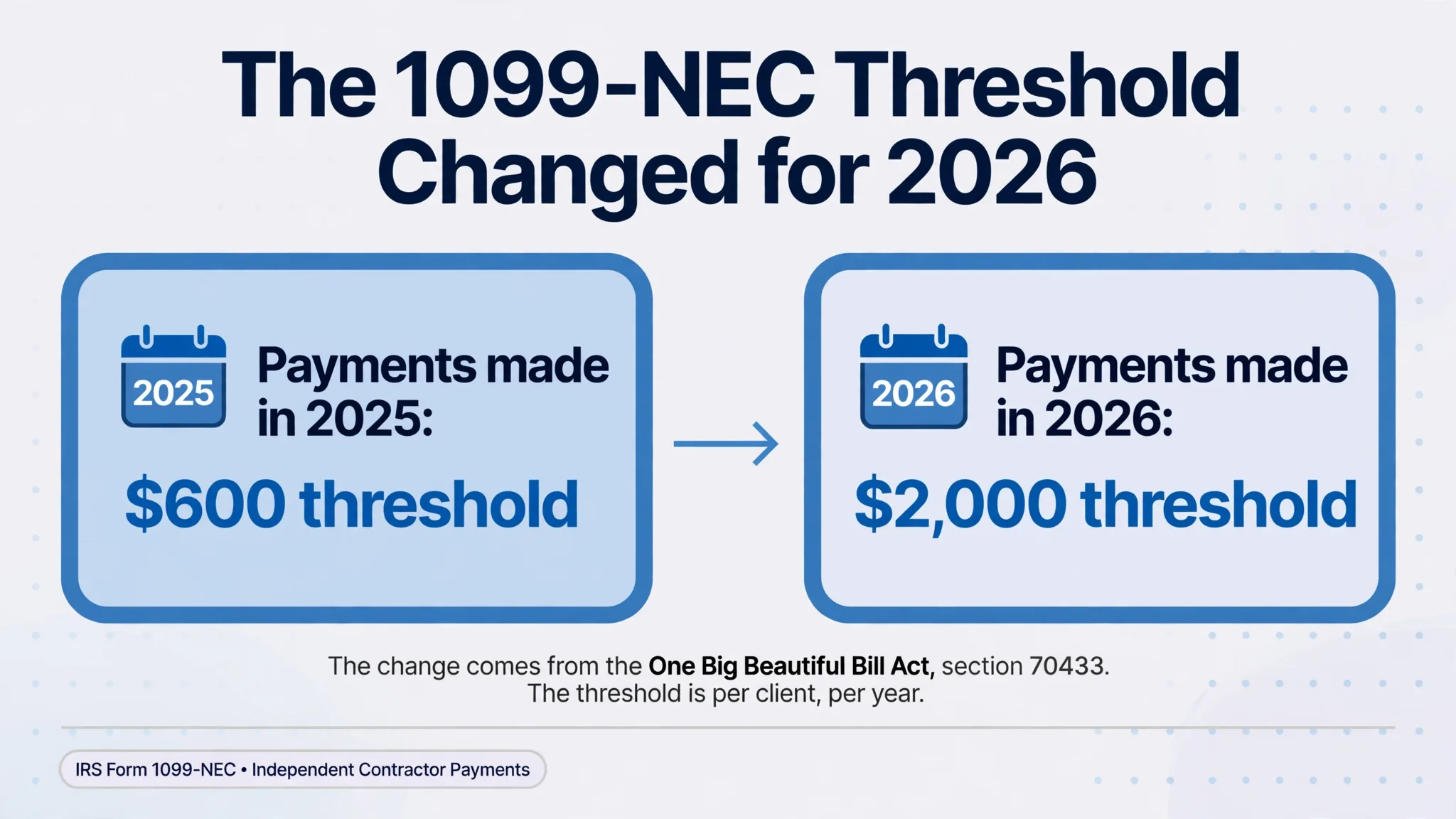
Here is the change most guides still get wrong, and it is the most important fact in this post. For payments made in 2025 and earlier, a client had to send you a 1099-NEC if they paid you 600 dollars or more during the year. For payments made on or after 1 January 2026, that threshold is 2,000 dollars. The change comes from the One Big Beautiful Bill Act, Public Law 119-21, Section 70433, signed on 4 July 2025, and it is confirmed in the IRS Instructions for Forms 1099-MISC and 1099-NEC, dated December 2026. The instructions say to file Form 1099-NEC for each person to whom you have paid at least 2,000 dollars for services performed by someone who is not your employee, including parts and materials, or for payments to an attorney.
Read that carefully, because the threshold works by payment year, not by the year you receive the form. The forms that arrive in January 2027 report payments made during 2026, so the 2,000 dollar threshold applies to them. The forms that arrived in January 2026 reported payments made during 2025, so the old 600 dollar threshold applied to those. If you compare this January’s stack of forms against last January’s, the difference is not a mistake. A client who paid you 1,200 dollars in 2026 is not required to send you a 1099-NEC, even though the same payment in 2025 would have produced one.
That does not mean the income disappears. This is the misunderstanding I hear most often, and it is worth killing plainly: a higher reporting threshold is not a tax exemption. If a client paid you 1,200 dollars in 2026 and sends no form, you still earned 1,200 dollars, and you still have to report it. The threshold decides whether the client must file a form. It never decides whether you must report the income. The IRS says this directly in its Gig Economy Tax Center and in Tax Tip 2026-26: taxpayers must report income earned from gig work on a tax return even if the income is not reported on an information return form, like a Form 1099-K, 1099-MISC, 1099-NEC, or W-2, and even if it was paid in cash, property, goods, or virtual currency.
A few related thresholds are worth knowing so you are not confused when you see them. The 2,000 dollar figure applies to most 1099-MISC categories too, including rents, prizes and awards, other income, and medical and health care payments. Royalties keep a much lower threshold of 10 dollars. Payments to an attorney for gross proceeds still use the old 600 dollar threshold, and those stay on Form 1099-MISC, Box 10. And there are payments that never need a 1099-NEC at all: payments to a corporation, including an LLC treated as a C or S corporation, are generally exempt, although attorneys’ fees of 2,000 dollars or more are reportable in Box 1a even when paid to a corporation. Payments for merchandise, rent paid to real estate agents or property managers, wages reported on a W-2, and payments to a tax-exempt organization or a government are also generally exempt. As the IRS instructions put it, some payments do not have to be reported on Form 1099-NEC, although they may be taxable to the recipient. That sentence is the whole point of this section: the form and the tax are two different things.
One more thing to note, and I am noting it precisely because I will not state a number I cannot verify. The IRS instructions say the 2,000 dollar figure may be adjusted for inflation beginning in calendar year 2027. Some secondary sources have reported a 2027 figure, but I have not verified it against an IRS source, so I am not stating it here. If you read a 2027 number somewhere else, check it against the IRS instructions for that year before you rely on it. A threshold you plan around should come from the IRS, not from a blog post, including this one.
When Your 1099-NEC Arrives
The deadline for a 1099-NEC is 31 January, and it is one deadline for both copies. The client must furnish your copy and file with the IRS by 31 January. That is different from Form 1099-MISC, which has a later e-filing date. For the 1099-NEC, filing electronically does not extend the deadline. Paper or electronic, the date is the same.
For payments made during 2026, the date moves by one day, for a simple reason. 31 January 2027 is a Sunday, so the deadline falls on the next business day, Monday 1 February 2027. Expect your 1099-NEC forms for 2026 payments to arrive by Monday 1 February 2027. If a form arrives a few days late, it is usually a mailing delay rather than a violation, but if nothing has arrived by the second week of February, it is time to follow up. Do not wait until April to discover a missing form. The checklist later in this post gives you the exact steps.
Your client, on their side, has to e-file if they file 10 or more information returns, and the IRS is moving direct e-filing to its Information Returns Intake System, known as IRIS, from 1 January 2027, replacing the older FIRE system. That is payer-side detail, and you do not need to do anything about it. The only reason it matters to you is that it explains why organized clients ask for your W-9 early in the year: they are setting up their filing system long before January arrives.
1099-NEC vs 1099-MISC: The Split Since 2020
The most common confusion I see is between the 1099-NEC and the 1099-MISC, and it is understandable, because until tax year 2020 they were the same form. Before 2020, nonemployee compensation was reported in Box 7 of Form 1099-MISC. The IRS then reinstated the 1099-NEC and split them. Today the split is clean: the 1099-NEC reports payments for services by someone who is not an employee, in Box 1a. The 1099-MISC reports everything else in the miscellaneous family, including rents, royalties, prizes and awards, medical and health care payments, and other income.
For a freelancer, the practical rule is simple. If a client paid you for your work, expect a 1099-NEC. If someone paid you rent for a property, a royalty for a book, or a prize for a competition, expect a 1099-MISC. You can receive both forms in the same year for different kinds of income, and you report both. The 1099-MISC still exists. It was not replaced. It just no longer carries your service income.
One corner of the 1099-MISC is worth remembering because it surprises freelancers who do legal work. Gross proceeds paid to an attorney, of 600 dollars or more, are reported on Form 1099-MISC, Box 10, not on a 1099-NEC. Attorneys’ fees for services, on the other hand, go on the 1099-NEC in Box 1a at the 2,000 dollar threshold. Same profession, two different boxes, depending on what the payment was for. If you are a freelance paralegal or a legal writer, keep that distinction in mind when you check your forms.
1099-NEC vs 1099-K: Card and App Payments Are a Different Form
The second confusion is between the 1099-NEC and the 1099-K, and it matters more every year as more freelance payments move onto cards and apps. The rule is about how you were paid, not who paid you. Payments made by credit card or through a payment network are not reported on a 1099-NEC. They are reported on Form 1099-K by the payment processor, the company that moved the money.
So if a client pays your invoice by bank transfer, check, or cash, that payment belongs on a 1099-NEC if it meets the threshold. If the same client pays you through a card payment or a payment app that counts as a payment network, that payment belongs on a 1099-K, reported by the processor. A freelancer can receive both forms for the same year, covering different payments, and must add both together, plus any cash income that appears on neither form, to get total income. Do not assume that because one form covers some of your income, it covers all of it.
The 1099-K has its own threshold, and it is much higher. For 2026, the 1099-K threshold is over 20,000 dollars and over 200 transactions, restored by the One Big Beautiful Bill Act. That means most freelancers who take occasional card payments will not receive a 1099-K at all, which makes the 1099-NEC and your own income log even more important. If you take payments through an app, keep your own record of every payment, because the form that reports it may never arrive.
What to Do If Your 1099-NEC Never Arrives
First, do not panic, and do not wait. A missing 1099-NEC is common, and it is fixable. It usually means one of three things: the client was not required to send one because your payments fell below the threshold, the client sent it to an old address, or the client made a mistake. Only the first of those is harmless, and you cannot tell which one it is until you check.
Start with your own records. Go through your invoices and your bank statements for the year and add up what each client paid you. My guide to time tracking and invoicing for freelancers explains how to keep an income log that makes this step take minutes instead of hours, and if you do not have one yet, this January is the right time to start one. Once you know what each client paid you, compare that against the forms you received. The gap tells you exactly which clients to contact.
Then contact the payer. A short, polite message is enough. Say you are reconciling your records for the year, you received payments totalling a certain amount from them, and you have not received a 1099-NEC. Ask whether one was sent, to what address, and whether they can send a copy or confirm the total they reported. Keep a copy of your message and any reply. That paper trail matters if the question ever comes up again.
While you wait for a reply, remember the rule from the threshold section: no form never means no tax. Report the income you actually received, using your own records, even if the form never turns up. The IRS expects you to report all of your income, and your invoices and bank deposits are valid proof of what you earned. A missing form is the client’s problem to fix. Unreported income is yours.
There is one more reason to follow up promptly. If the client did file a 1099-NEC with the IRS but your copy went astray, the IRS still has its copy, and it will expect to see that income on your return. Finding out in January that a form exists is a small job. Finding out months later, when the IRS asks why your return does not match its records, is a much bigger one.
What to Do If the Amount Is Wrong
A wrong amount on a 1099-NEC is also common, and it is also fixable, but only in one direction. You cannot fix it yourself. Do not alter the form, do not cross out the number, and do not file a return with a corrected form you made yourself. The IRS matches your return against the copy the payer filed, so a form you changed yourself only creates a mismatch.
Instead, contact the payer and ask for a corrected form. Tell them the amount on the form, the amount your records show, and what the difference is, with your invoices as evidence. The payer’s process is straightforward: they file a corrected Form 1099-NEC with the CORRECTED box checked, sending Copy A to the IRS and Copy B to you. That is their job, not yours, and most payers will do it quickly once you show them the numbers.
If a correction cannot be obtained before you file, report the income you actually received, not the number on the wrong form, and keep your invoices, bank records, and the correspondence with the payer as proof. That is the advice given consistently by the tax guides that cover this situation, and it is the honest position: your return should reflect reality, and your records should be able to prove it.
The risk of ignoring a wrong form is real. If the IRS copy shows more income than your return reports, the IRS can send a CP2000 notice, which proposes additional tax based on the mismatch. A CP2000 is not an audit, but it is not a letter you want either. It is slow, stressful, and entirely avoidable. A corrected form in February, or a return backed by solid records, prevents it. The worst option is to notice the error, say nothing, and hope the IRS does not notice. The IRS has the payer’s copy. It will notice.
A wrong name or TIN follows the same process, and it matters for a different reason. A TIN mismatch can trigger backup withholding on your future payments, which means the client starts withholding tax from what they pay you. If your name or TIN is wrong on the form, ask for a corrected form just as you would for a wrong amount, and check that the correction arrives before the next payment cycle.
How the 1099-NEC Lands on Your Tax Return
Once your forms are checked and your income is reconciled, the 1099-NEC does one simple job on your tax return: it feeds your Schedule C. Add up the Box 1a amounts from all your 1099-NEC forms, add any income that arrived without a form, and that total is your gross receipts for the year. From there you subtract your business expenses, and the result is your net profit. That net profit is what your income tax and your self-employment tax are calculated on.
Self-employment tax is the part freelancers forget, because no employer ever paid half of it for them. The rate is 15.3 percent on your net earnings, covering Social Security and Medicare. That is the number to keep in mind when you look at a 1099-NEC total and wonder why the tax feels so much higher than the income tax alone. My guide to self-employment tax deductions for freelancers walks through the deductions that reduce that net profit, and it is worth reading alongside this post, because the form tells you what came in, and the deductions decide what stays taxable.
Quarterly estimated taxes are the other half of the same story. The income on your 1099-NEC forms is not taxed until you report it, but the IRS expects you to pay as you earn, in four quarterly instalments. If you wait until April to pay a full year of tax on 1099 income, you may owe an underpayment penalty on top of the tax itself. My guide to what freelancers owe and when lays out the quarterly calendar and the safe harbor rule that protects you if your estimates are close enough.
One last connection is worth making before the checklist. The contract you signed with a client is what sets up the whole chain: the contract names you as an independent contractor, the W-9 collects your tax details, the client pays against your invoices, and the 1099-NEC reports those payments at year end. If any link in that chain is missing, the January reconciliation gets harder. My independent contractor agreement template covers the contract and the W-9 and 1099 paperwork flow behind the form, so a new client relationship starts with the paperwork in place instead of ending with a scramble in January.
Your January Reconciliation Checklist
Put the whole process together and it becomes a short routine you can run every January in an hour or two. Do it before you file, not after, and keep the papers together until your return is accepted.
- Collect every 1099-NEC you received. Gather all the forms, paper and electronic, in one place, and note the payer and the Box 1a amount for each one.
- Add up your own income log for the year. Total your invoices and bank deposits client by client, using your own records rather than trusting the forms alone.
- Compare each form against your records. Check the Box 1a amount, your name and address, and your TIN on every form, and mark any form that is missing, wrong, or does not match.
- Contact any payer whose form is missing or wrong. Ask for a copy or a corrected form with the CORRECTED box checked, and keep a copy of your message and the reply.
- Report the income you actually received. Total your 1099-NEC amounts plus any income that arrived without a form, and carry that total to Schedule C, even if a form is still missing.
- File the forms and your notes together. Keep every 1099-NEC, your income log, your invoices, and your correspondence with payers in one folder, so you can answer a CP2000 notice or any other question without searching.

Run that list in order and January stops being stressful. The forms are checked, the missing ones are chased, the wrong ones are corrected, and your return reports what you actually earned. That is the whole job of a 1099-NEC, from the freelancer’s side: check it, fix it, file it.
Frequently Asked Questions
What is a 1099-NEC?
A 1099-NEC is the form a business uses to report payments of 2,000 dollars or more made to someone who is not its employee for services performed during the year. The business files one copy with the IRS and sends one copy to the person it paid. For a freelancer, it is the record of what a client paid you, and it is the starting point for reporting that income on your tax return.
Do freelancers get a 1099-NEC?
Yes, if a client paid you 2,000 dollars or more for services during 2026 in the course of their trade or business. The client is required to send you the form and file a copy with the IRS. If a client paid you less than the threshold, they are not required to send one, but you still have to report the income.
What is the 1099-NEC threshold for 2026?
The threshold for payments made in 2026 is 2,000 dollars, up from 600 dollars for payments made in 2025 and earlier. The change comes from the One Big Beautiful Bill Act, Public Law 119-21, Section 70433, and it is confirmed in the IRS Instructions for Forms 1099-MISC and 1099-NEC, dated December 2026. The threshold decides whether the client must file a form. It does not decide whether you must report the income.
When will I receive my 1099-NEC?
The client must furnish your copy and file with the IRS by 31 January. For payments made during 2026, the deadline is Monday 1 February 2027, because 31 January 2027 is a Sunday. Filing electronically does not extend the deadline. If nothing has arrived by the second week of February, contact the payer.
What if I never received a 1099-NEC?
First check your own records to see whether the client paid you 2,000 dollars or more, because below the threshold no form is required. If the total is above the threshold, contact the payer and ask whether a form was sent and to what address. Keep a copy of your message. Whatever happens, report the income you actually received on your tax return, using your invoices and bank records as proof.
Do I still have to report income if I never got a 1099?
Yes. The IRS states this plainly in its Gig Economy Tax Center and in Tax Tip 2026-26: taxpayers must report income earned from gig work on a tax return even if the income is not reported on an information return form, like a Form 1099-K, 1099-MISC, 1099-NEC, or W-2, and even if it was paid in cash, property, goods, or virtual currency. No form never means no tax.
What is the difference between a 1099-NEC and a 1099-MISC?
The 1099-NEC reports payments for services by someone who is not an employee, in Box 1a. The 1099-MISC reports other miscellaneous income, including rents, royalties, prizes and awards, and medical and health care payments. The two forms were split beginning with tax year 2020. Before that, nonemployee compensation was reported in Box 7 of the 1099-MISC. You can receive both forms in the same year for different kinds of income.
What is the difference between a 1099-NEC and a 1099-K?
The difference is how you were paid. Payments by bank transfer, check, or cash are reported on a 1099-NEC by the client. Payments made by credit card or through a payment network are reported on a 1099-K by the payment processor. For 2026 the 1099-K threshold is over 20,000 dollars and over 200 transactions, so most freelancers will not receive one, and the 1099-NEC and your own income log carry the record instead.
What do I do if my 1099-NEC amount is wrong?
Contact the payer and ask for a corrected form, showing them your invoices as evidence. The payer files a corrected Form 1099-NEC with the CORRECTED box checked, sending Copy A to the IRS and Copy B to you. Do not alter the form yourself. If a correction cannot be obtained before you file, report the income you actually received and keep your invoices, bank records, and correspondence as proof. Ignoring a wrong form risks a CP2000 notice from the IRS.
Do I pay self-employment tax on 1099 income?
Yes, generally. Income reported on a 1099-NEC is self-employment income, and the net profit from it is subject to self-employment tax at 15.3 percent, covering Social Security and Medicare, as well as income tax. The tax is calculated on your net profit after business expenses, not on the gross total of your 1099 forms, so your deductions matter. Quarterly estimated tax payments are how you pay it during the year.
Sources
- IRS, Instructions for Forms 1099-MISC and 1099-NEC (December 2026), including the $2,000 filing threshold, the 31 January deadline, and the exceptions: https://www.irs.gov/instructions/i1099mec
- IRS, Gig Economy Tax Center (report all income, even without an information return): https://www.irs.gov/businesses/gig-economy-tax-center
- IRS, Tax Tip 2026-26, Filing tips and updates for gig economy workers (31 March 2026): https://www.irs.gov/newsroom/filing-tips-and-updates-for-gig-economy-workers
- One Big Beautiful Bill Act, Public Law 119-21, Section 70433 (threshold change, signed 4 July 2025)
- IRS, Form 1099-NEC and its instructions for the 2026 form boxes, including Box 1a nonemployee compensation and Box 1b cash tips: https://www.irs.gov/instructions/i1099mec
I am not a lawyer, and this post is general information, not legal advice. If a project is worth a meaningful amount of money, or a dispute has already started, talk to a licensed attorney in your state before you act.
