


Introduction
Neither one is better. Freelance work suits people who want to run their own business, choose their clients, and set their own rates. Contract work suits people who want steadier pay, a single focus, and someone else handling payroll and benefits. The right choice depends on what you need most right now: freedom, stability, income, or time. This guide compares the two paths side by side, with the tax and pay numbers included, so you can choose with your eyes open instead of guessing.
I am writing this as a freelancer, and I have worked both ways. I have run my own freelance business, invoicing clients directly and handling every part of it myself. I have also watched friends take six month contract assignments through staffing agencies, where a paycheck arrived every two weeks and the agency handled the tax withholding. Both paths paid the bills. They felt completely different to live with. The difference was never the work itself. It was who carried the risk, who handled the paperwork, and who decided what a day looked like.
That is the question this guide answers. You will learn what freelance work and contract work actually are, why the word contract can mean two very different arrangements, how pay and taxes differ between the paths, what benefits and protections each one gives you, how much control and security each one offers, how to switch from one to the other, and which one fits which kind of person. If you are standing at the start of an independent career, read it in order. If you already know which path interests you and only need the numbers, the comparison table and the pay section are a short scroll away.
One note before we start. This guide is about choosing a career path. It is not a guide to worker classification law. If you need to know whether a specific working arrangement makes you legally an employee or an independent contractor, my guide to employee vs independent contractor classification covers the IRS common law test, the DOL economic reality test, and the state ABC tests in full, including the story of a working relationship that slowly turned into employment without anyone planning it. This post links to it where the law matters and does not repeat it.
This comparison is about the work arrangements themselves. For the legal classification tests that decide whether someone is an employee or a contractor, see our guide to employee vs independent contractor.
What Is Freelance Work?
A freelancer is a self-employed professional who offers services to several clients at the same time, on a project by project basis. Clients hire a freelancer for a defined piece of work, a set of articles, a brand identity, a website, a marketing campaign, and the freelancer delivers it, invoices for it, and moves on to the next client. There is no single employer. There is no fixed term. The freelancer is the business.
Freelancers set their own rates, choose which clients to take, decide when and where they work, and provide their own equipment, software, and internet connection. They also carry every cost of the business themselves: health insurance, retirement savings, quarterly estimated tax payments, business expenses, marketing, and the unpaid work of finding the next client. The tradeoff is simple to state and hard to live with. Freelancers get maximum autonomy, but every cost and every risk falls on them.
Common freelance fields include writing, design, marketing, photography, software development, and consulting. Most freelancers work remotely, and most find clients through a mix of platforms, referrals, and their own outreach. A freelance career is built one project at a time, and the income follows the same shape: good months when several clients pay at once, quiet months when projects end at the same time. If you are considering this path from the beginning, my guide on how to become a freelancer in ten proven steps walks through the whole setup, from picking a skill to landing the first paying client.
The scale of this way of working is large and still growing. According to MBO Partners 2025 State of Independence report, as cited by Amtec, roughly 72.9 million Americans now perform some form of independent work, which is nearly 45 percent of the entire United States labor force. That number is the reason the freelance vs contract question matters to so many people. It is no longer a niche choice. It is one of the main ways Americans now earn a living.
What Is Contract Work?
A contract worker is hired for a defined assignment with a single client, usually for a fixed duration. Three to twelve months is common, though some assignments run longer and some run for only a few weeks. The worker focuses on one company for the length of the assignment, often works on site or closely with the client team, and the engagement ends on a known date unless it is renewed. Contract work sits between freelancing and a permanent job: more commitment than a freelance project, less permanence than a full time role.
Here is the part most guides skip, and it is the most important thing to understand about contract work. The word contract can mean two very different arrangements, and the difference changes everything about pay, taxes, and benefits.
In the first arrangement, the contract worker is a direct independent contractor. The worker signs a contract with the client company directly, invoices the company, receives a Form 1099-NEC, and handles taxes the same way a freelancer does. The engagement is longer and more focused than a freelance project, but the worker is still self-employed. This is the arrangement many people picture when they hear the words contract work, and it is also the arrangement most likely to raise classification questions, because a worker who looks and behaves like an employee for months at a time may legally be one. That is why the classification guide linked above matters.
In the second arrangement, the contract worker is placed through a staffing agency and is a W-2 employee of that agency. The agency is the employer of record. It withholds income tax and payroll taxes from each paycheck, issues a Form W-2, pays the employer half of Social Security and Medicare taxes, handles workers compensation, and often provides access to health insurance and retirement plans. The worker performs the work at the client company but legally works for the agency. This is how reputable staffing firms operate, and it is the model behind most contract assignments in fields like engineering, IT, aerospace, manufacturing, project management, and finance.
The two arrangements look identical from the outside. The worker sits at the same desk, does the same work, and leaves at the end of the same term. But one worker is self-employed and one is an employee, and that difference decides who pays the taxes, who provides the benefits, and who carries the legal risk. Before you accept any contract role, ask one question: who is my employer of record? If the answer is the agency, you are a W-2 employee. If the answer is you, you are a 1099 contractor, and the freelancer tax rules in this guide apply to you.
Freelance vs Contract at a Glance

The table below brings the whole comparison into one place. Read it as a summary of the sections that follow, where each row gets its full explanation.
| Factor | Freelancer | Contract Worker |
|---|---|---|
| Clients | Many at once | One at a time |
| Duration | Project based | Fixed term, 3 to 12 months |
| Tax form | 1099-NEC | W-2 (agency placed) or 1099-NEC (direct) |
| How you get paid | You invoice each client | Regular paycheck from the agency, or invoice if direct |
| Benefits | Self funded | Often through the agency |
| Schedule control | You set it | The client sets it |
| Job security | Spread across clients | One assignment, known end date |
| Who pays payroll tax | You pay the full 15.3 percent | Shared with the employer (W-2) or you pay it all (direct 1099) |
Notice the pattern in the table. The freelancer column is about control: more clients, more choice, more responsibility. The contract column is about structure: one focus, steadier pay, someone else handling the infrastructure. Neither column is better in the abstract. The right column is the one that matches what you need this year.
How Pay Works: Freelance vs Contract

Freelancers are paid by invoice. They agree a price for a project or an hourly rate, do the work, send an invoice, and wait for payment. Payment terms vary, and late payment is one of the real costs of freelancing. My guide to freelance payment methods covers how freelancers actually get paid and how to protect yourself against slow payers. The key point for this comparison is that a freelancer is paid for delivered work, not for time spent sitting at a desk, and there is no payroll department standing between the client and the money.
A W-2 contract worker is paid by paycheck. The agency pays every week or every two weeks for the duration of the assignment, with income tax and payroll taxes already withheld. The amount is predictable, the timing is predictable, and the worker never has to chase an invoice. A direct 1099 contractor is paid more like a freelancer, by invoice, but usually on a regular schedule set by the contract, for example monthly for the term of the assignment.
Contract work is in demand right now, which affects what it pays. A survey by Express Employment Professionals and The Harris Poll, published in November 2026, found that 71 percent of United States companies build contract workers into their staffing strategies, 80 percent of hiring managers said they were likely to hire contract workers going forward, and 43 percent said their companies rely on contractors more than they did three years ago. On the worker side, 39 percent of workers said they want to pursue full-time contracting as a career. Those figures, attributed to that survey, explain why contract assignments are easy to find at the moment, and why the choice between the two paths is a live decision for so many people rather than a theoretical one.
Freelance pay has a higher ceiling and a lower floor. A freelancer can charge premium rates for specialized work, and ZipRecruiter salary data from November 2026 puts the average freelance hourly pay in the United States at 47.71 dollars. Treat that figure as an average that hides wide variation: a specialist can earn far more, a beginner far less, and the average says nothing about how many of those hours a freelancer actually bills in a year. The honest way to compare pay is not hourly rate against hourly rate. It is what is left after tax, benefits, and unpaid time are accounted for, which is the subject of the worked comparison below.
Taxes: The Biggest Practical Difference
Tax is where the two paths diverge most, and it is the difference people underestimate most often. The numbers below are the reason a contract rate and a freelance rate that look similar on paper can leave very different amounts in your bank account.
A freelancer pays the full self-employment tax themselves. The IRS sets self-employment tax at 15.3 percent of net earnings, made up of 12.4 percent for Social Security and 2.9 percent for Medicare. The tax is figured on 92.35 percent of net profit, and it applies once net earnings from self-employment reach 400 dollars. On top of that, the freelancer pays income tax on the profit, and must pay the whole bill in four quarterly estimated tax payments during the year, because nobody withholds anything from a freelance payment. The IRS generally requires estimated tax if you expect to owe 1,000 dollars or more when you file. I explain the whole quarterly system, with due dates and a worked example, in my freelance taxes for beginners guide, and in my dedicated guide to quarterly estimated taxes.
A W-2 contract worker splits the payroll tax with the employer. The employee pays 7.65 percent of wages in Social Security and Medicare taxes, and the employer pays the other 7.65 percent. The employer also withholds federal income tax from each paycheck, so there are no quarterly estimated payments to manage and no April surprise. The worker receives a Form W-2 in January showing wages and withholding. A direct 1099 contractor is in the freelancer position: full 15.3 percent self-employment tax, quarterly estimated payments, and no withholding.
There is also a 2026 change to the reporting threshold that every freelancer and direct contractor should know. Under the One Big Beautiful Bill Act, signed into law on 4 July 2025, the threshold for a business to issue a Form 1099-NEC rises from 600 dollars to 2,000 dollars for payments made in 2026, with the threshold indexed for inflation from 2027. That means a client who pays you less than 2,000 dollars in 2026 is no longer required to send you a 1099-NEC for that year, and the first forms under the new rule will be filed in early 2027. Two things about this change matter more than the number itself. First, income below the threshold is still taxable. The threshold changes the paperwork, not the tax. All income is taxable, and the IRS says so plainly. Second, self-employment tax still starts at 400 dollars of net earnings, so the threshold change does not change when you owe self-employment tax. Keep records of every payment, whether or not a 1099 arrives, because your records are what your tax return is built on.
The worked comparison below shows what the tax difference is worth in real money. Take two people who each earn 100,000 dollars in a year. One is a W-2 contract worker earning 100,000 dollars in wages. The other is a freelancer with 100,000 dollars of net profit after business expenses. The W-2 worker pays 7.65 percent of wages in payroll taxes, which is 7,650 dollars, and the employer pays the other 7,650 dollars. The freelancer pays self-employment tax of 15.3 percent on 92.35 percent of net profit, which is 14,130 dollars. The freelancer pays 6,480 dollars more in payroll type tax on the same 100,000 dollars, before income tax is even considered. That gap is the price of being your own employer, and it is the reason a freelancer must charge more per hour than an employee earns per hour to end up in the same place. The freelancer does get some relief the employee does not: one half of the self-employment tax is deductible when working out adjusted gross income, and business expenses are deductible against freelance income, while employees generally cannot deduct unreimbursed work expenses. Those deductions narrow the gap, but they do not close it, and they do not change the cash flow reality that the freelancer must set the money aside and pay it in quarterly instalments.
One habit makes the freelancer side of this manageable, and it is the same habit I recommend in every tax guide I write. Move the tax share into a separate account the day a client pays you, before you spend anything. I explain the setup in my guide to a separate bank account for your freelance business. A W-2 contract worker never needs this habit, because withholding does it automatically. A freelancer needs it, because nothing else will.
Benefits and Protections
Benefits are the second big difference, and they are the reason many people choose contract work even when freelance rates look higher. A W-2 contract worker placed through an agency often has access to health insurance, a retirement plan, and paid time off through the agency. The exact package varies by agency and assignment, so ask what is included before you accept, but the structure exists. The agency is an employer, and employers provide benefits.
A freelancer provides their own benefits, entirely out of pocket. Health insurance is bought on the marketplace or through a spouse plan. Retirement saving is done through an individual account such as a SEP IRA or a Solo 401(k), with no employer match. Paid time off does not exist: a week without work is a week without income. That is a real cost, and it belongs in any honest comparison of freelance and contract pay. A freelance rate that looks 20 percent higher than a contract rate can easily be worth less once health insurance premiums, retirement contributions, and unpaid days off are subtracted.
Protections follow the same split. W-2 employees are generally eligible for unemployment insurance and workers compensation, because those systems are built for employees. Independent contractors generally are not eligible for either, though the details vary by state. A freelancer who loses all their clients at once has no unemployment check coming. A contract worker whose assignment ends can generally claim unemployment while looking for the next assignment, subject to their state rules. That safety net is worth real money, and it is one of the least discussed reasons people choose the W-2 contract model.
There is one more protection difference worth naming. A freelancer can deduct business expenses, home office costs, equipment, software, mileage, professional development, and self-employed health insurance premiums, subject to the tax rules. A W-2 employee generally cannot deduct unreimbursed work expenses. So the freelancer has more deductions available, and the employee has more benefits provided. The tradeoff runs through the whole comparison: the freelancer gets flexibility and deductions, the employee gets structure and benefits.
Control, Flexibility, and Job Security
Control is where freelancing wins clearly. A freelancer decides which clients to take, which projects to refuse, when to work, where to work, and how the work gets done. A client can ask for a result, but cannot dictate the freelancer’s hours, methods, or tools. That control is the reason most freelancers chose the path in the first place, and it is the thing they miss most if they leave it.
A contract worker gives up much of that control. The client sets the hours, provides the equipment and systems, and integrates the worker into the team. A contract worker who is told to attend a 9 a.m. meeting attends it. That structure suits people who prefer clear expectations and a defined role, and it frustrates people who chose independent work precisely to escape it. Before accepting a contract assignment, ask how much of your day the client will direct. The answer tells you how much of the freelancer freedom you are trading away.
Job security works differently on the two paths, and neither one is secure in the way a permanent job is. A freelancer’s security is spread across clients. Losing one client hurts, but the others keep paying. A contract worker’s security is concentrated in one assignment with a known end date. The pay is steady for the term, and then it stops, unless the contract is renewed or extended. Contract assignments do often lead to extensions or to permanent offers, a path known as contract to hire, and that possibility is a genuine advantage of the contract route. But it is not a promise, and a contract worker should never count on an extension that is not in writing.
The honest summary is this. Freelancing is less secure month to month and more secure against any single client disappearing, because the risk is spread. Contract work is more secure month to month and less secure at the end of the term, because the risk is concentrated. Which risk you prefer depends on your temperament and your savings. A freelancer with a three month emergency fund can ride out a quiet month. A contract worker with the same fund can ride out the gap between assignments. Either way, the fund is what makes the risk bearable, not the path itself.
Which One Pays More?
The short answer is that freelancers usually charge more per hour, and contract workers usually keep more of what they are paid. The freelancer rate has to cover everything the employer normally covers: the employer half of payroll tax, health insurance, retirement, paid time off, equipment, software, and the unpaid time spent finding clients. The contract rate does not carry those costs, because the agency carries them.
The worked comparison in the tax section shows the size of the gap. On 100,000 dollars of income, the freelancer pays 6,480 dollars more in payroll type tax than the W-2 worker, before income tax and before any benefits are priced in. Add a health insurance premium, retirement contributions, and two weeks of unpaid time off, and the gap grows by thousands more. That is why the common rule of thumb in the industry is that a freelancer needs to charge meaningfully more per hour than an employee earns to end up in the same place. The exact figure depends on your costs, but the direction is not in doubt: the freelance rate must be higher, or the freelancer is quietly earning less.
Here is the practical way to set the rate. Work out what you need to earn in a year, add the cost of your tax, your health insurance, your retirement saving, and your unpaid time, and divide by the hours you can realistically bill. Do not divide by 2,080 hours, because no freelancer bills every working hour. Marketing, admin, and gaps between projects eat a real share of the year. My freelance hourly rate calculator walks through that calculation, so the tax share and the unpaid time are already built into the rate you quote instead of something you have to find afterwards. Use it before you accept either a freelance project or a contract assignment, because the same math tells you whether a contract rate is actually fair once the agency benefits are counted in.
How to Switch From Freelance to Contract Work
- Decide which contract model you want. Choose between a W-2 agency placement, with withholding and benefits, and a direct 1099 contract, where you stay self-employed. Read the offer carefully: if an agency is the employer of record, it is W-2 work.
- Work out your minimum acceptable rate. Use the hourly rate calculator to find the rate that covers your costs, then compare it with the contract rate on offer, counting the agency benefits as part of the pay.
- Update your resume and portfolio for one employer, not many. A contract application reads like a job application: one role, one team, one set of responsibilities. Rewrite your portfolio to show depth in that role, not breadth across many clients.
- Register with two or three staffing agencies in your field. Agencies are the main source of W-2 contract assignments. Meet the recruiters, tell them your rate and your availability, and keep the relationship warm even while you are busy.
- Read the contract before you sign it. Check the term, the renewal clause, the notice period, the non-compete if there is one, who owns the work, and what happens if the assignment ends early. Do not sign a contract you have not read in full.
- Plan your exit from freelancing cleanly. Finish or hand over open projects, tell regular clients you are taking a contract assignment and when you expect to be available again, and keep the relationships warm, because the contract will end and those clients are your way back.
Switching the other way, from contract work to freelancing, follows the same steps in reverse, with one addition: build the freelance pipeline before the contract ends. Line up the first two or three clients while you still have the contract income, set up the separate bank account, and start setting aside the tax share from the first freelance payment. The switch that fails is the one made in a rush, the day after an assignment ends, with no clients and no savings. The switch that works is the one planned a month or two ahead.
Which One Suits You?
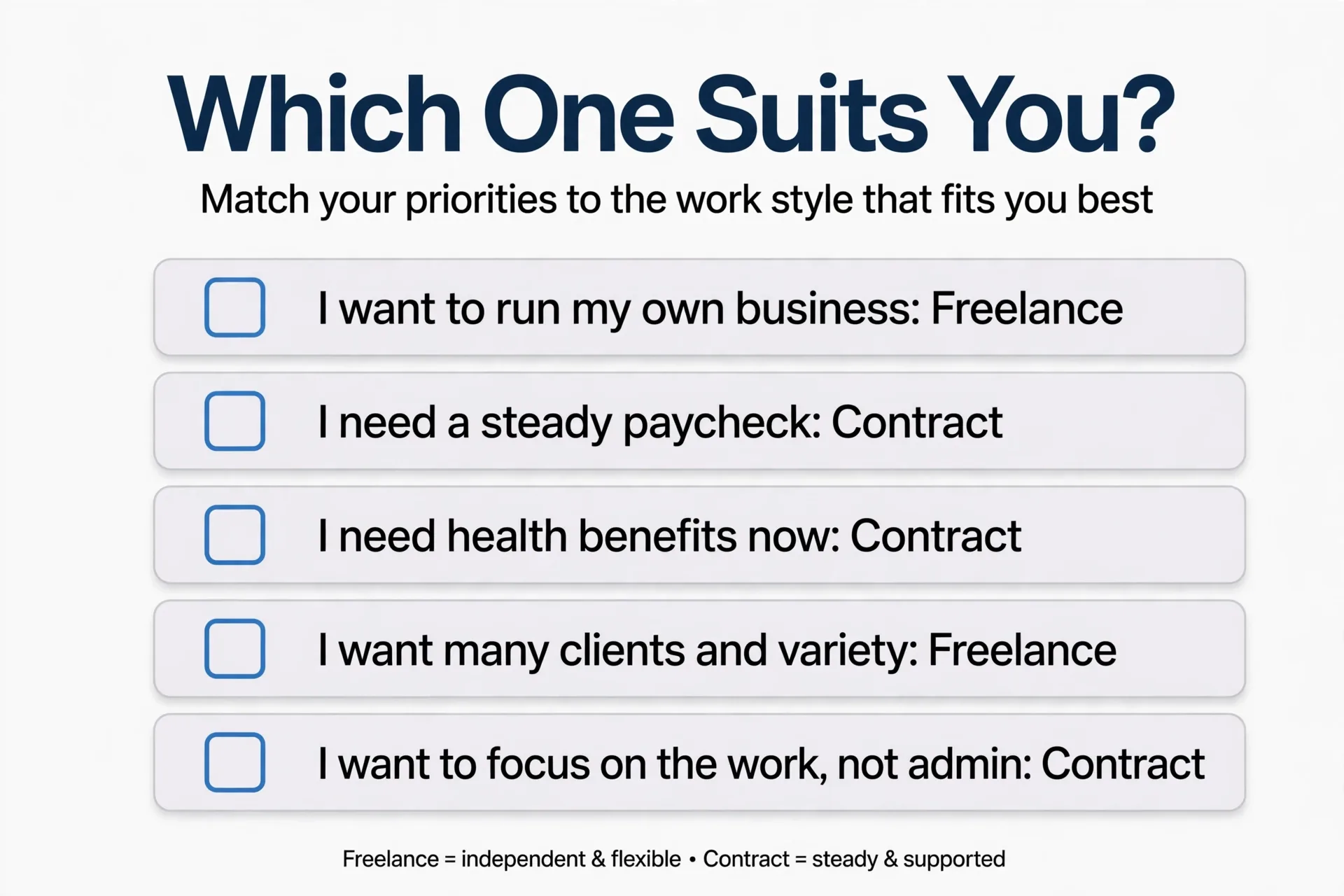
There is no universally right answer, so here is a short decision guide. Answer honestly, and the pattern will show itself.
Choose freelance work if you want to run a business, not just do the work; you want to choose your clients and set your own rates; you are comfortable with income that rises and falls; you can manage your own taxes, insurance, and retirement; and you value variety and control over predictability.
Choose contract work if you want a steady paycheck for a defined period; you need health benefits and paid time off now; you prefer to focus on the work and let someone else handle payroll and admin; you want to go deep with one team for months at a time; and you are comfortable with a known end date and the need to find the next assignment.
Consider a mix if you are unsure. Many independent workers do both: a contract assignment for steady income, with freelance projects on the side, or freelance work between contracts. The two paths are not a one way door. The skills are the same, the clients overlap, and the experience in one makes you better at the other. The question is not which path you choose forever. It is which path serves you best this year, and you can answer it again next year.
Frequently Asked Questions
Is contract work better than freelancing?
Neither is better for everyone. Contract work is better if you want steadier pay, benefits, and someone else handling payroll. Freelancing is better if you want to run your own business, choose your clients, and control your schedule. The right choice depends on whether you need stability or freedom more right now.
Is a contractor an employee or self-employed?
It depends on the arrangement. A contract worker placed through a staffing agency is a W-2 employee of the agency, which withholds taxes and pays the employer half of payroll taxes. A direct contractor who signs with the client company is self-employed, receives a Form 1099-NEC, and handles taxes like a freelancer. Always ask who the employer of record is before accepting a contract role.
Which pays more, freelance or contract work?
Freelancers usually charge more per hour, but contract workers usually keep more of what they are paid, because the agency covers the employer half of payroll tax and often provides benefits. On 100,000 dollars of income, a freelancer pays about 6,480 dollars more in payroll type tax than a W-2 worker, before income tax and benefits are counted. Compare take-home pay, not hourly rates.
Do contractors get benefits?
Often, yes, if they are W-2 employees of a staffing agency. Agency contract workers often have access to health insurance, retirement plans, and paid time off through the agency, though the exact package varies. Direct 1099 contractors do not get employer benefits and must fund their own.
Do freelancers get benefits?
No, not from an employer, because a freelancer has no employer. Freelancers buy their own health insurance, save for retirement through an individual account such as a SEP IRA or a Solo 401(k), and have no paid time off. Those costs must be built into the freelance rate.
Is freelance or contract work better for taxes?
Contract work is simpler for taxes if it is W-2 agency work, because the employer withholds income tax and payroll taxes from each paycheck. Freelance work means paying the full 15.3 percent self-employment tax yourself and making four quarterly estimated tax payments a year. Freelancers do get more deductions, including business expenses and one half of the self-employment tax, which narrows the gap.
How long do contract jobs last?
Three to twelve months is common for agency-placed contract work, though some assignments run for only a few weeks and some run longer than a year. Contracts can also be renewed or extended, and some lead to permanent offers through contract to hire. The term and the renewal clause should be in writing before you start.
Can you switch from freelance to contract work?
Yes. The usual route is to register with staffing agencies in your field, update your resume for one role rather than many clients, and read the contract carefully before signing, especially the term, the renewal clause, and who owns the work. Plan the exit from freelancing cleanly, finish open projects, and keep regular clients warm, because the contract will end and those clients are your way back.
Do I need a contract for freelance work?
Yes, every freelance project should have a written agreement covering the scope, the price, the payment terms, the deadline, and who owns the work. A written contract is what protects you when a client disputes the work or stops paying. The irony is that freelancers need contracts more than contract workers do, because no agency stands between them and the client.
Is contract work more stable than freelancing?
Month to month, yes, because the pay is steady for the term of the assignment. Over a whole year, it depends: a freelancer spreads risk across several clients, while a contract worker concentrates it in one assignment with a known end date. Neither path is as stable as a permanent job, and both need an emergency fund.
Sources
- Internal Revenue Service, Independent Contractor (Self-Employed) or Employee: https://www.irs.gov/businesses/small-businesses-self-employed/independent-contractor-self-employed-or-employee
- Internal Revenue Service, Self-Employment Tax: https://www.irs.gov/businesses/small-businesses-self-employed/self-employment-tax-social-security-and-medicare-taxes
- Internal Revenue Service, Estimated Taxes: https://www.irs.gov/businesses/small-businesses-self-employed/estimated-taxes
- Internal Revenue Service, About Form 1040-ES: https://www.irs.gov/forms-pubs/about-form-1040-es
- Internal Revenue Service, About Form 1099-NEC: https://www.irs.gov/forms-pubs/about-form-1099-nec
- Amtec, Freelance Vs. Contract Work: What’s the Real Difference? (updated 1 Oct 2026): https://www.amtec.co/blog/freelance-vs-contract-work-whats-the-real-difference
- Upwork, Freelance vs. Contract: Work Considerations and Differences: https://www.upwork.com/resources/freelance-vs-contract
- Gusto, What is the Difference Between a 1099 vs. W-2?: https://gusto.com/resources/articles/taxes/1099-vs-w2
- Express Employment Professionals and The Harris Poll, contract worker survey (Nov 2026), via Morningstar: https://www.morningstar.com/news/pr-newswire/20261111da93267/new-survey-finds-contract-workers-gaining-ground-in-workforce-plans
- Andrews Hooper Pavlik, 1099 Reporting Threshold Rises to $2,000 for 2026: https://www.ahpplc.com/insight/1099-reporting-threshold-rises-to-2000-for-2026/
- OnPay, 1099 Reporting Thresholds: 2026 Changes Explained: https://onpay.com/insights/1099-reporting-threshold-updates/
I am not a lawyer, and this post is general information, not legal advice. If a project is worth a meaningful amount of money, or a dispute has already started, talk to a licensed attorney in your state before you act.
