


Introduction
A freelance invoice template is a reusable document that lists who you are, who the client is, what work you did, how much they owe, and when and how they should pay. A good one has ten fields, and every field answers a question the client’s accounts team would otherwise have to ask you. If you send a complete invoice, you get paid faster. If you send an incomplete one, you get an email asking for the missing detail, and your payment waits while the email goes back and forth.
I am a freelance writer, and I learned this the slow way. My early invoices were little more than a sentence in an email: the project name, a total, and “please pay soon.” Some clients paid anyway. Others asked what the total covered, or when it was due, or where to send the money, and each question added days. One client could not pay me at all until I gave him an invoice number, because his accounts system would not process a payment without one. That was the day I stopped treating the invoice as an afterthought and started treating it as part of the work.
This guide gives you the complete template. You will get the ten fields every freelance invoice must include and the reason each one exists, a full sample invoice from a freelance writer explained line by line, three ways to number your invoices, a comparison of payment terms so you can choose between due on receipt, Net 15, Net 30 and Net 60, a five-step process for sending an invoice, the common mistakes that delay payment, and the IRS rules for keeping your invoices for tax time. The worked example throughout is a writer’s invoice, because that is the work I do, but every rule in this guide applies to any freelancer: designer, developer, editor, consultant, or anyone else who bills a client for work.
One thing to know before we start. There is no single United States federal law that dictates what an invoice must look like. No statute hands you a required format. What exists instead is a practical standard: the fields that clients, accountants, and the IRS expect to see, because those fields are what make a payment processable and a record defensible. This guide teaches that standard, and it says plainly where a rule comes from a law and where it comes from good practice.
What Is a Freelance Invoice Template?
A freelance invoice template is a ready-made layout you fill in each time you bill a client, instead of building a new invoice from scratch. It has fixed places for your details, the client’s details, the invoice number, the dates, the list of work, the totals, the payment terms, and the payment instructions. You keep the layout the same and change only the job-specific facts. That consistency is the whole point. A client who has paid you before already knows where to find the total and the due date on your invoice, and a new client’s accounts team can process a familiar-looking document without asking questions.
An invoice is not the same thing as a quote, an estimate, or a receipt, and mixing them up causes real confusion. A quote or estimate comes before the work: it says what the work will cost. An invoice comes after the work, or after a milestone the contract says you can bill for: it says what the client owes now. A receipt comes after the payment: it confirms the money arrived. If you send a client a document that says “invoice” at the top, they know it is a request for payment. If you send them a document that says “estimate” after the work is done, they may file it and wait, because an estimate does not ask for money.
You do not need special software to use a template. A document in Word or Google Docs, or a spreadsheet in Excel or Google Sheets, works perfectly well for a freelancer who sends a handful of invoices a month. Software earns its keep when the volume grows: when you send many invoices, chase late ones, or want payment links and automatic reminders. My guide to the best invoicing software for freelancers in 2026 compares the tools for that stage. But the template itself is the same either way, and this guide teaches the template, not the tool.
The template also protects you in a quieter way. An invoice is a record. It proves what you delivered, when you delivered it, what you charged, and what the client agreed to pay. If a client later says the work was never delivered, or the price was different, your invoice, together with your contract and your delivery emails, is the evidence. That is why the fields matter, and why guessing at them is a bad idea. A complete invoice is a business document. A vague one is a favour you are hoping gets repaid.
What Should a Freelance Invoice Include?
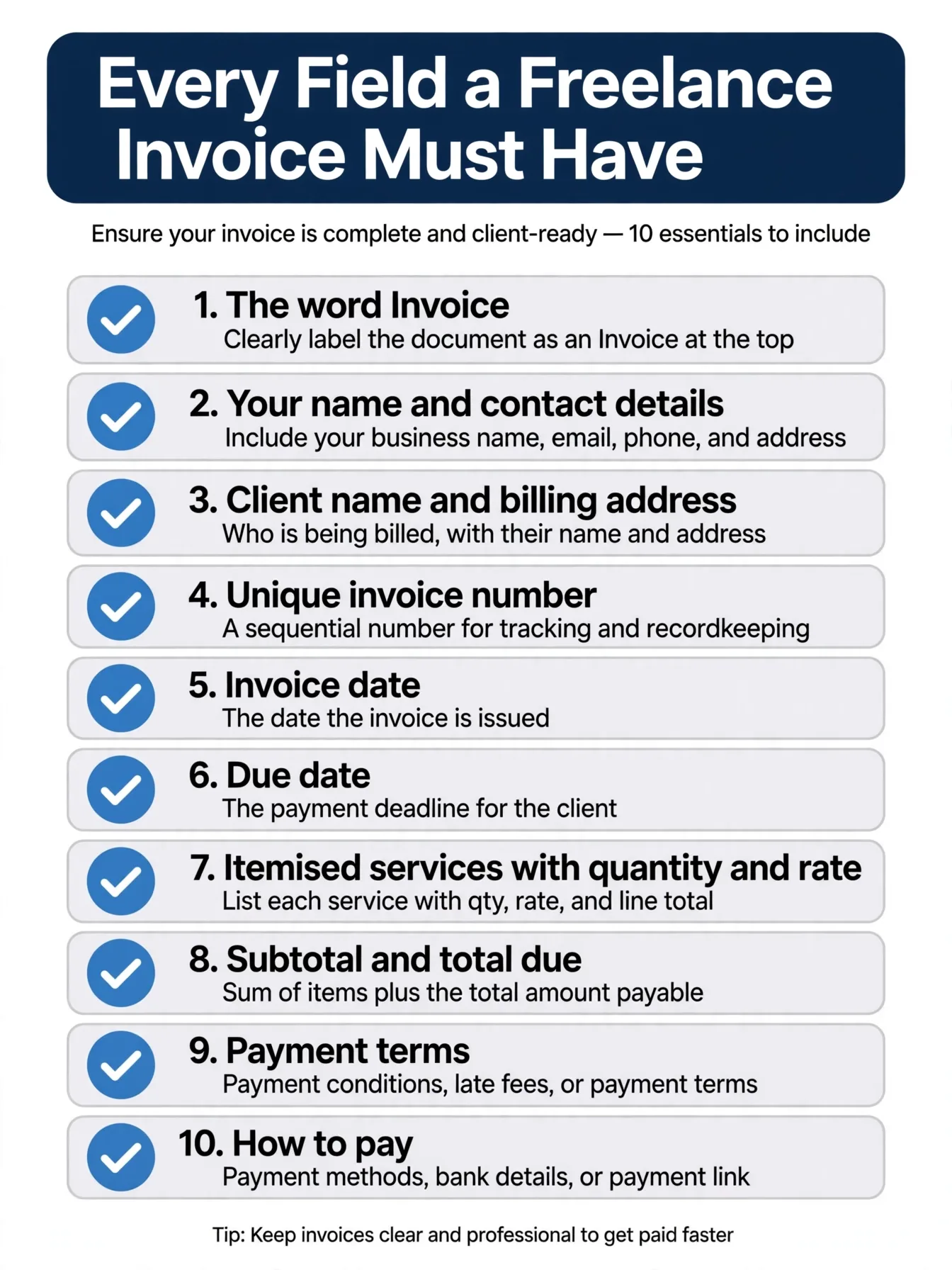
Every freelance invoice needs ten fields. They are the same ten fields whether you are a writer, a designer, or a developer, and whether the job is worth 150 dollars or 15,000 dollars. The checklist image above is the quick version. This section explains each field, why it exists, and what goes wrong when it is missing.
1. The word “Invoice” at the top. Label the document clearly. It sounds obvious, and it is the field people skip most often when they build an invoice in a hurry. The word tells the client’s accounts team, at a glance, that this document is a request for payment and not a quote, a statement, or a receipt. Put it at the top, in large type, where no one can miss it.
2. Your name and contact details. Your full legal name, or your business name if you work under one, plus your email address, phone number, and mailing address. If you have a logo, add it, but the name and contact details are what matter. The client needs to know who is asking for money and how to reach you if something is wrong. If you work under a business name, include your own name too, so the client knows the person behind the business.
3. The client’s name and billing address. The client’s full legal name or company name, the billing address, and the name and email of the person who asked for the work. Getting the client name exactly right matters more than it looks. A large company may have several departments, and an invoice addressed to the wrong one can sit unread for weeks. Ask for the exact billing name once, at the start of the project, and use it every time. If the client gave you a purchase order number, put it here too. An accounts team that works from purchase orders will not process an invoice without one.
4. A unique invoice number. Every invoice you send must have a number no other invoice has. The number is how you and the client find the invoice later, how you match a payment to a job, and how you prove to the IRS that your records are complete. The numbering systems are explained in their own section below. What matters here is that the field exists and the number is never reused.
5. The invoice date. The date you issued the invoice. This date starts the clock on your payment terms. If your terms are Net 30 and the invoice date is 14 November, the payment is due 14 December. Without an invoice date, no one can agree on when the 30 days started, and that is exactly the kind of argument that delays payment.
6. The due date. The calendar date the payment is due. Write the real date, not just the term. “Due: 14 December 2026” is clearer than “Net 30” on its own, because it removes any argument about when the 30-day clock started. Write both: the term and the date. That way the client sees the rule and the deadline in the same line.
7. Itemised services, with quantity and rate. This is the heart of the invoice. List each piece of work on its own line, with a clear description, the quantity, the rate, and the line total. A vague line such as “writing services, 2,175 dollars” invites questions. A specific line such as “Blog article: How to Start Freelancing, 4 articles at 450 dollars each” answers them before they are asked. The sample invoice below shows exactly how this looks.
8. Subtotal and total due. Add the line items into a subtotal, then show any adjustments, and then show the total amount due in large, clear type, with the currency stated. If a deposit was already paid, subtract it here and show the remaining balance, so the client can see the maths. Never make the client add the numbers themselves. The total is the one figure the whole document exists to communicate, so make it impossible to miss.
9. Payment terms. The payment terms line states when the money is due and what happens if it is late. The terms themselves are compared in their own section below. One rule belongs here: a late fee can only appear on your invoice if it was already agreed in the contract. An invoice cannot create new terms on its own. A fee that appears for the first time on an invoice was not agreed by the client and is hard to enforce, and it sours the relationship. My guide to late payment fees on a freelancer invoice explains the rules and the state laws behind them in full.
10. How to pay. Tell the client exactly how to send the money: bank transfer details, a payment link, or the address to send a check to. Include the reference the client should use, which is normally your invoice number. Never leave a client hunting for payment information. The easiest option is a payment link inside the invoice itself, so the client only has to click. If you offer more than one method, list them all. Two ways to pay are better than one, because a client who cannot use the first method will use the second instead of emailing you to ask.
Two things do not belong on an invoice. Do not put your Social Security Number on it. An invoice is a document that passes through several hands, and your Social Security Number should not travel with it. If the client needs your tax identification number, give it separately on a Form W-9, which is the IRS form for giving your correct taxpayer identification number to a person who must file an information return. And do not put a tax line on the invoice unless you have checked your own state’s rules. Sales tax on services is a state-by-state question. In many states a pure service such as writing is not taxed, but some states do tax certain services, so check your own state’s rules before you add a tax line or leave one out.
A Complete Sample Invoice, Explained Line by Line
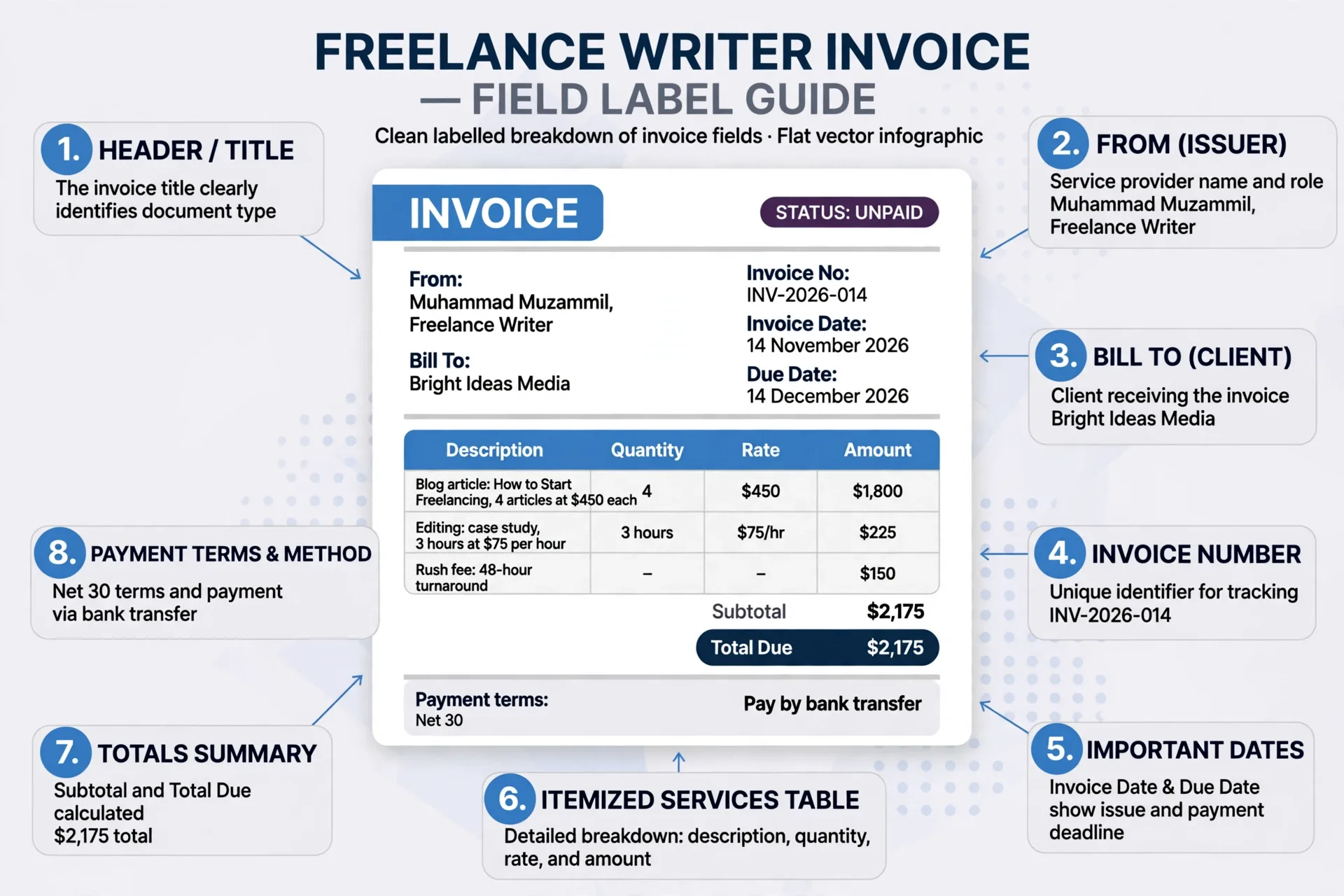
The image above is a complete sample invoice for a freelance writer, with every field labelled. The figures are a sample, not a real invoice: a writer billing a client called Bright Ideas Media for work done in November 2026. Walk through it line by line, because this is the template in use.
| Field | What the sample shows |
|---|---|
| Title | INVOICE, in large type at the top |
| From | Muhammad Muzammil, Freelance Writer |
| Bill To | Bright Ideas Media |
| Invoice number | INV-2026-014 |
| Invoice date | 14 November 2026 |
| Due date | 14 December 2026 |
| Line 1 | Blog article: How to Start Freelancing, 4 articles at 450 dollars each, 1,800 dollars |
| Line 2 | Editing: case study, 3 hours at 75 dollars per hour, 225 dollars |
| Line 3 | Rush fee: 48-hour turnaround, 150 dollars |
| Subtotal | 2,175 dollars |
| Total due | 2,175 dollars |
| Payment terms | Net 30 |
| How to pay | Pay by bank transfer |
Start with the three line items, because they are where most invoices go wrong. Line one is the main work: four blog articles, each one named, at 450 dollars each, for 1,800 dollars. The description names the article, because a client who ordered several pieces wants to see which ones are on this invoice. The quantity is 4 and the rate is 450 dollars, so the maths is visible: 4 times 450 is 1,800. Line two is hourly work: editing a case study, three hours at 75 dollars an hour, for 225 dollars. Hours are the quantity and the hourly rate is the price, and the description says what the hours were spent on. Line three is the extra: a 150 dollar rush fee for a 48-hour turnaround. Anything extra you agreed to goes on its own line with the reason, so nobody thinks it is a mistake. A fee with no explanation looks like an error. A fee with a reason looks like what it is: work you were asked to do faster.
Now look at the top of the invoice. The “From” block says who is billing, and the “Bill To” block says who is being billed. The invoice number is INV-2026-014, which tells the reader this is the fourteenth invoice of 2026 in a year-prefixed sequence. The invoice date is 14 November 2026, and the due date is 14 December 2026, which is exactly 30 days later, matching the Net 30 terms printed at the bottom. The total due is 2,175 dollars, which is the subtotal, because there is no tax line and no deposit to subtract. If a deposit had been paid, the invoice would show the subtotal, then a line subtracting the deposit, then the remaining balance as the total due.
Notice what the sample does not do. It does not lump the work into one line. It does not leave the due date to be worked out from the terms. It does not hide the payment method. And it does not invent a tax line. Every figure on it can be checked by the client’s accounts team in under a minute, and that is the standard your own invoices should meet. If your invoice needs a phone call to explain it, the invoice is not finished yet.
Copy this structure for your own work. Change the client, the dates, the descriptions, the quantities and the rates, and keep everything else the same. If you bill by the hour, your line items will look like line two of the sample. If you bill by the piece, they will look like line one. If you bill by the project, the line item will be the project or the milestone, with the agreed fee as the amount. The template takes any of them. What changes is what goes in the quantity and the rate columns, not the shape of the document.
How to Number Your Invoices
Every invoice needs a unique number, and the numbering system is yours to choose. There is no law that tells you which system to use. What matters is that the system is simple, that no number is ever used twice, and that there are no unexplained gaps, because gaps make an accounts team wonder whether an invoice is missing. Pick one system and use it for every invoice.
The simplest system is plain sequential numbering: INV-001, INV-002, INV-003, and so on. It is easy to remember and easy to search. The most useful system for most freelancers is year-prefixed sequential numbering: INV-2026-001, INV-2026-002, and so on, starting again at 001 each January. The year prefix makes it easy to sort invoices by year, which is exactly what you want at tax time, and the sample invoice in this guide uses this system. A third system is client-prefixed numbering: ACME-001, ACME-002 for one client, and a different prefix for the next. That works well if you invoice a small number of clients many times each, because all of one client’s invoices sit together in sequence.
Whichever system you choose, follow three rules. First, never reuse a number, even if an invoice was cancelled. A cancelled invoice keeps its number, and the next invoice takes the next number, because reusing a number makes two different documents share one identity. Second, never skip numbers without a note. If you void an invoice, keep a record that says it was voided and why. Third, do not restart your numbering at random. If you restart each year, the year prefix must change with it, so INV-2026-001 and INV-2027-001 are clearly different invoices. Software can generate numbers for you automatically, which removes the whole problem, but a spreadsheet with a running list works just as well if you check it before each new invoice.
The number also does quiet work in a dispute. If a client says they never received an invoice, the number lets you both point at the same document. If a client pays the wrong amount, the number tells you which invoice the payment belongs to. And if the IRS ever asks about your income, a clean, unbroken sequence of invoice numbers is the simplest proof that your records are complete. A freelancer with invoice numbers 001 to 047 and no gaps has a story the numbers tell for themselves.
Payment Terms: Net 15, Net 30, or Due on Receipt?
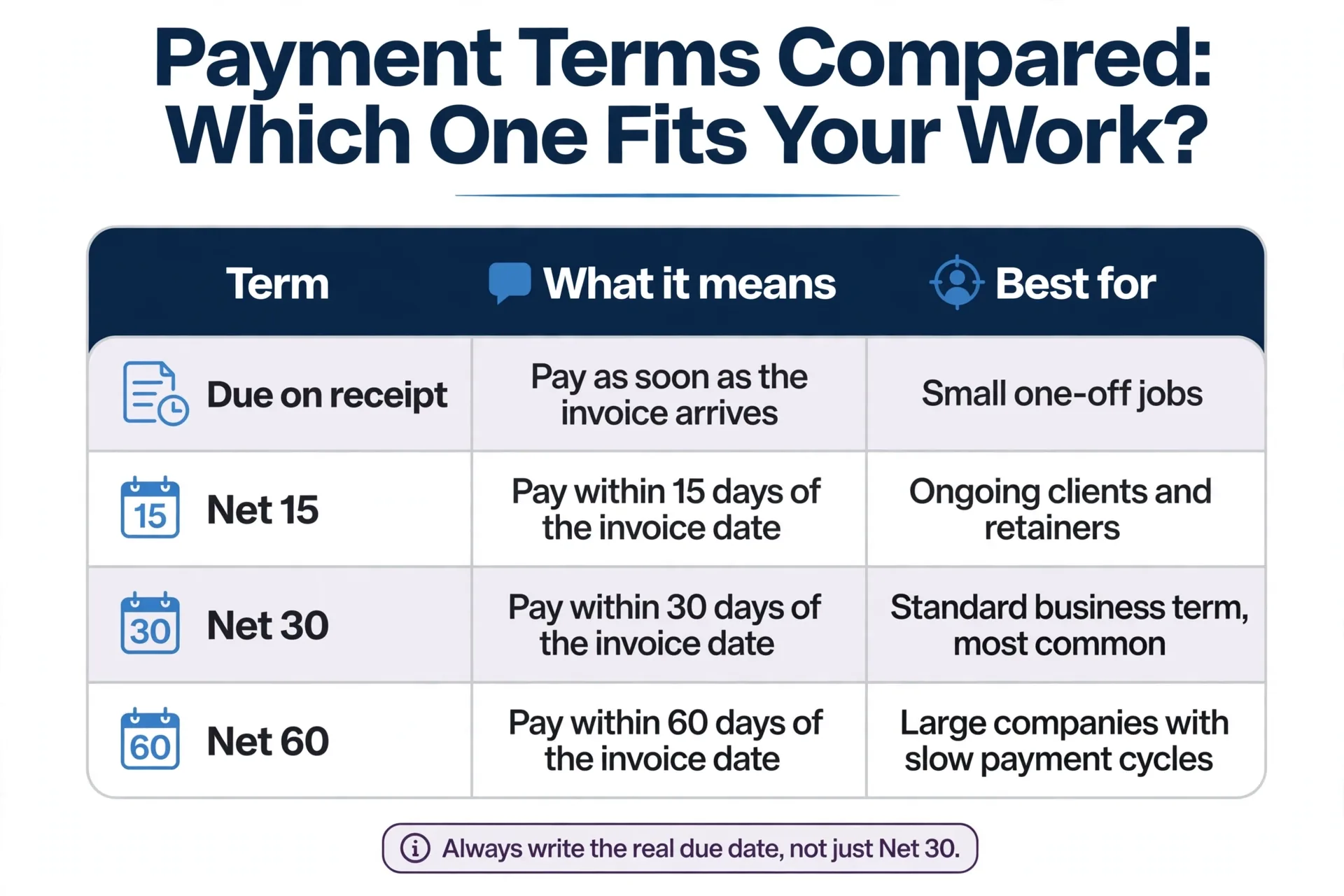
Payment terms are the part of the invoice that says when the money is due. The word “Net” followed by a number means the client has that many days from the invoice date to pay. Net 15 means 15 days. Net 30 means 30 days. Net 60 means 60 days. The comparison image above, and the table below it, lay out the four common choices.
| Term | What it means | Best for |
|---|---|---|
| Due on receipt | Pay as soon as the invoice arrives | Small one-off jobs |
| Net 15 | Pay within 15 days of the invoice date | Ongoing clients and retainers |
| Net 30 | Pay within 30 days of the invoice date | Standard business term, most common |
| Net 60 | Pay within 60 days of the invoice date | Large companies with slow payment cycles |
Net 30 is the standard business term and the most common choice for freelancers. It is what most companies expect, and it is what most accounts teams are set up to process. For a new client, Net 30 is the safe default. For a client you have worked with for a while and trust, Net 15 is better, because it shortens the wait without looking aggressive. The tighter the terms, the faster you get paid, and the less likely the invoice is to be forgotten. A Net 60 term sounds generous and flexible, but the extra time makes it more likely the client forgets the invoice entirely, so I only accept Net 60 when a large company insists on it and the work is worth the wait.
Due on receipt fits small, one-off jobs, where the amount is modest and the work is already delivered. It is a fair ask when there is nothing left to wait for. Two other terms belong in this section even though they are not Net terms. Payment in advance means the client pays part or all of the fee before the work starts, which is the right choice for a new client or a large project. Milestone payments mean you are paid at set stages of a project, with an invoice after each milestone, which is the right choice for long projects where you do not want to carry weeks of unpaid work. A deposit, normally part of the fee paid upfront, works the same way, and my guide to the time tracking and invoicing workflow shows how milestone and hourly billing turn into invoice line items.
Two practical rules close this section. First, agree the terms in the contract before the work starts, and then repeat them on the invoice. The invoice repeats terms that already exist. It does not invent them. Second, always write the real due date next to the term. “Payment terms: Net 30. Due date: 14 December 2026” leaves no room for argument. A term on its own leaves room for a client to count the days differently, and that difference is paid for with your time.
One more thing worth knowing. Some states have laws that protect freelancers on payment timing. New York State, for example, has a law in effect since 28 August 2024 under which a freelancer must be paid on the date set in the contract, or, if no date was agreed, no later than 30 days after the work is completed. Illinois and California have similar laws. These laws apply where a written contract exists, and the detail, including the thresholds and the remedies, is in my late payment fees guide. The practical lesson for your template is simple: a written due date on the invoice, agreed in the contract, is what makes those protections usable.
How to Send Your Invoice
- Finish the work, then invoice the same day. Send the invoice as soon as the work is accepted, while the project is fresh in the client’s mind. An invoice sent a month after delivery looks like an afterthought, and it is treated like one.
- Check every field before you send it. Read the invoice once as if you were the client’s accounts team. Is the client name right? Is the invoice number new? Do the line items add up to the total? Is the due date a real calendar date? Is the payment method there? One wrong number costs more time than the check does.
- Save it as a PDF with a clear filename. Save the invoice as a PDF named after its number and client, for example Invoice-INV-2026-014-Bright-Ideas-Media.pdf. A PDF cannot be edited by accident, and a clear filename means you can find it in seconds at tax time.
- Send it by email to the right person. Send the invoice to the person who asked for the work, and copy the accounts contact if you have one. A short, polite email is enough: thank the client, attach the invoice, state the total and the due date in the email itself, and invite questions. Sending it to a general inbox instead of a named person is the most common reason an invoice goes unread.
- Record it the same day. Log the invoice number, the client, the amount, the date sent, and the due date in your records the day you send it. Then set a reminder for the due date, so you know the moment it passes unpaid. An invoice you cannot find is an invoice you cannot chase.
Send the invoice by email in almost every case. A PDF attached to a short email is the standard, and it gives you a sent date you can point to later. Invoicing software can send the invoice for you and add a payment link, which is worth using when your volume grows. What matters is not the channel but the record: you should always be able to say, for any invoice, when it was sent, to whom, and for how much. That record is what turns a polite reminder into a firm one, and a firm one into a legal step, if it ever comes to that.
What to Do When a Client Ignores Your Invoice
A good template reduces ignored invoices, but it cannot eliminate them. Sometimes a client goes quiet after the work is done, and the invoice sits unpaid past its due date. When that happens, the invoice itself becomes the starting point for the chase, because it holds the number, the date, and the amount you will refer to in every message. I learned this the hard way when a client disappeared on payment day, a story I tell in full in my guide to collecting unpaid invoices as a freelancer.
The short version is this: send a short, calm reminder the day after the due date, referencing the invoice number and the amount. If there is no reply, call the client. If that fails, send a formal overdue notice. After 30 days with no movement, the options become legal ones, including small claims court. The full escalation, with email wording and a timeline, is in my guide to invoicing a client who ignores you. This post does not repeat that workflow, because it is already written there, and repeating it here would only make both guides harder to keep accurate. What belongs here is the connection between the two: the invoice you send today is the document the escalation runs on tomorrow. A complete invoice makes the chase short. An incomplete one makes it long.
One warning from that experience. Do not keep working for a client who has not paid an overdue invoice. New work for a client who owes you money is a loan you did not agree to give. Finish the chase first, and only then take the next job from them, with payment in advance.
Common Invoice Mistakes That Delay Payment
Most late payments are not caused by bad clients. They are caused by small gaps in the invoice. Here are the mistakes I see most often, including ones I made myself when I started.
Sending the invoice late. The most expensive mistake. Every day between finishing the work and sending the invoice is a day the client is not thinking about paying you. Send it the day the work is accepted.
Leaving out the due date. Terms without a date invite argument. A client who has to work out the due date will work it out in their own favour, or not at all. Write the real date.
Vague line items. “Writing services, 2,175 dollars” tells the client nothing. It invites an email asking what the figure covers, and that email costs days. Name the work, the quantity, and the rate on every line.
Wrong maths. Line items that do not add up to the total destroy trust instantly. An accounts team that finds one wrong number will check every number, and the invoice will wait while they do. Add the figures twice before you send.
No invoice number, or a reused one. Without a unique number, the client cannot find your invoice in their system, and you cannot prove which invoice a payment belongs to. Number every invoice, and never reuse a number.
Missing payment instructions. An invoice that says what is owed but not how to pay it is unfinished. Include the payment method, the details, and the reference to use, which is normally the invoice number.
Inventing a late fee on the invoice. A late fee that was never agreed in the contract cannot be created by writing it on the invoice. Agree it first, in writing, and then repeat it on the invoice. A surprise fee does not get you paid faster. It gets you an argument.
Sending it to the wrong person. An invoice sent to a general inbox, or to the person who commissioned the work when accounts handles payment, can sit unread for weeks. Find the right contact, and send it to them by name.
Forgetting your own rate. This is a quieter mistake, and it happens before the invoice is written. If your rate does not cover your costs and your tax share, the invoice will be accurate and the business will still lose money. Before you put a rate on an invoice, work it out properly with my freelance hourly rate calculator, which helps you price work so the tax share is already inside the rate you quote instead of something you have to find afterwards.
Invoice Record-Keeping for Taxes
Your invoices are not just requests for payment. They are tax records, and the IRS expects you to keep them. The good news is that the IRS does not demand a special kind of record. Its recordkeeping guidance says you may choose any recordkeeping system suited to your business that clearly shows your income and expenses, and that except in a few cases, the law does not require any special kind of records. A folder of saved invoice PDFs, with a simple list of what was sent and what was paid, is a recordkeeping system, as long as it clearly shows your income.
Good records help you monitor the progress of your business, prepare your financial statements, identify sources of income, keep track of deductible expenses, prepare your tax returns, and support the items reported on your tax returns. That is the IRS list, and your invoices are the first item on it: they are the proof of your income. Keep the sent invoice, keep the proof it was paid, and keep the contract and the delivery emails with it, so the whole job can be reconstructed from the file if anyone ever asks.
How long should you keep them? The IRS rule is that you must keep your records that support an item of income, deduction or credit shown on your tax return until the period of limitations for that tax return runs out. The general rule is three years. Keep records for six years if you do not report income that you should report and it is more than 25 percent of the gross income shown on your return. Keep records indefinitely if you do not file a return, or if you file a fraudulent return. And keep employment tax records for at least four years after the date the tax becomes due or is paid, whichever is later. My working rule is simple: keep every invoice for at least three years after the return it belongs to was filed, and keep the filed tax returns themselves forever, because they help in preparing future returns and in making computations if you file an amended return.
Build the habit into the sending process, so record-keeping never becomes a separate chore. Save the PDF with a clear filename, log the invoice in your list the day you send it, and mark it paid the day the money arrives, with the payment date and the reference the client used. At the end of the year, your list of invoices is your income for the year, and your tax return is a summary of that list. The freelancers who struggle at tax time are rarely the ones with complicated taxes. They are the ones who cannot find their invoices.
Frequently Asked Questions
What should a freelance invoice include?
Your name and contact details, the client’s name and billing address, a unique invoice number, the invoice date and the due date, itemised services with quantity and rate, the subtotal and total due, the payment terms, and how to pay. Label the document “Invoice” at the top. Do not put your Social Security Number on it; give your tax ID separately on a Form W-9 if the client asks for it.
How do I make an invoice as a freelancer?
Start with a template that has all ten fields, fill in the job-specific facts, check the maths, save it as a PDF with a clear filename, and email it to the right person the day the work is accepted. A document in Word or Google Docs works well for a handful of invoices a month; invoicing software earns its keep when the volume grows.
What is a good invoice template for freelancers?
A good template has fixed places for your details, the client’s details, a unique invoice number, the dates, an itemised list of the work with quantity and rate, the subtotal and total due, the payment terms, and the payment instructions. It stays the same from job to job, so only the job-specific facts change, and it can be read and approved by a client’s accounts team in under a minute.
Do I need an invoice number on every invoice?
Yes. Every invoice must have a unique number that no other invoice has. The number is how you and the client find the invoice later, how you match a payment to a job, and how you prove your records are complete. Common systems are plain sequential numbering, year-prefixed numbering such as INV-2026-014, and client-prefixed numbering.
What does Net 30 mean on an invoice?
Net 30 means the client has 30 days from the invoice date to pay. Net 15 means 15 days, and Net 60 means 60 days. Always write the real due date next to the term, for example “Payment terms: Net 30. Due date: 14 December 2026”, so there is no argument about when the clock started.
What payment terms should I use as a freelancer?
Net 30 is the standard business term and the safe default for a new client. Net 15 is better for a client you trust, because it shortens the wait. Due on receipt fits small one-off jobs. Agree the terms in the contract before the work starts, and repeat them on the invoice.
How do I send an invoice to a client?
Email a PDF to the person who asked for the work, and copy the accounts contact if you have one. Keep the email short: thank the client, attach the invoice, state the total and the due date in the email itself, and invite questions. Then record the invoice the same day and set a reminder for the due date.
Should I charge sales tax on a freelance invoice?
It depends on your state. Sales tax on services is a state-by-state question. In many states a pure service such as writing is not taxed, but some states do tax certain services. Check your own state’s rules before you add a tax line or leave one out, and do not guess.
What happens if a client ignores my invoice?
Send a short, calm reminder the day after the due date, referencing the invoice number and the amount. If there is no reply, call the client, then send a formal overdue notice. After 30 days with no movement, the options become legal ones, including small claims court. The full escalation is in my guide to invoicing a client who ignores you.
How long should I keep my invoices?
Keep the records that support an item of income on your tax return until the period of limitations for that return runs out. The general IRS rule is three years. Keep records for six years if unreported income is more than 25 percent of the gross income on your return, and keep employment tax records for at least four years. Keep your filed tax returns forever.
Sources
- Internal Revenue Service, Recordkeeping: https://www.irs.gov/businesses/small-businesses-self-employed/recordkeeping
- Internal Revenue Service, How Long Should I Keep Records?: https://www.irs.gov/businesses/small-businesses-self-employed/how-long-should-i-keep-records
- Internal Revenue Service, About Form W-9: https://www.irs.gov/forms-pubs/about-form-w-9
- FreshBooks, How to Invoice as a Freelancer 2026: https://www.freshbooks.com/hub/invoicing/invoice-as-freelancer
- PayPal, Freelance Invoice Template: https://www.paypal.com/us/brc/article/freelancer-invoice-template-online
- HoneyBook, How to Invoice as a Freelancer: 8 Must-Haves: https://www.honeybook.com/blog/invoice-as-a-freelancers
- Billgrid, Freelance Invoice Template: https://www.billgrid.com/invoice-templates/freelance
I am not a lawyer, and this post is general information, not legal advice. If a project is worth a meaningful amount of money, or a dispute has already started, talk to a licensed attorney in your state before you act.
