

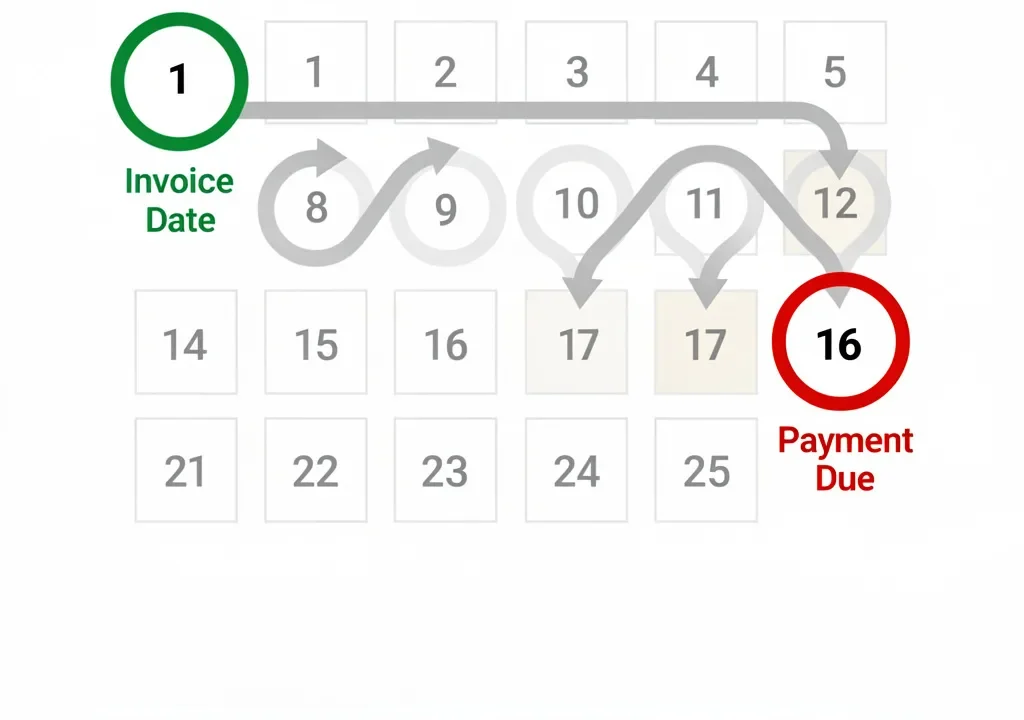
Three misunderstandings about Net 15 cause a disproportionate share of late-payment pain. Freelancers assume the 15 days are business days. They assume payment is due on the 15th of the month. And when neither works out, they assume the term on their invoice cannot be enforced anyway. Each assumption is wrong, and each one quietly hands the client extra weeks of your money.
The confusion is understandable. Clients’ accounts teams start the clock when an invoice is approved or logged, not when you sent it, and few contracts say which reading applies. Meanwhile a recurring monthly invoice can make Net 15 look like a fixed calendar date when it is not. None of this requires a bad client, just an undefined term.
This post takes the three myths in turn, shows what Net 15 actually means in each case, and gives the contract wording that prevents the dispute before it starts. For the full mechanics, definitions, due-date calculations and software setup, the complete Net 15 guide on this site goes deeper.
Myth 1: Net 15 Means 15 Business Days
This distinction deserves its own section because it causes so much real world confusion.
Calendar days include every single day on the calendar. Weekends, bank holidays, national holidays, everything. This is the default interpretation of net 15 unless stated otherwise.
Business days exclude weekends and officially recognized public holidays. A net 15 business days agreement could effectively give the client 21 or more calendar days to pay, depending on how many weekends and holidays fall within that window.
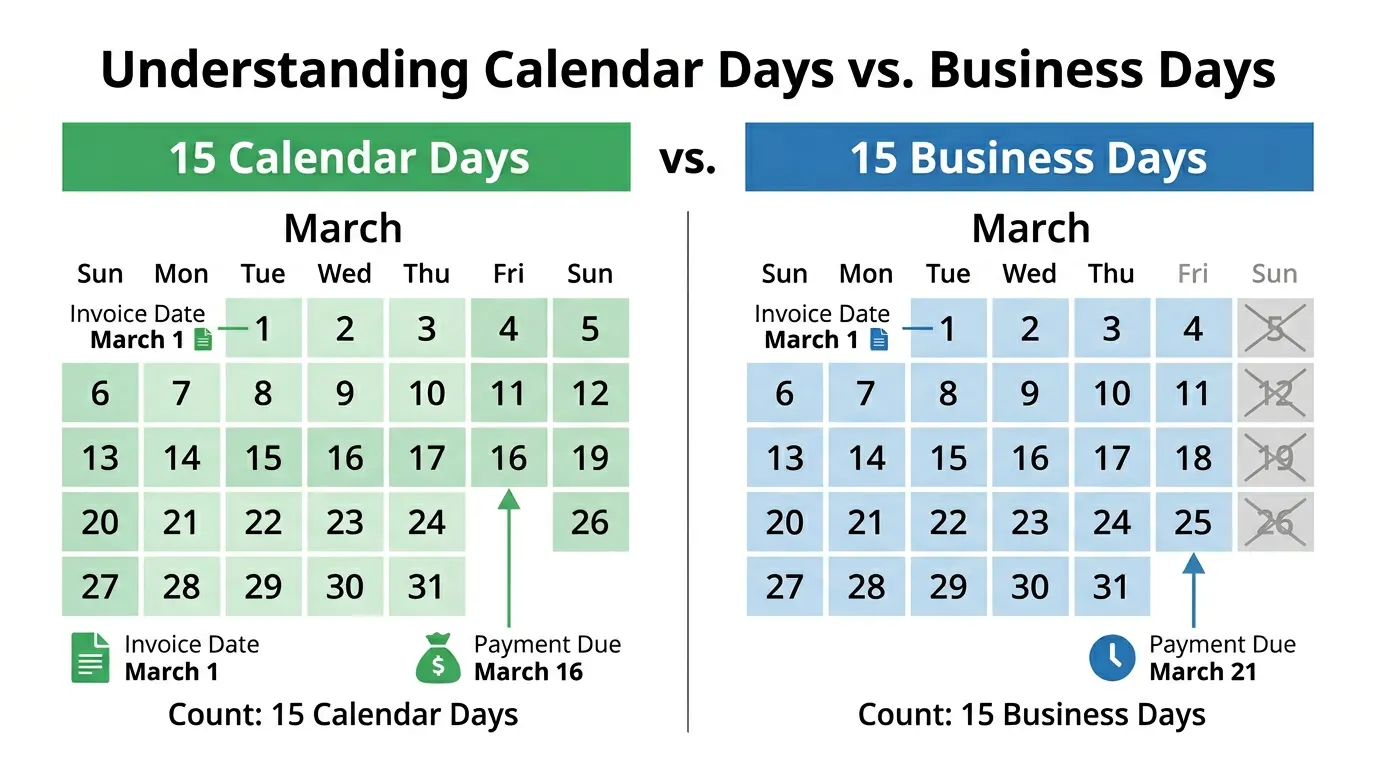
From a cash flow management perspective, always specify which type of days you mean. Write it clearly. Do not assume the client will interpret it the same way you do.
Consider the following scenario:
The Scenario: Consider an SEO content writer who finishes a batch of 8 articles for a client. The rate is $150 per article. Total invoice amount: $1,200.
- Invoice Date: Tuesday, March 3rd, 2026
- Payment Terms: Net 15
- Payment Due Date: Wednesday, March 18th, 2026
The writer sends the invoice by email. The client receives it. Their accounts payable team processes it. By March 18th, $1,200 should land in the writer’s bank account.
That is a clean net 15 transaction. Simple. Professional. Clear.
But what happens in reality? Sometimes the client does not start the 15 day clock on the invoice date. Sometimes they start it on the day their manager approves the invoice. Sometimes they start it on the day their accounting software logs the document. These discrepancies are real. And they are the root cause of most net 15 payment disputes.
The fix is to address this in your contract before work begins. State explicitly: “The 15 day payment period begins on the date printed on the invoice, regardless of internal approval timelines.” That sentence reduces the risk of clock-start disputes.
Myth 2: Net 15 Means Payment on the 15th of the Month
A recurring-service business that invoices on the 30th of each month for that month’s services, with payments due by the 15th of the following month for clients not on autopay, is a real-world version of this structure. That is technically a variation of net 15 but calculated differently, using a fixed calendar date rather than counting forward from the invoice date. That approach is sometimes called EOM Net 15, which is explained just below.
What Does Net 15 EOM Mean?
Net 15 EOM means that the invoice is due 15 days after the end of the month in which it was issued.
EOM stands for End of Month. This is a completely different calculation from standard net 15.
Real example: You issue an invoice on March 5th. Under standard net 15, payment is due March 20th. Under net 15 EOM, payment is due April 15th (15 days after March 31st). That is a 41 day wait instead of a 15 day wait.
That recurring-service example used a version of this approach. They invoiced on the 30th of each month and required payment by the 15th of the following month. That structure works well for recurring service businesses with monthly billing cycles but is significantly slower than standard net 15 from a cash flow perspective.
Net 15 for Recurring Monthly Invoices
If you bill clients on a monthly retainer, you have two clean options. You can use standard net 15 (payment due 15 days after each monthly invoice date) or you can use a fixed date system (all invoices due on the 15th of the month following the service period). The second option simplifies your own bookkeeping but usually extends your actual wait time.
Myth 3: Net 15 Terms Cannot Be Enforced
Enforcing net 15 payment terms requires a combination of a signed contract, a clear late fee policy stated on every invoice, and a consistent follow-up system starting on day 16. The SBA also outlines financing options for businesses carrying outstanding invoices.
Myths 1 and 2 are about what the term means. This one is about whether it has any force behind it. A net 15 term does nothing by itself: it works only when the contract, the invoice and your follow-up all say the same thing.
Protect Your Net 15 Payment Terms With Late Fees
A late fee is one of the most effective enforcement tools available to freelancers and small businesses. It works not because clients fear the fee itself (though some do) but because it signals that you take your payment terms seriously and will not silently absorb non-payment.
The standard approach is a percentage based monthly late fee. Commonly cited rates range from 1% to 1.5% per month on the outstanding balance, but caps vary by state, 1.5% monthly equals 18% annually, which exceeds some states’ ceilings, so always use the lesser of your rate or the legal maximum. Some freelancers prefer a flat fee per week of delay. Both work. The key is that the fee must be disclosed before the work begins, written into the contract, and printed clearly on every invoice.
Here is language you can use on your invoices:
“A late fee of 1.5% per month will be applied to any invoice balance unpaid after the payment due date.”
Simple. Clear. Non-threatening in tone but completely firm in intent. Read next: how to set late payment fees that actually hold up.
The Deposit Strategy for Net 15 Payment Terms
A deposit changes the whole shape of a late payment. Ask for 30% to 50% before work begins and three things follow. You have cash in hand to cover your costs while the project runs. The client has money in the project too, which tends to concentrate their mind. And if they vanish after delivery, the amount you are chasing is the balance, not the whole fee.
When you combine an upfront deposit with net 15 terms for the remaining balance, you build a payment structure that is genuinely robust. The deposit protects you during the work phase. The net 15 term protects you after delivery. Even if a difficult client pushes back on the final payment, you have already collected a meaningful portion of your fee.
What to Do When a Net 15 Invoice Goes Unpaid
Day 16 arrives. No payment. Your first move should always be a calm, professional reminder email. Not angry. Not passive aggressive. Direct.
Here is a simple template:
Subject: Invoice #[number] Past Due
Body: “Hi [client name], I am following up on Invoice #[number] for $[amount], which was due on [date]. Please let me know if you need a copy of the invoice or have any questions about the payment. I appreciate your prompt attention to this.”
Send that on day 16. If you get no response by day 20, follow up again and mention the late fee that is now accumulating. If you get no response by day 30, consider escalating to a phone call or formal written notice depending on the size of the invoice.
For invoices above $1,000 that remain unpaid past 45 days, consider small claims court or speaking with a small business attorney. Many countries and US states have straightforward small claims processes for invoice disputes under specific dollar thresholds, so check your local court’s self-help pages to understand your options before you ever need them. Read next: the step-by-step process for collecting an unpaid invoice.
The Mechanics, in Brief
None of the three myths survives the basic mechanics, and the mechanics are short. Net 15 means the full amount is due within 15 calendar days of the invoice date, counted from the date printed on the invoice. A properly written invoice states that date, the term and the exact due date, and the complete Net 15 guide works through the due-date calculations and the invoice wording in full.
The same guide covers the questions this post leaves aside: how early-payment discounts such as 2/10 net 15 work, how net 15 compares with net 30, net 60, net 90 and due on receipt, how the invoices sit in your accounting and days sales outstanding, and how to negotiate the term with a client who pushes back.
What Net 15 Actually Costs You: A Worked Example
Payment terms sound like paperwork. They are actually a loan, you are lending the client the value of your work, interest-free, for the length of the term. A worked example makes the size of that loan visible.
Say you invoice a client $3,000 on the 1st of the month for work already delivered, and your monthly business and living costs run to about $2,400, roughly $80 a day. The only thing that changes below is the term on the invoice. The U.S. Small Business Administration makes the same point about conserving cash flow by managing payment terms.
On Net 15, payment arrives on day 15. You have carried the client’s cost for 15 days, and you need about $1,200 of your own money in reserve to bridge the gap between delivering the work and being paid for it. On Net 30, payment arrives on day 30. The bridge doubles to roughly $2,400, and at any moment after the first month you have a full $3,000 invoice permanently outstanding. On Net 60, payment arrives on day 60, by which time you have already delivered and invoiced a second month’s work. You now have $6,000 permanently outstanding, and before the first payment ever arrived you had to fund about $4,800 of expenses out of reserves or credit.
The pattern matters more than any single invoice. With a monthly recurring client, the term sets how much of your money lives in the client’s bank account instead of yours: roughly half a month’s billing on Net 15, a full month on Net 30, and two full months on Net 60. That is money you cannot use for tax payments, software, or a quiet month’s cushion. See also: how Net 30 compares, in full.
There is also a financing cost if the gap pushes you onto credit. Covering a $3,000 shortfall for the extra 45 days that Net 60 adds over Net 15, at a typical credit-card rate of 24% APR, costs about $89 per invoice in interest (3,000 × 0.24 × 45 ÷ 365). Repeated monthly, that is over $1,000 a year, paid by you, for the privilege of being paid late, on terms you agreed to.
None of this means Net 30 or Net 60 is always wrong. A large, reliable client may be worth the wait, and the maths above is exactly how you price that decision: if a client insists on Net 60, you know the term is worth roughly $89 per $3,000 invoice in financing alone, before the risk that a longer wait means a higher chance of chasing, disputes, or non-payment. You can respond with a deposit, milestone billing, a rate that reflects the term, or a shorter term for the first project.
What you cannot do is treat the term as a formality. Fifteen days either way is real money, and now you can calculate exactly how much.
Common Mistakes That Sabotage Your Net 15 Payment Terms
Most net 15 disputes trace back to one of the six mistakes below. None of them is exotic. They are small omissions, usually made before the work even starts, that only become visible when a payment does not arrive.
Mistake 1: Not specifying the clock start date in your contract.
Always state that the 15 day period begins on the invoice date printed on the document. Do not leave this undefined.
Mistake 2: Sending the invoice to the wrong person.
Sending your invoice to your day-to-day project contact instead of the accounts payable department adds days of internal forwarding time to your payment cycle. Always ask, during the project kickoff phase, who should receive invoices and what information they need on the document.
Mistake 3: Missing required information on the invoice.
Many corporate clients will not process an invoice that is missing a purchase order number, vendor ID, or other specific internal reference. Find out what they require before you send the invoice. Receiving a request for missing information on day 12 of your 15 day window is genuinely frustrating.
Mistake 4: No late fee policy.
An invoice without a late fee policy is a document without consequences. It communicates that late payment is acceptable. It is not.
Mistake 5: Only following up once.
One reminder email after the due date is not an enforcement strategy. It is a hope. Build a follow-up sequence: day 16 email, day 20 follow-up email mentioning the late fee, day 30 phone call or formal written notice, day 45 escalation decision.
Mistake 6: Accepting verbal agreements on payment terms.
If it is not in writing, it is much harder to prove. Every payment term agreement must be in a signed contract or at minimum confirmed in writing by email before any work begins.
Trending FAQs: Net 15 Payment Terms
Does net 15 include weekends?
Yes. Unless your terms specifically state “net 15 business days,” weekends and public holidays count toward the 15 day window.
Can I charge a late fee on a net 15 invoice?
Yes. As long as your late fee policy is disclosed in your contract and printed on the invoice before the work begins, you can legally charge late fees in most jurisdictions. Always verify local laws for specific rates and notification requirements.
What does net 15 EOM mean?
Net 15 EOM means payment is due 15 days after the end of the month in which the invoice was issued. For an invoice dated March 5th, payment would be due April 15th under EOM terms.
What is 2/10 net 15?
2/10 net 15 is a discount term offering a 2% reduction on the invoice total if the buyer pays within 10 days. The full invoice amount is due within 15 days if the early payment discount is not taken.
What happens if I do not specify “calendar days” or “business days” on my net 15 invoice?
The default interpretation in most business contexts is calendar days. But to eliminate any ambiguity entirely, write it out explicitly on your invoice: “Payment due within 15 calendar days of invoice date.”
Does net 15 help with days sales outstanding (DSO)?
Yes. Consistently applied net 15 terms, when actually enforced, should drive your DSO toward 15. If your DSO remains high despite offering net 15 terms, enforcement is often the problem, though invoice errors and client approval delays can also play a part.
Can a client refuse to pay a late fee on a net 15 invoice?
They can try. But if the late fee policy was disclosed in the signed contract and printed on the invoice before work began, you have a legally documented agreement. For disputed late fees on smaller invoices, small claims court is a practical option. For larger disputes, consult a small business attorney.
That is the myths post in short: net 15 means 15 calendar days from the invoice date, not business days and not the 15th of the month, and it can be enforced with a late fee, a deposit and a consistent follow-up sequence. For the full mechanics behind each point, see the complete Net 15 guide.
This guide reflects current best practices as of 2026. Payment term laws and invoicing regulations vary by country and state. Always consult a qualified accountant or attorney for advice specific to your business situation.
