Introduction
Work made for hire is the legal phrase that decides who owns the work you create for a client. If your deliverable qualifies as a work made for hire, the client is treated as the author from the moment of creation, and you keep no copyright in it at all. If it does not qualify, you own the copyright by default, even though the client paid you in full. That one distinction shapes everything else in a freelance engagement: whether you can reuse the work, show it in your portfolio, license it to someone else, or stop a client from changing it. Most freelancers first meet the phrase in a contract they are about to sign, in a clause they have not read twice. This guide explains it the way I wish someone had explained it to me: the two routes the law allows, the nine categories that limit the second route, the assignment clause that saves the deal when the first route fails, and the new question AI has added on top, which is whether there is any copyright to own at all.
I am not a lawyer, and this is general information, not legal advice. But I have signed enough freelance agreements to know that the ownership clause is the part you read last and regret first. Read it first from now on.
What Is Work Made for Hire?
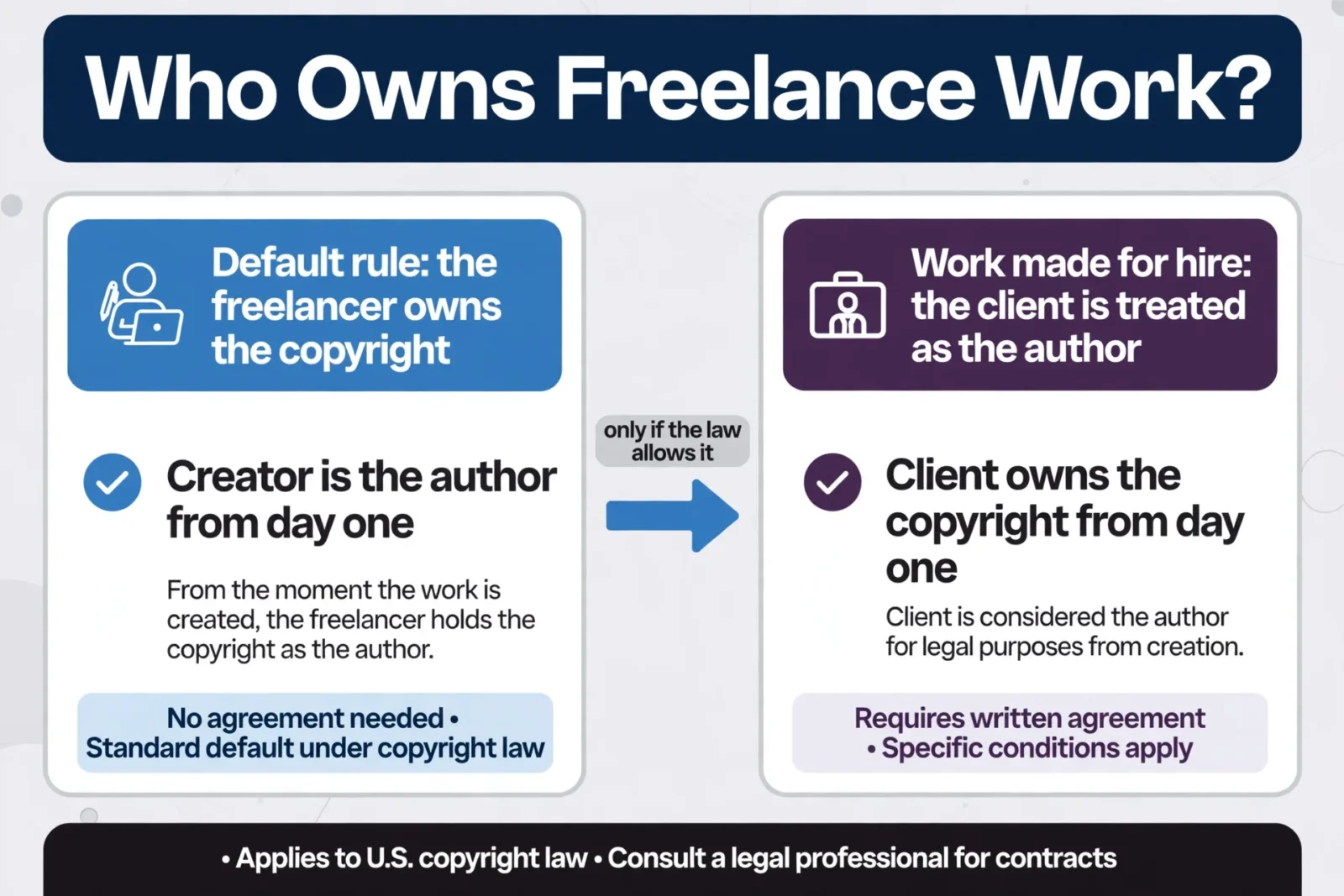
Under United States copyright law, the person who creates an original work owns the copyright in it automatically, from the moment the work is fixed in a tangible form. That is the default rule, and section 201(a) of the Copyright Act states it plainly: copyright vests initially in the author. If you write the article, design the logo, or build the website, you are the author, and the copyright is yours, unless something in the law moves it somewhere else.
Work made for hire is that something. It is a narrow exception to the default rule. When a work qualifies as a work made for hire, the law treats the employer or the client as the author instead of the person who actually made the thing. The client owns the copyright from day one, not because you transferred it, but because the law says the client was the author all along. Nothing was transferred, because in the eyes of the law you never held it.
That is why the phrase matters so much more than it looks. A normal copyright transfer, an assignment, starts with you owning the work and handing it over. A work made for hire skips that step entirely. And because there was never a transfer, there is also no later right to take the copyright back, which is a point I come back to below. The Supreme Court has said the distinction carries profound significance for freelance creators, and it was right. It decides who can sell the work, who can sue over it, who can license it, and how long the copyright lasts.
The Two Routes to a Work Made for Hire
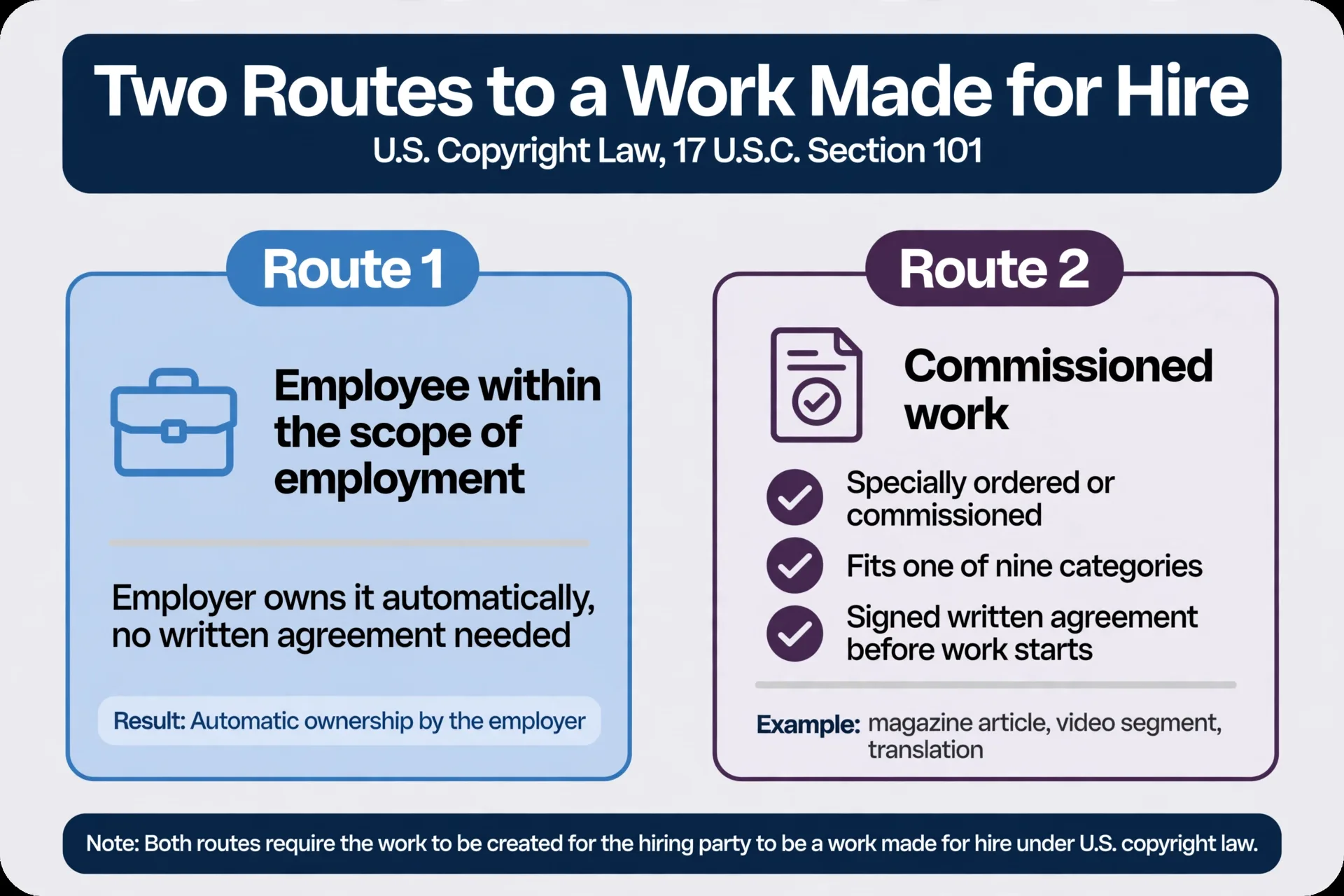
The law, in section 101 of the Copyright Act, allows exactly two routes. A work is a work made for hire if it is prepared by an employee within the scope of employment, or if it is specially ordered or commissioned for use in one of nine listed categories and both parties sign a written agreement saying so. There is no third route. If your situation does not fit one of these two, the work is not a work made for hire, whatever the contract says.
Route One: An Employee Working Within the Scope of Employment
If you are an employee and you create work as part of your job, your employer owns the copyright automatically. No written agreement is needed, though employment contracts usually say so anyway. A staff writer at a magazine, a designer on a company payroll, a developer employed by a software firm: the work they produce during their job belongs to the employer from the moment it is created.
Whether someone is really an employee is decided by common-law agency principles, not by the label on the contract. The Supreme Court set this out in Community for Creative Non-Violence v. Reid in 1989, and courts still use that approach. They look at how much control the hiring party has over how the work is done, who supplies the tools and the workplace, how the worker is paid and taxed, how long the relationship lasts, and whether the worker receives employee benefits. Calling someone an independent contractor in an invoice while treating them like an employee does not change the answer. If you want the full picture of how that classification works, my guide on employee vs independent contractor walks through the tests in detail.
Most freelancers are not on this route, and that is the point. If you are genuinely an independent contractor, route one does not apply to you, and your client has to use route two, which is much narrower.
Route Two: A Commissioned Work, in One of Nine Categories, With a Signed Agreement
For an independent contractor, the work qualifies only if three conditions are all met at the same time. First, the work must be specially ordered or commissioned, meaning the client asked for it and you made it for them. Second, the work must fall into one of the nine categories listed in section 101. Third, both parties must expressly agree in a written instrument, signed by both of them, that the work shall be considered a work made for hire. Miss any one of the three and the work is not a work made for hire. A signed clause alone cannot do the job if the category is wrong, and a perfect category cannot do the job if nobody signed anything.
The written agreement should be signed before the work is created. A retroactive work-made-for-hire designation, signed after the work already exists, is not valid under the law. If the work is finished and the paperwork was never done, the fix is not a backdated clause. It is a copyright assignment, which I explain below.
The Nine Categories, With Freelance Examples
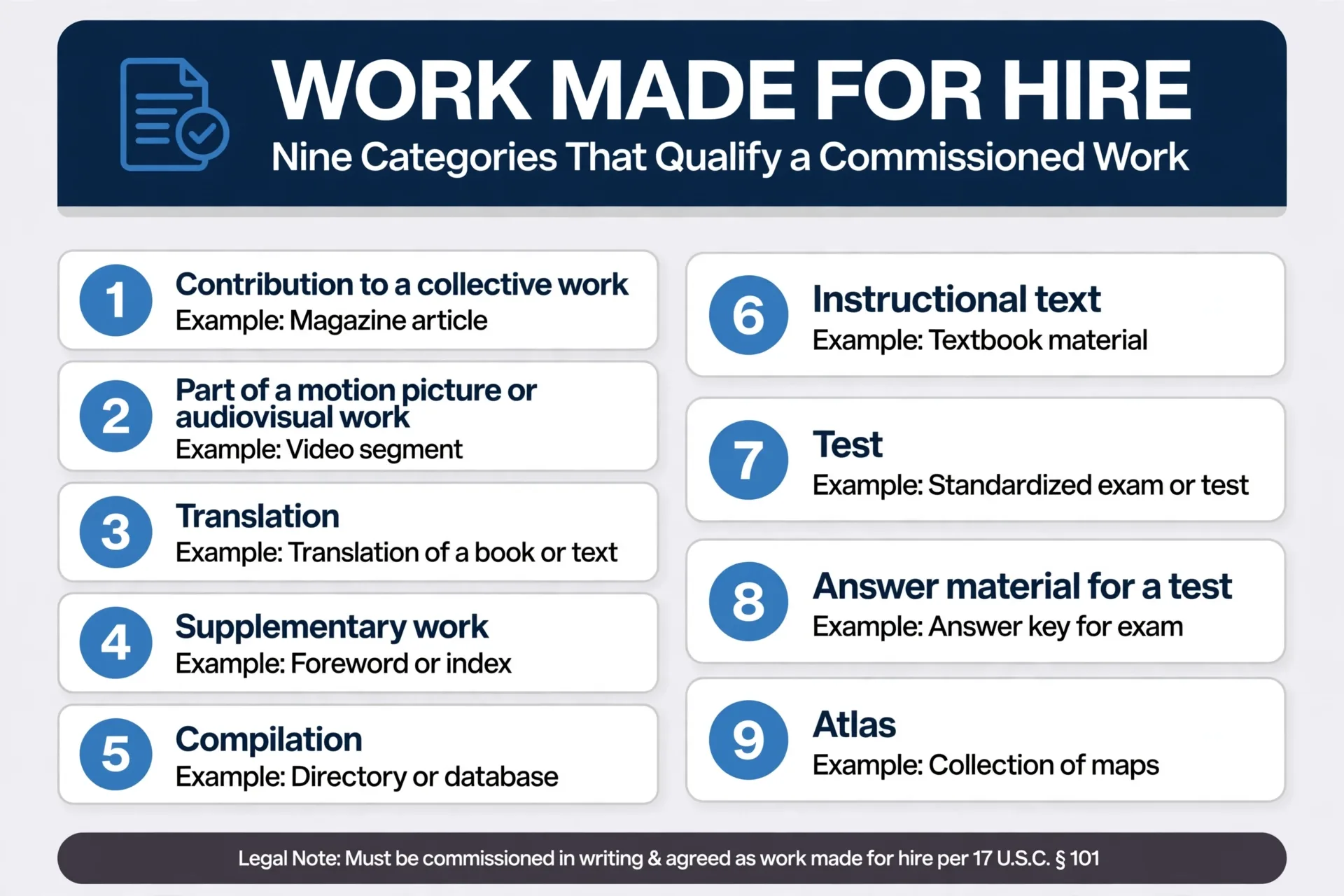
Here is the full list from section 101, with the kind of freelance work each one actually covers. Read it slowly, because this list is where most freelance contracts quietly fail.
- A contribution to a collective work. An article written for a magazine issue, a chapter written for an anthology, an entry written for an encyclopedia. The collective work is the magazine or the anthology; your piece is one contribution inside it. My freelance writing contract template is built around exactly this kind of work.
- A part of a motion picture or other audiovisual work. A segment of a video, a scene in a film, a piece of a training course. If you are hired to produce one part of a larger video production, this category can apply.
- A translation. Translating an existing work from one language into another, commissioned as a translation.
- A supplementary work. A work prepared for publication as a secondary addition to a work by another author, for the purpose of introducing, concluding, illustrating, explaining, revising, commenting on, or assisting in the use of that other work. Forewords, afterwords, pictorial illustrations, maps, charts, tables, editorial notes, bibliographies, appendixes, and indexes are the examples the statute itself names.
- A compilation. A work formed by collecting and arranging preexisting materials or data, such as a directory or a curated database, where the selection and arrangement is itself original.
- An instructional text. A literary, pictorial, or graphic work prepared for publication with the purpose of use in systematic instructional activities. Textbook material is the classic example, whether or not it is in book form.
- A test. A test prepared for use in an educational or assessment setting.
- Answer material for a test. The answer key or answer material that goes with a test.
- An atlas. A collection of maps in book form.
Notice how short and specific the list is. Congress drew it narrowly on purpose. It covers the kinds of work that publishers and producers traditionally commissioned from freelancers, and it leaves out most of what modern freelancers actually sell.
Where the Clause Fails: Logos, Software, Websites, and Marketing Copy
This is the trap, and it catches real contracts every day. A client hires a freelance designer to create a logo, pays in full, and the contract says all deliverables are works made for hire. The clause looks airtight. It is not. A standalone logo does not fit any of the nine categories. It is not a contribution to a collective work, not a translation, not a compilation, not an instructional text, and not any of the rest. The work-made-for-hire clause fails, and the designer keeps the copyright unless something else in the contract moves it.
The same problem hits the most common freelance deliverables. Standalone software code written by an outside developer is generally not an audiovisual work and not a compilation, so a work-made-for-hire clause alone does not transfer it. A custom website built from scratch is not in the list. An original marketing strategy document, a brand identity system, a set of social media graphics made as standalone pieces: none of these sit comfortably in any category. The contract can call them works made for hire as loudly as it likes. The law does not follow the label.
That does not mean the client gets nothing. It means the client needs the right tool, which is the next section. But it does mean the freelancer should never assume a work-made-for-hire clause in their contract is doing what it claims to do. For the client, the risk is paying for an asset they do not own. For the freelancer, the risk is the opposite: signing away rights the clause cannot actually take, and then discovering later that the real transfer happened through a different clause they never noticed.
Work Made for Hire vs Copyright Assignment
These two are constantly confused, and the difference is worth getting right, because it changes what you can do later.
A work made for hire means the client is treated as the author from the start. There is no transfer, because you never owned the copyright. A copyright assignment means you are the author first, and then you transfer the copyright to the client. The assignment has to be in writing and signed by you, the owner of the rights, under section 204(a) of the Copyright Act. An oral promise, a chat message, or an implied understanding cannot transfer copyright ownership.
The practical differences follow from that. An assignment can cover any copyrightable work, with no nine-category limit. A work-made-for-hire clause cannot. An assignment is a transfer, so the author who assigns rights can, in some cases, terminate that transfer after 35 years under section 203. A work made for hire has no transfer to terminate, so there is no 35-year termination right: the client keeps the copyright for its full term. And the copyright term itself is different. For a work made for hire, the copyright lasts 95 years from the year of first publication, or 120 years from the year of creation, whichever expires first, under section 302(c). For a work you create as an individual author, the term is generally your life plus 70 years.
Neither mechanism is good or bad on its own. What matters is knowing which one your contract actually uses, because the consequences are not the same.
The Belt and Suspenders Clause, and a Five Step Checklist
Experienced contract drafters do not choose between a work-made-for-hire clause and an assignment clause. They use both. The contract first says the deliverables are works made for hire to the fullest extent the law allows. Then, in the very next sentence, it says that to the extent any deliverable does not qualify as a work made for hire, the freelancer assigns all right, title, and interest in it to the client. That second sentence is the fallback, and it is what saves the deal when the deliverable turns out to be a logo or a piece of software instead of a magazine article.
The wording of the fallback matters. It should use present-tense language, such as “hereby assigns”, rather than a promise to assign later. A present assignment moves the rights the moment the work is created. A promise to assign in the future needs a second document to finish the job, and that second document is the one that never gets signed.
Whether you are the freelancer or the client, run this checklist before the work starts.
How to Protect Ownership in Your Next Freelance Contract
- Read the intellectual property clause before you sign anything. Find the work-made-for-hire and assignment language and read it as carefully as the payment terms. It decides who owns the work.
- Check whether your deliverable fits one of the nine categories. If it is a logo, standalone software, a website, or marketing copy, a work-made-for-hire clause alone will not transfer it. Make sure an assignment clause is there too.
- Add an assignment fallback clause. The contract should say that if any deliverable does not qualify as a work made for hire, the freelancer assigns all rights in it to the client, using present-tense language such as “hereby assigns”.
- Sign before the work starts. The written agreement must exist before creation begins. A clause signed after the work is finished cannot make it a work made for hire.
- Keep a signed copy and note any AI use in writing. Save the signed agreement where you can find it, and record in the agreement or in writing what AI tools were used on the deliverable, because that affects what copyright exists to transfer.
If the contract you are handed has no assignment fallback and your deliverable is outside the nine categories, ask for one before you sign. And if you are the client, ask for one before you pay. The independent contractor agreement template on this site shows how the two clauses sit together in a real agreement.
What Happens If There Is No Written Contract?
Many freelance jobs still start with an email and a handshake. When there is no written agreement at all, the law falls back on an implied non-exclusive license. Courts recognise that when a client commissions work and pays for it, the freelancer implicitly gives the client permission to use the work for the purpose it was made for. The client can use the logo on their website, or publish the article they paid for, and the freelancer cannot sue them for infringement the next day for doing exactly what was agreed.
But an implied license is thin protection for both sides. It is not exclusive, so the freelancer still owns the copyright and can license the same work to someone else, including a competitor, unless another agreement stops them. It usually does not include the right to change the work or build on it, so hiring a new developer to rework code delivered under an implied license can itself be infringement. And the client cannot sue anyone else for copying the work, because only the copyright owner has standing to bring an infringement claim. If a dispute over ownership ever reaches the point where someone is using your work without permission, my guide on the ways to end intellectual property rights violations sets out the practical steps. The larger lesson is simpler: get the ownership in writing before the work starts, because the implied license is a safety net with holes in it.
What AI Changes: There May Be No Copyright to Own
Everything above assumes the work has a copyright in the first place. AI has broken that assumption, and this is where the newest version of the question lives.
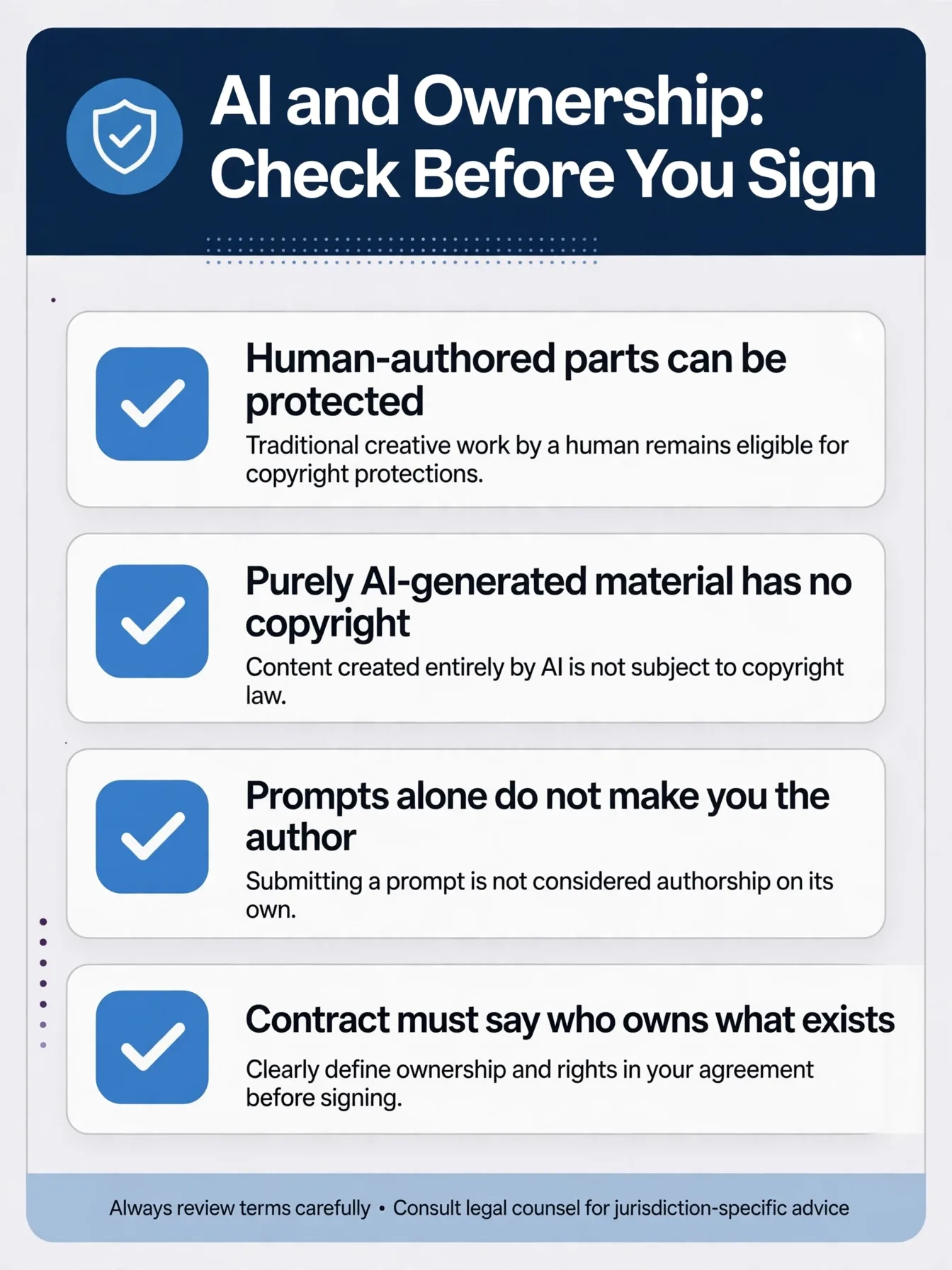
United States copyright law protects human authorship. The U.S. Copyright Office said so in its registration guidance of 16 March 2023, and it said so again in Part 2 of its Copyright and Artificial Intelligence report, published 29 January 2025. The position is consistent: copyright protects the original expression in a work created by a human author, even if the work also includes AI-generated material, but it does not extend to purely AI-generated material, or to material where there is insufficient human control over the expressive elements. The D.C. Circuit confirmed the same rule in Thaler v. Perlmutter in March 2025, holding that the Copyright Act requires a human author.
The part that surprises most freelancers is the Office’s conclusion about prompts. Based on how generally available AI tools work today, prompts alone do not provide sufficient control to make the person who wrote the prompt the author of the output. The Office compares a prompt to instructions given to a commissioned artist: the prompt says what you want depicted, but the system decides how the instructions are carried out, including the words, the structure, and the details. That is why a long and careful prompt still does not create a copyright in the output by itself.
What can be protected, in the Office’s own framing, is the human contribution. Three kinds of human contribution count: your own original work that is perceptible in the output, such as text or drawings you made and fed into the system; your creative selection, coordination, or arrangement of material in the output, such as choosing and ordering AI images alongside your own story; and your creative modifications of the output, such as rewriting or reworking AI material to a degree that the changes themselves are original. In each case, the protection covers only your contribution, not the AI-generated material itself. And if you register a work that contains AI-generated material, the Office requires you to disclose it and to claim only the human authorship.
For a freelancer, this creates a practical problem that the old contract language does not solve. A work-made-for-hire clause and an assignment clause both assume a copyright exists and move it from one person to another. But an assignment cannot transfer a right that never existed. If a contractor delivers a report that is almost entirely AI output accepted with no meaningful human contribution, there may be no copyright in it at all, and no clause in the contract can create one. The client paid for an asset they cannot own in the copyright sense, and the freelancer cannot sell what they do not own either.
The way through is contractual and practical rather than legal magic. First, the agreement should say plainly whether AI tools may be used on the deliverable, and require the freelancer to disclose what was used and how. Second, the deliverable should be built so that real human authorship is perceptible in it: your own drafting, your own editing, your own selection and arrangement, not a prompt and a paste. Third, read the AI tool’s own terms before you rely on them, because the terms decide what the tool provider claims and what you are allowed to do with the output, and they vary from product to product. Fourth, remember that even where no copyright exists, the contract can still control the work through other means, such as confidentiality and the agreed right to use it, so the ownership conversation does not end with copyright. And if the deliverable includes third-party material such as stock images, the licensing rules still apply on top of all of this, as my guide on stock photo copyright for freelancers explains.
What Freelancers Should Negotiate Before Signing
Ownership clauses are negotiable, and the negotiation is where a freelancer protects the parts of their work that matter to their future. Four points cover most of it.
First, portfolio rights. A work-made-for-hire arrangement gives you no right to show the work at all unless the contract says you can. Ask for a written right to display the work in your portfolio and to describe the project, even if the client owns the copyright. Second, reuse and licensing. If you built a reusable component, a template, or a design system inside a client project, agree in writing that you keep the rights to the reusable parts and license them to the client, while the client owns the finished deliverable. Third, payment-linked assignment. Tie the transfer of rights to full payment, so the copyright moves to the client when the invoice is paid, not before. That protects you if a client takes the work and refuses to pay, and my guide on whether a freelancer can withhold work until paid explains the leverage that gives you. Fourth, background intellectual property. Keep your pre-existing tools, libraries, templates, and frameworks out of the assignment. The client should get a licence to use them as embedded in the finished work, not ownership of the tools you use for every client.
None of this is about being difficult. It is about making sure the contract says what both sides actually agreed, before the work exists and before anyone has a reason to argue about it.
Frequently Asked Questions
What is work made for hire in simple terms?
It is a legal rule that makes the employer or client the author of a work, instead of the person who actually created it. When a work qualifies as a work made for hire, the client owns the copyright from the moment of creation, and the creator keeps no copyright in it.
Does paying a freelancer automatically make the work a work made for hire?
No. Payment alone does not make anything a work made for hire. For an independent contractor, the work must fall into one of the nine categories in section 101 of the Copyright Act, and both parties must sign a written agreement saying the work is made for hire, before the work is created. Without both conditions, the freelancer keeps the copyright, however much they were paid.
Is a logo I design for a client automatically a work made for hire?
No. A standalone logo does not fit any of the nine statutory categories, so a work-made-for-hire clause alone does not transfer its copyright. The contract needs a copyright assignment clause as well, in writing and signed by you, to move the copyright to the client.
What is the difference between work made for hire and a copyright assignment?
In a work made for hire, the client is treated as the author from the start, so there is no transfer at all. In a copyright assignment, you are the author first and then you transfer the copyright to the client in a signed writing. An assignment can cover any copyrightable work, while a work-made-for-hire clause only works inside the nine categories.
Can a work-made-for-hire agreement be signed after the work is finished?
No. The written agreement must exist before the work is created. A retroactive work-made-for-hire designation is not valid. If the work is already complete, a copyright assignment is the correct way to transfer ownership.
How long does copyright last for a work made for hire?
Under section 302(c) of the Copyright Act, the copyright in a work made for hire lasts 95 years from the year of its first publication, or 120 years from the year of its creation, whichever expires first. For a work created by an individual author, the term is generally the author’s life plus 70 years.
Can I get my copyright back later if I signed a work-made-for-hire agreement?
No. Because a work made for hire treats the client as the author from the start, there was never a transfer of rights from you to terminate. The 35-year termination right in section 203 applies to transfers, and it does not apply to works made for hire. This is one reason to read the clause before signing.
What happens if there is no written contract at all?
The law falls back on an implied non-exclusive license. The client may use the work for the purpose it was commissioned for, but the freelancer still owns the copyright, can license it to others, and the client generally cannot modify it or sue others for copying it. It is thin protection for both sides, and it is no substitute for a written agreement.
Who owns AI-generated work?
No one owns purely AI-generated work under United States copyright law, because copyright requires a human author. If a freelancer uses AI to produce a deliverable, the human-authored parts can be owned and transferred, but the purely AI-generated parts carry no copyright at all, so no contract clause can transfer them.
Can AI-generated work be copyrighted?
Only the human parts can. Under the U.S. Copyright Office’s March 2023 guidance and its January 2025 report, a work can be protected where a human author’s original expression is perceptible in it, or where the human creatively selected, coordinated, or arranged the material, or creatively modified the AI output. Prompts alone do not provide enough control to make the prompter the author. The protection covers only the human contribution.
Sources
- 17 U.S.C. section 101, definition of “work made for hire” (two routes and the nine categories): https://www.law.cornell.edu/uscode/text/17/101
- 17 U.S.C. section 201, ownership of copyright, including section 201(b) (employer or commissioning party treated as author): https://www.law.cornell.edu/uscode/text/17/201
- 17 U.S.C. section 204(a), execution of transfers of copyright ownership (signed writing required): https://www.law.cornell.edu/uscode/text/17/204
- 17 U.S.C. section 302(c), duration of copyright for works made for hire (95 years from publication or 120 years from creation): https://www.law.cornell.edu/uscode/text/17/302
- U.S. Copyright Office, “How Long Does Copyright Protection Last?” (duration FAQ): https://www.copyright.gov/help/faq/faq-duration.html
- U.S. Copyright Office, Registration Guidance: Works Containing Material Generated by Artificial Intelligence, 16 Mar 2023 (88 Fed. Reg. 16190): https://www.copyright.gov/ai/ai_policy_guidance.pdf
- U.S. Copyright Office, Copyright and Artificial Intelligence, Part 2: Copyrightability, report of the Register of Copyrights, 29 Jan 2025: https://www.copyright.gov/ai/Copyright-and-Artificial-Intelligence-Part-2-Copyrightability-Report.pdf
- Community for Creative Non-Violence v. Reid, 490 U.S. 730 (1989), Supreme Court text on employee status under section 101: https://www.wipo.int/wipolex/en/text/581491
I am not a lawyer, and this post is general information, not legal advice. If a project is worth a meaningful amount of money, or a dispute has already started, talk to a licensed attorney in your state before you act.
