


Introduction
A copyright assignment transfers ownership of your work to the client. A license only gives the client permission to use it, while you keep the ownership. That one sentence is the whole difference, and it decides who can sell the work, who can stop others from copying it, and who still owns it when the project ends. If you are a freelancer, you will meet both arrangements in client contracts, often in the same paragraph, and the contract will not always use the plain words assignment or license. This guide explains the difference in plain English, shows you the three-way split most guides skip, and gives you a short checklist to run before you sign anything.
I write this as a freelancer who has learned to read the ownership clause before the payment clause. Payment terms tell you when the money arrives. The ownership clause tells you what you gave away to get it. A client who pays well and takes everything is a different deal from a client who pays the same amount and takes only a limited permission to use the work. Both deals exist, both can be fair, and the difference between them is worth understanding before your signature is on the page.
What a Copyright Assignment Actually Is
A copyright assignment is a transfer of ownership. When you assign your copyright in a piece of work, you hand the ownership of that copyright, or of the specific rights you name, to the other party. The other party becomes the copyright owner for the rights you assigned. You generally lose control over how the work is used, changed, or sold, unless the assignment itself reserves something back to you.
The law treats this seriously, and it should. Under section 204(a) of the Copyright Act, a transfer of copyright ownership is not valid unless it is in writing and signed by the owner of the rights being transferred, or by the owner’s authorized agent. An email saying “sure, you own it” is a weak foundation. A spoken promise is weaker still. The signed writing is what makes the transfer real.
An assignment does not have to cover everything. Copyright is divisible. Section 201(d) of the Copyright Act says the ownership of a copyright may be transferred in whole or in part, and any of the exclusive rights in a copyright, including subdivisions of those rights, may be transferred and owned separately. You can assign the right to reproduce a photograph in print while keeping the right to display it online. You can assign all rights in one deliverable and keep every right in the rest of your work. What matters is that the assignment names exactly what moves and what stays. Vague wording like “all intellectual property” creates arguments later, because nobody can agree afterwards what that phrase was meant to cover.
For a freelancer, the common assignment looks like this: a client hires you to create a logo, a set of illustrations, a website, or a piece of code, and the contract says you assign all right, title, and interest in the finished work to the client, usually when the final payment is made. After that, the client owns the copyright in that work. They can change it, sell it, license it to others, or register it. You cannot use it for another client, and you cannot stop the client from altering it, unless you negotiated a reservation, such as portfolio rights, into the same agreement.
What a Copyright License Actually Is
A copyright license is permission. When you license your work, you keep the ownership and you give the other party permission to exercise some of your rights, under the terms you set. The license can limit how the work is used, where it is used, for how long, and in what medium. A license to use a photograph on a company website for one year is a different deal from a license to use the same photograph in advertising worldwide forever, and the price should reflect that.
Licenses come in two kinds, and the kind matters more than most freelancers realize.
Exclusive License: Permission for One Party Only
An exclusive license gives one licensee the exclusive right to use the work in the way the license describes, for the time and territory it names. While it lasts, you promise not to give the same permission to anyone else. Here is the part that surprises people: under section 101 of the Copyright Act, an exclusive license counts as a transfer of copyright ownership in the rights it covers. That means an exclusive license needs the same signed writing that an assignment needs, under section 204(a), and the exclusive licensee can generally sue someone who infringes the licensed right, under section 501(b).
There is another trap inside exclusivity. Unless your contract expressly reserves your own right to keep using the work, an exclusive licensee can exclude even you, the creator, from using your own creation in the licensed way. If you grant a client an exclusive license to use your illustrations in their product packaging, and you do not reserve portfolio use, you may not be able to show those illustrations in your own portfolio. Read the exclusivity language as if it applies to you, because it does.
Nonexclusive License: Permission You Can Give Again
A nonexclusive license is the lightest arrangement of all. You give someone permission to use the work, you keep the ownership, and you can give the same permission to others. A stock photo license is the everyday example: the photographer keeps the copyright and licenses the same image to hundreds of buyers. My guide to stock photo copyright for freelancers walks through how those licenses work in practice.
A nonexclusive license does not have to be in writing to be valid. It can even be implied by conduct, which is how many freelancers end up in trouble without realizing it: you deliver files, the client uses them, and a court may later treat that as an implied nonexclusive license even though nothing was signed. A written nonexclusive license is still far better than an implied one, because it records the limits, the duration, and the price, instead of leaving all of that to be argued about later.
Assignment vs License: The Comparison
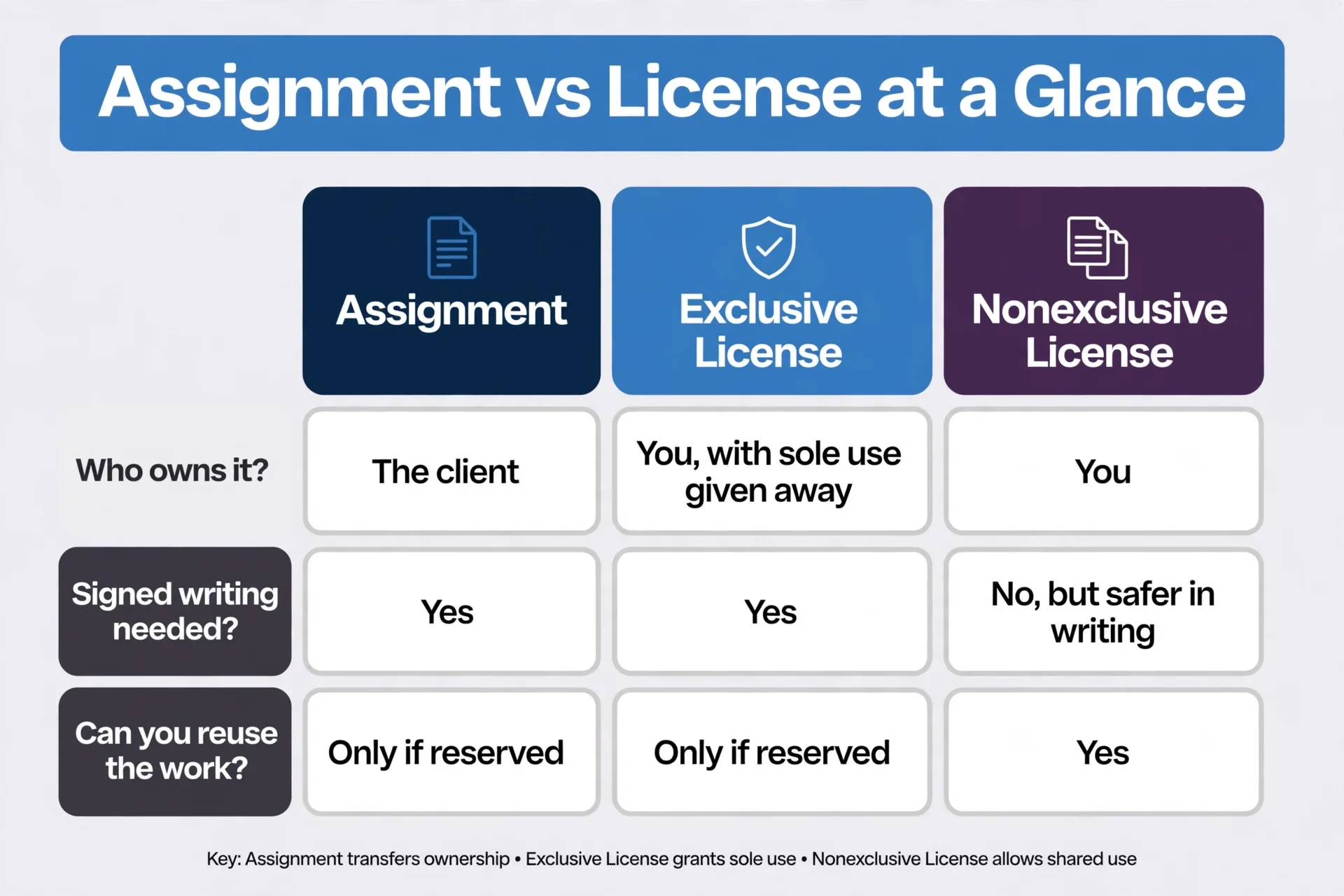
| Question | Assignment | Exclusive license | Nonexclusive license |
|---|---|---|---|
| Who owns the copyright? | The client (assignee) owns the assigned rights | You keep the underlying copyright, but the licensee owns the licensed rights for the license term | You keep the copyright |
| Can you license the same work to someone else? | No, for the rights you assigned | No, for the rights and uses the license covers | Yes |
| Can you still use the work yourself? | Only if the assignment reserves that right to you | Only if the license reserves that right to you | Yes |
| Signed writing required? | Yes, under section 204(a) | Yes, under section 204(a) | No, but a written agreement is far safer |
| Can the other party sue infringers? | Yes, as the owner of the assigned rights | Yes, for the licensed rights, under section 501(b) | Generally no |
| Does it end on its own? | No, unless the assignment says so; the section 203 termination window is decades away | Yes, when the license term ends | Yes, when the license term ends, or when its conditions end |
| Typical payment | One larger payment, often on delivery or final payment | Upfront fee, royalties, or a mix | Smaller fee per use, or royalties |
Read the table from the freelancer’s side and the choice becomes practical. An assignment is the right deal when the client genuinely needs to own the work, for example a logo that becomes their brand, or code that becomes their product. An exclusive license fits when one client needs sole use for a defined time, such as a campaign, but you want the rights back afterwards. A nonexclusive license fits when the same work can earn from many buyers, such as photographs, templates, or stock-style content. The mistake is not choosing one of these. The mistake is signing a contract that uses the wrong one without noticing, or uses the word “license” while the terms describe an assignment.
The Bundle of Rights You Are Really Talking About
Copyright is not one right. It is a bundle of exclusive rights, and section 106 of the Copyright Act lists them. When you assign or license your work, you are moving some or all of these rights, so it helps to know what is in the bundle before you hand any of it over.
- Reproduction: the right to make copies of the work, such as printing a book or duplicating a design file.
- Derivative works: the right to create new work based on the original, such as adapting a story into a film or turning an illustration into merchandise.
- Distribution: the right to sell, rent, lend, or otherwise distribute copies of the work to the public.
- Public performance: the right to perform the work publicly, such as staging a play or playing a song.
- Public display: the right to show the work publicly, such as displaying a photograph on a website.

Because the bundle is divisible, a careful contract names the rights it moves instead of waving at all of them. A client who needs your article published on their blog does not need your right to turn it into a book. A client who needs your photo on their homepage does not need your right to sell prints of it. When a contract says “all rights” without naming them, ask what the client actually needs, and keep the rest. Every right you keep is a future income stream, a portfolio piece, or a reuse you do not have to buy back.
The Trap Most Freelancers Miss: An Exclusive License Is a Transfer of Ownership
Most guides present two boxes: assignment means ownership moves, license means it does not. The law has three boxes, and the middle one catches people. An exclusive license is a transfer of copyright ownership in the rights it covers, even though you remain the copyright owner underneath. That is not my interpretation. Section 101 defines a transfer of copyright ownership as an assignment, mortgage, exclusive license, or any other conveyance of a copyright or of any of the exclusive rights in a copyright, whether or not it is limited in time or place of effect, but not including a nonexclusive license.
So when a contract offers you an “exclusive license” for all rights, in all media, worldwide, forever, read it again. In practical terms that deal behaves very much like an assignment: nobody else can use the work, including you, unless you reserved the right. The only real difference is that the underlying copyright stays in your name and the rights return to you when the term ends, if there is a term at all. A perpetual exclusive license with no reversion is an assignment wearing a different label, and it should be priced and negotiated like one.
The fix is simple and it belongs in every exclusive license you sign: reserve, in writing, the rights you need. Portfolio use is the one freelancers forget most often. Add a sentence that you may display the work in your portfolio and use it to promote your services. If the client refuses that reservation, that refusal is information. It tells you the client wants control over your future use of your own work, and the fee should reflect that.
The Third Route: Work Made for Hire, and Why Your Freelance Work Usually Is Not
Assignment and licensing are not the only ways ownership moves. There is a third route, and client contracts mention it constantly: work made for hire. When a work qualifies as a work made for hire, the hiring party is treated as the author from the very beginning and owns all the rights, unless the parties agreed otherwise in a signed writing. No assignment is needed, because the ownership never starts with you. That is section 201(b) of the Copyright Act.
Here is the part that matters for freelancers: your work usually does not qualify. A work is made for hire in only two situations. The first is a work prepared by an employee within the scope of employment. As an independent contractor, that is not you. The second is a work specially ordered or commissioned for use in one of nine specific categories, and only if the parties expressly agree in a signed written instrument that the work shall be considered a work made for hire. The nine categories are a contribution to a collective work, a part of a motion picture or other audiovisual work, a translation, a supplementary work, a compilation, an instructional text, a test, answer material for a test, or an atlas. That is the definition in section 101, and the Copyright Office explains it in Circular 30.
Notice what is missing from that list. A logo is not in it. A website is not in it. A piece of custom software is not in it. A set of marketing illustrations is not in it. So when a contract labels your logo or your code as a work made for hire, the label alone does not make it so. If the work does not fit one of the nine categories, the work-made-for-hire language fails, and ownership stays with you unless a separate assignment transfers it.
That is why well-drafted freelance contracts contain both: a work-made-for-hire clause and an assignment clause as a fallback. The work-made-for-hire clause tries the first route. The assignment clause catches the ownership if the first route fails. My independent contractor agreement template uses exactly that belt-and-suspenders structure, and my freelance writing contract template does the same for writing work. If your contract has only the work-made-for-hire sentence and no assignment sentence, and the work is not in one of the nine categories, the client may believe they own the copyright when they do not. That gap causes disputes in both directions, so it is worth closing before the work starts, not after it is delivered.
What Happens When a Client Pays You but You Never Sign Anything
This is the most common ownership mistake in freelancing, and it is easy to see why. A client hires you, pays the full invoice, receives the files, and starts using the work. Everyone assumes the payment bought the copyright. It did not.
Payment for creative work does not, by itself, transfer copyright ownership. Delivery of the files does not transfer it either. Commissioning a project does not transfer it. Possessing the finished product does not transfer it. The Copyright Act requires a signed writing for a transfer of ownership, and without one, the client generally holds at most an implied nonexclusive license to use the work for the purpose it was commissioned for. That is the lesson of a real case I have read about more than once: a business paid a freelance artist in full for logos, used them, and only discovered when it tried to protect the logos formally that it had no assignment and therefore no ownership. The artist had been paid, the business had the files, and the copyright still belonged to the artist.
For the freelancer, that is a protection and a warning at the same time. It protects you when a client claims ownership they never bought. It warns you that your leverage is the ownership itself: if you have not been paid, you still own the work, and that ownership is the reason my guide on how a freelancer can withhold work until paid treats the files as leverage rather than as a gift. But do not confuse leverage with a business model. A clean, signed assignment or license, tied to final payment, protects both sides and avoids the argument entirely.
Can You Get Your Copyright Back After an Assignment?
Sometimes, but slowly, and only if you follow a formal process. Section 203 of the Copyright Act lets an author, or the author’s heirs, terminate a grant of a transfer or license that the author made on or after 1 January 1978. The termination window is a five-year period beginning at the end of 35 years from the date the grant was signed. If the grant covers the right of publication, the window begins at the end of 35 years from publication under the grant or 40 years from signing, whichever ends earlier. You must serve written notice on the grantee not less than two years and not more than ten years before the effective date, and record a copy of the notice with the Copyright Office before it takes effect.
Two limits matter. First, termination does not apply to works made for hire, because in that case you were never the author in the eyes of the law. Second, 35 years is a long time to wait for a remedy. A lawyer I read on this point put it bluntly: creators should negotiate narrowly tailored licenses, limited by term, territory, and medium, up front, rather than relying on a statutory reclamation window three decades down the road. I agree with that advice. The section 203 window is a real right and it is worth knowing about, but it is not a reason to sign an all-rights assignment carelessly today. Negotiate the limits now, when you still have something to trade.
Some assignments also include a reversion clause: the rights return to you if the client stops using the work, fails to pay, or after a set number of years. That is a contractual term, not a statutory right, so it only exists if you put it in the agreement. If you assign a work you care about, ask for one. A reversion clause is the practical version of the 35-year window, on a timetable you can actually use.
Should You Record the Assignment?
Recordation is the step most freelancers never hear about. Under section 205 of the Copyright Act, a transfer of copyright ownership or other document pertaining to a copyright may be recorded with the U.S. Copyright Office. Recording is voluntary. An unrecorded assignment can still be perfectly valid between you and the client. But recording does three useful things.
First, it puts the public on constructive notice that ownership has changed, so a later buyer cannot claim they had no way to know. Second, it decides priority between conflicting transfers: as between two conflicting transfers, the one executed first prevails if it is recorded within one month after its execution in the United States, or within two months if executed outside the United States, or at any time before recordation of the later transfer. Third, it creates a public record of the transfer that helps during future licensing, financing, enforcement, or sale of the work.
For an ordinary small freelance job, recordation is usually more formality than the deal needs. For a valuable asset, a logo that becomes a brand, a catalog of photographs, a software codebase, or any work the client may later sell or license onward, it is worth considering. If you do record, check the Copyright Office’s current fee schedule before filing, because the fee has changed more than once and older guides quote outdated figures. Copyright Office Circular 12 explains how recordation fees are calculated.
Assignment or License: Which One Should You Choose?
The honest answer is that it depends on what the client needs and what you want to keep, and the right choice is usually obvious once you ask two questions: does the client need to own this work, or only to use it? And what do you want to keep for yourself?
Choose an assignment when the client needs clean ownership to build on the work: a logo that becomes their brand identity, a website they will sell with their business, code that becomes their product, or a character design that anchors a whole product line. In those cases the client is buying the asset, and the fee should look like a purchase price, not a day rate. Reserve your portfolio rights in writing, and consider a reversion clause if the work goes unused.
Choose an exclusive license when one client needs sole use for a defined purpose and time, but you expect the rights to come back: a campaign image for one season, an illustration for one product launch, a piece of music for one advertisement. Set the term, the territory, and the medium, name the fee or royalty, and reserve your own right to use the work outside the licensed scope.
Choose a nonexclusive license when the same work can earn from many buyers: photographs, templates, illustrations, stock-style content, or any work where wide distribution is the business model. Price per use or per buyer, and keep the ownership so the work keeps earning.
And in every case, tie the transfer to payment. The cleanest structure I use is simple: the assignment or exclusive license takes effect when the final payment clears. Until then, you own the work. That single sentence connects the ownership clause to the payment clause, and it is the reason I keep pointing freelancers to the payment side of the site as well. When ownership is clear, enforcement is easier too, which is why my guide to ending intellectual property rights violations starts from knowing who owns what. If you are still unsure why any of this matters to a working freelancer, my post on why copyright law matters sets out the five practical wins ownership gives you.
Five Steps Before You Sign Anything
- Name the work and the rights. Describe the work covered by the agreement and list the specific rights involved, such as reproduction, distribution, or adaptation, instead of relying on a general reference to “all rights”.
- Decide whether you are licensing or assigning. If you are licensing, decide whether the license is exclusive or nonexclusive, because that choice decides whether you can give the same permission to others and whether you can keep using the work yourself.
- Set the term, territory, and payment. State how long the arrangement lasts, where and in which formats the work may be used, and how you will be paid, including what happens on renewal or non-payment.
- Put it in writing and get the right signature. An assignment or exclusive license needs a signed writing from the owner of the rights being transferred. Even a nonexclusive license is far stronger in writing, with both parties signing.
- Reserve what you need and consider recording. Reserve portfolio use and any reuse you want to keep, ask for a reversion clause on assignments, and consider recording the transfer with the Copyright Office for valuable work.
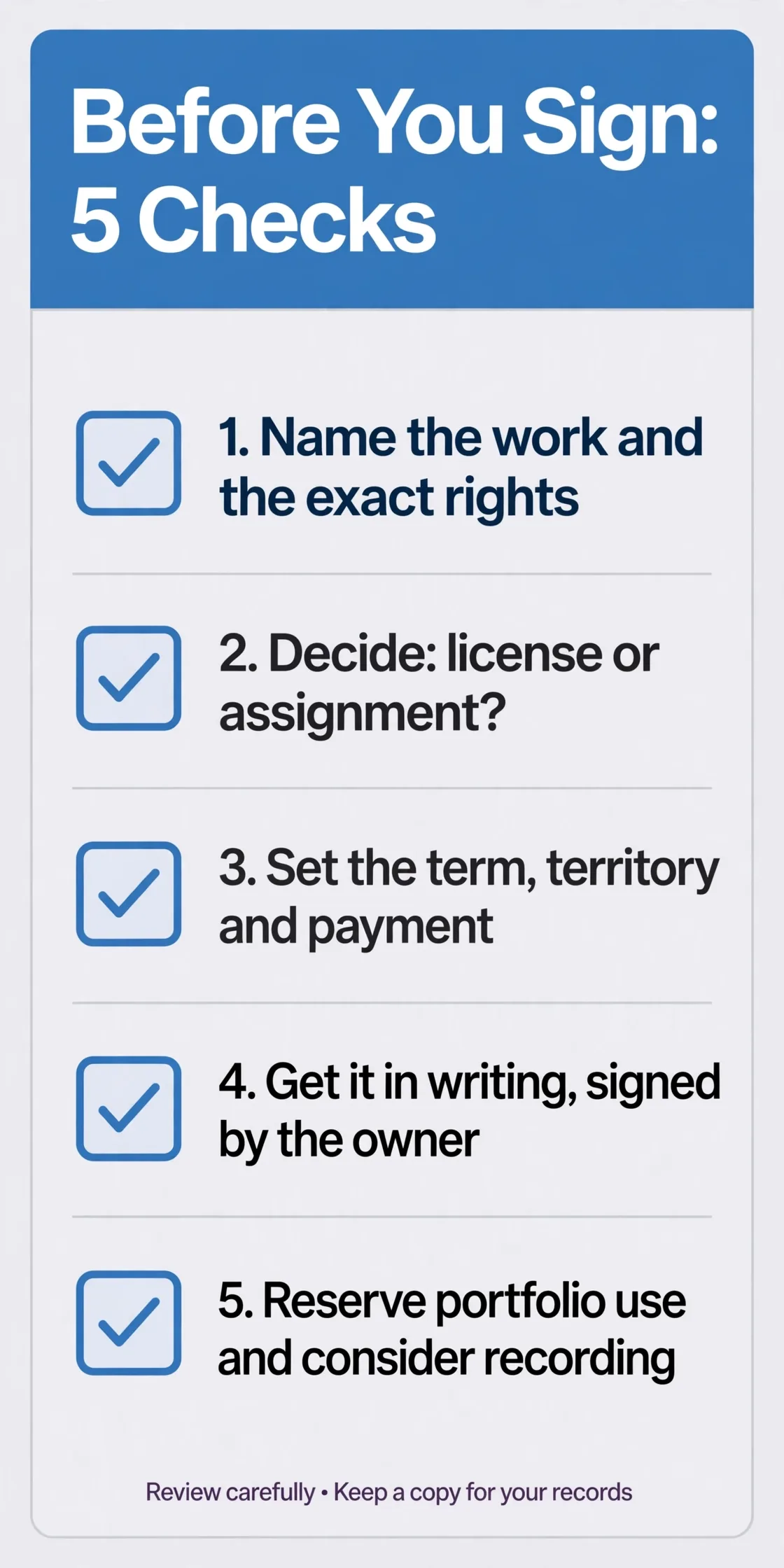
Run that list on every contract, even the short ones, even the friendly clients. The contracts that cause trouble are rarely the hostile ones. They are the friendly ones where nobody wrote anything down and both sides later remember the deal differently.
Frequently Asked Questions
What is the difference between a copyright assignment and a license?
A copyright assignment transfers ownership of the copyright, or of the specific rights named, to another party. A license only gives permission to use the work under set terms, while you keep the ownership. An assignment is a sale of rights. A license is permission to use them.
Does a copyright assignment transfer ownership?
Yes. When you assign your copyright, the assignee becomes the copyright owner for the rights you assigned. You generally lose control over how the work is used, changed, or sold, unless the assignment reserves specific rights back to you, such as portfolio use.
Does an exclusive license transfer copyright ownership?
In the eyes of the law, yes, for the rights it covers. Section 101 of the Copyright Act defines a transfer of copyright ownership to include an exclusive license, whether or not it is limited in time or place. That is why an exclusive license needs a signed writing under section 204(a), and why the exclusive licensee can generally sue infringers of the licensed right.
Do I need a written agreement for a copyright assignment?
Yes. Under section 204(a) of the Copyright Act, a transfer of copyright ownership is not valid unless an instrument of conveyance, or a note or memorandum of the transfer, is in writing and signed by the owner of the rights conveyed or the owner’s authorized agent. The only exception is a transfer by operation of law, such as inheritance. A nonexclusive license does not need a writing to be valid, but a written one is far safer.
Can a copyright assignment be reversed?
Usually only in two ways. First, if the assignment itself contains a reversion clause, the rights return when its conditions are met. Second, under section 203 of the Copyright Act, an author can terminate a grant made on or after 1 January 1978 during a five-year window beginning 35 years after the grant was signed, by serving notice two to ten years in advance and recording it. Termination does not apply to works made for hire. Neither route is quick, so negotiate limits before signing.
Does paying a freelancer transfer copyright?
No. Payment alone does not transfer copyright ownership, and neither does delivering the files, commissioning the project, or possessing the finished work. Without a signed writing that assigns the copyright, the client generally holds at most an implied nonexclusive license to use the work for the purpose it was commissioned for.
Can I still use my own work after assigning copyright?
Only if the assignment reserves that right to you. After a full assignment, the new owner controls the work, including whether you may display it in your portfolio. Always reserve portfolio use in writing before you sign an assignment, and the same applies to an exclusive license.
Is a work made for hire the same as an assignment?
No. In a work made for hire, the hiring party is treated as the author from the beginning and owns the copyright from the start, so no transfer is needed. In an assignment, you are the author first and then transfer the ownership. For freelancers, work-made-for-hire treatment applies only to the nine categories in section 101, plus a signed written agreement, so most freelance work does not qualify and needs an assignment instead.
Do I need to record a copyright assignment with the Copyright Office?
Recording is voluntary, not required for the assignment to be valid between you and the client. Under section 205, recording gives constructive notice of the transfer to the public and decides priority if the same rights are transferred twice. It is most worth doing for valuable work, such as a brand logo, a photo catalog, or a codebase. Check the Copyright Office’s current fee schedule before filing.
What should a copyright assignment agreement include?
At minimum: the parties, a clear identification of the work, the specific rights being assigned, whether the transfer covers the whole copyright or only named rights, the territory and term if any, the effective date and any payment condition, what you keep (such as portfolio rights), any reversion clause, and the signature of the owner of the rights being transferred. Broad language such as “all intellectual property” without naming the work and the rights creates disputes later.
Sources
- 17 U.S.C. section 101 (definitions: transfer of copyright ownership; work made for hire): https://www.govinfo.gov/content/pkg/USCODE-2024-title17/html/USCODE-2024-title17-chap1-sec101.htm
- 17 U.S.C. sections 201, 203, 204 and 205 (ownership, termination, execution of transfers, recordation): https://www.govinfo.gov/content/pkg/USCODE-2024-title17/html/USCODE-2024-title17-chap2.htm
- U.S. Copyright Office, Circular 30, Works Made for Hire: https://www.copyright.gov/circs/circ30.pdf
- U.S. Copyright Office, Circular 12, Recordation of Transfers and Other Documents (fees): https://www.copyright.gov/circs/circ12.pdf
- U.S. Copyright Office, Termination of Transfers and Licenses Under 17 U.S.C. section 203: https://www.copyright.gov/docs/203.html
- Lemler IP, The Difference Between Copyright Licensing and Assignment (updated 4 Nov 2026): https://www.lemlerip.com/the-difference-between-copyright-licensing-and-assignment/
- Cohn Legal, Copyright Assignments and Transfer of Ownership: https://www.cohnlg.com/practices/copyright-assignments/
I am not a lawyer, and this post is general information, not legal advice. If a project is worth a meaningful amount of money, or a dispute has already started, talk to a licensed attorney in your state before you act.
