You finished the project. Sent the files. Got paid.
Then three weeks later, you find your design on a competitor’s website. Your article published under someone else’s name. Your code running inside a product you never agreed to license.
This is not a rare horror story. It happens to freelancers every single day writers, graphic designers, photographers, web developers, videographers. And most of the time, the person who stole the work does it confidently, because they’re banking on one thing: that you don’t know your rights.
That’s exactly why understanding why is copyright law important isn’t just an academic exercise. For freelancers operating in the U.S., it’s the difference between owning your creative output and watching someone else profit from it without consequence.
This guide will walk you through everything what copyright actually covers, how it protects your income, what happens when it gets violated, and the specific steps you can take right now to lock down your work legally. No law school jargon. No vague generalities. Just practical, actionable knowledge built specifically for how freelancers actually work.
Let’s get into it.
Copyright Law Explained What It Actually Covers (And What It Doesn’t)
Copyright is a form of intellectual property law that gives the creator of an original work exclusive rights to reproduce, distribute, display, perform, and create derivative works from it automatically, from the moment the work is fixed in a tangible form.
Most people think copyright is something you have to apply for, pay for, or formally register before it kicks in. That’s a common misconception that costs freelancers dearly. The truth is simpler and more powerful than most realize.
What Does Copyright Protect?
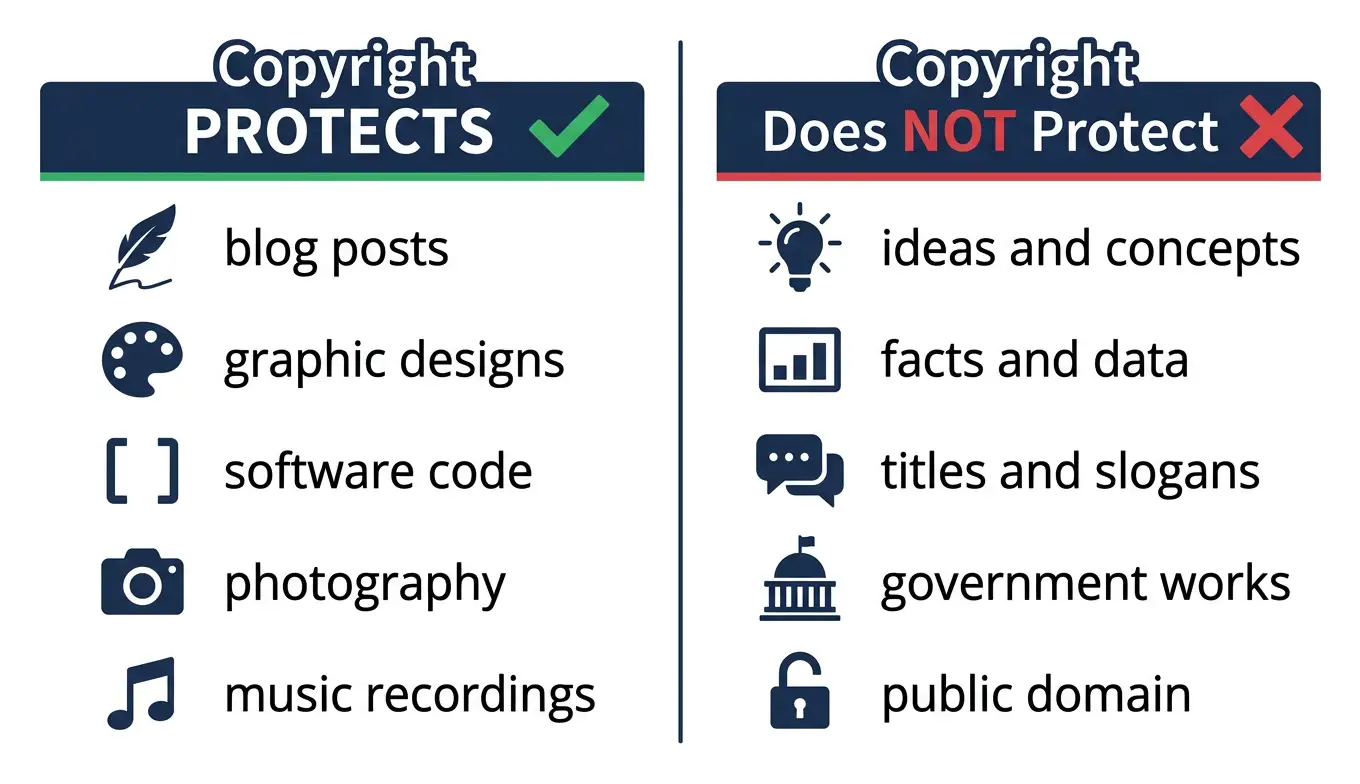
Copyright protection covers a wide range of original creative works, including:
- Literary works: blog posts, articles, books, scripts, website copy
- Visual art: illustrations, graphic design, photography, infographics
- Musical compositions and sound recordings
- Audiovisual works: videos, films, animations
- Software and code: yes, your custom-built code is protected
- Architectural works
- Choreographic works and dramatic works
If you’re a freelancer producing any of the above, you already have copyright protection on everything you create from the moment your fingers leave the keyboard or your stylus lifts off the tablet.
The U.S. Copyright Office defines the threshold simply: the work must be original (meaning it originated from you, not copied from someone else) and fixed (meaning it exists in some tangible form, whether digital or physical).
What Copyright Does NOT Protect
This is where many freelancers get burned either by accidentally infringing on someone else’s work, or by misunderstanding what their own copyright actually covers.
Copyright does not protect:
- Ideas, concepts, or methods: only the specific expression of an idea
- Facts and raw data: a database of public information isn’t copyrightable
- Titles, names, slogans, and short phrases: these fall under trademark law instead
- Government works: documents produced by U.S. federal government employees in their official capacity
- Works in the public domain: older works whose protection has expired
That last point trips up a lot of freelancers who work in research, journalism, or content marketing. You can’t copyright the fact that the U.S. unemployment rate was 4.1% in a given month. But the 2,000-word analysis you wrote interpreting that data? That’s protected the moment you write it.
Understanding this boundary matters because clients sometimes claim you can’t copyright a “simple logo” or a “basic template.” That’s not how the law works if there’s original creative expression involved, it’s protected.
When Does Copyright Protection Begin?
Copyright protection begins automatically the instant you create and fix a work in tangible form. You do not need to register it, mail it to yourself, or display the © symbol for protection to exist.
However and this is a big however registration with the U.S. Copyright Office dramatically strengthens your legal position if you ever need to enforce your rights in court. We’ll cover exactly why in a later section.
For now, just understand that every piece of work you produced today is already protected. The question is whether you’ve taken the steps to enforce that protection effectively.
What Is the Purpose of Copyright Law?
The purpose of copyright law is to incentivize the creation of original works by granting creators a limited monopoly over how their work is used, while ultimately enriching society by ensuring that knowledge, art, and culture continue to flow into the public domain.
That dual purpose protecting the individual while serving the public is the philosophical engine behind every copyright statute ever written.
The Constitutional Roots: Why Does Copyright Exist?
The importance of copyright law in the United States isn’t just statutory. It’s constitutional. Article I, Section 8, Clause 8 of the U.S. Constitution often called the “Copyright Clause” or “Intellectual Property Clause” explicitly grants Congress the power:
“To promote the Progress of Science and useful Arts, by securing for limited Times to Authors and Inventors the exclusive Right to their respective Writings and Discoveries.”
The Founders understood something that’s even more relevant today: without some form of protected incentive, creators won’t invest the time, risk, and skill required to produce original work. A musician who knows their album will be copied and distributed freely the moment it drops has less economic reason to make the next one. A freelance developer who can’t protect their codebase can’t build a business around it.
Copyright law solves this problem by creating a legal bridge between creative labor and economic reward. It’s not charity it’s a calculated social contract.
What Is the Purpose of Copyright in the Digital Age?
The internet didn’t change the purpose of copyright. It intensified the need for it.
When a piece of content can be copied, modified, and republished globally in seconds at zero cost to the person doing it the copyright protection importance becomes undeniable. A blog post that ranks well can be scraped and reposted on 50 websites overnight. A design uploaded to Behance can end up on a merchandise site in another country before the original creator even wakes up.
The digital age has made infringement easier, faster, and more anonymous than at any point in history. That’s precisely why knowing your rights under copyright law in the digital age isn’t optional for freelancers it’s a survival skill.
For a deeper look at how intellectual property violations specifically affect independent workers, check out this resource on ending intellectual property rights violations that’s particularly relevant to freelancers and solo creators.
Copyright Law 2026 Updates: What’s Changed for Creators
The biggest conversation in copyright law heading into 2026 centers on artificial intelligence and machine learning. In February 2023, the U.S. Copyright Office issued guidance stating that AI-generated content where a human didn’t make the creative choices is not eligible for copyright protection.
But the rules around AI-assisted work are more nuanced. If you used an AI tool to help draft a document but made substantial creative decisions yourself selecting, arranging, and modifying the output that human-authored portion may still be protectable.
The Copyright Office launched a formal AI study initiative and has been issuing updated guidance throughout 2024 and 2025. As of 2026, the core principle holds: human authorship remains the bedrock of copyright eligibility. If you’re a freelancer using AI tools in your workflow, document your creative process carefully. That paper trail could matter enormously in a dispute.
The Importance of Copyright Law for Freelancers Specifically
Here’s what makes the freelance situation uniquely risky compared to, say, an employee at a creative agency: when you work as a freelancer, you’re often operating without the institutional legal support that protects salaried creatives. No in-house legal team. No standard employment contract that clearly defines IP ownership. Just you, your laptop, and a client who may or may not understand or respect where the work legally belongs.
Why Copyright Matters When You Work Without a Contract
Let’s say a client hires you verbally, you deliver the work, and they pay you. Simple enough. But who owns the copyright on what you created?
Under U.S. copyright law, the default answer is you do unless there’s a written agreement saying otherwise. This is actually good news for freelancers. But here’s where it gets complicated: many clients assume that paying for work automatically transfers ownership. That assumption has no legal basis without a written contract.
If a dispute arises and there’s no written agreement, you’re in a murky legal situation that wastes time and money even if you ultimately win. A clear freelance contract that explicitly addresses IP ownership is the most direct way to prevent this. If you’re not sure where to start, a freelance writing contract template can give you a working baseline that covers copyright assignment language.
How Copyright Protects Freelance Writers, Designers, and Developers
The specific protections copyright provides differ slightly depending on your discipline:
Freelance Writers: Your articles, blog posts, scripts, and copy are protected from the moment you write them. A client can’t republish your work on additional platforms, sell it to third parties, or translate it without your permission unless your contract explicitly grants those rights.
Freelance Designers: Your logo concepts, UI mockups, illustrations, and brand assets are protected. If a client requests multiple revisions and then disappears without paying, they do not own those files. You do and you have the legal right to prevent them from using designs they haven’t paid for.
Freelance Developers: Your original code is protected as a literary work under copyright law. Custom scripts, proprietary frameworks, and unique architectures you build are yours. However, if you incorporate open-source libraries, those come with their own licensing terms that you must comply with.
In all three cases, copyright protection importance comes down to one thing: it gives you legal leverage when a client decides to test the limits of what they can get away with.
The “Work Made for Hire” Trap Most Freelancers Walk Into
This is one of the most misunderstood areas in freelance copyright law, and it catches people off guard constantly.
Under the U.S. Copyright Act, a “work made for hire” belongs to the employer or commissioning party rather than the creator. For actual employees, this applies automatically. For freelancers, however, the rules are stricter. A freelance work can only be classified as “work made for hire” if:
- It falls into one of nine specific statutory categories (contributions to collective works, translations, compilations, instructional texts, tests, answer material for tests, atlases, supplementary works, or parts of a motion picture), AND
- There is a written agreement signed by both parties explicitly stating it’s a work made for hire.
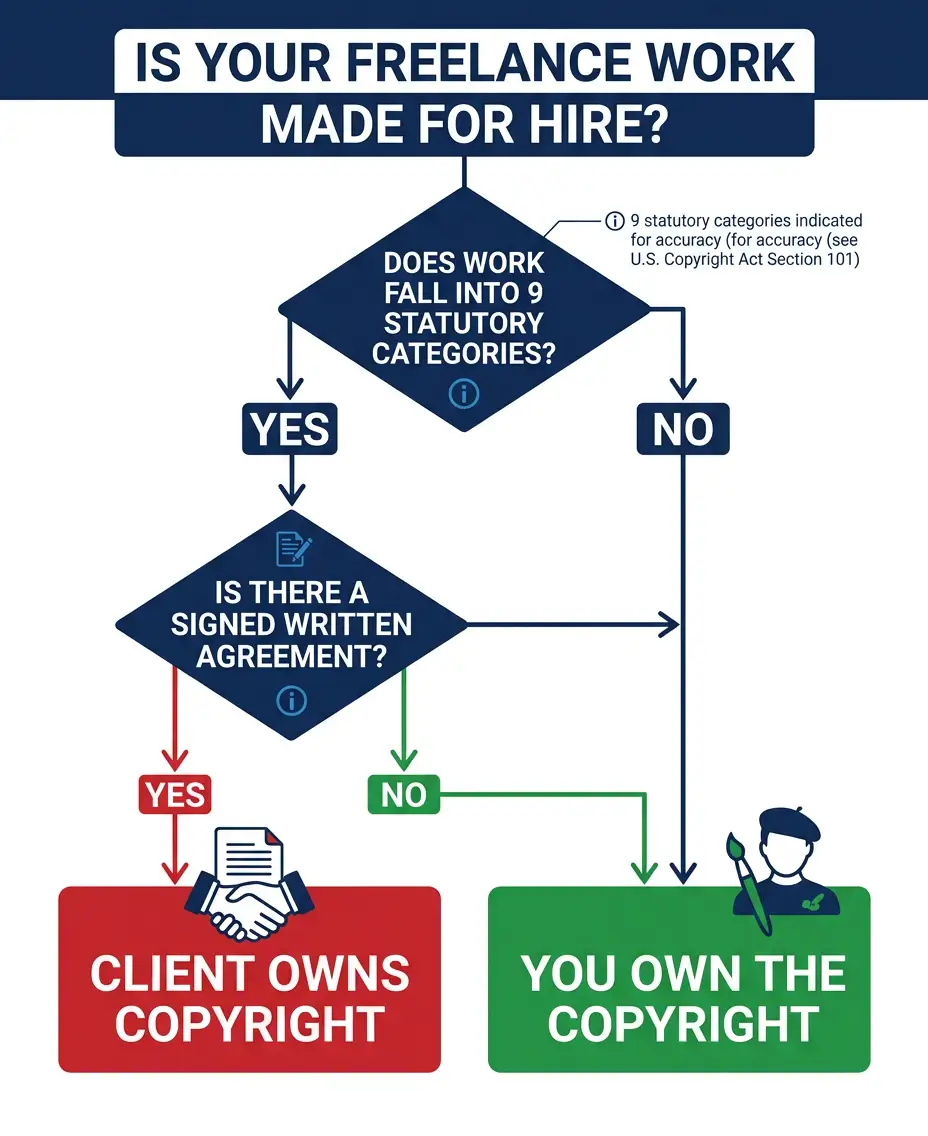
If both conditions aren’t met simultaneously, you retain the copyright even if the client paid you, even if they briefed you fully, even if they supplied all the creative direction.
Many clients especially in content marketing and digital agencies include “work made for hire” language in their contracts as a matter of course, often without the freelancer fully understanding what they’re signing away. Before you sign, read that language carefully. If you need help understanding what you’re agreeing to, resources like how long a freelance contract should be and statement of work vs. scope of work can help you build a clearer picture of what strong contract language looks like.
How Does Copyright Law Protect Creators? 7 Real-World Benefits
Copyright law protects creators by granting them a bundle of exclusive rights reproduction, distribution, display, performance, and the creation of derivative works that no one else can exercise without permission, giving creators full legal control over how their work is used and monetized.
Here’s what that looks like in practice.
1. Exclusive Rights Over Your Own Work
When you own a copyright, you own a bundle of six distinct exclusive rights under 17 U.S.C. § 106:
- The right to reproduce the work
- The right to distribute copies
- The right to create derivative works (adaptations, translations, sequels)
- The right to publicly display the work
- The right to publicly perform the work
- For sound recordings specifically, the right to perform the work digitally
No one not your client, not a competitor, not a platform can exercise any of those rights without your permission. That’s not a courtesy. That’s federal law.
2. Economic Security and Income Protection
The economic argument for copyright is straightforward: without it, there’s no financial incentive to create.
Think about it from a purely practical standpoint. If you spend 40 hours building a custom website template and someone can legally copy it, resell it, and profit from it the moment you publish it why would you invest those 40 hours in the first place? Copyright creates the economic moat that makes creative work viable as a profession.
For freelancers specifically, this matters because your entire business model rests on the value of your creative output. Protecting that output legally is the same as protecting your income.
If you’re still building the financial infrastructure around your freelance business, pairing copyright knowledge with resources like freelancer taxes for beginners and self-employment tax deductions gives you a more complete picture of your financial rights and obligations.
3. Moral Rights Protecting Your Professional Reputation
In the U.S., moral rights are narrower than in many European countries, but they still exist particularly for works of visual art under the Visual Artists Rights Act (VARA) of 1990. VARA gives artists the right to:
- Claim authorship of their work
- Prevent the use of their name on work they didn’t create
- Prevent intentional distortion, mutilation, or modification that would damage their honor or reputation
For freelance illustrators, photographers, and fine artists, this matters enormously. If a client takes your illustration and edits it in a way that misrepresents your style or artistic intent, VARA gives you the right to object and potentially take legal action.
Even outside VARA, standard copyright law prevents unauthorized modifications. If a client wants to alter your deliverables significantly, they need a license that specifically grants that right.
4. Legal Standing to Sue for Infringement
Here’s where copyright registration goes from “nice to have” to “absolutely essential.”
While copyright exists automatically at creation, you cannot file a lawsuit for copyright infringement in federal court unless your work is registered with the U.S. Copyright Office. And beyond just gaining the right to sue, registration before infringement occurs or within three months of publication unlocks statutory damages and attorney’s fees.
Statutory damages mean you don’t have to prove exactly how much money you lost. Instead, a court can award between $750 and $30,000 per infringed work, or up to $150,000 per work if the infringement was willful. For a freelancer dealing with a client who ripped off their design or republished their content without permission, that’s real leverage.
Without registration, you’re limited to actual damages meaning you have to prove exactly how much money you lost, which is often difficult and rarely covers your legal fees.
5. Licensing as a Revenue Stream
Copyright doesn’t just protect you from theft. It creates an active revenue opportunity.
When you own the copyright to a piece of work, you can license it granting others specific, limited rights to use it while you retain ownership. This turns a single piece of creative work into an ongoing income source:
- A photographer can license images to multiple publications simultaneously
- A developer can license a proprietary plugin to dozens of clients
- A writer can license article rights for different geographic territories or platforms
Licensing structures can be exclusive (only one party gets the right) or non-exclusive (multiple parties can license the same work). They can be limited in time, geography, medium, or purpose. The more granular your copyright knowledge, the more strategically you can price and structure these arrangements.
If you’re exploring how to price your freelance services more strategically, the freelance hourly rate calculator can help you factor licensing revenue into your overall income model.
6. Copyright and Creativity Fueling the Next Idea
There’s a compelling argument that copyright law and creativity are not at odds they’re symbiotic.
When creators know their work is protected, they take bigger risks. They invest more time. They experiment. The economic safety net that copyright provides allows a freelance illustrator to spend three months developing a unique visual style without fear that a competitor will replicate it freely the moment it goes live.
The Copyright Alliance makes this point clearly: copyright doesn’t just protect finished works, it encourages the creation of future ones by making creative investment financially rational.
7. Building Long-Term Business Value
For freelancers who want to eventually scale whether that means hiring subcontractors, selling a digital product, or building a content library copyright ownership is a business asset.
A portfolio of registered copyrights has real, transferable value. If you ever sell your freelance business, license your content library to a media company, or bring on a business partner, the copyrights you own are part of what makes the deal worth anything. Treating your creative output as a legally protected asset from day one is what separates freelancers who build durable businesses from those who remain perpetually vulnerable.
Benefits of Copyright Law: The Economic Impact on Creators
The Economic Impact of Copyright in the U.S. By the Numbers
The economic impact of copyright across the U.S. economy is staggering and often underappreciated.
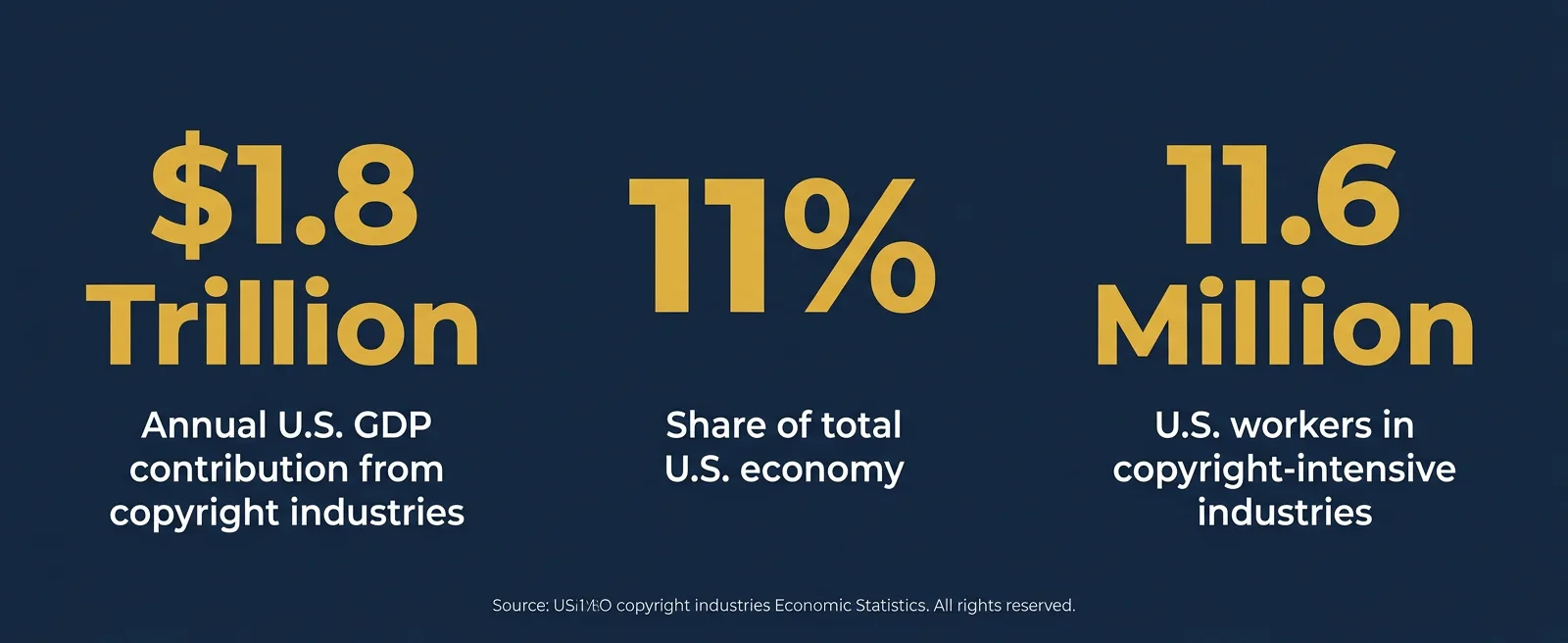
According to data from the International Intellectual Property Alliance (IIPA), copyright-intensive industries contribute over $1.8 trillion annually to the U.S. GDP representing more than 11% of the total U.S. economy. These industries employ approximately 11.6 million workers in the United States and pay wages significantly above the national average.
For freelancers, this context matters because it reinforces that creative work isn’t peripheral to the economy it is a major economic pillar. And copyright law is the legal framework that makes that entire sector function.
How Copyright Generates Passive Income for Freelancers
Beyond the one-time project fee, copyright protection enables freelancers to build passive income streams that continue generating revenue long after the original work is delivered:
- Stock licensing: selling usage rights to images, music, or templates on platforms like Shutterstock or Creative Market
- Royalties: earning ongoing payments from publishers, platforms, or distributors
- Syndication rights: licensing articles or content to additional outlets beyond the original publisher
- Template sales: selling reusable design or code templates while retaining the underlying copyright
Each of these models depends entirely on the freelancer owning the copyright in the first place. This is why understanding stock photo copyright rules for freelancers is particularly valuable if you work in photography or visual content creation.
Copyright Law for Businesses: Why Your Clients Care Too
Your clients have a vested interest in copyright clarity, even if they don’t always act like it.
When a business commissions freelance work for commercial use a company logo, a marketing campaign, a website they need to be confident that the copyright situation is clean. If they can’t demonstrate clear ownership or licensing rights, they risk:
- Publishing or advertising content they legally can’t use
- IP disputes with former freelancers who never explicitly signed over rights
- Due diligence problems during acquisitions or investor rounds, where IP clarity is non-negotiable
Sophisticated clients especially startups preparing for funding or established businesses with legal teams will insist on clear copyright terms in your contract. Being fluent in this language doesn’t just protect you; it makes you a more professional, trustworthy vendor to work with.
History of Copyright Law From the Printing Press to the Platform Era
Understanding where copyright came from helps clarify why it exists in its current form and why it keeps evolving.
The Statute of Anne (1710) Where It All Started
The world’s first copyright statute the Statute of Anne was enacted in England in 1710, shortly after the invention of movable type printing made it economically viable to mass-produce books. Before this law, printers held monopolistic control over publication. The Statute of Anne shifted the balance by granting authors a 14-year period of exclusive rights, with the option to renew for another 14 years.
The key philosophical shift was radical for its time: for the first time, the law acknowledged that the creator of a work, not just the publisher or distributor, had rights worth protecting.
U.S. Copyright Act Milestones You Should Know
The U.S. has revised and expanded its copyright framework several times since the first federal copyright law was enacted in 1790. Key milestones include:
- Copyright Act of 1790: Protected maps, charts, and books for 14 years (renewable once)
- Copyright Act of 1976: The most significant overhaul. Extended protection to the life of the author plus 50 years and brought U.S. law closer to international standards
- Sonny Bono Copyright Term Extension Act (1998): Extended protection to life of the author plus 70 years (or 95 years for corporate works), which remains the current standard
- Digital Millennium Copyright Act (DMCA) of 1998: Addressed internet-age infringement, established safe harbors for platforms, and created the takedown notice system
Each of these updates responded to economic and technological realities. The current framework will almost certainly be updated again as AI and digital distribution continue to reshape how creative work is made and consumed.
The DMCA and Why It Still Matters in 2026
The Digital Millennium Copyright Act is arguably the most directly relevant piece of copyright legislation for freelancers operating online today. It does two critical things:
- Creates a takedown notice system: allowing copyright holders to demand platforms remove infringing content quickly, without going through full litigation
- Provides safe harbor for platforms: meaning YouTube, social media platforms, and web hosts aren’t liable for user-uploaded infringing content as long as they respond to valid takedown requests
For freelancers who find their work stolen and republished online, a DMCA takedown notice is often the fastest, most cost-effective first step. Understanding how to file a DMCA takedown notice is a foundational skill for any independent creator working online.
If you want to go deeper on how to find stolen content before you can even file a takedown, the guide on DMCA search for protected content online walks you through the monitoring process step by step.
Copyright Law and Fair Use The Line Every Freelancer Must Understand
What Is Fair Use and How Is It Determined?
Fair use is a legal doctrine that permits limited use of copyrighted material without permission from the copyright holder, evaluated case-by-case using four statutory factors.
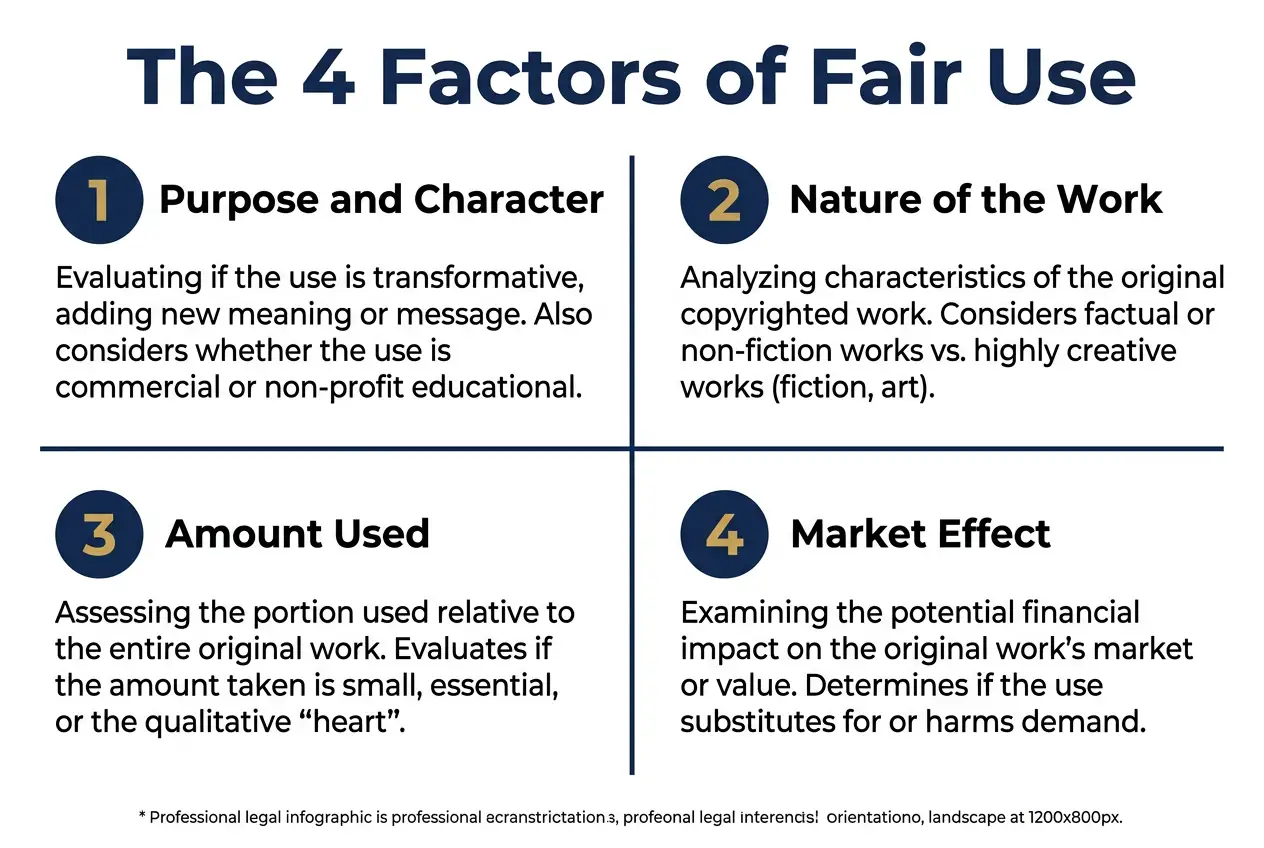
Those four factors, codified in 17 U.S.C. § 107, are:
- The purpose and character of the use: Is it commercial or educational? Is it transformative (adding new meaning) or merely reproductive?
- The nature of the copyrighted work: Factual works receive less protection than creative ones
- The amount and substantiality of the portion used: How much was taken, and was it the “heart” of the work?
- The effect on the potential market: Does the use harm the copyright holder’s ability to sell or license the original?
No single factor is decisive. Courts weigh all four together, which is why fair use determinations are notoriously unpredictable. The Harvard University Office of General Counsel describes fair use as “one of the most important and unpredictable doctrines in copyright law.”
Common Fair Use Myths That Get Freelancers in Trouble
Several dangerous myths circulate among freelancers and content creators about what constitutes fair use:
Myth 1: “I credited the original creator, so it’s fine.”
Attribution is ethically correct, but it does not create a legal right to use someone’s copyrighted work without permission.
Myth 2: “I only used a small portion, so it qualifies as fair use.”
Amount alone doesn’t determine fair use. Using even a few seconds of a highly recognizable song hook has been found to infringe copyright. The qualitative significance matters as much as the quantitative amount.
Myth 3: “It’s for educational purposes, so it must be fair use.”
Education is a factor, not a free pass. A commercial online course using someone else’s copyrighted images doesn’t automatically qualify as fair use simply because it’s educational in nature.
Myth 4: “I found it on the internet, so it’s public domain.”
Publicly accessible and legally free to use are completely different things. Almost everything you find online is protected by copyright unless specifically marked otherwise.
When a Client Claims “Fair Use” on Your Work What to Do
Occasionally, clients or competitors will use your copyrighted work and claim fair use as their defense. If that happens:
- Don’t panic or immediately back down. Fair use is an affirmative defense meaning they must prove it, not you.
- Document everything. Screenshots, timestamps, URLs, and any communications related to the infringement.
- Assess the four factors yourself. Is their use commercial? Did they reproduce your work in full? Did they transform it meaningfully? If the answers suggest infringement, you have grounds to act.
- Send a formal demand letter first. Many infringement cases resolve at this stage without litigation.
- Consider legal counsel if the value of the infringed work justifies it.
If a client is refusing to acknowledge your rights or is using the “fair use” argument as a stalling tactic, the guide on what to do when a client refuses to sign a freelance contract has useful context on navigating adversarial client relationships.
Copyright Infringement Consequences: What Happens When the Law Is Ignored
Civil Penalties: Statutory Damages Up to $150,000 Per Work
When a copyright holder registers their work and then proves infringement in federal court, the financial consequences for the infringer can be severe:
- Standard statutory damages: $750 – $30,000 per infringed work (court’s discretion)
- Willful infringement damages: Up to $150,000 per work
- Attorney’s fees: Awarded to the prevailing party if the copyright was registered before infringement or within three months of publication
That “per work” language is important. If someone infringes 10 of your registered works simultaneously say, by scraping your entire design portfolio the damages multiply accordingly.
Criminal Copyright Infringement Yes, It Can Go That Far
Most freelancers think of copyright infringement as a civil matter. It is but it can also be criminal under 17 U.S.C. § 506.
Criminal charges apply when infringement is:
- Willful, and
- Done for commercial advantage or private financial gain, OR involves reproduction or distribution of works with a total retail value exceeding $1,000 within a 180-day period
Criminal penalties include fines and imprisonment of up to 5 years for a first offense, and up to 10 years for repeat offenders. While criminal prosecution of individual infringers is relatively rare, it does happen particularly in cases involving large-scale piracy or commercial counterfeiting.
For most freelancers, the civil framework is what matters. But understanding that copyright infringement can carry criminal consequences changes the tone of any enforcement conversation you need to have with a client or competitor.
Real-World Infringement Cases Freelancers Should Study
Several landmark cases illustrate how courts have handled copyright disputes and offer practical lessons:
Feist Publications v. Rural Telephone Service (1991): The Supreme Court confirmed that originality not mere effort determines copyright eligibility. A phone directory arranged alphabetically lacked sufficient originality. Lesson: creativity in selection and arrangement matters.
Campbell v. Acuff-Rose Music (1994): The Supreme Court ruled that commercial parody can qualify as fair use. The four-factor test must be applied in full. Lesson: fair use is genuinely case-by-case.
Perfect 10, Inc. v. Amazon.com (2007): Established that thumbnail images in search results could qualify as fair use due to their transformative nature. Lesson: context and transformation matter significantly.
Goldsmith v. Warhol Foundation (2023): The Supreme Court ruled that Andy Warhol’s use of a Lynn Goldsmith photograph of Prince was not fair use when used commercially. Lesson: transformation alone doesn’t guarantee fair use commercial purpose and market impact still matter.
Each of these cases has direct relevance to how freelancers license, adapt, and protect their creative work.
International Copyright Law: Does Your Protection Follow Your Work Abroad?
The Berne Convention and What It Means for U.S. Freelancers
The short answer is: yes, your copyright protection does follow your work into most foreign countries because of the Berne Convention for the Protection of Literary and Artistic Works.
The Berne Convention is the primary international copyright treaty, currently with 181 signatory countries. Under Berne, member countries must give foreign copyright holders the same protections they give their own citizens. So if a German company steals your U.S.-registered content, German copyright law applies and Berne ensures it’s at least as protective as U.S. law.
Key Berne principles relevant to freelancers:
- Automatic protection: no registration required in any member country
- Minimum standards: all member countries must provide at least life-plus-50-years protection
- National treatment: foreign creators get the same rights as domestic creators
Copyright Law for Content Creators Working with Global Clients
If you work with clients in other countries and most freelancers do, thanks to platforms like Upwork, Toptal, and direct outreach your contracts need to address governing law explicitly.
Which country’s law governs the agreement? Which courts have jurisdiction? These questions get complicated fast when you’re a U.S.-based freelancer working for a U.K. company with a client in Singapore. Without explicit contractual language, you could find yourself in a jurisdiction where your rights are harder to enforce.
The safest approach: specify in every international freelance contract that the agreement is governed by U.S. law (or the law of your home state) and that disputes will be resolved in U.S. courts or through a specified arbitration process.
Jurisdiction Problems When a Foreign Client Steals Your Work
Here’s the uncomfortable reality: even with the Berne Convention providing baseline protections, enforcing your copyright against a foreign infringer is hard.
You may have the legal right, but practical enforcement requires navigating foreign legal systems, potentially hiring attorneys in another country, and dealing with courts that may deprioritize foreign IP claims. This is why prevention watertight contracts, upfront payment structures, and careful licensing terms is so much more effective than enforcement after the fact.
If you’re dealing with a client who has gone silent on payment, the guide on how to invoice a client who ignores you lays out practical legal steps that work both domestically and in international contexts.
Copyright Law in the Digital Age: New Threats, Stronger Tools
AI-Generated Content and Copyright: The 2026 Grey Zone
This is the issue reshaping copyright law right now, and every freelancer needs a working understanding of where things stand.
The U.S. Copyright Office has issued a series of guidance documents making the current position clear: purely AI-generated content where no human made the expressive creative choices is not eligible for copyright protection.
What does this mean practically?
- If a client asks you to submit AI-generated content as your own original work, that content likely carries no copyright protection for either of you
- If you use AI as a tool in your workflow using it to draft, then editing substantially and making real creative decisions the human-authored elements may be protectable
- If a competitor uses an AI tool to replicate your distinctive creative style, existing copyright law may not fully protect you, since style itself isn’t copyrightable
The Copyright Office is actively developing more comprehensive AI copyright guidance. This remains a genuinely evolving area of law, and the rules in 2026 may shift further as test cases work their way through the courts.
If you’re a freelancer integrating AI into your workflow, the resource on AI tools for freelancers in 2026 helps you understand how to use these tools in ways that protect rather than undermine your own IP position.
Social Media, Viral Sharing, and Your Rights
Posting your work on Instagram, LinkedIn, TikTok, or any other social platform does not mean you’ve given up your copyright. But it does mean you’ve agreed to each platform’s Terms of Service, which typically grant the platform a broad license to display, distribute, and reproduce your content often across their entire global network.
What platforms generally cannot do under standard ToS: sell your content, transfer your copyright to third parties, or allow other users to commercially exploit your work without a separate license agreement.
What’s not covered: if another user screenshots your post and republishes it without credit or permission, the platform’s ToS doesn’t protect them. That’s still copyright infringement and DMCA takedowns apply to social platforms just as they apply to websites.
DMCA Takedowns: Your First Line of Digital Defense
When your work appears online without authorization, a DMCA takedown notice is typically the fastest tool available. Here’s how it works:
- You identify the infringing content and the platform hosting it
- You send a formal DMCA notice to the platform’s designated copyright agent (every major platform publishes this contact information)
- The platform must remove the content “expeditiously” or lose its safe harbor protection under the DMCA
- The infringer can file a counter-notice, after which you have 10-14 business days to file a lawsuit or the content is restored
Most infringers don’t file counter-notices, because doing so requires them to submit to U.S. jurisdiction and effectively admit they received the takedown request. In practice, a well-crafted DMCA notice resolves the majority of online infringement situations quickly and without legal fees.
For a step-by-step walkthrough of the entire process, the guide on how to file a DMCA takedown notice in three steps is the most practical starting point.
Copyright Law for Freelancers: Practical Steps to Protect Your Work Today
Knowing why copyright matters is one thing. Building the habits that protect your work is another. Here’s a practical four-step framework.
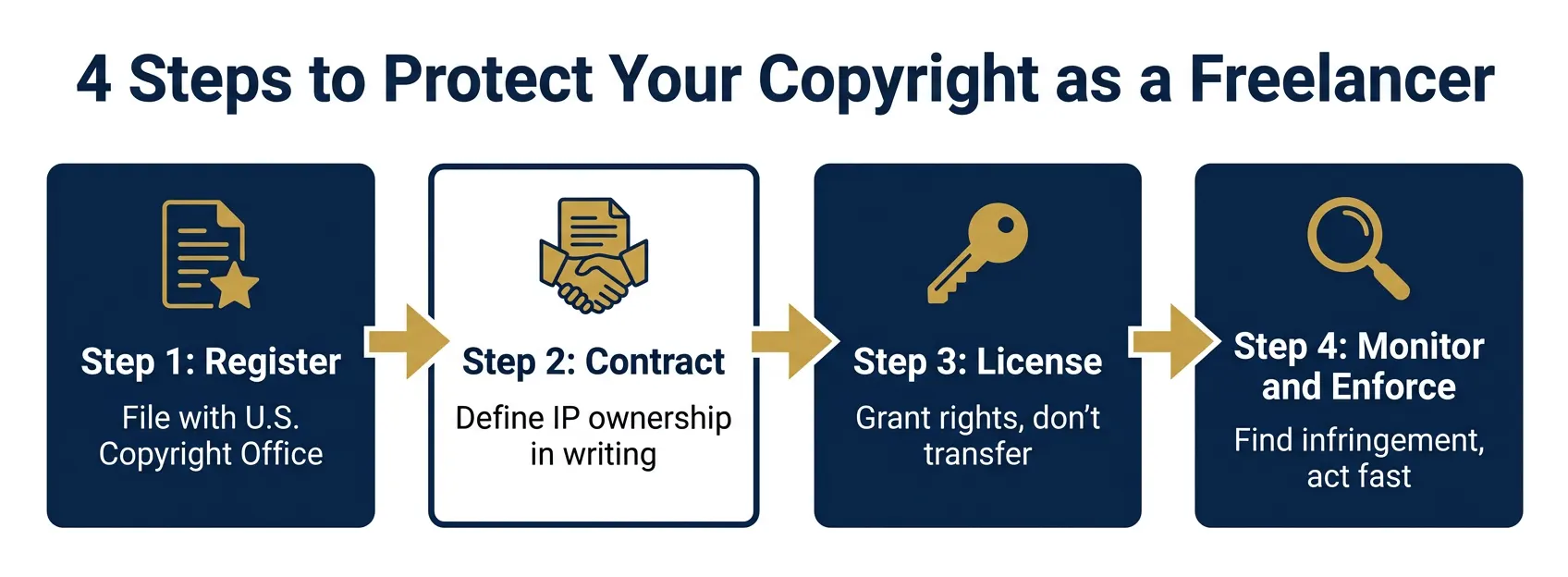
Step 1: Register Your Copyright (It’s Worth It)
Registration with the U.S. Copyright Office costs as little as $45 for a single work or $65 for a group of published photographs as of current fee schedules. For a freelancer producing high-value work regularly, this is one of the best investments you can make.
Register before you publish or deliver work to clients. That timing unlocks statutory damages and attorney’s fees the most powerful enforcement tools available to individual creators.
Step 2: Use Clear Contracts That Define IP Ownership
Every freelance project should have a written contract that explicitly addresses:
- Who owns the copyright on deliverables
- What rights are being transferred or licensed (and under what conditions)
- Whether it’s a “work made for hire” arrangement (and if so, that both parties acknowledge the written requirement)
- Kill fee provisions in case the project is cancelled before delivery protecting both your time and your rights to the work
A strong contract is your first and most effective line of defense. The resources on what a kill fee is in freelancing and force majeure clauses in freelance contracts are particularly useful for building out contract terms that hold up when things go sideways.
Step 3: License, Don’t Give Away
Get comfortable with the distinction between a copyright transfer (you give up ownership entirely) and a license (you retain ownership and grant specific usage rights).
In most cases, clients don’t actually need full copyright ownership they need the right to use the deliverable for specific purposes. A logo design licensed for use by a specific company in digital and print media is functionally identical to a transferred copyright from the client’s practical standpoint. But from your standpoint, the difference is enormous: with a license, you retain the right to negotiate additional uses, enforce your rights, and build asset value over time.
Make “licensing, not transferring” your default position. If a client needs full copyright transfer for legitimate business reasons, charge accordingly because you’re giving up something of real, long-term value.
Step 4: Monitor and Enforce Proactively
Protecting your copyright isn’t a one-time action it’s an ongoing practice. Tools like Google reverse image search, Copyscape for text content, and TinEye for images allow you to regularly check whether your work is appearing somewhere it shouldn’t be.
Set up Google Alerts for distinctive phrases from your written work. Periodically run your images through reverse image search. Check your code’s fingerprints if you suspect a developer has lifted your proprietary work.
When you find infringement, act quickly. Delay can complicate enforcement, and in some situations, prolonged inaction can be used to argue implied permission. The moment you discover infringement, document it and begin the enforcement process whether that’s a DMCA notice, a demand letter, or consultation with an attorney. If you’re not sure what enforcement actually costs or whether it’s worth it, consulting with a legal professional through a resource like Gig Law Guide’s legal contact page can help you assess your options before committing to a course of action.
Trending FAQs: Why Is Copyright Law Important?
Q: What is copyright and its importance?
Copyright is a form of intellectual property law that grants creators exclusive rights to their original works including the rights to reproduce, distribute, and adapt those works. Its importance lies in providing both the legal protection and economic incentive that makes creative professions viable. Without it, anyone could freely copy and profit from someone else’s creative labor.
Q: What would happen if there were no copyright laws?
Without copyright protection, creators would have no legal mechanism to prevent others from copying and profiting from their work. The immediate result would be a massive reduction in the economic incentive to create. Publishers, investors, and platforms that fund creative work would divert resources elsewhere. Over time, the volume and quality of original creative output across music, literature, software, and design would decline significantly. The public would ultimately lose access to the sustained flow of new creative works that copyright law is designed to encourage.
Q: Why is copyright and fair use important?
Copyright and fair use work together as complementary parts of the same system. Copyright protects creators’ rights. Fair use carves out specific exceptions that allow limited use for commentary, criticism, education, and transformation without stifling public discourse. Both are necessary: too much copyright protection without fair use exceptions would restrict legitimate scholarship and creative commentary; too much fair use without firm copyright protection would undermine creators’ economic rights.
Q: Is copyright automatic or do I need to register?
Copyright protection is automatic the moment you create and fix an original work in tangible form. Registration is not required for the copyright to exist. However, registration with the U.S. Copyright Office is required to file a federal infringement lawsuit, and registration before infringement (or within three months of publication) unlocks statutory damages and attorney’s fees the most powerful enforcement tools available.
Q: Can a client own my copyright without a written agreement?
No. Under U.S. copyright law, a client cannot own the copyright to your freelance work without a written agreement that explicitly transfers or assigns those rights. The common assumption that “paying for work = owning it” has no legal basis for independent contractors. Without a written copyright transfer or work-made-for-hire agreement that meets statutory requirements, the copyright remains with you, the creator.
Q: Does copyright law protect freelance social media content?
Yes. Original content you create including social media posts, graphics, captions written with genuine creative expression, and videos is protected by copyright from the moment of creation. Posting content on a social platform grants the platform a license under its Terms of Service to display and distribute the content, but it does not transfer your copyright or authorize other users to copy and republish your work without permission.
Q: How long does copyright protection last in 2026?
For works created by individual authors, copyright protection lasts for the life of the author plus 70 years. For works made for hire, anonymous works, or pseudonymous works, protection lasts 95 years from publication or 120 years from creation, whichever expires first. Works published before 1928 are now in the public domain in the United States.
Q: What is the difference between copyright and a trademark?
Copyright protects original creative expression writing, art, music, software, and other authored works. Trademark protects brand identifiers names, logos, slogans, and other marks that distinguish goods or services in commerce. A logo design can be protected by both: the creative visual expression by copyright, and the brand identity function by trademark registration. They are separate legal systems with different registration processes, terms, and enforcement mechanisms.
Q: Can I copyright an idea or just the final work?
You cannot copyright an idea. Copyright protects only the specific expression of an idea, not the underlying concept. If you pitch a client a unique campaign concept and they thank you for the meeting, then hire someone else to execute the exact same idea, copyright law generally won’t help you because ideas aren’t protected. What is protected is the specific creative work you produce. This is why documenting your creative process and producing distinctive, original deliverables matters so much.
Q: How do I file a DMCA takedown if my work is stolen?
To file a DMCA takedown: (1) Identify the infringing content and the platform hosting it; (2) Locate the platform’s designated DMCA agent this information is typically found in the platform’s Terms of Service or on its copyright policy page; (3) Send a written takedown notice containing your contact information, identification of the infringing content, a statement of good faith belief that the use is unauthorized, and your signature. The platform must respond “expeditiously” by removing the content. For a detailed walkthrough of exactly what to include and how to format the notice, see the full guide on filing a DMCA takedown notice.
Wrapping Up
Copyright law isn’t a bureaucratic formality that only matters to large media companies and entertainment lawyers. For freelancers, it’s the legal framework that turns your creative skill into a protected, enforceable asset.
Every article you write, every design you deliver, every line of code you produce these aren’t just deliverables. They’re works of authorship with legal protection attached. Whether you’re a brand-new freelancer trying to understand your baseline rights, or an experienced independent professional looking to formalize your IP strategy, the core message is the same: know what you own, protect it properly, and enforce it when necessary.
Start with the fundamentals covered here. Register your key works. Build IP ownership language into every contract. License strategically rather than transferring ownership by default. And stay current as the law continues to evolve around AI, digital platforms, and global commerce.
For broader guidance on the legal side of freelancing from contracts to client disputes to payment rights explore the full library of resources at Gig Law Guide, where everything is built specifically for independent workers navigating the real legal landscape of the gig economy.