

Introduction
This self employed taxes calculator walks you through your freelance tax bill. If you are a freelancer in the United States, your tax bill is not one tax. It is three taxes stacked together: self-employment tax, federal income tax, and state income tax. Add them up and you get the number you actually owe, and once you know that number you can split it into four quarterly payments and set aside the right share of every client payment as it arrives. This guide shows you the whole calculation, step by step, with every line of the math shown, so you can work out your own number with a pen and a calculator instead of trusting a black-box tool.
The short answer, before the detail, is this: start with your net profit, which is your gross freelance income minus your ordinary and necessary business expenses. Take 92.35 percent of that net profit and multiply it by 15.3 percent. That is your self-employment tax. Then take your net profit, subtract half of that self-employment tax and subtract the standard deduction, and run what is left through the 2026 federal income tax brackets. That is your federal income tax.
Add your state tax on top, and the total is your tax bill. A single freelancer with $60,000 of net profit in 2026 owes about $12,989 in federal tax before the QBI deduction and before state tax, which is about 21.6 percent of net profit, or about $3,247 per quarter. The rest of this guide shows you exactly where each of those numbers comes from, so you can repeat the calculation with your own figures.
I am writing this as a freelancer, not as a tax professional, and this post is general information, not tax advice. Every figure in it was verified on irs.gov on the day I wrote it, and the Sources section at the end names each IRS page so you can check my work. Where a figure changes every year, I give you the 2026 figure and tell you it is the 2026 figure, so this guide stays honest even after the numbers move on.
The Three Taxes Inside Every Freelance Tax Bill
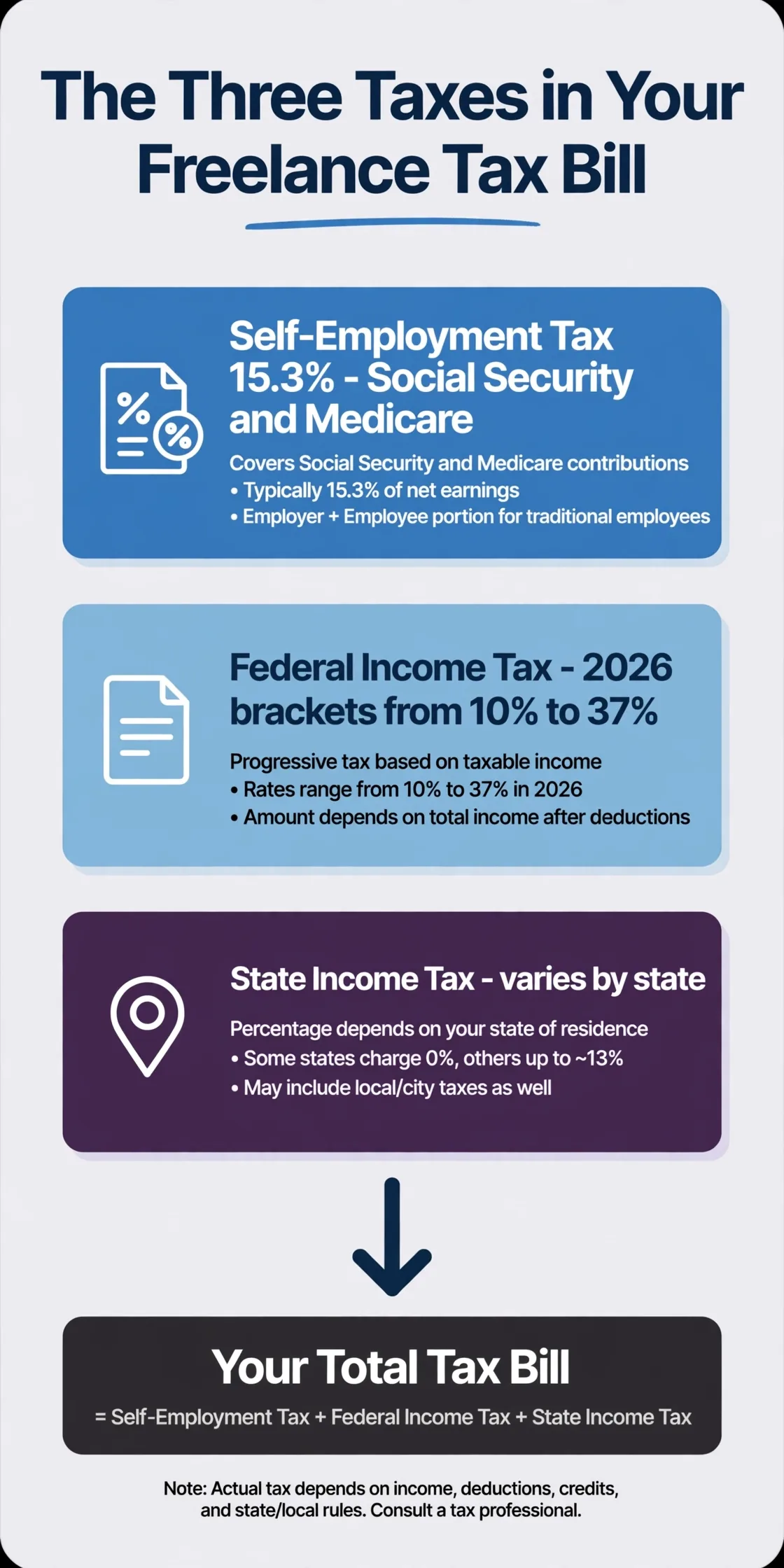
An employee never sees the full shape of their tax bill, because the employer takes tax out of every paycheck before the money arrives. A freelancer sees the whole shape at once, because nobody withholds anything from a freelance payment. That is why the bill feels so large when it arrives. It is not one tax. It is three, and each one is calculated differently.
The first tax is self-employment tax. It pays for Social Security and Medicare, and it is the tax that replaces the payroll tax an employer would normally pay on your behalf. The rate is 15.3 percent, and it applies to 92.35 percent of your net profit, not to your gross income. There is a cap on the Social Security part, which I explain in Step 2, and there is no cap on the Medicare part.
The second tax is federal income tax. It is calculated on what is left after you subtract half of your self-employment tax and the standard deduction from your net profit, and it runs through progressive brackets, which means different slices of your income are taxed at different rates. The 2026 brackets for a single filer run from 10 percent up to 37 percent, and Step 3 walks through them with a real example.
The third tax is state income tax. It depends entirely on where you live. A few states, including Florida and Texas, have no state income tax at all. Most states do, and most of them want their own estimated payments on their own schedule. Step 4 covers the principle, and I do not list state rates here, because they change often and the only reliable source for your rate is your own state’s revenue department.
Keep those three apart in your head and the calculation stops being mysterious. The rest of this guide is one worked calculation, repeated at four income levels, plus the quarterly payments and the set-aside percentage that turn the annual total into a habit you can live with.
The Self Employed Taxes Calculator in Six Steps
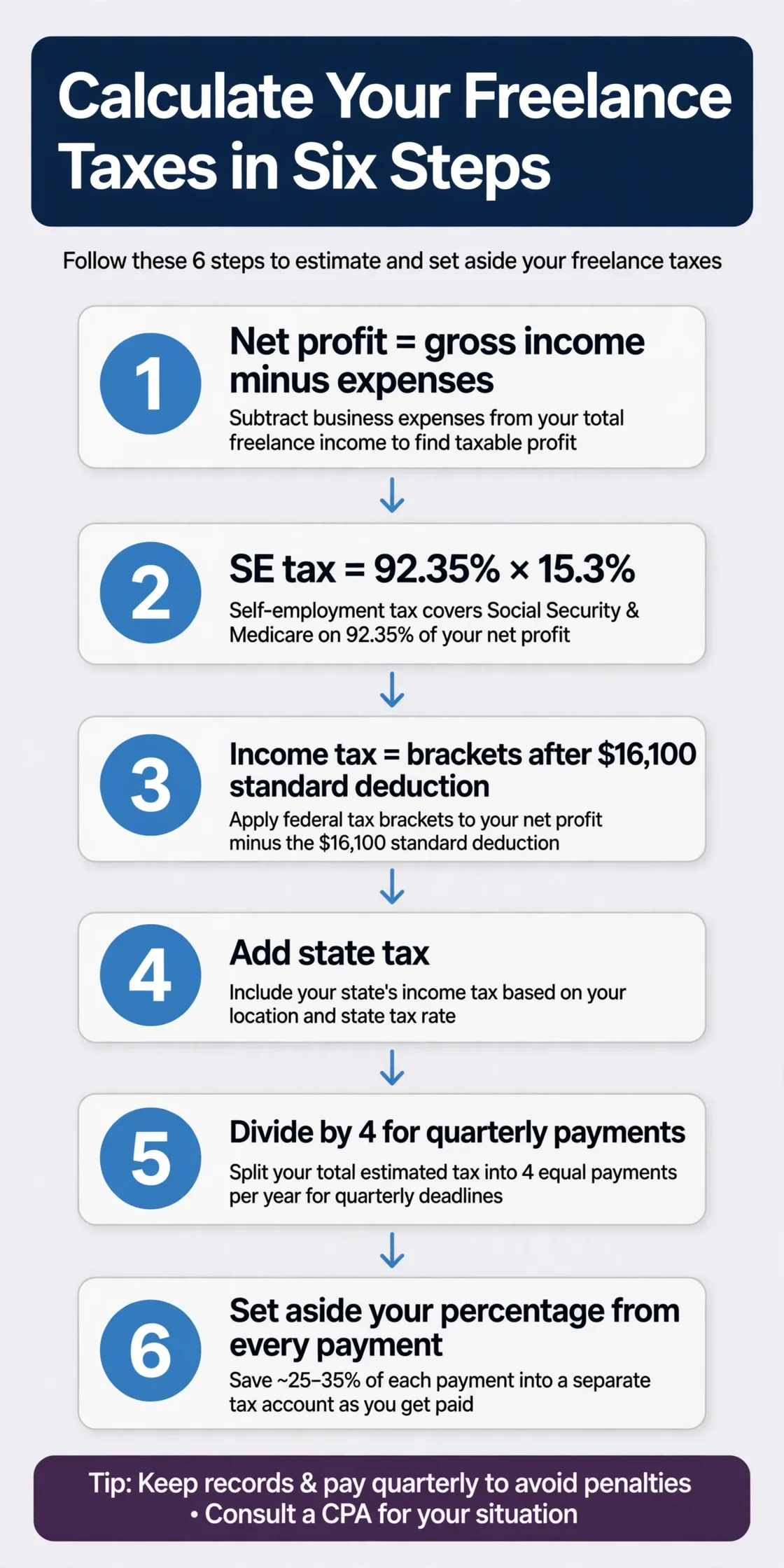
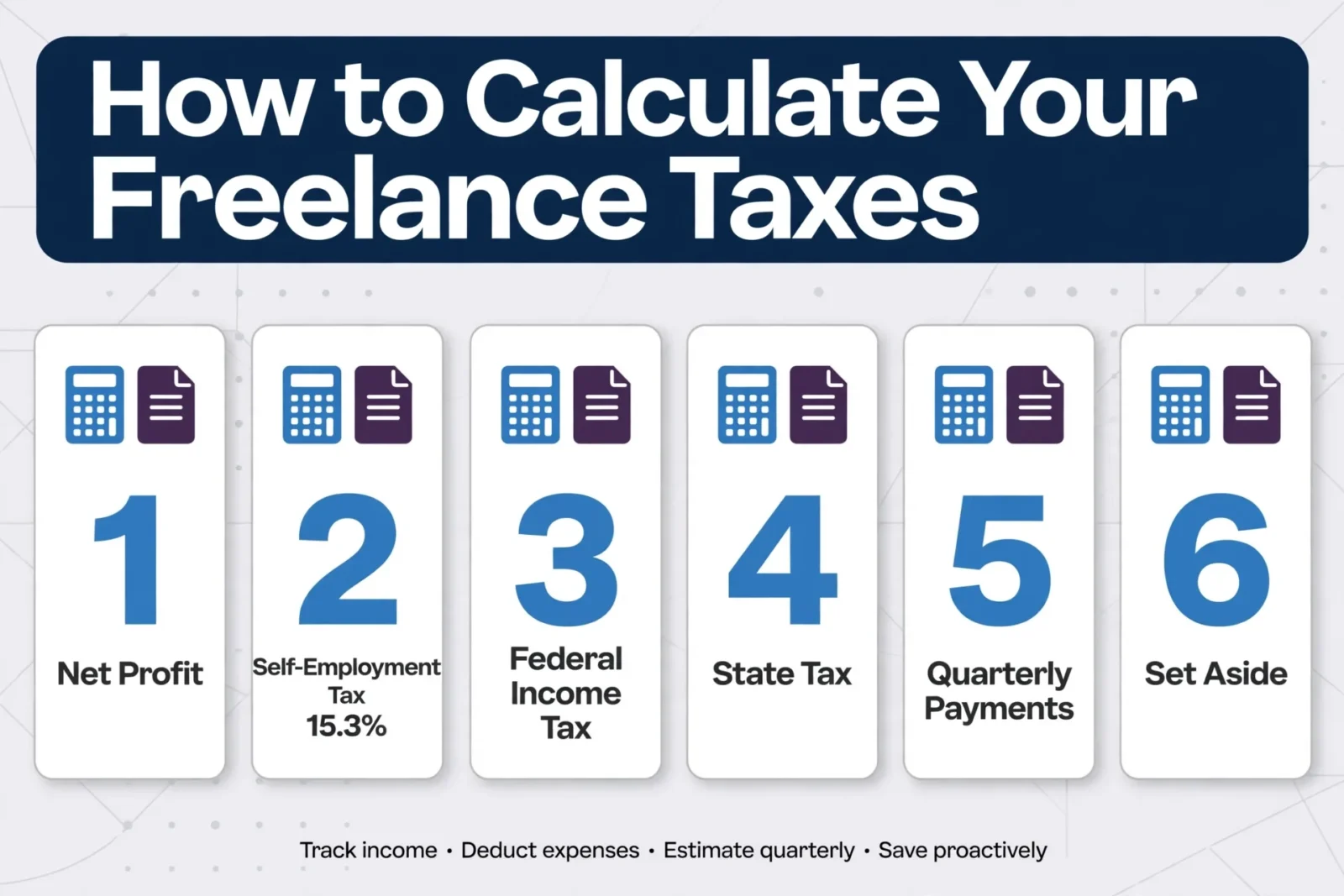
Before the detail, here is the whole self employed taxes calculator in six steps. Each step below has its own section, and the worked example at the end runs all six steps with real numbers.
Step 1: Find your net profit. Gross freelance income minus ordinary and necessary business expenses.
Step 2: Calculate self-employment tax. Multiply 92.35 percent of your net profit by 15.3 percent.
Step 3: Calculate federal income tax. Subtract half of your self-employment tax and the standard deduction from your net profit, then run the result through the 2026 brackets.
Step 4: Add state tax. Apply your state’s rate, or zero if your state has no income tax.
Step 5: Turn the total into quarterly payments. Divide the annual total by four and pay on the four due dates.
Step 6: Set aside from every payment. Divide your total tax by your net profit to get your personal set-aside percentage, and move that share aside every time a client pays you.
Step 1: Find Your Net Profit
Every tax calculation for a freelancer starts from the same number: net profit. Net profit is your gross freelance income minus your ordinary and necessary business expenses, and it is the number you report on Schedule C. Gross income is everything clients paid you for your work during the year, including payments that never produced a 1099 form. Expenses are the costs of running your freelance business: software subscriptions, a share of your internet and phone bills, equipment, travel for client work, and similar costs. The IRS test for an expense is that it is ordinary, meaning common in your line of work, and necessary, meaning helpful and appropriate for your business.
Net profit matters so much because both of your federal taxes are calculated from it, not from your gross income. A freelancer who earns $80,000 and spends $20,000 on genuine business costs has a net profit of $60,000, and every tax in this guide is calculated on that $60,000. That is why tracking expenses is the single most valuable tax habit a freelancer can build. Every dollar of legitimate expense you can document lowers the number that every tax is calculated on.
Keep a simple record as the year goes on: every invoice you send, every payment you receive, and every business expense with its receipt. A spreadsheet is enough. My guide to the deductions that lower your net profit lists the fifteen deductions freelancers most often miss, and this post does not repeat that list. The only thing you need here is the principle: gross income minus expenses equals net profit, and net profit is the starting line for everything that follows.
Two common mistakes happen at this step. The first is counting only the income that arrived with a 1099 form. The IRS requires you to report all of your income, whether or not a form arrived, and I cover that in the 1099 section below. The second is forgetting the $400 rule. If your net earnings from self-employment are $400 or more, you owe self-employment tax, even if your total income is small. Below $400 of net earnings, no self-employment tax is due, although income tax may still apply depending on your total income.
Step 2: Calculate Your Self-Employment Tax
Self-employment tax is the tax that replaces the payroll tax on an employee’s wages. When you were an employee, your employer paid half of your Social Security and Medicare tax and you paid the other half through withholding. As a freelancer, there is no employer, so you pay both halves yourself. That is why the rate looks high at first glance: 15.3 percent, made of 12.4 percent for Social Security and 2.9 percent for Medicare.
The calculation has three parts. First, take 92.35 percent of your net profit. This figure comes from the IRS, and it exists because an employer paying payroll tax would not pay it on the full wage either. Your net earnings for self-employment tax purposes are 92.35 percent of your net profit from Schedule C. Second, multiply that figure by 15.3 percent. Third, check the Social Security wage base. For 2026, only the first $184,500 of your combined wages, tips and net earnings is subject to the Social Security part of the tax. The Medicare part has no cap, and it keeps applying above $184,500.
Here is the math for a freelancer with $60,000 of net profit. Net earnings are 92.35 percent of $60,000, which is $55,410. Self-employment tax is 15.3 percent of $55,410, which is $8,478. That is the whole calculation at this income level, and it is the same at any income level below the wage base: multiply your net profit by 0.9235, then multiply the result by 0.153. If your combined wages and net earnings pass $184,500, the Social Security part stops at the cap and only the 2.9 percent Medicare part continues, which is a detail that matters to high earners and to freelancers who also hold a W-2 job.
There is one more figure that belongs in this step: the additional Medicare tax of 0.9 percent. It applies to wages and self-employment income above $200,000 for a single filer, $250,000 for married couples filing jointly, and $125,000 for married couples filing separately. Most freelancers will never meet it, but if your income is in that range, add 0.9 percent on the amount above the threshold. The threshold is not adjusted for inflation.
One relief is built into the law, and it matters for the next step. Half of your self-employment tax is deductible from your income for federal income tax purposes. It does not reduce your self-employment tax itself, and it does not reduce the amount the 15.3 percent is calculated on. It only reduces the income that your federal income tax is calculated on. For our $60,000 example, half of $8,478 is $4,239, and that $4,239 comes off your income before the income tax calculation in Step 3.
Step 3: Calculate Your Federal Income Tax
Federal income tax is where most freelancers get confused, because it is not a flat percentage of anything. It is a progressive tax, which means your income is sliced into bands, called brackets, and each band is taxed at its own rate. Only the slice inside a band pays that band’s rate. Your first dollars are taxed at 10 percent, the next slice at 12 percent, and so on. Your top rate is not your tax rate. It is only the rate on your last slice of income.
Before you touch the brackets, you need your taxable income, and that takes two subtractions from your net profit. First, subtract half of your self-employment tax, which Step 2 already calculated. Second, subtract the standard deduction. For tax year 2026, the standard deduction for a single filer is $16,100. For married couples filing jointly it is $32,200, and for heads of household it is $24,150. Most freelancers take the standard deduction, because it is larger than their itemized deductions would be. If your itemized deductions are larger, you would use those instead, but that is a separate calculation and it is outside this guide.
Here are the 2026 federal income tax brackets for a single filer, verified in the IRS release of the 2026 inflation adjustments:
| Taxable income (single filer, 2026) | Tax rate |
|---|---|
| Up to $12,400 | 10% |
| $12,400 to $50,400 | 12% |
| $50,400 to $105,700 | 22% |
| $105,700 to $201,775 | 24% |
| $201,775 to $256,225 | 32% |
| $256,225 to $640,600 | 35% |
| Over $640,600 | 37% |
Let me run the $60,000 example through these brackets, because this is the step where a worked number teaches more than a paragraph. Net profit is $60,000. Subtract half of the self-employment tax, which is $4,239, and you get adjusted gross income of $55,761. Subtract the standard deduction of $16,100, and you get taxable income of $39,661 before the QBI deduction. That $39,661 sits in two brackets. The first $12,400 is taxed at 10 percent, which is $1,240. The remaining $27,261 is taxed at 12 percent, which is $3,271. Add them together and your federal income tax is $4,511 before QBI.
QBI is the qualified business income deduction, and it can lower this number further. If you qualify, you can deduct up to 20 percent of your qualified business income from your taxable income. It does not reduce your self-employment tax, only your income tax. The deduction is subject to income limits, so not every freelancer qualifies for the full 20 percent, and the exact limits are set in the IRS rules for Form 8995.
For our $60,000 example, a freelancer who qualifies for the full QBI deduction would deduct 20 percent of $55,761, which is $11,152, leaving taxable income of $28,509 and federal income tax of $3,173. That is $1,338 less than the $4,511 figure without QBI. In the worked example below, I show the total both ways, so you can see the size of the difference and decide whether to dig into the QBI rules for your own return.
One warning about the figures you will find online. Some calculator pages still show stale numbers from earlier tax years. One ranking calculator page still shows the 2024 standard deduction of $14,600 for a single filer, and another still uses the old Social Security wage base of $168,600 in one of its tables. Both figures are wrong for 2026. The correct standard deduction for a single filer in 2026 is $16,100, and the correct wage base is $184,500. If a calculator gives you a number that looks too high, check which year’s figures it is using before you trust it.
Step 4: Add State Tax
State tax is the third and most variable part of the bill, and it is the part no national calculator can get right for you without knowing where you live. A few states, including Florida and Texas, have no state income tax at all, so a freelancer living there owes zero state income tax on freelance earnings. Most other states do have an income tax, and their rates and brackets are set by the state, not by the IRS.
There are two things to know about state tax. First, your state tax is calculated on your income under your state’s own rules, which are usually similar to the federal rules but never identical. Your state may allow a different standard deduction, or none at all, and its brackets will be different. Second, most states that have an income tax also want estimated payments during the year, on their own schedule, which may or may not match the federal quarterly dates. If you only pay the federal quarters and forget the state, you can end the year owing the state a lump sum plus its own underpayment penalty.
For the worked example in this guide, I show the federal total only, and I label it clearly as federal only. Add your own state tax on top of it. As a rough guide, a freelancer in a state with a 5 percent flat income tax and $60,000 of net profit would owe roughly another $2,000 to $3,000 to the state, depending on the state’s own deductions, which would push the total set-aside percentage from about 22 percent toward 25 or 26 percent. Check your own state’s revenue department site for its rates and its estimated payment dates, and do not copy a rate from a national blog post, because state rates change and national posts go stale.
The Full Worked Example: $60,000 of Net Profit
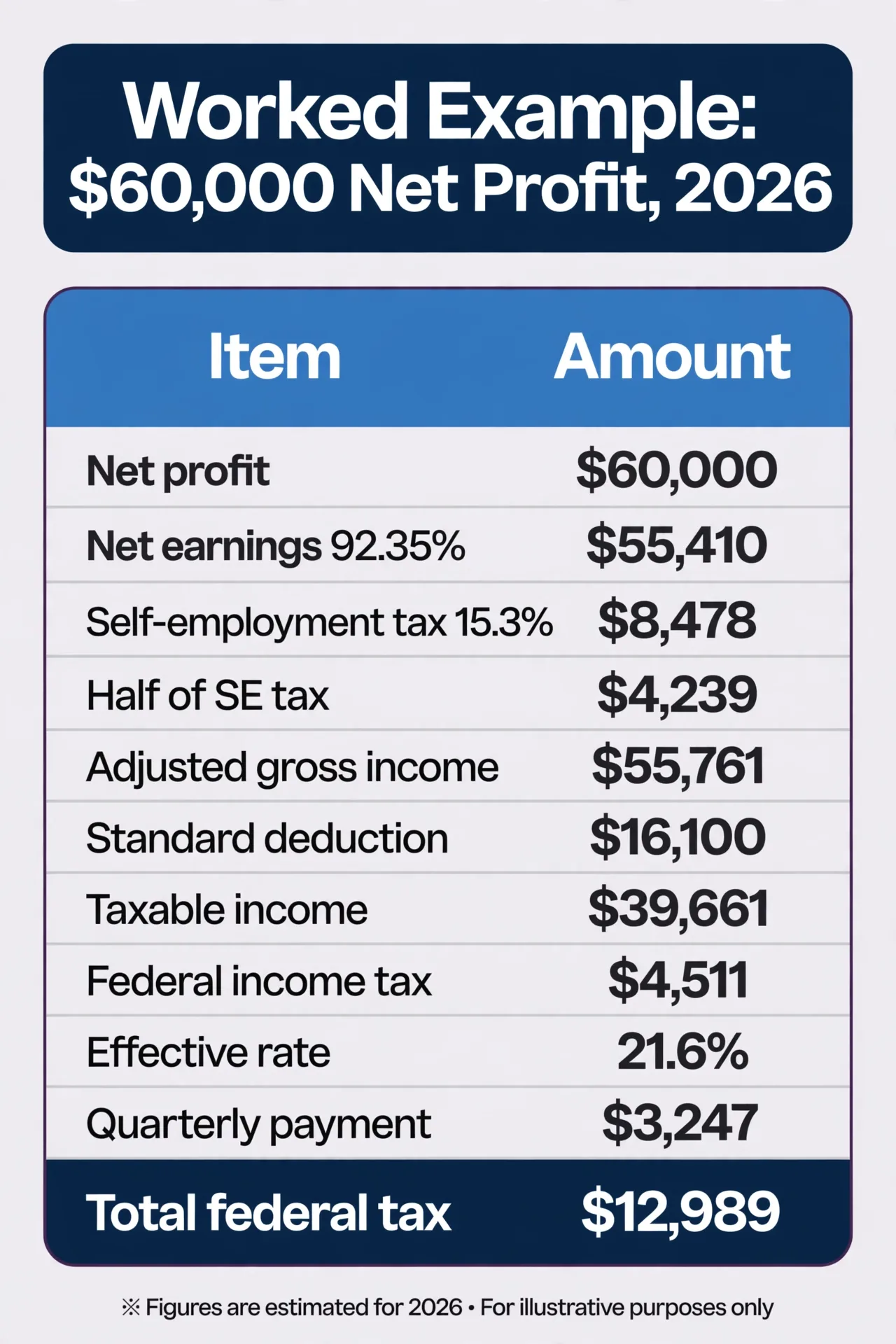
Here is the whole self employed taxes calculator in one place, for a single freelancer with $60,000 of net profit in 2026, no W-2 wages, and no state tax in the total. Every line is shown, so you can copy the shape of it and replace the numbers with your own.
| Line | Calculation | Amount |
|---|---|---|
| Net profit | Gross income minus business expenses | $60,000 |
| Net earnings for SE tax | 92.35% of $60,000 | $55,410 |
| Self-employment tax | 15.3% of $55,410 | $8,478 |
| Half of SE tax (deductible) | 50% of $8,478 | $4,239 |
| Adjusted gross income | $60,000 minus $4,239 | $55,761 |
| Standard deduction (single, 2026) | Fixed figure | $16,100 |
| Taxable income before QBI | $55,761 minus $16,100 | $39,661 |
| Federal income tax before QBI | 10% of $12,400 plus 12% of $27,261 | $4,511 |
| Total federal tax before QBI | $8,478 plus $4,511 | $12,989 |
| Effective federal rate | $12,989 divided by $60,000 | 21.6% |
| Quarterly payment | $12,989 divided by 4 | $3,247 |
With the QBI deduction, the same example changes in two lines. The QBI deduction is 20 percent of $55,761, which is $11,152. Taxable income falls to $28,509, federal income tax falls to $3,173, and the total federal tax falls to $11,651, which is 19.4 percent of net profit, or about $2,913 per quarter. That is the size of the QBI effect at this income level: about $1,338 a year. Whether you qualify for the full 20 percent depends on your total income and on the IRS limits, so treat the $11,651 figure as the best case and the $12,989 figure as the safe planning number. Plan your set-aside on the higher figure, and treat any QBI saving as a bonus at filing time.
Notice what the table does not include: state tax, and any tax credits, such as credits for children or for education. Credits reduce your tax dollar for dollar, and they are claimed on your return, not in this calculation. If you qualify for credits, your final bill will be lower than the table shows. The table is an estimate of your federal tax before credits and before state tax, and that is the right number to use when you are deciding how much to set aside during the year.
What You Owe at Other Income Levels
The $60,000 example is one point on a curve. Here is the same self employed taxes calculator, run the same way, at three other income levels, so you can find the row closest to your own situation. All four rows are for a single filer in 2026, with no W-2 wages, before the QBI deduction and before state tax. I computed each row myself from the same brackets and the same 15.3 percent rate, so the rows are consistent with each other and with the worked example above.
| Net profit | Self-employment tax | Federal income tax | Total federal tax | Effective rate |
|---|---|---|---|---|
| $50,000 | $7,065 | $3,396 | $10,461 | 20.9% |
| $60,000 | $8,478 | $4,511 | $12,989 | 21.6% |
| $75,000 | $10,597 | $6,504 | $17,101 | 22.8% |
| $100,000 | $14,130 | $11,616 | $25,746 | 25.7% |
Two patterns in this table are worth noticing. First, the effective rate rises as income rises, because the income tax brackets are progressive. At $50,000 of net profit you keep about 79 cents of every dollar after federal tax, and at $100,000 you keep about 74 cents.
Second, the self-employment tax is the larger half of the bill at lower incomes and the smaller half at higher incomes. At $50,000, self-employment tax is $7,065 of the $10,461 total. At $100,000, it is $14,130 of the $25,746 total, and the income tax has grown faster. That is why the 25 to 30 percent set-aside rule works as a rough guide but is only a rough guide: your real percentage depends on where you sit on this curve, on whether you qualify for QBI, and on your state.
If your income is above $100,000, the same method still works, but two more details appear. The Social Security wage base of $184,500 starts to matter once your combined wages and net earnings approach it, and the additional Medicare tax of 0.9 percent appears above $200,000 of income for a single filer. A calculator can handle those details, but now you know what it is doing underneath, which means you can spot it when a calculator gets one of them wrong.
Turn the Total Into Quarterly Payments

A freelancer does not pay tax once a year. The IRS expects estimated tax payments four times a year, and the due dates for the 2026 tax year are fixed. The simplest way to turn your annual total into quarterly payments is to divide it by four and pay that amount on each date. For the $60,000 example, that is $12,989 divided by four, or about $3,247 per quarter before QBI, or about $2,913 per quarter with the full QBI deduction.
| Payment | Due date | Period it covers |
|---|---|---|
| First quarter | 15 April 2026 | January, February and March 2026 |
| Second quarter | 15 June 2026 | April and May 2026 |
| Third quarter | 15 September 2026 | June, July and August 2026 |
| Fourth quarter | 15 January 2027 | September, October, November and December 2026 |
Two details in this table catch people out. The first is the second quarter due date: 15 June 2026, which is a Monday. One ranking calculator page lists it as 16 June, which is wrong, and a freelancer who trusts that page and pays a day late has still paid late.
The second is the uneven length of the quarters. The second quarter covers only two months, April and May, while the fourth quarter covers four months, September through December. Equal quarterly payments can still leave you short if your income is lumpy, for example if most of your work lands in the last months of the year. The fix for lumpy income is the annualized income installment method, which you claim on Schedule AI of Form 2210, and my guide to quarterly estimated taxes for freelancers walks through that method and the Form 1040-ES worksheet step by step.
You generally have to make estimated payments if you expect to owe $1,000 or more when your return is filed. That is the IRS threshold, and it is easy to pass: a freelancer with even $10,000 of net profit will owe more than $1,000 in combined tax. The safe harbor rule protects you from the underpayment penalty if you pay enough during the year. You avoid the penalty if you owe less than $1,000 after subtracting your withholding and credits, or if you paid at least 90 percent of the tax for the current year, or 100 percent of the tax shown on your return for the prior year, whichever is smaller.
If your prior-year adjusted gross income was over $150,000, or $75,000 if you are married filing separately, the prior-year figure becomes 110 percent instead of 100 percent. The safe harbor is about the penalty, not about the tax itself: you still owe the full tax at filing time, but you will not be charged extra for paying it late in the year.
One more timing rule is worth knowing. The fourth quarterly payment is not required if you file your 2026 return by 1 February 2027 and pay the full balance with it. The 31 January 2027 deadline falls on a Sunday, so it moves to Monday 1 February 2027. That is a narrow window and it only helps if your return is genuinely ready, so most freelancers are better off paying the fourth quarter on 15 January 2027 and treating any overpayment as a refund or a credit toward the next year.
How Much to Set Aside From Every Payment
The quarterly schedule tells you when to pay, but it does not tell you how to have the money ready. The habit that makes quarterly payments painless is the set-aside: every time a client pays you, move a fixed percentage of that payment into a separate savings account the same day, and do not touch it until a quarterly due date arrives. This self employed taxes calculator gives you that percentage.
The common rule of thumb is 25 to 30 percent of every payment. For the $60,000 example, the real federal rate before QBI is 21.6 percent, so 25 percent covers the federal tax with a small cushion, and 30 percent covers it with room for state tax in most states. At $100,000 of net profit, the federal rate is 25.7 percent before QBI, so 25 percent is not enough on its own, and 30 percent is the safer choice. In a high-tax state, or at a high income, 30 to 35 percent is the honest figure.
The better method is to use this self employed taxes calculator to work out your own percentage instead of borrowing the rule of thumb. Take your total tax from the worked example and divide it by your net profit. For the $60,000 example, that is $12,989 divided by $60,000, which is 21.6 percent for federal tax alone. Add your state rate on top, add two or three points as a cushion, and you have a personal set-aside percentage that fits your income, your state and your deductions.
I learned the set-aside habit the hard way in my first year, a story I tell in full in my beginner’s guide to freelance taxes, and the lesson from it is simple: the percentage matters less than the habit. A freelancer who sets aside 25 percent of every payment on the day it arrives will never face a quarterly date with empty hands.
One practical tip makes the habit stick. Open a separate savings account and call it your tax account, and set up an automatic transfer if your bank allows it. When a client payment lands, the transfer happens before you can spend the money on anything else. If you price your work with tax in mind, the habit gets easier still: build the tax share into your rate, so the money you set aside was never yours to spend in the first place. My free hourly rate calculator helps you price a project so the tax share, your expenses and your profit are all inside the rate you quote.
First-Year Freelancers: No Prior-Year Safe Harbor
If this is your first year freelancing, one piece of the safe harbor rule does not exist for you. The 100 percent prior-year method works by comparing what you paid this year with what you owed last year. In your first year, there is no last year, so that method is not available. You must use the 90 percent current-year method instead, which means paying at least 90 percent of this year’s actual tax during the year, or use the annualized income method if your income arrives unevenly.
In practice, a first-year freelancer should do three things. First, estimate the year’s net profit honestly, even if the estimate is rough, and run the six-step calculation on that estimate.
Second, set aside 25 to 30 percent of every payment from the first client onward, so the money is there when the first quarterly date arrives. Third, revisit the estimate every quarter and adjust the payments, because a first-year estimate is almost always wrong in one direction or the other. If the year turns out better than expected, your later quarters can catch up. If it turns out worse, you will have overpaid slightly and the excess comes back as a refund or a credit. Overpaying a little in the first year is far cheaper than underpaying and meeting the penalty.
There is one more first-year trap to avoid. Many new freelancers assume that because they have never filed as a freelancer before, the IRS will not notice a missed quarter. The IRS does not send a reminder, and the penalty is calculated on your return, not announced in advance. The absence of a letter is not the absence of a penalty. Pay the quarters, keep the receipts, and let the return sort out the difference.
1099 Forms and Your Calculation
The 1099 forms that arrive in January are records to check, not the starting point of your calculation. Your calculation starts from your own records: your invoices, your bank deposits and your platform statements. The forms are there to be reconciled against those records, and the reconciliation matters, because the IRS receives a copy of every 1099 too, and it matches what the payer reported against what you reported.
Two forms matter most to freelancers. Form 1099-NEC is the form a business client uses to report what it paid you for services. For payments made in 2025 and earlier, a client had to report payments of $600 or more. For payments made on or after 1 January 2026, the threshold is $2,000, a change from the One Big Beautiful Bill Act that I verified in the IRS instructions for Forms 1099-MISC and 1099-NEC dated December 2026. The practical meaning is that a client who paid you $1,500 for work in 2026 does not have to send you a 1099-NEC, but you still owe tax on that $1,500. The threshold decides whether a form is sent. It never decides whether income is taxable. My 1099-NEC guide for freelancers reads the form box by box from the recipient’s side, and my W-9 guide for freelancers explains the form clients ask you to complete before they pay you, including the 24 percent backup withholding that applies if your taxpayer identification number is wrong or missing.
Form 1099-K is the form from payment apps, online marketplaces and card processors, and it is the one freelancers confuse with the 1099-NEC most often. A payment app or online marketplace must send you a Form 1099-K when the payments you received for goods or services total over $20,000 in more than 200 transactions. Both tests must be met. A platform may still send you a form below the threshold, and if a customer pays you directly by credit, debit or gift card, the card processor reports it no matter how small the amount is. The gross amount on a 1099-K includes fees and refunds, so check it against your own records before you copy the number onto your return, and remember that a payment app reports the gross amount, not your profit. My guide to every freelance tax form maps all seven forms in one place, so you can see which ones apply to you and when each one is due.
If no 1099 arrives, your duty does not change. Report the income from your own records on Schedule C, do not wait for the form, and keep your invoices and bank records as proof. If a 1099 arrives with the wrong amount, do not change the form yourself. Ask the payer for a corrected form, and if the correction cannot be made before you file, report the income you actually received, keep your records, and file on time. The IRS matches your return against the copies the payers filed, so a number that disagrees with a 1099 without an explanation is the fastest way to receive a notice.
What Happens If You Miss a Payment
Missing a quarterly payment does not make the tax disappear. It adds a penalty on top of it, and the penalty is calculated from the date the payment was due until the date you pay it. The underpayment penalty is charged at the federal short-term interest rate plus three percentage points, compounded daily, and the rate changes every quarter, so there is no single fixed rate I can give you here that would stay correct. The IRS publishes the current rate on its site, and Form 2210 is the form that calculates the penalty.
The penalty is usually small for a single missed quarter, and it grows the longer the underpayment lasts. The safe harbor rule in the quarterly section is your protection against it: pay at least 90 percent of the current year’s tax, or 100 percent of the prior year’s tax, during the year, and the penalty does not apply. If you have already missed a payment, the best move is to pay it as soon as you can, because the penalty stops growing on the day you pay. Then adjust the remaining quarters so the year still ends at or above the safe harbor line.
If you also hold a W-2 job alongside your freelance work, there is an alternative to quarterly payments that many freelancers miss. You can increase the withholding on your W-4 with your employer instead of making estimated payments, and withholding is treated as if it were paid evenly through the year, even if you increase it late in the year. That timing rule can rescue a freelancer who discovers in November that the year’s quarters were too small. It is not a way to pay less tax. It is a way to pay the same tax on a different schedule.
Frequently Asked Questions
How much tax does a freelancer pay?
A single freelancer in the United States typically pays about 20 to 26 percent of net profit in federal tax before state tax and before the QBI deduction, with the exact figure rising as income rises. At $60,000 of net profit in 2026, the federal total is about $12,989, or 21.6 percent, before QBI, and about $11,651, or 19.4 percent, with the full QBI deduction. State tax adds on top of that.
How do I calculate my freelance taxes?
Use this self employed taxes calculator to work through six steps. Find your net profit, which is gross income minus business expenses. Multiply 92.35 percent of your net profit by 15.3 percent to get your self-employment tax. Subtract half of that tax and the standard deduction from your net profit, then run the result through the 2026 federal income tax brackets. Add your state tax. Divide the total by four for your quarterly payments, and divide the total by your net profit to get your set-aside percentage.
How much should I set aside for freelance taxes?
Set aside 25 to 30 percent of every client payment as a rule of thumb, and 30 to 35 percent if you live in a high-tax state or earn a high income. The precise method is to divide your total annual tax by your net profit to get your personal percentage, add two or three points as a cushion, and move that share into a separate savings account the day each payment arrives.
What percentage should freelancers save for taxes?
Most freelancers should save 25 to 30 percent of every payment. The federal rate alone is about 21 to 26 percent for net profits between $50,000 and $100,000, and state tax pushes the total higher. A freelancer in a state with no income tax can sit at the low end of the range, and a freelancer in a high-tax state should sit at the high end.
How much tax do I pay on $60,000 of freelance income?
On $60,000 of net profit as a single filer in 2026, you pay $8,478 in self-employment tax and $4,511 in federal income tax before QBI, for a total of $12,989, or about $3,247 per quarter. With the full QBI deduction, the total falls to $11,651, or about $2,913 per quarter. These figures are federal tax only, before state tax and before any tax credits.
When are freelance quarterly taxes due in 2026?
The four due dates for the 2026 tax year are 15 April 2026, 15 June 2026, 15 September 2026 and 15 January 2027. The fourth payment is not required if you file your 2026 return by 1 February 2027 and pay the full balance with it. Note that the second quarter is due on 15 June, not 16 June, even though one ranking calculator page says otherwise.
Do I have to pay taxes if I did not receive a 1099?
Yes. You must report all of your income on your tax return whether or not a 1099 form arrived. The 1099 thresholds decide whether a payer has to send you a form, and they never decide whether the income is taxable. Report the income from your own records on Schedule C, keep your invoices and bank records as proof, and do not wait for a form that may never come.
What is the difference between a 1099-NEC and a 1099-K?
A 1099-NEC comes from a business client and reports what it paid you for services, with a $2,000 threshold for payments made in 2026. A 1099-K comes from a payment app, online marketplace or card processor and reports payments for goods or services, with a threshold of over $20,000 in more than 200 transactions for payment apps and marketplaces, and no threshold at all for direct card payments. Both forms are records to check against your own income records.
How is self-employment tax calculated?
Take 92.35 percent of your net profit from Schedule C, then multiply the result by 15.3 percent, which is 12.4 percent for Social Security and 2.9 percent for Medicare. For 2026, only the first $184,500 of your combined wages, tips and net earnings is subject to the Social Security part. An additional Medicare tax of 0.9 percent applies above $200,000 of income for a single filer. You owe self-employment tax if your net earnings are $400 or more.
Does the QBI deduction apply to freelancers?
Yes, if you qualify. The qualified business income deduction lets an eligible freelancer deduct up to 20 percent of qualified business income from taxable income, subject to income limits set in the IRS rules. It reduces your federal income tax only, not your self-employment tax. At $60,000 of net profit, the full deduction saves about $1,338 a year. Check the IRS rules for Form 8995 to see whether the limits affect you.
Sources
Every figure in this post was verified on irs.gov on 29 November 2026. The pages below are the primary sources, so you can check each number yourself.
- IRS, Self-Employment Tax (Social Security and Medicare Taxes): the 15.3 percent rate, the 12.4 percent and 2.9 percent split, the 2026 Social Security wage base of $184,500, the $400 net-earnings threshold, the 0.9 percent additional Medicare tax thresholds, and the rule that half of self-employment tax is deductible for income tax purposes. https://www.irs.gov/businesses/small-businesses-self-employed/self-employment-tax-social-security-and-medicare-taxes
- IRS, Topic No. 554, Self-Employment Tax: the 92.35 percent factor for net earnings and the $400 threshold. https://www.irs.gov/taxtopics/tc554
- IRS, IR-2025-103, IRS Releases Tax Inflation Adjustments for Tax Year 2026 (Rev. Proc. 2025-32): the 2026 standard deduction of $16,100 for single filers, $32,200 for married couples filing jointly and $24,150 for heads of household, and the 2026 federal income tax brackets for single filers. https://www.irs.gov/newsroom/irs-releases-tax-inflation-adjustments-for-tax-year-2026-including-amendments-from-the-one-big-beautiful-bill
- IRS, Estimated Taxes: the $1,000 estimated-tax rule and the safe harbor rule of 90 percent of the current year or 100 percent of the prior year. https://www.irs.gov/businesses/small-businesses-self-employed/estimated-taxes
- IRS, Instructions for Forms 1099-MISC and 1099-NEC (December 2026): the 1099-NEC threshold of $2,000 for payments made in 2026 and $600 for payments made in 2025, the 1099-MISC thresholds, and the 31 January furnishing and filing deadline. https://www.irs.gov/instructions/i1099mec
- IRS, Understanding Your Form 1099-K: the threshold of over $20,000 in more than 200 transactions for payment apps and online marketplaces, no threshold for direct card payments, and the rule that all income must be reported whether or not a form arrives. https://www.irs.gov/businesses/understanding-your-form-1099-k
- IRS, Form 1040-ES, Estimated Tax for Individuals (2026): the quarterly payment due dates and the rule that the 15 January 2027 payment is not required if the return is filed by 31 January 2027. https://www.irs.gov/pub/irs-pdf/f1040es.pdf
Last reviewed: November 2026.
I am not a lawyer, and this post is general information, not legal advice. If a project is worth a meaningful amount of money, or a dispute has already started, talk to a licensed attorney in your state before you act. For tax questions about your own situation, talk to a qualified tax professional.
