


Introduction
An independent contractor agreement is the written contract between a business and a self-employed worker that sets out the services, the fee, the payment schedule, who owns the finished work, and how either side can walk away. If you hire contractors, or you work as one, this single document does more to prevent disputes than any other piece of paper in the relationship. Below you will find a complete template structure with all twelve clauses explained in plain English, sample wording you can adapt, the classification tests the agreement has to agree with, and the paperwork routine that goes with it: Form W-9 before work starts, invoices during the project, and Form 1099-NEC at year end.
I write and review freelance agreements for a living, and the pattern I see is always the same. The projects that end in arguments are rarely the ones with a bad clause. They are the ones with no written agreement at all, where the fee was agreed in a call, the deadline lived in someone’s memory, and ownership of the work was never mentioned until the client wanted the source files. A one-hour investment in this document, before the work starts, is the cheapest protection either side will ever buy.
What Is an Independent Contractor Agreement?
An independent contractor agreement is a legally binding contract that records a working relationship in which the worker is self-employed, not an employee. It names the parties, describes the services and deliverables, states the compensation and when it is paid, allocates ownership of the work product, and confirms the contractor’s independent status: the contractor controls how the work is done, supplies their own tools, can work for other clients, and carries their own taxes and insurance.
You will see the same document called a contractor agreement, a consulting agreement, a services agreement, or a freelance contract. The label matters far less than the contents. What makes it an independent contractor agreement, rather than an employment contract, is the relationship it describes: a business buying a result from another business, not a boss directing an employee’s hours and methods.
One honest note before the template. If you are a writer, this site already carries a specialist freelance writing contract template with clauses built for articles and content work. The agreement below is the general version, written for any trade: designers, developers, consultants, marketers, tradespeople, and the businesses that hire them.
Do You Legally Need a Written Agreement?
No single federal law forces every business and contractor to sign a written agreement for ordinary private work. In many engagements the contract would be enforceable even if it were only spoken, although proving what was said is another matter, as my guide to verbal and email agreements explains. But three things make the written version close to compulsory in practice.
First, some state laws require one. New York’s Freelance Isn’t Free Act requires a written contract for freelance engagements of $800 or more within a 120-day period, and a client who refuses can face double damages. California’s SB 988 requires a written contract for freelance work of $250 or more. The Illinois Freelance Worker Protection Act requires one for engagements of $500 or more over 120 days. If your work touches those states, the written agreement is not optional paperwork; it is a legal duty, usually on the hiring side.
Second, the agreement is evidence. When a tax authority or a court asks whether a worker was really a contractor, the signed agreement is one of the facts they weigh, and it is the only fact you fully control in advance. Third, it is the payment record: the fee, the due dates, and the late fee all live here, and an unpaid-invoice claim is far easier with the agreement attached. My full breakdown of how classification is decided sits in the guide to employee vs independent contractor status.
The Template: 12 Clauses at a Glance
Here is the whole agreement on one screen. The sections after this list explain each clause and give sample wording.
- Parties: who is who, identified by full legal name and address.
- Services and scope: what will be delivered, in what format, and what is not included.
- Term and timeline: the start date, milestones, and the end date or completion point.
- Compensation and payment terms: the amount, the schedule, the deposit, and the late fee.
- Expenses: which costs the contractor absorbs and which the client reimburses.
- Independent contractor status: the clause stating the contractor is self-employed, not an employee.
- Taxes and paperwork: Form W-9 at the start and Form 1099-NEC at year end.
- Intellectual property and ownership: who owns the work, and the moment ownership passes.
- Confidentiality: what each side must keep private, during and after the project.
- Termination: how either side can end the agreement, and what is paid when it ends.
- Liability and indemnification: caps on liability and who covers third-party claims.
- Governing law and disputes: which state’s law applies and how a dispute starts.

Clause 1: Parties
Open with the full legal names of both sides, their addresses, and the date the agreement takes effect. If the contractor works through a company or an LLC, name that entity, because the entity is who gets paid and who signs. Most later confusion about invoices and tax forms starts with a nickname or a trading name in this clause.
This Independent Contractor Agreement is entered into on [date] between [Client legal name], of [address] (the Client), and [Contractor legal name], of [address] (the Contractor).
Clause 2: Services and Scope
Describe the deliverables with quantities, formats, and deadlines, and name what is excluded. A vague scope is the seed of almost every dispute I see, and it is exactly how unpaid extra work creeps in. If your projects suffer from expanding requests, pair this clause with the revisions and change-order wording in my guide to freelance scope creep and the revisions clause.
The Contractor will deliver [deliverables, quantities, formats] by [dates or milestones]. Work not listed in this clause is outside the scope and will be quoted and approved in writing before it begins.
Clause 3: Term and Timeline
State when the agreement starts, when it ends, and whether it covers a single project or an ongoing relationship. For ongoing work, add a review point or an end date, because an open-ended agreement quietly starts to look like employment, which matters for the classification tests below.
This Agreement begins on [start date] and continues until [end date or completion of the services], unless ended earlier under the Termination clause.
Clause 4: Compensation and Payment Terms
This is the clause the whole document exists for. State the fee structure (fixed fee, hourly, or milestone-based), the amount, when invoices are issued, how many days the client has to pay, and what happens when payment is late. A deposit before work begins is standard protection; my guide to how much deposit a freelancer should charge works through the percentages. If you want the late fee to hold up, it has to be written here, a point covered in depth in the late payment fees guide.
The Client will pay the Contractor [amount or rate] as follows: [deposit] before work begins, and the balance within [number] days of each invoice. Invoices unpaid after that period accrue a late fee of [amount or percentage] per month, to the extent allowed by law.
Clause 5: Expenses
One short clause prevents a month of small arguments. State that the contractor covers their own tools, software, and travel, or list the specific expenses the client reimburses and require written pre-approval above a set amount.
The Contractor is responsible for their own tools, equipment, and operating costs. Expenses above [amount] are reimbursed only when approved by the Client in writing in advance.
Clause 6: Independent Contractor Status
This clause states the relationship both sides intend: the contractor is an independent business, controls the manner and means of the work, sets their own hours, may serve other clients, and is not entitled to employee benefits. Write it truthfully. A status clause that contradicts how the work actually happens is worse than none, for reasons the classification section below explains.
The Contractor is an independent contractor and not an employee, agent, or partner of the Client. The Contractor controls how and when the services are performed, provides their own equipment, and may provide services to other clients.
Clause 7: Taxes and Paperwork
The contractor is responsible for their own income and self-employment taxes; the client withholds nothing. On the paperwork side, the client collects a completed Form W-9 from the contractor before the first payment, and, if the year’s payments reach the reporting threshold, files Form 1099-NEC after year end. The threshold is $600 for payments made in 2025 and $2,000 for payments made in 2026 and later, under the One Big Beautiful Bill Act. Getting the W-9 at the start, rather than chasing it in January, is the single easiest compliance habit to build.
The Contractor is solely responsible for all taxes on amounts paid under this Agreement. The Contractor will provide a completed Form W-9 before the first payment. The Client will report payments on Form 1099-NEC where required by law.
Clause 8: Intellectual Property and Ownership
Decide who owns the work product and say so in words. Two routes exist. Where the work fits one of the nine categories in the federal work made for hire definition in 17 U.S.C. section 101, such as a contribution to a collective work, a translation, or a compilation, the parties can agree in a signed writing that it is a work made for hire, and the client is treated as the author from creation. Most freelance work, including logos, websites, and code, sits outside those nine categories, so the safer general route is an assignment: the contractor assigns the rights to the client, effective on full payment. Tying the transfer to payment is what gives the contractor leverage, and my guide to withholding work until paid explains where that leverage begins and ends. Keep the contractor’s pre-existing tools and know-how carved out, so the client gets the deliverable, not the contractor’s whole toolbox.
On receipt of full payment, the Contractor assigns to the Client all rights in the final deliverables. Until full payment is received, those rights remain with the Contractor. The Contractor’s pre-existing tools, templates, and know-how remain the Contractor’s property.
Clause 9: Confidentiality
Cover the client’s non-public information: unreleased plans, customer data, pricing, and credentials. Make it mutual where the contractor’s own rates and methods deserve the same respect, and state how long the duty lasts after the project ends. Where the information is genuinely sensitive, a standalone NDA may sit alongside this clause.
Each party will keep the other’s non-public information confidential and will use it only to perform or receive the services under this Agreement.
Clause 10: Termination
Let either side end the agreement with a stated notice period, and settle the money in advance: work completed up to the end date is invoiced and paid, and any deposit treatment is spelled out. A kill fee for late cancellation is common on creative projects and belongs here if you use one.
Either party may end this Agreement with [number] days written notice. The Client will pay for all services performed up to the final day, invoiced in the normal way.
Clause 11: Liability and Indemnification
Cap each side’s liability at a sensible figure, often the total fees paid under the agreement, and add a mutual indemnity: each side covers third-party claims caused by its own work or negligence. Contractors who carry professional insurance should say so here, because some clients require it.
Neither party’s total liability under this Agreement will exceed the amounts paid or payable under it. Each party will indemnify the other against third-party claims arising from its own work, materials, or negligence.
Clause 12: Governing Law and Disputes
Name the state whose law governs, and set the first step of a dispute: a written notice and a short window to resolve it, then mediation or court. Most freelance money disputes that do reach a courtroom land in small claims court, and the agreement’s paper trail is what you will stand on there.
This Agreement is governed by the laws of the State of [state]. The parties will try to resolve any dispute by written notice and good faith discussion before filing any claim.
How to Fill In and Sign the Template
- Identify both parties by legal name. Use the names that appear on tax documents, not trading names or nicknames, and add addresses and the effective date.
- Describe the services and deliverables. List what will be delivered, in what format, by which dates, and write down the main exclusions so the scope has edges.
- Set the fee structure and payment schedule. Choose fixed fee, hourly, or milestones; add the deposit, the payment window in days, and the late fee.
- Choose the intellectual property route. Use work made for hire wording only if the work fits the federal categories; otherwise use an assignment that takes effect on full payment.
- Add the term, termination, and governing law. Fix the start and end, the notice period for ending early, and the state whose law applies.
- Sign, date, and store it with the W-9. Both sides sign, electronic signatures count under the federal ESIGN Act, and each side keeps a copy with the contractor’s Form W-9 on file.

That sequence, W-9 first and 1099-NEC last, is the whole paperwork rhythm of a contractor relationship. For a sense of what the forms side costs when it goes wrong, the Internal Revenue Service charges penalties for late or incorrect information returns, and the amounts rise the longer a filing is left.
The Classification Trap: Why the Paper Alone Cannot Protect You
Here is the misunderstanding this template cannot fix on its own. Calling someone an independent contractor in a signed agreement does not make them one in the eyes of the law. Classification is decided by the facts of the working relationship, tested three different ways, and the agreement is only one piece of evidence inside those tests.
The IRS common law test: control
For federal employment taxes, the IRS weighs all the evidence of control and independence in three categories. Behavioral control asks whether the business directs how the work is done, through instructions, training, or set hours. Financial control asks who provides the tools, who carries unreimbursed expenses, whether the worker can profit or lose money, and whether the worker offers services to the wider market. The relationship of the parties looks at written contracts, employee-type benefits, and whether the work is a key, ongoing part of the business. No single fact decides it, and either side can ask the IRS to decide by filing Form SS-8.
The DOL economic reality test: dependence
For wage and hour law under the Fair Labor Standards Act, the Department of Labor applies an economic reality test built on six factors: the worker’s opportunity for profit or loss, the investments of both sides, the permanence of the relationship, the nature and degree of control, how integral the work is to the business, and the worker’s skill and initiative. The factors are weighed together, under the 2024 final rule, and the question underneath all six is whether the worker is economically dependent on the business or genuinely in business for themselves. The Department has proposed revisiting that rule, so treat the six factors as the current framework and check for updates on larger engagements.
State ABC tests: often the strictest
Many states apply an ABC test for unemployment insurance and wage claims, and it is usually the hardest to pass. In its common form, the worker must be free from the hiring firm’s control, the work must sit outside the firm’s usual line of business, and the worker must run an independently established trade. Fail one prong and the worker is an employee for that law’s purposes, whatever the contract says.
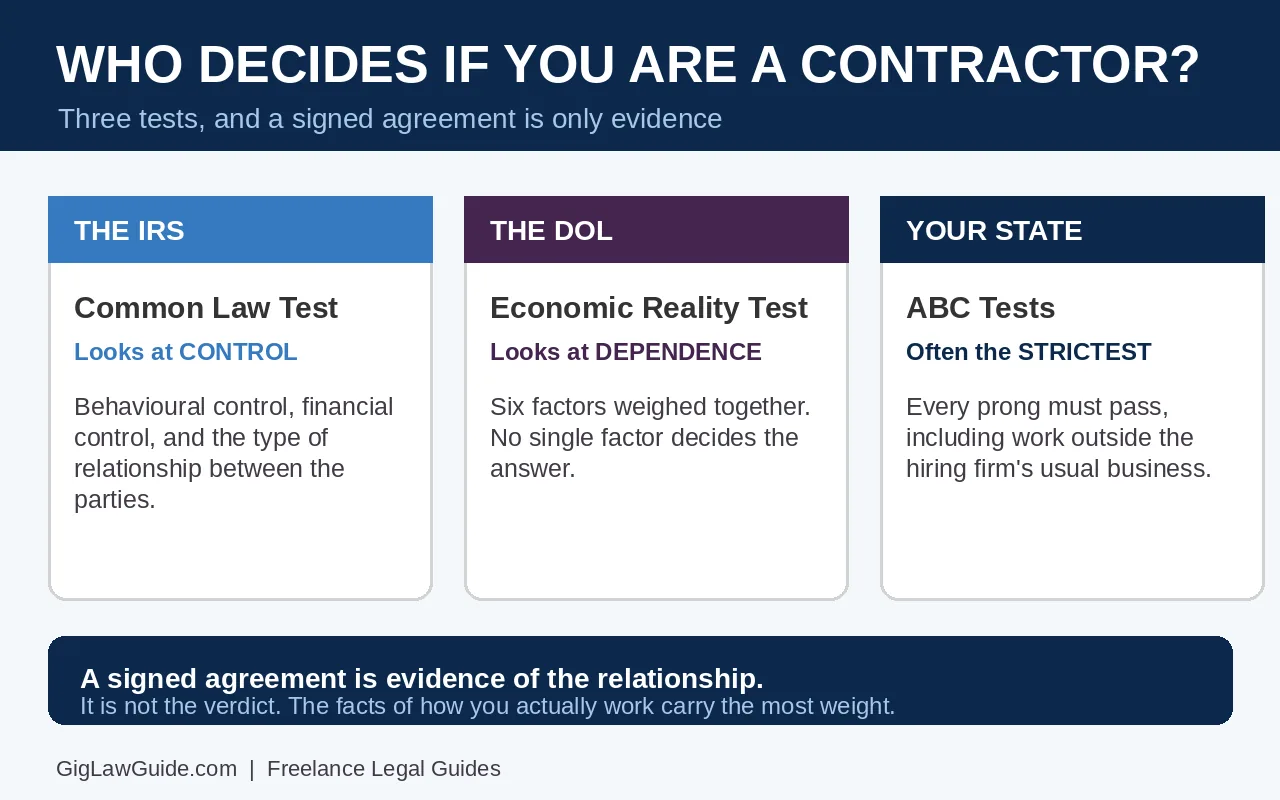
The practical lesson is simple. Draft the agreement to describe a genuinely independent relationship, then run the relationship the way the agreement describes: no set office hours, no employee handbook, no exclusivity by the back door. Paper and practice have to match.
Independent Contractor Agreement vs Employment Contract
| Question | Independent contractor agreement | Employment contract |
|---|---|---|
| Who controls the work? | The contractor controls how and when the work is done; the client buys a result. | The employer controls the work, the hours, and the methods. |
| How is the worker paid? | By invoice, per project, milestone, or hour, with no tax withheld. | By payroll, with income and payroll taxes withheld. |
| Which tax form reports it? | Form 1099-NEC, at the $600 threshold for 2025 payments and $2,000 for 2026 payments. | Form W-2. |
| Who provides tools and covers costs? | The contractor, unless the agreement says otherwise. | Usually the employer. |
| Can the worker serve others? | Yes, unless a narrow, lawful restriction is agreed. | Often restricted by the job itself. |
| Employee benefits? | None from the client; the contractor arranges their own. | Commonly included or legally required. |
Short-Form or Full Agreement?
For a small, one-off job with a client you know, a one-page short-form agreement covering parties, scope, fee, payment date, ownership, and signatures may be enough, and a short document that actually gets signed beats a long one that does not. Move to the full twelve-clause version when the fee is meaningful, the project runs for months, the work involves confidential information or valuable intellectual property, or the client is new. The cost of the longer document is an hour; the cost of the missing clause is usually the whole fee. Before either side needs a courtroom, it also helps to know how the small claims route works, which my guide to taking a client to small claims court covers step by step.
Red Flags in an Agreement a Client Hands You
Contractors are often asked to sign the client’s paper instead of their own. Read that version for these four patterns. First, an intellectual property clause that grabs everything you create, including your pre-existing tools and anything built outside the project. Second, payment terms that pay you only when the client gets paid, with no final backstop date; insist on a long-stop date after which you are paid regardless. Third, a non-compete so broad it would stop you working in your own trade; narrow it by client, service, and time, or strike it. Fourth, unlimited revisions or unlimited liability, both of which turn a fixed fee into an open cheque. Each of these is negotiable, and a client who will not move on any of them is telling you something about the project. If you are pricing the engagement as you negotiate, the free gig tools on this site include a rate calculator that helps you sanity-check the fee before you sign.
Frequently Asked Questions
What should be included in an independent contractor agreement?
Twelve things: the parties’ legal names, a specific scope of work, the term and timeline, compensation and payment terms with a late fee, expenses, an independent contractor status clause, taxes and paperwork duties, intellectual property ownership, confidentiality, termination, liability, and governing law. The template above covers each one with sample wording.
Is an independent contractor agreement legally binding?
Yes, when it meets the normal requirements of a contract: offer, acceptance, consideration, capacity, and a lawful purpose, with definite enough terms. A signed writing is the easiest form to prove, and in some states, including New York, California, and Illinois, a written contract is legally required above set fee thresholds.
What is the difference between an independent contractor agreement and an employment contract?
An independent contractor agreement buys a result from a self-employed worker who controls how the work is done, invoices for it, and receives a Form 1099-NEC. An employment contract hires a person the employer directs, pays through payroll with taxes withheld, and reports on Form W-2. The real relationship, not the document’s title, decides which one the law sees.
Does an independent contractor agreement protect against misclassification?
Only partly. The agreement is evidence of the relationship the parties intended, and the IRS counts written contracts inside its relationship category. But the IRS, the Department of Labor, and state agencies all test the actual facts: control, economic dependence, and, in ABC test states, whether the work sits outside the hiring firm’s usual business. Paper that contradicts practice will not save the classification.
When does a business have to send a contractor a 1099-NEC?
A business files Form 1099-NEC for a contractor it paid at least $600 for services in 2025, or at least $2,000 for services paid in 2026 and later, after the One Big Beautiful Bill Act raised the threshold. The form for 2026 payments is due to the contractor and the IRS by February 1, 2027, because January 31 falls on a Sunday. Collecting the contractor’s Form W-9 at the start of the work makes January simple.
Who owns the work under an independent contractor agreement?
Whoever the agreement says, within the limits of copyright law. A signed work made for hire clause only works for the nine categories listed in 17 U.S.C. section 101. For everything else, ownership passes by a written assignment, and the safest drafting makes that assignment take effect when the client has paid in full.
Can I use a free independent contractor agreement template?
Yes, as a starting structure, and the template on this page is free to adapt. Check any template for the clauses free versions most often drop: the late fee, the assignment-on-payment wording, the contractor status clause, and the termination settlement. For a high-value or long-running engagement, have a local attorney review the final version once; it is cheaper than one dispute.
Does an independent contractor agreement need to be notarized?
No. A signature from each party is enough for an ordinary services agreement, and electronic signatures are valid under the federal ESIGN Act and state electronic transaction laws. Notarization is for specific document types, such as certain property and court filings, not for a standard contractor agreement.
What happens if a contractor is reclassified as an employee?
The hiring business can owe back payroll taxes, benefits, overtime, and penalties, and the worker’s own tax position changes as well. Reclassification can be triggered by an audit, a claim for unemployment benefits, or a Form SS-8 filing. It is the main reason the classification section of this guide matters more than any single clause.
How long should an independent contractor agreement be?
As long as the risk requires. A one-page short form can cover a small one-off job. A full agreement for ongoing or valuable work usually runs three to six pages once scope, payment, intellectual property, and liability are written properly. Length is not the goal; coverage of the twelve clauses is.
Sources
- Internal Revenue Service, Topic No. 762, Independent Contractor vs. Employee (common law rules: behavioral control, financial control, relationship of the parties): https://www.irs.gov/taxtopics/tc762
- Internal Revenue Service, Independent Contractor (Self-Employed) or Employee?: https://www.irs.gov/businesses/small-businesses-self-employed/independent-contractor-self-employed-or-employee
- US Department of Labor, Small Entity Compliance Guide, Employee or Independent Contractor Classification Under the Fair Labor Standards Act (2024 final rule, six economic reality factors): https://www.dol.gov/agencies/whd/flsa/misclassification/small-entity-compliance-guide
- US Department of Labor, Frequently Asked Questions, Final Rule on Employee or Independent Contractor Classification Under the FLSA: https://www.dol.gov/agencies/whd/flsa/misclassification/rulemaking/faqs
- One Big Beautiful Bill Act, section 70433 (1099 reporting threshold of $2,000 for payments made after December 31, 2025), as set out in the IRS Instructions for Forms 1099-MISC and 1099-NEC and reported by Paychex: https://www.paychex.com/articles/payroll-taxes/form-1099-nec and Xero: https://www.xero.com/us/accountant-bookkeeper-guides/1099-filing-requirements/
- 17 U.S.C. section 101, definition of a work made for hire (nine categories for specially ordered or commissioned works), Cornell Law Institute, Legal Information Institute: https://www.law.cornell.edu/uscode/text/17/101
- 17 U.S.C. section 204(a), transfer of copyright ownership in writing, Cornell Law Institute: https://www.law.cornell.edu/uscode/text/17/204
- New York State Department of Labor, Freelance Isn’t Free Act (written contract at $800 or more in 120 days): https://dol.ny.gov/node/54011
- New York City Department of Consumer and Worker Protection, Freelancer Workers’ Rights: https://www.nyc.gov/site/dca/workers/workersrights/freelancer-workers.page
- Illinois Department of Labor, Freelance Worker Protection Act, 820 ILCS 193 (written contract at $500 or more in 120 days): https://labor.illinois.gov/laws-rules/legal/freelance-worker-protection-act
- Electronic Signatures in Global and National Commerce Act, 15 U.S.C. section 7001, Cornell Law Institute: https://www.law.cornell.edu/uscode/text/15/7001
I am not a lawyer, and this post is general information, not legal advice. If a project is worth a meaningful amount of money, or a dispute has already started, talk to a licensed attorney in your state before you act.
