You landed a new client. They need SEO. You said yes.
Now you’re staring at a to-do list that includes title tag audits, header hierarchy rewrites, schema markup implementation, internal linking restructures, and content optimization across 47 pages on a CMS you’ve barely touched before.
This is the exact moment most agencies either start turning down SEO clients or start burning out their existing team. Neither option grows a business.
White label SEO lets agencies own the client relationship while partners handle the technical execution behind the scenes.
White label on page SEO solves this problem directly. You sell the service, set the strategy, own the client relationship and a specialized partner executes the technical work invisibly, under your brand name.
This guide breaks down exactly how it works, what’s included in a real deliverable, what providers actually charge, and the red flags that cost agencies thousands. Whether you’re a solo SEO freelancer looking to scale or a 10-person agency trying to add capacity without adding payroll, this is the blueprint you need.
What Is White Label On Page SEO? (And Why the Definition Matters)
White label on page SEO is an outsourced service model where a third-party provider handles the technical execution of on-page optimization tasks, title tags, header structures, content optimization, schema markup, internal linking, and delivers the finished work under your agency’s branding, not theirs.
The client never knew a partner was involved. The deliverables carry your logo. The relationship stays yours.
Simple concept. Powerful application.
White label on page SEO is when a third-party SEO provider optimizes a client’s website pages including title tags, meta descriptions, headers, content, and schema markup and delivers the finished work under the reselling agency’s brand name.
What Is White-Label SEO and How Can It Help My Business?
Think of white label SEO like a restaurant using a commissary kitchen. The food comes out under the restaurant’s name, plated their way, served by their staff, but the prep work happens somewhere else, by specialists with the right equipment.
In the agency world, white label SEO works the same way. A digital marketing agency, web design firm, or freelance SEO consultant partners with a white label provider. The provider does the actual optimization work. The agency presents everything to its client as its own service.
The business impact for agencies is significant:
You add a high-margin service line without hiring a specialist
You retain clients longer because you offer a more complete solution
You spend time on strategy and acquisition instead of technical execution
You scale revenue without scaling headcount at the same pace
For freelancers specifically, white label partnerships let you take on projects that would normally require a full team. A freelance web designer can now offer full on-page SEO as part of every site build, subcontracting the SEO work to a white label partner and marking it up without ever claiming to do the work personally in a deceptive way, as long as contracts and disclosures are structured correctly. If you want to build this kind of service offering from scratch, this guide on how to become an SEO freelancer walks through the foundational steps.
What Is On-Page SEO and How Does It Improve Rankings?
On-page SEO optimizes elements that exist directly on a webpage, such as titles, headers, content, internal links, and schema, whereas off-page SEO builds authority off the site through backlinks and external signals.
That distinction matters because it defines what a white label on page SEO partner is actually responsible for.
On-page optimization improves rankings by making pages clearer and more relevant to both search engines and the people using them. Google Search and Bing parse each page’s HTML source code and content to determine what the page is about, how authoritative it is for a given topic, and whether it matches a searcher’s intent.
How Has SEO Changed and What Does That Mean for Agencies in 2026?
SEO in 2016 meant stuffing keywords and building as many links as possible. SEO in 2026 means something categorically different.
Google’s systems now evaluate pages through the lens of E-E-A-T Experience, Expertise, Authoritativeness, and Trustworthiness. A page that simply has keywords in the right places but lacks depth, accuracy, or author credibility will struggle to rank.
Three shifts define the current environment that every agency reselling SEO needs to understand:
1. AI Overviews changed the visibility model. AI Overviews now appear on roughly a quarter of all Google searches, with significantly higher penetration on informational and commercial queries. Getting cited in an AI Overview doesn’t require ranking #1 but it does require clean structure, direct answers, and credible sourcing. Pages that answer questions in self-contained 40 to 160-word blocks get extracted more often.
2. Core Web Vitals moved past FID. The old First Input Delay metric is gone. Google now measures Interaction to Next Paint (INP) as the primary responsiveness signal, alongside Largest Contentful Paint (LCP) and Cumulative Layout Shift (CLS). These aren’t direct ranking factors in the traditional sense, but poor scores actively suppress ranking potential by signaling a poor page experience.
3. Mobile-first indexing is now the only indexing. Google indexes the mobile version of pages first. If your client’s mobile page has thin content or broken structured data, that’s what Google is evaluating not the desktop version.
White label on page SEO providers who haven’t updated their deliverables to reflect these realities are selling 2019 SEO in 2026. Ask any prospective provider directly how they handle INP optimization and AI Overview citation structure. The answer tells you everything about how current their methodology is. You can also explore AI tools that are reshaping how this work gets done in 2026 to understand where human expertise still wins over automation.
White Label SEO for Agencies: The Scalability Argument Nobody Talks About Honestly
White label SEO for agencies allows a firm to expand its SEO service capacity instantly without hiring, training, or managing additional staff by outsourcing execution to a specialized provider who delivers work under the agency’s branding.
The scalability pitch sounds obvious. But the real math behind it is what most discussions skip over.
How Does White-Label SEO Scale With My Business Growth?
Here’s how the capacity math actually works.
A mid-level in-house SEO specialist in the US costs between $55,000 and $85,000 per year in salary alone. Add benefits, software licenses, management time, and the productivity ramp period you’re looking at $80,000 to $110,000 before that person delivers consistent output.
A white label on page SEO partner for a comparable volume of work runs $800 to $3,000 per month depending on the package tier. At the low end, that’s under $10,000 per year. The margin difference is substantial.
But the scalability advantage goes beyond cost:
Elastic capacity: You take on five new SEO clients this quarter and scale back to two next quarter. With an in-house hire, you’re paying the same salary either way. With a white label partner, you scale the engagement up or down.
Instant expertise: A white label provider who optimizes pages daily for multiple CMS platforms WordPress, Shopify, Squarespace, Webflow, Wix brings depth your in-house generalist probably can’t match on day one.
Faster client results: Because the provider runs an optimized process, turnaround times on deliverables are typically tighter than onboarding a new internal employee.
The growth tools and startup resources in GigLawGuide’s growth and navigation toolkit cover how freelancers and small agencies can structure this scalable service model from a business perspective.
What Gaps Can White-Label SEO Fill in My Marketing Team?
Most agencies that explore white label SEO aren’t doing it because they have zero SEO capability. They’re doing it because they have a specific gap and plugging it with a full hire feels disproportionate to the problem.
Common gaps white label on page SEO fills:
Gap
What It Looks Like
White Label Solution
CMS expertise
Client uses Webflow or Shopify; your team knows WordPress
Provider covers all major CMS platforms
Schema markup
Your team writes content well but doesn’t code structured data
You can spot issues but can’t fix 200 pages at scale
Provider delivers full audit + implementation
Content optimization
You drive strategy but need someone to execute rewrites
Done-for-you on-page optimization service
Reporting
You lack a white-label dashboard to present to clients
Provider supplies branded reports
The honest reality from Reddit’s r/SEO community where working agency owners discuss this openly is that the gaps agencies most often describe aren’t a lack of SEO knowledge. It’s a lack of time and the specific technical depth needed to execute at volume while simultaneously managing client relationships and new business development.
What Does White Label On Page SEO Actually Include? (The Full Deliverable Breakdown)
White label on-page SEO services typically include title tag and meta description optimization, header tag hierarchy structuring, keyword mapping, content optimization, image alt text, internal linking, schema markup implementation, URL structure review, and search intent alignment all delivered under your agency’s branding.
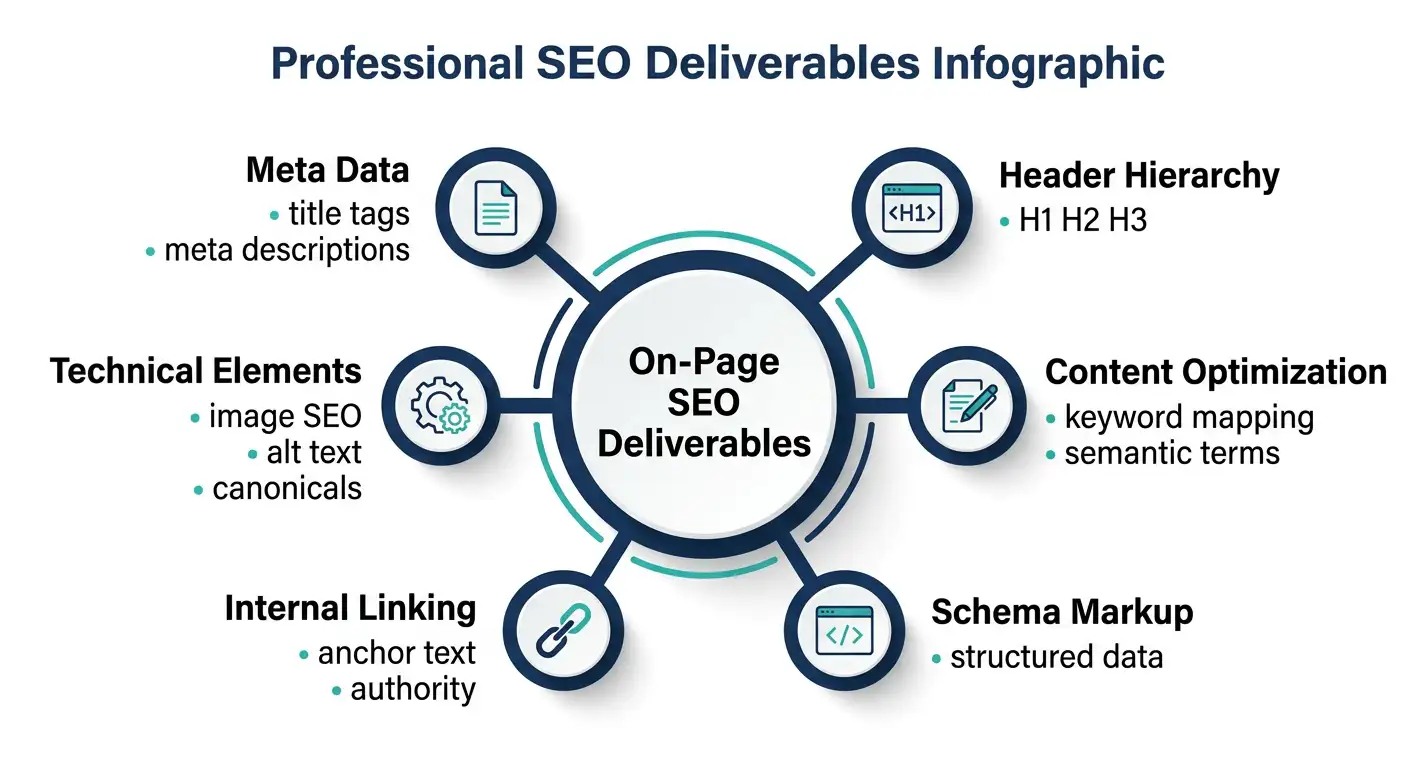
A complete on-page SEO engagement touches meta data, content, schema, internal links, and technical elements across every page.
What Services Are Included in White-Label SEO?: The Complete Checklist
Here is what a legitimate, full-scope white label on page SEO service should deliver for every page it touches:
Meta Data Optimization
Title tags: Written to 50 to 60 characters, containing the primary keyword, clear page intent, and a reason to click. A strong title tag for a local law firm’s homepage isn’t “Welcome to Smith Law” it’s “Personal Injury Lawyer in Denver | Free Consultation | Smith Law.”
Meta descriptions: 140 to 158 characters, written to improve CTR with a clear value proposition. They don’t directly affect rankings but a well-written meta description can improve CTR by 4 to 6%, which sends positive engagement signals back to Google Search.
Header Tag Hierarchy (H1 through H3)
One H1 per page, targeting the primary keyword
H2s covering the page’s major sub-topics, often targeting secondary keywords
H3s for supporting details, FAQs, and long-tail variations
No keyword stuffing in headers Google’s NLP systems recognize forced insertion
Keyword Research and Mapping
Each page gets mapped to a primary keyword with a clear search intent classification: informational, navigational, commercial, or transactional
Supporting keywords are distributed into headers and body copy, not crammed
Cannibalization checks prevent two pages on the same site from targeting the same keyword and competing against each other
Content Optimization
Primary keyword appears in the first 100 words
Semantic keywords and LSI terms woven naturally into the body
Topical authority signals through coverage of related entities and concepts
Thin content identified and flagged for expansion or consolidation
Image SEO and Alt Text
Descriptive, keyword-relevant alt text for every image
File names optimized before upload (not “IMG_4892.jpg” but “white-label-seo-dashboard.jpg”)
File size optimization for faster load times directly relevant to LCP scores
Internal Linking Structure
Relevant pages on the same domain linked with descriptive anchor text
Orphan pages identified and connected to the site’s content hierarchy
Authority flow mapped logically from high-authority pages to conversion pages
Schema Markup / Structured Data
Article or BlogPosting schema for content pages
Organization schema for brand identity
BreadcrumbList for navigation context
Person schema for authors directly supports E-E-A-T verification by connecting the author entity to verifiable external profiles
URL Structure
Clean, descriptive, hyphen-separated slugs
Canonical tags set correctly to avoid duplicate content issues
Redirect chains identified and resolved
What Are SEO Tags and How Do I Choose Them?
The term “SEO tags” gets used loosely, but it typically refers to three distinct HTML elements: title tags, meta description tags, and canonical tags.
Title tags are the single most important on-page signal you control. They appear in the browser tab, the SERP blue link, and social shares. Choose them based on:
Primary keyword placement near the front
Search intent match (a transactional page needs a transactional title)
Character length under 60 to avoid truncation in search results
Meta description tags don’t directly affect rankings, but they do affect whether someone clicks. Write them as a one-sentence value proposition: what the reader will gain by clicking this specific page over the nine other results on the same SERP?
Canonical tags solve a specific technical problem: they tell Google Search which version of a page is the “master” when similar or duplicate URLs exist. For e-commerce sites on Shopify or WordPress, where filtered URLs create hundreds of near-duplicate pages, canonical tags are not optional; they’re what keep your ranking signals consolidated instead of split.
How Does Content Strategy Fit Into White-Label SEO?
On-page optimization without a content strategy is like painting a house that has structural damage. The surface looks better, but the underlying problem still costs you.
A legitimate white label on page SEO service addresses topical authority, not just individual page optimization. This means:
Content clusters: One pillar page covers the broad topic; supporting cluster pages cover sub-topics and link back to the pillar. Google recognizes this as a signal of subject expertise.
Search intent alignment: A page targeting “white label SEO packages” needs to lead with pricing options and comparison information not a history of SEO. Matching content format to intent is as important as keyword placement.
Content gap identification: Pages on the site that offer no unique angle or duplicate topics already covered elsewhere are flagged for consolidation or expansion.
For small businesses specifically, this content-first thinking is what separates SEO campaigns that build long-term authority from those that generate rankings for two months before dropping. The practical side of this approach is covered in detail in this guide on content marketing tips for small businesses.
How Do White-Label Agencies Handle Keyword Research?
The keyword research process inside a professional white label operation typically runs like this:
Step 1: Seed keyword generation. The provider uses tools like Semrush or Ahrefs to pull the client’s existing ranking keywords, identify gaps, and generate topically related terms.
Step 2: Intent classification. Every keyword gets sorted by intent: informational, navigational, commercial investigation, or transactional. This prevents a blog post from competing with a service page for the same keyword a common mistake that tanks both pages.
Step 3: Keyword-to-page mapping. Each page on the site gets assigned one primary keyword. No page shares a primary keyword with another page on the same domain.
Step 4: Difficulty and opportunity scoring. Lower-difficulty keywords with clear commercial intent get prioritized for quick ranking wins. Higher-difficulty, higher-value terms get included in the content cluster strategy for longer-term gain.
Step 5: Competitor gap analysis. The provider identifies keywords competitors rank for that the client doesn’t, then maps those gaps to existing pages or recommends new content to fill them.
The research output becomes the strategic foundation for everything else title tags, headers, content rewrites, and internal linking all flow from it.
On-Page SEO Reseller Program: How the Workflow Actually Runs (Step by Step)
Most content about white label SEO describes what it is. Very few sources explain the actual operational workflow of what happens between the moment you hand off a client brief and the moment you deliver a polished report with your logo on it.
Here’s the real sequence:
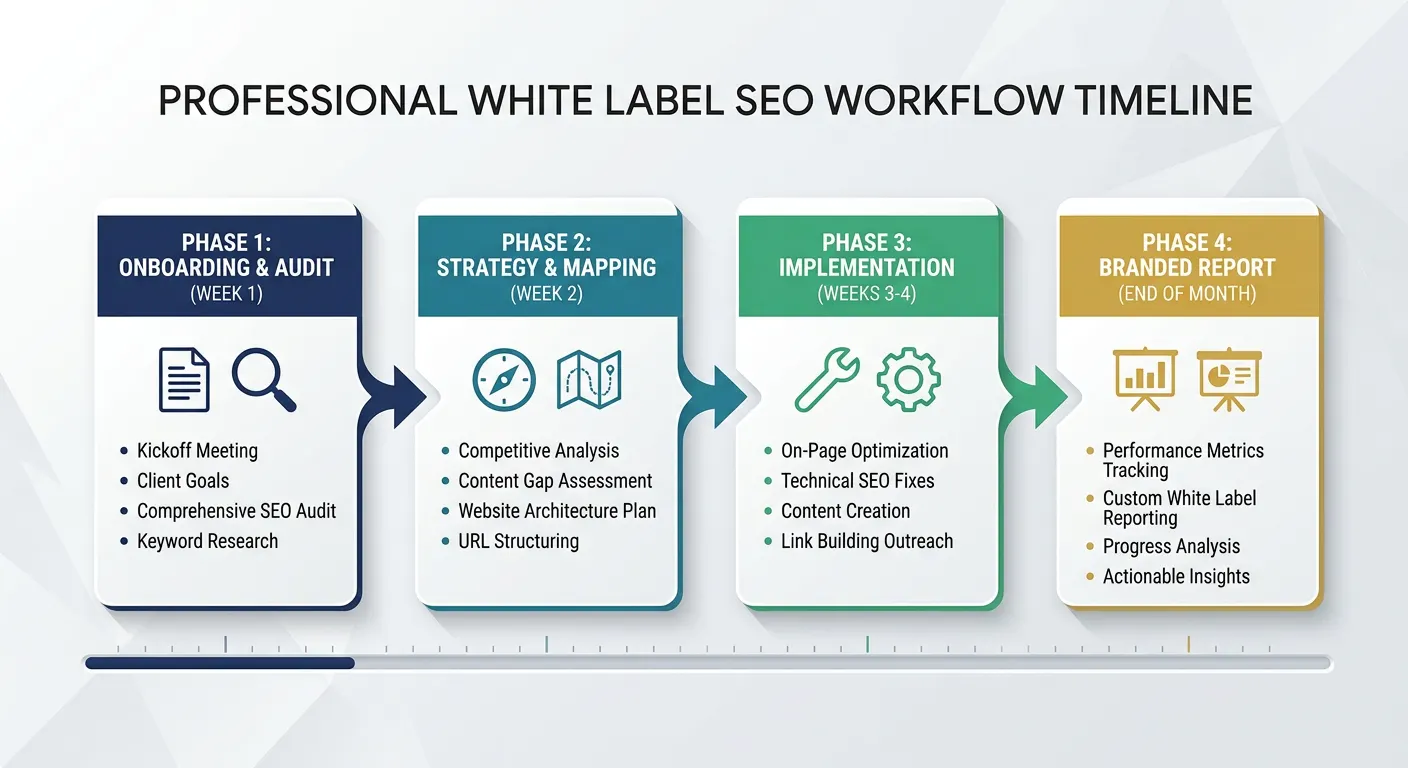
The white label SEO workflow follows a 4-week cycle from audit and strategy through implementation and branded reporting.
Week 1: Onboarding and Audit You submit the client’s website URL and a completed brief ideally a statement of work that clearly defines scope, target pages, and goals. (Understanding the difference between a statement of work and a scope of work matters here the wrong document creates scope disputes later.) The provider runs an SEO audit covering crawlability, indexation, existing keyword rankings, technical health, and on-page element status.
Week 2: Strategy and Mapping Keyword research is completed. A content map is built assigning primary and secondary keywords to each target page. The provider flags priority pages those with the highest traffic potential or most critical business intent.
Weeks 3 to 4: Implementation Title tags, meta descriptions, header tags, schema markup, image alt text, internal links, and URL structures are updated. On a CMS like WordPress or Shopify, this happens directly in the backend. On platforms like Webflow or Squarespace, the process may involve exporting and reimporting data or working with a staging environment.
End of Month: Branded Report A white-label report is generated your agency’s logo, your color scheme, your client’s name on the cover. The report includes before/after comparisons for every optimized element, keyword ranking snapshots from Google Search Console, and recommendations for next steps.
Your client sees your work. Your partner remains invisible. The relationship is entirely yours.
How Do White-Label Agencies Handle Competitor Analysis?
Competitor analysis in on-page SEO isn’t about spying it’s about understanding why a competitor outranks your client and what it would take to close that gap.
A professional white label provider approaches competitor analysis in four layers:
SERP visibility mapping: Which competitors appear in the top 10 for your client’s target keywords? Are they ranking with blog content, service pages, or landing pages? The content format that ranks tells you the search intent Google has assigned to that keyword.
On-page element comparison: The provider audits the top three ranking competitors for each target keyword, comparing title tag structure, header hierarchy, word count, keyword density, and schema markup implementation.
Content gap identification: Keywords that competitors rank for but your client doesn’t become the roadmap for new content or page expansion. This is where fast ranking wins often hide.
Internal link analysis: High-ranking competitors often have a clear internal linking strategy that distributes authority from their strongest pages to their target landing pages. Mapping this reveals a structural strategy your client can replicate.
Technical SEO vs On-Page SEO: What’s the Difference and Which Do You Need?
This is one of the most commonly confused distinctions in SEO, and it matters practically for agencies deciding what to include in a white label engagement.
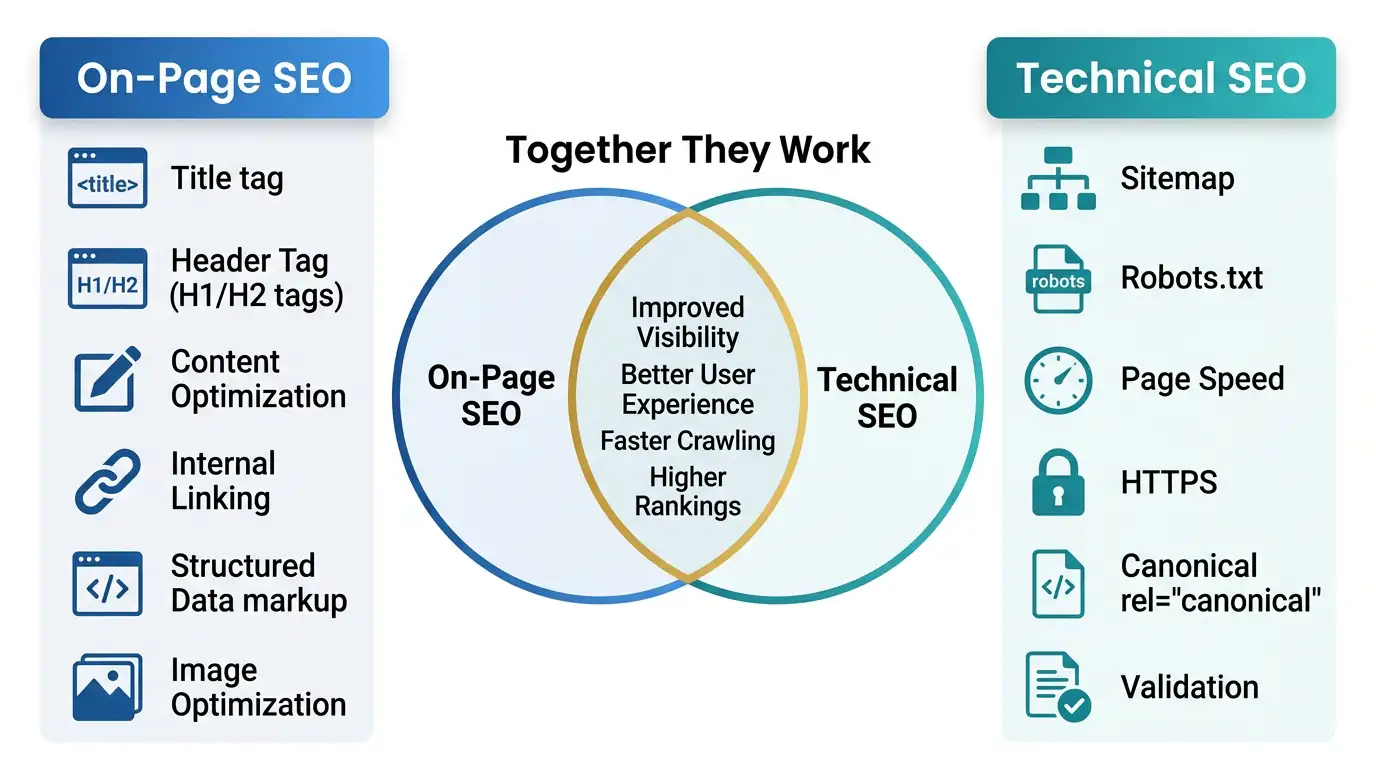
On-page SEO optimizes elements that exist on and within the page: content, titles, headers, internal links, schema markup, image alt text, and URL structure. These signals tell Google and Bing what a page is about and why it should rank for a given query.
Technical SEO operates at the infrastructure level it covers the systems that allow search engines to find and process pages correctly. Technical SEO includes:
XML sitemap configuration and submission to Google Search Console and Bing Webmaster Tools
Robots.txt directives controlling what crawlers can access
Crawl budget optimization for large sites
Core Web Vitals remediation is improving INP, LCP, and CLS scores
HTTPS configuration and security headers
Canonical tag architecture at the site level
Structured data validation using Schema.org guidelines
The relationship: Technical SEO creates the conditions for on-page SEO to work. A perfectly optimized title tag on a page blocked by robots.txt accomplishes nothing. Both are needed but they address different problems.
On-page and technical SEO work together; technical SEO creates the conditions for on-page optimization to produce ranking results.
Most white label on page SEO packages handle the on-page layer. Some providers also offer technical SEO audits as an add-on. When vetting providers, ask specifically which technical elements are included in their standard scope.
Outsource On-Page SEO: The Honest Pros, Cons, and Red Flags
Should I Hire a White-Label SEO Agency or Build an In-House Team?
The honest answer depends on three variables: your current revenue, your growth trajectory, and your client volume.
Build in-house when:
You have 15 or more ongoing SEO clients generating consistent monthly recurring revenue
You need deep brand alignment and real-time strategy adjustment that a partner can’t provide
You’re building a specialized SEO agency as your primary business model, not an SEO add-on
Outsource via white label when:
SEO is one of several services you offer, not your core identity
You have inconsistent client volume (some months three clients, some months eight)
You want to test demand for SEO before committing to a full hire
Your budget doesn’t support a $70,000+ annual salary for specialized expertise
The Reddit r/agency community is candid about this: white label makes strong sense as a bridge strategy. It lets you validate demand, generate margin, and gather case studies before you have the revenue to justify an in-house team.
One practical consideration that rarely gets discussed: if you’re using a white label partner, the service agreement between you and that partner needs to clearly address IP ownership, deliverable standards, and what happens if they miss a deadline. This is the same logic that applies to any contractor relationship your freelance contract essentials resource covers how to structure these agreements so you’re protected.
If you’re approaching this from the freelance side considering whether to position yourself as a white label provider or as the agency reselling white label work this guide on becoming a freelancer with proven steps to get paid is a useful starting point.
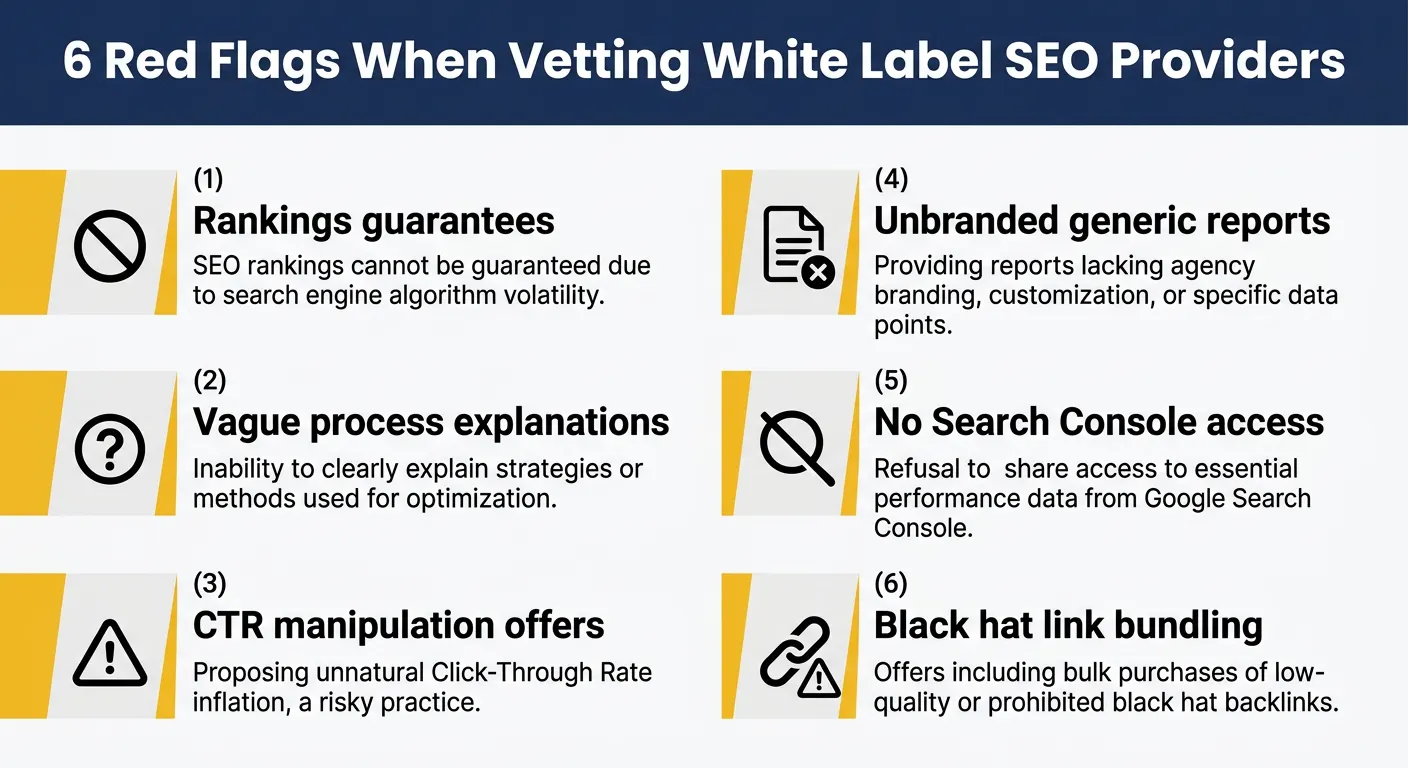
Red Flags to Watch Before You Sign With Any White Label SEO Provider
The propowerwash.com forum captured a real question that circulates constantly among agency owners: “What do you look for before hiring a white label agency? Anything that’s a red flag?”
Here are the specific warning signs worth taking seriously:
Red Flag 1: They guarantee specific rankings. No ethical SEO provider can guarantee a #1 ranking on Google. Rankings are influenced by dozens of factors outside any single provider’s control. A guarantee is a sales tactic, not a deliverable.
Red Flag 2: They can’t explain their process in plain terms. If you ask “how do you approach title tag optimization for a competitive keyword?” and get a vague answer about “proprietary methods,” that’s a problem. Legitimate providers explain their methodology clearly.
Red Flag 3: They mention CTR manipulation. A thread on propowerwash.com explicitly mentioned one agency seeking CTR manipulation as part of their white label mix. This refers to artificially inflating click-through rates using bots or click farms. Google actively detects and penalizes this. Any provider offering it is putting your clients’ domains at risk.
Red Flag 4: Reports are generic and unbranded. If a provider can’t deliver reports with your logo and color scheme, they’re not set up for a real white label relationship. Generic reports mean your client immediately sees it came from somewhere else.
Red Flag 5: No Google Search Console or Bing Webmaster Tools access. A provider that doesn’t request access to these platforms can’t verify ranking changes, indexation status, or Core Web Vitals scores. They’re working blind and so are you.
Red Flag 6: Black hat link building is bundled in. Some providers quietly mix white hat on-page work with black hat off-page tactics. Ask directly: “Do you build any backlinks as part of your on-page packages?” If so, ask for specifics on their link-acquisition methods.
Watch for these six red flags when vetting any white label SEO provider to avoid risking your clients’ domains.
Private Label SEO Services vs White Label SEO: Is There Actually a Difference?
Short answer: in practice, these terms are used interchangeably. But there is a technical distinction worth understanding.
White label SEO refers to a service delivered by a third party with no branding applied like a blank product ready to receive any label.
Private label SEO technically refers to a more exclusive arrangement in which the provider creates a service specifically for your agency, sometimes with custom processes, dedicated account managers, or exclusive territory rights.
In the real market, most providers use both terms to describe the same offering: third-party SEO work delivered under your branding. The meaningful differentiator isn’t the label it’s the level of customization, exclusivity, and dedicated support the provider actually offers.
When evaluating a “private label SEO services” offer, ask whether you have a dedicated account manager, whether the provider serves your direct competitors, and whether deliverable templates can be fully customized to your agency’s standards.
White Label SEO Services Core Web Vitals, Page Experience, and the 2026 Algorithm Reality
How Do White-Label Agencies Improve My Website’s User Experience?
Page experience and on-page SEO are not separate concerns in 2026. They’re deeply connected.
Core Web Vitals are now measured with INP rather than the deprecated FID support rankings indirectly by improving page experience signals that Google evaluates alongside content relevance. Here’s how a white label on page SEO provider should be addressing each metric:
LCP (Largest Contentful Paint) measures how fast the biggest visible element loads. On-page fixes that affect LCP include:
Compressing and converting images to WebP format
Adding proper width and height attributes to images to prevent layout recalculation
Preloading critical fonts referenced in CSS
INP (Interaction to Next Paint) measures responsiveness how quickly the page responds after a user interaction. While this sits closer to the technical SEO layer, on-page providers can flag heavy third-party scripts, unoptimized JavaScript, and render-blocking resources, which a developer can then address.
CLS (Cumulative Layout Shift) measures visual stability whether elements jump around as the page loads. Common on-page contributions to CLS include images without declared dimensions and dynamically injected content that shifts the page layout.
A white label provider who optimizes a page for keyword relevance but delivers it with an LCP score of 8 seconds is solving half the problem. For platforms like WordPress, Shopify, and Webflow, the best providers coordinate on-page optimization with performance recommendations simultaneously.
Schema Markup and Structured Data The Part Most White Label Providers Skip
Structured data (Schema.org) doesn’t guarantee rankings, but it reduces ambiguity, enabling Google and Bing to extract your content into rich results and AI answers more reliably.
This is the element most white label on page SEO providers either implement incorrectly or skip entirely. Here’s what 2026-accurate schema implementation actually looks like:
Deploy these schema types:
Article / BlogPosting: For blog content and editorial pages. Signals to Google the content type and publication date important for freshness evaluation.
Organization: For the business entity. Connects your client’s brand name, logo, URL, and contact information as a recognized entity in Google’s Knowledge Graph.
BreadcrumbList: Adds breadcrumb navigation to the SERP listing, helping Google understand the site hierarchy.
WebPage: Page-level wrapper that provides additional context about the page’s purpose.
Person (Author): Directly supports E-E-A-T verification. By connecting an author’s name to their LinkedIn profile or other professional presence via the sameAs property, you give Google a way to verify that a real, credible person wrote the content.
What NOT to deploy:
FAQPage schema: Google restricted FAQ rich results to government and healthcare sites in August 2023. On a commercial SEO page, deploying FAQPage schema won’t generate rich snippets in Google Search but it can still aid AI system extraction and is more useful on Bing, where FAQ rich results are still active.
HowTo schema: Deprecated entirely in September 2023. Do not use it.
The gap in the current white label market is that many providers are still deploying HowTo schema and expecting FAQ rich results on commercial pages both based on outdated information. Ask your prospective provider what schema types they implement and why. The answer immediately reveals whether their knowledge is up to date.
White Label SEO Packages and Pricing What Agencies Actually Charge (And Pay)
How Much Does White-Label SEO Cost Per Month?
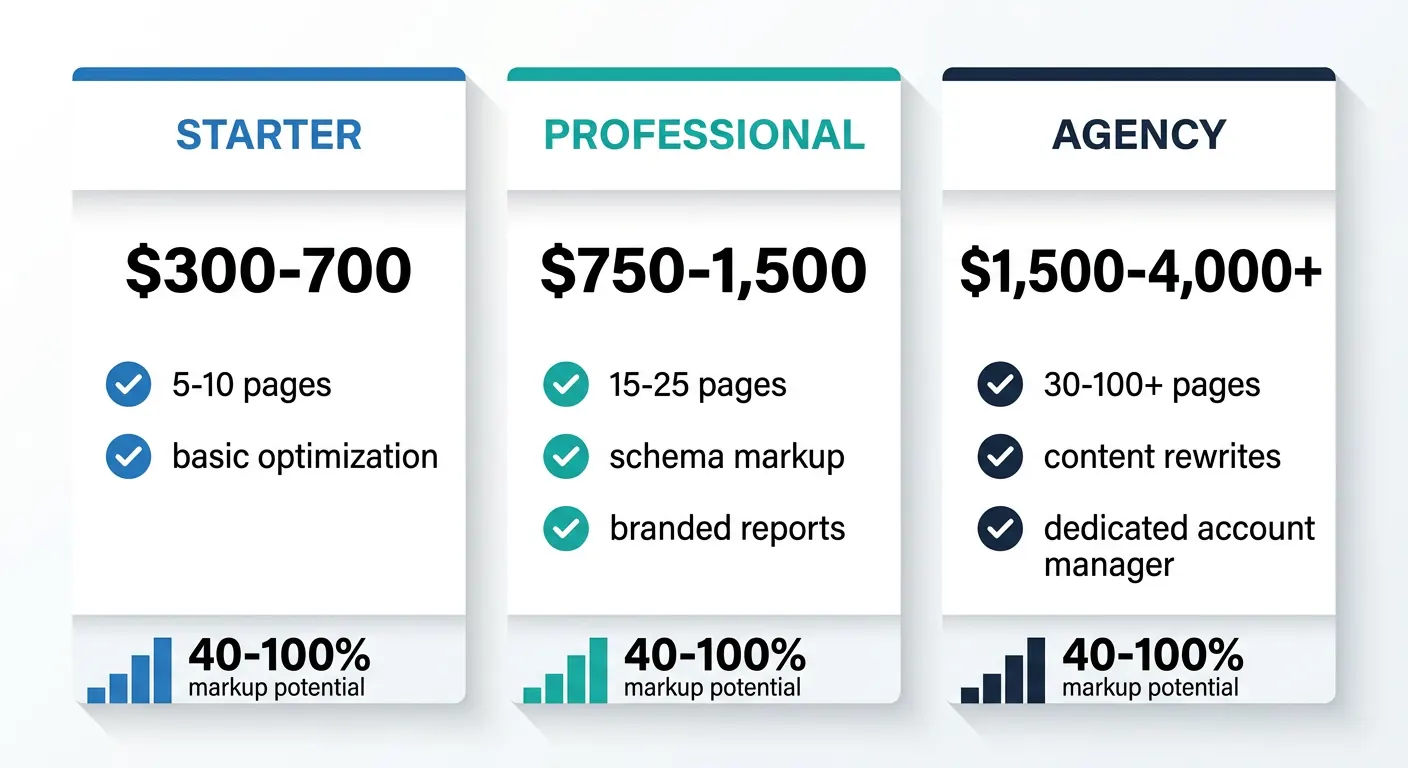
White label on page SEO pricing follows a fairly consistent tier structure in the US market, though significant variation exists based on the provider’s specialization, reporting quality, and turnaround speed.
White label SEO pricing ranges from $300 to $4,000+ monthly depending on page volume and service depth, with agencies typically marking up 40-100%.
Tier
Monthly Cost (What You Pay)
Pages Optimized
What’s Typically Included
Starter
$300 to $700
5 to 10 pages
Title tags, meta descriptions, basic header optimization, image alt text
Everything in Professional + content optimization rewrites, competitor analysis, dedicated account manager, custom-branded dashboards
The reseller margin math:
Most agencies mark up white label SEO by 40% to 100%. A professional-tier package costing you $1,000 per month gets billed to your client at $1,500 to $2,000. That’s $500 to $1,000 in margin per client, per month, for work you aren’t personally executing.
For agencies managing five SEO clients on a professional tier, that’s $2,500 to $5,000 in monthly margin after the white label cost before any other services you bill.
To calculate the rate that makes sense for your own positioning, the freelance hourly rate calculator can help you work backward from your target margin to per-page pricing.
Done-for-You On-Page Optimization What “Full Service” Actually Means at Each Price Point
The phrase “done-for-you on-page optimization” sounds complete. It often isn’t. Here’s what that term actually means at each price tier:
At the $300 to $700 range: “Done-for-you” typically means the provider updates meta fields inside your client’s CMS. Headers might get touched. Image alt text may or may not be included. There’s usually a standardized report template not a custom-branded one. This works for small local business clients with 5 to 10 pages and low competition keywords.
At the $750 to $1,500 range: This is where real on-page work begins. The provider conducts keyword research, builds a page-level map, implements schema markup, restructures internal links, and delivers a branded report. Content rewrites are limited they’ll optimize existing text but rarely rewrite a page from scratch.
At the $1,500 to $4,000+ range: Full-service means full-service. Content rewrites, competitor gap analysis, technical SEO flagging, Core Web Vitals recommendations, dedicated account management, and fully custom-branded reporting. This tier supports agencies running SEO for multiple clients in competitive verticals.
The mistake agencies make is selling a $2,000/month SEO retainer to a client and then buying a $300 white label package to fulfill it. The gap between what you promise and what the provider delivers creates client churn. Match the white label tier to the client’s actual needs and your margin expectations.
White Label Reporting, Branded Dashboards, and Proving Your Value to Clients
What Is a Branded Reporting System and Why Does It Matter?
A branded reporting system is the client-facing output that makes the white label model work commercially. It’s the difference between your client seeing “Powered by [Provider Name]” and seeing their own account manager’s name on a polished, professional monthly summary.
At minimum, a white label reporting system should include:
Your agency’s logo, brand colors, and contact information on every page
The client’s domain name and business name prominently placed
Keyword ranking changes (before/after comparison for every target keyword)
Organic traffic trends pulled from Google Search Console
SERP visibility changes
On-page elements changed this month (a specific list, not just “we optimized your pages”)
Core Web Vitals scores from Google’s PageSpeed Insights
Recommended next steps for the following month
The psychological value of a clean, branded report should not be underestimated. It’s the monthly proof of work that justifies the retainer. Agencies that send generic CSV exports from Semrush lose clients faster than agencies that deliver structured, visual reports even when the underlying SEO work is identical.
What Should I Expect in SEO Reporting From My Agency?
If you’re an agency buying white label services, the report you receive from your provider is the raw material you either pass through or enhance before client delivery.
At a minimum, expect:
Ranking data: Position changes for every target keyword, week-over-week or month-over-month
Organic traffic: Sessions from organic search, compared to the previous period
CTR data: From Google Search Console how many people saw the page vs. clicked
Indexation status: Are all target pages indexed in Google? Bing?
On-page changes log: A specific record of every title tag, meta description, header, or schema element changed this cycle
Core Web Vitals: LCP, INP, and CLS scores for key pages
What you should push back on: Vague summary statements like “we worked on your site’s SEO this month” with no specific change log. If a provider can’t tell you exactly which elements changed and how rankings moved afterward, you have no way to assess whether the work is producing results.
How Do I Know If My SEO Agency Is Doing Good Work?
Four signals tell you whether the white label work you’re receiving is genuinely moving the needle:
1. Keyword ranking movement: Target keywords should show measurable position improvement over a 60 to 90-day window. Flat rankings for more than 90 days after optimization on low-to-medium-competition keywords suggest the work isn’t being implemented correctly or that the keyword targets are unrealistic.
2. Organic CTR improvement: If ranking positions improve but CTR stays flat, the title tags and meta descriptions aren’t compelling enough to win clicks. This is a quality issue with the meta writing, not the ranking signal.
3. Page-level traffic growth: Overall traffic can be misleading. Look at traffic to the specific pages that were optimized. If a service page received on-page optimization in month one but shows no traffic growth by month three, investigate whether the keyword target was realistic and whether the page was actually indexed.
4. Client retention: This is the ultimate downstream metric for agencies. If your SEO clients are renewing, the work is delivering perceived and actual value. If they’re churning after three months, something in the delivery chain is broken.
How Do I Measure ROI From White-Label SEO Services?
ROI from white label on page SEO requires connecting the ranking and traffic data to actual business outcomes which most reporting stops short of doing.
Here’s a practical framework:
Step 1: Establish baseline conversion rate. Before optimization, what percentage of organic visitors convert to leads or sales? Even an approximate number works.
Step 2: Project traffic impact. A keyword moving from position 8 to position 3 roughly triples its click-through rate (from approximately 2% to approximately 10%, based on average SERP CTR studies). Apply that to your current search volume estimate.
Step 3: Calculate incremental leads. Additional monthly visitors × baseline conversion rate = estimated additional leads or sales per month.
Step 4: Assign lead value. If a lead is worth $200 and you generate 15 additional leads per month from organic traffic, the monthly SEO value is $3,000. If you’re charging your client $1,500, the ROI is 2x straightforward to justify.
Step 5: Compare against white label cost. Your actual cost is the white label package price. Your margin is the difference between what you charge and what you pay. The client’s ROI is the incremental business value generated.
This approach transforms SEO from an opaque monthly service into a measurable investment which is exactly what retains clients past the first three months.
Is White-Label SEO Transparent About Their Work?
This question from the PAA data reflects a genuine concern that surfaces constantly in agency forums: “I’m paying someone to do SEO work for my clients how do I know what they’re actually doing?”
Transparency in white label SEO has two dimensions: process transparency and results transparency.
Process transparency means the provider can show you exactly what they changed on each page, when they changed it, and why. You should receive a change log not a summary. Title tag before: “[keyword] | Company Name.” Title tag after: “[Primary keyword] [modifier] | Company Name.” Every change is documented.
Results transparency means ranking data, traffic data, and Core Web Vitals scores are pulled from verifiable sources Google Search Console and Google Analytics, not just the provider’s proprietary platform. Verifiable data sources mean you can cross-check the numbers independently.
What opacity looks like: Providers who summarize work done without specifics, refuse to connect to Google Search Console directly, or deliver reports with data you can’t verify against any independent source. This is the “outsourcing thinking” problem described by LinkedIn SEO professionals in the community: when strategy stays vague, execution turns mechanical and accountability disappears.
How to Choose the Right White Label SEO Provider for Your Agency
How Do I Choose the Right White-Label SEO Provider?
Seven-point vetting checklist:
1. Ask for a sample report before you commit. A provider who can’t show you what their branded report looks like in under 24 hours doesn’t have one ready. The report quality tells you immediately how seriously they take client presentation.
2. Request a mini audit of your own site. Ask them to run a quick on-page audit of one of your agency’s pages. Watch what they flag, how they explain it, and whether their recommendations align with current best practices (2026 standards, not 2019 ones).
3. Verify their CMS coverage. Your clients use whatever CMS they choose, not the one that’s convenient for your provider. Confirm the provider works in WordPress, Shopify, Squarespace, Webflow, and Wix not just one or two.
4. Ask about their schema implementation process. If they mention the HowTo schema or expect FAQ rich snippets on commercial pages, their knowledge is outdated. This single question filters out a significant portion of the market.
5. Confirm access to Google Search Console and Bing Webmaster Tools. Any provider not using these tools for verification is operating without ground truth data. Non-negotiable.
6. Understand their communication structure. Will you have a dedicated account manager? What’s the turnaround time for implementation after you submit a brief? What happens if a deliverable is late? Get this in writing treat it like any other service contract, with defined scope and clear deliverable timelines.
7. Check their white hat commitment explicitly. Ask directly: “Do you use any link building, CTR manipulation, or PBN tactics as part of your on-page service?” The answer and the way they answer it tells you whether they understand the risk they’d be creating for your clients’ domains.
What Makes a White-Label SEO Agency Reliable?
Reliability in a white label context isn’t just about the quality of work, it’s about the consistency of output over time.
Three reliability signals that matter most:
E-E-A-T alignment in their own presence. Does the provider have verifiable case studies, named team members with LinkedIn profiles, and demonstrable results on real client domains? If they can’t show E-E-A-T signals on their own site, they won’t build them effectively for yours.
Portfolio evidence across verticals. A provider that has optimized only e-commerce sites may struggle with local service businesses or SaaS companies. Ask for examples across the types of clients you serve.
Communication SLAs in writing. What is the committed turnaround time? What happens if they miss it? Reliable providers are comfortable putting these commitments in a service agreement. Unreliable ones keep it vague. Before signing anything, review how your own contractor agreements are structured. These freelance contract essentials principles apply equally to the agreements you sign as a buyer of white-label services.
What Questions Should I Ask a White-Label SEO Agency Before Hiring?
Ten specific questions with the reasoning behind each:
1. “Can you show me three branded reports from current clients?” Why: Report quality is the product your clients see. Generic reports mean the provider isn’t actually white label.
2. “What CMS platforms do you optimize for?” Why: Gaps here mean you’ll have to turn away certain clients.
3. “How do you handle keyword cannibalization?” Why: Providers who don’t address this actively will create ranking conflicts across your client’s pages.
4. “What schema types do you implement, and which do you avoid and why?” Why: Outdated schema practices. HowTo, FAQ on commercial pages signal knowledge that hasn’t kept pace with the 2023 and 2026 Google updates.
5. “How do you measure whether optimization is working?” Why: The answer should reference Google Search Console data, ranking movement over time, and CTR trends not just a proprietary platform dashboard.
6. “What does your change log look like?” Why: A specific, page-by-page change log is your proof of work. Summary statements are not enough.
7. “What is your turnaround time after I submit a brief?” Why: Missed deadlines affect your client relationships, not theirs.
8. “Do you offer any link building as part of your on-page service?” Why: If they do, you need to know exactly what type. Any black hat link acquisition puts your client’s domain at risk.
9. “How do you handle underperforming pages?” Why: A good provider has a defined process for pages that don’t improve after optimization content consolidation, keyword retargeting, or escalation to technical review.
10. “What happens to the work if we end the contract?” Why: You need clarity on IP ownership. The optimized content, reports, and keyword maps should belong to your agency not the provider. Check your agreements against these NDA and contractor agreement pitfalls to make sure your arrangements protect you.
Is White Label On-Page SEO Worth It in 2026? (The Straight Answer)
Yes. With a specific condition attached.
White label on-page SEO is worth it when you choose a provider who is operating with 2026 methodology not recycled 2019 checklists dressed up in new packaging.
The propowerwash.com forum highlighted a point worth attention: one agency owner noted that “good SEO improves AI SEO showing up on ChatGPT anyway, tons of my clients tell me a lot of their sales come from customers finding their brand on ChatGPT or AI LLMs.” This is increasingly true. The pages that Google cites in AI Overviews and the content that surfaces in AI chatbot answers are often the same pages that rank well in traditional organic search. Strong on-page optimization, clear structure, relevant entities, credible authorship, and proper schema serve both channels simultaneously.
The concern from the LinkedIn community is legitimate too: “outsourcing thinking” is the real risk. If you hand off a white label engagement with a vague brief and no strategic direction, you get mechanical execution with no strategic outcomes. The agency that succeeds with white label SEO keeps strategy ownership internally and delegates execution externally. That division is what makes the model work.
For US freelancers specifically, white label on-page SEO represents one of the most practical ways to move from a solo operation to a scalable service business without taking on the overhead of a full team. You set the prices, own the client relationships, and build the brand. The white label partner provides the specialized execution that would otherwise require two or three full-time hires.
The market isn’t shrinking. AI Overviews haven’t replaced blue-link rankings they’ve added a new visibility layer that requires the same foundational on-page quality to compete in. SEO in 2026 demands more expertise, not less. White label partnerships give agencies access to that expertise without building it from scratch.
Trending FAQs About White Label On-Page SEO
Can white-label SEO agencies deliver results for my website?
Yes but results depend heavily on the provider’s methodology, the competitiveness of your target keywords, and the baseline condition of the website being optimized. Agencies with documented case studies and verifiable Google Search Console data backing their claims are significantly more likely to deliver measurable ranking improvements than those relying on vague promises.
How long does it take to see results from white-label SEO?
For low-to-medium competition keywords on a technically healthy site, you’ll typically see meaningful ranking movement within 60 to 90 days of on-page optimization. High-competition verticals can take 4 to 6 months. Factors that accelerate results include the site’s existing domain authority, how quickly the provider’s changes are crawled and indexed, and whether the keyword research was well-targeted from the start.
Can I white-label SEO services for my own clients?
Yes. This is the entire premise of the reseller model. You purchase white label SEO services from a provider, add your markup, deliver the work under your brand, and bill your client directly. The provider remains invisible to the end client. Just ensure your service agreements with clients and your contracts with providers are clearly structured around deliverables, timelines, and IP ownership.
How does local SEO help my business get more customers?
Local SEO connects businesses with searchers in their geographic area people who are actively ready to buy locally. For clients with a physical location or a defined service area, local on-page optimization includes optimizing Google Business Profile listings, adding location-specific schema markup, and building location pages targeting city- or neighborhood-level keywords.
What is an SEO audit and do I need one?
An SEO audit is a diagnostic review of a website’s on-page elements, technical health, content quality, and backlink profile. Before beginning any white label on page SEO campaign, an audit identifies what’s broken, what’s already working, and where the highest-impact opportunities exist. Yes a thorough audit is the essential first step, not an optional add-on.
Can white-label SEO work alongside my paid ads?
Absolutely. In fact, the data from paid search campaigns which keywords convert, which landing pages have the best quality scores provides excellent input for on-page SEO targeting. Paid ads drive immediate traffic while SEO builds sustainable organic visibility. The two strategies reinforce each other when the landing pages they both direct traffic to are properly optimized.
Should I use white-label SEO if I’m a small business?
If you’re a small agency or freelancer looking to offer SEO services without in-house SEO expertise, white label is a practical and cost-effective path. If you’re a small business owner (rather than an agency) looking for SEO help, you’d typically hire an agency that provides white label services on the backend your experience is simply receiving managed SEO under that agency’s brand.
Is SEO still worth it in 2026?
Yes. Organic search still drives more traffic than any other single channel for most businesses. The addition of AI Overviews has changed where some of that visibility surfaces, but the pages cited in AI answers are the same ones that rank well under conventional SEO signals. Strong on-page optimization serves both traditional rankings and AI visibility simultaneously.
Can white-label SEO help me compete with bigger companies?
It significantly closes the content quality gap. Larger competitors have bigger budgets and more content but on-page SEO allows a well-optimized, focused page to outrank a larger site’s unfocused, poorly structured content on specific queries. Targeting longer-tail, higher-intent keywords where larger competitors haven’t invested is where smaller agencies and their clients win fastest.
What is the difference between SEO and paid search?
SEO generates organic traffic from search engines without paying per click. Paid search (like Google Ads) places ads in the SERP and charges per click or per impression. SEO builds compounding value over time a well-optimized page keeps generating traffic without ongoing ad spend. Paid search delivers immediate visibility but stops the moment the budget runs out.
Can I switch white-label SEO agencies if I’m not happy?
Yes but review your service agreement first. Check for notice periods, data ownership clauses, and any exclusivity provisions before initiating a switch. You should own all keyword research, reports, and optimized content created during the engagement. If your contract doesn’t specify this clearly, negotiate it before signing. Understanding payment terms and what you’re owed when ending any service relationship is relevant here.
How does branding connect to my SEO strategy?
Brand signals increasingly influence how Google evaluates a site’s authority. Branded searches people searching directly for your client’s business name signal to Google that the brand has real-world recognition. Consistent brand entity information across the web (name, address, contact, social profiles) also supports the Organization schema signals that improve knowledge graph recognition and E-E-A-T.
Should I invest in SEO or social media marketing first?
For most agencies and their clients, SEO should come first. Organic search traffic compounds over time and doesn’t require ongoing spend to maintain. Social media drives awareness and engagement but generates traffic that stops when you stop posting. If the budget is limited, on-page SEO optimization of existing pages delivers long-term ROI with a lower ongoing cost than maintaining active social content production.
What industries benefit most from white-label SEO?
Any industry where clients search for services online before making a purchase decision benefits from on-page SEO. The highest-impact verticals for white label clients typically include: local service businesses (law firms, medical practices, contractors), e-commerce stores, SaaS companies, real estate agencies, and professional services firms.
Can white-label SEO help my e-commerce store sell more products?
Yes particularly through category page optimization, product page title tags and descriptions, schema markup for product entities (price, availability, reviews), and internal linking that connects product pages to high-authority blog content. E-commerce platforms like Shopify and WooCommerce on WordPress both support robust on-page optimization through their native SEO fields and plugin ecosystems.
How does my website’s traffic improve with white-label SEO?
On-page SEO improves traffic by moving your pages higher in the SERP for relevant keywords, improving title tags and meta descriptions to increase CTR at existing positions, and adding your pages to AI Overview citations and featured snippets. Collectively, these changes bring more qualified visitors people who are searching specifically for what your pages offer without paying for each click.
What is the quickest way to start getting SEO results?
Target low-competition, high-intent long-tail keywords on pages that already have some ranking history. Optimizing an existing page that ranks on page two for a relevant keyword is faster than building a new page from scratch. Additionally, fixing broken title tags and missing meta descriptions on high-traffic pages often produces measurable CTR improvements within two to four weeks of implementation.
Can I trust my website to a white-label SEO provider?
With the right vetting process yes. Require Google Search Console access to be granted through Google’s official permission system (so you can revoke it any time). Never give a provider direct CMS admin credentials unless there’s a specific implementation need. Request that all changes be logged and reversible. A professional provider won’t need superuser access to do on-page optimization and if they insist on it, that’s a red flag worth taking seriously.
Muzammil is a freelance legal content writer and independent contractor rights advocate based in Pakistan. He writes practical guides on gig worker protections, freelance contract clauses, and NDA negotiation strategies for independent professionals worldwide. His work helps self-employed writers, designers, and remote contractors understand their legal rights without hiring a lawyer.