SEO by HighSoftware99.com: What You Need to Know Before Investing

What Exactly Is SEO by HighSoftware99.com?
When you search for ‘SEO by HighSoftware99.com,’ you’re looking for answers about a specific approach to search engine optimization that’s been gaining attention online. I haven’t been paid by or affiliated with HighSoftware99.com in any way—this analysis is based purely on evaluating their claims against how search engines actually work. Let me explain what this service actually is, what it claims to do, and how it fits into the broader world of digital marketing.
SEO by HighSoftware99.com positions itself as a modern search engine optimization service. Their approach emphasizes structured content organization, semantic SEO (writing about topics naturally rather than just repeating keywords), and what they call rapid ranking strategies.The approach emphasizes modern SEO practices that align with how Google actually works today, moving away from outdated tactics that no longer produce results. Basically, SEO is about making your website visible to people actively searching for what you offer—not about manipulating algorithms through shortcuts.
The basic concept is straightforward. When you search for something on Google, the search engine sends out automated bots, called crawlers, that scan websites. Google then pulls the most relevant results from all the information it has stored. If your website is well-optimized, properly structured, and contains high-quality content that answers what people are searching for, Google will rank it higher. This creates organic traffic growth more traffic from people actively searching for what you offer. More leads and ultimately more business for you.
Before I address what sets this approach apart from standard SEO practices, let me first ground us in what search engine optimization actually is at a fundamental level. This foundation will help you understand the differences when we get to them.
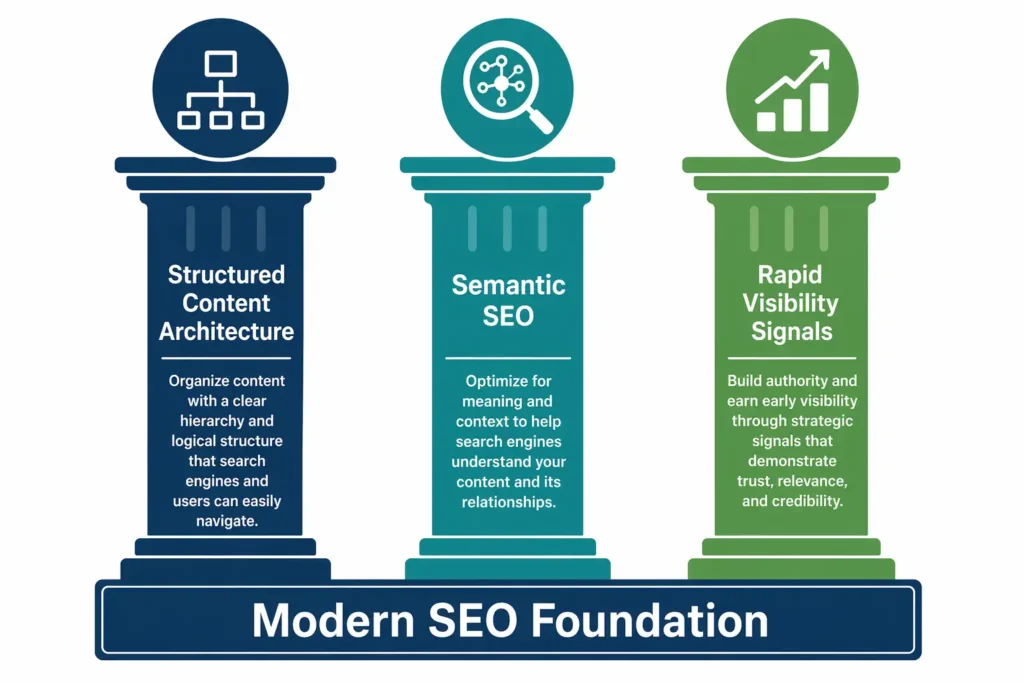
The Core Concept: Three Main Pillars of SEO by HighSoftware99.com
SEO by HighSoftware99.com presents a branded SEO approach built around three main pillars: structured content architecture, semantic search engine optimization, and rapid visibility signals—techniques designed to get your website visible faster than traditional SEO might.Before I evaluate what makes this specific service unique, let me ground us in what search engine optimization fundamentally does, so you have the foundation needed to assess any SEO service claim.
Search engine optimization is the practice of optimizing a website so that it ranks higher on Google for specific queries that your target audience is actually searching for. This is organic traffic, meaning you don’t pay Google for each click like you would with paid advertising. Instead, you earn visibility through strategic optimization of your site.
The way this works is fairly consistent across all legitimate SEO approaches. You conduct keyword research to understand what people are searching for. You then create or optimize content to answer those searches. You improve the technical health of your website so Google can crawl and index it properly. You build authority through quality backlinks from other relevant websites. And you monitor the results to see what’s working.
SEO by HighSoftware99.com emphasizes structured content architecture—organizing your website so Google and readers can clearly see how information pieces relate to each other. Think of it like creating a well-organized library where everything is categorized logically, rather than throwing books randomly on shelves.
Semantic SEO is another core piece of their methodology. This is a more sophisticated approach than the old keyword-stuffing tactics from years ago. Instead of just repeating your target keyword over and over, you write naturally about the topic while including related terms, variations, and concepts that all relate to what you’re trying to rank for. This signals to Google that you truly understand the topic in depth.
SEO by HighSoftware99.com also emphasizes what the service calls “instant appear” signals—a claim about achieving visibility more quickly than traditional SEO approaches. I’ll examine this claim thoroughly in the next section, but the core idea is that the methodology aims to get your website visible in search results faster. This positioning is important to understand when you’re evaluating any SEO service that promises speed.
How It Differs from Traditional SEO
This is probably the question you’re actually wondering about. If SEO is already a well-established practice, what’s different about this particular branded approach?
The answer lies in how SEO has evolved over the past few years, creating a stark difference between modern SEO and traditional SEO approaches.The date specification is less important than understanding the concept. Shortening makes it punchier.People would stuff keywords into content, build low-quality backlinks by the thousands, and try to trick Google’s algorithm with various technical tricks. Modern SEO, by contrast, works with Google’s actual guidelines instead of against them.
Modern SEO, which SEO by HighSoftware99.com positions itself within, takes a completely different approach. Instead of trying to trick Google, you work with Google’s actual guidelines and principles. When evaluating an SEO service like this one, you’ll want to confirm they focus on these three main areas:
On-page optimization involves making sure your content directly answers what people are searching for. You use proper heading structures, optimize your meta descriptions, include related keywords naturally, and link internally to other relevant pages on your site. It’s about clarity and relevance—and it’s one of the evaluation criteria you should verify any SEO service actually implements.
Technical SEO means making sure Google can actually crawl and index your website efficiently. This includes site speed, mobile responsiveness, having a proper XML sitemap, making sure your site structure is logical, and fixing any backend issues that might prevent indexing. This is critical to evaluate because poor technical SEO can sabotage even great content.
Off-page SEO is about building genuine authority. This primarily means earning backlinks from other quality websites that relate to your industry. It’s not about buying links or engaging in link schemes. It’s about creating such good content that other websites naturally want to link to you—and this is where many sketchy SEO services cut corners.
The shift from traditional to modern SEO is fundamental. It’s the difference between trying to manipulate search results versus genuinely becoming the best resource for what people are searching for. Traditional SEO asked “How can we trick the algorithm?” Modern SEO asks “How can we genuinely help people and prove our expertise to Google?”
SEO by HighSoftware99.com positions itself as part of this modern wave. They claim to use semantic SEO techniques, structured content optimization, and what they call rapid ranking methodologies. Whether these elements are significantly different from what other reputable SEO services offer—and whether they’re worth the investment—is exactly what you need to evaluate before making any decision. That’s where our evaluation framework comes in.
What’s important to understand right now is that the core principles haven’t changed. Rankings still depend on content quality, technical health, and authority. What has changed is HOW you apply those principles. You’re no longer fighting against Google’s algorithm. You’re working with it by creating genuinely valuable content and building real authority in your industry.
How Search Engines Actually Work: The Foundation You Need to Understand
Before you can evaluate whether SEO by HighSoftware99.com or any other service delivers realistic results, you need to understand how Google actually finds and ranks websites. This foundation will help you spot realistic claims versus hype, and it explains why certain promises about fast results don’t match how search engines actually work.
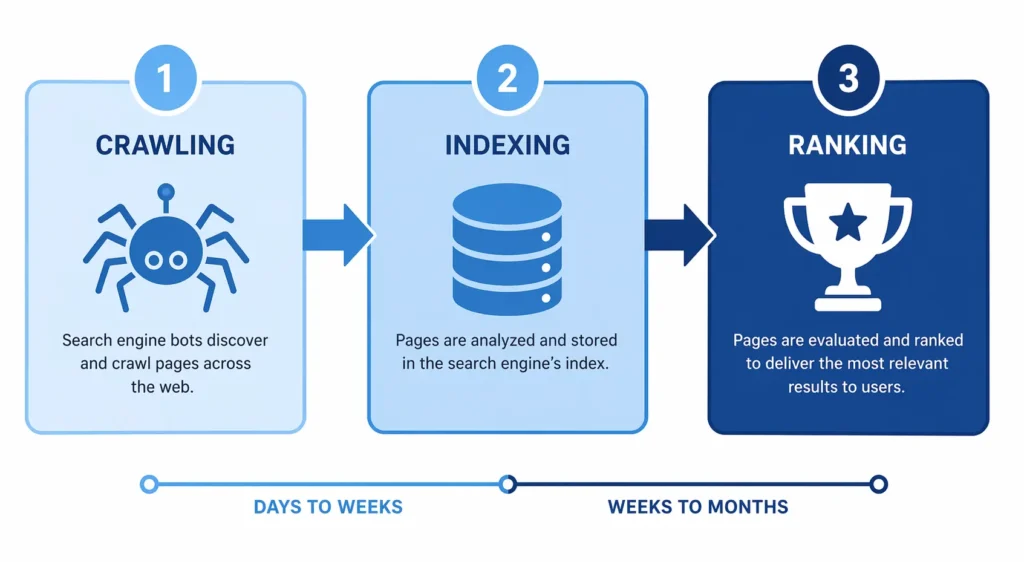
Google operates through a three-step process: crawling websites, indexing them in its database, and then ranking them based on hundreds of factors. Understanding each step is crucial because it shows you exactly where delays happen and why “instant” ranking claims are unrealistic.
Let me walk you through exactly how this works, because once you understand the mechanics, you’ll be able to evaluate any SEO claim with confidence.
Crawling and Indexing: The First Step
Google doesn’t just magically know your website exists. The search engine relies on automated bots, commonly called crawlers or spiders, to scan the web and discover pages. These bots follow links from one page to another, reading the content and structure of each page they find.
When a crawler visits your website, it’s essentially taking notes on everything it sees. It reads your content, checks your headings, follows your internal links to other pages on your site, and looks at technical signals like page speed and mobile responsiveness. The crawler also checks what other websites link to you, which tells Google that other people find your content valuable enough to reference.
Here’s where the first timing issue comes in: once a crawler visits your page, Google doesn’t immediately show that page in search results. The page has to be stored in Google’s massive index first. Think of Google’s index like a library catalog. When a book arrives at the library, it doesn’t go straight to the shelf. Someone has to process it, catalog it, and add it to the system. Only then can people find it.
A webpage will not appear in the Search Engine Results Pages (SERPs) until it is permanently stored in Google’s database. This indexing process can take anywhere from a few days to several weeks, depending on factors like your website’s authority, how often Google crawls your site, and the quality of your content.
You can actually check if one of your pages is indexed by using a simple Google Search command. Type “site:yourwebsite.com” into Google Search, and it will show you every page from your site that Google has indexed. If a page you published isn’t showing up in that search, it hasn’t been indexed yet, and that’s why it won’t appear in regular search results.
This indexing step is important to understand because it’s the first place where “instant” claims break down. No matter what SEO approach you use, you cannot speed up Google’s indexing process dramatically. You can optimize for faster indexing, but you cannot make it instant.
Ranking: Why Your Page Appears (or Doesn’t)
Once your page is indexed, Google faces a new challenge. When someone searches for something, Google needs to pull the most relevant and best-structured data from its database and show the most useful results first. This is where ranking comes in.
Google uses hundreds of ranking factors, but they generally fall into a few categories. The most important ones are content relevance, technical health, and authority. Let me explain what each of these means in practical terms.
Content relevance means Google is trying to determine whether your page actually answers what someone is searching for. If someone searches for “how to bake chocolate chip cookies,” Google looks for pages that contain thorough, helpful information about baking chocolate chip cookies. The search engine checks whether your content covers the topic deeply, whether you use related terms naturally, and whether your page structure makes sense to both readers and the algorithm.
Technical health refers to the backend factors that affect how well Google can crawl and use your page. This includes page speed, mobile responsiveness, secure HTTPS connection, proper XML sitemap submission, and clean site architecture. A fast-loading, mobile-friendly website signals to Google that you’ve put effort into user experience.
Authority is about your website’s credibility and trustworthiness. Google measures this primarily through backlinks, which are links from other websites pointing to your content. When authoritative websites in your industry link to you, it’s like getting a recommendation. It tells Google that your content is so valuable that other reputable sources want their readers to see it.
The SERP ranking factors that Google considers also include user behavior signals. How long do people spend on your page after clicking? Do they click the back button immediately or do they stay and read? Do they click other links on your site? These signals tell Google whether your page actually satisfied what the searcher was looking for.
This ranking process typically takes weeks to months to fully take effect. You might see initial movements in your rankings within two to three weeks if you make significant improvements, but substantial ranking changes usually require one to three months of consistent optimization. Some competitive keywords take even longer.
De-indexing: Why Websites Disappear from Results
Here’s something most people don’t talk about, but it’s critical to understand: ranking positions are not permanent. Your page can lose rankings even if you do everything right, and understanding why helps you appreciate why SEO requires ongoing effort.
Pages get removed from search results, or more commonly, they drop in ranking position, usually because competitors produce better content. Google’s algorithm is constantly comparing your page to other pages ranking for the same keywords. If someone else publishes more comprehensive content, better answers the searcher’s question, or builds more authority, Google may demote your page lower in the results.
Think of search rankings like a leaderboard. Your position depends not just on how good your content is, but on how good it is compared to everything else competing for that same keyword. If your competitors aren’t working on SEO, you maintain your ranking. But the moment someone publishes better content or builds stronger authority in your space, the leaderboard changes.
De-indexing can also happen for technical reasons. If Google tries to crawl your site and encounters errors, if you accidentally block crawlers through your robots.txt file, or if you remove important pages without proper redirects, pages can disappear from the index entirely. These are mistakes that can be fixed, but they cost you visibility while you correct them.
Your search visibility depends on maintaining and improving your content over time. This is why legitimate SEO services focus on continuous improvement rather than one-time optimization. Your website needs ongoing attention to stay competitive.
Understanding de-indexing also helps you see why SEO is not a one-time project. After you reach the first page of Google, you need to keep improving your content, monitoring user signals, and staying ahead of competitors. This is just how search rankings work.
Why This Foundation Matters for Evaluating SEO Claims
Now that you understand how crawling, indexing, and ranking actually work, you can spot the problems with unrealistic claims.
If someone promises to get your website on page one of Google within 48 hours, you know they’re not being honest about how long indexing and ranking take. One Google algorithm update could shift those rankings tomorrow, which is why guarantees are always unrealistic. One Google algorithm update could shift those rankings tomorrow, which is why guarantees are always unrealistic. If they promise “instant” visibility, they’re either misunderstanding Google’s process or intentionally misleading you.
Real SEO takes time because Google’s process takes time. A good search engine optimization service can optimize your content better, build your authority faster, and help you avoid mistakes that waste months of progress. But they cannot speed up Google’s fundamental crawl-and-index process, and they cannot guarantee rankings in a timeframe that defies how the algorithm actually works.
This is the foundation you need. The rest of this article builds on this understanding to help you evaluate whether SEO by HighSoftware99.com or any other service is making realistic promises about timelines, results, and what’s actually possible with search engine optimization.
Core Principles of Modern SEO: What Drives Rankings in 2026
After working in SEO for seven years, I can tell you one thing with complete confidence: the rules of the game have changed dramatically. What worked in 2018, stuffing keywords into every paragraph and buying cheap backlinks, will actually hurt your website today. Modern SEO is built on a completely different foundation, and understanding that foundation is the first step toward building rankings that actually last.
Let me walk you through the core principles that drive real results in 2026.
Keyword Research and Intent Mapping
The most important thing about keyword research strategy is not finding high-volume keywords. It is understanding what the person searching for that keyword actually wants.
I learned this the hard way early in my career. I once optimized an entire page for a high-volume keyword, drove decent traffic to it, and watched the bounce rate hit 90%. The problem was not the traffic. The problem was that I had misread the intent behind the keyword. The page I built answered the wrong question.
Search intent optimization means matching your content to the reason someone is searching, not just the words they typed. There are four distinct types of search intent you need to understand:
Informational intent is when someone wants to learn something. A search like “how does SEO work” is a perfect example. The person wants knowledge, not a sales pitch.
Navigational intent is when someone is looking for a specific website or page. They already know where they want to go. Trying to intercept this traffic with unrelated content rarely works.
Commercial intent is when someone is researching before making a decision. They are comparing options, reading reviews, and evaluating choices. Content here should help them think through their decision.
Transactional intent is when someone is ready to act. They want to buy, sign up, or download something. This is where your conversion-focused pages should live.
A proper keyword research strategy maps every target keyword to one of these four intent types before any content is created. When your content matches the intent behind the search, Google rewards you with better rankings and users reward you with lower bounce rates.
On-Page Optimization: Content, Structure, Metadata
On-page optimization is the process of making each individual page as clear and useful as possible for both the reader and the search engine. This includes search intent optimization ensuring your content answers the actual question the searcher is asking, not just matching keywords. When done right, it works invisibly. The reader simply finds what they need. Google simply understands what the page is about.
Content depth matters enormously here. Thin pages with 300 words rarely compete with thorough, well-structured pages that genuinely cover a topic. From my experience, long-form content in the range of 1,500 to 2,000 words tends to perform significantly better for competitive blog topics. This is not about padding word count. It is about covering the topic completely enough that the reader does not need to go anywhere else.
Structured content architecture means organizing your page with clear headings, logical flow, and a hierarchy that makes sense. Use your H1 for the main topic, H2s for major sections, and H3s for supporting details. This structure helps both readers and search engines navigate your page.
Metadata still matters. Your title tag should stay between 50 and 60 characters so it displays fully in search results. Your meta description should fall between 150 and 160 characters and should genuinely describe what the reader will find on the page. Think of it as a small advertisement for your content.
Internal linking is something many people overlook completely. Every new page you publish should link to at least two or three relevant pages on your website. This helps Google discover and crawl your content and it keeps readers moving through your site naturally.
Content quality signals like reading time, scroll depth, and engagement rate tell Google whether people actually found your page valuable. Writing for the reader first and the algorithm second is the best way to win on all of these signals simultaneously.
Technical SEO Foundations
Technical SEO audit work is not glamorous but it is absolutely essential. You can write the most insightful content in your industry and it will still struggle to rank if the technical foundation of your website is broken.
A technical SEO audit covers several key areas. Site speed is one of the most critical factors. Pages that load slowly frustrate users and Google penalizes slow websites in rankings. Aim for a page load time under three seconds on both desktop and mobile, which is the threshold most SEO professionals target based on Google’s recommendations.
Mobile responsiveness is no longer optional. Over 80% of web traffic now comes from mobile devices (a figure that continues to grow each year).Google uses mobile-first indexing, which means Google primarily looks at the mobile version of your website when deciding how to rank it. If your mobile experience is poor, your rankings will reflect that.
Your XML sitemap tells search engines which pages on your website exist and how often they are updated. Your robots.txt file tells search engines which pages to crawl and which to ignore. Both need to be set up correctly to ensure Google is indexing the right content.
Site architecture, meaning how your pages link together and how deep they are from your homepage, affects how efficiently Google crawls your website. Keep important pages close to the surface. A page that requires seven clicks to reach from your homepage may never get crawled properly.
A thorough technical SEO audit should check all of these elements regularly, not just once at launch.
Building Authority Through Links and E-E-A-T
Authority in SEO comes from two places: external signals and internal signals. Understanding both is critical.
Backlink building remains one of the strongest ranking signals Google uses. A backlink is a link from another website pointing to yours. Google treats these links as votes of confidence. When a well-respected website links to your content, it is essentially telling Google that your content is trustworthy and valuable. One high-quality backlink from a relevant, authoritative website is worth far more than dozens of links from low-quality sources.
Internal linking strategy builds authority differently. By linking strategically between your own pages, you distribute what SEO professionals call “link equity” across your website. If your homepage earns strong external backlinks and you link from the homepage to a key service page, some of that authority passes to the service page.
The E-E-A-T framework is Google’s way of evaluating content quality at a deeper level. E-E-A-T stands for Experience, Expertise, Authoritativeness, and Trustworthiness. Google introduced the extra E for Experience to emphasize that content written by someone with real, hands-on experience in a subject is more valuable than content written purely from research.
Demonstrating E-E-A-T means showing your credentials, citing your experience, linking to authoritative sources, and making sure your website is technically trustworthy with proper security and accurate information throughout.
Semantic SEO: Beyond Keywords
Semantic SEO is the practice of writing content that helps search engines understand not just the keywords on a page but the actual meaning, context, and relevance of that content.
Think about it this way. If I write an article about “apple” and I also mention iPhone, Mac, iOS, and Tim Cook, Google can reasonably conclude I am writing about Apple the technology company. If I mention orchard, harvest, fruit, and recipes instead, Google understands I am writing about apples the fruit. Semantic SEO is about giving Google enough context to understand your topic clearly without any confusion.
Semantic SEO requires three key elements in your content. First, entities: these are the specific nouns, people, places, brands, and concepts that define your topic. Second, attributes: these are the characteristics and qualities that describe your entities. Third, NLP-friendly language: this means writing naturally, the way a real person speaks, so that natural language processing systems can parse and understand your meaning accurately.
The practical application of semantic SEO means you stop asking “how many times should I use my keyword?” and start asking “have I fully covered this topic?” Include related terms, answer surrounding questions, mention relevant concepts, and write in complete, natural sentences. A page built this way will rank for many related searches, not just the single keyword you targeted.
Keyword stuffing is the opposite of semantic SEO and it signals low quality to both readers and Google. Natural, thorough writing that covers a topic from multiple angles is what modern search engines are built to reward.
When you combine a strong keyword research strategy, clean on-page optimization, solid technical foundations, genuine authority signals, and semantic depth, you have built something that is very difficult to compete with. That is the standard I apply to every project I work on, and it is the standard that drives lasting results in 2026.
Understanding “SEO Instant Appear”: What It Actually Means
When I first came across the phrase “SEO instant appear” connected to HighSoftware99.com, I had the same reaction most experienced SEO professionals would have. I was curious, a little skeptical, and genuinely interested in understanding what the claim was actually promising. After seven years in this field, I have seen enough bold SEO promises to know that the words matter a lot, and so does the gap between what is claimed and what Google actually does.
Let me break this down honestly, because I think you deserve a clear picture before you invest time or money into any SEO service.
How Google Autocomplete Actually Works
Google Autocomplete is a feature that predicts and suggests search queries as you type in the search bar. Google Autocomplete generates suggestions based on real search data, meaning the queries that large numbers of people have already searched for repeatedly over time.
This is an important distinction. Autocomplete is a reflection of existing search behavior, not a tool that individual websites or SEO services can manipulate through optimization techniques. No SEO strategy, regardless of how sophisticated the approach is, can force a specific phrase to appear in Google Autocomplete suggestions.
What influences Autocomplete suggestions? A few things drive what appears:
Search volume is the biggest factor. Queries that thousands of people type regularly surface as suggestions. A phrase that very few people search for will not appear no matter how well optimized the associated content is.
Location and language also play a role. Google personalizes Autocomplete suggestions based on the user’s geographic region and language settings.
Search trends matter too. A topic that suddenly spikes in public interest may appear in Autocomplete temporarily while the trend is active.
The takeaway here is straightforward. If someone claims their SEO service will make your brand or keyword appear in Google Autocomplete, that claim deserves a very careful second look. Autocomplete reflects what people are already searching for in large numbers. SEO influences your rankings in those searches. The two are related but they are not the same thing.
What “Instant Appear” Could Mean (And Probably Doesn’t)
To be fair to HighSoftware99.com, I want to interpret the “instant appear” claim as generously as possible before explaining where the realistic limits are.
There are a few legitimate things “instant appear” could refer to in an SEO context. It could mean faster indexing—or what some call instant indexing—getting Google to discover and store your web pages in its database more quickly than the standard waiting period. It could also refer to rapid on-page optimization, meaning getting your existing pages properly structured and optimized quickly so they are ready to compete. Both of these are real and achievable goals.
The problem is that instant indexing and instant ranking are two completely different things.
Instant indexing means Google has found your page and added it to the index. That can happen within a few days if your website is properly set up with a clean sitemap, good internal links, and no technical barriers blocking the crawlers. You can even request indexing manually through Google Search Console to speed up the process.
Ranking on page one of Google is an entirely different journey. A webpage will not appear prominently in search results until Google has evaluated it against hundreds of ranking factors, observed how users interact with the content, and compared the page against established competitors who may have months or years of authority built up.
Expecting instant SEO results is one of the most common and costly mistakes I see business owners make. The realistic timeline for SEO to produce meaningful, measurable results is a minimum of two to three months, and for competitive keywords, the timeline is often six months to a year or longer.
The Reality Check: How Long Does Indexing Actually Take?
Here is where I want to give you the clearest, most honest picture possible.
Indexing can happen quickly. For a well-structured website with no technical barriers, Google can discover and index a new page within 24 to 72 hours, especially if you submit the URL through Google Search Console. In some cases I have seen pages indexed within hours. So in that narrow technical sense, something close to “instant appear” in Google’s database is possible.
But being indexed and being ranked on page one of Google are completely different outcomes. Indexing simply means Google knows your page exists. Ranking means Google has decided your page is one of the best results for a specific search query, and that decision takes time to develop.
Think of it this way. Getting indexed is like submitting a job application. Ranking on page one is like getting hired after beating out hundreds of qualified candidates. The application process can be fast. The selection process takes considerably longer.
For a new page targeting a competitive keyword, the journey from indexed to page one Google ranking typically involves:
Weeks one through four: Google crawls and indexes the page. Early ranking signals begin to form.
Months two and three: Google tests the page in various ranking positions to measure how users respond. Click-through rates, time on page, and engagement data all feed into this evaluation.
Months three through six and beyond: Rankings stabilize based on accumulated authority, content quality, backlinks earned, and ongoing optimization.
SEO instant appear as a concept can work in the narrow sense of fast indexing and rapid technical setup. But no SEO service on the planet can guarantee that a page will rank prominently on Google within days or even weeks of going live. Any claim that suggests otherwise is not aligned with how Google’s ranking system actually operates.
The good news is that SEO done correctly, even if it takes time, builds rankings that are durable and genuinely valuable. That is the kind of result worth investing in.
How to Evaluate an SEO Service: The 8-Point Verification Framework
I haven’t used this specific service myself, so I can’t give you a direct review of how they perform. What I can do is give you the framework to evaluate them yourself, and show you how to verify their claims independently.
Work through each point carefully before you commit to anything.
Point 1: Verify the Company’s Legitimacy
The very first thing I do when evaluating any SEO service is check how long the company has actually existed. Domain age is one of the clearest early signals of legitimacy. A company operating a domain that is only a few months old with bold claims and polished marketing deserves extra scrutiny.
You can check a domain’s registration history for free using WHOIS lookup tools. These tools show you when the domain was registered, who registered it (if the information is not hidden by a privacy service), and where the registrant is located.
Beyond domain age, look for a verifiable physical address. Search the address on a mapping service to confirm the location is real. Look for the company’s name in business directories and check whether a consistent digital footprint exists across multiple platforms. A legitimate SEO business that has been operating for years will have a traceable history. A company that is difficult to verify in multiple independent places is worth approaching with caution.
Point 2: Check Their Client Testimonials and Results
Real client results are the most honest evidence an SEO service can offer. Strong testimonials include specific outcomes: rankings improved for particular keywords, traffic increased by a measurable percentage, or leads and sales grew within a defined timeframe.
Generic praise like “great service” or “highly recommended” without any supporting detail tells you very little. What you want to see are case studies that show where a client started, what the SEO service did, and what measurable results followed.
When reviewing any SEO agency, ask whether the testimonials are verifiable. Can you find the client business independently? Does the client business actually rank well in search results? A compelling SEO agency review should be backed by evidence you can partially verify yourself, not just quotes on a sales page.
Point 3: Analyze Their Transparency on Pricing
Transparent pricing is a strong indicator of a trustworthy SEO service. When a company clearly explains what each SEO pricing package includes, what the monthly cost is, and what deliverables you receive in each tier, it shows respect for the client’s decision-making process. Understanding clear payment terms protects you—if disputes arise, you’ll want to know how to collect unpaid invoices and hold providers accountable.
Hidden pricing, vague package descriptions, or pressure to “contact us for a quote” before any pricing context is provided can be a sign that pricing is adjusted based on how much the company thinks it can charge rather than the actual value delivered.
Ask directly: What does this package include? What do you measure as success? What happens if the promised results do not materialize? A confident, ethical SEO provider will answer these questions clearly without hesitation.
Point 4: Perform a Technical SEO Audit on Their Own Website
This is one of my favorite evaluation steps because it is so revealing. If an SEO service cannot demonstrate good SEO practice on their own website, that is a significant red flag.
Start with a simple check. Open Google and type “site:theirdomainname.com” in the search bar. This command shows you how many pages Google has indexed from that website. A well-maintained SEO company’s site should have a healthy number of indexed pages with no obvious structural problems.
Then check the website’s loading speed on a mobile device. Run the URL through a free performance testing tool. Look at whether the website is mobile responsive. Check whether the content is well-structured with clear headings, useful information, and proper metadata.
A thorough technical SEO audit of the provider’s own website tells you more about their actual capabilities than any sales pitch ever could. You are essentially looking at their work in the most honest context possible: their own business.
Point 5: Verify Compliance with Google Guidelines
Any reputable SEO service builds its strategy around Google’s published guidelines. SEO compliance guidelines exist for a reason: they protect websites from penalties that can wipe out rankings overnight and take months to recover from.
Ask the SEO provider directly whether their approach uses white hat techniques exclusively. You can verify their claims by checking Google Search Central, which publishes clear guidelines on approved SEO practices. When they confirm their practices align with Google’s guidelines, make sure this commitment is reflected in your service agreement understand contractor agreements that document exactly what ethical practices they’ll follow.
Be cautious of any provider that promises unusually fast results, guaranteed rankings, or methods they describe vaguely or refuse to explain. Tactics that manipulate rankings through shortcuts may produce temporary results but carry serious long-term risks to your website’s standing in Google search.
Point 6: Assess Their ROI-Focused Strategy
Traffic is only valuable if it leads to real business outcomes. A strong ROI-focused SEO strategy prioritizes traffic that converts into leads, enquiries, or sales rather than chasing vanity metrics like raw visitor numbers that look impressive but generate no revenue.
When evaluating an SEO service, ask how the provider defines success for your specific business. Do they ask about your conversion goals and understand conversion rate optimization how to turn visitors into customers? Do they understand what a qualified visitor looks like for your industry? An SEO agency that talks only about rankings and traffic without asking about your business goals is missing the most important part of the equation.
Real SEO results show up in your revenue, not just in your analytics dashboard. The best providers understand this distinction and build their entire strategy around it.
Point 7: Check Their Communication and Support
Reliable communication is non-negotiable in any professional service relationship. Before signing with any SEO provider, test how easy the company is to reach and how clearly their team communicates.
Send an inquiry and note how long it takes to receive a response. Pay attention to whether the response actually addresses your specific questions or offers a generic reply. Ask what reporting you will receive, how often you will receive updates, and who your point of contact will be throughout the engagement.
An SEO service that is difficult to reach before you become a client is unlikely to communicate well once your money is on the table. Strong customer support and regular transparent reporting are signs of a provider that takes accountability seriously.
Point 8: Ask Them Directly About Their Methodology
A confident, knowledgeable SEO provider can explain their methodology clearly in plain language. Ask them directly: how does your SEO process work, what do you do in the first 30 days, and how do you decide which keywords to target?
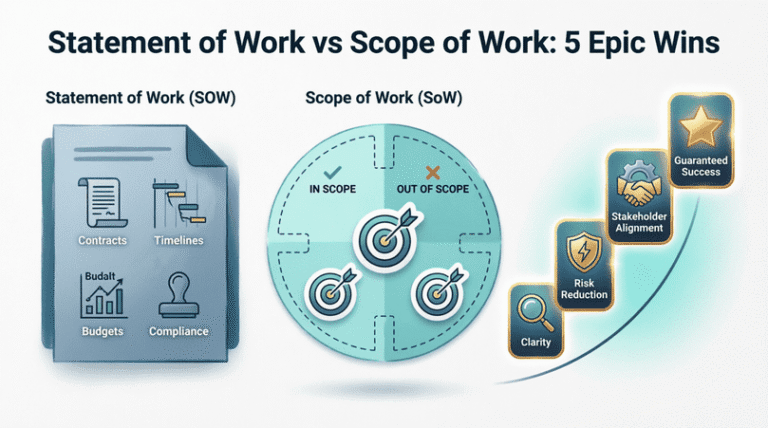
Listen carefully to the response. A skilled practitioner will walk you through their process with enough specificity that you understand what you are paying for. They will mention things like keyword research, content planning, technical audits, link acquisition, and performance tracking in a way that makes logical sense. Better yet, ask them to provide a statement of work that documents their exact methodology and deliverables in writing, so there’s no ambiguity later.
If the explanation is vague, relies heavily on buzzwords without substance, or the provider seems reluctant to describe their actual approach, treat that as a serious warning sign. Legitimate SEO methodology is not a trade secret. Any experienced professional should be able to explain clearly how their work creates value for your website.
Use this eight-point framework every time you evaluate an SEO service and you will make a far more informed decision with your budget and your trust.
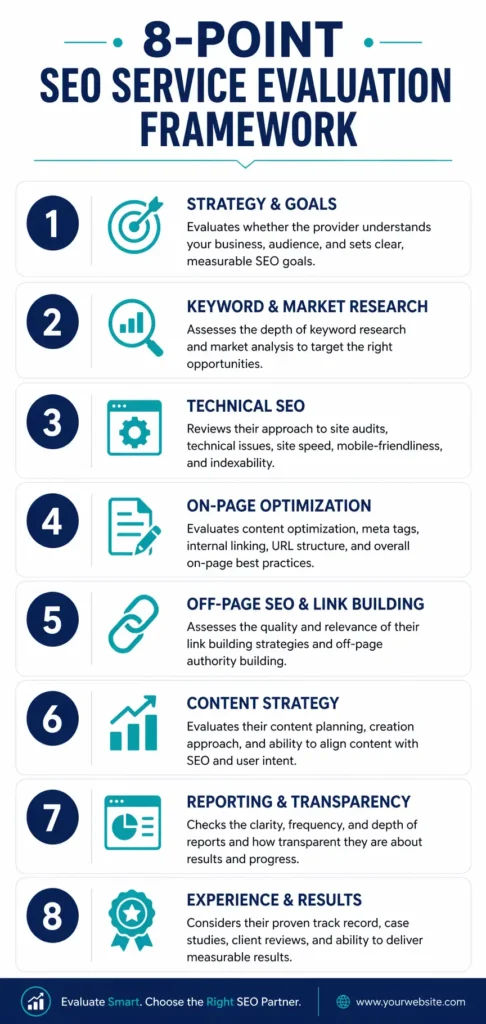
Run every SEO service through all eight points before committing — legitimate providers pass every check.
Red Flags and Scam Detection: How to Identify Fraudulent SEO Claims
The SEO industry has a real problem with misleading promises, and I say that as someone who has worked inside this industry for seven years. Most business owners searching for SEO help are not SEO experts. That knowledge gap is exactly what bad actors exploit. Learning to spot the red flags for SEO services before you hand over your budget is one of the most valuable skills you can develop as a business owner.
Let me walk you through the warning signs I look for and the verification steps I use when something feels off.
Red Flag 1: Guaranteeing Specific Rank Positions
No legitimate SEO service can guarantee you a number one ranking on Google. I want to say that as clearly as possible because this claim appears constantly in SEO marketing and it is simply not true.
Google’s search algorithm is updated hundreds of times each year. The algorithm’s sensitivity to changes in content quality, link profiles, user behavior, and technical signals means that rankings shift constantly, even for well-established pages. A competitor might publish a stronger piece of content tomorrow. Google might adjust how it weighs a particular ranking factor next week.
Any provider that guarantees a specific ranking position is either misunderstanding how search engines work or making a promise they know they cannot keep. Ethical SEO practices focus on improving your website’s overall authority and relevance, which tends to produce better rankings over time, but no honest professional puts a specific position in writing as a guarantee.
Red Flag 2: Pressure to Add Links to Unknown Websites
This is one of the more sophisticated patterns I have seen used against website owners, and it deserves careful attention. The way this scheme typically works is that a website owner receives a formal-looking communication claiming that their website is using copyrighted material without permission—often written in a way designed to mimic a real DMCA notice. If you receive such a communication, it’s critical to verify whether a copyright claim is legitimate before taking any action.The message demands that the website owner add a specific link to a particular website as a resolution, often framed as an alternative to legal action.
The urgency and professional appearance of these messages can make them feel legitimate. But the demand itself, adding a link to an unknown third-party website as compensation for a supposed copyright issue, is not a standard legal remedy for copyright disputes.
If you receive any communication demanding that you add a link to your website as part of a legal settlement or copyright resolution, pause before taking any action. Verify everything independently before responding or complying.
Red Flag 3: Unrealistic Speed Claims
When an SEO service promises “instant results,” “48-hour rankings,” or “overnight page one placement,” treat that claim with serious skepticism. Google’s indexing and ranking processes operate on their own timeline and no external service controls that timeline.
A new or updated page can sometimes be indexed within a day or two if the website is well-structured and you request indexing through Google Search Console. But being indexed and ranking prominently are two very different outcomes. Building genuine ranking authority takes a minimum of two to three months even under good conditions, and for competitive keywords the process takes considerably longer.
Speed claims that sound extraordinary almost always involve shortcuts that put your website at risk of Google penalties. The consequences of those penalties can last far longer than any temporary ranking boost the shortcut might produce.
Red Flag 4: No Transparent Pricing or Vague Package Descriptions
A legitimate SEO service can tell you clearly what you are paying for and what you will receive. When a provider’s website says “contact us for pricing” without offering any context at all, or when package descriptions use vague language that does not specify actual deliverables, that is worth noting.
Transparent pricing does not mean every service needs to publish a fixed price list. Custom projects often require custom quotes. But a trustworthy provider will at minimum explain what factors affect pricing and give you a realistic range during an initial conversation. Pricing that only becomes clear after a lengthy sales process designed to build commitment before revealing cost is a pattern worth being cautious about.
Red Flag 5: Black Hat SEO Tactics
Black hat SEO refers to techniques that violate Google’s published guidelines in order to manipulate search rankings artificially. Common black hat tactics include keyword stuffing, which means cramming keywords into content at an unnatural density to try to trick ranking systems. Cloaking involves showing different content to Google’s crawlers than to actual human visitors. Automated link building uses software to generate large volumes of low-quality backlinks quickly.
All of these tactics trigger algorithm sensitivity in Google’s systems. Google Search Central, which is Google’s official resource for webmaster guidance, explicitly identifies these practices as violations that can result in manual penalties or algorithmic suppression of affected websites. I have seen websites lose the majority of their organic traffic after a single Google algorithm update targeted the exact tactics an SEO provider used on their site. Recovering from that kind of penalty takes significant time and effort.
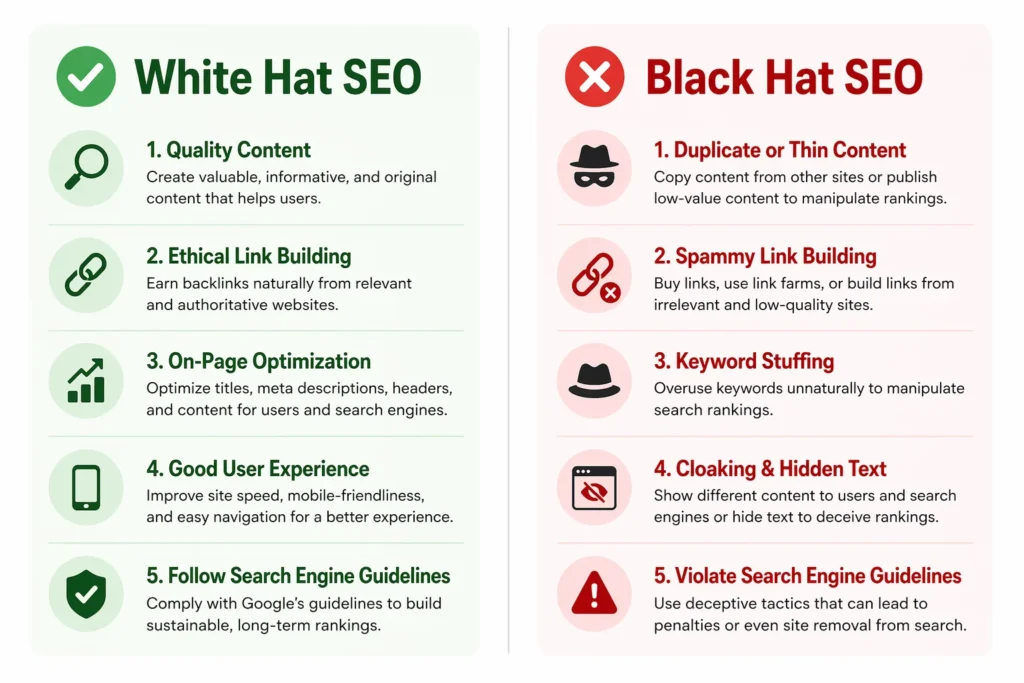
White Hat SEO vs Black Hat SEO: Know the Difference
White hat SEO is the straightforward term for SEO done the right way, meaning strategies that align fully with Google’s guidelines and focus on genuinely improving a website’s value to its visitors.
White hat SEO includes creating original, thorough content that answers real questions. It includes earning backlinks from relevant and authoritative websites through the quality of your content and outreach. It includes making technical improvements that help your site load faster, perform better on mobile devices, and be easier for search engines to crawl and understand.
Black hat SEO cuts these corners by trying to manipulate the system rather than earn recognition through quality. The distinction matters because white hat SEO builds rankings that are stable and sustainable, while black hat SEO produces results that are fragile and temporary at best, and actively damaging at worst.
Ethical SEO practices are not just about following rules. They are about building something that actually serves your business over the long term.
How to Verify a Suspicious Legal Threat
If you receive a message claiming copyright infringement and demanding that you add a link to your website, here is the verification process I recommend working through before you do anything else.
Step one: Search for the image or piece of content in question using a reverse image search or content verification tool. Confirm whether the material actually appears on your website and whether the original source matches what the claimant states.
Step two: Check the domain of the website they are asking you to link to. Use a WHOIS lookup tool to check the domain’s registration date and ownership history. A recently registered domain with hidden ownership details is a meaningful warning sign.
Step three: Verify the attorney or legal contact named in the message. Search for the attorney’s name and firm independently using official bar association directories or legal professional listings. If the attorney cannot be found through independent verification, the legal framing of the message is not genuine.
Step four: Check the physical address provided in the communication using a mapping service. Verify that the address corresponds to an actual office for the firm or company named.
Step five: Search the company name and domain name together with terms like “complaint” or “scam report” to see whether other website owners have reported similar messages from the same source.
Working through these five steps takes less time than you might expect and gives you a much clearer picture of whether a threatening communication is legitimate or designed to manipulate you into adding a link you should not add. If you determine the threat may be legitimate, you’ll want to understand how to properly respond to DMCA or copyright threat claims with professional guidance rather than acting on the sender’s instructions.
When something in an SEO service’s marketing or communication does not feel right, that instinct is worth listening to. Taking the time to verify before you act is always the right decision.
Realistic SEO Timeline and Expectations: What You Should Actually Expect
The most honest thing I can tell you about SEO is that it rewards patience more than almost any other digital marketing channel. I learned this not from a textbook but from watching campaigns I personally managed go through painfully slow early stages before producing results that genuinely transformed a business’s online presence.
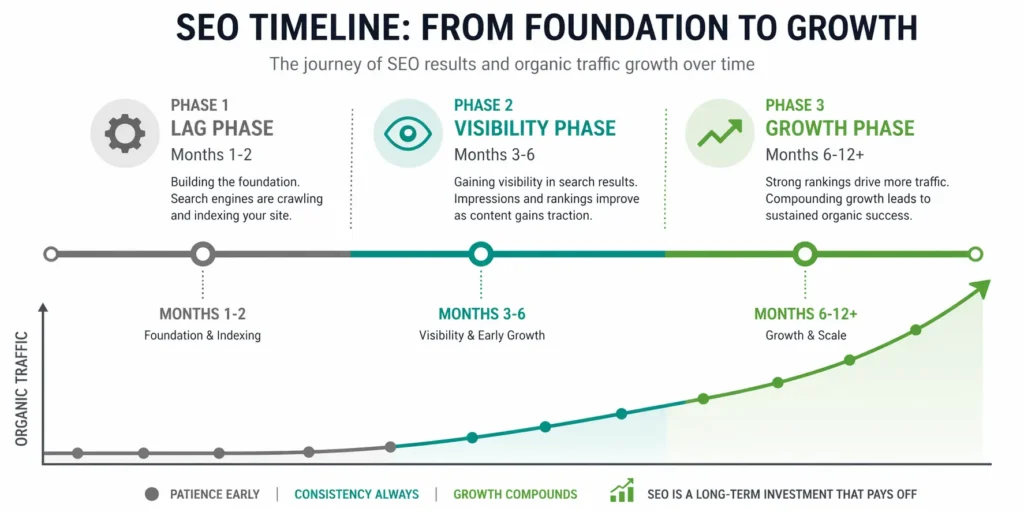
The SEO results timeline is not a straight line upward. It moves in phases, and understanding those phases in advance will save you from making premature decisions that undermine your own progress.
Months 1 and 2: The Lag Phase
During the first two months of any serious SEO effort, most of the important work happens behind the scenes where you cannot easily see it. This is the phase where your website gets technically cleaned up, content gets created or improved, on-page elements get optimized, and Google slowly begins to process all of those changes.
Google does not rank a page the moment it discovers the page. Google first indexes the page, meaning the search engine stores the page in its database, and then it begins to evaluate the page’s quality and relevance against competing pages. That evaluation process takes time and involves observing real user behavior over multiple weeks.
During months one and two, do not expect to see significant movement in your keyword rankings. Traffic may look completely flat in your analytics. This is normal and does not mean the work is not producing value. Think of this phase like planting seeds. The growth is happening beneath the surface even when you cannot see anything yet.
Months 3 to 6: The Visibility Phase
Around the three-month mark is where most campaigns begin to show their first visible signs of life. This is the part of the SEO results timeline that I find most encouraging to watch because the early signals at this stage often predict the trajectory of everything that follows.
You might start to see your target pages appearing in search results, perhaps not at the very top initially but within the first few pages for your target keywords. Long-tail keyword traffic, meaning traffic from more specific and less competitive search queries, tends to come in first. This is a good sign. It means Google is beginning to understand what your pages are about and is testing them in relevant searches.
For business owners who have been told that SEO can deliver results in days or weeks, month three is often when reality sets in. The honest truth is that three months is the realistic starting point for initial visibility, not the finish line. Managing this expectation from the beginning protects you from making the mistake of abandoning a strategy right before it would have started working.
Months 6 to 12 and Beyond: The Growth Phase
This is the phase where sustainable SEO growth becomes visible and measurable. By the six-month mark on a well-executed campaign, authority has been building steadily, content has been accumulating engagement signals, and backlinks have had time to establish credibility in Google’s eyes.
What happens during this phase often surprises people who are new to SEO. Growth starts to compound. A page that ranked on page two in month four might climb to page one by month seven. A piece of content that attracted a handful of visitors in month three might be drawing hundreds of visitors by month nine because additional backlinks and engagement signals have pushed the page’s authority higher.
Achieving a page one Google ranking for competitive keywords typically requires six months to a year of consistent, well-executed effort, based on what I’ve observed across multiple industries and competitive levels. For less competitive niches or longer-tail keywords, the timeline can be shorter. But the compounding nature of SEO growth during this phase is what makes the channel so valuable. Unlike paid advertising, where traffic stops the moment you stop paying, organic rankings built on genuine authority continue delivering traffic over time.
The Danger of De-indexing: Maintaining Rankings Over Time
Ranking well on Google is not a permanent achievement you can lock in and walk away from. This is something many business owners discover the hard way, and it is worth understanding clearly before you invest in any SEO strategy.
Google continuously re-evaluates the pages it ranks. When a competitor publishes a more thorough, better-structured, more authoritative piece of content on the same topic, Google may gradually shift rankings in that competitor’s favor. A page that ranked strongly for months can begin to slip if the content on the page becomes outdated, if user engagement signals decline, or if stronger pages enter the competitive landscape.
De-indexing in this context does not always mean Google removes your page entirely. More often it means your page’s ranking position drops because the search engine has found content it considers more relevant or more helpful for that particular query. The practical effect is the same: you lose traffic you had earned.
The solution is treating SEO as an ongoing process rather than a one-time project. Updating existing content regularly, continuing to build quality backlinks, monitoring your rankings for any drops, and responding to competitive changes in your niche are all part of maintaining the results you work to build.
The businesses I have seen succeed long-term with SEO are the ones that committed to consistent effort over months and years, not the ones that treated it as a short campaign with a defined end date. Sustainable SEO growth is built through persistence, not shortcuts.
Who Should (And Shouldn’t) Use This SEO Approach?
Not every business is a natural fit for SEO, and I think it is important to say that clearly before you invest time or money into any optimization strategy. SEO works incredibly well for certain types of businesses and situations, and it works poorly or too slowly for others. Understanding where your business falls on that spectrum will help you make a smarter decision about whether SEO is the right channel to focus on right now.
Let me walk you through the situations where SEO tends to produce strong returns and the situations where you should probably look elsewhere first.
Best For: E-commerce, Service Businesses, and Niche Blogs
SEO delivers the strongest results when people are actively searching for what you offer. E-commerce businesses selling specific products, service businesses that solve clearly defined problems, and niche blogs covering topics people research regularly are all natural fits for search engine optimization.
E-commerce SEO works well because product searches have clear commercial intent. When someone searches for “best running shoes for flat feet” or “organic dog food brands,” that person is researching a purchase decision. If your product pages and category pages can rank for these searches, you are connecting with buyers at exactly the moment they are ready to evaluate options.
Service businesses benefit from SEO for similar reasons. A plumber, accountant, web designer, or marketing consultant can build steady lead flow by ranking for searches related to the services they offer. Small business SEO, when executed properly, allows local service providers to compete effectively even against larger competitors with bigger budgets.
Niche blogs thrive on SEO because the business model depends entirely on attracting consistent organic traffic. A blog focused on a specific hobby, skill, or interest area can build authority over time by publishing thorough content that answers the questions people in that niche are searching for.
The common thread across all of these business types is that the target audience is actively using search engines to find information, products, or services. When that search behavior exists, SEO can capture it.
Who Should Avoid: Highly Saturated Industries and Immediate Traffic Needs
There are two situations where I would suggest looking at alternative marketing channels before committing heavily to SEO.
The first is when you are entering an extremely saturated industry where the top rankings are dominated by massive brands with years of accumulated authority and enormous budgets. Industries with this level of competition require significant investment and patience before meaningful results appear. Competing in these spaces is possible but the timeline and resource requirement may not align with what a smaller business can sustain.
The second situation where SEO is not the right fit is when you need traffic immediately. If your business model requires generating leads or sales within the next few weeks, SEO cannot deliver fast enough to meet that need. The realistic timeline for SEO to produce measurable results is a minimum of two to three months, and often longer for competitive keywords. Paid advertising, partnerships, or direct outreach will produce faster results when speed is critical.
Choosing your niche carefully matters enormously in SEO. Some niches are simply oversaturated with established competitors and thin profit margins, making the return on SEO investment weak even when rankings improve. Evaluating niche viability before committing resources is a step worth taking seriously.
Budget Considerations: DIY vs Hiring an SEO Service
One of the most practical questions business owners face is whether to learn and implement SEO themselves or hire a professional service to handle the work. Both approaches have real trade-offs.
Learning SEO yourself is entirely possible. The information is freely available through resources like Google Search Central, quality blogs, and educational content from experienced practitioners. Free tools like Google Search Console, Google Analytics, and various keyword research tools give you the data you need to make informed decisions. The main cost in the DIY approach is your time. SEO has a real learning curve and implementing strategies properly while running a business is demanding.
Hiring an SEO service shifts the time investment to someone else but introduces cost and requires careful vetting to ensure you are working with a provider who uses ethical practices and delivers real value. The quality range in the SEO services market is enormous. Some providers offer genuine expertise and produce measurable results. Others take your money and deliver little beyond reports filled with metrics that do not translate to business growth.
Your decision between DIY and hiring often comes down to whether you have more available time than budget or more available budget than time. Both paths can work if approached thoughtfully.
Best For Local Businesses: Local and Global SEO
Local businesses have access to a particularly powerful subset of SEO strategies that larger national or global businesses cannot leverage in the same way. Understanding the difference between local and global SEO strategies helps you choose the right approach for your business model. Local and global SEO strategies differ significantly in focus and execution.
Local SEO focuses on making your business visible in geographically targeted searches and in map results. Optimizing your Google Business Profile, ensuring your business name, address, and phone number are consistent across all online directories, earning reviews from local customers, and creating content that targets location-specific keywords all contribute to local SEO performance.
A restaurant, retail store, medical practice, or any business that serves customers in a specific geographic area can benefit enormously from investing in local SEO. The competition in local search is often less intense than in global search, and the traffic you earn converts at higher rates because the searchers are specifically looking for businesses in your area.
Global SEO targets a broader audience without geographic limitations. This approach makes sense for e-commerce businesses shipping nationally or internationally, software companies selling digital products, or service providers who work remotely with clients anywhere.
Understanding which type of SEO aligns with your business model helps you focus your efforts on the strategies most likely to produce meaningful results for your specific situation.
Modern SEO + AI Integration: How Tools Like ChatGPT Fit In
AI has fundamentally changed how I approach SEO work in 2026, and I think ignoring that shift would be doing a disservice to anyone trying to understand how modern search optimization actually works right now. The integration of AI tools like ChatGPT and Claude into the SEO workflow is no longer experimental or optional. These tools have become practical assets that accelerate research, content creation, and optimization when used properly.
The key phrase there is “when used properly.” AI is not a replacement for SEO expertise. AI is a tool that amplifies what a skilled practitioner can accomplish.
How AI Tools Accelerate SEO Without Being a Shortcut
I use AI tools regularly in my SEO work, and the productivity gain is real. What used to take me hours of manual research and drafting now takes a fraction of that time because AI can handle the initial heavy lifting. But the output AI produces is never the final product. AI-generated content requires human review, personalization, and refinement before it is ready to publish.
Here is how AI fits into a modern SEO workflow effectively. AI tools excel at generating topic ideas based on keyword research, creating detailed content outlines that cover all the relevant subtopics for a given search query, and producing initial drafts that provide a structural foundation to build from. AI can also suggest related questions to address, identify semantic keywords to include naturally, and help optimize existing content by highlighting gaps or areas that need more depth.
What AI cannot do is replace the human judgment required to evaluate whether the content is genuinely helpful, whether it aligns with your brand voice, whether the information is accurate and current, and whether the content demonstrates real experience or expertise. Generic AI content without personalization performs poorly because it lacks the depth and authenticity that ranking well in competitive searches requires.
I have seen successful case studies where practitioners ranked websites and generated significant revenue by integrating AI tools into their SEO process. The common thread in these success stories is that AI accelerated the work but human expertise guided the strategy and refined the output.
The Shift to AEO and GEO: Answer Engine and Generative Optimization
The way people interact with search engines is changing, and the changes are happening fast enough that every SEO practitioner needs to pay attention. The future of SEO is increasingly moving toward what some call Answer Engine Optimization and Generative Engine Optimization.
Answer Engine Optimization, or AEO, refers to optimizing content to appear in AI-generated answer summaries that Google and other search platforms now display at the top of many search results. These AI overviews pull information directly from indexed pages and present a synthesized answer to the user’s query. Getting your content cited in these overviews requires structuring information clearly, answering questions directly, and providing information in formats that AI systems can easily parse and extract.
Generative Engine Optimization, or GEO, takes this concept further by recognizing that AI tools like ChatGPT, Claude, and Perplexity are themselves becoming search alternatives. Users ask these tools questions and receive answers generated from the information those models have been trained on or can retrieve. Optimizing for visibility in these generative responses means creating content that is clear, authoritative, well-structured, and cited by sources the AI models trust.
Each Google algorithm update introduces new elements of AI-driven ranking and presentation. The practical implication for anyone doing SEO in 2026 is that content needs to be optimized not just for traditional keyword matching and backlink authority but also for how AI systems interpret, extract, and present information.
Will AI Replace SEO?
This is the question I get asked most often when discussing the intersection of AI and search optimization, so let me answer it as directly as I can. No, AI will not replace SEO. AI is changing how SEO work gets done, but the fundamental principles that drive search visibility remain constant.
User intent is still the foundation of effective SEO. Understanding what a person actually wants when they type a query into a search bar is a skill that requires human insight. AI can help you research intent and suggest content structures, but interpreting intent and crafting a response that genuinely satisfies that intent is a human decision.
Content quality remains critical. Google’s algorithms, even as they integrate more AI, still prioritize content that demonstrates experience, expertise, authoritativeness, and trustworthiness. AI-generated content that lacks depth, originality, or real-world insight will not outperform thoughtfully crafted human content that demonstrates genuine knowledge.
Authority and trust still matter. Backlinks from reputable sources, consistent publishing history, and signals that your website is a reliable source of information all contribute to rankings. AI does not build these authority signals. Human effort and genuine value creation do.
What has changed is the speed at which SEO tasks can be completed and the sophistication of the content that needs to be produced to compete effectively. AI tools allow skilled practitioners to work faster and produce more comprehensive content, which raises the bar for everyone. The professionals who integrate AI thoughtfully into their workflow will outpace those who resist the technology entirely. But those who rely solely on AI without applying human expertise and refinement will produce work that falls short of what modern search algorithms reward.
SEO has evolved continuously since search engines first appeared. AI is the latest evolution, not the end of the discipline. The practitioners who adapt, learn to use the new tools effectively, and continue focusing on the fundamentals will thrive in this new landscape.
Final Verdict: Should You Invest in SEO by HighSoftware99.com?
After walking through the fundamentals of modern SEO, the evaluation framework for any service, the red flags to watch for, and the realistic expectations you should hold, the question remains: should you invest in SEO by HighSoftware99.com specifically?
Here is my honest answer. The brand name on the service matters far less than whether the approach aligns with Google’s actual ranking principles and whether the provider demonstrates transparency, ethical practices, and verifiable results.
SEO is not magic. SEO is methodology. The same core principles that have driven search rankings for years, user intent, content quality, technical health, authority signals, and semantic relevance, continue to determine which pages rank and which pages do not. Any SEO service that understands and implements these fundamentals correctly can produce results. Any service that ignores these fundamentals or tries to shortcut around them will waste your money regardless of how polished the marketing looks.
When evaluating SEO by HighSoftware99.com or any other provider, apply the decision framework I outlined earlier in this guide. Does the service promise results that align with realistic timelines, meaning several months rather than days or weeks? Does the provider explain their methodology clearly when you ask, or do they hide behind vague language and buzzwords? Can you verify the company’s legitimacy through independent research, including domain age, client testimonials, and their own website’s SEO performance?
If the service demonstrates transparency about pricing, shows evidence of ethical white hat practices, communicates clearly about what you will receive, and sets realistic expectations about timelines and outcomes, those are positive signals worth considering. If the service guarantees specific rankings, pressures you with urgency tactics, refuses to explain how their approach works, or makes claims that sound too good to be true, walk away.
The truth I have learned after seven years working in SEO is that consistent implementation of fundamentals beats any particular brand or proprietary system. A business owner who understands the core principles and applies them steadily over time will outperform someone who pays for a service that promises shortcuts but delivers nothing sustainable.
Your success with SEO depends more on commitment to the process than on which service provider you choose. If you decide to work with HighSoftware99.com, hold the provider accountable to the standards outlined in this guide. If you decide to learn and implement SEO yourself, focus on mastering the fundamentals rather than chasing the latest trend or trick.
SEO works when done correctly. The results compound over time and produce traffic that continues delivering value long after the initial work is complete. But SEO only works when built on a foundation of genuine quality, ethical practices, and realistic expectations. Choose your approach based on those principles and you will make a decision you can feel confident about.
Essential Tools for Independent SEO Verification
One of the most empowering things you can do as a business owner is learn to verify SEO performance yourself using free tools that are available to everyone. You do not need expensive enterprise software to understand how your website is performing in search or to check whether an SEO provider is actually delivering results. The tools I rely on most are completely free and accessible to anyone willing to spend a few minutes learning how to use them.
Let me walk you through the essential tools I recommend for independent SEO verification.
Google Search Console: Your Source of Truth
Google Search Console is the single most important tool for understanding how Google actually sees your website. This is not an estimate or a third-party guess. Google Search Console provides real data directly from Google about how your pages are performing in search results.
Once you verify ownership of your website in Google Search Console, the tool shows you exactly which search queries are triggering your pages to appear in results, how many impressions each page receives, how many clicks those impressions generate, and what your average ranking position is for each query. This data tells you precisely which keywords are working and which pages are gaining traction.
Google Search Console also alerts you to technical issues that might be blocking your pages from being indexed properly. Crawl errors, mobile usability problems, and security issues all appear in the console with clear explanations. When an SEO provider claims they have improved your rankings, you can verify that claim directly in Google Search Console by comparing performance data before and after their work.
I check Google Search Console weekly on every website I manage. The data is too valuable to ignore, and the tool is completely free with no usage limits.
Google Analytics: Understanding User Behavior
Google Search Console tells you how people find your website. Google Analytics tells you what people do once they arrive. Both pieces of information are essential for evaluating whether your SEO efforts are producing real business value.
Google Analytics tracks session duration, which shows how long visitors stay on your site. Bounce rate shows how many visitors leave immediately after viewing only one page. Pages per session shows how deeply visitors explore your content. Conversion tracking shows how many visitors complete the specific actions you care about, whether that is filling out a contact form, making a purchase, or signing up for a newsletter.
The current version, Google Analytics 4, provides deeper insights into user behavior across devices and sessions than previous versions. Setting up GA4 properly requires some initial configuration, but once the tool is running, the insights you gain are invaluable for understanding whether your traffic is actually helping your business grow.
If an SEO service increases your traffic but your conversion rate drops or your bounce rate spikes, that is a clear signal that the traffic quality is poor. Google Analytics gives you the data to spot these issues quickly.
Chrome Extensions for Quick SEO Checks
Several browser extensions allow you to perform quick SEO checks on any website without leaving your browser. I use these tools constantly for rapid audits and competitive research.
Wappalyzer is a Chrome extension that identifies the technologies a website uses. The extension shows you which content management system the site runs on, which analytics tools are installed, which advertising platforms are active, and dozens of other technical details. This information is helpful when you want to understand how a competitor’s site is built or verify that your own site has the right tools properly installed.
SEOquake provides a quick overview of a page’s SEO metrics directly in your browser. The extension shows indexing status, keyword density, internal and external link counts, and social media signals. You can use SEOquake to compare multiple pages side by side and spot obvious optimization gaps.
Ubersuggest offers a free browser extension that shows search volume data, keyword difficulty scores, and backlink information for any page you visit. While the free version has usage limits, the data you can access without paying is still useful for basic competitive research.
These extensions turn your browser into a lightweight SEO analysis tool that travels with you wherever you browse.
Free Alternatives to Expensive Tools
Professional SEO tools like Ahrefs, Semrush, and Moz offer powerful features, but they also carry monthly subscription costs that can range from hundreds to thousands of dollars. If you are just starting with SEO or working with a limited budget, you do not need these premium tools to make meaningful progress.
Ubersuggest offers a free plan with limited daily searches that provides keyword ideas, search volume data, and basic competitive analysis. Moz offers a free account that includes limited access to their keyword explorer and link analysis tools. Google Keyword Planner, which is part of Google Ads, provides search volume estimates and keyword suggestions completely free, though you need a Google Ads account to access the tool.
For backlink analysis, Google Search Console shows you a sample of the links pointing to your site, which is often enough to get started. You can also estimate domain authority through free tools like Ubersuggest, which helps you understand your site’s overall authority level compared to competitors. For rank tracking, you can manually check your positions using private browsing mode in your browser, though this approach becomes impractical as your keyword list grows.
The point is that budget constraints should not stop you from learning SEO or verifying your own results. Free tools provide enough data to understand what is working, identify problems, and make informed decisions about where to invest your effort.
Start with the free tools, learn how to extract value from them, and upgrade to paid options only when your SEO work has grown to the point where the investment clearly pays for itself.
Frequently Asked Questions About SEO Services
Is SEO by HighSoftware99.com a scam?
SEO by HighSoftware99.com is not inherently a scam, but like any service, its legitimacy depends on several verifiable factors. A legitimate SEO service demonstrates transparent pricing, provides proven client results, uses ethical white hat practices, sets realistic timelines, and offers verifiable testimonials from real customers.
I recommend using the eight-point evaluation framework I outlined earlier in this guide to assess HighSoftware99.com or any other SEO provider. Check the company’s domain age and ownership history to verify legitimacy. Verify that client testimonials are specific and traceable. Confirm that the pricing structure is clearly explained. Perform a technical audit on the provider’s own website to see whether they practice what they preach.
No SEO service should promise guaranteed rankings, instant results, or outcomes that sound too good to be true. Any provider making these claims is either misrepresenting how search engines work or using risky tactics that could harm your website in the long run. Evaluate the service based on evidence, not marketing claims.
How long until I see results from SEO?
The realistic timeline for SEO results is two to three months for initial optimization and indexing, three to six months before you see first visible improvements in rankings and traffic, and six to twelve months or longer for significant measurable impact on your business.
Instant results do not exist in legitimate SEO because Google’s indexing and ranking processes operate on their own schedule. A new page can be indexed within days if your website is properly structured, but earning a strong ranking position requires Google to evaluate your content against competitors, observe user engagement signals, and build trust in your page’s authority. That evaluation process takes weeks to months.
Anyone promising results in days or guaranteeing page one rankings within a week is not aligned with how Google actually works. Sustainable SEO growth builds gradually through consistent effort, not through shortcuts or manipulation.
What’s the difference between this approach and regular SEO?
Modern SEO incorporates semantic search optimization, AI integration, and a strong focus on the E-E-A-T framework, which evaluates content based on Experience, Expertise, Authoritativeness, and Trustworthiness. These elements represent the evolution of SEO from older methods that relied heavily on keyword stuffing and manipulative link building.
The core fundamentals of SEO remain consistent regardless of which approach or service you choose. Quality content that genuinely answers user questions, technical website health that allows search engines to crawl and index your pages efficiently, and authority building through legitimate backlinks all drive rankings today just as they have for years.
Any SEO service claiming a completely unique or magical approach that breaks from these fundamentals deserves skepticism. Effective SEO is built on well-established principles applied consistently over time, not on secret techniques that bypass Google’s systems.
Can I do SEO myself or do I need to hire a service?
You can absolutely learn and implement SEO yourself using free tools and publicly available educational resources. Google Search Console, Google Analytics, free versions of keyword research tools like Ubersuggest, and educational content from experienced practitioners provide everything you need to get started.
The main investment required for DIY SEO is time. Learning the fundamentals, conducting thorough keyword research, creating quality content, building backlinks, and monitoring performance all take significant effort. If you have more available time than budget, the DIY approach is entirely viable and many successful websites are built this way.
Hiring an SEO service accelerates results by applying professional expertise to your website, but professional services come with monthly costs that range from hundreds to thousands of dollars depending on the scope of work. I recommend learning the fundamentals yourself first so you understand what good SEO looks like, then deciding whether hiring help makes sense based on your specific situation and resources.
What red flags should I watch for in any SEO service pitch?
Watch for these warning signs when evaluating any SEO service: guaranteed rankings on page one of Google, unrealistic speed claims like instant or overnight results, lack of transparent pricing or refusal to quote costs upfront, unverifiable client results without specific metrics or traceable testimonials, pressure to add links to unknown third-party websites, mention of black hat tactics like keyword stuffing or automated link building (which can create serious legal risks, so understand the legal implications of black hat tactics if you’re evaluating a provider using such methods), newly registered domain with no established track record, and unwillingness to explain their methodology clearly.
Any one of these red flags is worth pausing to investigate further. Multiple red flags appearing together is a strong signal to walk away and look for a more trustworthy provider. Legitimate SEO services are transparent about their approach, realistic about timelines, and willing to explain how their work aligns with Google’s published guidelines.
Does SEO work for my industry or business type?
SEO works effectively for most businesses when two conditions are met: users actively search for the products or services you offer, and the competitive landscape in your niche is manageable relative to your resources and timeline.
To evaluate whether SEO makes sense for your specific situation, research your competitors’ domain authority scores, check search volume data for keywords relevant to your business, analyze how many backlinks top-ranking competitors have built, and assess whether keyword opportunities exist that are not completely dominated by established brands.
If search volume exists, competition is reasonable, and you can commit to consistent effort over several months, SEO can produce strong returns regardless of your industry. Service businesses, e-commerce stores, niche blogs, and local businesses all benefit from SEO when the fundamentals are applied correctly.
Can anyone guarantee rankings on page one of Google?
No legitimate SEO service can guarantee specific rankings on page one of Google. Google’s search algorithm changes regularly with hundreds of updates each year, and competitive dynamics shift constantly as other websites publish new content and earn additional backlinks. When evaluating an SEO service, guaranteed ranking claims should be an immediate red flag.
Promising guaranteed rankings is either a dishonest claim designed to win your business or evidence that the provider plans to use risky black hat tactics that violate Google’s guidelines. Both scenarios should make you walk away immediately.
Ethical SEO providers set realistic expectations based on competitive research and explain what results are likely given your industry, budget, and timeline. The goal of good SEO is improving your overall visibility and authority, which tends to produce better rankings over time, but no honest professional puts specific ranking positions in writing as a guarantee. This is a key evaluation criterion when choosing any SEO service.
How much should I expect to pay for professional SEO?
SEO service pricing varies widely based on the scope of work, the competitiveness of your industry, and the provider’s experience level. Small business SEO services typically range from five hundred to two thousand dollars per month. Larger campaigns for competitive industries can cost anywhere from two thousand to ten thousand dollars monthly or more.
Transparent pricing is a positive signal when evaluating any SEO provider. A company that clearly explains what each pricing tier includes and what results you can reasonably expect is demonstrating respect for your decision-making process. Providers who refuse to discuss pricing or only offer quotes after lengthy sales conversations deserve extra scrutiny.
The DIY approach costs only your time investment, which can be substantial but avoids monthly service fees entirely. Professional services cost money but save you time and apply expert knowledge to accelerate results. Choose the option that aligns with your available resources and business priorities.