What is net 30 payment freelancer agreements, contracts, and invoices if you have been freelancing for even a few weeks, someone has already thrown this term at you. Maybe a client slipped it into an onboarding email. Maybe you saw it on a vendor agreement and just nodded along. Either way, you are not alone if it confused you the first time.
I still remember sitting at my desk, three months into freelancing full time, staring at an email from a marketing agency that said “we operate on Net 30 terms.” I typed back “sounds great!” and immediately opened a new browser tab to Google what I had just agreed to.
That decision cost me. Not because the agency was bad. But because I had no protection in place, no deposit, no late fee clause, and no idea that I would be waiting over a month to see a single dollar from that project.
This guide is everything I wish someone had told me back then. Not a glossary definition. A real, practical breakdown of what net 30 actually means for freelancers, when it helps you, when it hurts you, and exactly how to protect yourself in 2026.
What Is Net 30 Payment Freelancers?
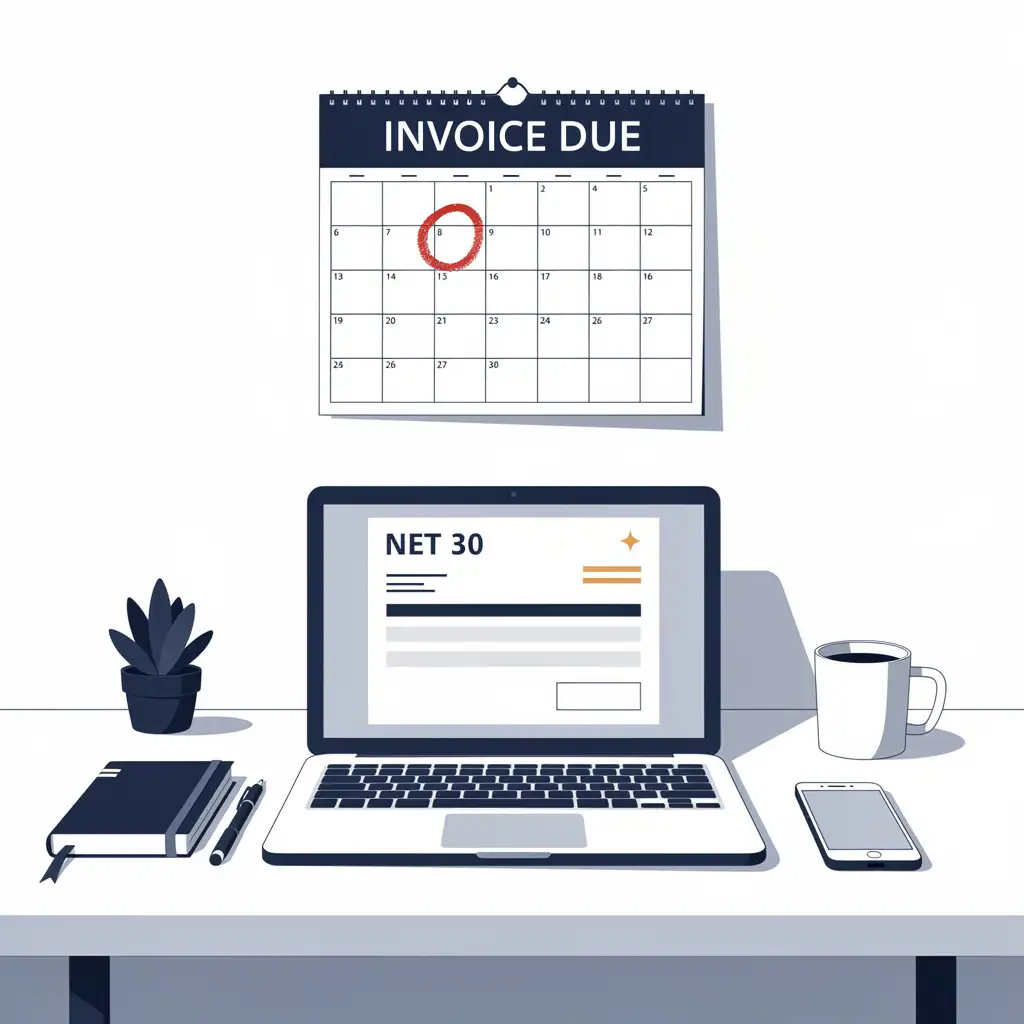
Net 30 is a payment term that means your client has 30 calendar days from your invoice date to pay you in full.
That is the short version. The word “net” simply refers to the total amount owed, meaning the full balance after any discounts or credits. The number tells you how many days the client has to pay it.
So “net 30” means 30 days. “Net 15” means 15 days. “Net 60” means 60 days. Net 30 is by far the most common one you will run into as a freelancer.
Here is a simple example:
You send an invoice on June 1, 2026. Under net 30 terms, your client has until July 1, 2026 to pay you. You do the work first. You get paid later. That is the basic deal.
Sounds simple enough, right? It is, on paper. In practice, things get messier. And that is exactly what this guide is going to walk you through.
How Net 30 Works Step by Step
Understanding how the net 30 payment process actually moves from start to finish helps you see where things can go wrong.
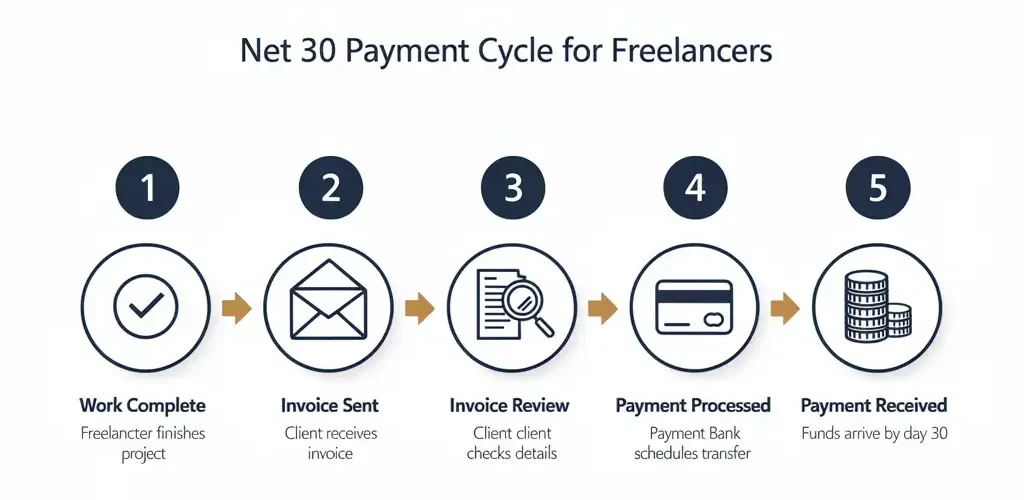
Step 1: You complete the work or deliver the service. Whether you are writing content, designing a logo, building a website, or shooting photos, you finish the job first.
Step 2: You send the invoice. The invoice is dated the day you send it. That date is critical. It starts the net 30 clock.
Step 3: The client receives and reviews the invoice. In a large company, this often means the invoice goes through an approval chain. An account manager reviews it. A finance department logs it. A payment batch gets scheduled.
Step 4: The client processes payment. Some clients pay within a week. Some wait until day 28 or 29. A frustrating number go past day 30 entirely.
Step 5: Payment arrives in your account. Depending on the payment method, this could take another one to three business days on top of everything else.
So when you add it all up, a net 30 project can easily take 35 to 45 days before money actually hits your bank account. Sometimes longer.
When Does the Net 30 Clock Actually Start?
This is one of the most argued points between freelancers and clients. The clock should start on the invoice date. That is the standard interpretation.
But here is what actually happens in real life:
Some clients say the 30 days start when they receive the invoice. Some say it starts when their internal team approves it. I once had a client tell me their clock started when they received payment from their own client, which had nothing to do with me whatsoever.
This is why you need to spell it out clearly in writing every single time. More on that shortly.
Why Big Companies Love Net 30
Net 30 was not invented to frustrate freelancers. It was created by large corporations to manage their accounts payable at scale.
When a Fortune 500 company has thousands of vendor invoices coming in every month, processing each one immediately is operationally impossible. Batching payments on a 30 day cycle is far more manageable for their finance departments.
From their perspective, net 30 is a cash flow tool. They hold their money longer, keep it earning interest or covering other operating costs, and pay out on a predictable schedule.
For a company writing a $10,000 check to a freelancer, that 30 day wait barely registers. For the freelancer who spent three weeks working to earn that $10,000, it is a very different story.
I worked with one major media conglomerate that had all of the following layered on top of standard net 30 terms:
- A separate vendor portal that took 48 hours to accept invoice submissions
- A required purchase order number that had to be obtained before submitting
- An internal approval process that added 10 more days on average
- A habit of paying 7 to 10 days late on top of all of that
That is a potential wait of 55 to 65 days for work I finished on day one. That is not a bad company. That is just how large organizations operate. Knowing this going in changes how you price, structure, and protect yourself on those projects.
The Real Problem Net 30 Creates for Freelancers
Here is the fundamental issue: net 30 was designed for businesses with cash reserves, credit lines, and accounts receivable departments. Most freelancers have none of those things.
When a freelancer finishes a $2,000 project in the first week of the month, that money is often mentally already spent. Rent. Software subscriptions. Contractor fees. Business credit card balance. A 30 day wait does not just feel inconvenient. For many freelancers, it creates a genuine cash flow crisis.
Let me share what happened to me once. I had four active clients simultaneously, all on net 30 terms, all with invoices outstanding at the same time. On paper I had several thousand dollars owed to me. In my bank account I had $340.
Technically flush. Practically broke.
I could not take on new work because I was already booked. I could not cover basic expenses because the money had not arrived yet. It is a uniquely frustrating kind of financial situation that nobody warns you about before you go freelance.
That experience taught me more about managing a freelance billing cycle and cash flow than any course or book ever did. It is the reason I now structure every project differently. And it is the reason you should too.
How to Build a Proper Net 30 Invoice
If you are going to use net 30 payment terms, your invoice needs to be airtight. Vague invoices cause disputes. Disputes cause delays. Delays cost you money.
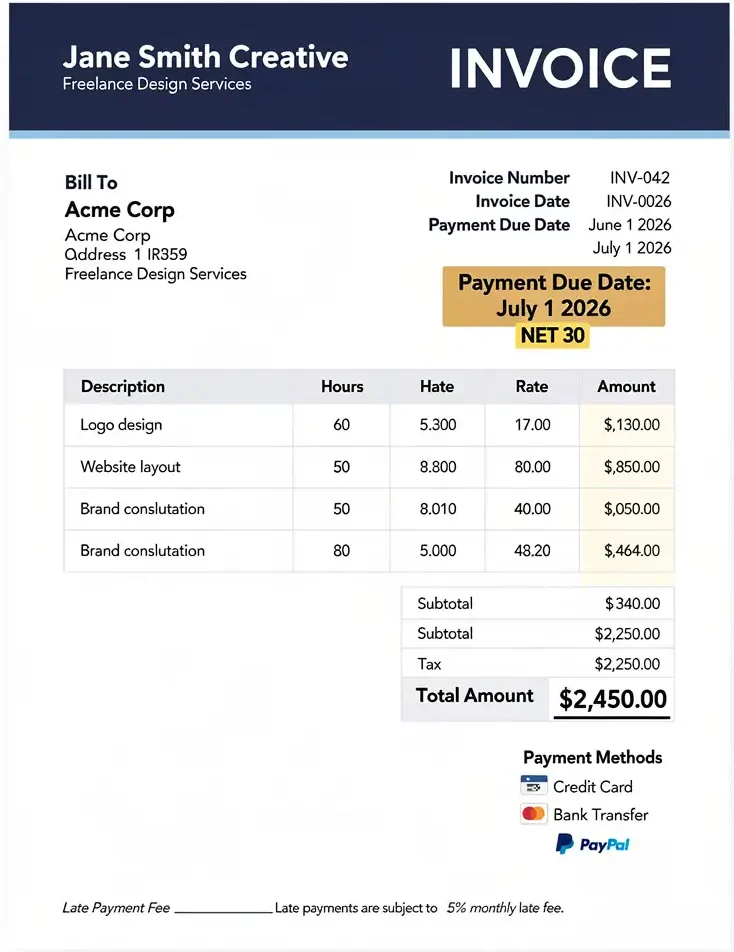
Here is exactly what every net 30 invoice must include:
Your Name and Contact Information
Basic stuff, but many early freelancers skip it. Your full name or business name, email, phone number, and website if you have one. Professional presentation matters, especially with corporate clients.
A Unique Invoice Number
Keep a sequential numbering system. Something like INV001, INV002, and so on. This makes it easy to reference specific invoices when following up. Tools like FreshBooks, Wave, and Bonsai handle this automatically.
The Invoice Date
This is your net 30 start date. Make it explicit. “Invoice Date: June 1, 2026.” No ambiguity.
The Payment Due Date
Do not make your client calculate it. Write it out: “Payment Due: July 1, 2026 (Net 30).” Spelling it out eliminates any excuse for confusion about the timeline.
A Detailed Breakdown of Services
Line items. What you did, how many hours or units, and at what rate. Vague invoices invite disputes. “Copywriting services: $2,000” will get questioned. “Blog post writing, 8 posts at 1,500 words each at $250 per post: $2,000” will not.
Your Payment Methods
Bank transfer details, PayPal, Wise, Stripe, whatever you accept. The easier you make it for clients to pay you, the faster they do it. Friction kills payment speed.
Your Late Payment Terms
This needs to be on every invoice. We will cover what to write shortly, but leave a dedicated line for it. Never leave it off.
Net 30 Pros: When It Actually Makes Sense
I am not here to tell you net 30 is universally bad. That would not be accurate. There are real situations where accepting net 30 terms is the right call.
You Are Working With Established Corporate Clients
Large companies with proper accounts payable departments, an established vendor payment history, and serious project budgets often run exclusively on net 30 or similar terms. Demanding payment on receipt from a multinational corporation is almost always a non-starter.
A $10,000 project on net 30 terms is almost always better than a $1,200 project paid immediately. The waiting is frustrating. But the math usually favors the bigger client.
Your Cash Flow Is Stable Enough to Absorb the Wait
If you have a retainer client or two providing consistent monthly income, plus a savings buffer covering four to six weeks of expenses, net 30 is manageable. Not ideal, but manageable. The danger is when you are entirely dependent on individual project payments with no buffer in place.
You Are Building a Long Term Client Relationship
Some clients use net 30 as a standard part of establishing a professional vendor relationship. Meeting them where they are, within reason and with your own protections in place, can signal that you are a serious, reliable professional. That goodwill can turn into a long term retainer, higher rates, and valuable referrals.
The Project Uses Milestone Payments
For large projects structured with milestone payments, the final invoice being on net 30 terms is a minor inconvenience rather than a crisis. If you have already received 60 percent of the project value before that final invoice goes out, waiting 30 days for the remaining 40 percent is far less stressful.
Net 30 Cons: Why Freelancers Struggle With It
Now let us be honest about the downsides. Net 30, at its core, is interest free credit that benefits your client far more than it benefits you. You are the lender. They are the borrower. And unlike a bank, you are not earning interest on the arrangement.
The Cash Flow Gap Is Very Real
Between the day you finish work and the day you receive payment, you are operating without income from that project. Two active clients both on net 30 can leave you going 30 to 45 days without a payment hitting your account. For full time freelancers without a secondary income stream, that is a serious problem.
Financial advisors generally recommend having three to six months of expenses saved as a buffer. Most people who go freelance, especially early on, do not have that. Net 30 makes that vulnerability much worse.
Most Clients Do Not Pay Exactly on Day 30
Here is the uncomfortable truth: net 30 does not mean they will pay in 30 days. It means they have up to 30 days. And a significant number of clients push past it.
In my experience across years of freelancing, roughly 60 percent of clients on net 30 terms actually pay within the 30 day window. The other 40 percent are late to some degree. Most respond to a single reminder and pay within a few days after that. But some stretch it to 45, 60, or even 90 days. And a small number, this has happened to me personally twice, simply go silent.
This is why “net 30” often means “net 30 to 50” in practice. You need a follow up system and late payment terms from day one, not after things go wrong.
It Creates a Feast and Famine Cycle
When you are a new freelancer taking on projects as they come, you often end up with several invoices going out at the same time, followed by a large batch of payments all arriving together, followed by a long quiet stretch while you work on the next round of projects. Then the wait starts again.
It is nothing like a salary. It is more like waiting for rain. You know it is coming. You just cannot be sure exactly when, and the dry spells between can feel extremely long.
It Does Not Account for Your Upfront Costs
When you take on a project, you often spend money immediately. Software licenses, stock images, third party tools, subcontractor fees, domain registrations, whatever the work requires. You pay those costs on day one and then wait 30 days for reimbursement. You are essentially giving your client a short term, interest free loan that you never agreed to. That is a real cost that most freelancers forget to account for.
Net 30 vs Other Payment Terms: Full Comparison for 2026
Understanding your options is essential. Net 30 is not your only choice, and it should not be your automatic default.
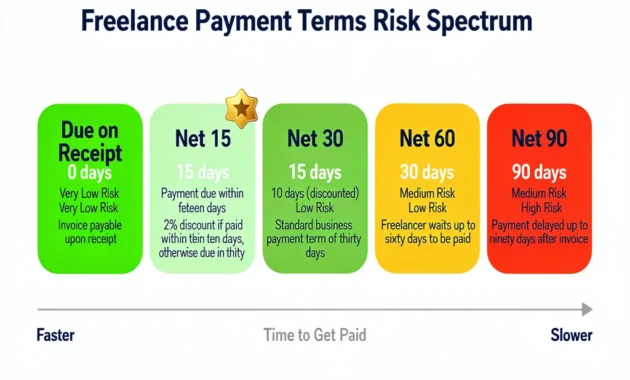
Due on Receipt (Net 0)
Payment is expected immediately upon receiving the invoice. This is ideal for smaller projects, returning clients with a solid payment history, digital file deliveries, and any client that is not a large corporation with a formal accounts payable process.
Some clients push back on this for larger amounts, but it is completely reasonable to use it as your default and treat extended terms as a negotiated concession rather than a given.
Net 15
A solid middle ground. Good for clients who genuinely need a few internal days to process payments but where net 30 feels too generous. I use net 15 as my default for most small to mid sized clients and reserve net 30 for larger corporate relationships.
2/10 Net 30 (Early Payment Discount)
One of the most underused tools in freelancing. This term means: pay within 10 days and receive a 2 percent discount. Otherwise, the full amount is due within 30 days.
For cash rich clients who want to reduce expenses, 2 percent is a meaningful saving. For you, getting paid in 10 days instead of 30 is almost always worth giving up 2 percent of the invoice value. I have used this on several large invoices and it works well when the client has the cash and motivation to act early.
Net 60 and Net 90: When to Push Back Hard
If a client asks for net 60 or net 90 terms, that is a serious conversation you need to have. These timelines are common in manufacturing and government contracting. For a freelancer delivering creative, consulting, or development work, they are almost always unreasonable.
A 60 or 90 day payment window means you are financing the client’s project for two to three full months. If anything goes wrong during that time, you have essentially worked for free for an extended period.
My personal rule: for net 60 or net 90, I either decline the project, increase my quoted rate by 15 to 20 percent to compensate for the extended wait and added risk, or require a much larger upfront deposit. Usually some combination of all three.
| Payment Term | Days to Pay | Best For | Risk Level |
|---|---|---|---|
| Due on Receipt | 0 | Small projects, returning clients | Very Low |
| Net 15 | 15 days | Small to mid clients | Low |
| Net 30 | 30 days | Established corporate clients | Medium |
| 2/10 Net 30 | 10 days (discounted) | Cash rich clients | Low |
| Net 60 | 60 days | Government, large enterprise | High |
| Net 90 | 90 days | Manufacturing, supply chain | Very High |
How to Protect Yourself: 6 Strategies That Actually Work
These are not theoretical tips. These are the exact strategies I built into my own freelance practice after learning each one the hard way.
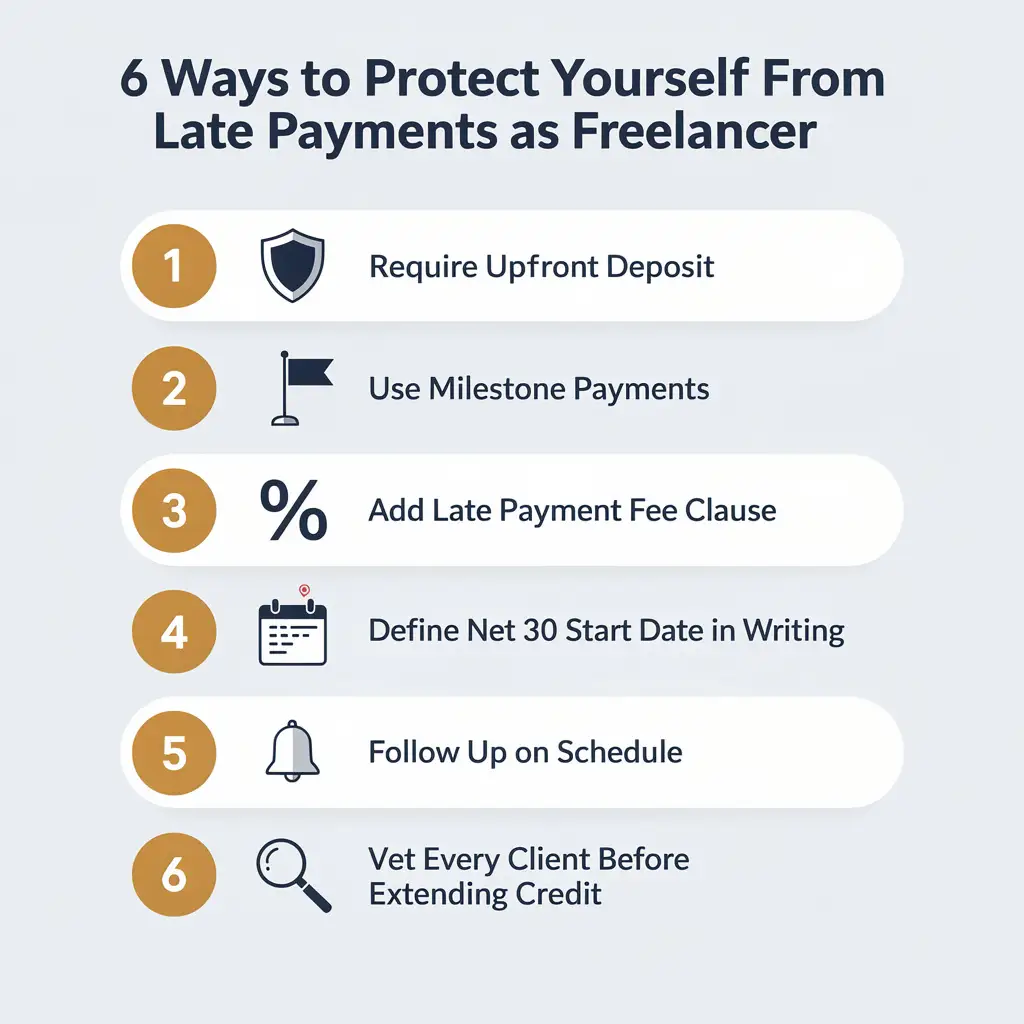
Strategy 1: Require an Upfront Deposit Every Time
This is the single most effective protection available to any freelancer. Standard practice is a 50 percent deposit before work begins, with the remaining 50 percent on delivery. Some freelancers go 30/30/40 across three phases. For smaller projects under a few hundred dollars, requiring 100 percent upfront is completely reasonable.
The deposit does two things. First, it gives you working capital during the project so you are not spending your own money while waiting to be paid. Second, it acts as a filter. Clients who refuse to pay a deposit before work starts are showing you something important about how they will behave when your final invoice comes due.
I have never once had a client who paid a deposit on time and then failed to pay the final balance. Not once. The deposit is a psychological commitment device. Once a client has money in, they are far more invested in the project reaching a successful conclusion.
When a client balks at a deposit, I say this: “All my projects start with 50 percent upfront. It is how I manage my workload and make sure client projects stay prioritized.” That response is professional, true, and does not sound accusatory.
Strategy 2: Use Milestone Payments on Bigger Projects
For any project over roughly $2,000 or with a timeline longer than two weeks, break the payment into milestones tied to specific deliverables rather than a single invoice at the end.
A structure that works well:
- Milestone 1 (30%): Kickoff deposit paid before work begins
- Milestone 2 (30%): Midpoint delivery, first draft, initial designs, or beta version
- Milestone 3 (40%): Final delivery and client approval
Each milestone gets its own invoice. The client reviews and approves each phase before the next begins. This creates accountability on both sides and ensures you are being compensated as the project progresses.
I learned this lesson after spending three weeks on a complete branding project, delivering every element, and having the client disappear without paying. Under a single invoice structure, I had done everything and received nothing. Under milestones, I would have had at least 60 percent in hand before the situation deteriorated.
Strategy 3: Add a Late Payment Fee Clause and Actually Use It
This is the most universally underused tool among new freelancers. Most avoid it because they fear seeming “difficult” or damaging the client relationship. But here is the perspective shift that helped me:
A late payment clause is not aggressive. It is standard business practice. Banks charge interest on late payments. Utilities charge reconnection fees. Every professional services firm has payment terms with teeth. You are running a business too.
A typical late payment clause looks like this:
“Invoices not paid within 30 days of the invoice date will incur a late payment fee of 1.5 percent per month on the outstanding balance.”
Include this on your invoice and in your contract. In many jurisdictions you also have a statutory right to charge interest on late commercial payments, but it is much easier to enforce when it is clearly written in your agreement.
You do not have to apply the fee every single time. But having it written down changes how quickly clients prioritize your invoice. When there is a financial consequence for dragging their feet, invoices tend to get processed faster.
Strategy 4: Define When Net 30 Starts in Writing
Do not just write “Net 30” on your invoice. Write: “Payment is due within 30 calendar days of the invoice date.”
Put the same language in your contract. The invoice date is a fixed, documented, undeniable fact. By tying your payment terms explicitly to that date, you eliminate every argument about when the clock started. No discussion about when they received it, when they reviewed it, or when their own client paid them.
Strategy 5: Follow Up on a Schedule Without Apologizing for It
Many freelancers feel guilty following up on overdue invoices. That guilt is understandable. But here is the reframe:
Following up on a legitimate, unpaid debt is not rude. It is the minimum requirement of running a business. You would not apologize to your bank for asking why a transfer had not arrived. This is the same thing.
Here is the follow up schedule I use:
Day 28 (2 days before due): Send an automated friendly reminder through your invoicing tool. “Just a quick heads up that invoice INV042 for $1,800 is due on [date]. Let me know if you have any questions.” Set this up once in FreshBooks, Wave, or HoneyBook and it runs on its own.
Day 31 (1 day after due): Send a personal email, not automated. Something like: “Hi [Name], checking in on invoice INV042 which was due yesterday. Happy to answer any questions or resend if needed. Just wanted to make sure it had not slipped through.”
Day 38 (1 week late): More direct follow up. Reference the invoice number, the amount, and the original due date specifically. Keep it professional but make it clear you are paying attention.
Day 45 (2 weeks late): Invoke your late payment clause. “As per the payment terms in our agreement, a late payment fee of 1.5 percent per month will begin accruing on the outstanding balance from [original due date]. Please confirm your expected payment date.”
Day 60 and beyond: Depending on the amount, consider consulting a collections service, a freelance legal resource, or pursuing a small claims process. For US freelancers, the Freelancers Union provides excellent guidance. For UK freelancers, the Small Business Commissioner office handles escalation. Small claims court is a real and accessible option for amounts under the jurisdictional threshold in most regions.
Strategy 6: Vet Every Client Before Extending Credit
Net 30 is functionally credit. You are delivering a service and trusting the client to pay for it afterward. A bank does not extend credit to strangers without assessing their reliability. You should not either.
For new clients you found online or who approached you cold, consider:
- Starting with shorter terms such as net 15 or due on receipt for the first project
- Requiring a larger deposit than usual
- Searching the company name for reviews, complaints about non payment, or red flags on platforms like Clutch, Google Business, or LinkedIn
- Checking whether they have a legitimate online presence and verifiable business history
Once a client has completed two or three projects with you and paid every invoice on time, it is entirely reasonable to extend net 30 for future work. Trust is built through a track record, not promises.
How to Add Net 30 to Your Freelance Contract
An invoice states your terms. A signed contract makes those terms legally enforceable. If you are only putting payment language in invoices and not in contracts, you are leaving yourself in a very vulnerable position.
Here is the core payment clause language I use in my own contracts:
Payment Terms: All invoices are due within [15 or 30] calendar days of the invoice date. Projects above [dollar threshold] require a 50 percent deposit prior to commencement of work, with the remaining balance invoiced upon delivery. Late payments will incur interest at a rate of 1.5 percent per month (18 percent annually) on the outstanding balance, accruing from the original due date.
Intellectual Property: All intellectual property rights in the deliverables, including but not limited to copyright and design rights, shall remain with the contractor until full payment has been received. Upon receipt of full payment, all agreed rights transfer to the client.
That IP retention clause is one of the most powerful late payment deterrents available to creative freelancers. If you retain ownership of the work until you are paid, a non paying client cannot legally use that work. Most clients do not realize this is an option. Including it in your contract changes the entire dynamic.
For contract tools in 2026:
- Bonsai: Purpose built for freelancers with excellent templates and built in e signature
- HelloSign / Dropbox Sign: Great for adding signatures to your own documents
- Fiverr Workspace (formerly And.co): Free contracts with integrated payment tracking
- DocuSign: The enterprise standard for large corporate clients
Whatever tool you use, the signed contract is non negotiable. A verbal agreement means nothing when you are chasing an invoice at day 45.
Common Mistakes Freelancers Make With Payment Terms
Let me walk you through the ones I see most often. Most of these I made myself.
Mistake 1: Accepting Terms Without Trying to Negotiate
Just because a client sends you an onboarding packet with net 30 built in does not mean it is set in stone. Everything in business is negotiable, especially with smaller clients. A simple response of “I typically work on net 15 terms, would that work for you?” gets a yes more often than you would expect.
Larger companies are less flexible. But even with corporate clients, you can often negotiate a higher deposit, a milestone structure, or shorter terms on smaller deliverables.
Mistake 2: Starting Work Without a Signed Contract and Deposit
I did this twice. Both times were framed as “urgent rush situations” where the client needed results immediately and promised to “sort the paperwork later.” Both situations ended badly. One resulted in a payment dispute. The other turned into uncontrolled scope creep with no written spec to reference.
The urgency is their problem. Not yours. No contract, no deposit, no work. Hold that line every single time.
Mistake 3: Sending Vague Invoices
An invoice that says “web design services: $3,000” is an open invitation for a dispute. Clients will ask questions. “What exactly is included? I did not approve all of this. Can you break it down?” These are delay tactics that evaporate when your invoice is detailed and specific.
Write it out completely: “Homepage design, 16 hours at $95 per hour. About page design, 8 hours at $95 per hour. Contact page design, 4 hours at $95 per hour.” There is nothing left to question.
Mistake 4: Not Following Up Because It Feels Awkward
Your invoice will not chase itself. Every day you do not follow up is a day the client has less urgency to pay. Follow up the day after the due date, every single time, without exception. Most late payments are not intentional. They are a result of busy inboxes and competing priorities. A single professional nudge is usually all it takes.
Mistake 5: Not Factoring the Wait Into Your Rate
If you know a client pays on net 30, net 45, or net 60 terms, the cost of waiting should be reflected in your rate. The opportunity cost, the stress of managing cash flow, and the administrative time spent on follow up are all real business costs. Some freelancers add an explicit “payment terms adjustment” to their quotes. Others simply quote higher for clients with extended terms. Either approach is valid.
Mistake 6: Treating Every Client Identically
A large enterprise asking for net 30 is not the same situation as a solo consultant asking for net 30. The enterprise has a real AP process and an established payment history. The solo consultant may be asking for extended terms because they cannot pay you right now. That is a significant red flag.
Tailor your terms to the actual client in front of you. Unknown clients and small operators need more upfront protection. Long term corporate relationships can be handled more flexibly. A single rigid policy applied universally exposes you to unnecessary risk on one end and leaves opportunity on the table on the other.
Mistake 7: Introducing Payment Terms After the Project Starts
Payment terms belong in the contract that is signed before work begins. Not in the invoice after everything is delivered. Introducing your terms post delivery creates conflict. “I thought we were doing payment on delivery” is an infuriating conversation to have when the work is already done. Agree on everything upfront. Document it in writing. Then execute cleanly.
Real World Example: The Same Project, Two Very Different Outcomes
Let me show you how all of this plays out in practice with a concrete example.
The scenario: You are a freelance copywriter. A digital agency hires you for 10 SEO blog posts at $250 each. Total value $2,500. Timeline four weeks.
Without proper payment terms:
You send one invoice at the end for $2,500 on net 30. Day 35 arrives with no payment. You feel awkward reaching out. Day 45 you send a tentative email. They apologize and say it is “in the approval queue.” Day 55 the payment finally arrives. That is nearly two months between finishing the work and getting paid. During that time you have covered three other projects, paid your own bills, and waited for money you had already mentally spent.
With proper payment terms:
Before starting, you send a contract specifying 50 percent upfront, 50 percent on delivery, net 15 on both invoices, and a 1.5 percent monthly late fee.
The client signs and pays the $1,250 deposit within three days. You deliver all 10 posts slightly ahead of schedule at the end of week three. You send the final $1,250 invoice. The client pays on day 12. Well within net 15.
Total time from first invoice to final payment: approximately four weeks. And you had $1,250 in your account before you wrote a single word.
Same project. Same client. Completely different financial experience. The only difference was how you structured it.
Best Tools to Manage Net 30 in 2026
One of the real improvements in modern freelancing is the quality of dedicated invoicing and payment tools. These are not luxuries. They are the difference between spending two hours a month chasing payments and spending 15 minutes.
Wave: Free invoicing, accounting, and payment acceptance with automatic payment reminders. The best starting point for freelancers who want solid tools without monthly fees.
FreshBooks: Paid but worth it for active freelancers. Time tracking, client portals, recurring invoices, and smart late payment reminders with customizable schedules. The overdue invoice dashboard alone saves hours.
Bonsai: Combines contracts, invoicing, project management, and time tracking in a single tool built specifically for freelancers. The contract templates are particularly well thought out.
HoneyBook: Excellent for creative professionals including photographers, designers, and event based freelancers. Strong client communication and project workflow tools alongside clean invoicing.
Stripe Invoices: If you already use Stripe for payment processing, their invoice product is clean and professional. Clients can pay by card directly from the invoice, which dramatically speeds up payment for many clients.
Wise (formerly TransferWise): The essential tool for freelancers with international clients. Far lower fees than PayPal or traditional bank wire transfers. Multi currency accounts let you hold and convert foreign currency on your own schedule.
For any tool you use, the three features that matter most are: automatic payment reminders before and after the due date, a clear payment due date displayed prominently on the invoice, and a direct payment link that lets clients pay in seconds. Friction kills payment speed. Remove every possible obstacle between your client and paying you.
Your Legal Rights Around Late Payment in 2026
Payment rights vary by country, but knowing your local framework gives you real leverage when a client is being deliberately difficult.
United States
Several states have enacted specific freelancer protection legislation. New York City’s Freelance Isn’t Free Act is among the strongest, requiring written contracts for freelance work over $800 and providing legal recourse, including double damages and attorney fees, for non payment. Similar laws have passed or are pending in California, Illinois, and other states. The Freelancers Union (freelancersunion.org) maintains updated resources on your rights by state.
United Kingdom
The Late Payment of Commercial Debts (Interest) Act 1998 gives UK businesses the statutory right to charge 8 percent over the Bank of England base rate on late commercial payments, even without it being specified in the contract. The Small Business Commissioner office handles dispute escalation for freelancers and small businesses.
European Union
The Late Payment Directive establishes a default 30 day payment period for B2B transactions across EU member states and requires governments to enforce payment rights. Many member states have additional national legislation on top of the directive.
Knowing these rights does not mean you will need to invoke them constantly. Most payment issues resolve through direct, professional communication. But understanding the legal framework behind your payment terms means that when a client is genuinely acting in bad faith, you are not powerless.
When to Accept, Negotiate, or Refuse Net 30
Here is a practical framework for making the right call on any project.
Accept Net 30 Without Too Much Concern When:
- The client is a well established company with a verifiable payment track record
- The project value is large enough that a 30 day wait is a minor inconvenience relative to the total fee
- You have enough cash flow buffer to cover your expenses during the wait
- You have already required a meaningful upfront deposit
- A signed contract with late payment terms is already in place
Negotiate Harder or Add More Protection When:
- The client is new or unverified
- The project is medium sized and you are depending on the payment to cover near term expenses
- The client seems to want extended terms because of their own cash flow situation
- The project requires you to pay upfront costs before delivery
- The timeline extends beyond four to six weeks
Push Back Strongly or Walk Away When:
- The client wants net 60, net 90, or longer with no willingness to negotiate
- They are requesting net 30 on a small project that would normally be due on receipt
- They refuse any deposit entirely
- Their responses to standard payment term questions are evasive or dismissive
- Your instincts say something is wrong about how they are engaging
That last point is worth taking seriously. The way a client responds to a direct conversation about payment terms tells you almost everything about how they will behave when an invoice is overdue. Someone who is direct, professional, and cooperative about money discussions almost always pays well. Someone who becomes vague, irritated, or evasive at basic payment questions is someone who will give you trouble later.
Building Long Term Relationships That Pay on Time
The goal is not to spend your entire freelance career negotiating payment terms and chasing overdue invoices. The goal is to build a client roster where the payment relationship is so well established that invoices are paid quickly, consistently, and without drama.
I have three long term clients I have worked with for several years now. With all three, invoicing is essentially frictionless. They pay within five to seven business days, often before I have had a chance to send a reminder. We have signed agreements, established terms, and years of mutual trust built through consistently good work on both sides.
Getting to that point requires starting with the right protections in place, being professional and consistent with your invoicing, and doing genuinely excellent work so that clients value the relationship and want to maintain it. It also requires having direct, honest conversations when something is not working rather than letting resentment build silently.
The freelancers who burn out on payment disputes are usually the ones who skipped the early protections, built bad habits, and attracted clients who learned they could push without consequences. The freelancers who build sustainable, well paid practices treat invoicing and payment management with the same level of professionalism they bring to the work itself.
People Also Ask: what is net 30 payment freelancer FAQs
What Does Net 30 Mean on an Invoice?
Net 30 on an invoice means the client has 30 calendar days from the invoice date to pay the full amount owed. The word “net” refers to the total balance due, and “30” is the number of days in the payment window.
Does Net 30 Start From the Invoice Date or the Delivery Date?
Net 30 standard practice is that the 30 day window starts on the invoice date, not the delivery date. However, some clients interpret it differently. This is why you should always write “payment due within 30 calendar days of the invoice date” explicitly in your contract and on your invoice.
Is Net 30 Legal for Freelancers?
Yes. Net 30 is a legal and standard business payment term used worldwide. In many jurisdictions, you also have statutory rights around late payment, including the right to charge interest, regardless of whether your contract specifies it.
How Do I Handle a Client Who Misses a Net 30 Deadline?
Start with a professional email the day after the due date. Reference the invoice number and amount specifically. If payment does not follow within a week, escalate to a second follow up. At two weeks past due, invoke your late payment fee clause. If the invoice remains unpaid past 60 days, consider a collections service or small claims court depending on the amount.
Should I Accept Net 30 as a New Freelancer?
With protections in place, yes, sometimes. The key is to never accept net 30 without a deposit, a signed contract, and a late payment clause. For small projects or new clients you cannot verify, push for shorter terms or payment on delivery.
What Is the Difference Between Net 30 and Due on Receipt?
Net 30 gives the client 30 calendar days to pay after receiving the invoice. Due on receipt means payment is expected immediately. Due on receipt is better for your cash flow. Net 30 is more accommodating for larger corporate clients with formal payment processes.
Can I Charge Late Fees on Net 30 Invoices?
Yes. As long as your contract and invoice clearly state your late payment terms, including the rate and when fees begin accruing, you have the right to charge late fees. In many jurisdictions you also have a statutory right to interest on late commercial payments even without it being written into your agreement.
What Is 2/10 Net 30?
2/10 net 30 means the client gets a 2 percent discount if they pay within 10 days. Otherwise the full amount is due within 30 days. It is a way of incentivizing early payment without demanding it. Useful on large invoices where the cash flow benefit of receiving payment in 10 days outweighs giving up 2 percent of the invoice value.
What Is Net 30 for Freelancers vs Employees?
Employees are paid on a regular payroll schedule set by the employer. Net 30 is a B2B payment arrangement between two independent businesses. As a freelancer operating as an independent contractor, you negotiate your own payment terms rather than receiving a scheduled paycheck.
Are Net 60 or Net 90 Terms Reasonable for Freelancers?
Rarely. These extended terms are common in manufacturing, government contracting, and large enterprise supply chains. For most freelance creative, consulting, or development work, net 60 or net 90 is unreasonable. If a client insists on these terms, require a significantly larger deposit and consider increasing your rate to compensate for the extended waiting period and elevated financial risk.
Final Thoughts
Net 30 is not your enemy. It is a legitimate, widely used payment arrangement that works perfectly well in the right context with the right protections in place. But it was designed by large corporations for large corporations. Freelancers who accept it passively, without a deposit, without a signed contract, and without a follow up system, are subsidizing their clients’ cash flow at their own expense.
The good news is that protecting yourself is not complicated. Require a deposit. Structure milestone payments on larger projects. Put a late payment clause in your contract. Use invoicing software that automates your reminders. Know your legal rights. And most importantly, have the payment terms conversation before the work starts, not after you have delivered everything and are hoping for the best.
I have been freelancing long enough that payment disputes are genuinely rare now. Not because I got lucky with clients. Because I built a system that makes it difficult for anyone, even someone with bad intentions, to take advantage of me. That system came from expensive lessons, but the principles behind it are simple.
Know your terms. Write them down. Send the reminder. Follow up without apology.
You did the work. You deserve to get paid for it.
Further Reading: For more on protecting yourself as a freelancer, visit the Freelancers Union for updated legal resources, state specific protections, and community support from over 500,000 independent workers across the United States.
If you’re looking for more real world insights and practical tips to level up your freelancing journey, make sure to check out our website. We regularly share simple, actionable content to help you land better clients, protect your time, and confidently grow your freelance career.