
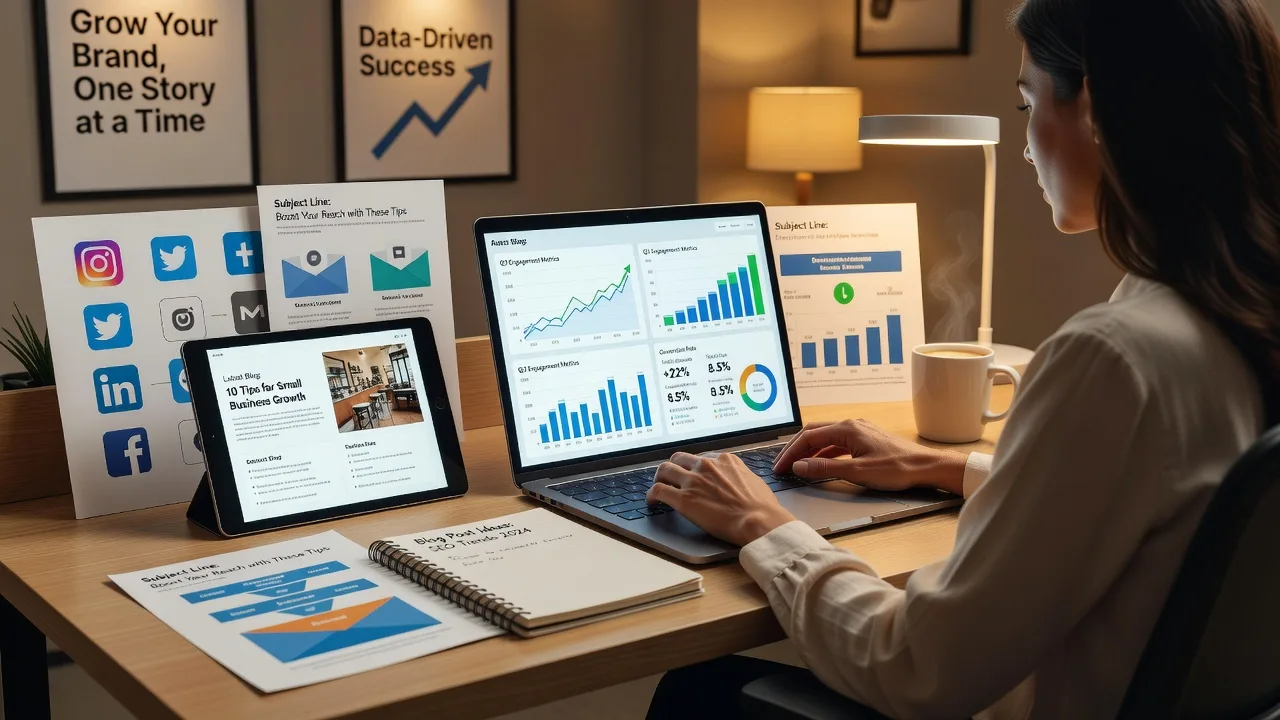
You already know you need to market your business. The problem is not motivation. The problem is that most content marketing advice online was written for companies with a dedicated marketing team, a five figure monthly budget, and a full time content strategist on staff.
You have none of that. You have a business to run, maybe a part time helper, and a few hours a week to figure out how to get more customers through the door or the inbox.
Here is the thing: that constraint is actually your advantage.
Small business owners who do content marketing right consistently outperform big brands in local and niche search results. They build real trust with their audience. They generate leads without paying for every single click. And they do it with free tools, a smartphone, and a clear plan.
Content marketing for small businesses is the practice of creating and sharing helpful, relevant content to attract your ideal customers, build trust, and ultimately drive sales — without relying on paid advertising.
This guide gives you 25 battle tested content marketing tips for small businesses in 2026. Every tip is actionable. Every strategy accounts for real world constraints like limited time, limited budget, and zero marketing experience.
Why Content Marketing Is Essential for Small Businesses in 2026
Content marketing is essential for small businesses in 2026 because it builds organic visibility and customer trust without the recurring cost of paid ads. Businesses that publish consistent, helpful content generate 3x more leads than those relying on outbound tactics alone, according to HubSpot.
The marketing world shifted dramatically between 2023 and 2026. Google now surfaces AI generated summaries at the top of search results. Paid ad costs on Google and Meta increased by an average of 19% year over year. And consumer trust in traditional advertising hit a record low, with 81% of buyers saying they need to trust a brand before making a purchase.
For small businesses, this is not a crisis. It is an opening.
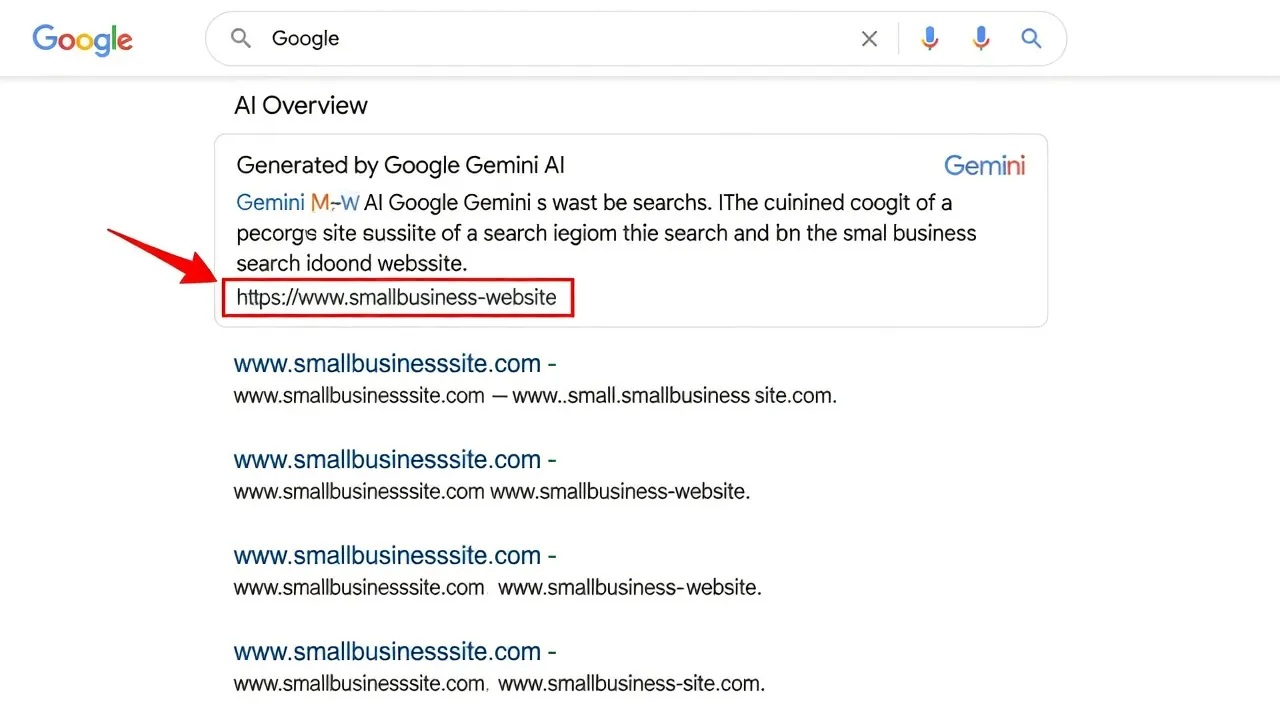
Here is why: Google’s AI Overviews and Bing’s AI search features actively pull content from smaller, authoritative sources when that content directly and specifically answers a question. A local landscaping company with a detailed blog post about “how to fix lawn drainage problems in clay soil” can appear in an AI Overview right alongside a national home improvement brand. The content wins, not the domain authority alone.
The Real Numbers: What Content Marketing Actually Does for Revenue
Let’s talk numbers that matter to a small business owner.
According to the Content Marketing Institute’s 2026 B2B report, 71% of small and medium sized businesses that maintained a consistent content strategy for 12 months reported a measurable increase in organic leads. The average cost per lead from content marketing is 62% lower than from outbound marketing methods like cold calling or display ads.
Here is a real world scenario that illustrates this. A local plumbing company in Austin, Texas started publishing two blog posts per month answering common questions their customers called about. Questions like “why is my water heater making a popping noise” and “how to shut off water in an emergency.” Within eight months, that content drove 340 monthly organic visits. Forty of those visitors filled out a contact form. The cost to produce that content? Roughly four hours of the owner’s time per month and $0 in ad spend.
That is the ROI equation content marketing offers small businesses that paid advertising simply cannot match over the long term.
Can Content Marketing Really Generate Leads?
Yes. Content marketing generates leads by moving potential customers through a clear awareness to action path. A stranger searches a question on Google. Your content answers it. They trust you. They contact you.
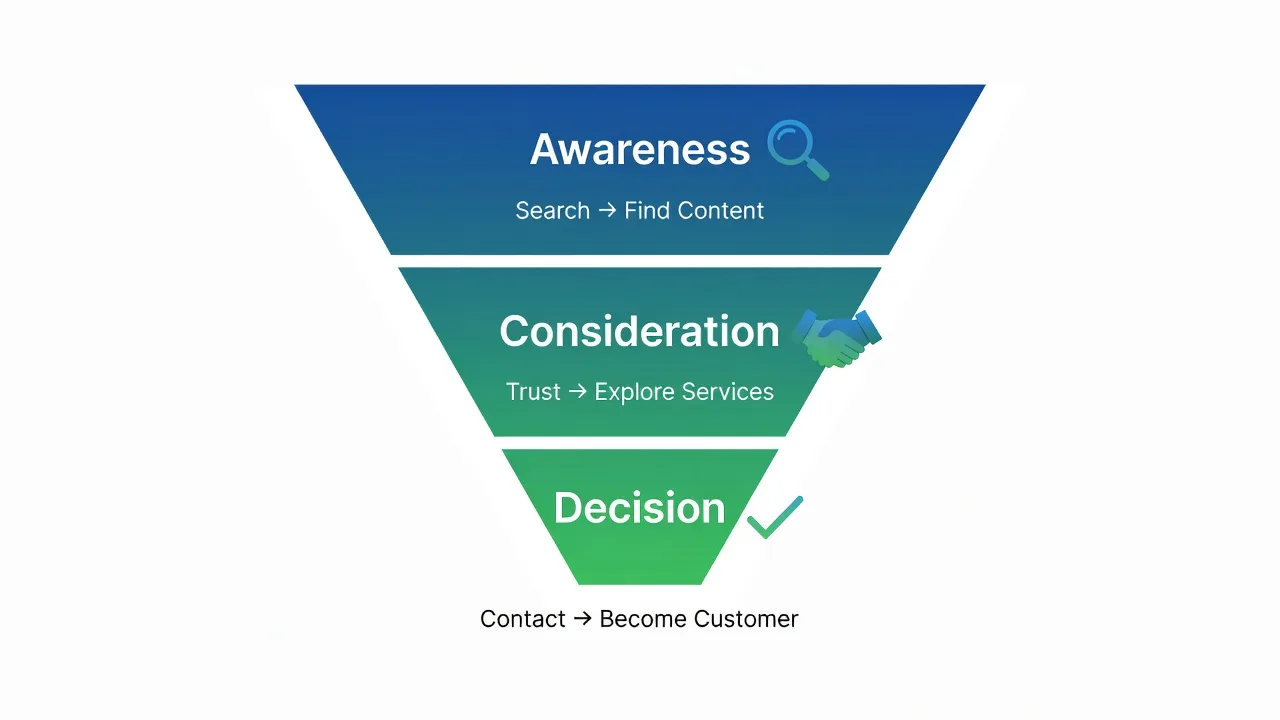
The inbound marketing funnel works like this for a small business:
Stage 1 — Awareness: Someone searches “best way to remove kitchen grease stains” and finds your cleaning service’s blog post. They have never heard of you before.
Stage 2 — Consideration: They read your post. It is specific, honest, and helpful. They notice you offer cleaning services. They click to your services page.
Stage 3 — Decision: They see your Google reviews, your pricing transparency, and a clear contact form. They book a call.
No ad was shown. No money was spent in that transaction. The content did the entire job.
The mistake most small business owners make is expecting content to generate leads in week two. Content marketing compounds over time like interest in a savings account. Your blog post from month three keeps pulling in readers in month fourteen. Your YouTube video from last year keeps getting views today. Each piece of content you publish is a permanent sales asset.
What Makes 2026 Different: The AI Search Shift Every Small Business Must Know
Google’s integration of Gemini into search results changed how content gets discovered. AI Overviews now appear for roughly 47% of informational search queries, and they pull directly from well structured, authoritative web pages.
What this means practically: if your content clearly and directly answers a specific question, you now have a real shot at being cited inside the AI answer box, regardless of your domain authority.
The businesses that will win in search over the next three years are those that write with genuine expertise, structure their content for passage indexing, and cover topics with enough depth that both human readers and AI systems recognize them as the authoritative source on that subject.
Bigger sites cover broader topics. You can win by going deeper on narrower ones.
How to Build a Content Marketing Strategy for Small Business
A content marketing strategy for small businesses is a documented plan that defines your target audience, the type of content you will create, where you will publish it, and how you will measure success. Without this plan, you are creating content in the dark.
Most small business owners skip this step and jump straight to posting. That is why most small business content fails. The content is not bad. It is just pointed in the wrong direction.
Building a strategy takes about two to three hours the first time. After that, it runs on a simple system you can maintain in under an hour per week.
How to Find Your Target Customer Online
Before you write a single word of content, you need to know who you are writing for. Not in a vague “women aged 25 to 45” kind of way. You need to know what keeps them up at night, what questions they type into Google at 11pm, and what language they use when they describe their problems.
Here is a three step process to build that picture for free:
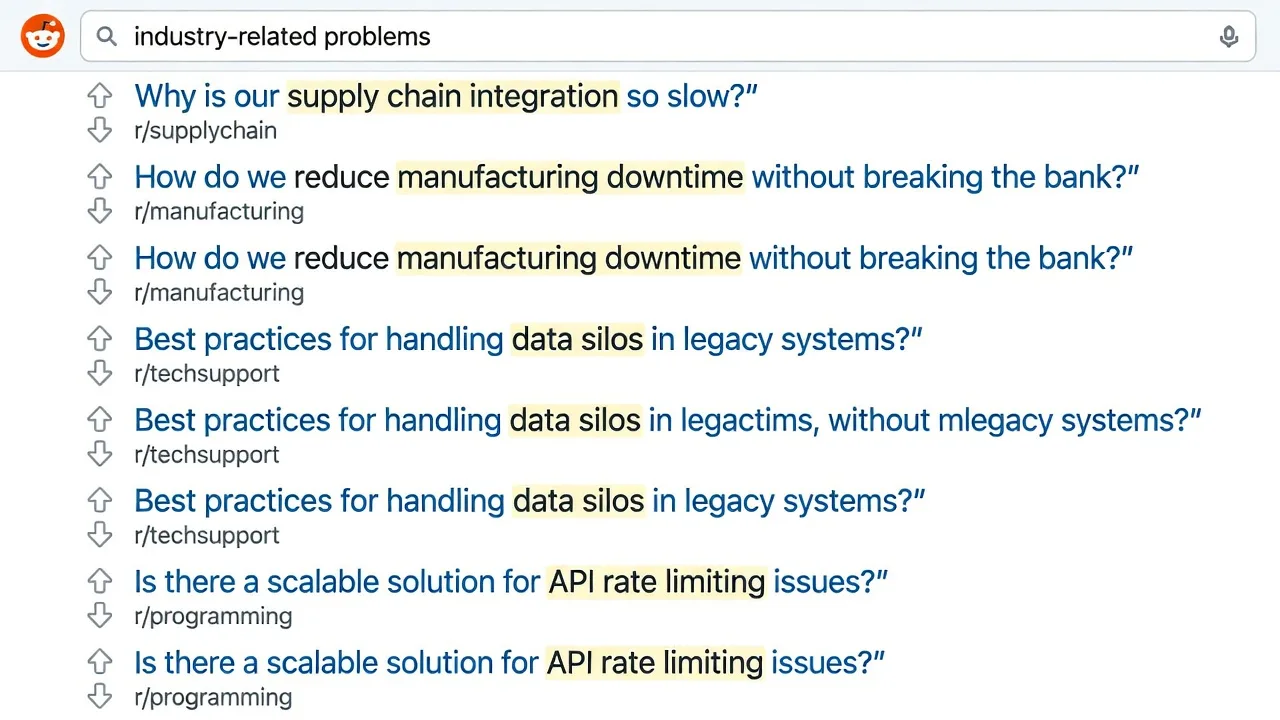
Step 1: Mine Reddit for raw, unfiltered customer language.
Go to Reddit and search your industry plus the word “problem” or “help.” Read the posts. Look at how people describe their frustrations. Copy the exact phrases they use. This is the language your content should speak.
Step 2: Check Google’s “People Also Ask” boxes.
Search your main service or product on Google. Look at the PAA questions that appear. These are real questions real customers are asking right now. Every one of these is a content opportunity.
Step 3: Dig into your own inbox and DMs.
What do customers ask you before they hire you? What objections do they raise? What do they wish they had known before buying? Those conversations are your content strategy, already written for you.
Once you have gathered this information, build a simple one page buyer persona. Name them. Describe their situation. List their top five questions. This document becomes your editorial compass for every piece of content you create.
How to Create a Content Marketing Plan for Your Small Business (Step by Step)
Building a plan does not require expensive software or a marketing degree. Here is the exact process:
Step 1: Set one measurable goal.
Pick one. More website traffic. More email subscribers. More quote requests. One goal keeps you focused and makes measuring success simple.
Step 2: Choose your primary content format.
Pick the format you can produce consistently. If writing is natural to you, start with a blog. If talking feels easier, start with short videos. Do not try to do everything at once.
Step 3: Build a 30 day content calendar.
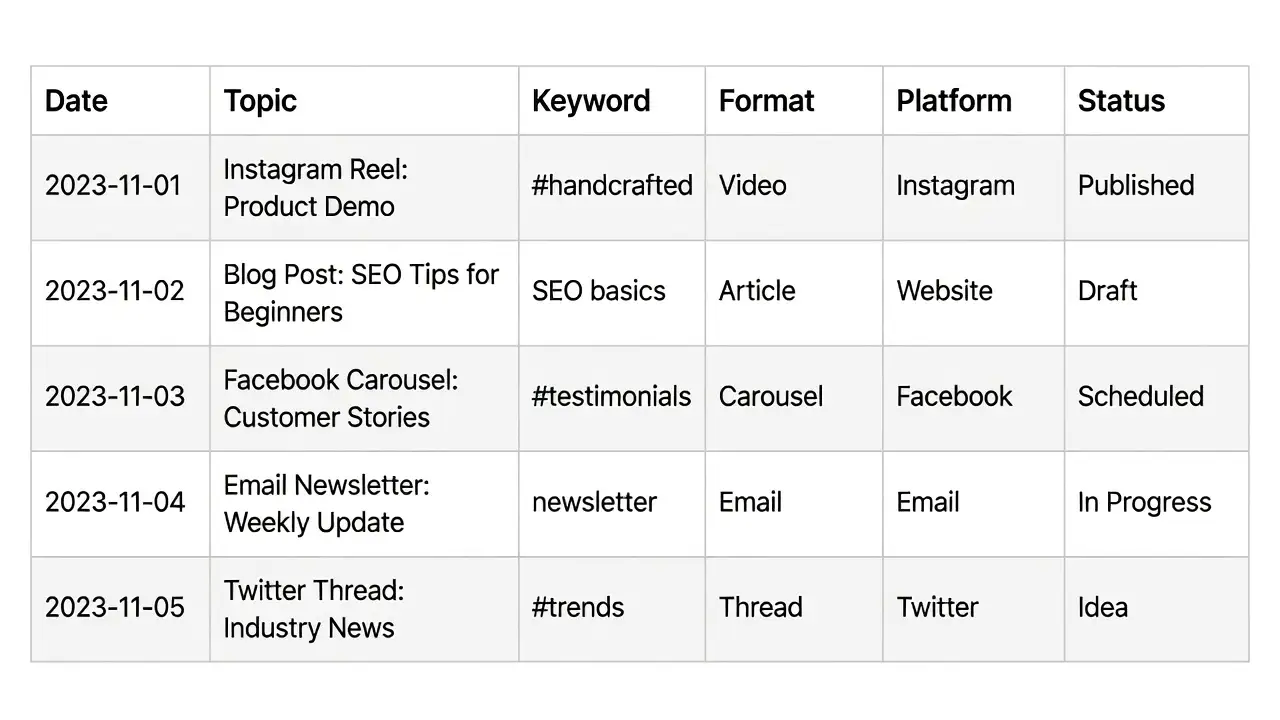
Plan four to eight pieces of content for the next 30 days. Write down the topic, the target keyword, the publish date, and the distribution channel for each piece.
Step 4: Pick one to two distribution channels.
Where does your target customer actually spend time online? That is where you publish. Not where you personally enjoy spending time.
Step 5: Produce and publish your first four pieces.
Done beats perfect. Your first four pieces of content will not be your best. That is fine. Consistency over time beats sporadic perfection every single time.
Content Calendar for Small Business: How to Build One You Will Actually Stick To
The reason most small business owners abandon their content efforts after six weeks is not lack of motivation. It is lack of a system.
A content calendar removes the daily decision of “what should I post today?” That question alone is responsible for more abandoned content strategies than any other factor.
Here is a simple system that works:
Use Google Sheets, Notion, or Trello. Create columns for: Topic, Keyword Target, Format, Platform, Due Date, and Status. Fill in one month at a time, ideally on the last Sunday of every month for the month ahead.
The “batching” method makes this even more manageable. Set aside one day per month to plan and create all your content in one sitting. Many solo business owners use a Saturday morning to outline four blog posts, record two short videos, and schedule two weeks of social posts. The rest of the month, you are simply executing a plan that already exists.
For the actual template structure, a 30 day calendar for a small local business might look like this:
Week 1: One educational blog post + two social posts based on the blog content
Week 2: One customer story or review spotlight + one behind the scenes video
Week 3: One FAQ based article or video + two social posts
Week 4: One promotional piece + one repurposed piece from earlier in the month
That is eight to ten content pieces per month. Achievable for one person in under four hours per week.
How to Create a Website That Actually Converts Leads
Your website is not a brochure. It is a salesperson that works 24 hours a day. Most small business websites fail not because they look bad but because they never tell the visitor what to do next.
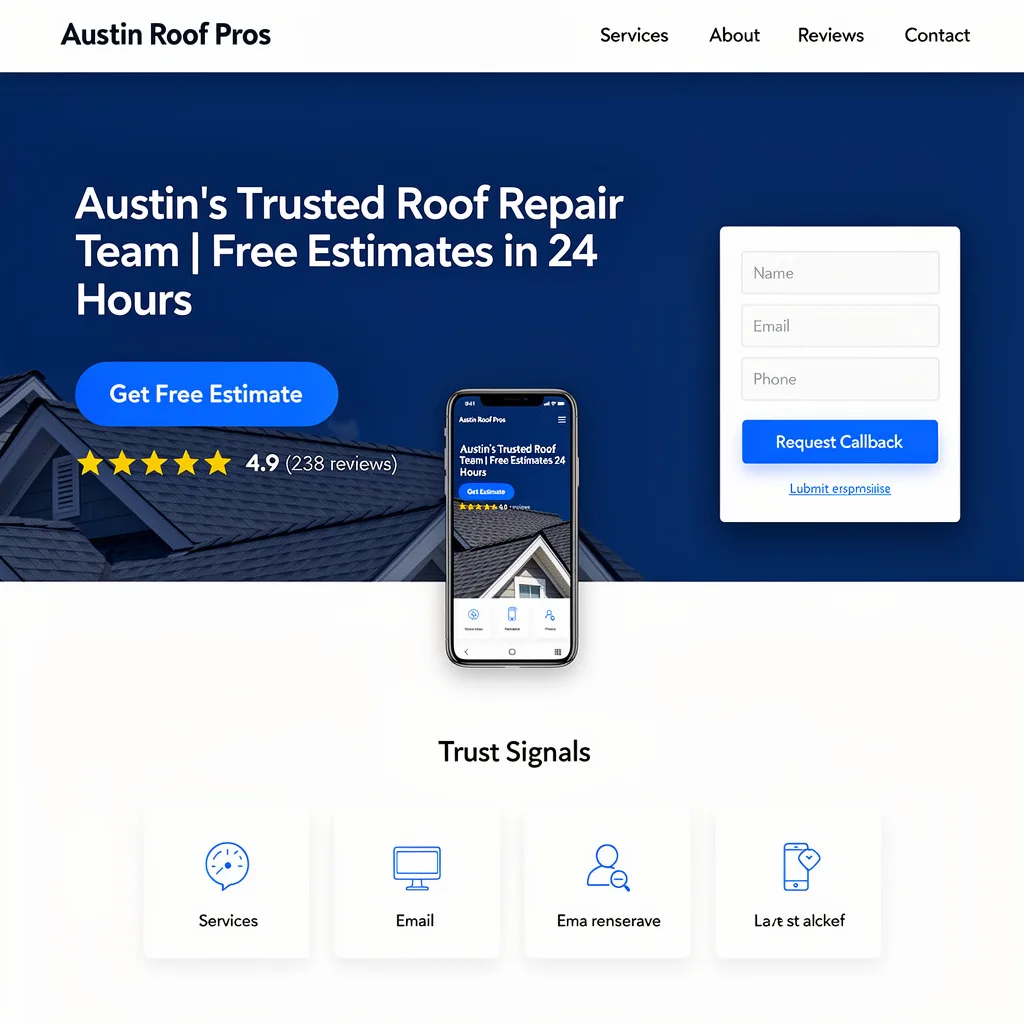
Five elements every small business website needs to convert visitors into leads:
1. A clear headline above the fold.
In the first five seconds, a visitor should know what you do, who you serve, and what they should do next. “Austin’s Trusted Roof Repair Team | Free Estimates in 24 Hours” does this. “Welcome to Our Website” does not.
2. One primary call to action.
Every page should ask the visitor to do one thing. Call now. Book a free consultation. Download the guide. One action. Not three.
3. Social proof near the top.
Star ratings, review counts, or a single powerful testimonial placed near your headline dramatically increases the likelihood a visitor stays on the page.
4. A simple contact process.
If getting a quote requires filling out 8 fields, you are losing leads to competitors who ask for only 3. Name, email, and their main question. That is all you need to start a conversation.
5. Mobile performance.
Over 64% of small business website visits now come from mobile devices. If your site loads slowly or buttons are hard to tap on a phone screen, you are losing customers before they read a single word.
How to Make Your Small Business Stand Out From Competitors Through Content
Here is what most small businesses do with their content: they post the same tips, the same advice, and the same promotional content as every other business in their category.
Here is what wins: a distinctive content point of view.
Your content POV is the specific angle, belief, or perspective that runs through everything you publish. It is what makes your content sound like you, not like a generic business.
A financial advisor might have a POV of “stop chasing market returns and focus on building financial resilience.” An HVAC company might have a POV of “the cheapest HVAC unit almost always costs you more in the long run.” Every piece of content they publish connects back to that core belief.
Developing your content POV takes 15 minutes. Answer these three questions:
- What do most people in your industry get wrong?
- What do you believe that your competitors would never say publicly?
- What is the one thing you wish every customer knew before hiring anyone in your field?
Those answers become your content angle. Build every piece of content around that perspective and you will never sound generic again.
Storytelling is your most powerful tool here. According to research by cognitive scientist Jerome Bruner, stories are 22 times more memorable than facts alone. A plumber who shares the story of the family whose basement flooded at Christmas because a previous contractor cut corners will be remembered. A plumber who lists their certifications will not.
Should I Hire Someone for Marketing or Do It Myself? What Skills to Look For
The honest answer: do it yourself until content marketing is generating enough inbound leads to justify the hire. For most small businesses, that threshold is when content work consistently takes more than eight hours per week to maintain.
When you do decide to bring in outside help, here are five skills a marketing hire or freelance content creator must have for a small business in 2026:
- SEO writing ability — They understand how to write content that ranks, not just content that sounds good.
- Platform fluency — They actively use and understand the platforms where your audience spends time.
- Analytics literacy — They can read Google Analytics 4 and Google Search Console data and adjust based on what it shows.
- Brand voice adaptability — They can write in your voice, not theirs.
- Content repurposing skills — They can turn one piece of content into multiple formats without you having to explain the process each time.
If you decide to hire a freelance content creator, protect yourself legally from day one. A proper freelance writing contract protects your intellectual property, sets clear revision expectations, and defines payment terms before work begins. You can find a freelance writing contract template that covers all of these terms, written specifically for the realities of working with independent content creators.
25 Content Marketing Tips for Small Businesses on a Budget
Content marketing on a budget means using your expertise, your existing customer relationships, and free tools to create content that attracts and converts customers. You do not need money to start. You need a plan and consistency.
This is the core of what you came here for. Twenty five specific, actionable tips organized around the real constraints small business owners face every single day.
How to Market Your Small Business Without Spending Money
The zero budget content strategy is not a compromise. For many small businesses, it outperforms paid advertising within 6 to 12 months because organic content compounds over time, while ad spend resets to zero the moment you stop paying.
Tip #1: Start with your expertise, not a content brief.
You already know things your customers desperately want to know. The mistakes to avoid. The questions to ask. The red flags to watch for when hiring in your industry. That knowledge is your first six months of content, already living in your head. Write it down.
Tip #2: Turn customer conversations into content.
Every question a customer asks you on the phone, in a review, or in an email is a content idea. Keep a running note on your phone. Every week, pick one question and answer it in a blog post, a video, or a social post. This method alone can fuel a consistent content calendar for an entire year.
Tip #3: Use your Google Business Profile as a content channel.
Most small businesses treat their GBP as a static directory listing. The businesses that dominate local search results treat it as a publishing platform. Post weekly updates, share photos, answer the Q&A section, and respond to every single review. Google’s algorithm treats active GBP profiles as trust signals for local rankings.
Tip #4: Answer questions on Reddit and Quora.
Find the subreddits and Quora topics related to your industry. Provide genuinely helpful answers. Include your website link in your profile, not in every answer. Over time, this builds awareness, drives traffic, and signals authority to search engines through natural link acquisition.
Tip #5: Partner with complementary local businesses for content cross promotion.
A local yoga studio and a local health food store share the same customer. A plumber and a home renovation contractor both work for the same homeowner. Create content together. Write a joint blog post. Film a short video interview. Share each other’s content. You both get exposure to an entirely new, already qualified audience at zero cost.
How to Get Started With Email Marketing on a Budget
Email marketing delivers the highest ROI of any digital marketing channel, averaging $36 returned for every $1 spent, according to Litmus’s 2025 Email Marketing Report. For small businesses, it is also the most underused.
Tip #6: Start building your email list on day one.
You do not need a large website or a big following to start collecting email addresses. Add a simple signup form to your website with a compelling reason to join. “Get our free guide to [solving your customer’s main problem]” converts far better than “Subscribe to our newsletter.”
Free tools that make this completely achievable with no budget: Mailchimp’s free tier allows up to 500 contacts and 1,000 emails per month. Brevo (formerly Sendinblue) offers up to 300 emails per day on the free plan. Either one is more than enough to start.
Tip #7: Write a three email welcome sequence.
When someone joins your list, send them three emails over seven days:
Email 1 (Day 1): Deliver what you promised. Welcome them. Tell them what to expect.
Email 2 (Day 3): Share your most helpful piece of content. A blog post, a tip, a resource.
Email 3 (Day 7): Tell your story. Why you started this business. What you believe. Make it personal.
This sequence builds more trust in one week than most businesses build in six months of sporadic posting.
Tip #8: Send one email per week using the three part structure.
Every weekly email should have three parts: something educational, something personal or relatable, and one soft offer or call to action. This structure prevents every email from feeling like a sales pitch while still moving subscribers toward a purchase decision.
How to Create Content That Solves Customer Problems
The biggest mistake in small-business content marketing is creating content you find interesting rather than content your customers find useful.
Tip #9: Use the “pain point mining” method.
Before you write anything, identify the specific problem your content will solve. Not a general problem. A specific one. Not “help with taxes” but “what to do when you realize you missed a quarterly estimated tax payment.” Specific problems attract specific searches from people who are actively looking for a solution right now.
Tip #10: Build a FAQ library from your inbox and DMs.
Go through your last six months of customer emails, text messages, and social media DMs. Identify the ten most common questions. Each one becomes a piece of content. These are questions with proven demand because real customers are already asking them.
Tip #11: Write for the problem first, the product second.
If your content immediately pivots to selling your service, readers leave. If your content genuinely solves the problem and then mentions your service as a natural next step, readers convert. The rule: provide 90% of the value, and make 10% of the content a relevant mention of what you offer.
Tip #12: Use content to answer objections before the sales call.
What do prospects hesitate about before hiring you? Price? Timeline? Whether your service is right for their situation? Create content that addresses those hesitations directly. A roofing company that publishes a post titled “Here Is Exactly How We Price a Roof Replacement (No Hidden Fees)” removes the biggest barrier to picking up the phone.
How to Get Content Ideas for Your Business: The Repeatable System
Tip #13: The three source method.
Every week, spend 15 minutes across three sources: the relevant subreddit for your niche, the “People Also Ask” boxes in Google for your main service keyword, and the comment section of your top competitors’ most popular content. Write down every question and frustration you see. You will never run out of ideas using this method.
Tip #14: Use Answer the Public or AlsoAsked.
Both tools are free at the basic level. Type in your main keyword and they generate dozens of real questions people are searching. Answer the Public visualizes questions by who, what, where, when, how, and why. Each question on that map is a potential blog post, video, or social post.
Tip #15: Build a content swipe file.
Any time you see a piece of content in your industry that performs well, whether it is a viral LinkedIn post, a highly shared article, or a YouTube video with thousands of comments, save it to a dedicated folder. Study what made it work. The format. The headline. The angle. Then create your own original version that serves your specific audience.
Social Media Content Tips for Small Businesses That Drive Real Results
Social media content marketing for small businesses works when you pick the right platform for your audience, post consistently rather than perfectly, and focus on content that starts conversations rather than content that broadcasts promotions.
Most small business owners make social media harder than it needs to be. They try to be on five platforms at once, post inconsistently, and measure success by follower count rather than by the number of leads generated.
Should I Focus on One Social Platform or Multiple?
Start with one platform. This is not a suggestion. It is the most important social media decision you will make as a small business owner with limited time.
Here is how to pick the right one:
Local service businesses (plumbers, landscapers, cleaners, contractors): Facebook and Nextdoor. Your customers are homeowners who actively use neighborhood groups to find and recommend local services.
B2B businesses and professional services (consultants, agencies, accountants): LinkedIn. Your buyers are decision makers who spend time on LinkedIn for professional development and vendor discovery.
Visual product businesses (bakeries, boutiques, home decor, beauty): Instagram and Pinterest. Your product is the content.
Younger consumer audiences (fitness, food, entertainment, lifestyle): TikTok and Instagram Reels. Short form video is the dominant format for audiences under 40.
When should you expand to a second platform? Watch for three signals: your first platform is generating consistent inbound leads, you have a repeatable content system that runs in under three hours per week, and you can repurpose existing content rather than creating from scratch for the new platform.
How to Optimize Your Google Business Profile for Local Customers
Most small businesses set up their Google Business Profile once and forget it exists. That is a major missed opportunity. Your GBP is one of the highest visibility content channels available to a local business, and it is completely free.
How does local SEO help my small business? Local SEO helps your small business appear in Google Maps and local search results when nearby customers search for your services. An optimized Google Business Profile is the single most powerful local SEO tool available to small businesses, and it costs nothing.
Six elements every GBP must have completely filled out:
- Business name, address, and phone number — exactly as they appear on your website
- Business category — be specific, not just “contractor” but “general contractor” or “bathroom remodeling contractor”
- Business description — 750 characters that describe what you do, who you serve, and what makes you different
- Photos — at least 10 photos, updated regularly. GBPs with photos receive 42% more direction requests than those without, according to Google
- Services or menu section — list every specific service you offer with a brief description and price range where applicable
- Weekly GBP posts — treat this like a social media feed. Post updates, offers, tips, and announcements at least once per week
How to Get More Google Reviews and Use Them as Marketing Content
Reviews are the most trusted form of content a small business can produce. They are not produced by you. They are produced by your happiest customers, and they are read by every potential customer who finds you online.
Tip #16: The three step review request process.
Step 1: Deliver excellent service. Ask for the review at the peak of the customer’s satisfaction, which is immediately after the positive experience, not a week later.
Step 2: Make it effortless. Send a direct link to your Google review page via text or email. The fewer steps between the happy customer and the review box, the higher your conversion rate.
Step 3: Follow up once. If they have not left a review within three days, send one polite reminder. One reminder only.
Tip #17: Turn your five star reviews into marketing content.
Take your best review and turn it into a graphic using Canva. Post it on Instagram and Facebook. Add it as a testimonial block on your website homepage. Include it in your email signature. Include it in a follow up email sequence for new leads. One genuine review, used strategically, becomes seven pieces of content.
Tip #18: Respond to every single review, including the negative ones.
Google’s algorithm treats owner responses as an engagement signal. Every response adds fresh content to your GBP. More importantly, potential customers read your responses to negative reviews more carefully than the negative review itself. A professional, empathetic response to a complaint tells a potential customer more about your character than a hundred five star reviews.
How to Build Local Partnerships That Bring in Referrals
Tip #19: The content swap strategy with complementary businesses.
Identify three businesses in your area that serve the same customer but do not compete with you. Propose a simple content exchange: you write a guest blog post for their audience, they write one for yours. Or you feature them in a social post, and they return the favor.
A local interior designer could partner with a furniture store, a lighting showroom, and a home cleaning service. Each partnership puts their content in front of a new, already relevant audience.
Tip #20: Co author content with a local business partner.
Create a piece of content together that serves both your audiences. A “Ultimate Guide to Renovating Your Home in [City Name]” written jointly by a contractor and an interior designer provides more value than either could alone and is shared by both businesses with both audiences.
If you are a freelancer building your client base through content, understanding how to structure your service offering and client relationships from the beginning makes a significant difference in your growth trajectory. Starting a freelance business with the right foundation means your content strategy actually converts to clients rather than just readers.
User Generated Content for Small Business: Your Cheapest Marketing Asset
Tip #21: Actively encourage your customers to create content for you.
User generated content, meaning photos, videos, and reviews created by your customers, is the most trusted content format in digital marketing. According to Nielsen, 92% of consumers trust recommendations from other people over any form of brand advertising.
How to encourage UGC without being pushy:
Ask at the right moment. When a customer expresses satisfaction, say: “Would you mind snapping a photo and tagging us? We love sharing our customers’ experiences.” Most people will say yes in that moment.
Create a reason to share. Add a small, photogenic element to your service or product experience that naturally makes people want to share. A beautifully packaged order. A before and after transformation photo. A handwritten thank you note.
Repost and credit. When a customer does post about you, repost it on your channels and tag them. This creates a positive loop where customers feel recognized and other customers want the same recognition.
Best Content Marketing Tools for Small Businesses (Free & Paid) in 2026
The best content marketing tools for small businesses are the ones you will actually use consistently. You do not need an expensive tech stack to produce great content. A combination of five free tools covers everything from writing and design to scheduling and analytics.
Before we get into the full list, here is the honest reality about tools: most small business owners spend more time researching tools than using them. Pick one tool per function, learn it well, and move on. The tool is not the strategy. The strategy is the strategy.
Here is the complete toolkit breakdown for 2026:
| Tool | Purpose | Best For | Cost |
|---|---|---|---|
| Canva | Design and graphics | Social posts, infographics, thumbnails | Free / Pro $15 per month |
| Mailchimp or Brevo | Email marketing | Newsletter and automation | Free tier available |
| Buffer or Later | Social scheduling | Multi platform post scheduling | Free / Paid |
| WordPress | Blog and CMS | Long form content hub | Free (hosting cost only) |
| Semrush or Ubersuggest | Keyword research | Blog topic planning and SEO | Paid / Free tier |
| Google Analytics 4 | Traffic analytics | Performance tracking | Free |
| Google Search Console | SEO monitoring | Keyword and ranking data | Free |
| ChatGPT or Claude | AI content assistance | Drafting, outlining, brainstorming | Free / Paid |
| CapCut or DaVinci Resolve | Video editing | Short form video creation | Free |
| Notion or Trello | Content calendar | Planning and scheduling | Free |
Free Content Marketing Tools in 2026: The Zero Budget Starter Stack
You can run a complete content marketing operation for your small business spending exactly zero dollars per month. Here is the five tool setup that covers every function:
Tool 1: Google Search Console for keyword research and content ideas
Tool 2: Canva free tier for all visual content
Tool 3: Mailchimp free tier for email marketing up to 500 contacts
Tool 4: WordPress.org with free hosting from a low cost provider for your blog
Tool 5: Buffer free tier for scheduling up to three social accounts
That stack handles research, creation, distribution, and measurement. No credit card required for any of it.
One underused strategy with Google Search Console specifically: once you have published a handful of blog posts, go into Search Console and look at the queries section. You will see the exact search terms people are using to find your content, including terms you never specifically targeted. Those queries are your next batch of content ideas, and they come with built in demand because real people are already searching them right now.
AI Content Tools for Small Businesses: What Actually Saves Time
AI writing tools genuinely changed what is possible for solo content creators and small business owners in 2025 and 2026. The question is not whether to use them. The question is how to use them in a way that actually improves your content rather than making it sound like every other AI generated article on the internet.
Here is the distinction that matters: use AI for ideation and structure, not for final output.
The most effective workflow for small business content creation using AI looks like this:
Step 1: Ask the AI tool to generate 15 blog post ideas based on your target keyword and audience.
Step 2: Ask it to create a detailed outline for the idea you select.
Step 3: Ask it to draft the sections you find most difficult to write, typically the introduction and transitions.
Step 4: Rewrite every AI generated sentence in your own voice. Add your real experience, your real opinions, and your real examples.
Step 5: Publish content that reads like you wrote it, because at that point, you essentially did.
This workflow cuts content production time in half without producing content that sounds robotic or generic.
The warning you need to hear: fully AI generated content is a liability in 2026. Google’s Helpful Content system has become significantly better at identifying content that provides no unique value beyond what is already indexed. Content that reads like a standard AI output with no original perspective, no real experience, and no unique examples consistently underperforms in search rankings compared to content with clear human authorship signals.
If you are using AI tools in your freelance content work or to support your broader business growth, you can find a full breakdown of the most effective AI tools for freelancers that covers both content creation and business management applications.
How to Create an Infographic Without Design Experience
Infographics consistently earn more backlinks and social shares than standard blog posts. According to Semrush’s content marketing data, visual content receives three times more inbound links than text only content. For a small business trying to build authority, that is a significant advantage.
Creating a professional quality infographic in Canva requires zero design experience and about 20 minutes. Here is the exact process:
Step 1: Open Canva and search “infographic” in the template library. You will see hundreds of professionally designed templates. Pick one that fits your topic style.
Step 2: Identify the five data points or steps your infographic will communicate. Keep it simple. An infographic that tries to say ten things says nothing clearly.
Step 3: Replace the template text with your content. Keep each point to one sentence or a short statistic. Visual content works because it simplifies, not because it exhausts.
Step 4: Replace the template colors with your brand colors. In Canva, you can set your brand color palette so every design stays consistent without manual adjustments.
Step 5: Download as a PNG and publish it in three places: embedded in the relevant blog post, shared as a standalone social post on Pinterest and LinkedIn, and included in your next email newsletter.
An infographic about “5 Signs Your Small Business Needs a Content Strategy” could realistically earn links from marketing blogs, business resource sites, and local business association pages. That kind of natural link acquisition accelerates your domain authority faster than most other tactics available to a small business.
Video Content Marketing for Small Businesses: The Competitive Edge You Are Not Using
Video is the dominant content format of 2026. Short form video on Instagram Reels, TikTok, and YouTube Shorts now accounts for over 68% of all social media content consumption, according to Cisco’s Annual Internet Report projections updated for 2026.
Here is the part that surprises most small business owners: professional production quality is not a competitive advantage anymore. Authenticity is.
The landscaping company filming a genuine before and after lawn transformation on an iPhone consistently outperforms the polished corporate video from a national brand. The reason is not production quality. It is trust. Real footage from a real business doing real work tells the viewer exactly what to expect when they hire you.
How to Film Better Videos With Just Your Smartphone
Every smartphone manufactured after 2022 shoots video quality that would have required a professional camera setup five years ago. The camera is not your limiting factor. Lighting and audio are.
Tip #22: Master free lighting before spending money on anything else.
Natural window light is the most flattering, professional looking light source available for free. Set up facing a window so the light hits your face directly, not from the side. If you are filming outdoors, shoot in the hour after sunrise or the hour before sunset. Midday sun creates harsh shadows that make any footage look amateur regardless of camera quality.
If you are filming indoors away from natural light, a $25 ring light from Amazon solves 90% of lighting problems. This is the one piece of equipment worth spending money on before anything else.
Tip #23: Use the three shot structure for every business video.
Every effective short form business video follows a three part structure:
The Hook (first three seconds): Say or show something that makes the viewer stop scrolling. Lead with the most interesting, surprising, or valuable element of the video. Never start with your business name or a greeting.
The Value (middle 20 to 50 seconds): Deliver the promise the hook made. Show the transformation. Explain the tip. Demonstrate the process. Be specific and be fast.
The CTA (final five seconds): Tell the viewer one thing to do next. Follow for more tips. Comment with your question. Click the link in bio to book a call. One action only.
Audio quality matters more than most people realize. A video with excellent audio and average visuals performs better than a video with excellent visuals and poor audio. If you are filming in a room with echo, hang a blanket or move to a smaller space with soft furnishings. A $20 lapel microphone that plugs into your phone headphone jack or lightning port dramatically improves audio quality.
Can You Use Your Phone to Create All Your Marketing Content?
Yes. Completely and without compromise in 2026.
A solo business owner can run an entire content marketing operation using only a smartphone. Here is a real example of what a phone only content day looks like:
7:00 AM: Film a 60 second “tip of the week” video in natural morning light using your phone camera.
7:15 AM: Upload to CapCut, add captions using the auto caption feature, add your logo using the free template, export.
7:30 AM: Post to Instagram Reels and TikTok directly from your phone.
8:00 AM: While having coffee, open Canva on your phone and turn the video’s main tip into a quote graphic for a social post scheduled for Thursday.
8:15 AM: Open your email app and write a 200 word email to your list sharing the tip and linking to your website.
8:30 AM: Done.
That 90 minute morning produced a short form video, a social graphic, and an email newsletter. Four pieces of content distributed across five channels, created entirely on a phone, before the business day even started.
The freelance project management tools available today also work entirely from mobile, which means you can manage your content calendar, track client work, and monitor your publishing schedule from anywhere without needing a desktop.
Repurposing Content for Multiple Platforms: The One to Ten Method
Tip #24: Turn every single piece of long form content into at least five derivative pieces.
Content repurposing is the highest leverage activity in small business content marketing. One well researched blog post contains enough material to fuel two weeks of content across every channel you use.
Here is the complete repurposing map for a single blog post:
Original piece: One 1,500 word blog post on a topic relevant to your audience
Derivative pieces:
- Email newsletter: Summarize the three main points in a 200 word email with a link to the full post
- Instagram carousel: Turn the three main points into a five slide carousel using Canva
- Short form video: Film yourself explaining the most surprising point from the article in under 60 seconds
- LinkedIn post: Write a 150 word text post sharing your personal opinion on the topic
- Pinterest pin: Create a visual tip graphic using the article’s headline and main image
- Twitter or X thread: Break the article into a seven tweet thread covering each main section
- YouTube video: Record a longer five to ten minute video expanding on the topic with examples
- GBP post: Share a one sentence tip from the article as a Google Business Profile update
- FAQ content: Pull the most common question the article answers and format it as a standalone FAQ page
- Quote graphic: Pull the most shareable line from the article and turn it into a branded quote image for Instagram
That is ten pieces of content from one original piece. Done consistently, this approach means a small business publishing two blog posts per month is actually producing 20 pieces of content per month across all channels.
Small Business Blog Tips: How to Write Posts That Actually Rank on Google
Blogging remains one of the highest ROI content formats available to small businesses in 2026. The businesses abandoning their blogs because “AI replaced search” are making a significant strategic error.
Here is what is actually happening: Google’s AI Overviews pull from well structured, authoritative blog content. A well written blog post that earns an AI Overview citation gets more visibility in 2026 than it ever did in traditional search results, because the AI Overview appears above position one and includes a direct link to the source.
Blogging did not die. Generic blogging died. Specific, expert, well structured blogging is performing better than ever.
How to Write Blog Posts That Rank on Google for Small Business
The six part structure that consistently captures Featured Snippets and earns AI Overview citations:
Part 1: A keyword focused title that matches search intent exactly.
Your title should include the exact phrase someone would type into Google to find this information. “How to Remove Hard Water Stains From a Glass Shower Door” outperforms “Our Top Cleaning Tips” every single time in search.
Part 2: A direct answer in the first 100 words.
Google’s passage indexing means the algorithm evaluates individual paragraphs independently. If your introduction contains a clear, direct answer to the search query, that paragraph alone can appear in a Featured Snippet or AI Overview even if the rest of the post is not yet ranking strongly.
Part 3: Headers that mirror the questions your reader is actually asking.
Each H2 and H3 in your post should read like a question your target customer would type into Google. This structure satisfies both reader experience and search engine passage indexing simultaneously.
Part 4: Specific examples, not general advice.
“Engage your audience” is general advice. “Post a poll on your Instagram Stories asking customers to choose between two product options, then follow up with the results three days later” is specific advice. Specific content gets bookmarked, shared, and linked to. General content gets skipped.
Part 5: A clear internal linking structure.
Every blog post should link to at least three other pages on your website. This keeps visitors on your site longer, distributes page authority across your content, and signals to Google that your site covers a topic comprehensively rather than in isolation.
Part 6: A single, clear CTA at the end.
What should the reader do after finishing your article? Contact you for a consultation? Download your free resource? Read a related article? Pick one action and make the CTA clear, specific, and easy to complete.
For the on page SEO specifics that maximize your blog post’s ranking potential, the complete SEO guide for 2026 covers everything from title tag optimization to backlink building strategy in detail.
Is Blogging Still Effective for Small Business Growth in 2026?
Absolutely. But the answer requires nuance that most “blogging is dead” articles skip entirely.
Generic blogging is ineffective. Publishing a 500 word post titled “5 Tips for Better Customer Service” that says nothing specific to your industry, your location, or your unique perspective will not rank, will not be shared, and will not generate leads.
Specific, expert blogging is more effective than it has ever been.
Here is why. Google’s algorithm now rewards what it calls “information gain,” meaning content that adds something new to the conversation rather than simply restating what already exists. A local accounting firm that publishes a detailed breakdown of “How the 2026 Tax Law Changes Affect Self Employed Contractors in California” provides information gain. A generic post about “tax tips for small businesses” does not.
The compound interest argument for blogging is also real. A blog post you publish today will continue ranking and driving traffic in three years. Compare that to a social media post, which has an average organic lifespan of 48 hours. Your blog is the only content channel where today’s effort generates tomorrow’s traffic and next year’s leads simultaneously.
Is blogging worth the time investment for a small business? Yes. According to HubSpot’s 2026 State of Marketing Report, businesses that publish 11 or more blog posts per month generate four times more leads than those publishing four or fewer. Even at a more realistic pace of two posts per month, the cumulative traffic and lead generation from 12 months of consistent blogging significantly outpaces any social media only strategy.
How to Get Consistent Website Traffic Without Paying for Ads
Tip #25: Build an evergreen and timely content mix that keeps traffic flowing year round.
Evergreen content is content that remains relevant and continues to rank regardless of when it was published. “How to write a freelance contract” is evergreen. “The Best Super Bowl Ads of 2024” is not.
For most small businesses, 70% of your content should be evergreen and 30% should be timely and seasonal. The evergreen content builds your long term traffic foundation. Timely content captures seasonal search demand spikes.
A local HVAC company might publish these evergreen posts: “How to Choose the Right AC Unit Size for Your Home,” “Why Your Furnace Keeps Turning On and Off,” and “Signs Your HVAC System Needs Replacing.” These posts drive traffic year-round.
They supplement those with timely posts: “How to Prepare Your AC for Summer in [City Name]” is published every April, and “Furnace Maintenance Checklist for Winter” is published every October. These posts capture the predictable seasonal search surge in their industry.
Internal linking connects all this content into a web of traffic. Every time you publish a new post, link it to at least three existing posts. Every older post should link forward to newer related content. This structure keeps visitors reading multiple pages per visit, reduces your bounce rate, and tells search engines that your website covers this topic comprehensively.
How to Measure Your Content Marketing ROI as a Small Business
Measuring content marketing ROI for small businesses means tracking the specific metrics that connect your content activity to actual business outcomes, such as leads generated, appointments booked, and revenue attributed to organic search traffic.
Most small business owners either measure nothing or measure the wrong things. Follower count is not a business metric. Likes are not a business metric. The metrics that matter are those that show whether your content is generating actual customers.
What Metrics Should You Track to Know If Content Marketing Is Working?
Here is the complete measurement framework, organized by tool and business impact:
| Metric | Tool | What It Tells You | Review Frequency |
|---|---|---|---|
| Organic Sessions | Google Analytics 4 | How much traffic comes from search | Weekly |
| Top Landing Pages | Google Analytics 4 | Which content drives the most visits | Monthly |
| Keyword Rankings | Google Search Console | Where you appear in search results | Weekly |
| Click Through Rate | Google Search Console | How compelling your titles and descriptions are | Monthly |
| Email Open Rate | Mailchimp or Brevo | Whether your subject lines and sender reputation are strong | Per campaign |
| Email Click Rate | Mailchimp or Brevo | Whether your email content drives action | Per campaign |
| Conversion Rate | GA4 Goals | How many visitors complete a desired action | Weekly |
| Time on Page | GA4 | Whether your content holds attention | Monthly |
| Bounce Rate | GA4 | Whether visitors find what they expected | Monthly |
| Backlinks Earned | Semrush or Google Search Console | Whether your content earns natural authority signals | Monthly |
| GBP Actions | Google Business Profile Insights | How many people call, visit, or request directions | Weekly |
| Social Engagement Rate | Native platform analytics | Whether your content resonates with your audience | Per post |
The metrics that matter most for a small business in the first six months are organic sessions, keyword rankings, and conversion rate. Everything else is secondary until you have established baseline traffic.
How to Make Your Marketing Content More Engaging and Keep People Reading
The F pattern problem: research by the Nielsen Norman Group shows that most web readers scan content in an F shaped pattern. They read the first line fully, scan the left side of the page for interesting words or phrases, and rarely read full paragraphs in the middle of an article.
Your content structure needs to account for this reality.
Three techniques that dramatically increase content engagement:
Technique 1: The bucket brigade.
A bucket brigade is a short phrase that creates a transition and pulls the reader to the next sentence. Examples: “Here is why that matters.” “But here is the part most people miss.” “Let me show you exactly how.” These phrases interrupt the scanning pattern and pull readers back into full reading mode.
Technique 2: The open loop.
An open loop is a question or statement that promises something valuable later in the content. “We will cover the one metric most small businesses completely ignore in the measurement section below.” That sentence creates a reason to keep reading. Use two or three open loops per article to maintain reading momentum throughout a long piece.
Technique 3: The one idea per paragraph rule.
Each paragraph should contain exactly one idea. When a paragraph tries to say two things, readers get confused and skip to the next section. Short paragraphs, one idea each, create a reading rhythm that feels natural and keeps engagement high. Three to four sentences per paragraph is the sweet spot for online content.
You can also significantly reduce bounce rate by loading your most valuable insight earlier in the article rather than burying it at the end. If someone has to read 2,000 words to get to the actionable tip they came for, most of them will not stay long enough to find it.
How to Know If Your Content Strategy Is Working: Setting 90 Day Benchmarks
New content rarely ranks strongly in the first 30 days. This is normal and not a signal that something is wrong. Google takes time to index, evaluate, and position new content in its rankings. Understanding what realistic progress looks like prevents most small business owners from abandoning a strategy that was actually starting to work.
Here is what to expect at each milestone:
Days 1 to 14: Google indexes your content. It may appear in search results at positions 50 to 100 for your target keyword and related terms. Traffic is minimal. This is normal.
Days 14 to 45: Your content starts appearing for long tail variations of your target keyword. You may see 10 to 30 organic visits per month from these early rankings. Engagement metrics like time on page begin telling you whether your content is resonating.
Days 45 to 90: If your content is well optimized and your site has some existing authority, your primary keyword rankings begin climbing into the top 20. Long tail keywords may already be on page one. Organic traffic starts showing meaningful month over month growth.
Days 90 to 180: This is where the compounding begins. Rankings stabilize or continue climbing. Each new piece of content adds to the cumulative traffic. Your site begins earning natural backlinks as other sites find and reference your content.
The most important thing you can do during this period is not abandon ship at day 45 because the results feel slow. Every major content marketing success story has the same shape: slow early growth followed by an inflection point where traffic compounds rapidly. The businesses that reach that inflection point are simply the ones that kept publishing consistently until it arrived.
If you are investing your own time into content creation, it is worth calculating the actual hourly value of that time against the leads it generates. A freelance hourly rate calculator can help you understand exactly what your content creation time is worth compared to outsourcing it, so you can make that decision based on real numbers rather than assumptions.
Trending FAQs About Content Marketing for Small Businesses
FAQ 1: Why do people prefer authentic over polished marketing?
Because authenticity signals honesty, and honesty reduces the perceived risk of buying. A smartphone video of a real customer’s before and after result tells a potential buyer what to realistically expect from your service. A polished advertisement tells them what you want them to believe. According to Stackla’s Consumer Content Report, 88% of consumers say authenticity is important when deciding which brands they support. For small businesses, this is an inherent advantage over big brands whose content is produced by agencies and approved by committees.
FAQ 2: What is the best free tool for creating social media graphics?
Canva is the clear answer for 2026. The free tier includes thousands of professionally designed templates for every social media format, a brand kit to save your colors and fonts, and a library of free stock photos and icons. For most small businesses, the free tier covers every design need without requiring a paid upgrade. The one exception is if you need a background remover for product photos, which is a Canva Pro feature; several free alternative tools like Remove.bg handle that task.
FAQ 3: How often should I post on social media?
Consistency matters far more than frequency. Posting three times per week every week produces better results than posting every day for two weeks and then disappearing for a month. For most small businesses with limited time, three to four posts per week on your primary platform is both achievable and effective. For email marketing, one email per week is the standard that maintains engagement without burning out your list.
FAQ 4: Should I hire someone for marketing or do it myself?
Do it yourself until your content workload consistently exceeds 8 hours per week, or until your business revenue comfortably supports a $500 to $1,500 per month content investment. When you do hire, start with a freelance content creator rather than a full time employee. You get specialized skills, flexible commitment, and lower cost. Protect the relationship legally from the start with a proper contract that defines ownership, revisions, and payment terms.
FAQ 5: What is the best way to ask customers for reviews?
Ask immediately after the positive experience. The request should include a direct link to your Google review page, a brief personal note explaining why reviews matter to your small business, and zero pressure. A text message that says “We loved working with you on [specific project]. If you have two minutes, an honest Google review would genuinely help our small business grow. Here is the direct link: [link]” consistently outperforms any automated review request template.
FAQ 6: What kind of content should I create for my business?
Start with the three formats that consistently drive results for small businesses: FAQ based blog posts that answer questions your customers already ask, before and after visual content that shows your work’s impact, and short form video that gives people a genuine look at how you operate. These three formats cover the awareness, consideration, and decision stages of the customer journey simultaneously.
FAQ 7: Why should I address customer pain points in my content?
Because customers search for solutions to problems, not for businesses to buy from. Someone searching “why does my drain keep clogging” is not ready to hire a plumber yet. They are looking for information. A plumbing company that answers that question earns that person’s attention at the beginning of their journey and stays top of mind when they decide they need professional help. Content that addresses pain points captures customers when they are most open to finding a solution.
FAQ 8: What is the difference between free and paid marketing?
Free marketing, meaning organic content, SEO, and social media, builds compounding assets over time. Every blog post, video, and review you earn keeps working for you indefinitely. Paid marketing generates immediate visibility that stops the moment you stop spending. The smart approach for small businesses is to use paid advertising for immediate lead generation while simultaneously building organic content that reduces your dependence on paid channels over time.
FAQ 9: How long does it take for content marketing to work?
Expect the first meaningful organic results between 60 and 90 days for long tail keywords with low competition. Primary keyword rankings typically develop between 90 and 180 days. The full compounding effect of a consistent content strategy becomes visible at the 12 month mark. These timelines assume you are publishing consistently, optimizing properly, and building some level of backlink authority alongside your content. Businesses that publish sporadically see much longer timelines.
FAQ 10: Should I run ads on Facebook or Google?
It depends on your business type and where your customers are in their buying journey. Google Ads capture demand that already exists. Someone searching “emergency plumber near me” is ready to hire right now. Facebook and Instagram Ads create demand by reaching people who are not currently searching but fit your ideal customer profile. For most local service businesses, Google Ads provide faster and more predictable returns. For product businesses and B2C brands, Facebook and Instagram Ads offer better audience targeting capabilities.
FAQ 11: What should I include in my Google Business Profile?
Your GBP should include your exact business name, address, and phone number; a keyword rich business description of up to 750 characters; your complete list of services with descriptions; your business hours updated for holidays; at least 10 photos updated regularly; responses to every review; weekly GBP posts with updates and offers; and answers to every question in the Q&A section. A fully completed GBP earns seven times more clicks than an incomplete one, according to Google’s own research.
FAQ 12: Can networking replace my digital marketing strategy?
No, but it should complement it. Local networking through chambers of commerce, industry associations, and community events generates high-trust referrals with fast conversions. Digital content marketing generates scale that local networking alone cannot achieve. The businesses that grow fastest combine both: they build genuine local relationships while using content to reach people who will never attend a networking event.
FAQ 13: Is blogging still effective for small business growth?
Yes. Blogging remains one of the highest ROI content formats for small businesses in 2026. The caveat is that generic, short, and thin blog content does not perform. Specific, expert, well structured blog posts that answer real questions in real depth consistently rank, generate leads, and earn backlinks. Businesses that publish two to four quality posts per month consistently outperform competitors who rely entirely on social media for their online presence.
FAQ 14: What is the right budget for a small business marketing plan?
A common benchmark for an established small business is allocating 7% to 10% of gross revenue to marketing. For a business in growth mode, 15% to 20% is more appropriate. However, many of the most effective content marketing tactics for small businesses cost nothing but time. Start with zero-budget strategies until you have proven which content formats and channels generate leads for your specific business, then invest in paid media to amplify what is already working.
FAQ 15: Should I outsource marketing or build an in house team?
For most small businesses with fewer than 20 employees, outsourcing to a mix of freelance specialists produces better results at lower cost than a full time hire. You get a specialized SEO writer for blog content, a social media manager for posting and engagement, and a graphic designer for visual content, all without the overhead of a full time salary and benefits package. As your business scales and content volume increases, bringing one generalist content role in house becomes more cost effective.
FAQ 16: How do I know if my marketing strategy is actually working?
Check three numbers every week: organic website sessions in Google Analytics 4, keyword ranking changes in Google Search Console, and your contact form or call volume. If organic sessions are growing month over month, your content is building visibility. If keyword rankings are climbing, your SEO is working. If contact volume correlates with content traffic growth, your content is converting. All three moving in the right direction simultaneously is a clear signal your strategy is working.
FAQ 17: What is the best platform for local business marketing?
Google Business Profile is the single most impactful platform for local business marketing in 2026. It is free, it directly influences local map rankings, and it captures customers at the exact moment they are searching for what you offer. Facebook comes in second for most local service businesses because of its neighborhood groups and local advertising capabilities. Instagram is third for businesses with strong visual content. Start with GBP, master it, then add one social platform based on where your specific customer spends time.
FAQ 18: Can I really start a marketing campaign without experience?
Yes. The most effective starting point for a zero experience small business marketer is to focus on one thing: answering customer questions in writing or on video. You do not need to understand algorithms, funnels, or ad platforms to do this well. You need to know your customer’s problems and be willing to share your expertise honestly and consistently. Technical skills such as SEO, analytics, and ad management can be learned gradually or outsourced as your budget allows.
FAQ 19: What should my marketing budget be as a startup?
For a startup in the first 12 months, prioritize free and low cost channels first: Google Business Profile, organic social media, and basic SEO driven blogging. Keep your hard marketing costs below 10% of revenue until you have proven your business model and identified which channels convert best for your specific offer. Once you know which content type generates leads, begin allocating paid budget to amplify those specific channels rather than spreading a small budget thin across everything.
FAQ 20: What is the easiest way to start social media marketing?
Pick one platform. Create a complete profile with your business name, logo, contact information, and a clear description of what you do. Post three times in the first week to populate your profile before promoting it. Then commit to a posting schedule you can maintain for at least 90 days without breaking. The easiest content to start with is answering one customer question per post in plain, direct language. Do that consistently for 90 days before evaluating whether to adjust your approach or add a second platform.
FAQ 21: Can content marketing really generate leads?
Yes, and the results are measurable and documented across industries. According to Demand Metric, content marketing costs 62% less than traditional outbound marketing and generates approximately three times as many leads. For small businesses specifically, the lead quality from content marketing tends to be higher than from paid advertising because content attracts people who are already researching a solution to a specific problem. A person who found your business by reading your expert guide on solving that problem arrives at your contact form far more informed and ready to buy than someone who clicked a generic display ad.
Your Content Marketing Action Plan Starts Today
Here is the truth about content marketing for small businesses: the gap between knowing what to do and actually doing it is where most businesses stay stuck.
You now have 25 specific, actionable tips. You have a strategy framework. You have a tool stack, a blog structure, a social media approach, a video system, and a measurement framework. The information is no longer a barrier.
The barrier is starting.
So here is your first week action plan:
Day 1: Set up or fully complete your Google Business Profile. This takes 45 minutes and immediately impacts your local search visibility.
Day 2: Build your buyer persona using the three source method from Section 2. Spend 30 minutes on Reddit and Google PAA boxes for your industry.
Day 3: Write your first FAQ based blog post answering the question you get asked most often by customers.
Day 4: Create a 30 day content calendar using Google Sheets or Notion. Plan eight pieces of content for the next month.
Day 5: Film a 60 second smartphone video sharing the tip from your blog post and post it on your primary social platform.
That five day plan costs $0, requires no technical experience, and puts more content marketing infrastructure in place than most small businesses build in six months.
If your business involves freelance work, contract based services, or you are building your client base through content, the legal side of that growth matters too. Understanding how to start and protect your freelance business ensures the clients your content attracts are working with you on terms that protect your time, your work, and your income.
For a full breakdown of the growth tools that work specifically for small businesses and startups, the startup and growth tools resource at GigLawGuide covers the practical business infrastructure side of scaling alongside your content efforts.
The businesses winning with content marketing in 2026 are not the ones with the biggest budgets or the largest teams. They are the ones that show up consistently, speak directly to their customers’ real problems, and treat every piece of content as a long term business asset rather than a short term social post.
Your expertise is your competitive advantage. Start sharing it.