Bad contractor non disclosure agreement templates are floating all over the internet, quietly trapping talented freelancers every single day.
Let me paint the picture.
I’d just wrapped up a discovery call for what seemed like a dream remote SEO content writing gig. The conversation flowed, the rate matched my expectations, and the client seemed like someone I’d actually enjoy working with. A few minutes later, an onboarding email landed in my inbox with a neat little PDF attached and a casual instruction: “Just sign here so we can get started.”
Now, between juggling client work and surviving the heavy, jargon filled reading list of a four year LLB program, my brain is usually tuned to spot contractual red flags. But I’ll be real with you the dopamine rush of landing a new project almost had me clicking “sign” without a second thought.
Almost.
When I actually took a breath and read through the clauses, my jaw dropped. This wasn’t just a straightforward contractor non disclosure agreement designed to protect the client’s genuine trade secrets. It went way beyond that. It tried to claim control over my future work and hinted at eye watering financial penalties for even a minor, accidental disclosure.
Have you ever felt that pressure to just sign a contract so you don’t slow things down or seem “difficult”? You’re far from alone. Most of us treat these documents like app terms and conditions we scroll straight to the end, scribble an e signature, and hit send.
But here’s the hard truth: as an independent professional, your signature is one of your most powerful tools. If you’re not careful, agreeing to the wrong terms can muzzle you, expose you to serious financial risk, and even block you from showcasing your own work or attracting better clients down the line.
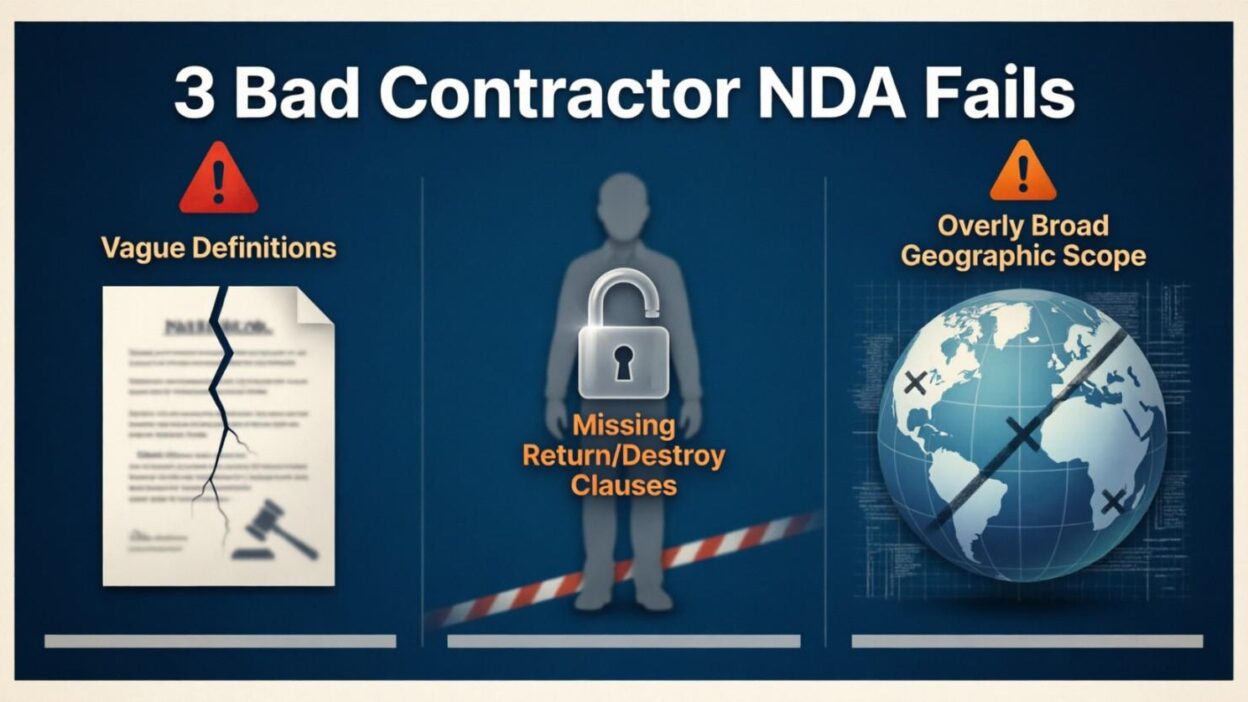
So let’s slow things down and unpack this together. In this guide, we’ll break down the three biggest legal landmines that often hide in plain sight inside a contractor non disclosure agreement and how you can push back to protect your livelihood without scaring away a good client.
Table of Contents
Fail #1: Agreeing to a Broad Contractor Non Disclosure Agreement: Definition of “Confidential”
The single most common and arguably most damaging problem in a contractor non disclosure agreement is an overly broad definition of what counts as “confidential information.”
Here’s how it usually happens: a client grabs a generic template off the internet, or their legal team drafts something so sweeping it tries to cover every possible scenario. On paper, it looks thorough and “protective.” In reality, it often goes way too far. Instead of focusing on genuine secrets like proprietary processes, private financials, or unreleased product details it ends up labelling everyday information as confidential too.
In other words, you’re not just agreeing to protect their real trade secrets. You’re potentially agreeing to stay silent about things that were never truly confidential in the first place.

The “Everything Under the Sun” Clause
I once reviewed a contract for a fellow freelancer where the confidentiality clause literally read: “Any and all information, whether written, oral, or observed, shared during the course of the relationship shall be deemed strictly confidential.”
Let’s pause on that for a second. Observed information? So if the client casually comments on the weather in London during a Zoom call, is that suddenly a corporate secret?
It sounds absurd, but the legal consequences can be very real. When a contractor non disclosure agreement is written this broadly, you’re not just promising to protect genuine trade secrets you’re potentially agreeing to stay silent about almost anything you see, hear, or learn while working with that client.
A fair and balanced contractor non disclosure agreement should do the opposite of this. It should clearly spell out what actually needs protection. Are they concerned about unreleased software code? Upcoming Q4 financial projections? A proprietary customer email list? Those are valid, sensitive assets.
But here’s what should not be swept into the “confidential” bucket:
- General industry knowledge
- Skills and expertise you already had before you took the job
- Information that’s already publicly available
No client should be able to gag you from using your own skills, sharing general best practices, or talking about things anyone could Google.
That’s why every single contractor non disclosure agreement should explicitly exclude information that is already in the public domain (or that becomes public through no fault of yours). If that carve‑out is missing, you’re not just signing a contract you’re walking straight into a legal trap.
How a Broad NDA Kills Your Freelance Portfolio
For creative and technical freelancers writers, developers, designers, SEO specialists your portfolio isn’t just a nice to have. It’s your lifeblood. It’s the concrete, visual proof that you can actually do what you say you can do.
But when you sign a sweeping contractor non disclosure agreement, you may be agreeing to something you didn’t intend: to ghost‑write or ghost‑create your own career. If everything is confidential, how are you supposed to show future clients what you’ve built?
Take a real example. A talented UK based web developer I know spent eight months building a complex, high performing e‑commerce platform for a US client. It was the best work of her career beautiful, fast, technically impressive. But because she’d signed a blanket NDA without pushing back, her hands were tied. She couldn’t share screenshots. She couldn’t link to the live site. She couldn’t even mention the client’s name on her CV.
On paper, it looked like she had an eight‑month gap in her work history. In reality, she’d just done the most demanding project of her life with absolutely nothing she could show for it.
The fix: Before you sign your next contractor non disclosure agreement, ask for a simple “Portfolio Exception.” It can be as straightforward as adding a line like:
“Notwithstanding the above, Contractor retains the right to display final, publicly released deliverables in their professional portfolio and marketing materials.”
This tiny tweak can make the difference between a dead end project and a career defining case study.
And if you want to dive deeper into what’s fair in freelance contracts and how to protect your creative assets, the Freelancers Union has some excellent, plain language resources worth bookmarking.
Fail #2: Letting a Contractor Non Disclosure Agreement Lock You In Forever
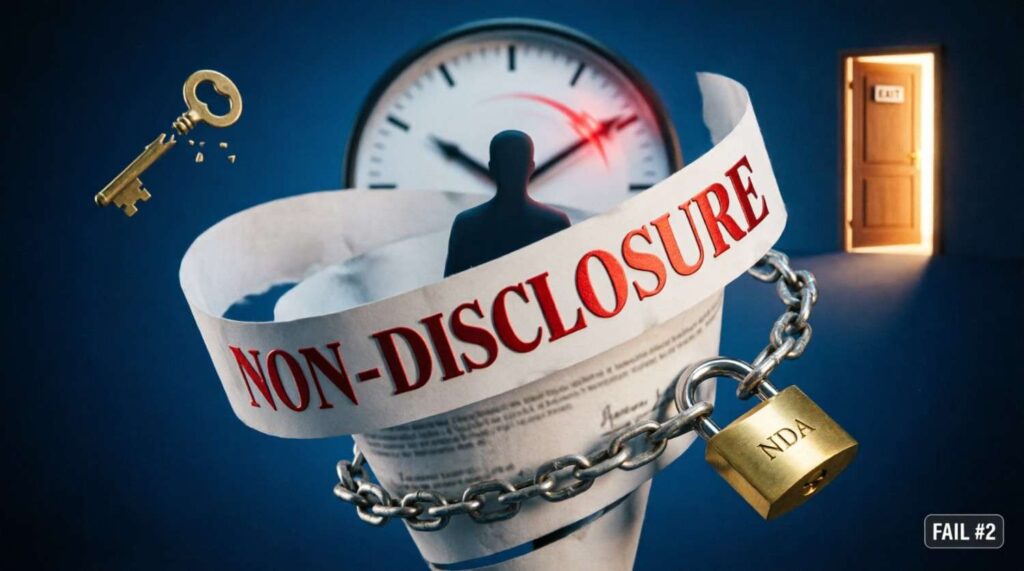
If you actually slow down and read the fine print, you might be shocked by how long some clients expect you to stay silent. Buried in that legalese is the “duration” or “term” of the agreement and for a lot of independent contractors, this is where things quietly go off the rails.
In other words, you’re not just agreeing to keep a secret for the project. In some cases, you’re being asked to keep quiet for years…or even indefinitely.
Why Perpetual NDAs Are a Massive Red Flag
Have you ever seen a contract that says the confidentiality obligations survive “in perpetuity”? In plain English, that means forever.
Now, unless you’re being brought in to guard the formula for Coca Cola, the algorithm behind Google Search, or state level classified intel, there’s almost never a good reason for a contractor non disclosure agreement to last for the rest of your life.
Think about how fast things move in our world especially in digital marketing, tech, and design. A marketing strategy that feels cutting edge today will be outdated in five years. A website that looks stunning right now will feel old in three. Expecting you to keep a standard business strategy secret for eternity isn’t just unrealistic it creates a permanent cloud of legal risk that follows you throughout your career.
In fact, truly indefinite contractor non disclosure agreements are rarely enforceable in many places. Courts generally don’t like contracts that lock someone into restrictions that never end, especially when it limits their ability to earn a living.
But here’s the catch: you don’t want to be the one paying a lawyer to go into court and argue all of that on your behalf. It’s far better to catch the problem early and push for a reasonable time limit before you sign.
Setting Fair and Realistic Expiration Dates
You need clear boundaries. The length of your confidentiality obligations should actually reflect how long the information is valuable not stretch on forever just because a template says so.
For most everyday freelance projects writing blog posts, optimizing SEO, creating logos, building standard business apps a reasonable window is usually 1 to 3 years. After that, the content, strategy, or design has typically evolved, been updated, or simply stopped being sensitive.
So when you’re reviewing a contractor non disclosure agreement, make a beeline for the “Term” or “Duration” section. If you see words like “perpetual,” “in perpetuity,” or there’s no end date at all, that’s your cue to speak up.
Here’s a simple, professional way to push back:
“Hi [Client Name],
I noticed the NDA doesn’t include an expiration date for the confidentiality obligations. In my standard practice, I keep project details confidential for 24 months. I’ve updated the document to reflect a two year term. Please let me know if that works for you.”
Most reasonable clients won’t have an issue with this many just haven’t thought about it and relied on whatever their template said.
If you want to understand why some information (like true trade secrets) can justify longer protection, the World Intellectual Property Organization (WIPO) has helpful resources explaining the difference between everyday confidential information and genuine trade secrets that may legitimately warrant longer or even perpetual confidentiality.
Fail #3: Ignoring the Jurisdiction of Your Contractor Non Disclosure Agreement
This one might feel like the most intimidating legal detail in the whole document which is exactly why so many freelancers just skim past it. But if you work with clients in other countries (which is incredibly common for freelancers in the US and the UK), skipping over the “Governing Law” or “Jurisdiction” clause is a serious roll of the dice.
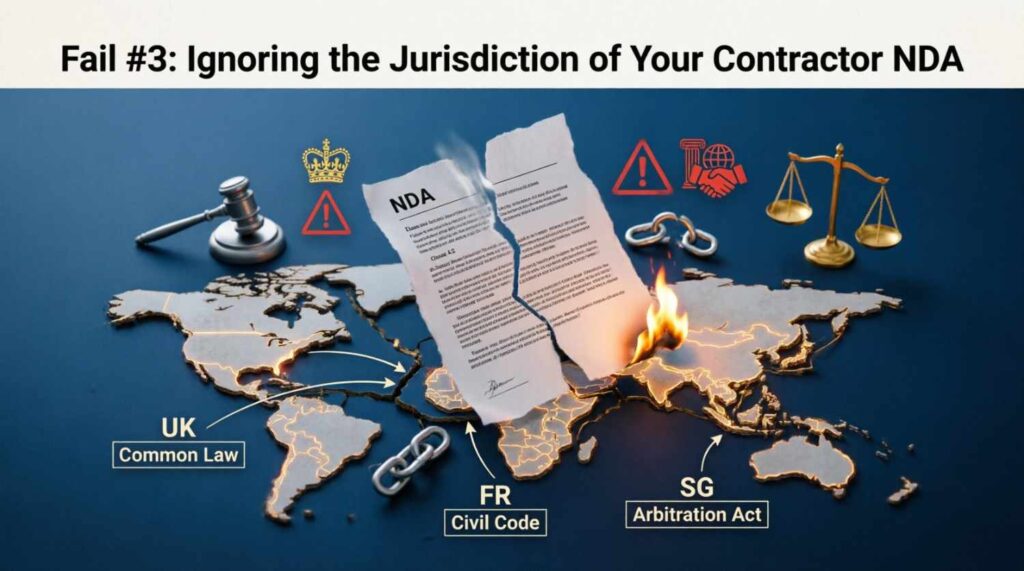
The Cross Border Trap: US vs. UK Laws
Imagine you’re a freelance SEO consultant based in London. You land a fantastic contract with a tech startup in San Francisco, California. The rate is great, the work is exciting, and they send over their standard paperwork.
Right at the bottom, in tiny size‑9 font, there’s a line that says:
“This Agreement shall be governed by the laws of the State of California. Any disputes arising from this Agreement shall be resolved exclusively in the state or federal courts located in San Francisco County.”
If you sign that, you’ve just agreed that any legal fight will happen on their turf. So if there’s ever a dispute over the contractor non disclosure agreement, the client can drag you into a legal battle in California.
As a UK resident, are you really prepared to:
- Hire a California‑licensed lawyer
- Pay legal fees in US dollars
- Potentially fly across the Atlantic for a court date over a disagreement about a “confidential” email?
Of course not. The cost of simply defending yourself could wipe out years of income for most freelancers before the case even gets off the ground.
So if you’re a UK freelancer signing a US contractor non disclosure agreement (or the other way around), you cannot ignore this.
The fix: Whenever possible, negotiate the jurisdiction so it’s based in your home country or state. If the client pushes back, suggest a compromise: a neutral third‑country jurisdiction or, even better, mandatory online arbitration or mediation. That way, if something does go wrong, you’re not forced into an expensive, cross‑border courtroom battle.
If you want to dig deeper into how cross‑border contracts work for small businesses and freelancers, resources like the Gov.uk business portal offer accessible guides on international contract law and dispute resolution.
Outrageous Financial Penalties (Liquidated Damages)
Alongside those sneaky jurisdiction clauses, there’s another big red flag you need to watch for: “Liquidated Damages.”
In plain English, this is a clause where you and the client agree in advance on exactly how much money you’ll owe if you ever breach the contractor non disclosure agreement.
On paper, that might sound neat and tidy. In reality, the numbers can be wild. I’ve seen contracts for a $2,000 web design project that included a liquidated damages clause demanding $50,000 if the freelancer ever leaked confidential information. That’s not protection that’s a scare tactic.
Under common law (which underpins both US and UK legal systems), these kinds of penalty style clauses are often unenforceable if they’re clearly meant to punish you rather than reflect real, provable financial loss. But remember: you do not want to be the person paying a lawyer to fight that battle in court.
So here’s the practical move: if you spot a specific dollar amount tied to a breach of confidentiality, cross it out and push back. The client’s remedy should be limited to their actual, demonstrable damages not some dramatic, arbitrary number designed to keep you up at night.
Conclusion.
As freelancers, we pour so much of ourselves into our work whether that’s optimising SEO content, designing digital products, or building complex web apps from scratch. But all that effort can be quietly undermined if we don’t give our contracts even a fraction of the attention we give our craft.
Understanding how a contractor non disclosure agreement really works isn’t some niche skill only corporate lawyers need. It’s a basic survival skill for anyone who works independently.
To protect your business and your peace of mind, keep these three red flags front and centre every time you’re about to sign:
- Refuse the “Everything is a Secret” Trap: Don’t accept bloated definitions of “confidential information” that stop you from building a strong, visible portfolio.
- Reject Perpetual Timelines: Standard freelance work doesn’t require a lifelong vow of silence. Aim for reasonable, industry‑standard expiry dates usually somewhere between 1 and 3 years.
- Fight Unfair Jurisdictions and Penalties: Don’t give clients automatic home court advantage or agree to eye‑watering, arbitrary financial penalties. Push back on foreign courts and outrageous “liquidated damages” clauses.
Your signature is one of the most powerful business tools you have—protect it fiercely. Saying no to a flawed contractor non disclosure agreement doesn’t make you “difficult.” It signals that you’re a serious professional who understands the value of a fair, balanced working relationship.
Frequently Asked Questions.
Q1: Is there ever a scenario where signing a perpetual (forever) NDA actually makes sense?
A: Yes but it’s extremely rare in the context of standard freelance work.
If you look at the basics of contract law, you’ll see that true “trade secrets” really are in a different category. Things like:
- The recipe for a famous soft drink
- A genuinely proprietary piece of source code
- A unique, unpatented manufacturing process
Those kinds of assets can stay valuable and vulnerable for a very long time. That’s why perpetual protection can sometimes make sense there.
But if you’re:
- Writing blog posts
- Designing standard graphics
- Creating routine marketing strategies
…the competitive value of that work naturally fades. After a few years, the market has moved on, the campaigns have changed, and that information simply isn’t sensitive in the same way anymore.
So when you’re looking at a contractor non disclosure agreement, make a mental distinction: Is this truly a trade secret, or just ordinary business information? Real trade secrets may justify long term protection. Everyday client work usually doesn’t.
Q2: I work as a remote freelancer with clients all over the world. If an NDA lists a foreign jurisdiction, is that an immediate dealbreaker?
A: Not necessarily but it is a big red flag that you shouldn’t ignore.
If you walk away the moment you see a foreign jurisdiction, you might miss out on a great client who just copied a default legal template without thinking it through. So don’t sprint for the exit right away start with a conversation.
Push back calmly and clearly. You can say something like:
“As a remote contractor, it’s not realistic for me to deal with court cases in another country. International litigation just isn’t feasible for my business. Would you be open to using mandatory online arbitration or mediation instead?”
A reasonable client will understand that you’re not trying to be difficult you’re just trying to avoid a situation where defending yourself would be impossibly expensive.
If they flat out refuse to budge and insist on keeping all the home‑court advantage anyway, that’s a sign. At that point, it may be worth asking yourself whether this is really a relationship you want to invest in.
Q3: The article mentions predatory “liquidated damages” (huge financial penalties). Do clients actually try to enforce these against individual freelancers?
A: In most cases, those eye‑watering numbers are there to scare you, not to serve as a realistic legal remedy.
Courts generally don’t like contract clauses that are clearly designed to punish rather than reflect real, provable financial loss, and they often strike them down. But here’s the problem: even if a $50,000 “penalty” would never hold up in court, just seeing that number with your name attached to it is enough to cause serious anxiety.
That’s why it’s much smarter to challenge those clauses before you sign. If you spot an arbitrary, sky high dollar amount tied to a breach of confidentiality, cross it out and push back. Don’t rely on the hope that a judge might save you later protect yourself upfront instead.
Q4: Confession time: I’ve already signed a terrible contractor non disclosure agreement in the past before I knew any better. Am I completely stuck?
A: Take a deep breath you’re definitely not the only one who’s signed something you regret. We’ve all been there.
Remember, contracts aren’t carved in stone. They’re agreements between two people (or businesses), which means they can also be updated if both sides are willing.
If you have a good relationship with the client, you can reach out and say something like:
“I’ve been revisiting some of my older contracts and noticed that our NDA is missing a few standard protections (like an expiration date). Would you be open to signing a short amendment so it better reflects common industry practice?”
A simple amendment can tweak specific terms like adding a time limit to confidentiality without ripping up the whole agreement.
If the project is long finished and the client isn’t responding, try not to panic. At that point, the best thing you can do is treat it as a powerful (and very common) learning experience. Use what you’ve learned to negotiate more confidently and carefully on your next contract.
If you’re looking for more real world insights and practical tips to level up your freelancing journey, make sure to check out our website. We regularly share simple, actionable content to help you land better clients, protect your time, and confidently grow your freelance career.
Now Your Next Step
Now I’d love to hear from you: What’s the most ridiculous or over the top clause you’ve ever seen in a contractor non disclosure agreement, and how did you handle it? Share your stories and negotiation wins in the comments your experience might be exactly what another freelancer needs to see before they sign their next contract.