

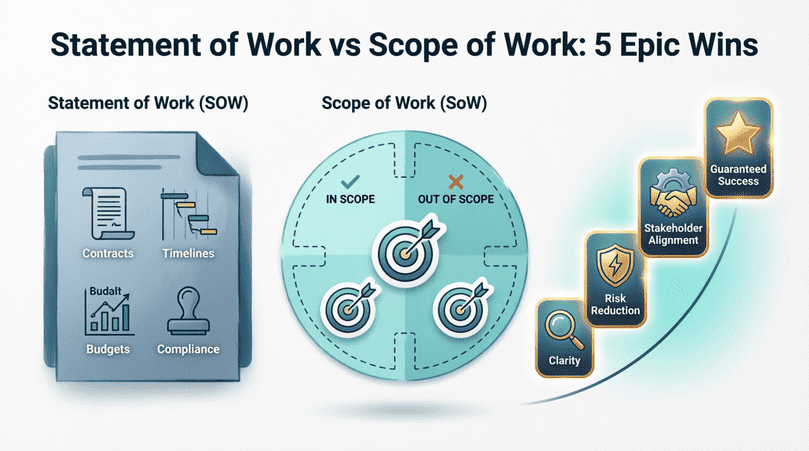
Have you ever noticed how truly understanding the Statement of Work vs Scope of Work can be the difference between feeling like an overworked gig worker and operating like a well paid freelance CEO?
Let me share a quick story.
I’m an SEO content writer juggling tight client deadlines with the heavy reading load of a 4 year LLB program so my time is my most guarded asset. But early in my career I didn’t treat it that way. I had just landed what felt like a dream project writing a batch of optimized articles for a new client. We agreed on a flat rate over a casual email thread and I jumped straight into the work.
Then the “quick favors” started trickling in.
“Could you just upload these directly to the CMS?”
“Actually can you source some custom images for each post?”
“We need just one more round of heavy edits!”
Before I knew it that seemingly profitable writing gig had turned into an exhausting time consuming nightmare. I was putting in almost double the hours for the exact same paycheck all because I didn’t want to seem “difficult” by pushing back.
The issue wasn’t that the client was malicious it was that I had no real professional boundaries. I realized that if I wanted to not just survive but actually thrive in this industry I needed to connect the contract law principles I was studying in class with the way I ran my freelance business. I had to build a protective wall around my time and energy.
That’s when I finally sat down and learned how to properly use my paperwork. Spoiler: getting your documents right doesn’t just prevent headaches it can actively help you earn more. So let’s dive into the five epic wins waiting for you when you finally nail the boundaries between these two crucial documents.
Table of Contents
Unpacking the Jargon: Statement of Work vs Scope of Work
Before we can celebrate the wins we need to lay a solid foundation. I’m someone who genuinely enjoys the fine print and the legal mechanics of how businesses work and if there’s one thing I’ve learned it’s this: clarity is your best friend when you’re drafting agreements. Any kind of vagueness or ambiguity usually ends up helping the client not the freelancer.
To make it easier to picture think of your client relationship like a brand new house you’re building together.
The Statement of Work (The “How” and “When”)
The Statement of Work (SOW) is the big picture blueprint for the entire “house” you and your client are building together. It’s the comprehensive formal document that governs how your working relationship functions from start to finish. In simple terms it lays out the rules of how you’ll do business together.
A strong SOW usually covers things like:
- Terms and Conditions: The basic legal ground rules of your relationship.
- Payment Terms: How and when you get paid (Net 30? A 50% deposit upfront? Late fees if invoices aren’t paid on time?).
- Governance: Who your main point of contact is and how any disputes will be handled.
- Confidentiality: NDAs and intellectual property rights like who owns the copyright once the content is delivered.
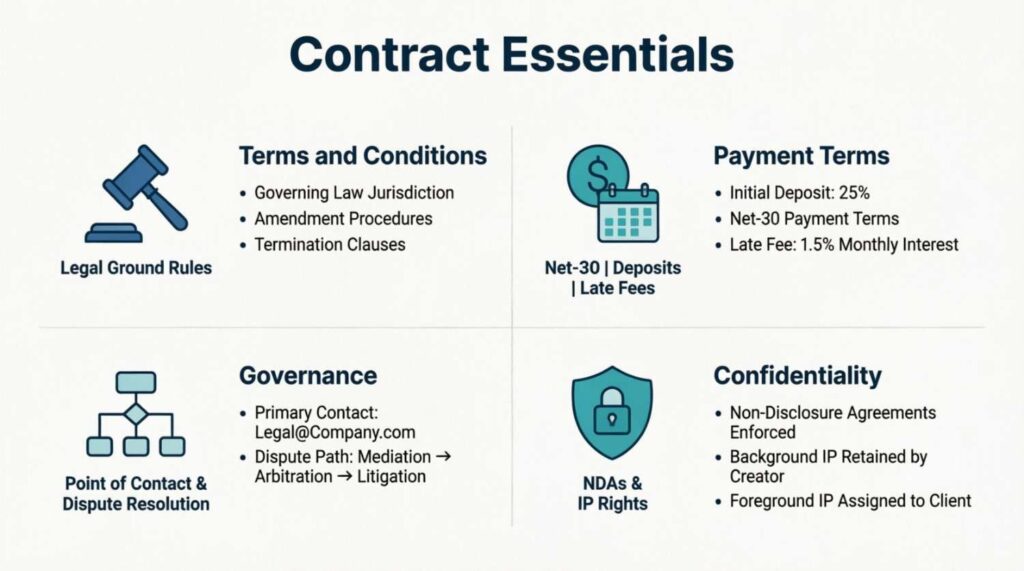
The SOW is intentionally broad. You typically sign it once at the start of a new client relationship and it should cover all the future projects you might do together. If you want some solid starting points for these kinds of terms, organizations like the Freelancers Union have excellent contract templates you can adapt.
The Scope of Work (The “What” and “What Not”)
If the SOW is the blueprint for the whole house the Scope of Work is the step by step guide for renovating the kitchen.
The Scope of Work is a super specific zoomed in section (often attached as an appendix to the main SOW) that spells out the exact details of the project you’re working on right now.
A watertight Scope of Work usually includes:
- Deliverables: Exactly what you’re handing over (for example “Four 1 000 word blog posts delivered in Google Docs”).
- Timeline and Milestones: Clear dates for first drafts client feedback and final delivery.
- Revisions: How many rounds of edits are included (for example “Includes one round of minor revisions; additional revisions billed at $50/hour”).
- Exclusions: This part is absolutely crucial. You spell out what you won’t be doing (for example “Does not include graphic design CMS uploading or keyword research”).
When you master the statement of work vs scope of work dynamic you stop operating like a gig worker scrambling to meet every last minute request and you start showing up like an agency CEO. Now let’s break down the five epic wins this brings to your freelance life.
The 5 Epic Wins of Mastering Both Documents
Getting your paperwork in order might not sound exciting, but the payoff definitely is. Here’s what starts to happen when you put these documents to work the right way.
Win #1: Banishing “Scope Creep” Once and For All
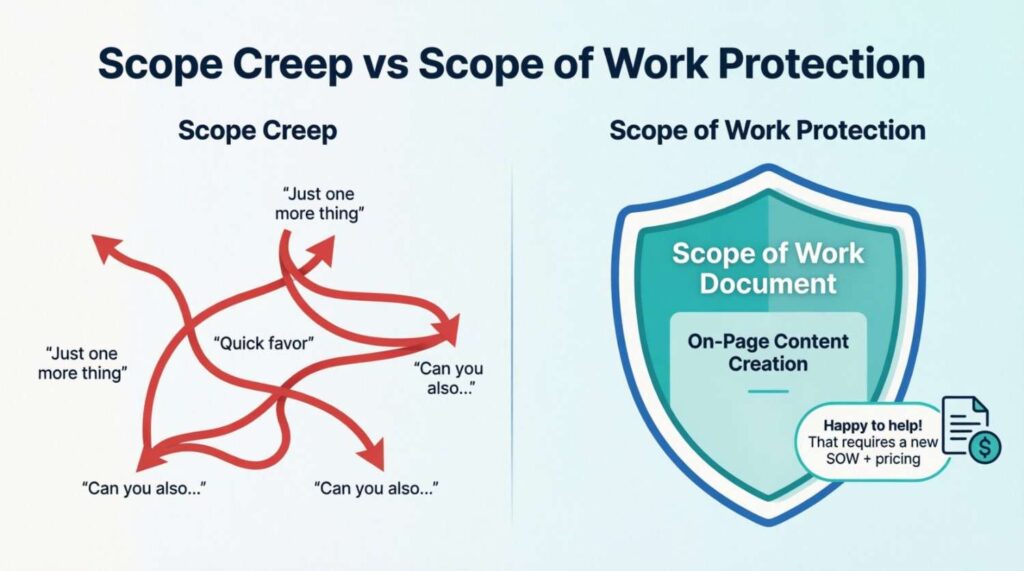
We’ve all been hit by scope creep at some point. It’s rarely intentional. Most clients genuinely don’t understand how much work goes into what you do, so they keep asking for “little favors” that quietly snowball into hours of unpaid work.
When you’ve nailed down a clear, specific Scope of Work, you’ve got something powerful on your side: an objective, emotionless document you can calmly point back to.
Real World Example: I once had a client who, halfway through an SEO writing project, asked me to “just quickly run a full technical SEO audit on the site.” Because my Scope of Work clearly said my deliverables were limited to on page content creation and that technical audits were explicitly excluded, the conversation was simple.
I didn’t have to over explain, apologize or feel guilty. I just replied:
“I’d be happy to handle a technical audit for you! As per our Scope of Work, that falls outside the current project parameters. I can draft up a new Scope for that audit and send over the pricing. Shall I go ahead?”
Nine times out of ten, the client will either happily pay more or quietly drop the request. Either way, you win. Your Scope of Work becomes a professional boundary that protects both your hourly rate and your sanity.
Win #2: Securing Faster, Dispute Free Payments
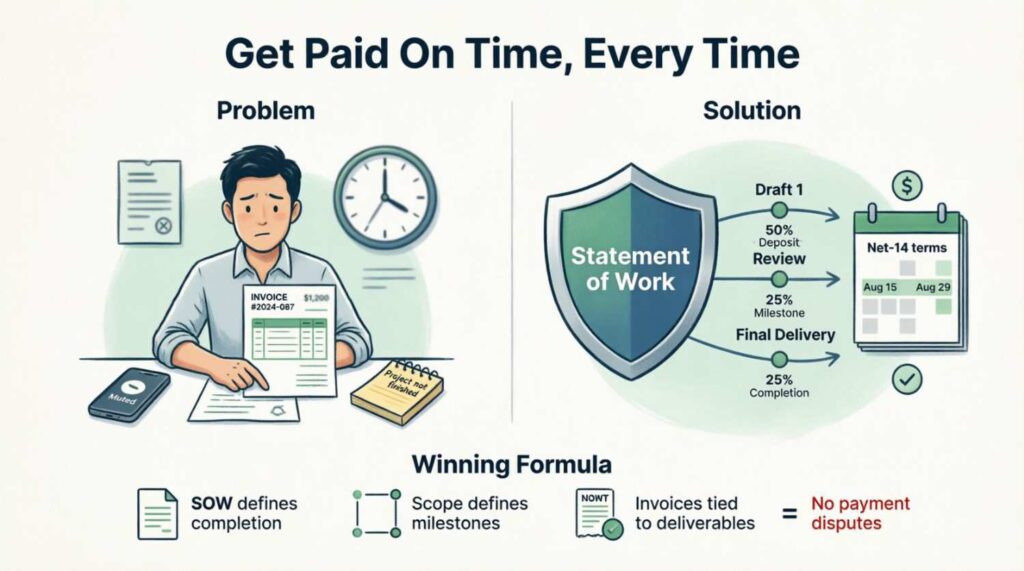
There’s almost nothing more frustrating than delivering a great piece of work, sending your invoice and then… silence. Even worse is when a client pushes back and says they shouldn’t have to pay yet because “the project isn’t really finished.”
This is where your Statement of Work really flexes its muscles. When you clearly define what “completion” means and lock in firm payment terms in your SOW, you remove the gray area that difficult clients use to stall or dodge payments.
Freelancer Action Step: Always connect your invoices to specific milestones in your Scope of Work, backed by the rules in your Statement of Work. For example, if your SOW says invoices are due within 14 days of receipt and your Scope defines a milestone as “delivery of the first draft,” the client can’t ethically hold off on paying you while they take three weeks to send feedback.
Win #3: Setting Crystal Clear Client Boundaries
The emotional strain of freelancing is so often rooted in one thing: weak or missing boundaries. It looks like clients pinging you on WhatsApp at 9:00 PM on a Saturday or expecting you to jump on a “quick” 45‑minute strategy call you’re not getting paid for.
When you use these documents properly, you set the tone of the relationship from day one. You’re essentially training your client on how to treat you.
Inside your Statement of Work, you can add a simple “Communications Protocol” clause that spells out exactly how and when you’re available.
Example:
“All project communications will be handled via email or the designated project management tool. The Contractor is available for correspondence between 9 AM and 5 PM EST, Monday through Friday. Any required meetings must be scheduled 48 hours in advance.”
When you clearly document these boundaries alongside your specific project deliverables, you create a respectful, professional working environment one where your time, energy, and personal life are actually protected.

Win #4: Elevating Your Professional Brand
Imagine you’re a client looking to hire an expert.
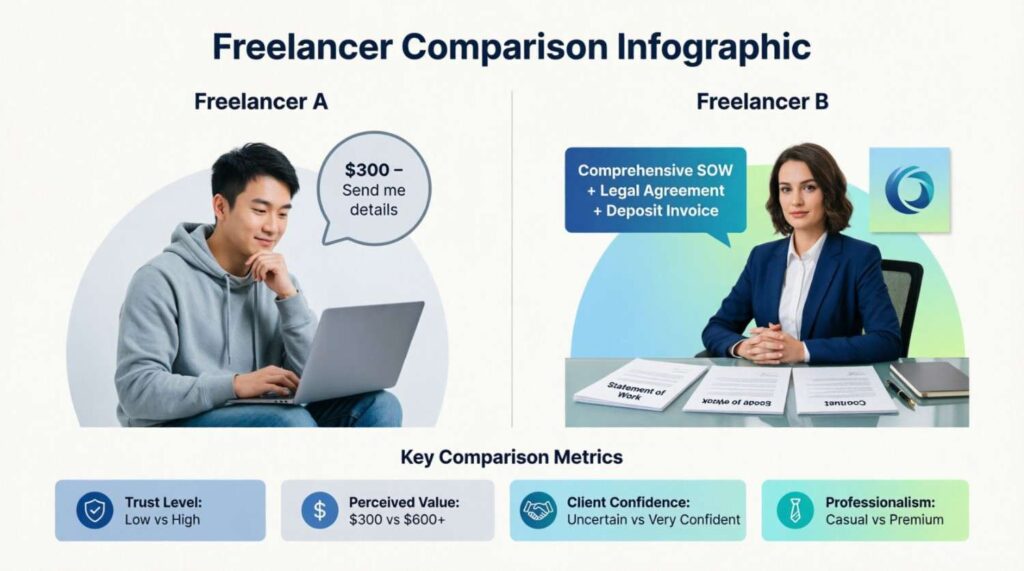
Freelancer A says, “Sounds good, my rate is $300. Send me the details and I’ll get started.”
Freelancer B says, “Excellent. I’ll put together a comprehensive Statement of Work that outlines our legal agreement, along with a detailed Scope of Work for this specific project. Once you’ve reviewed and signed, I’ll send over the deposit invoice and we’ll officially kick things off.”
Which freelancer are you going to trust more? Which one could realistically charge double and still feel worth it?
Freelancer B wins every time.
When you use proper documentation, you instantly upgrade how clients see you. You stop coming across like a casual freelancer and start showing up as a premium service provider. Clients especially established businesses in places like the US and UK are used to formal B2B (business to business) processes. When you hand them clear, well organized contracts, they feel safer, more confident and far more willing to invest in working with you.
Win #5: Scaling Fast with Reusable Templates
One of the biggest myths about creating solid contracts is that they take forever. When you’re hustling for gigs, you want to start working and earning now not spend three hours wrestling with legal language.
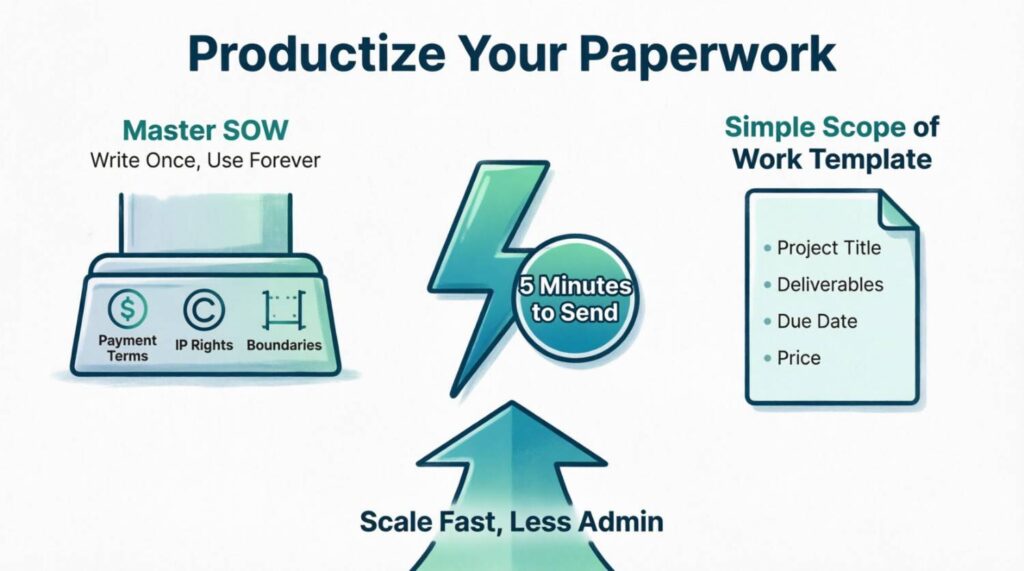
But here’s the final epic win: once you understand the structure you can actually productize your paperwork.
You only need to write your Master Statement of Work once. Put your best energy into crafting a rock solid, airtight document that covers all your standard payment terms, IP rights, and boundaries. Then save it as a PDF or upload it to your favorite e‑signature tool.
After that, all you need is a simple, customizable one‑page Scope of Work template. Since the heavy legal lifting lives in your master SOW your Scope just becomes a quick checklist for the current project:
- Project Title
- Deliverable Description
- Due Date
- Price
So when a new client says “yes” you can send the paperwork in under five minutes. That’s how you scale your freelance business fast without drowning in admin every time you land a new gig.
Putting It Into Practice: How to Combine Them
Now that you understand the statement of work vs scope of work debate, the real question is: how do you actually use these documents in your day‑to‑day freelance life?
The simplest and most efficient approach is to treat them as part of a clear hierarchy. In the corporate world, this is often done with a Master Services Agreement (MSA), which basically works the same way as a broad, overarching Statement of Work.
Where Should the Scope Live?
For freelancers, the easiest way to handle this is to bundle everything into one simple package so you’re not overwhelming the client.
Start by creating a single PDF. The first 3 to 4 pages should be your overarching Statement of Work the terms, conditions and legal fine print. Then, at the very end add a section labeled “Appendix A: Initial Scope of Work.”
This way, the client signs just one document that covers both your general rules and the details of the first project.
When that first project is wrapped up and the client comes back three months later wanting more blog posts, you don’t have to start from scratch or send a brand‑new Statement of Work. You simply create Appendix B: Scope of Work, send it over for signature and get to work. It makes onboarding repeat projects feel smooth and effortless for both you and the client.
If you want a streamlined way to manage all of this, tools like DocuSign or PandaDoc make it easy to combine documents, send them for e‑signature, and keep everything stored safely in one place.
Conclusion: Guard Your Time, Grow Your Income
Mastering the statement of work vs scope of work dynamic is about so much more than just crossing your t’s and dotting your i’s. As we’ve seen, getting these documents right is the secret weapon behind banishing scope creep, getting paid faster, setting rock solid boundaries, elevating your professional brand, and scaling your business without burning out.
Balancing a content writing career with the heavy reading load of a 4 year LLB program has taught me one huge lesson: the legal framework around your business is just as important as the actual work you deliver. You don’t need to be a law student to protect yourself but you do need clarity. When you separate the big picture rules of your working relationship (the Statement of Work) from the ultra specific project details (the Scope of Work), you shift from being a reactive freelancer to a proactive business owner.
The final takeaway: stop thinking of contracts as an annoying hurdle you have to jump over to get hired. Start treating your paperwork like your most loyal, non negotiable teammate one that works 24/7 to protect your time, energy, and bank balance.
Frequently Asked Questions
1. How did you get over the fear of scaring away clients with formal contracts?
It definitely didn’t happen overnight. When I first started freelancing, I was genuinely afraid that sending a multi page contract would make me look “high maintenance” or too difficult to work with. I just wanted clients to say yes, so I tried to keep everything casual.
But juggling a 4 year LLB program alongside my content writing work completely changed how I saw things. I realized that clear legal terms aren’t aggressive or unfriendly they’re actually the foundation of mutual respect. The clients who get “scared off” by a standard Statement of Work are usually the same ones who were planning to push your boundaries and take advantage of your time.
Now I see contracts as a filter, not a barrier: the right clients appreciate them.
Let’s chat in the comments: What was your biggest fear when you first started sending formal contracts?
2. In your story about the client asking for a technical SEO audit, did they actually end up paying for the extra work?
Yes, they did and it was a huge “aha” moment for me.
Because my Scope of Work clearly stated that technical SEO was excluded from my on page writing deliverables, the conversation stayed calm and straightforward. There was no awkwardness, no guilt and no need to over explain. The client understood the extra value of a full technical audit, agreed to the new scope and I got paid properly for the additional hours.
Have you ever had a client happily agree to an upcharge after you pointed back to your Scope of Work? I’d love to hear your wins in the comments.
3. What do you do if a client pushes back and refuses to sign the overarching Statement of Work?
Honestly, I see it as a huge red flag. If a client isn’t willing to agree to basic, industry‑standard terms around payment, confidentiality, and ownership, it almost always spells trouble later on.
Walking away from money is never easy especially when you’re in growth mode and hungry for projects but protecting your peace of mind is worth far more than a stressful contract.
I’m curious: what’s your personal red flag? What makes you decide to walk away from a potential freelance project?
4. How do you handle the emotional guilt of saying “no” to small, quick client favors?
This is incredibly common in the freelance world. We’re service providers, so our default setting is to be helpful and it can feel really uncomfortable to push back.
What helps me is reframing the situation. I’m not actually saying “no” to the client; I’m saying “yes” to the integrity of the project (and my own wellbeing). If I spend unpaid hours doing extra tasks, I have less time, energy, and focus for the work they’re actually paying me for.
It also helps to keep a little swipe file of polite, pre written email responses so you can decline out of scope requests without spiraling or overthinking every word.
How about you do you struggle with the people‑pleasing side of freelancing, or are you naturally pretty good at setting boundaries?
5. How often do you find yourself updating your Master Statement of Work?
It’s absolutely a living document. Every time I run into a new, unexpected situation with a client like a bizarre delay in feedback or a totally new kind of revision request I make a note of it. Once or twice a year, I sit down with my master template and add a specific clause to protect myself from that exact scenario going forward. It’s an ongoing learning process, and my contract grows with my experience.
Freelancers, I’m curious: what’s one weird or super specific clause you’ve added to your contracts after a bad experience?
If you’re looking for more real world insights and practical tips to level up your freelancing journey, make sure to check out our website. We regularly share simple, actionable content to help you land better clients, protect your time, and confidently grow your freelance career.
Over to you now I’d love to hear from you. What’s the hardest lesson you’ve learned about freelance agreements, or the biggest thing you’re still struggling with when it comes to locking down a project’s scope? Share your thoughts and stories in the comments below!