

How long should freelance contract be? I wish someone had handed me a real answer to that question before I sent my very first one to a client. That contract was one paragraph. I am not joking even slightly.
It said, roughly: I will design your website, you pay me $800, we call it done. My friend who had been freelancing for several years took one look at it and laughed. Not in a cruel way. More like watching someone stroll directly into a situation you could see coming from across the room, completely unaware.
Two months in, that client wanted 14 rounds of revisions. Went silent for three weeks. Came back with a completely different creative vision for the project. And eventually paid me $400 less than the agreed rate, because the final product did not match what he had imagined. That one paragraph contract protected me in exactly zero ways. I had nothing to point to, nothing to enforce, nothing that helped.
Two things came out of that experience. A proper freelance contract matters far more than most new freelancers give it credit for. And the length of your contract has almost nothing to do with how many pages it runs. It has everything to do with whether it covers the specific situations that actually break a working relationship apart.
How Long Should Freelance Contract Be? The Smart Range for 2026
No universal number says a freelance contract must be exactly 3 pages or 10 pages or 500 words. The right freelance contract length is the one that is long enough to cover what can go wrong, and short enough that a client will actually read it before signing.
In 2026, most working freelance contracts and independent contractor agreements land somewhere between 1 and 5 pages depending on the project. Here is how that range breaks down in practice:
1 page: Works for small, simple, one-off projects with a clear deliverable and a client you already have history with. A quick logo refresh. A single 500 word blog post for a repeat client. The kind of project where the scope fits on an index card.
2 to 3 pages: The range where most working freelancers actually land. Covers the core sections without making a client feel like they are filing for incorporation before they hire someone to write a landing page.
4 to 5 pages: Appropriate for larger, more complex scopes. Website builds, ongoing retainer agreements, brand identity packages, anything involving multiple phases or significant dollar amounts.
6 pages and above: This is corporate territory. Agency level work, complex legal requirements, or ongoing arrangements with auto-renewal freelance contract terms built in. At this level, a legal review is genuinely worth the investment.
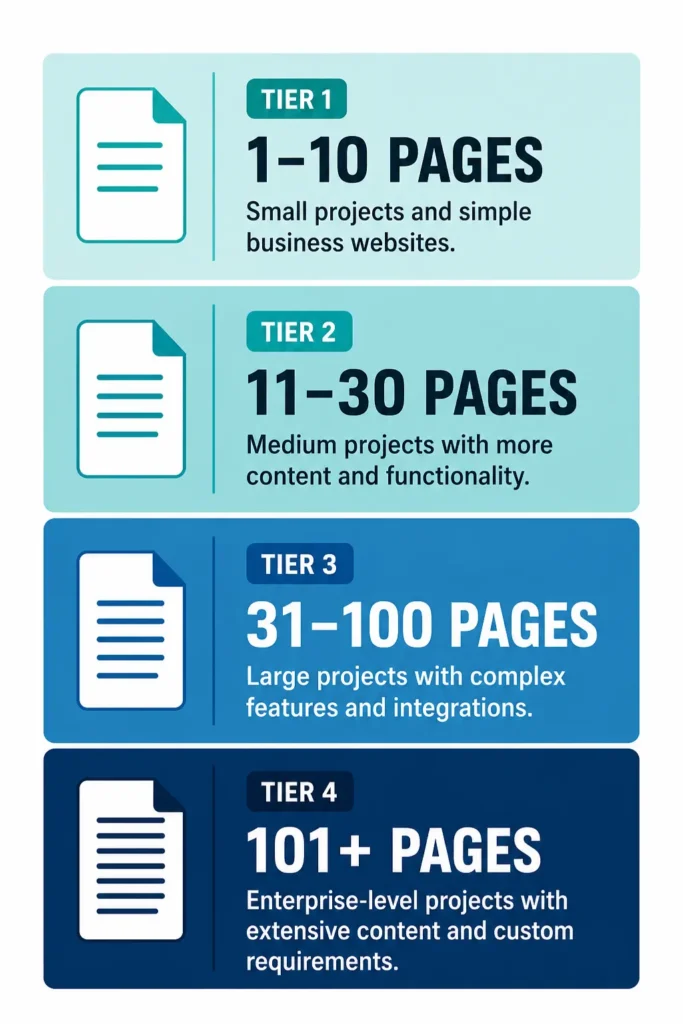
not to what looks most professional.
I run a 2 page base contract for most projects and add clauses as the work demands. Over 60 freelance projects in the past several years, that structure has held up every single time I actually needed it to.
How Many Pages Should Freelance Contract Be?
The page count question is one I get constantly, and I understand why. It feels like there should be a clean answer.
There is not. But there is a practical rule: the contract should match the risk. A $150 logo concept does not need the same document as a $12,000 website build with six phases, two rounds of stakeholder review, and a go-live date attached to a product launch.
What matters more than page count is clause count. A tight, well-written 2 page contract with clear scope, payment terms, a revision policy, and a termination clause will outperform a vague 6 page document every single time.
The Sections That Actually Matter
Most freelance contract guides hand you a list of 15 points and tell you to include every one regardless of the project. For a $200 writing assignment, half those clauses are unnecessary overhead. For a $15,000 development contract, the same list might leave out something that matters. The freelance contract clauses below are organized by what they actually protect you from, not by what looks impressive in a template.
Project Scope: The Most Important Section
If your contract has exactly one section, this is the one it needs to be.
The scope of work defines precisely what you are delivering. Not vaguely. Not “a website.” Specifically: how many pages, what functionality is included, whether copywriting is in scope, how many revision rounds are allowed, what file formats you will deliver, and what is explicitly not covered in the price.
Freelance scope creep, the gradual expansion of project requirements beyond what was originally agreed, is the single most consistent source of freelance disputes. And it almost always traces back to a scope section written too loosely. Someone finds a gray area in the language and pushes on it. Every time.
Write this section as if the person reading it will look for every possible way to stretch its meaning. Because occasionally, they will.
Here is the difference between a weak scope statement and a strong one:
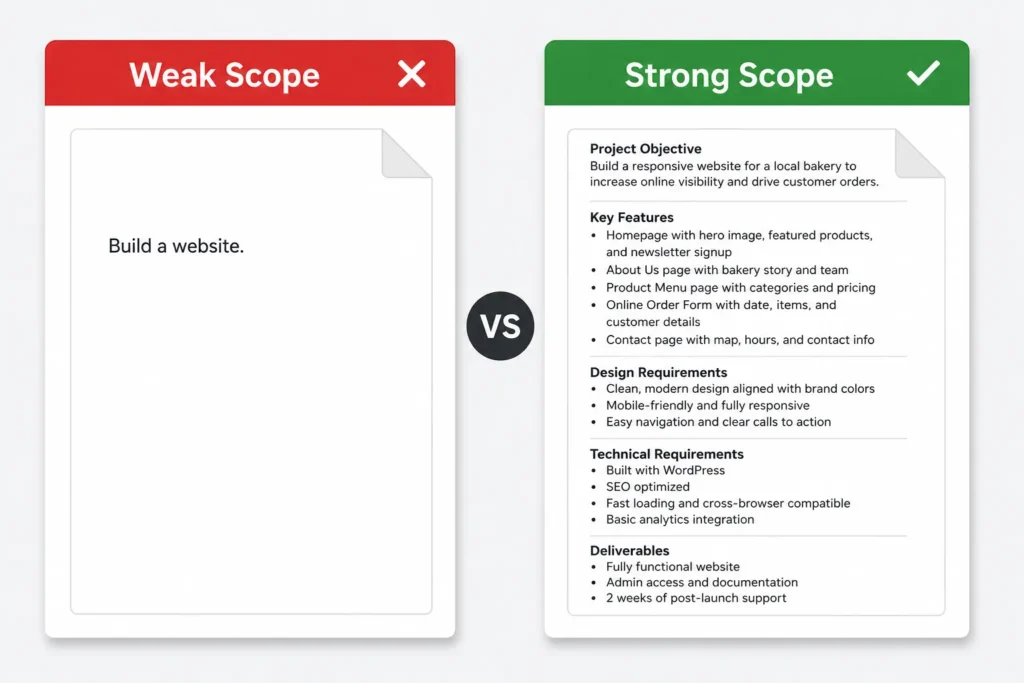
most freelance disputes begin.
Weak: “Freelancer will design a website for the client.”
Strong: “Freelancer will design a 5 page WordPress website including Home, About, Services, Blog, and Contact pages. Project includes 2 rounds of design revisions. Copywriting, SEO setup, and third party plugin costs are not included. Any additional pages will be quoted separately.”
That gap between those two statements is where most freelance disputes get started.
Payment Terms: Get Specific About Every Dollar
This section needs to cover three things without ambiguity: how much you are owed, when you get paid, and what happens if the client does not pay on time.
My payment structure for most projects looks like this:
A deposit upfront, usually 30 to 50 percent, before I start anything. A milestone-based contract payment midway through on larger projects, tied to a specific approved deliverable. And final payment before I hand over source files or push anything live.
That last point is the one that matters most. Nothing leaves my possession until the full invoice clears. That is a line I do not move on. I learned this after a client accepted a completed logo package and went completely silent. Since then, not a single final file has gone out before payment.
Your payment terms section should also cover:
Payment method, whether bank transfer, PayPal, Stripe, Wise, or another platform your client prefers. Invoice due date, Net 7, Net 14, or Net 30 depending on what you agree to. Late payment fees. I charge 5 percent per month on overdue invoices and have enforced that clause twice. Both times, payment arrived within 48 hours of the follow-up.
In 2026, clients expect digital invoicing as a baseline. Tools like Bonsai, HoneyBook, and Wave handle this automatically and create a paper trail that matters if a dispute ever escalates.
Revision Policy: Because Just One More Change Can Be Infinite
Define what a revision is. This is not optional.
A revision is a targeted, minor modification within the scope you both agreed on. A request for a completely new design direction, a different concept, or a color palette overhaul after the client already approved one: none of that is a revision. That is a new scope of work, and it gets quoted and billed as one.
My contract language for this reads:
“This project includes 2 rounds of revisions. A revision is defined as minor modifications to the approved design direction. Structural changes, new concepts, or scope additions will be quoted and billed separately.”
That clause has stopped more than a few runaway revision cycles before they started. Without it, “just one more small thing” becomes a full repaint of the project with no additional compensation. I have watched that exact situation play out with colleagues who left this section vague. It rarely ends without bad feelings on both sides.
Timeline and Deadlines: Both Yours and Theirs
Most freelance contracts only specify the freelancer’s delivery deadlines. That is one of the most common and costly oversights in a freelance agreement.
Client delays are a primary reason projects drag on months past their original completion date. If a client takes three weeks to provide feedback that was due in three days, that delay is not your fault. But without a timeline clause in your contract, it quietly becomes your problem when they return urgent and expecting everything done by the end of the week.
Your timeline section should include:
Your delivery schedule with specific milestone dates where the project warrants it. Client feedback deadlines, for example: “Client agrees to provide feedback within 5 business days of each submitted deliverable.” And a clause stating that delays caused by the client will extend the overall project timeline accordingly.
I have had clients go completely silent for a full month and come back expecting me to reprioritize everything immediately. The timeline clause let me explain clearly, without any awkwardness, that the original schedule had shifted and we would need to set new dates together. No argument. The contract did the uncomfortable part so I did not have to.
Ownership and Intellectual Property Rights
Who owns the work once the project wraps up?
This is one of the most consistently overlooked sections in freelance contracts, particularly for designers and writers. The legal default in most jurisdictions is: until a client pays you in full, you own the work. But relying on that assumption without spelling it out in the contract is a risk not worth taking.
Your intellectual property rights freelance clause should clearly state three things:
Ownership transfers to the client upon receipt of full payment. You retain the right to display the work in your portfolio unless both parties agree otherwise in writing. If a client requests a full IP waiver that includes portfolio rights, that is an additional cost, not a standard inclusion.
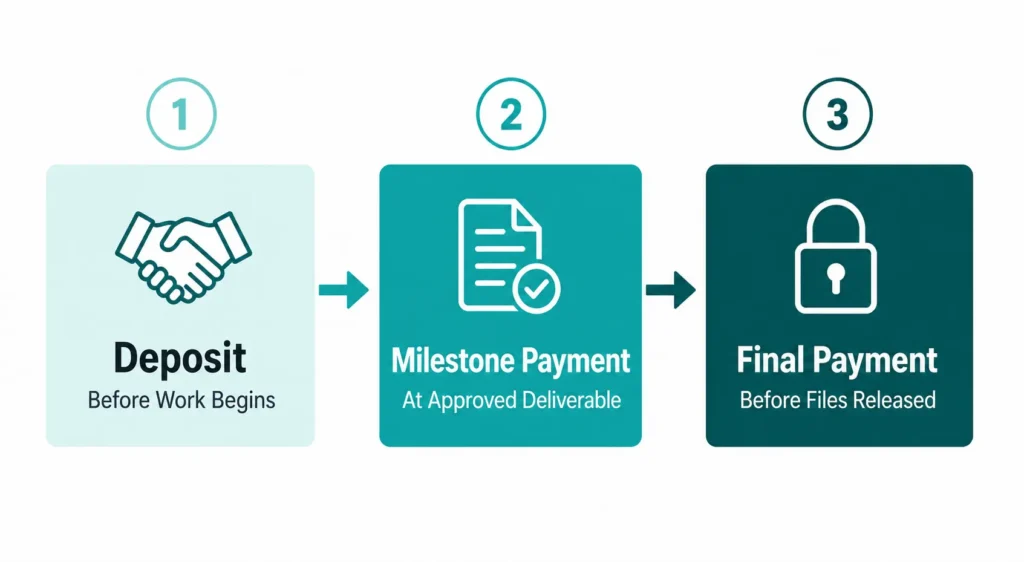
clears — this structure enforces that automatically.
That last point is worth emphasizing. Some corporate clients will ask you to sign away every right to the work, including any public display. That is a reasonable request to honor. But it should always come with a rate adjustment. You are giving up something of real professional value, and your pricing needs to reflect that.
Note: Intellectual property rules vary by country and by the specific type of work. In some jurisdictions, commissioned work may automatically transfer ownership to the client by default. If you regularly work with international clients, a one-time consultation with a contract attorney is worth the cost.
Termination Clause: What Happens When Things Go South
Projects get cancelled. Sometimes the client’s situation changes. Sometimes the working relationship stops functioning. Regardless of the reason, your contract needs to spell out what happens when a project ends before completion.
A reasonable termination clause covers three things:
Either party may end the contract period with 7 to 14 days written notice. The client pays for all work completed up to the termination date. The deposit is nonrefundable if the client ends the contract without cause.
The kill fee is worth mentioning separately. If a client cancels after you have already turned down other work to take their project, a kill fee, typically 25 to 50 percent of the remaining contract value, compensates you for that lost opportunity. I include this clause in every retainer agreement and every project valued above $2,000. In practice, having a kill fee clause in writing tends to make clients think considerably more carefully before walking away from a commitment casually.
Supporting Clauses Worth Adding
Two shorter additions that belong in most freelance contracts:
Confidentiality: If you are handling sensitive client information such as internal strategy documents, unreleased product details, or private business data, include a paragraph stating that both parties agree not to share confidential information with outside third parties. Freelance NDA length does not need to be extensive. One clear paragraph inside your main contract is sufficient for most standard situations. Standalone NDA documents become necessary only for unusually sensitive engagements.
Governing law: If a dispute ever arises, which country or state’s laws apply? Add one sentence: “This agreement shall be governed by the laws of [Your State or Country].” That is all it takes. One sentence that does a lot of quiet work, especially when you are working with clients across borders.
Freelance Contract Length by Industry and Project Type
Different industries carry different norms for contract length and structure. Here is a quick breakdown based on what I have seen across my own projects and those of freelancers I know:
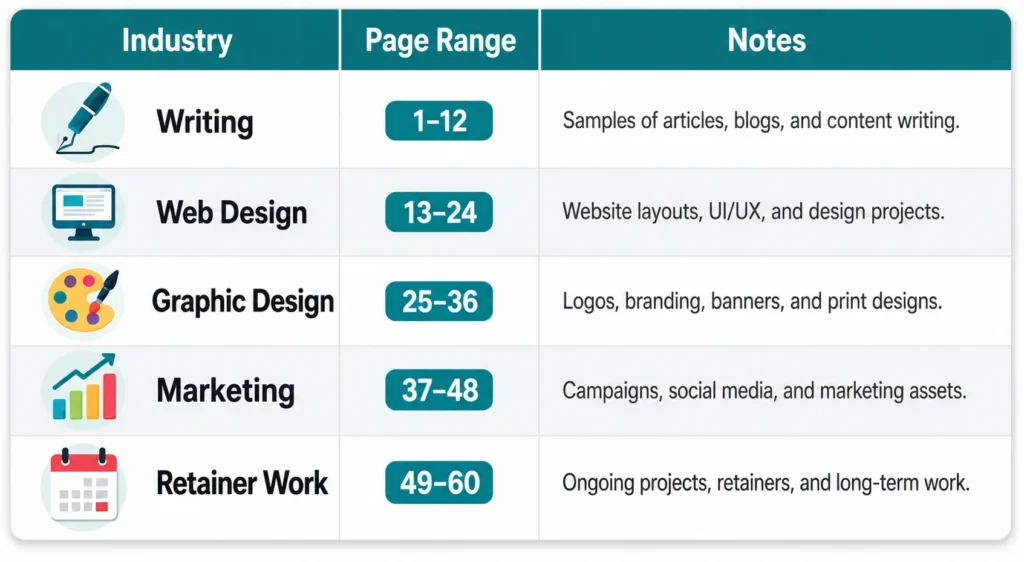
use this as your starting reference point.
Freelance writing contracts: Typically 1 to 2 pages for one-off articles or content packages. Retainer writing agreements covering ongoing monthly deliverables run 2 to 3 pages with clear monthly scope definitions.
Web design and development contracts: Usually 3 to 5 pages. These projects involve multiple phases, client approval gates, and significant technical scope, so the additional length is earned.
Graphic design contracts: 2 to 3 pages for brand identity or packaging projects. Shorter for single-asset jobs. The revision policy section is especially important here.
Consulting and marketing contracts: 3 to 5 pages, particularly if the engagement involves strategy, ongoing reporting, or access to confidential business information.
Freelance retainer contract length: For any ongoing retainer, 3 to 4 pages minimum. The contract needs to cover the monthly deliverable scope, renewal terms, the notice period for exiting, and what happens if either party needs to pause the arrangement.
Common Mistakes Freelancers Make With Contracts
These are the mistakes that actually cost people money, not the theoretical ones from legal guides.
No contract at all. Still common among new freelancers, especially for smaller projects. Small projects produce small problems too, and small problems are still worth protecting yourself from.
Copy-pasting a contract from the internet without reading it. I have seen freelancers use contracts with clauses written for an entirely different country’s legal system, with provisions that did not apply to their situation at all. A template is a starting point, not a finished product.
Making the contract too complex for the job. If a client feels like they are signing a legal treaty in exchange for a $200 blog post, they will either walk away or sign it with resentment. Keep the length proportionate to the scope and the dollar amount involved.
Not keeping a signed copy. Use the tools section below for the best options for collecting and storing signed contracts in 2026. An email reply saying “sounds good” is not a contract.
Never updating your contract template. Every unexpected situation on a project is free feedback. Ask yourself after each one: would my contract have protected me here? If the answer is no, that is your next clause.
Tools That Make Contract Management Way Easier
Emailing Word documents back and forth for signatures is a habit that should have ended years ago. In 2026, there is genuinely no reason to do it that way.
HoneyBook: An all-in-one platform built specifically for freelancers. Proposals, contracts, invoices, and client payments live under one roof. A strong choice if you want everything managed from a single dashboard.
Bonsai: Clean, profession-specific contract templates designed for designers, writers, developers, and marketers. Setup is fast and the output looks like something a seasoned professional would send without hesitation.
DocuSign or Dropbox Sign: If you already have a contract you are satisfied with and just need a reliable e-signature tool, either of these delivers. Both produce a legally admissible signature record.
Google Docs combined with an e-signature tool: Free and functional for getting started. Just do not treat an email reply as your legal record. Pair it with a real signature tool.
I have been using Bonsai for my contracts for a few years now. My initial template took about 45 minutes to build out. Every contract since then has gone out in under 5 minutes, ready to sign. For anyone still emailing PDFs and waiting on scanned signatures, the time savings alone are worth switching.
One Last Thing Worth Saying
A contract is not only a legal document. It functions as a communication tool at exactly the same time.
When a client reads your agreement and sees that you have clearly thought through scope, revisions, timelines, and ownership, that tells them something real about how you operate. I have had clients tell me before a single task was started that reading my contract made them feel like they were working with someone who knew what they were doing. That reaction is not accidental. It comes from a document that actually covers the right ground.
Start simple if you need to. A 2 page contract covering the sections in this guide will handle 95 percent of the situations you face. Refine it as you go. Every time a project catches you off guard, ask whether your contract would have helped. If not, that gap is your next clause.
And please, for the love of everything, stop sending one paragraph contracts. Your future self will be genuinely grateful.
Frequently Asked Questions About Freelance Contract Length
How long should a freelance contract be in pages?
Most freelance contracts run between 1 and 5 pages depending on the project. A small, simple one-off project may need only a single page. A complex website build or ongoing retainer will typically require 3 to 5 pages to cover all the necessary terms. The page count should reflect the project complexity, not a fixed rule.
How long should a freelance contract last in terms of duration?
For project-based work, the contract duration matches the project timeline. For short-term freelance contracts, this might be 2 to 6 weeks. For retainer agreements, contracts are typically signed in 3 to 6 month increments, with an option to renew. Annual freelance contract structures are common for long-term agency or corporate clients.
Should a freelance contract have an end date?
Yes. Every freelance contract should include a clear contract start date and an expected end date or completion milestone. For open-ended retainers, include an auto-renewal clause that specifies the notice period required to end the agreement, typically 30 days. Without an end date or renewal clause, the contract’s enforceability in certain disputes becomes unclear.
Can a freelance contract be just one page?
Yes, for the right project. A one-page freelance contract works well for small, low-risk, single-deliverable jobs with a client you already have a working relationship with. It should still include the core sections: scope, payment terms, and a basic termination clause. Skipping those because the contract is short is what creates problems.
How long should a freelance retainer agreement be?
Freelance retainer contract length typically runs 3 to 4 pages. The document needs to cover the monthly scope of deliverables, the retainer fee and payment schedule, the renewal terms, and the notice period both parties must give to exit the arrangement. Shorter retainer agreements tend to leave too many operational questions unanswered as the relationship evolves.
What happens if a freelance contract has no end date?
A contract without an end date creates ambiguity about when obligations conclude, when ownership fully transfers, and how either party exits the arrangement. In practice, this means disputes about whether the project is “finished” are harder to resolve. Always include either a specific end date or a completion milestone that triggers the contract’s conclusion.
Does a freelance contract need an expiration date?
Yes, in the sense that every contract should define when the working relationship formally ends or renews. A freelance contract expiry date, whether tied to a delivery date or a calendar date for retainers, gives both parties a clear reference point and makes contract renewal a deliberate choice rather than an indefinite default.
How many pages is a standard freelance contract for a small project?
For freelance contract for small projects, 1 to 2 pages is standard and appropriate. The key is including the minimum viable set of clauses: scope of work, payment terms, revision limits, and a termination clause. Everything else can be added as the project size and risk level increases.
What is the minimum a freelance service contract must include?
At minimum, every freelance contract should define what is being delivered, how much is being paid and when, what happens if the client requests changes beyond the original scope, and how either party can end the agreement early. These four elements cover the vast majority of situations where contracts get tested.
How long does a freelance contract take to put together?
Using a template tool like Bonsai or HoneyBook, a well-structured freelance contract takes 15 to 45 minutes to set up for the first time. Once your base template is built, sending a customized contract for a new project typically takes under 10 minutes.
Got a contract horror story, or a clause you rely on that I did not cover here? Drop it in the comments. I read every single one.
If you’re looking for more real world insights and practical tips to level up your freelancing journey, make sure to check out our website. We regularly share simple, actionable content to help you land better clients, protect your time, and confidently grow your freelance career.