

The first time a client paid me $2,400 without taking out a single dollar in taxes, I felt rich for about 48 hours. Then reality arrived.
Nobody had warned me. No employer was quietly sending a portion of that money to the IRS on my behalf. No W-2 was coming in January to wrap everything up neatly. I was on my own, responsible for figuring out freelance taxes for beginners with zero prior experience managing self-employment income.
That experience is exactly why I built this guide. It covers every core obligation a first-year freelancer faces: what self-employment tax actually is, the 15.3% rate that catches beginners off guard, how quarterly estimated taxes work, which IRS forms you need, which deductions you’re probably missing, and how to avoid the penalty traps that cost new freelancers hundreds of dollars every year.
If you just received your first 1099 income and have no idea where to start, this is the right place.
1. What Are Freelance Taxes for Beginners and Why Are They Different From a Regular Job?
Freelance taxes are the federal income taxes, state income taxes, and self-employment taxes owed by independent contractors and sole proprietors who receive 1099 income instead of a W-2. Unlike employees, freelancers are responsible for calculating, withholding, and remitting their own taxes directly to the IRS because no employer performs this function on their behalf.
When you work a traditional job, your employer handles an enormous amount of tax administration behind the scenes. Federal income tax, Social Security contributions, and Medicare payments are all calculated and sent to the IRS before your paycheck ever reaches your bank account. You get a W-2 in January, plug the numbers into a tax software, and you are mostly done.
Freelancing breaks every part of that system.
Your clients pay you the full gross amount. Every dollar. No deductions, no withholding, no automatic compliance. The IRS still expects its share on the same schedule it has always had. The difference is that now you are responsible for calculating the share, setting it aside, and sending it in, often multiple times per year.
This is not a minor administrative change. It is a completely different relationship with the tax system, and understanding that shift is the first step in managing freelance taxes correctly.
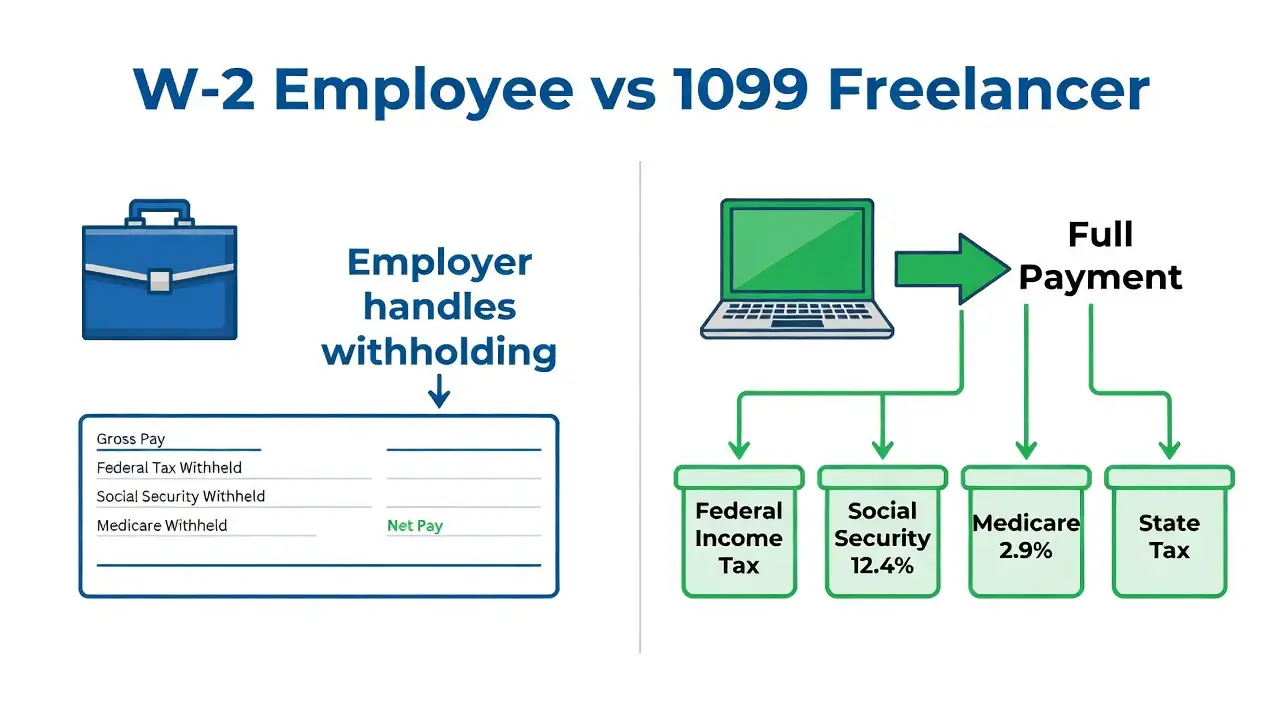
The Core Difference Between a W-2 Employee and a 1099 Freelancer
The primary difference between a W-2 employee and a 1099 freelancer is tax withholding responsibility. An employer automatically withholds federal income tax, Social Security tax, and Medicare tax from employee paychecks and remits these amounts to the IRS. A 1099 freelancer receives gross payment in full and bears sole responsibility for calculating and remitting these taxes independently.
The table below shows exactly how the tax treatment differs between the two structures. This is the comparison most beginners need to see before anything else makes sense.
Table 1: W-2 Employee vs. 1099 Freelancer Tax Treatment
| Tax Obligation | W-2 Employee | 1099 Freelancer |
|---|---|---|
| Federal Income Tax | Withheld automatically by employer | Must calculate and pay via Form 1040-ES |
| Social Security Tax | 6.2% (employer pays matching 6.2%) | 12.4% (pays both halves via SE tax) |
| Medicare Tax | 1.45% (employer pays matching 1.45%) | 2.9% (pays both halves via SE tax) |
| Effective SE Tax Rate | Not applicable | 15.3% on net earnings |
| Filing Frequency | Annual (W-2 received from employer) | Quarterly estimated payments plus annual return |
| Key IRS Form Used | Form W-4 and W-2 | Schedule C, Schedule SE, and Form 1040-ES |
| Penalty Risk | Minimal (employer manages withholding) | Underpayment penalty if quarterly payments are missed |
Source: IRS Publication 15, Employer’s Tax Guide, 2024 and IRS Publication 334, Tax Guide for Small Business, 2024
When I audited my own first-year freelance setup years ago, the Social Security line in that table is what hit hardest. As an employee I had been paying 6.2%. As a freelancer, I suddenly owed 12.4% because I was covering both sides of the contribution. The employer share does not disappear when you go freelance. It just transfers to you.
This is why freelance tax planning is not optional. Without a system, that extra tax liability blindsides you at filing time.
For a broader look at how the IRS distinguishes between employees and independent contractors at the legal level, the employee vs. independent contractor guide on Gig Law Guide breaks down the classification rules in detail.
2. Do I Have to Pay Taxes on Freelance Income? The $400 Rule Explained
All freelance income is taxable income under U.S. federal tax law, regardless of whether a client sends a Form 1099-NEC. The IRS requires freelancers to report all self-employment income on Schedule C. However, the self-employment tax obligation specifically triggers only when net freelance earnings reach $400 or more in a tax year, per IRS Publication 334.
Yes. Full stop. If a client pays you $50 for a single project and never sends a 1099-NEC, that $50 is still taxable income. The IRS income reporting threshold is zero dollars, not $600. The $600 figure is the threshold that triggers a client’s obligation to send you a 1099-NEC. It has nothing to do with your own reporting obligation.
The two most common early mistakes beginners make are treating $600 as the reporting floor and assuming that no 1099-NEC means no tax owed. Neither is accurate.
What Happens If I Made Less Than $400 Freelancing?
If net freelance income is under $400, the self-employment tax does not apply. However, federal income tax may still apply if total income from all sources exceeds the standard deduction threshold, which was $14,600 for single filers in 2024. Freelancers earning under $400 from self-employment must still report that income on Schedule C if they are otherwise required to file a federal return.
So the $400 rule is specifically about self-employment tax, not about income tax and not about whether you file at all. If you freelanced on the side while holding a full-time job and made $300 from freelance work, you still report it. You just avoid the SE tax on that specific amount.
If you are building your freelance business from the ground up, the step-by-step guide to starting a freelance business on Gig Law Guide covers how to structure your operation from day one, including the financial foundation that makes tax management easier.
Is Freelance Income Considered Earned Income for Tax Purposes?
Freelance income is classified as earned income by the IRS, specifically as net earnings from self-employment. This classification means freelance income is subject to both self-employment tax and federal income tax, and it qualifies freelancers for earned income-dependent benefits including IRA contribution eligibility and, in applicable cases, the Earned Income Tax Credit.
The earned income classification matters beyond taxes. It determines whether you can contribute to a retirement account in a given year and which tax credits you qualify for. This is one reason why some tax professionals recommend that beginning freelancers actually want to show earned income rather than minimize it entirely, because the retirement account access alone can create significant long-term value.
3. Self-Employment Tax Rate for Beginners: What You Actually Owe in 2025 and 2026
The self-employment tax rate is 15.3% of net freelance earnings, composed of 12.4% for Social Security and 2.9% for Medicare. For 2025, the Social Security portion applies to net earnings up to $176,100. The Medicare portion has no income ceiling. Freelancers pay both the employee and employer share of this tax because no employer exists to cover the other half.
This is the number that shocks most first-year freelancers. They expect to pay income tax at whatever their bracket rate is, somewhere between 10% and 22% for most beginning earners. What they do not expect is a separate, additional 15.3% tax stacked on top of income tax.
According to IRS Publication 334, Tax Guide for Small Business (2024), the self-employment tax rate is 15.3% for 2024 and 2025, comprising 12.4% for Social Security applied to net earnings up to $168,600 in 2024 and $176,100 in 2025, and 2.9% for Medicare with no income ceiling. Self-employed individuals pay both the employee and employer portions of this tax.
That is a passage-level fact. Keep it handy because it appears on virtually every beginner’s first question list.
How Self-Employment Tax Is Calculated: Step by Step
Self-employment tax is calculated by first multiplying net self-employment income by 92.35% to arrive at the taxable SE income base, then applying the 15.3% SE tax rate to that adjusted figure. The 92.35% multiplier accounts for the deductible employer-equivalent portion of SE tax, which mirrors the business expense treatment that traditional employers receive for payroll tax contributions.
Here is the actual formula laid out step by step:
Step 1: Calculate net self-employment income
Net freelance earnings = Gross freelance income minus deductible business expenses (from Schedule C)
Step 2: Multiply by 92.35%
Taxable SE income = Net self-employment income × 0.9235
Step 3: Apply the 15.3% SE tax rate
SE tax owed = Taxable SE income × 0.153
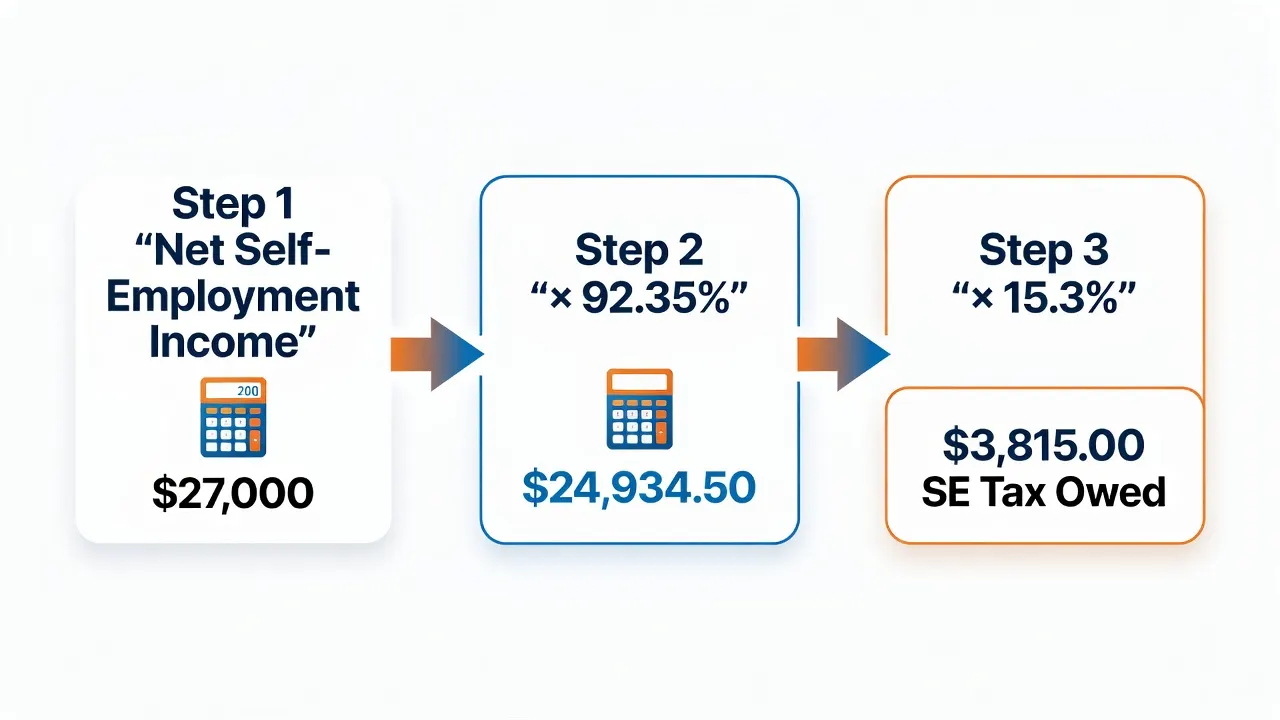
Table 2: Self-Employment Tax Calculation at Two Common Income Levels
| Income Scenario | Gross Freelance Income | Estimated Business Expenses | Net SE Income | × 92.35% | SE Tax Rate | SE Tax Owed |
|---|---|---|---|---|---|---|
| Beginner Freelancer | $30,000 | $3,000 | $27,000 | $24,934.50 | 15.3% | $3,815.00 |
| Growing Freelancer | $50,000 | $5,000 | $45,000 | $41,557.50 | 15.3% | $6,358.30 |
Figures are rounded. Calculations based on IRS Schedule SE instructions, 2024-2025 tax year.
These numbers are approximations and your actual figures depend on your specific deductions and income, but this table gives you a working mental model before you ever open a tax form.
Why Freelancers Pay More Tax Than W-2 Employees: The Real Reason
Freelancers pay more total tax than equivalent W-2 employees primarily because freelancers bear the full 15.3% self-employment tax, whereas employees pay only 7.65% with their employer contributing the matching 7.65%. This structural difference means a freelancer earning $50,000 pays approximately $3,179 more in payroll-equivalent taxes annually than an employee earning the same gross amount, before income tax is factored in.
The math is straightforward but rarely explained clearly.
An employee earning $50,000 pays 6.2% Social Security plus 1.45% Medicare, totaling 7.65%, or $3,825. Their employer pays another $3,825 on their behalf, which the employee never sees or thinks about.
A freelancer earning $50,000 pays both halves. The full $7,650, adjusted slightly by the 92.35% multiplier. This is not a punitive tax. It is the same total contribution to Social Security and Medicare. The difference is who writes the check.
Understanding this distinction helps you plan rather than panic. The full breakdown of how employee and contractor classifications affect your financial obligations is worth reading alongside this section.
The SE Tax Deduction: How to Cut Your Bill Before You Even File
The self-employment tax deduction allows freelancers to deduct 50% of the SE tax paid from their adjusted gross income on Form 1040, Line 15. This above-the-line deduction does not reduce the SE tax itself, but it lowers taxable income for federal income tax purposes, partially replicating the tax benefit that employers receive when they deduct payroll tax contributions as a business expense.
Using the $50,000 example from the table above:
SE tax owed: approximately $6,358
50% deduction: approximately $3,179
This $3,179 is subtracted from your adjusted gross income before income tax is calculated.
At a 22% income tax bracket, that deduction saves roughly $699 in income tax. Not a dramatic reduction, but it is money left in your account instead of sent to the IRS, and it requires zero additional action beyond completing Schedule SE.
The complete guide to self-employment tax deductions for freelancers on Gig Law Guide covers every above-the-line deduction available to independent contractors, including retirement contributions and health insurance premiums that can significantly reduce your total tax burden.
4. Quarterly Estimated Taxes: The System Every Freelancer Must Understand
Quarterly estimated taxes are advance payments that freelancers make to the IRS four times per year to cover both income tax and self-employment tax liability before the annual filing deadline. The IRS requires these payments when a taxpayer expects to owe $1,000 or more in federal taxes for the year. Failure to pay on time results in an underpayment penalty calculated quarterly on the unpaid amount.
This is where most beginners get into trouble. They know taxes exist. They intend to pay at tax time. Then April arrives, the bill is $4,000, and they do not have it because they spent it throughout the year thinking it was income.
Quarterly payments are not optional when your tax liability crosses $1,000. They are a legal requirement. The structure exists because the IRS operates on a pay-as-you-go system. Employees satisfy this requirement automatically through employer withholding. Freelancers satisfy it through estimated payments.
The 2025 and 2026 IRS Quarterly Tax Deadline Calendar
The four IRS estimated tax payment deadlines for the 2025 tax year are April 15 for Q1, June 16 for Q2, September 15 for Q3, and January 15, 2026 for Q4. These dates apply to income earned in each respective quarter. Missing a deadline does not cancel the payment obligation; it triggers a per-quarter underpayment penalty on the late amount starting from the due date.
Table 3: IRS Quarterly Estimated Tax Deadline Calendar — 2025 and 2026
| Quarter | Income Period Covered | IRS Payment Due Date |
|---|---|---|
| Q1 2025 | January 1 through March 31, 2025 | April 15, 2025 |
| Q2 2025 | April 1 through May 31, 2025 | June 16, 2025 |
| Q3 2025 | June 1 through August 31, 2025 | September 15, 2025 |
| Q4 2025 | September 1 through December 31, 2025 | January 15, 2026 |
Source: IRS Estimated Tax for Individuals, Form 1040-ES, 2025
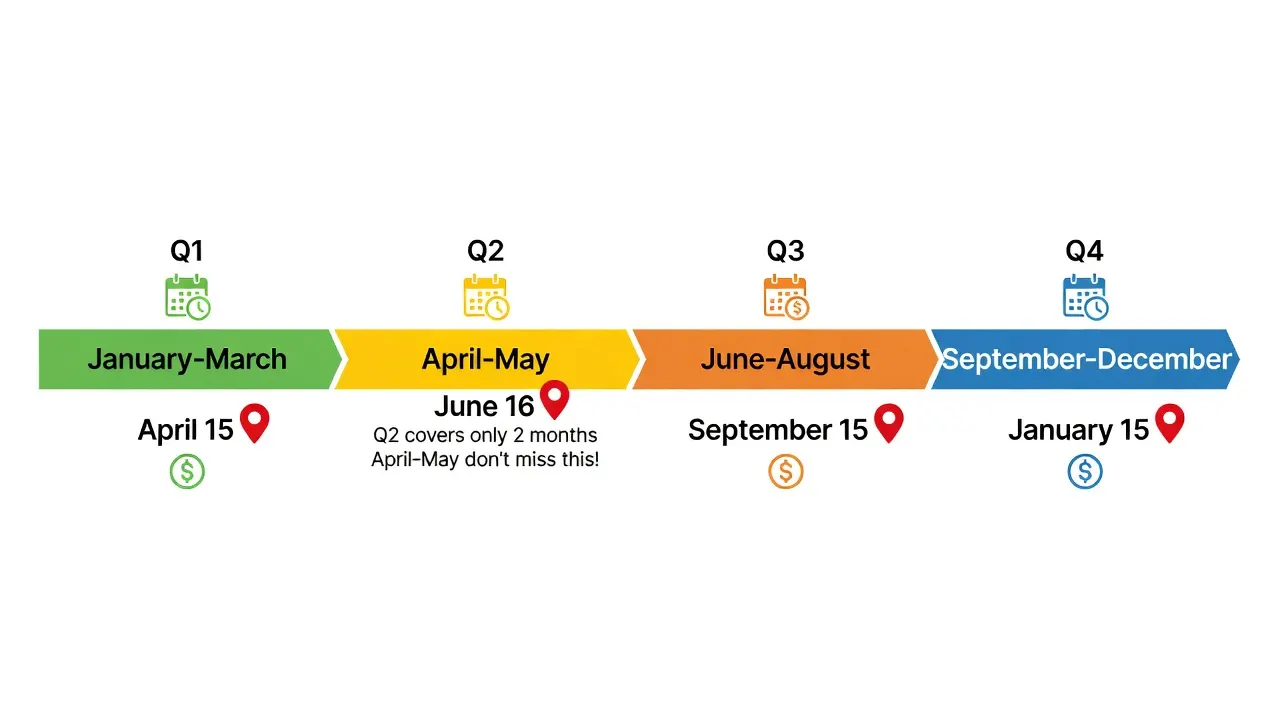
One detail beginners frequently miss: Q2 covers only two months (April and May), not three. The IRS shortens that window intentionally, and many freelancers underpay Q2 because they assume it mirrors the other quarters. It does not.
Expert Perspective: According to the IRS Self-Employed Individuals Tax Center, “As a self-employed individual, generally you are required to file an annual income tax return and pay estimated taxes quarterly.” The IRS uses direct language here because the quarterly requirement is not advisory. It is a structural tax obligation with a penalty mechanism attached to noncompliance.
How to Calculate What You Owe Each Quarter
Freelancers calculate quarterly estimated taxes using the IRS Form 1040-ES worksheet, which estimates annual income, deductions, credits, and resulting tax liability. The safest approach for most beginners is the safe harbor method: paying 100% of the prior year’s total tax liability in four equal installments, which protects against underpayment penalties regardless of how much actual income changes during the current year.
The safe harbor rule is one of the most useful concepts in freelance tax planning. Here is how it works in plain terms:
If your total federal tax bill last year was $4,000, paying $1,000 per quarter this year keeps you penalty-free, even if you earn significantly more this year and your actual liability turns out to be $7,000. You will owe the difference at filing time, but you will not owe the underpayment penalty.
For higher earners, specifically those whose prior year adjusted gross income exceeded $150,000, the safe harbor requires 110% of last year’s tax liability rather than 100%.
⚠️ First-Year Freelancer Note: If this is your first year freelancing, you have no prior-year self-employment tax liability to reference. Use the IRS Estimated Tax Worksheet inside Form 1040-ES to estimate based on projected current-year income. The worksheet walks you through income, deductions, and expected tax step by step. It is free, it is official, and it is the correct starting point for first-year calculations.
The freelance hourly rate calculator on Gig Law Guide can help you build income projections for the year, which feeds directly into your quarterly tax estimates.
What Happens If You Miss a Quarterly Payment?
Missing an IRS quarterly estimated tax payment results in an underpayment penalty calculated at an annualized rate applied to the shortfall for each quarter. The IRS underpayment penalty rate for 2024 is 8% per annum per IRS Revenue Ruling 2024-01, computed on IRS Form 2210 and added to total tax liability at the time of annual filing.
The penalty is not catastrophic on small amounts. On a $1,000 shortfall for one quarter at 8% annualized, the penalty is roughly $20. But penalties compound across multiple quarters, and at higher income levels where quarterly payments should be several thousand dollars, missing two or three payments can result in penalty totals that make the oversight genuinely expensive.
The IRS estimated that the tax gap, the difference between taxes legally owed and taxes voluntarily and timely paid, reached $688 billion annually as of the 2021 tax year, per IRS Tax Gap Projections released in 2023. The IRS attributes a meaningful portion of this gap to underreporting and underpayment by self-employed individuals. Enforcement attention on freelancers and independent contractors has increased in proportion to the growth of the gig economy.
The fix is simple: set up payments in advance rather than scrambling at each deadline.
5. The IRS Forms Every Beginning Freelancer Must Know
The core IRS forms required for freelance tax filing are Schedule C for reporting business income and expenses, Schedule SE for calculating self-employment tax, and Form 1040-ES for making quarterly estimated payments. Freelancers who pay subcontractors $600 or more in a calendar year are also required to file Form 1099-NEC with the IRS by January 31 of the following year.
You do not need to memorize every line of every form before your first filing. But you do need to know what each form does, why it exists, and where it fits in the sequence. Getting these relationships wrong is the single most common structural error I see in first-year freelance tax returns.
Schedule C: How to Report Your Freelance Income and Expenses
Schedule C, formally titled Profit or Loss from Business, is the IRS form that sole proprietors and single-member LLC owners use to report total business income and deductible business expenses. The net profit figure calculated on Schedule C flows into Schedule SE for self-employment tax computation and then onto the main Form 1040 as part of total taxable income.
Think of Schedule C as your business’s income statement translated into IRS language. You report every dollar of freelance income on the front side. You list every legitimate business expense on the back side. The difference between those two numbers, your net profit, is what everything else is calculated from.
In my first year tracking this properly, I discovered I had been overpaying by not recording recurring software subscriptions as business expenses. Twelve months of a project management tool at $15 per month. That is $180 I had left on the table because I did not know it belonged on Schedule C.
If your freelance work involves contracts with clients, the freelance writing contract template on Gig Law Guide is a practical resource for ensuring your payment documentation is clean and complete before tax time arrives. Clean contracts mean cleaner income records on Schedule C.
Schedule SE: Calculating Your Self-Employment Tax
Schedule SE is the IRS form that calculates the actual self-employment tax owed based on the net profit figure carried forward from Schedule C. Schedule SE applies the 92.35% adjustment to net earnings, then the 15.3% tax rate, and produces the SE tax amount that appears on Form 1040 as a separate tax line distinct from income tax.
Schedule SE is a short form. For most freelancers, the calculation takes less than ten minutes. The form exists primarily to create an auditable paper trail showing how the SE tax figure was derived. You do not need a tax professional to complete it. What you need is an accurate Schedule C figure to include.
Form 1040-ES: Your Quarterly Payment Vehicle
Form 1040-ES, Estimated Tax for Individuals, is the IRS worksheet and payment voucher that freelancers use to calculate and submit quarterly estimated tax payments. The form includes a worksheet for projecting annual income and tax liability, along with four detachable payment vouchers corresponding to the four quarterly deadlines. Payments can be submitted online through the IRS Direct Pay system, eliminating the need to mail physical vouchers.
The online payment route through IRS Direct Pay is faster, creates a confirmation record, and eliminates the risk of a mailed check arriving late. I strongly recommend setting up payments electronically from the first quarter rather than learning the mail timing the hard way.
Step-by-step process for first-time quarterly payments:
- Download Form 1040-ES from IRS.gov
- Complete the Estimated Tax Worksheet using projected annual income
- Divide the resulting estimated tax liability by four
- Submit each quarterly payment via IRS Direct Pay or by mailing the corresponding voucher before each deadline
Form 1099-NEC: What to Do When a Client Sends It
Form 1099-NEC is an information return that clients issue to freelancers who received $600 or more in payments during a tax year. The client files this form with the IRS and sends a copy to the freelancer by January 31. The freelancer does not file this form. The freelancer reports the underlying income on Schedule C, including all income regardless of whether a 1099-NEC was received, because the IRS reporting threshold for self-employment income is zero dollars, not $600.
When a 1099-NEC arrives in January, do not treat it as a tax bill. It is a report. Your job is to verify that the income figure on the 1099-NEC matches what you actually received from that client. If the figure is incorrect, contact the client immediately to request a corrected form before you file.
If a client owes you payment and has not issued a 1099-NEC, that is a separate problem from your tax obligation. The guide to collecting unpaid invoices as a freelancer on Gig Law Guide covers the legal steps available when clients go silent on outstanding payments.
6. Tax Deductions for Freelancers: What You Can Legally Write Off
Tax deductions for freelancers are ordinary and necessary business expenses that reduce net profit on Schedule C, thereby lowering both income tax and self-employment tax liability simultaneously. The IRS defines an ordinary expense as one common in the freelancer’s trade or field, and a necessary expense as one that is helpful and appropriate for the business, not a personal expense reclassified as a business cost.
This section matters more than most beginners realize, because deductions reduce the Schedule C net profit figure. That reduction flows through to lower SE tax and lower income tax. Every dollar of legitimate deduction is worth roughly 25 to 40 cents in combined tax savings depending on your bracket and state.
⚠️ Reminder: This content is for informational purposes only and does not constitute tax advice. Consult a licensed CPA or enrolled agent for advice specific to your situation before claiming deductions.
The Most Valuable Deductions for First-Year Freelancers
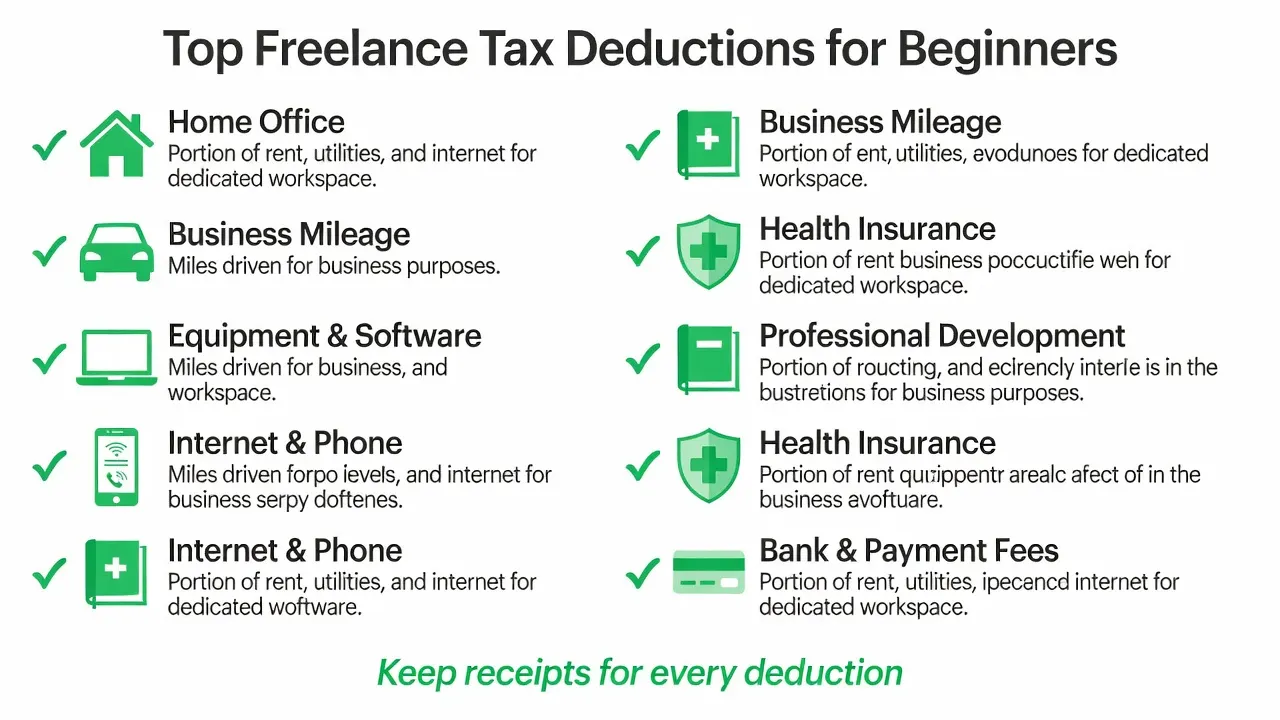
The most impactful tax deductions available to beginning freelancers include the home office deduction, self-employed health insurance deduction, business mileage at the IRS standard rate, internet and phone costs allocated to business use, software and subscription costs, professional development and education expenses, and 50% of self-employment tax paid. Each deduction requires contemporaneous documentation and must satisfy the IRS ordinary and necessary standard to withstand scrutiny.
First-Year Freelancer Deduction Checklist:
- Home office dedicated workspace used regularly and exclusively for business (simplified method: $5 per square foot, up to 300 square feet)
- Business mileage: IRS standard mileage rate for 2025 is 70 cents per mile for business travel (track every trip)
- Internet service: the percentage used for business purposes (many freelancers can justify 50% to 80%)
- Cell phone business use percentage only (document your estimate)
- Software and app subscriptions, project management tools, design tools, writing tools, accounting software
- Website hosting and domain registration are fully deductible as a business expense
- Professional development courses, books, and certifications directly related to your freelance services
- Equipment purchases computers, cameras, microphones, monitors (subject to depreciation rules or Section 179 expensing)
- Health insurance premiums are fully deductible above the line if you are not eligible for employer-sponsored coverage through a spouse
- 50% of self-employment tax is deducted from AGI, not on Schedule C (calculated on Schedule SE automatically)
- Professional services, accountant fees, and legal consultation fees for business purposes
- Bank and payment processing fees, Stripe fees, PayPal fees, business account monthly fees
The complete breakdown of self-employment tax deductions for freelancers on Gig Law Guide goes through each category with IRS citation, documentation requirements, and real examples.
The Home Office Deduction: Who Qualifies and How to Claim It
The home office deduction is available to freelancers who use a portion of their home regularly and exclusively for business purposes. The IRS offers two calculation methods: the simplified method, which allows $5 per square foot up to 300 square feet for a maximum deduction of $1,500, and the regular method, which deducts the actual percentage of home expenses proportional to the office space used.
The exclusive use requirement is the one that disqualifies most home office claims. The space must be used only for work. A kitchen table where you sometimes open your laptop does not qualify. A dedicated room or a clearly partitioned workspace used solely for business does qualify.
For the detailed IRS rules governing home office eligibility, the IRS Publication 587, Business Use of Your Home, provides the complete regulatory framework directly from the source.
Deducting Business Equipment, Software, and Internet: The Rules
Business equipment deductions for freelancers are governed by the IRS ordinary and necessary standard from IRS Publication 334. Mixed-use assets, such as a laptop used for both work and personal activity, must be deducted on a proportional basis reflecting only the business-use percentage. Section 179 of the Internal Revenue Code allows freelancers to deduct the full cost of qualifying business equipment in the year of purchase rather than depreciating it over multiple years.
The laptop example is one I see mishandled constantly in forums.
A freelancer buys a $1,500 laptop. They use it 70% for client work and 30% for personal browsing and entertainment. The deductible amount is $1,050, which is 70% of $1,500. Not the full $1,500. The business use percentage must be documented and defensible if the IRS ever questions it. Keep a simple log for the first few weeks after purchase to establish a credible usage pattern.
7. How to Set Aside Money for Taxes When You’re Just Starting Out
The most reliable method for freelancers to manage tax obligations is to automatically transfer a fixed percentage of every client payment into a dedicated tax savings account immediately upon receipt. Most tax professionals recommend that beginning freelancers set aside between 25% and 30% of gross freelance income to cover self-employment tax, federal income tax, and a buffer for state income taxes.
This is not a complex system. It is a transfer rule applied immediately and without exception.
When a $1,000 payment arrives, $275 goes into a dedicated savings account before you spend a dollar of the rest. That account is not touched for any purpose other than tax payments. This single habit prevents every “I don’t have the money at tax time” scenario that makes April miserable for unprepared freelancers.
The 25 to 30 Percent Rule: A Beginner-Safe Formula That Works
The 25 to 30 percent tax savings rule is a simplified framework used by freelance financial educators to help independent contractors avoid underpayment at filing time. Setting aside 25% covers self-employment tax at an effective rate of approximately 14.1% of gross income plus a conservative federal income tax buffer. The additional margin toward 30% accounts for state income taxes, which range from 0% in states like Texas, Florida, and Nevada to over 13% in California.
Let me break down where the 25% figure comes from at a common beginner income:
- Gross freelance income: $40,000
- Estimated business expenses: $4,000
- Net SE income: $36,000
- SE tax (at effective ~14.1% of gross): approximately $5,640
- Federal income tax (at 12% bracket, post SE deduction): approximately $3,200
- Total estimated federal tax: approximately $8,840
- As percentage of gross income: approximately 22%
The 25% rule builds in a 3-percentage-point buffer above that estimate. The 30% rule adds another 5 points on top, primarily to catch state taxes and bracket creep as income grows.
For freelancers in states with no income tax, such as Texas, Florida, or Nevada, 25% is generally sufficient. For freelancers in California, New York, or New Jersey, 30% or even slightly higher is a safer target.
Setting up a separate bank account for your freelance business is the structural foundation for making this system work. Keeping tax money in the same account as spending money is how that money disappears before April.
How to Budget for Taxes When Your Freelance Income Is Inconsistent
Freelancers with variable income should apply the percentage-based savings rule to every payment received rather than attempting to calculate a fixed monthly set-aside amount. Because freelance income fluctuates, a fixed monthly transfer creates both overpayment risk in slow months and underpayment risk in high-earning months, while the percentage method automatically scales the tax reserve proportionally to actual earnings.
The percentage method is the correct approach for variable income. Every payment. Every time. The math adjusts automatically because the percentage is constant.
In months where income is lower than expected, your tax reserve is lower. In months when a large project pays out, your reserve increases. The system is self-correcting, so you don’t need to recalculate anything.
The salary raise calculator on Gig Law Guide can help you model what income growth looks like over time, which is useful for projecting when your tax bracket might shift and whether your withholding percentage needs adjustment.
8. Tax Mistakes Beginners Make: And Exactly How to Avoid Them
The most damaging freelance tax mistakes made by beginners are using gross income instead of net income to calculate tax estimates, missing quarterly payment deadlines, failing to document deductible expenses in real time, misclassifying personal expenses as business deductions, and underreporting income by treating the $600 1099-NEC threshold as the reporting floor rather than the correct $0 threshold.
I pulled the user experience data from freelancer communities to identify which mistakes are actually causing the most financial damage in year one. These are not theoretical errors. These are the specific failures that show up repeatedly in Reddit threads and accounting questions from people who got hit with surprise bills.
Mistake 1: Using Gross Income Instead of Net to Estimate Taxes
Using gross freelance income rather than net self-employment income to calculate quarterly estimated tax payments leads to systematic overpayment or, more commonly, to inaccurate projections when freelancers forget that deductible business expenses reduce the taxable income base before any tax rate is applied.
This one runs in both directions. Some beginners apply the 15.3% SE tax rate to gross income, which inflates their estimate. Others calculate income tax on the full gross figure without accounting for Schedule C deductions, creating the illusion of a higher tax bill than will actually materialize.
Net income is what matters. Gross income minus legitimate business expenses. That is the number SE tax and income tax are both calculated from.
Mistake 2: Missing Quarterly Deadlines Because You Did Not Know They Existed
The IRS quarterly estimated tax requirement catches most first-year freelancers unprepared because the obligation is never communicated directly to newly self-employed individuals. There is no IRS notice, no automatic enrollment, and no employer reminder. The requirement exists by law, and the underpayment penalty applies regardless of whether the taxpayer was aware of the obligation.
This is the mistake that costs real money. The IRS underpayment penalty rate for 2024 is 8% per annum per IRS Revenue Ruling 2024-01, applied quarterly to any shortfall. On a $3,000 underpayment across three missed quarters, the penalty can easily exceed $150 to $200 before the filing deadline arrives.
Set calendar reminders for all four deadlines right now: April 15, June 16, September 15, and January 15, 2026.
Mistake 3: Skipping Deductions You Are Legally Entitled To
First-year freelancers frequently leave significant deductions unclaimed because they are unaware the deductions exist or assume claiming them will trigger audit scrutiny. The most commonly missed deduction, based on patterns in freelancer tax forums and accounting communities, is the 50% self-employment tax deduction, which reduces adjusted gross income automatically when Schedule SE is completed correctly.
From a frequently-cited Reddit discussion in r/tax: “The ones most first-year freelancers miss: half your self-employment tax is deductible. On $50k net income that’s roughly $3,500 you can deduct.”
That observation is accurate and matches IRS guidance. The deduction does not require itemizing. It does not require additional documentation. It is calculated on Schedule SE and flows directly to Form 1040 as an above-the-line deduction. There is no reason to leave it on the table.
What Records You Need to Keep as a Self-Employed Person
The IRS requires self-employed individuals to maintain contemporaneous records of all business income and deductible expenses, including receipts, invoices, bank statements, and mileage logs. The IRS statute of limitations for audit is generally three years from the filing date, meaning records should be retained for a minimum of three years, and in cases involving significant income underreporting, up to six years.
Minimum record keeping requirements for freelancers:
- All client invoices issued and payments received
- Bank statements for the business account
- Receipts for every business expense over $75 (the IRS generally does not require receipts under $75, but keeping them regardless is cleaner)
- Mileage logs with dates, destinations, and business purpose for every business trip
- Home office measurements and documentation of exclusive business use
- Records of all quarterly estimated payments made, including IRS confirmation numbers
Cloud storage with automatic receipt capture is the practical solution here. A folder structure organized by tax year with subfolders for income, expenses, and quarterly payments takes about five minutes to set up and eliminates every “I can’t find that receipt” problem at filing time.
The legal tips for freelancers guide on Gig Law Guide covers documentation practices from both the tax and contract law perspective, which is relevant because the same records that support your tax deductions often serve as evidence in payment disputes.
9. Freelance Business Structure and Taxes: Sole Proprietor vs. LLC
The default tax structure for an unregistered freelancer is sole proprietorship, in which all self-employment income flows directly to the individual’s personal tax return via Schedule C. A single-member LLC is treated identically to a sole proprietorship for federal tax purposes by default, meaning LLC formation alone does not change the self-employment tax obligation or the filing method.
This distinction matters because many freelancers form an LLC expecting a tax benefit and then discover that the federal tax treatment is unchanged. The LLC provides liability protection at the state level. It does not automatically create a tax advantage unless the owner elects to be taxed as an S-Corporation, a separate and more complex election with its own requirements and costs.
For most beginning freelancers earning under $50,000 from self-employment, operating as a sole proprietor and filing Schedule C is the straightforward and appropriate structure. The LLC election becomes worth examining when income reaches a level where the S-Corp tax strategy produces meaningful savings relative to the administrative costs involved.
The guide to setting up a registered agent for an LLC on Gig Law Guide explains the state-level mechanics of LLC formation for freelancers considering that structure from a liability standpoint.
10. When Should You Hire a Tax Professional for Freelance Income?
Freelancers should seriously consider hiring a licensed CPA or enrolled agent when their annual self-employment income exceeds $40,000, when they operate across multiple states, when they employ subcontractors, when they are considering an S-Corporation election, or when they have significant asset purchases, retirement plan contributions, or audit risk factors. Below these thresholds, many beginning freelancers successfully self-file using tax software paired with reliable reference guides.
Most beginning freelancers can self-file their first return using software like TurboTax Self-Employed or a similar product. The forms are standardized, the calculations are automated, and the tax software correctly computes Schedule SE when given accurate inputs.
The value of a CPA becomes concrete when the situation involves strategic decisions rather than just form completion. Choosing between the standard mileage method and actual expense method for vehicle deductions. Evaluating whether an S-Corp election would reduce SE tax liability at your income level. Structuring retirement contributions to maximize deductions without violating contribution limits.
When you reach that point in your freelance career, the cost of professional advice is itself deductible as a business expense on Schedule C.
For questions about the legal side of your freelance practice, the Gig Law Guide contact page connects you with resources specific to independent contractor legal and financial guidance.
Freelance Taxes for Beginners FAQ: Quick Answers for Beginners
The following questions address the most common tax concerns raised by first-year freelancers and are answered based on 2024 and 2025 IRS rules. These answers are educational starting points. They are not a substitute for advice from a tax professional licensed in your state.
Do I have to pay taxes if I made less than $400 freelancing?
If your net freelance income is under $400, you are not required to pay self-employment tax. However, if your total income from all sources exceeds the standard deduction threshold of $14,600 for single filers in 2024, you are still required to file a federal income tax return and report the freelance income on Schedule C.
What happens if I miss a quarterly estimated tax payment?
Missing a quarterly payment triggers an IRS underpayment penalty at an annualized rate of 8% as of 2024, per IRS Revenue Ruling 2024-01. The penalty is calculated on Form 2210 and added to your tax bill at filing. You can reduce the penalty by catching up on missed payments in a later quarter, but the per-quarter penalty on the original shortfall remains.
Can I deduct my laptop if I use it for both work and personal use?
Yes, but only the business-use percentage. If you use a laptop 70% for client work and 30% personally, you deduct 70% of the cost. The business-use allocation must be documented and consistently applied. Claiming 100% on a clearly mixed-use device is the kind of inflated deduction that draws IRS attention.
Do I need an LLC to file freelance taxes?
No. An LLC is not required to file freelance taxes. Without forming an LLC, you are a sole proprietor by default and file Schedule C attached to Form 1040. A single-member LLC is treated identically for federal tax purposes unless you make an affirmative election to be taxed differently.
When are freelance taxes due for the first time?
The annual return for your first year of freelance income is due April 15 of the following year. If you expect to owe $1,000 or more in federal taxes, quarterly estimated payments are required during the tax year itself, beginning with the Q1 deadline of April 15 of the current year.
What is the self-employment tax rate in 2025?
The self-employment tax rate in 2025 is 15.3%, consisting of 12.4% for Social Security applied to net earnings up to $176,100 and 2.9% for Medicare with no income cap. This rate applies to net self-employment income after the 92.35% adjustment, per IRS Schedule SE instructions for 2025.
How much should I set aside for freelance taxes?
Most tax professionals recommend setting aside 25% to 30% of gross freelance income. The 25% figure covers self-employment tax plus a federal income tax buffer for earners in the 12% bracket. The additional 5% margin covers state income taxes and bracket protection as income grows.
Is freelance income considered earned income for tax purposes?
Yes. Freelance income is classified as earned income by the IRS under the category of net earnings from self-employment. This classification subjects it to both self-employment tax and federal income tax, and it qualifies freelancers to make IRA contributions and, in some income ranges, claim the Earned Income Tax Credit.
Author Bio
Muhammad Muzammil is a freelance legal and financial writer at Gig Law Guide, where he covers U.S. tax law, contract rights, and financial compliance for independent contractors and gig economy workers. His work focuses on translating IRS regulations and legal frameworks into actionable guidance for freelancers navigating self-employment for the first time.
About Gig Law Guide | Freelance Legal Contact | All Freelance Business Resources