

An employee works under an employer’s direct control, receives benefits and payroll tax withholding, and is protected by federal labor law, while an independent contractor runs their own business, sets their own methods, pays self-employment tax, and operates without those protections. The IRS, the Department of Labor, and most U.S. states each apply a distinct multi-factor test to determine the correct classification, and getting it wrong can carry serious tax penalties and legal liability for the hiring entity. If you are a freelancer trying to understand where you stand, or a business owner trying to stay compliant, this guide about “Employee vs Independent Contractor” covers every test, every consequence, and every scenario that matters in 2026.
What Is the Difference Between an Employee and an Independent Contractor?
An employee is a worker whose employer controls not only the results of the work, but also the manner and means by which the work is accomplished. An independent contractor is a self-employed worker who retains control over how, when, and where the contracted work is performed.
These two classifications sit at the center of U.S. employment law, tax compliance, and labor policy. They sound simple on paper. In practice, the line between them gets blurry fast — especially in the gig economy, where platform-based work has forced courts, the IRS, and state legislatures to reexamine what “control” even means.

The classification is not just administrative. It determines who pays Social Security taxes, who is protected from overtime, who qualifies for unemployment insurance, and who can sue under the Fair Labor Standards Act. Wrong classification is not a technicality. It is the kind of mistake that triggers audits, back-tax assessments, and class-action lawsuits.
How Employees Are Defined Under U.S. Law
Under federal common law, an employee is someone who performs services subject to the will and control of an employer, both in terms of what must be done and how it must be done. That definition comes directly from IRS guidance rooted in decades of case law.
But “control” means more than telling someone what to do. It includes:
- Setting the worker’s schedule
- Requiring work to be performed at a specific location
- Providing the tools, equipment, and training needed to do the job
- Integrating the worker’s services into the regular business operation
The employer also handles tax withholding. Every paycheck has Social Security, Medicare, and income taxes pulled out before the worker ever sees the money. At the end of the year, the worker receives a Form W-2 that documents it all.
Employees are also covered by a stack of federal protections — minimum wage under the FLSA, overtime pay, anti-discrimination laws under Title VII, family leave under the FMLA, and workers’ compensation in most states. These protections do not extend automatically to contractors.
How Independent Contractors Are Defined Under U.S. Law
Under IRS and DOL frameworks, an independent contractor is a worker who is in business for themselves. The economic reality test, which I will cover in detail later, asks a straightforward question: Is this worker economically dependent on a single hiring entity, or is the worker operating an independent enterprise?
True independent contractors typically:
- Set their own hours and work methods
- Supply their own tools and equipment
- Serve multiple clients simultaneously
- Invoice for completed work rather than receiving a salary
- Bear the financial risk of their own business (profit or loss)
- Operate under a contract for a specific result, not ongoing employment
The tax picture is entirely different. No withholding happens at the payment stage. The contractor receives a Form 1099-NEC if they earn more than $600 from a single client in a calendar year, and they are responsible for paying self-employment tax — which covers both the employee and employer share of Social Security and Medicare — on top of their regular income tax.
Side-by-Side Comparison Table Employee vs Independent Contractor (Control, Taxes, Benefits, Schedule, Tools, Legal Protections)
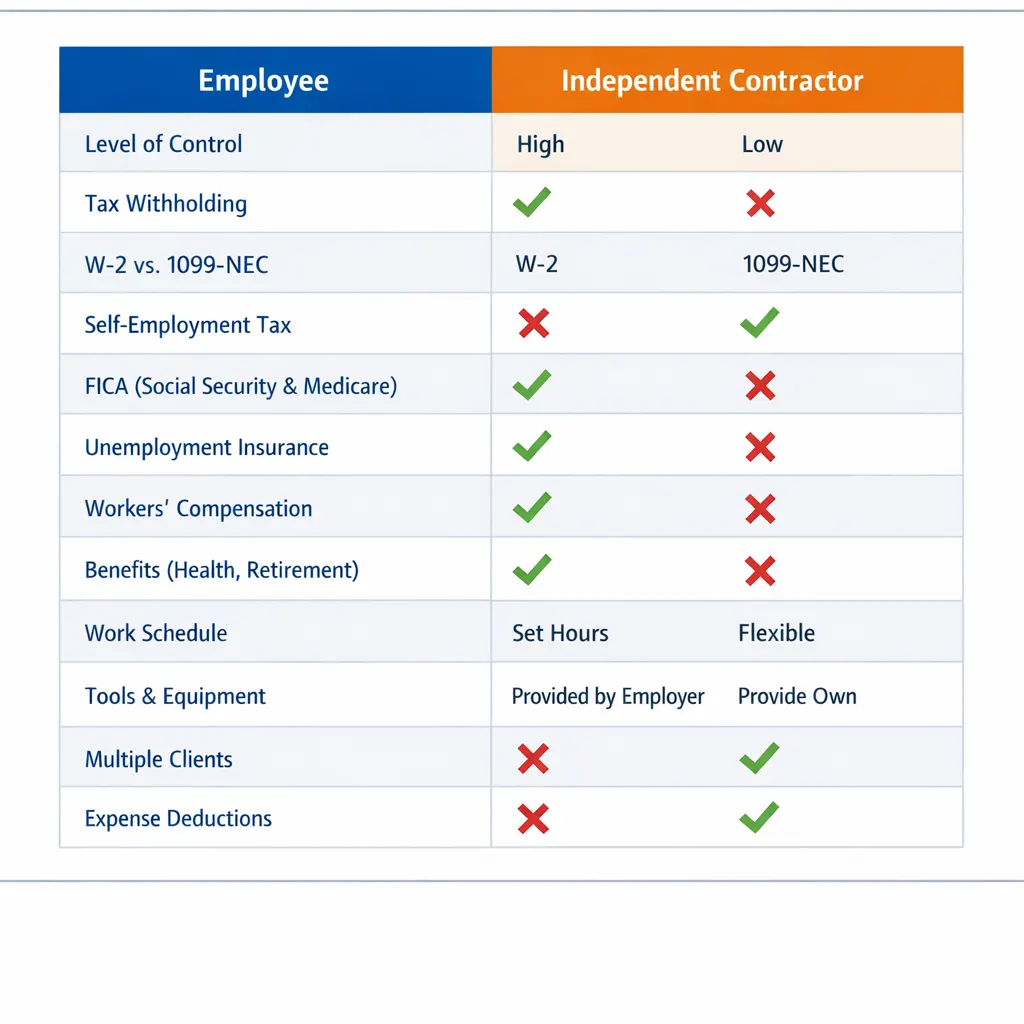
| Factor | Employee | Independent Contractor |
|---|---|---|
| Who controls how work is done | Employer | Worker |
| Tax withholding | YES — employer withholds | NO — worker pays directly |
| Year-end tax form | W-2 | 1099-NEC |
| Pays self-employment tax (15.3%) | NO | YES |
| Employer pays FICA (7.65%) | YES | NO |
| Eligible for unemployment insurance | YES | NO |
| Eligible for workers’ compensation | YES | Generally NO |
| Health insurance/retirement benefits | Often YES | NO (unless self-arranged) |
| Protected by FLSA (minimum wage, overtime) | YES | NO |
| Sets own schedule | Rarely | YES |
| Provides own tools and equipment | NO | YES |
| Can work for multiple clients simultaneously | Restricted | YES |
| Business expense deductions (Schedule C) | NO | YES |
| Written employment contract required | Sometimes | Strongly recommended |
Why Worker Classification Matters — and What’s Actually at Stake
Worker classification under U.S. law determines tax liability, benefits eligibility, and legal protections for both the worker and the hiring entity. Misclassification — treating an employee as an independent contractor — exposes employers to back taxes, civil penalties, and private lawsuits.
This is not a theoretical risk. The IRS collected over $3.4 billion in employment tax assessments related to worker misclassification between 2017 and 2022, according to the Treasury Inspector General for Tax Administration. The DOL recovered $274 million in back wages for misclassified workers in fiscal year 2023 alone. These numbers have only grown as gig work expanded.
What Workers Lose When They Are Misclassified as Contractors
When a worker who should legally be an employee gets classified as an independent contractor, the losses are immediate and compounding.
First, the tax hit. The worker suddenly owes the full 15.3% self-employment tax on their earnings — covering both the employee share (7.65%) and the employer share (7.65%). At $60,000 in income, that is an additional $9,180 in tax burden the worker was never warned about.
Second, the benefits disappear. No employer-sponsored health insurance. No 401(k) match. No paid time off. No short-term disability. No workers’ compensation if an on-the-job injury happens.
Third, the legal protections vanish. The FLSA does not cover independent contractors. That means no guaranteed minimum wage. No overtime for hours beyond 40 per week. No protections under the National Labor Relations Act. If a client refuses to pay, the freelancer cannot file a wage claim with the state labor board; they must pursue the matter through contract law in civil court.
If you are a freelancer and you suspect your working arrangement looks more like employment than contracting, the GigLawGuide resource on not getting paid as a freelancer walks through your legal options in detail.
Consequences of Misclassification for Employers
Misclassification is not just a worker problem. Employers who get this wrong face consequences across multiple fronts simultaneously.
The IRS can assess back payroll taxes for both the employer and employee share, going back three years for standard violations, six years for substantial understatements, and with no statute of limitations if the misclassification was willful. They can also assess interest and failure-to-pay penalties in addition to the underlying tax.
The DOL can pursue unpaid overtime and minimum wage claims under the FLSA. State agencies add another layer — many states have independent enforcement mechanisms, and states like California treat misclassification as a misdemeanor under Labor Code Section 226.8, with civil penalties up to $25,000 per violation.
Workers can also file private lawsuits. Class-action suits against companies like FedEx, Uber, and Lyft have resulted in settlements ranging from $20 million to over $100 million. The legal exposure is not abstract.
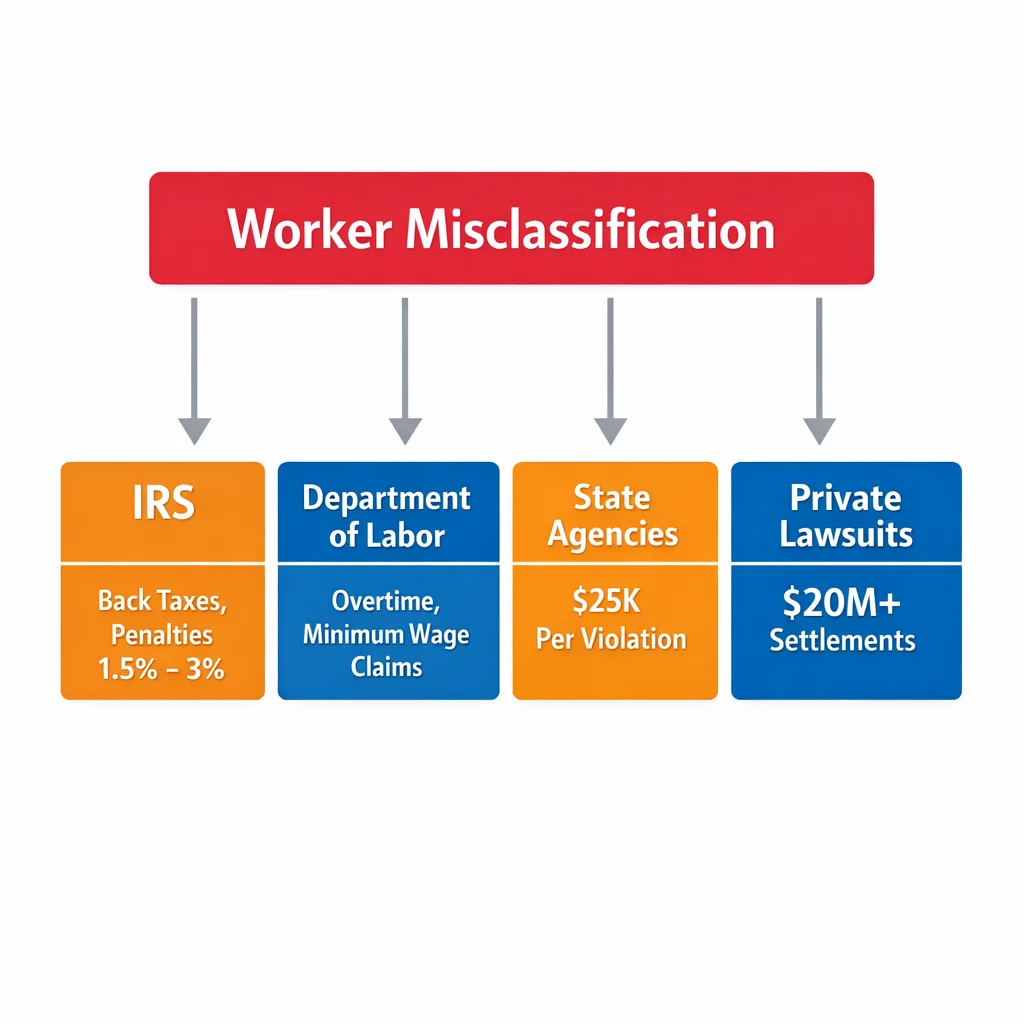
IRS Enforcement and Penalty Structure (Section 3509)
Under Internal Revenue Code Section 3509, employers who misclassify workers face a tiered penalty structure:
- Unintentional misclassification: 1.5% of wages paid to the misclassified worker for income tax, plus 20% of the employee’s share of FICA taxes
- No information returns filed (no 1099): Those rates double to 3% of wages and 40% of FICA
- Willful misclassification: Full employer and employee FICA taxes apply, plus a 100% penalty under IRC Section 6672 for responsible parties who willfully fail to collect and pay employment taxes
Section 3509 rates are intentionally lower than standard tax rates to encourage voluntary correction, but they still add up fast on a workforce of misclassified workers. An employer with 10 misclassified workers, each earning $50,000 per year, could face a six-figure assessment before penalties and interest are even factored in.
IRS Common Law Test: Who Controls the Work?
IRS Common Law Rule (Rev. Rul. 87-41): A worker is an employee when the hiring entity controls not just the result of the work, but the manner and means by which it is accomplished. Twenty factors are used to evaluate this control relationship.
The IRS Common Law Test evaluates worker classification across three categories — behavioral control, financial control, and type of relationship. No single factor is automatically determinative; the IRS examines the full picture of the working arrangement.
The IRS has significantly consolidated its classification guidance over the years, moving from the original 20-factor checklist in Rev. Rul. 87-41 to the current three-category framework. But those 20 original factors did not disappear — they were reorganized into the three buckets below. Courts still reference the original 20 factors regularly in employment disputes.
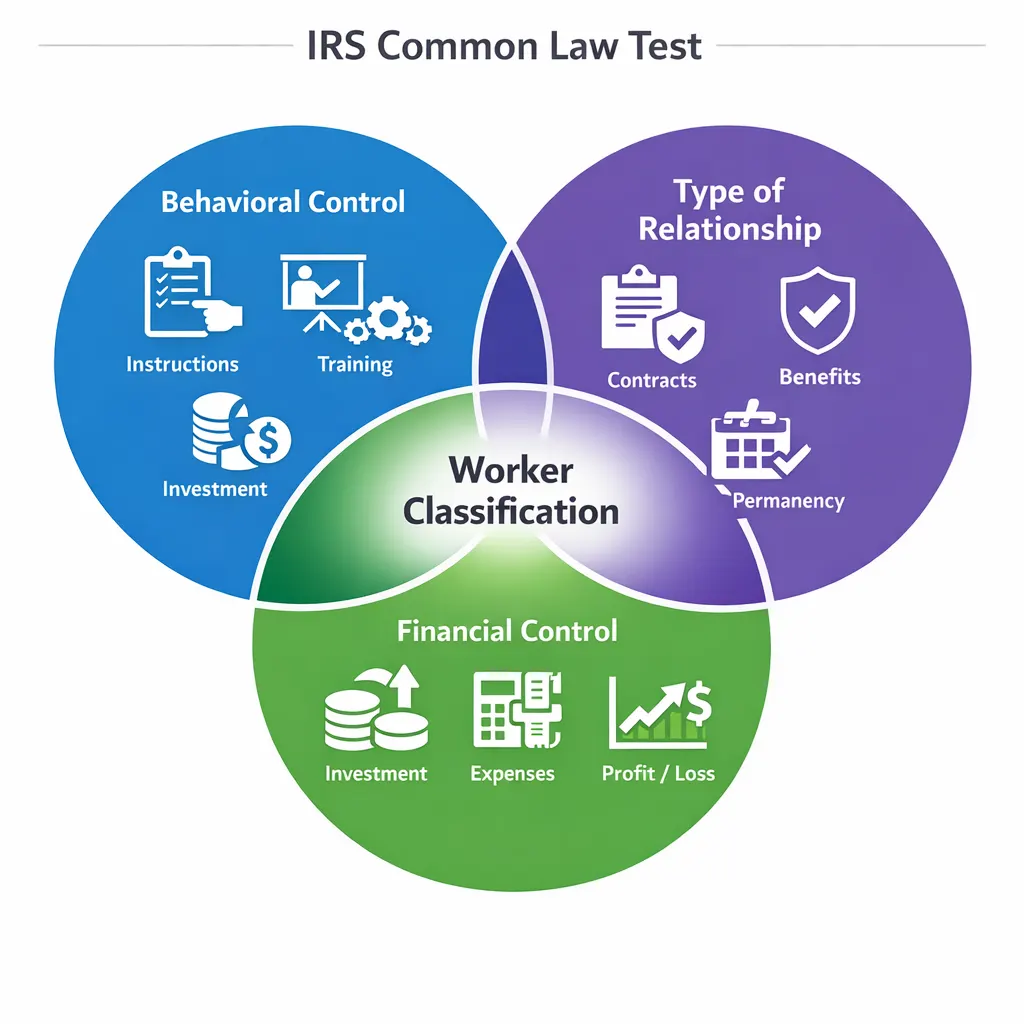
Behavioral Control Factors
Behavioral control asks: Does the company control how the worker performs the work, not just the final result?
Key indicators of behavioral control include:
Instructions given. If the hiring entity tells the worker when to work, where to work, what tools to use, what order to follow tasks in, and who to work with — those are employment signals. A contractor gets a result to deliver; an employee gets a method to follow.
Training provided. When a company trains a worker on how to do the job in a specific way — especially through ongoing or periodic training sessions — that signals an employment relationship. Independent contractors are hired precisely because they already have the expertise. Training them like a new hire undermines that logic.
Integration into business operations. If the worker’s services are deeply embedded in the company’s core daily operations, and the business could not function normally without them, the IRS treats this as a behavioral control signal pointing toward employee status.
Financial Control Factors
Financial control asks: Does the company control the economic aspects of the worker’s job?
Significant investment. Contractors typically invest in their own tools, equipment, and facilities. A web developer who owns their own computer and software, a photographer who owns their own camera equipment — these are contractor signals. A worker who uses company-owned equipment for company-directed tasks looks like an employee.
Unreimbursed business expenses. Independent contractors often incur unreimbursed expenses — they absorb the costs of running their own businesses. Employees are typically reimbursed for work-related expenses.
Opportunity for profit or loss. This is one of the most telling factors. A contractor can make business decisions that affect their profitability — they can price a project high, finish efficiently, and pocket the difference. They can also underbid and lose money. Employees receive a set wage regardless of business performance.
Services available to the general market. A true independent contractor markets their services to multiple clients, has a business presence, and is not exclusively dependent on one company for income.
Method of payment. Regular hourly or salary payments point toward employment. Payment per project, per deliverable, or upon invoice points toward contractor status.
Type of Relationship Factors
This category looks at how the parties perceive and structure their relationship.
Written contracts. A contract describing an independent contractor relationship is a starting point — but the IRS looks past the label. If the actual working conditions look like employment, the contract language does not override reality. This is the single most common mistake hiring entities make.
Employee-type benefits. If a company provides health insurance, a pension plan, vacation pay, or sick leave to a worker they call a “contractor,” that is a significant red flag for the IRS. These are benefits that employers provide to employees. Offering them to contractors sends a contradictory signal.
Permanency of the relationship. An ongoing, indefinite working relationship suggests employment. A time-limited engagement for a specific project suggests contracting.
Services integral to regular business. If a worker is performing the core function of the business — a graphic designer at a graphic design firm, for example — that weighs in favor of employee status.
What’s the 20-Factor Test for Independent Contractors?
The IRS originally published 20 specific factors in Revenue Ruling 87-41 to guide classification. These have since been reorganized into the three-category framework, but they remain relevant in audits and litigation. Here is how the original 20 factors map to the current structure:
Behavioral Control factors (from Rev. Rul. 87-41):
- Instructions — the worker must follow the employer’s instructions
- Training — the employer trains the worker
- Integration — workers’ services integrated into business operations
- Services rendered personally — work cannot be delegated
- Hiring, supervising, and paying assistants — the employer controls the team
- Continuing relationship — ongoing work relationship
- Set hours of work — the employer sets the schedule
- Full-time work required — the worker cannot work for others
- Work done on premises — employer controls the location
- Order or sequence set — the employer dictates the work order
Financial Control factors:
11. Reports required — the worker must submit regular reports
12. Payment by hour, week, month — regular payment structure
13. Payment of business expenses — employer covers costs
14. Furnishing tools and materials — the employer provides equipment
15. Significant investment — the worker has not invested in their own facilities
Type of Relationship factors:
16. Realization of profit or loss — no business risk for the worker
17. Working for multiple firms — the worker only works for one entity
18. Making services available to the public — no public market presence
19. Right to discharge — the employer can fire without breach of contract
20. Right to terminate — worker can quit without liability
No single factor from this list controls the outcome. The IRS weighs the full pattern.
IRS Form SS-8 — When and How to File It
Form SS-8 (Determination of Worker Status for Purposes of Federal Employment Taxes and Income Tax Withholding) is the formal mechanism for asking the IRS to rule on a worker’s classification.
Either the worker or the hiring entity can file it. The IRS will request information from both parties, review the actual working conditions against its classification framework, and issue a formal determination letter, which typically takes six months or more.
Workers file SS-8 when they believe they have been misclassified and want an official ruling before pursuing other remedies. Businesses sometimes file proactively when classification is genuinely ambiguous. The determination is not legally binding in court, but it carries significant weight with the IRS and state tax agencies.
One practical note: filing SS-8 as a worker can strain the working relationship. Many freelancers choose to consult an employment attorney before filing rather than triggering an IRS review that the hiring entity will immediately know about.
DOL Economic Reality Test: Who Bears the Financial Risk?
The Department of Labor operates under a different statute than the IRS — the Fair Labor Standards Act — and uses a different test. The DOL’s Economic Reality Test asks a fundamentally different question than the IRS Common Law Test. Where the IRS focuses on behavioral control, the DOL asks: as a matter of economic reality, is this worker in business for themselves, or are they economically dependent on the hiring entity?
The DOL updated its regulations on this test effective March 11, 2024, restoring a multi-factor totality-of-circumstances approach after a shorter, more contractor-friendly rule was rescinded.
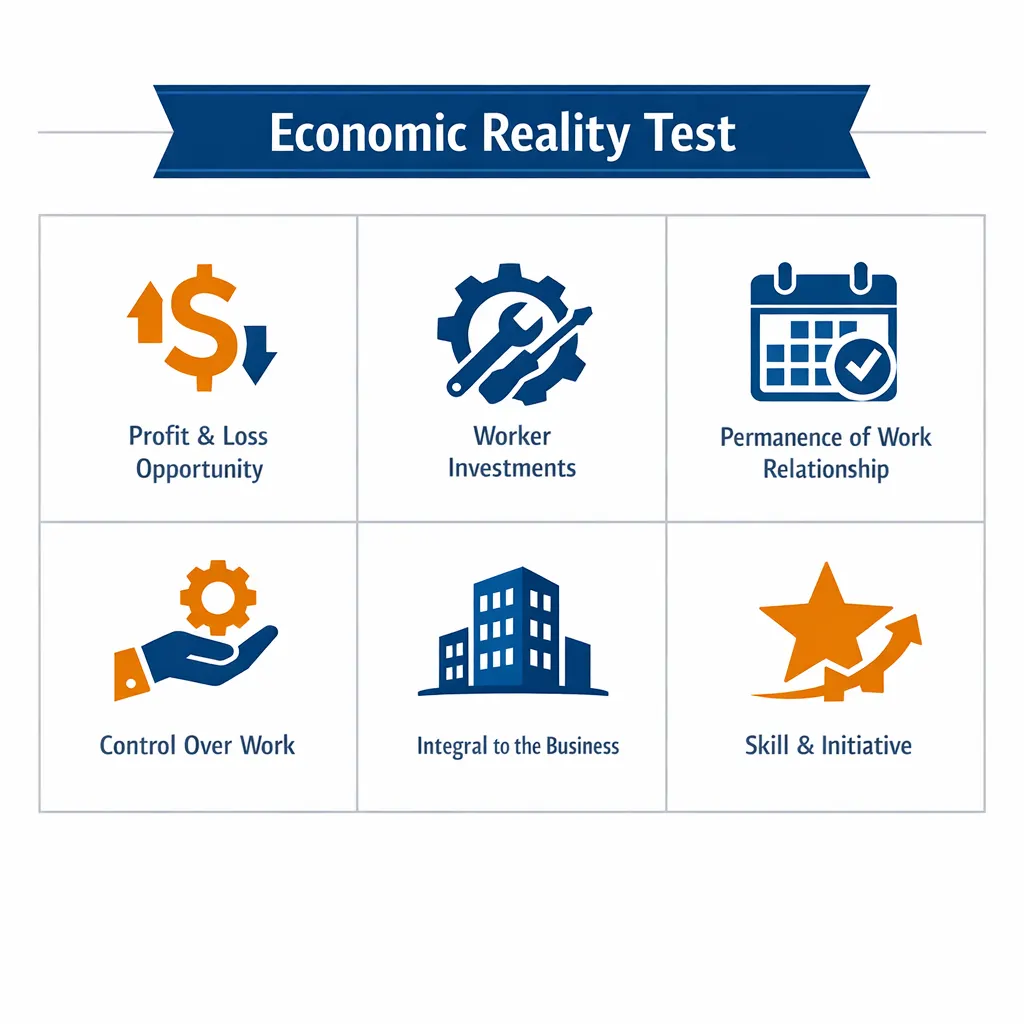
The 6-Factor Economic Reality Test Explained
The current DOL rule identifies six factors, with no single factor carrying a predetermined weight:
Factor 1: Opportunity for profit or loss depending on managerial skill. Can the worker make business decisions that affect how much money they make or lose? Do they negotiate prices, take on additional clients, market their services, or make investments? A worker with genuine entrepreneurial control over their income points toward contractor status.
Factor 2: Investments by the worker and the potential employer. Does the worker make capital investments in their business — equipment, tools, facilities, marketing — that are similar in nature (though not necessarily in scale) to the investments made by the hiring entity? A worker whose only investment is their own labor points toward employment.
Factor 3: Degree of permanence of the work relationship. Is the relationship indefinite and continuous, or project-based and time-limited? Permanent, ongoing relationships indicate employment. Definite-duration, project-specific relationships indicate contracting.
Factor 4: Nature and degree of control. Does the hiring entity set the schedule, supervise the work, restrict the worker from working for competitors, or control pricing? More control points toward employment. This factor overlaps significantly with the IRS behavioral control analysis.
Factor 5: The extent to which the work performed is an integral part of the potential employer’s business. If the work is central to what the business does — not peripheral or specialized — that is an employment signal. A driver for a trucking company is integral. A lawyer hired to handle a one-time contract dispute for a restaurant is not.
Factor 6: Skill and initiative. Does the worker bring specialized skills that they also market to others? Does the worker use those skills with genuine business initiative — seeking out clients, setting rates, managing their own reputation? Or do they simply apply their skills in a way controlled and directed by the employer?
How This Differs From the IRS Common Law Test
The two tests overlap but are not identical, and the distinction matters in practice.
The IRS Common Law Test is primarily concerned with behavioral control — who directs the work. The DOL Economic Reality Test is primarily concerned with economic dependence — who bears the financial reality of the work relationship.
A worker can pass the IRS test (low behavioral control from the employer) but still fail the DOL test if they are economically dependent on a single hiring entity. Uber drivers were classified as contractors under behavioral control analyses for years — Uber did not control how they drove. But DOL’s economic reality arguments focused on the fact that drivers had no real ability to set prices, negotiate terms, or build an independent business through the platform.
The practical implication: a worker can be classified as an independent contractor for federal income tax purposes under IRS rules while simultaneously qualifying as an employee under FLSA for minimum wage and overtime purposes. These are parallel legal frameworks with separate outcomes.
Which Workers Does the FLSA Test Apply To
The DOL Economic Reality Test applies under the Fair Labor Standards Act, which covers workers engaged in interstate commerce or employed by enterprises with annual gross sales of $500,000 or more. In practice, this covers the vast majority of U.S. workers.
The test is most frequently applied in industries where misclassification is widespread: trucking and delivery, construction, janitorial services, home healthcare, agriculture, and gig platforms. But it applies to any hiring situation where FLSA coverage is present.
ABC Test: Is the Work Core to the Hiring Business?
The ABC Test operates at the state level, and it is considerably more worker-protective than either the IRS or DOL federal tests. States that use the ABC Test presume that all workers are employees. The burden is entirely on the hiring entity to prove otherwise — and they have to satisfy all three criteria simultaneously to establish contractor status.
Which States Use the ABC Test (Full State List)
As of 2026, the following states use some version of the ABC Test for at least some classification purposes:
States using the ABC Test broadly:
California, Massachusetts, New Jersey, Vermont, Connecticut, Illinois, Indiana, Nevada, New Hampshire, New Mexico, and Oregon
States using modified ABC variants:
Colorado (for unemployment), Maryland (for unemployment and labor), Rhode Island, Virginia, and West Virginia
Note that even within this list, application varies. Some states apply the ABC Test only for unemployment insurance purposes. California applies it broadly under AB5 for labor code, unemployment, and most worker protection purposes. Always check which specific law applies to your state and industry.
How California AB5 Rewrote Independent Contractor Rules
California Assembly Bill 5, signed into law in September 2019 and effective January 2020, was the most significant state-level reclassification law in modern U.S. history. It codified the ABC Test from the California Supreme Court’s 2018 Dynamex decision and applied it to the state Labor Code, Unemployment Insurance Code, and the FLSA’s California equivalent.
Under AB5, a hiring entity in California must prove all three of the following to classify a worker as an independent contractor:
(A) The worker is free from the control and direction of the hiring entity in connection with the performance of the work, both under the contract and in fact.
(B) The worker performs work that is outside the usual course of the hiring entity’s business.
(C) The worker is customarily engaged in an independently established trade, occupation, or business of the same nature as the work performed.
Prong B is where AB5 bites hardest. If a company’s core business is delivery services, a delivery driver working for that company fails Prong B automatically — the work is directly within the company’s usual course of business. This is why AB5 had immediate and dramatic effects on platforms like Uber, Lyft, and DoorDash, which operate in California.
AB5 includes exemptions for specific industries and occupations — doctors, lawyers, architects, real estate agents, and certain licensed professionals under specific conditions. The exemptions are narrow and heavily negotiated. Many were added after fierce industry lobbying following the law’s passage.
Proposition 22, passed by California voters in November 2020, carved app-based rideshare and delivery drivers out of AB5 entirely, creating a third classification category with a different benefit structure. That carve-out has faced ongoing legal challenges.
If you are a California-based freelancer, understanding AB5’s application to your specific occupation is non-negotiable before you structure any client engagement. I recommend reviewing your contract structure carefully — GigLawGuide’s freelance contract essentials section covers the specific contract provisions that affect classification outcomes.
ABC Test vs. IRS Test — When Each One Applies
These two frameworks operate in parallel, not in sequence. The IRS Common Law Test governs federal tax classification — specifically, whether the hiring entity must withhold payroll taxes and issue a W-2. The ABC Test governs state-level labor law protections — whether the worker is entitled to minimum wage, overtime, unemployment insurance, and workers’ compensation under state law.
A worker can be classified as an independent contractor for IRS purposes and simultaneously classified as an employee under a state ABC Test. This creates a split-classification scenario where the hiring entity owes no federal payroll tax withholding but does owe state labor law protections.
The practical takeaway for freelancers under the ABC Test is that your federal 1099 status does not automatically mean you are a contractor under state law. If your work meets any of the ABC Test criteria — particularly if you only work for one client, in their core business area, without an independently established business — you may have state-law employee rights you are not currently exercising.
How Do Taxes Work Differently for Employees vs. Independent Contractors?
Tax treatment is the most immediate, quantifiable difference between employee and independent contractor status. Employees have taxes withheld by their employer and pay no self-employment tax. Independent contractors receive no withholding, owe self-employment tax of 15.3% on net earnings, and must make quarterly estimated tax payments to avoid underpayment penalties.
How Employee Taxes Work (FICA, Withholding, W-2)
When you are an employee, your employer handles the mechanical side of federal tax compliance before you ever receive a paycheck.
FICA taxes — the Federal Insurance Contributions Act — fund Social Security and Medicare. The total rate is 15.3% of wages. Employers split this evenly: they pay 7.65% directly to the IRS, and they withhold 7.65% from the employee’s paycheck. The employee’s half breaks down to 6.2% for Social Security (up to the annual wage base, which was $168,600 in 2024) and 1.45% for Medicare (no wage cap, plus a 0.9% Additional Medicare Tax on earnings above $200,000 for single filers).
Federal income tax withholding is in addition to FICA. The amount withheld depends on the W-4 the employee filed with their employer, their filing status, dependents, and any additional withholding amounts they chose.
At year’s end, the employee receives a Form W-2 showing total wages earned, federal income tax withheld, and FICA taxes withheld. They file their return using these numbers, and if withholding was accurate, they owe little or receive a refund.
What’s the Difference Between a W-2 Employee and a 1099 Contractor?
This is one of the most searched questions in this space — and the answer is less about the forms themselves and more about what the forms represent.
A W-2 is issued by an employer to an employee. It reports wages paid, income taxes withheld, and payroll taxes withheld. Receiving a W-2 means the hiring entity treated you as an employee, paid their share of FICA, and handled tax withholding on your behalf.
A 1099-NEC (Nonemployee Compensation) is issued by a client to an independent contractor. It reports the total amount paid for services — nothing withheld, nothing matched. Receiving a 1099-NEC means the hiring entity treated you as a contractor, paid you in full, and transferred the entire tax burden to you.
The form you receive reflects how the hiring entity classified you. It is not a legally protected classification by itself. A company can issue you a 1099 when you legally should have received a W-2, and that is exactly what misclassification looks like from the tax documentation side.
How Contractor Taxes Work (Self-Employment Tax, Quarterly Payments, 1099-NEC)
As an independent contractor, your tax situation requires active management throughout the year.
Self-employment tax is the most jarring surprise for new freelancers. It sits at 15.3% of net self-employment income (earnings after deductible business expenses). This covers the Social Security and Medicare contributions that would otherwise be split between employer and employee. As a contractor, you are both — so you pay both halves. One partial offset: you can deduct 50% of self-employment tax as an above-the-line deduction on your federal return.
Quarterly estimated taxes are required if you expect to owe $1,000 or more in federal taxes for the year. The IRS sets four payment deadlines annually (typically April 15, June 15, September 15, and January 15 of the following year). Missing these triggers an underpayment penalty calculated at the current federal short-term rate plus 3 percentage points.
For a detailed walkthrough of quarterly payment calculations and which deductions reduce your self-employment tax base, the freelancer taxes for beginners guide on GigLawGuide covers the mechanics step by step.
Tax Cost Comparison Table Employee vs Independent Contractor — Worker and Hiring Entity Side by Side
| Tax Obligation | Employee | Independent Contractor |
|---|---|---|
| Federal income tax withheld | YES — by employer | NO — paid directly by worker |
| Social Security tax (6.2%) — worker share | Withheld from paycheck | Included in 15.3% SE tax |
| Medicare tax (1.45%) — worker share | Withheld from paycheck | Included in 15.3% SE tax |
| Employer FICA match (7.65%) | Paid by employer | NOT paid by any third party |
| Self-employment tax (15.3% total) | NOT applicable | YES — on net earnings |
| SE tax deduction (50% above-the-line) | NOT applicable | YES — reduces adjusted gross income |
| Quarterly estimated payments required | NO | YES — if tax liability exceeds $1,000 |
| State income tax withholding | YES — by employer | NO — worker’s responsibility |
| Year-end tax document | W-2 | 1099-NEC (if paid $600+) |
Business Tax Deductions Only Available to Independent Contractors
This is where contractor status creates a genuine financial advantage that employees do not have.
Independent contractors file Schedule C with their federal return, reporting business income and deductible expenses. Employees cannot deduct unreimbursed work expenses at the federal level (that deduction was eliminated by the Tax Cuts and Jobs Act of 2017 and has not been restored).
Deductions available exclusively to self-employed workers and independent contractors include:
- Home office deduction — a dedicated workspace used regularly and exclusively for business
- Health insurance premiums — 100% deductible above-the-line for self-employed individuals not eligible for employer-sponsored coverage
- Self-employed retirement contributions — SEP-IRA contributions up to 25% of net self-employment income (capped at $69,000 for 2024)
- Business equipment and software — often fully deductible in the year of purchase under Section 179
- Professional development, subscriptions, and memberships — directly related to the business
- Business travel, vehicle use, and home internet — proportional to business use
- The 50% SE tax deduction reduces adjusted gross income directly
For a comprehensive breakdown of which deductions apply to your freelance situation, GigLawGuide’s self-employment tax deductions guide covers the full Schedule C picture.
How Much Does It Actually Cost to Hire an Employee vs Independent Contractor?
The sticker price difference between an employee and a contractor is almost never the real number. The real cost comparison requires accounting for everything that sits below the surface — and for most small businesses, that math is more complicated than it first appears.
What Are the Hidden Costs of Hiring Employees?
When a business hires an employee at a $60,000 annual salary, the $60,000 is just the starting point. Here is what actually gets added:
Mandatory employer costs:
- Employer FICA (Social Security + Medicare): 7.65% = $4,590
- Federal Unemployment Tax (FUTA): 6% on first $7,000 of wages = $420 (often reduced to 0.6% with state credits)
- State Unemployment Insurance (SUTA): varies by state, typically 2% to 5% of wages
- Workers’ compensation insurance: varies by industry and state, commonly 1% to 5% of payroll
Benefits costs (if provided):
- Employer-sponsored health insurance: the national average employer contribution was $7,034 per employee for single coverage and $17,393 for family coverage in 2023 (Kaiser Family Foundation data)
- 401(k) matching: commonly 3% to 6% of salary
- Paid time off (typically 10 to 15 days) represents 4% to 6% of annual salary in lost productive time
- Paid holidays (typically 10 per year): approximately 4% of annual salary
Administrative costs:
- Payroll processing (software or service)
- HR compliance management
- Onboarding and training time
- Potential recruiting fees (commonly 15% to 25% of first-year salary for agency placements)
Total true cost of a $60,000 employee: frequently $75,000 to $90,000 or more per year, depending on benefits package and state.
Independent Contractors vs. Employees — Which Costs Less?
The honest answer: it depends on the work volume, duration, and what you are comparing.
Contractors typically charge more per hour than the equivalent employee hourly rate — sometimes 20% to 40% more. They are pricing in their own self-employment tax (15.3%), benefits costs, and business overhead. A contractor charging $45 per hour versus an employee earning $30 per hour looks more expensive on paper.
But you are not paying FICA on the contractor. You are not paying workers’ comp. No unemployment insurance. No health benefits. No PTO. No onboarding costs in most cases. For project-based, time-limited, or specialized work, contractors are frequently the lower-cost option once the full employee cost stack is applied.
The calculation flips for ongoing, full-time work. A contractor working 40 hours per week for 50 weeks at $45 per hour costs $90,000 per year. An employee doing the same work at $30 per hour costs $62,400 in direct wages, plus benefits and employer taxes — but the total might still come in under $90,000 depending on the benefits package. For continuous, full-time work, employees often become the more economical long-term choice.
How Much More Should a Contractor Charge Than an Employee’s Salary?
This is the question freelancers almost always underestimate. The standard rule of thumb is to charge at least 1.25x to 1.5x the equivalent employee hourly rate, but that floor is often too low.
Here is the actual calculation framework:
| Cost Component | % of Employee Equivalent Rate to Add |
|---|---|
| Self-employment tax (15.3%) — both halves | +15.3% |
| Health insurance (no employer contribution) | +5% to 15% depending on plan |
| Retirement savings (no employer match) | +3% to 6% |
| Paid time off (approximately 15 days) | +6% |
| Unpaid overhead time (admin, marketing, client management) | +15% to 25% |
| Business expenses (equipment, software, internet) | +3% to 8% |
| Income variability / no guaranteed hours buffer | +10% to 20% |
Realistic minimum multiplier: 1.5x to 1.75x the equivalent employee hourly rate. A worker who would earn $30/hour as an employee should charge $45 to $52.50/hour as a contractor just to break even on true compensation. To profit from contractor status, the rate needs to go higher.
The GigLawGuide freelance hourly rate calculator walks through this calculation with your actual numbers.
How Do I Calculate the True Cost of Employment?
For employers building a budget, the standard formula is:
True Employment Cost = Base Salary + (Base Salary × Employer Tax Rate) + Annual Benefits Costs + Administrative Overhead
A simplified version using national averages:
- Base salary: $60,000
- Employer payroll taxes (FICA + FUTA + SUTA average): approximately 10% = $6,000
- Workers’ compensation: approximately 2% = $1,200
- Health insurance (employer share): $7,034
- Retirement contribution (3% match): $1,800
- PTO and holidays (approximately 10% of salary in time cost): $6,000
- Recruiting and onboarding: variable (one-time, often $5,000 to $15,000)
Estimated first-year true cost: $82,034 to $97,034 for a $60,000 salary.
Benefits, Protections, and Legal Rights — Who Gets What?
Benefits Employees Are Legally Entitled To
Not all employee benefits are legally mandated — some are employer-offered incentives. But several are required by federal or state law:
Legally required benefits:
- Social Security and Medicare contributions (FICA)
- Federal and state unemployment insurance
- Workers’ compensation coverage (state-level requirement)
- FMLA leave (for employers with 50+ employees) — up to 12 weeks of unpaid, job-protected leave
- Minimum wage and overtime pay under the FLSA
- Anti-discrimination protections under Title VII, ADA, and ADEA
Common employer-offered (not legally required) benefits:
- Health, dental, and vision insurance
- 401(k) or pension plans
- Paid time off, sick leave, and parental leave (though several states now mandate paid sick leave)
- Short-term and long-term disability insurance
- Life insurance
The Affordable Care Act requires employers with 50 or more full-time equivalent employees to offer health coverage meeting minimum value standards — but there is no federal mandate for employers with fewer than 50 employees.
Do I Need to Provide Benefits to Independent Contractors?
No. A hiring entity has no federal legal obligation to provide any benefits to a worker classified as an independent contractor. No health insurance. No retirement plan. No paid time off. No workers’ compensation.
This is one of the primary financial reasons companies prefer contractor relationships. But it is also a factor the IRS considers when evaluating whether a contractor relationship is legitimate. If a company is providing employee-type benefits to a worker, they are calling a contractor — health insurance, regular performance reviews, a dedicated workspace — those benefits become evidence pointing toward misclassification.
For the freelancer, this means the financial burden of benefits falls entirely on you. Health insurance, retirement savings, disability coverage, and any other financial protections are out-of-pocket business costs. Pricing your rates without accounting for these costs is one of the most common and damaging financial mistakes new freelancers make.
What’s the Difference in Liability Between Employees and Contractors?
Vicarious liability is the core legal concept here. Under the doctrine of respondeat superior, employers are generally liable for the negligent acts of their employees committed within the scope of employment. If an employee causes property damage or injury while performing their job, the employer shares legal exposure.
That liability generally does not extend to independent contractors. If a contractor causes harm while performing their work — a freelance electrician who wires something incorrectly, a delivery contractor who causes a traffic accident — the hiring entity typically bears no vicarious liability.
This is a real reason businesses choose contractor relationships beyond the tax savings. But the liability protection is not absolute. Courts apply a “right to control” test to determine whether vicarious liability extends to contractor conduct. If the hiring entity exercised significant control over how the contractor performed the work — the same control analysis used in employment classification — the liability protection can collapse.
For contractors, this means you carry your own liability exposure. Professional liability insurance (errors and omissions coverage) and general liability coverage are not optional extras — they are the cost of operating without an employer’s insurance umbrella behind you.
When Contractors Can Negotiate Their Own Benefits
Nothing in federal law prevents a contractor from negotiating benefits as part of their contract terms. Health insurance reimbursement, paid project downtime, equipment stipends, and professional development allowances can all be written into a contractor agreement.
The catch: these negotiated benefits must be structured carefully to avoid creating the appearance of an employment relationship. A health insurance stipend paid as part of a per-project fee is structurally different from an employer-provided health plan. How you document it — and how it is treated in your contract — matters. GigLawGuide’s freelance contract essentials covers how to structure these provisions without triggering reclassification concerns.
Can I Treat an Independent Contractor Like an Employee?
This is the question where most misclassification problems actually start. The short answer is no, and the longer answer is that “treating someone like an employee” is precisely the legal definition of misclassification.
How Much Control Can I Have Over an Independent Contractor’s Work?
You can control the result. You cannot control the method. That line — simple in theory, endlessly contested in practice — is the core boundary of the contractor relationship.
You can tell a contractor what you need delivered, by when, and to what specification. You cannot tell them what hours to work, which tools to use, in what order to complete tasks, or who else they can work for. The moment you start dictating the method of work, you are exercising behavioral control — and the IRS and DOL both treat behavioral control as an employment indicator.
Common behaviors that cross the control line include:
- Requiring contractors to work set hours (9 am to 5 pm, no exceptions)
- Mandating the use of company-provided software or tools when the contractor could use their own
- Prohibiting contractors from working for competitors (non-compete clauses in contractor agreements are legally suspect for this reason)
- Requiring contractors to attend regular internal staff meetings as a condition of the engagement
- Performing periodic performance reviews using the same rubric applied to employees
Can an Independent Contractor Work Full-Time for One Company?
Legally, yes — but the full-time arrangement creates significant classification risk that most hiring entities underestimate.
Working full-time hours for a single client does not automatically disqualify a contractor from contractor status. But it triggers multiple red flags simultaneously: it undermines the “available to the general market” factor, raises questions about economic dependence under the DOL test, and begins to look like a permanent employment relationship under the type-of-relationship IRS analysis.
Gig platform workers who work 50+ hours per week on a single platform have been at the center of exactly this legal debate — in California, Massachusetts, and in federal circuit courts. The more a contractor’s income is concentrated in a single client relationship, the more the relationship resembles employment.
For a freelancer, working exclusively for one client over an extended period is a business strategy choice with legal implications. If you are in that situation, the structure of your engagement — the contract terms, payment method, tools used, and documented independence — becomes the primary defense against reclassification.
Can an Independent Contractor Set Their Own Hours?
Yes — and in fact, the ability to set their own hours is one of the clearest indicators of legitimate contractor status.
A contractor who can choose when to work within the project’s deadline structure demonstrates the kind of autonomy that distinguishes contracting from employment. If a hiring entity mandates specific working hours — requiring a contractor to be “online from 9 am to 5 pm EST” or to respond within 15 minutes during business hours — that schedule control is an employment signal.
The nuance: deadlines and availability windows are not the same as scheduled hours. A contractor agreeing to complete a deliverable by Friday is exercising their own time management. A contractor who must be at their desk from 8 am to 4 pm is being scheduled like an employee.
What Does It Mean to Provide Tools and Equipment for Contractors?
When a hiring entity provides the tools, equipment, and materials a worker uses to do their job — computers, vehicles, specialized software, uniforms, workspace — the IRS treats this as a financial control factor pointing toward employee status.
The logic: independent contractors, by definition, run their own business. Running a business means investing in the tools of your trade. A plumber who uses the client’s wrench for every job doesn’t look like an independent plumber—they look like a plumber on somebody’s payroll.
This does not mean you can never provide any equipment. A client providing access to a proprietary software platform that the contractor could not otherwise use is different from a client providing the computer on which the contractor works every day. The distinction is whether the equipment provision is functionally necessary for the specific deliverable or a substitute for the contractor’s own business investment.
Can Contractors Attend Company Meetings and Training?
Occasional project-specific meetings: generally acceptable. Mandatory regular staff meetings, all-hands calls, and company-sponsored training sessions that apply to employees and contractors equally: a significant misclassification risk.
Training is especially problematic. When the IRS sees a company training a worker on how to do a job — particularly through ongoing sessions — it interprets that as the company dictating the method of work. That is behavioral control. Behavioral control is the primary indicator of employment under the IRS common-law framework.
Contractors can attend meetings where they receive project direction, review deliverables, or coordinate on work product. They should not be included in general employee orientation, company culture training, mandatory compliance training, or regular team-building activities — at least not on a required basis.
How to Determine the Right Classification for Your Situation
How Do I Know If Someone Should Be an Employee or Contractor?
Start with the control question. Who controls how the work is done — the hiring entity or the worker? If the answer is “the hiring entity, in significant detail,” start with a presumption of employment and work backward to see whether the contractor’s factors outweigh it.
Then apply each applicable test in sequence:
- IRS Common Law Test — behavioral control, financial control, type of relationship
- DOL Economic Reality Test — if the FLSA applies to the hiring entity
- State ABC Test — if the worker is in California, Massachusetts, New Jersey, or another ABC state
If the arrangement passes all applicable tests, contractor classification is defensible. If any of them fails, the hiring entity is exposed.
Decision Flowchart — Employee or Independent Contractor?
Use this sequence of questions to evaluate any working arrangement:
Step 1: Does the hiring entity control how the work is performed (method, tools, schedule)?
- YES → Strong employee indicator. Proceed cautiously.
- NO → Contractor indicator. Continue to Step 2.
Step 2: Does the worker invest in their own tools, equipment, and business infrastructure?
- YES → Contractor indicator. Continue.
- NO → Employee indicator.
Step 3: Does the worker perform work that is outside the hiring entity’s core business?
- YES → Contractor indicator (especially important in ABC Test states).
- NO → Employee indicator (critical in California under AB5).
Step 4: Does the worker have the opportunity to profit or incur losses based on their own business decisions?
- YES → Contractor indicator.
- NO → Employee indicator.
Step 5: Is the relationship indefinite and ongoing without a project-specific end date?
- YES → Employee indicator.
- NO → Contractor indicator.
Step 6: Does the worker have an independently established business that serves multiple clients?
- YES → Strong contractor indicator.
- NO → Employee indicator.
If a majority of your answers point toward “employee indicator,” the working arrangement likely does not support legitimate contractor classification — regardless of what the contract says.
Red Flags That Signal Misclassification Is Happening
From the worker’s perspective, these patterns suggest you may be misclassified:
- You work set hours dictated by the client, not self-determined
- You work exclusively for one client, full-time, for an extended period
- The client provides all the tools and equipment
- The client controls your work method in detail, not just the final result
- You cannot subcontract or delegate work to others
- You are integrated into the client’s daily operations like a staff member
- You receive quasi-benefits — expense reimbursements, a company email address, and inclusion in staff meetings as a permanent participant
- You have never negotiated your rate — you simply accepted what was offered
Any three or more of these patterns appearing together in a single client relationship is a serious warning sign.
What Paperwork Do I Need to Hire an Independent Contractor?
Minimum documentation for legally engaging an independent contractor includes:
Before work begins:
- Signed independent contractor agreement (specifying scope, deliverables, timeline, payment terms, and IP ownership)
- IRS Form W-9 (to collect the contractor’s taxpayer identification number for 1099 reporting purposes)
During the engagement:
- Invoices from the contractor (maintaining invoice records establishes the commercial, non-employment nature of the relationship)
At year-end (if applicable):
- IRS Form 1099-NEC (required if you pay the contractor $600 or more during the calendar year — due to the contractor and IRS by January 31 of the following year)
Some states require additional documentation. California requires written contracts for certain contractor engagements. Always check state-specific requirements for the state where the work is performed. For a complete look at contract structure, GigLawGuide’s freelance contract essentials covers what to include and why.
Do I Need an Employment Agreement With a Contractor?
You do not need a traditional employment agreement — and you should not use one, because employment agreement language carries employment relationship implications.
What you need is an independent contractor agreement that is specifically drafted to reflect the contractor relationship. The contract should:
- Identify the worker as an independent contractor (though the label alone does not control classification)
- Define a specific scope of work and deliverables
- Establish payment on a per-project or per-deliverable basis rather than an hourly salary
- Confirm that the contractor provides their own tools and equipment
- State that the contractor sets their own hours and methods
- Include an IP ownership clause (especially for creative and technical work)
- Avoid language that suggests permanence, exclusivity, or employee-type obligations
A poorly drafted contractor agreement — one that looks like an employment contract with “contractor” substituted for “employee” — provides almost no legal protection in an IRS audit or DOL investigation.
Should I Hire an Employee or an Independent Contractor for My Business?
Should Small Businesses Hire Part-Time Employees or Contractors?
For most small businesses operating with limited budgets, contractors offer a more flexible starting point — particularly for functions that are not core to daily operations.
If you need someone to build your website, handle a one-time bookkeeping project, write content for a product launch, or manage a specific campaign, a contractor is almost always the more practical choice. The engagement is time-limited, the deliverable is specific, and you avoid the ongoing payroll tax, benefits, and compliance obligations that attach to employment.
The calculation shifts when the work is ongoing, central to your operations, and requires significant integration into your team. A small business that needs someone to manage customer relationships full-time, handle daily bookkeeping, or run internal operations five days a week is describing an employment relationship — regardless of what they want to call it.
The honest threshold: if you would describe the role as “we need someone who works with us every day,” you are describing an employee. If you would describe it as “we need this specific thing done by this date,” you are describing a contractor.
Should I Hire a Contractor or Employee for My Service Business?
Service businesses — accounting firms, law practices, cleaning services, home repair companies, creative agencies — often rely heavily on contractors because their work is project-based and client-driven. But service businesses also face the highest scrutiny for misclassification, precisely because their workers perform the same function as the business itself.
Under the ABC Test’s Prong B, a cleaning company that classifies its cleaners as independent contractors faces an immediate problem: the cleaners perform work that is entirely within the company’s usual course of business. That is a per se employee signal in the ABC Test states.
In federal-only states without an ABC Test, the IRS and DOL tests leave more room for contractor classification in service businesses — but the behavioral control question still applies. A cleaning company that tells workers which houses to clean, at what times, using company-provided supplies, on company-scheduled routes, is exercising extensive behavioral control regardless of how the contract is labeled.
Can I Hire a Contractor if I’m a Startup?
Yes — and for early-stage startups, contractors are often the operationally logical choice. The work is project-specific. The budget is constrained. The team composition changes frequently. Contractor relationships give startups the flexibility to scale up or down without the fixed costs of employment.
Startups frequently use contractors for product development, legal and accounting work, marketing and design, and administrative support. The key is structuring these relationships correctly from the start. Misclassification that begins in the early stages becomes a significant liability during due diligence for funding rounds or acquisition — investors and acquirers scrutinize worker classification as part of standard legal review.
For founders building a contractor-heavy team, GigLawGuide’s guide to starting a freelance business covers the structural decisions that affect classification outcomes on both sides of the relationship.
When Should I Stop Using Contractors and Start Hiring Employees?
Several signals indicate that a contractor relationship has evolved past what the law supports:
- The work has become ongoing and indefinite rather than project-specific
- You are giving the contractor detailed day-to-day instructions
- The contractor works exclusively for you, full-time, for more than six months
- You are providing their equipment, workspace, or company email
- They are attending staff meetings, company events, and training as a regular participant
- You have assigned them management responsibilities over other workers
Any of these signals, consistently present, suggests the relationship has functionally become employment, whether or not the paperwork says so.
What Are the Pros and Cons of Building a Team of Contractors?
Advantages:
- Lower fixed costs (no benefits, no FICA employer share on contractor payments)
- Flexibility to scale up or down with workload
- Access to specialized expertise without permanent headcount
- Reduced HR and compliance overhead
- No wrongful termination exposure (when the contract ends properly)
Disadvantages:
- Less control over how work is done (by legal requirement)
- Higher per-hour cost than an equivalent employee labor cost
- No guaranteed availability — a contractor can decline future work
- Lower organizational loyalty and reduced long-term institutional knowledge
- Cultural fragmentation — teams built entirely on contractors often lack cohesion and shared accountability
- Ongoing misclassification risk if relationships evolve toward employment patterns over time
The businesses that manage contractor teams most effectively treat the relationship honestly: they engage contractors for defined work, pay rates that reflect the contractor’s full cost structure, and resist the temptation to exercise employee-level control over contractor behavior.
Industry-Specific Classification Examples
Gig Economy Workers (Uber, DoorDash, Freelance Platforms)
The gig economy has been the epicenter of worker classification litigation for the past decade. Platform companies argued that because they did not control how drivers drove or how delivery workers navigated routes, the behavioral control test was satisfied in their favor.
Courts and regulators pushed back on a different front: economic dependence. A driver who earns 80% of their income from a single platform, cannot negotiate their own rates, and has no ability to build an independent customer base, is economically dependent on that platform — even if they set their own hours.
In 2026, the classification status of gig workers varies dramatically by state. California’s Proposition 22 carves app-based rideshare and delivery drivers into a separate category. Massachusetts passed its own version of gig worker classification legislation in 2024. Federal classification of platform workers remains unsettled, with ongoing DOL rulemaking and Congressional activity.
For freelancers operating through platforms — Upwork, Fiverr, Toptal, Contra — the classification picture is cleaner. Freelancers on these platforms typically work for multiple clients, set their own rates, and deliver project-specific work. The platform itself is not the client — the individual business that hires through the platform is. This structure generally supports legitimate contractor classification under both IRS and DOL frameworks.
Construction and Trade Workers
Construction is one of the industries with the highest rates of worker misclassification in the United States. The DOL has identified it as a priority enforcement sector.
Subcontractors in construction can legitimately be independent contractors when they operate their own business, bring their own tools and crew, carry their own insurance, and work across multiple general contractors. Day laborers hired through a general contractor, directed to specific job sites at specific times, using company equipment, with no independent business structure — those workers look like employees under virtually every applicable test.
Many states have passed specific construction industry laws addressing misclassification. These laws often create a rebuttable presumption of employment for construction workers that is harder to overcome than the standard classification framework.
Healthcare and Clinical Workers
Healthcare presents one of the most complex classification landscapes because of its overlapping federal, state, and professional licensing frameworks.
Physicians, nurse practitioners, and other licensed professionals working as locum tenens or on per diem contracts at hospitals or clinics often qualify as legitimate independent contractors — they bring independent professional credentials, operate across multiple facilities, carry their own malpractice insurance, and are paid per engagement.
Home health aides, medical coders, and clinical support workers operating under agency direction present a different picture. If an agency tells a home health aide which client to see, at what time, following the agency’s care protocols, using agency-provided materials — those are behavioral control factors pointing toward employment. Several state labor agencies have taken aggressive positions on the classification of home healthcare workers in recent years.
Creative and Media Freelancers
Writers, designers, photographers, videographers, and other creative freelancers are among the most commonly discussed contractor populations — and among the most legally complex, because of the additional layer of intellectual property ownership that accompanies their work.
For classification purposes, creative freelancers generally fare well under both IRS and DOL tests when they maintain genuine business independence: they work for multiple clients, own their own equipment, set their own rates and methods, and are engaged for specific deliverable-based projects.
The IP dimension adds a critical wrinkle. Work created by an independent contractor is generally owned by the contractor under U.S. copyright law — unless the contract contains a valid work-for-hire clause. This is a point many clients either misunderstand or deliberately exploit. GigLawGuide’s intellectual property rights section covers how copyright ownership works in freelance engagements and what contract language you need to protect your work.
How to Correct or Change a Worker’s Classification
Can I Change an Independent Contractor to an Employee?
Yes — and in many cases, reclassifying a worker from contractor to employee is the legally correct action when the working relationship has evolved beyond what legitimate contractor status supports.
The process involves:
- Issuing a formal offer of employment with documented employment terms
- Beginning payroll tax withholding from the first paycheck as an employee
- Enrolling the worker in applicable benefits programs
- Filing the required new-hire reporting with the relevant state agency
- Stopping 1099-NEC issuance for payments made after the reclassification date
Reclassification does not automatically resolve liability for prior periods of misclassification. If the IRS determines the worker should have been an employee during the contractor period, back payroll taxes, interest, and penalties may still apply for those prior periods.
IRS Voluntary Classification Settlement Program (VCSP)
The IRS Voluntary Classification Settlement Program offers a structured path for businesses to voluntarily reclassify workers as employees, resulting in significantly reduced tax liability for prior years.
To qualify for VCSP, a business must:
- Have consistently treated the workers as independent contractors
- Have filed all required 1099-NEC forms for those workers
- Not currently under IRS audit for employment tax issues
- Apply using IRS Form 8952 before the IRS initiates contact
Under VCSP, the qualifying business pays 10% of the employment tax liability that would have been owed on the prior year’s worker compensation — a fraction of what a full IRS audit would assess. In exchange, the IRS agrees not to audit the reclassified workers’ prior classification for employment tax purposes.
This is genuinely one of the better-designed IRS remediation programs available. Businesses that suspect prior misclassification and want to correct course proactively — before an IRS audit letter arrives — should consult a tax professional about VCSP eligibility. The window for using VCSP closes the moment an IRS examination begins.
For external guidance on the VCSP application process, the IRS’s VCSP official page provides current eligibility criteria and instructions for Form 8952.
State-Level Reclassification Processes
State reclassification processes vary significantly and operate independently of the federal VCSP. Most states do not have a voluntary settlement equivalent — they simply audit, assess, and penalize.
California’s Labor Commissioner’s Office handles misclassification complaints under AB5. Massachusetts has a wage and hour enforcement division that investigates violations of the ABC Test. New Jersey’s Department of Labor and Workforce Development has specific enforcement authority for misclassification task force cases.
Several states have established joint enforcement task forces — combining the state labor department, state tax agency, and attorney general’s office — specifically targeting worker misclassification. These task forces share information with the IRS and DOL, meaning a state-level finding can trigger a federal examination.
If you are a worker who has been misclassified, the state labor agency in the state where the work was performed is usually the first point of contact. Filing a complaint is free. The agency investigates and, if misclassification is confirmed, can order back wages, benefit contributions, and civil penalties against the employer.
What Workers Can Do If They Believe They Are Misclassified
Workers who believe they are misclassified have several practical options, in rough order of invasiveness:
Step 1: Document everything. Before taking any formal action, gather documentation of how the working relationship actually operates — emails directing your work method, schedule requirements, equipment provided by the client, and evidence of exclusivity. This documentation becomes the evidentiary basis for any subsequent claim.
Step 2: File IRS Form SS-8. This asks the IRS to make a formal determination of your worker status. It triggers an IRS inquiry to both you and the hiring entity. The result is not legally binding but carries significant weight and often leads to informal resolution.
Step 3: Claim employee status on your tax return. Workers who believe they are employees but received 1099 income can use IRS Form 8919 (Uncollected Social Security and Medicare Tax on Wages) to pay only the employee share of FICA rather than the full self-employment tax — and to formally assert employee status to the IRS.
Step 4: File a wage claim with the state labor agency. If you are owed minimum wage, overtime, or other FLSA protections as a misclassified employee, the state labor agency can pursue the claim on your behalf without requiring you to hire an attorney.
Step 5: Consult an employment attorney. For situations involving significant back wages, ongoing patterns of misclassification affecting multiple workers, or potential class-action claims, an employment attorney who handles worker misclassification cases can evaluate your situation and advise on the strongest path forward.
The DOL Wage and Hour Division complaint page allows workers to file FLSA misclassification complaints directly online.
Common Mistakes Business Owners Make With Contractor Hiring
What Mistakes Do Business Owners Make With Contractor Hiring?
The most expensive mistakes are almost always the invisible ones — practices that feel like management but function as misclassification.
Mistake 1: Relying on the contract label alone. Writing “independent contractor” in an agreement does not make someone a contractor. The IRS explicitly states that contract language does not override the actual working conditions. Businesses that use contractor agreements while exercising employee-level control create documented evidence of misclassification.
Mistake 2: Requiring set schedules. “We need you available Monday through Friday, 9 am to 5 pm” is an employee schedule. Attaching it to a contractor agreement does not change what it is.
Mistake 3: Providing all equipment and software. When the company provides everything the worker needs to do the job, the “independent” in “independent contractor” becomes fictional.
Mistake 4: Prohibiting other client relationships. Exclusivity clauses in contractor agreements are a significant red flag. A true independent contractor, by definition, can work for other clients.
Mistake 5: Extending the relationship indefinitely. Project-based contractor relationships that quietly become ongoing, permanent arrangements stop looking like contracting. The relationship structure should match the contract terms — if the project ended months ago and the person is still there, something has changed.
How Long Can I Keep Someone as a Contractor?
There is no federal statutory time limit on how long a contractor relationship can last. But duration interacts with other factors to affect classification risk.
A contractor engaged on a two-year project, with a clear project scope and end date, maintains contractor indicators throughout that period. A contractor who starts on a three-month project and then just keeps working — with no new contract, no defined scope, and no defined end — is accumulating employment indicators with every passing month.
Some companies impose internal policies — 18-month limits, 24-month limits — on contractor engagements before requiring a conversion decision. Microsoft settled a landmark case in 2000 over long-term contractor misclassification, paying $97 million. That case still shapes how large companies think about contractor duration.
Should My Contractor Provide Their Own Equipment?
Yes — and this should be explicitly documented in the contractor agreement. A contractor who provides their own computer, software, tools, and workspace demonstrates an independent business investment that supports contractor classification.
The practical exception: access credentials and proprietary platforms. If your business uses a specific internal tool that a contractor needs temporary access to in order to deliver the work product — a project management system, a client database, a publishing platform — providing access to that tool does not undermine contractor status. Providing the contractor with a company laptop, company phone, and company-branded workspace does.
Will My Contractor Need a Business License?
This depends on the state, the type of work, and local jurisdiction requirements. In many states, independent contractors operating as sole proprietors can legally provide general services without a formal business license. But certain trades — construction, electrical work, plumbing, healthcare, legal services, real estate — require specific professional licenses regardless of employment status.
Some states and municipalities also require a general business license for any business operating within their jurisdiction, including sole proprietors. California, for example, requires many cities to issue business licenses to contractors working within city limits.
From the hiring entity’s perspective, asking a contractor to provide proof of business licensing, business insurance, and a taxpayer ID number (via Form W-9) is both legally prudent and a supporting indicator of legitimate contractor status — it documents that the contractor operates as an independent business.
What Happens to Company Culture When You Hire Only Contractors?
This is the question that does not show up in the IRS guidance but matters practically for any organization beyond a certain size.
Contractors are not invested in your company’s long-term trajectory — by design. They are engaged for specific work, compensated for specific deliverables, and their relationship with your organization ends when the project does. That structure is appropriate for project-based, specialized, or time-limited work. It creates friction when applied to functions that require institutional knowledge, relationship continuity, and cultural alignment.
Teams built entirely on contractors often experience: higher knowledge transfer costs when engagements end, reduced accountability for long-term outcomes, weaker team cohesion on collaborative projects, and an absence of the kind of organizational loyalty that drives discretionary effort — showing up extra hard not because the contract requires it, but because the person is genuinely invested in the outcome.
None of this is an argument against using contractors. It is an argument for being intentional about which functions should be contractor-based and which require the continuity that employment provides.
Trending FAQs — Employee vs. Independent Contractor
Q1: What is the main difference between an employee and an independent contractor?
An employee works under an employer’s direct control, receives benefits like health insurance and paid leave, and has payroll taxes withheld by the employer. An independent contractor sets their own hours and methods, is responsible for their own taxes, and typically provides services to multiple clients under a separately established business.
Q2: How does the IRS determine if a worker is an employee or independent contractor?
The IRS uses a three-category common-law test examining behavioral control (does the company control how the work is done?), financial control (does the company control the economic aspects of the work?), and the type of relationship (are there written contracts or employee-type benefits?). No single factor is determinative — the IRS evaluates the full picture of the working arrangement.
Q3: What are the penalties for misclassifying an employee as an independent contractor?
Employers who misclassify employees as independent contractors may owe back payroll taxes for both the employer and employee share, unpaid overtime, and civil penalties. IRS Section 3509 imposes tax rates of 1.5% to 3% of the misclassified workers’ wages, plus interest and potential criminal liability for willful violations.
Q4: Can a worker be both an employee and an independent contractor at the same time?
Yes. A worker can legally be an employee at one company while simultaneously operating as an independent contractor for a different client. However, a single company cannot classify the same worker as both an employee and a contractor for the same type of work performed for that company, regardless of the contract language used.
Q5: What is the ABC Test for worker classification?
The ABC Test, used by California, Massachusetts, New Jersey, and other states, presumes all workers are employees unless the hiring entity proves three things:
(A) the worker is free from the company’s control
(B) the worker performs work outside the company’s usual course of business
(C) the worker has an independently established trade or business of the same nature as the work performed.
Q6: How do I determine if someone needs to be a W-2 employee?
Apply the IRS Common Law Test first: if the hiring entity controls the method of work (not just the result), provides tools and training, and maintains an ongoing relationship with the worker, the worker is likely a W-2 employee. In ABC Test states, also verify whether the work falls within the company’s core business — if it does, W-2 classification is almost certainly required.
Q7: What questions should I ask before hiring a contractor?
Before hiring a contractor, ask: Do they operate an independently established business? Do they carry their own professional and liability insurance? Do they serve other clients? Can they provide their own tools and equipment? Do they have a business license or a taxpayer ID? Will they submit invoices for payment rather than receiving a salary? If the answer to any of these is no, the arrangement may not support legitimate contractor classification.
Q8: What’s the difference between an employee and independent contractor culture?
Employees tend to build organizational loyalty, accumulate institutional knowledge, and contribute to long-term team cohesion. Independent contractors bring specialized expertise for specific deliverables but are not institutionally invested in the company’s ongoing success. Organizations that rely heavily on contractors often experience higher knowledge-transfer costs and weaker cultural continuity than those with primarily employed teams — particularly in roles that require ongoing collaboration and relationship management.
Q9: How do I write an independent contractor agreement?
An independent contractor agreement should identify the contractor as self-employed, define the specific scope of work and deliverables, establish project-based or per-deliverable payment terms, confirm that the contractor provides their own tools and sets their own methods, include an intellectual property assignment clause, and avoid any language suggesting permanence, exclusivity, or employee-type obligations. The agreement should reflect — and legally document — the actual independence of the contractor relationship. For a complete walkthrough of the contract structure, GigLawGuide’s freelance writing contract template provides a working starting point for creative and service-based contractors.
This guide is provided for informational purposes only and does not constitute legal or tax advice. Worker classification determinations are fact-specific and depend on the details of each individual working arrangement. If you are facing a classification decision with significant legal or financial stakes, consult a qualified employment attorney or tax professional.