

What is a kill fee freelance workers need to know about? It is the one contract clause that can save you from losing hundreds or even thousands of dollars when a client suddenly decides to walk away from a project. If you have ever worked for weeks on something only to get a “we are going in a different direction” email with zero payment attached, this article is for you.
Let me tell you what happened to me.
A client hired me for a full content project. I cleared my schedule. I turned down two other jobs. I spent three full days doing research, building outlines, and putting together a strategy document they had specifically asked for.
Then one morning I got an email.
“Hey, we are going to pass on this one. Thanks so much!”
No payment. No partial check. Just nothing.
I lost $1,400 that day. And the worst part? I had no protection in my contract because I had no kill fee clause.
That was the day everything changed for me as a freelancer.
What Is a Kill Fee? A Simple Explanation Anyone Can Understand
A kill fee is money a client pays you when they cancel a project after work has already started.
That is it. Simple as that.
You do not need a law degree to understand it. Think of it like this. Imagine you hired a pizza place to make 50 custom pizzas for your party. They bought all the ingredients, made 30 pizzas, and then you called and said “never mind, cancel everything.” You would still owe them something, right? Because they already put in the work.
A kill fee is the same idea. The freelancer started the job. They put in real time and real effort. The client cancelled. So the client owes them a fair payment for the work that was already done.
The word “kill” actually comes from the old publishing world. Newspaper and magazine editors used to “kill” stories that never made it to print. Even back then, writers still got paid something. That tradition stuck around and spread to design, photography, video, web development, copywriting, and basically every area of freelance work you can think of.
Today a kill fee simply means: if you cancel, you still pay me something.
Why So Many Freelancers Do Not Have One (And Why That Is a Mistake)
Here is the honest truth. Most beginner freelancers skip the kill fee clause for two reasons.
Reason one: They do not know it exists.
Reason two: They are scared it will push clients away.
Both of these reasons end up costing people real money.
I went two full years without a kill fee in any of my contracts. I kept thinking, “my clients are nice people, they would never just cancel without paying.” And then exactly that happened. More than once.
The fear of scaring off clients is also wrong. Good clients do not care about a kill fee clause. They are professionals. They understand that freelancers run real businesses. The clients who push back hard on a kill fee clause? Those are actually the ones you should be most worried about.
Think about it. Why would someone fight so hard against a clause that protects you from something that “probably will not happen anyway”?
A kill fee clause is like a smoke alarm. You hope you never need it. But the one time the kitchen catches fire, you will be very glad it was there.
How a Kill Fee Actually Works: A Real Example
Let me walk you through a scenario that makes this crystal clear.
Say you are a freelance graphic designer. A client hires you to redo their entire brand. Logo, colors, fonts, brand guide document. The total project fee is $3,000. Your contract says there is a 50 percent kill fee if the client cancels after the project has started.
Three weeks into the project you have already delivered two logo concepts and a full brand direction presentation.
Then the client calls and says their CEO decided to do the rebrand internally. Project cancelled.
Under your kill fee clause, the client owes you $1,500. Even though the final files were never delivered. Even though they will never use your work. You still get paid because you did the work.
Without that clause? You get whatever deposit you collected upfront. If you did not collect a deposit either, you walk away with absolutely nothing.
That $1,500 difference is real money. And it is all decided by one paragraph in your contract.
What Is a Kill Fee Freelance Standard Percentage?
This is the question most people have. How much should the kill fee actually be?
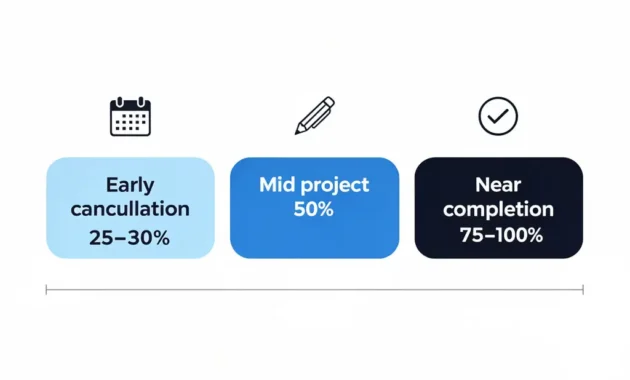
The answer depends on how far along the project is when it gets cancelled. Here is the standard breakdown most experienced freelancers use:
25 to 30 percent if the project is cancelled very early. This is for situations where you have done some planning and scheduling but not much actual deliverable work yet.
50 percent if the project is cancelled in the middle. This is the most common kill fee percentage across most industries. Advertising, media, copywriting, and design all tend to use 50 percent as the default.
75 to 100 percent if the project is nearly finished or already delivered. If you have done almost all the work and the client simply decides not to use it, you deserve close to your full fee.
In my own contracts I use a tiered system. 25 percent if cancelled before I submit anything. 50 percent once I have submitted initial work. 100 percent if I have delivered the final product and they choose not to use it.
Some freelancers prefer a flat rate instead. For example, a $500 kill fee no matter what the project size is. This works fine for small quick jobs. But for bigger projects, a percentage makes more sense because it scales with the actual value of the work.
For a deeper look at how freelance contracts should be structured overall, the Freelancers Union Contract Creator is one of the best free tools available and walks you through every major clause step by step.
How to Add a Kill Fee to Your Freelance Contract: Step by Step
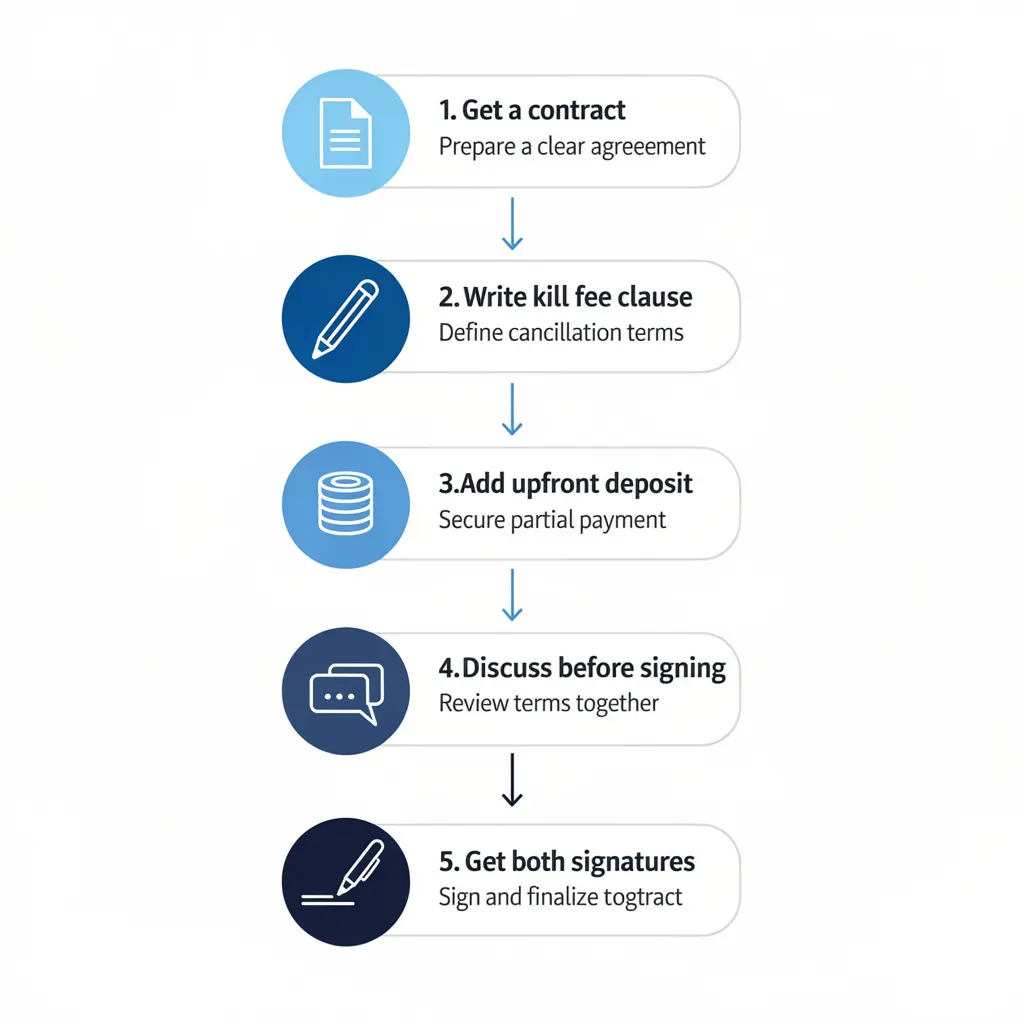
Ready to protect yourself? Here is exactly how to do it.
Step 1: Make Sure You Have an Actual Contract
If you are still doing work based on email threads and handshake deals, please stop right now.
You need a written contract before any project starts. Period.
There are great tools that make this easy. Bonsai, HoneyBook, and AND.CO all offer freelance contract templates with built in kill fee language you can customize. They also handle digital signatures so everything is official.
If you want a free option, Dropbox Sign (formerly HelloSign) lets you upload your own contract document and get it signed online at no cost.
Step 2: Write the Kill Fee Clause
Here is a simple sample clause you can copy and adapt:
“In the event that Client terminates this project after commencement, Client agrees to pay a kill fee equal to [X] percent of the total project fee. This kill fee is due within 14 days of written cancellation notice. If the final deliverable has been submitted and Client elects not to use it, the full project fee is owed.”
Replace [X] with your chosen percentage. Make sure the clause clearly states:
What event triggers the kill fee (client cancellation only, not your own failure to deliver)
How the amount is calculated
When it must be paid
Who keeps the rights to the work after payment
Step 3: Pair It with an Upfront Deposit
A deposit and a kill fee are two separate things. You want both.
A deposit locks in your time before the project starts. A kill fee compensates you if things fall apart midway through.
Here is the smart way to set it up. If you collect a 25 percent deposit at the start and your kill fee is 50 percent, the client only owes you the remaining 25 percent at cancellation. The deposit counts toward the total kill fee amount.
This makes the conversation much easier. You are not asking for surprise money. You are simply collecting what was already agreed upon.
Step 4: Bring It Up Before Anyone Signs
Do not hide the kill fee clause in fine print and hope the client does not see it. That is not professional and it will cause problems later.
Instead, mention it during your kickoff conversation before signing. Keep it casual and calm. Something like:
“I include a kill fee clause in all my contracts. It is standard practice. It protects both of us in case something unexpected happens. You probably will not ever need it, but it is there just in case.”
Notice how that framing works. You are calling it protection for both parties. Not just protection for you against the client. That tone makes a big difference in how people react.
Step 5: Get Both Signatures Before You Start Working
This is non negotiable. Both you and the client must sign the contract before any work begins.
A verbal agreement is not enforceable. An email saying “sounds good” is not enforceable. A signed contract is enforceable.
No signature, no start. That is the rule.
Kill Fee vs Cancellation Fee: Is There a Difference?
You will sometimes see these two terms used in different ways. Here is the simple breakdown.
A kill fee typically refers to payment made when a project is cancelled after real work has already been done. The word “kill” implies something that was alive and in progress has now been stopped.
A cancellation fee is sometimes used to describe a fee charged when a project is cancelled before any meaningful work has started. It is more like a booking fee you keep to compensate for the reserved time slot.
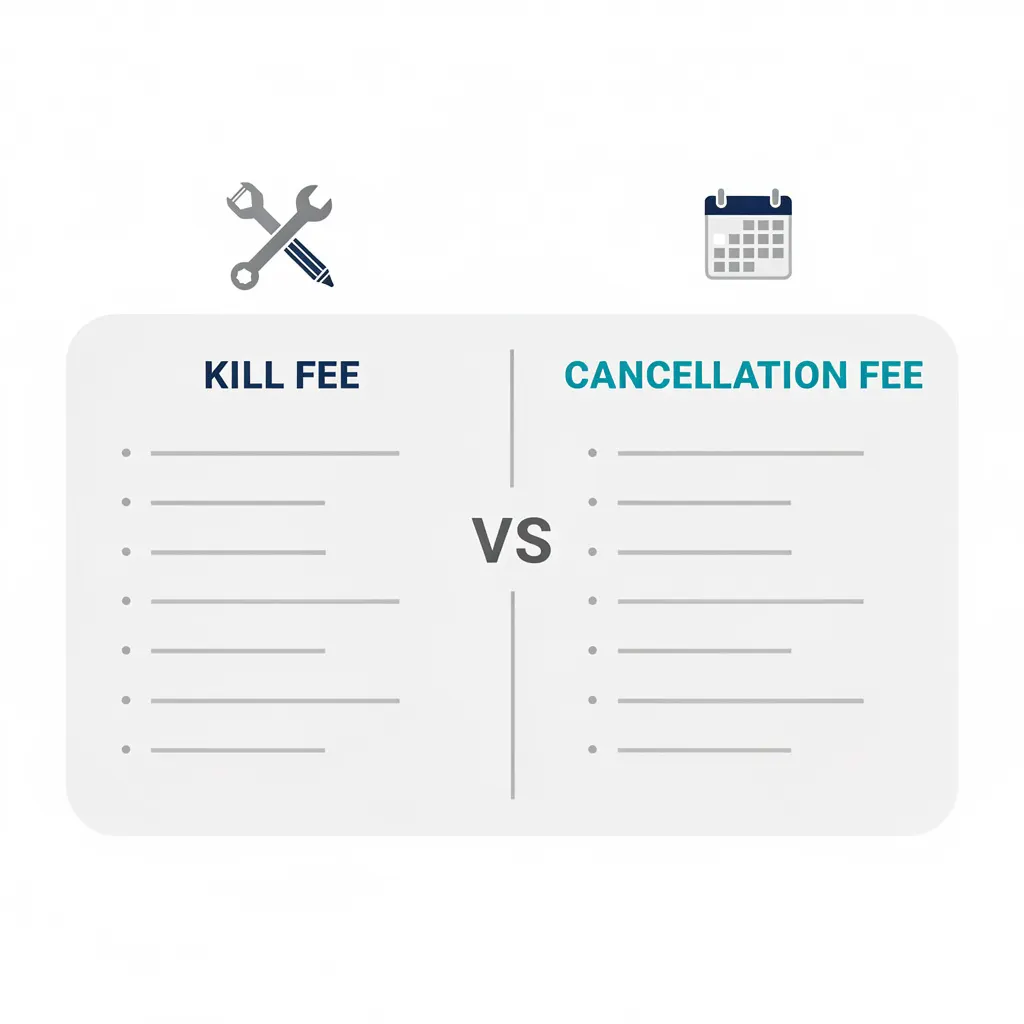
In practice, many freelancers use both terms interchangeably. What matters is not the label you use but how clearly the clause is written in your contract. Define exactly what triggers the payment and how much it is, and you will be fine either way.
Which Industries Use Kill Fees Most Often?
Kill fees are not just for writers. They show up across almost every area of freelance and creative work.
Journalism and Publishing: This is where kill fees started. When a magazine editor assigns a story and then decides not to run it, the writer still gets paid a portion of the fee.
Graphic Design and Illustration: Designers use kill fees when a client cancels after initial concept rounds have been delivered.
Photography and Video Production: These fields often deal with expensive equipment bookings and blocked calendar dates. Kill fees protect against last minute cancellations that are especially costly.
Copywriting: Copywriters use kill fees to protect against clients who commission full campaigns and then disappear.
Web Development and Software: Developers use kill fees because the technical setup and planning phases represent significant time investment even if the final build never launches.
Marketing and Strategy: Consultants and strategists who deliver research and planning documents before full execution use kill fees to protect that early phase work.

No matter what type of freelance work you do, if you invest time upfront and a client can cancel without consequence, a kill fee clause is relevant to you.
What Is a Kill Fee Freelance Contract Clause? Real Template Language
Want to see exactly what this looks like in a real contract? Here is a more detailed version you can adapt:
Kill Fee and Cancellation Policy
If Client cancels this project after project commencement, the following kill fee schedule applies:
Cancellation before first deliverable submission: 25 percent of total project fee is due within 7 days of written cancellation notice.
Cancellation after first deliverable submission but before final delivery: 50 percent of total project fee is due within 14 days of written cancellation notice.
Cancellation after final deliverable is submitted: 100 percent of total project fee is due within 14 days of written cancellation notice.
Upon payment of the applicable kill fee, all rights to the work in progress revert to Freelancer. Client does not retain rights to use, publish, distribute, or adapt any work for which a kill fee rather than the full project fee has been paid.
You can take this language, adjust the percentages and timelines to fit your own business, and drop it directly into your contract.
Common Mistakes Freelancers Make with Kill Fees
Even freelancers who know about kill fees often set them up wrong. Here are the most common mistakes.
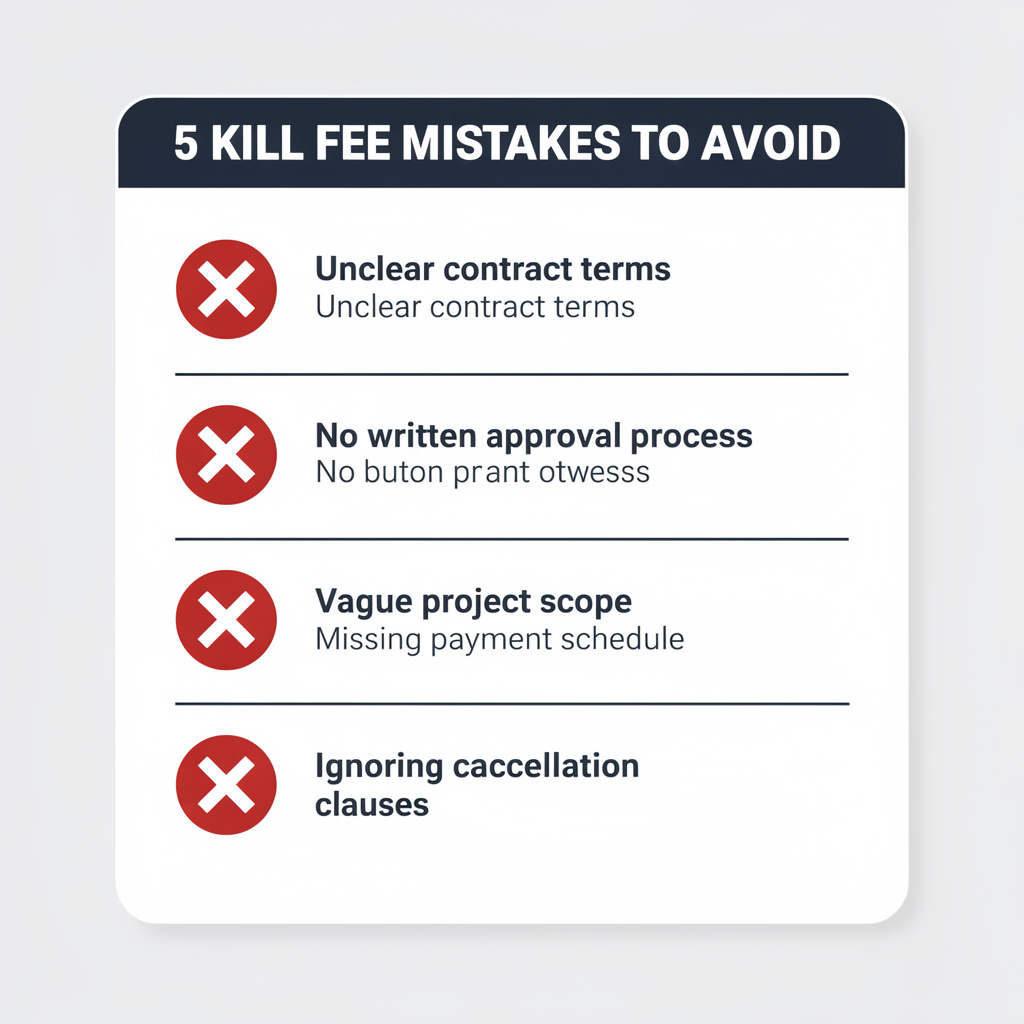
Setting the percentage too low. A 10 percent kill fee sounds polite but it will barely cover an hour of your time on most projects. Start at 25 percent at the very minimum.
Writing a vague trigger condition. Saying “if the project is cancelled” is not enough. Who cancels it? After what stage? Under what circumstances? Get specific. Write it like this: “If Client issues written cancellation notice after project commencement.”
Forgetting about content rights. This is a big one. When a kill fee is paid, who owns the work? In most standard freelance arrangements, the rights revert back to you. That means you can sell the work to someone else or use it in your portfolio. Make sure your clause states this clearly.
Adding it after a problem already happened. You cannot retroactively add a clause to a contract after something goes wrong. It must be there from the very beginning. Learn from my $1,400 mistake and add it before you ever start.
Being apologetic about having one. Lawyers have kill fees. Accountants have them. Photographers have them. You do not owe anyone an apology for protecting your income and your time.
What to Do When a Client Pushes Back on Your Kill Fee
Most clients will not push back at all. Professionals understand contracts.
But occasionally a client will say something like “I do not think we need that clause” or “can we just remove that part?” Here is how to handle it.
First, stay calm and explain it simply. “It is a standard clause that protects both of us if circumstances change. I include it in every contract I sign.”
If they continue to push back, that is actually useful information. A client who is very resistant to a clause that protects you from their cancellation is telling you something about how they operate. It is worth paying attention to.
I have walked away from projects because a client refused to sign a contract that included a kill fee clause. Every single time, I later found out the client had a history of cancelling on other freelancers. My gut was right.
A client who respects your business will respect your contract. If they do not respect your contract before the work starts, imagine how they will behave during the project.
Frequently Asked Questions About Kill Fees for Freelancers
Is a kill fee legally enforceable?
Yes, a kill fee written into a signed contract is legally binding in most countries. It is a standard contractual clause. Both parties agree to the terms before signing, which makes it enforceable the same way any other contract clause would be.
Can a client refuse to pay a kill fee?
A client can refuse, but that refusal creates a breach of contract. You would have legal recourse in that situation. Small claims court handles many freelance payment disputes. The signed contract is your evidence.
What if I collected a deposit and the client cancels?
The deposit typically counts toward the kill fee total. If your kill fee is 50 percent and you already collected 25 percent as a deposit, the client owes you the remaining 25 percent on cancellation.
Do I need a lawyer to write a kill fee clause?
Not necessarily. Many freelancers write their own using simple template language. Tools like Bonsai, HoneyBook, and the Freelancers Union Contract Creator have pre written clauses you can use. For large projects involving significant sums, consulting a lawyer is worth it.
Should the kill fee clause say what happens to the work?
Yes, always. Specify that rights revert to the freelancer when a kill fee rather than the full fee is paid. This prevents a situation where a client pays a kill fee and then tries to use your work anyway.
The Real Reason a Kill Fee Matters Beyond the Money
Here is something I want you to think about.
A kill fee clause is not just about protecting your income. It is about what kind of freelance business you are running.
When you show up to a client meeting with a real contract that includes clear protections, you are sending a signal. You are saying: I am a professional. I take my work seriously. I expect you to take it seriously too.
The clients who are also serious about their work will respect that. They will see it as a sign that they are hiring someone who knows what they are doing.
The clients who roll their eyes at it? Those are the ones who will also ignore your invoices, ghost you mid project, or change the scope of work three times without paying extra. The kill fee clause is actually doing you a favor by helping you spot them early.
I lost $1,400 on that first cancelled project. I will never make that mistake again. And you do not have to either.
Write the clause. Add it to your template right now. Talk about it calmly with every new client before you sign. And then go do the best work of your life, knowing you have a floor under you if things go sideways.
That protection is worth way more than the five minutes it takes to add it to your contract.
If you are building your freelance contract from scratch, the Freelancers Union Contract Creator is one of the most trusted free tools for independent workers and covers every major clause including kill fees, payment terms, intellectual property rights, and more.
If you’re looking for more real world insights and practical tips to level up your freelancing journey, make sure to check out our website. We regularly share simple, actionable content to help you land better clients, protect your time, and confidently grow your freelance career.