

Self employment tax deductions freelancer is the phrase that could change how much money you keep from every dollar you earn. If you are a freelancer or independent contractor in the United States, you already know that taxes hit differently when you work for yourself. The government does not automatically take anything out of your paychecks. That is both a blessing and a trap.
The first time many freelancers file taxes on their own, the number they owe shocks them. That is because self employment tax adds a full 15.3 percent on top of regular income tax. On $60,000 in freelance income, that is around $9,200 just in self employment tax before income tax is even counted.
But here is the good news that nobody tells you on day one: the IRS gives freelancers access to a long list of legal write-offs. These deductions reduce your taxable income, which means they reduce both your income tax and your self employment tax at the same time. Every $1,000 you write off saves you somewhere between $350 and $500 depending on your tax bracket. That math adds up fast.
This guide covers all 15 of the most powerful self employment tax deductions for freelancers, written in plain English. No confusing jargon. No vague advice. Just exactly what you can write off, how much you can save, and what the IRS requires from you.
Quick Stats:
- Self employment tax rate on net earnings: 15.3%
- Saved per $1,000 in legitimate deductions: $350 or more
- Average deductions claimed vs. entitled: 40% fewer than qualified
What You Will Learn in This Guide
- Why Freelancers Pay More Tax Than Employees
- The 15 Self Employment Tax Deductions for Freelancers
- 4 Common Mistakes That Cost Freelancers Money
- Best Tools to Track Your Deductions
- Quick Reference Deduction Table
- Frequently Asked Questions (People Also Ask)
Why Freelancers Pay More Tax Than Employees
When you work a regular job with a W-2, your employer pays half of your Social Security and Medicare taxes. You never even see that money. When you work as a freelancer, you pay both halves yourself. That is the self employment tax. It covers 12.4 percent for Social Security and 2.9 percent for Medicare, which equals 15.3 percent total.
This tax is calculated on 92.35 percent of your net earnings from self employment, not your gross income. So if you earned $70,000 in freelance income and had $20,000 in deductible expenses, your net is $50,000. Your self employment tax is calculated on $46,175 of that. That is already one way deductions help you.
The IRS standard rule for what counts as deductible is this: any expense that is ordinary and necessary for your business qualifies. Ordinary means it is common in your line of work. Necessary means it is helpful to running your business. You do not have to prove the expense was absolutely required. You just have to show it was reasonable and related to your work.
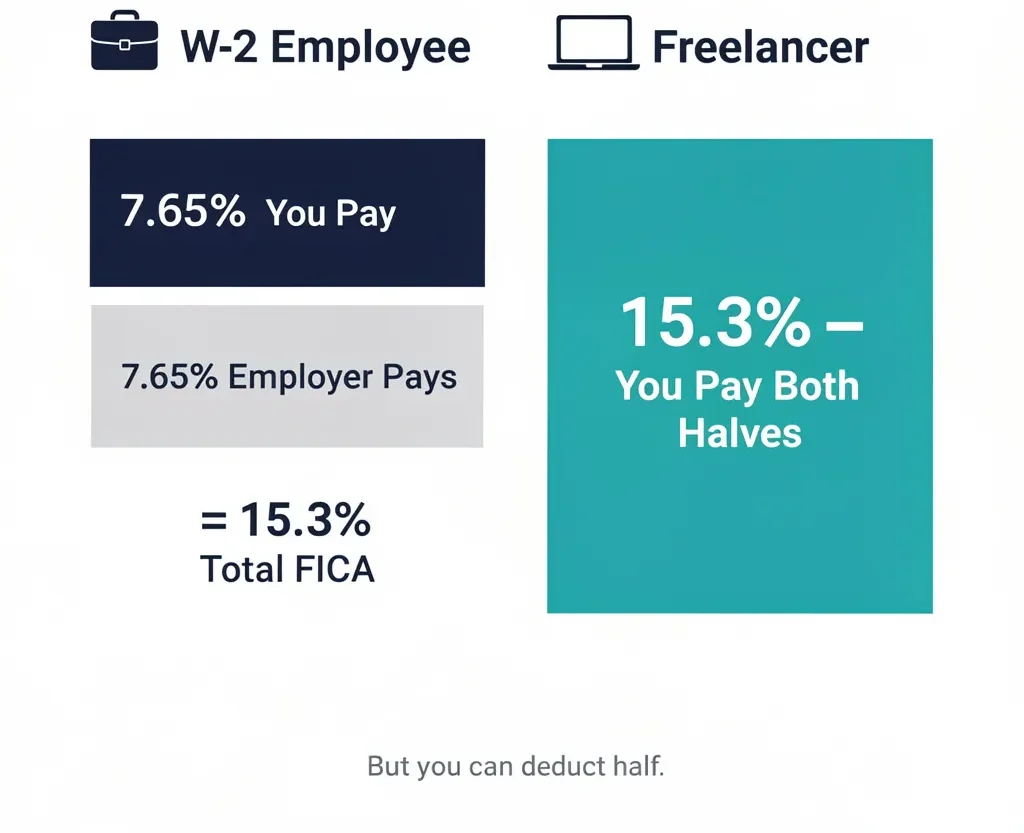
Key Point: Every dollar you deduct reduces your net income, which shrinks both your income tax AND your self employment tax. That is why freelancer deductions are worth more than most people think.
The 15 Self Employment Tax Deductions Freelancer Should Know
Deduction 1: Self Employment Tax Deduction Deduct Half of What You Paid
Often Missed High Value
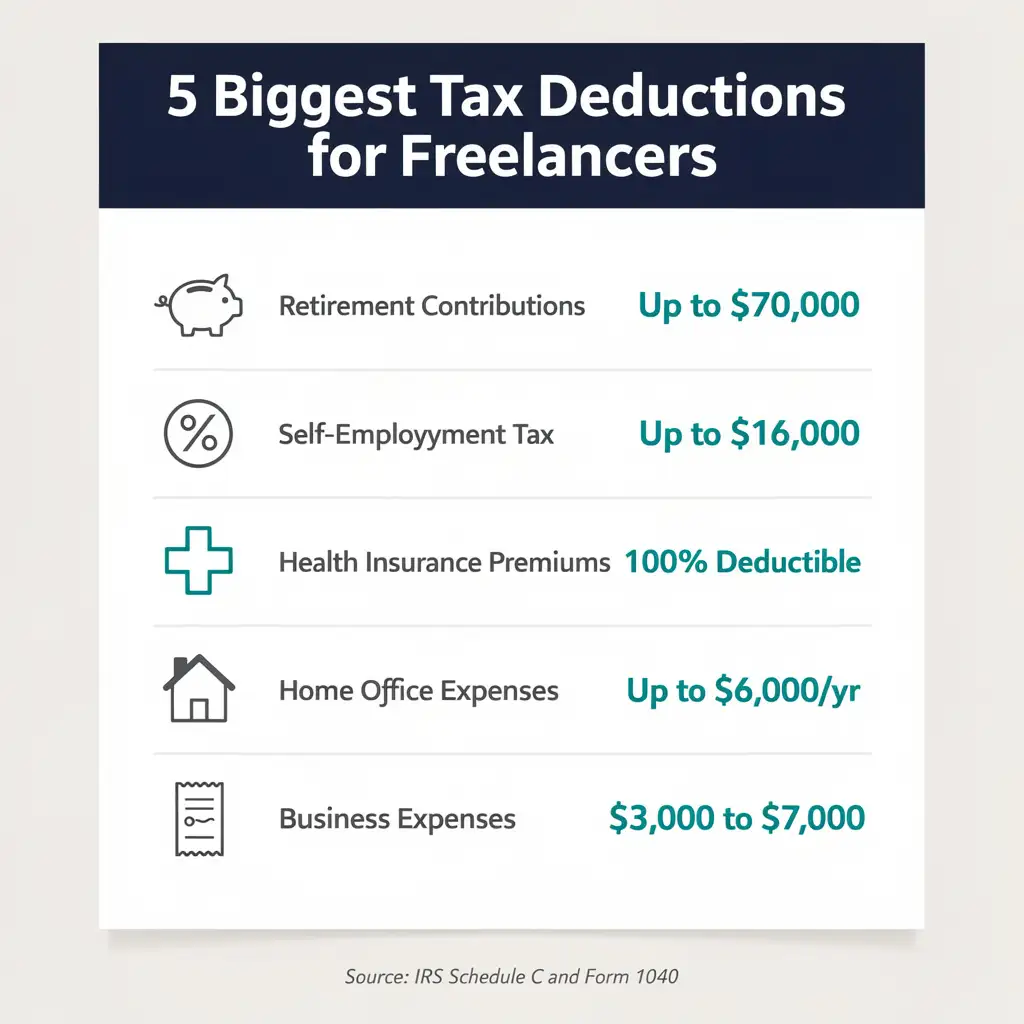
This is the first deduction on the list because it is the one most freelancers do not know about in their first year. You pay self employment tax. The IRS then lets you deduct exactly half of that amount from your adjusted gross income.
This does not go on Schedule C where most business expenses live. It goes directly on your Form 1040 as an above the line deduction. That means you get it whether or not you itemize. You do not have to do anything special to qualify. If you paid self employment tax, you get to deduct half of it. Full stop.
On $70,000 of net freelance income, your self employment tax is roughly $9,890. Your deductible amount is about $4,945. That is nearly $5,000 knocked off your adjusted gross income with a single line on your tax return.
How to Claim It: IRS Schedule SE calculates your self employment tax. The deductible amount is then carried to Schedule 1 of your Form 1040, Line 15. Your tax software handles this automatically.
Deduction 2: Qualified Business Income Deduction for Freelancers (Section 199A)
Up to $16,000 Off Your Income
The Qualified Business Income deduction, called the QBI deduction, lets eligible freelancers deduct up to 20 percent of their net business income. This is one of the biggest deductions available to self employed people, and as of 2026 it was made permanent by the One Big Beautiful Bill Act. The cliff that everyone worried about is gone.
If you have $80,000 in net freelance income, you could potentially deduct $16,000 right off your taxable income. No itemizing needed. No special account required. It just reduces your income.
There are income limits. For 2026, the deduction starts to phase out when your total taxable income goes above $200,900 for single filers or $401,800 for joint filers. Some professions also have restrictions at higher income levels. But for most freelancers earning under $200,000, the full deduction is available.
Pro Tip: Run this past a CPA if your income is above $150,000. The phase-out rules can get complicated for certain types of freelance work, especially in professional services.
Deduction 3: Home Office Deduction for Self Employed Freelancers
Up to $4,320 Per Year in Rent Alone
The home office deduction has an unfair reputation for triggering audits. That is mostly a myth that comes from older tax rules. If you use a part of your home regularly and exclusively for business, you are allowed to deduct it.
Simplified Method vs Actual Expense Method
The simplified method gives you $5 per square foot of your home office space, up to 300 square feet. That caps at $1,500, but it takes about five minutes to calculate and requires no receipts.
The actual expense method takes more work but usually saves more money. You calculate what percentage of your home your office takes up and apply that percentage to rent, utilities, internet, insurance, and repairs. If your office is 180 square feet and your apartment is 900 square feet, that is 20 percent. A freelancer paying $1,800 per month in rent could deduct $4,320 per year from rent alone, before utilities.
The word to pay attention to is exclusively. Your office space needs to be used only for work. A dedicated room you use only for client calls and project work qualifies. A couch where you sometimes open your laptop does not.
Gray Area: A dedicated desk in a corner of a room is a common gray area. Many freelancers claim it reasonably, especially when the space is clearly set up as a workspace. A tax professional can help you decide if your specific setup qualifies.
Deduction 4: Health Insurance Premium Deduction for Freelancers
100% Deductible If You Are Self Employed
If you pay for your own health insurance and you are not eligible to join a spouse’s employer plan, you can deduct 100 percent of your premiums as a self employed person. Medical, dental, and vision coverage all count. This includes coverage for your spouse, your dependent children, and even your kids up to age 26.
This is another above the line deduction, meaning it reduces your adjusted gross income directly and you do not need to itemize to get it.
A freelancer paying $450 per month for family health coverage is deducting $5,400 per year with this one line. That is real savings, not a rounding error.
One limit to know: your deduction cannot exceed your net self employment income for the year. If you earned $10,000 freelancing and paid $12,000 in premiums, your deduction is capped at $10,000.
Deduction 5: Retirement Contributions SEP-IRA and Solo 401k Tax Benefits for Freelancers
Up to $70,000 Per Year
This deduction is both a write-off for this year and an investment in your future. Both wins happen at the same time, which is rare.
With a SEP-IRA, you can contribute up to 25 percent of your net self employment income, capped at $69,000 for 2026. Every dollar you put in reduces your taxable income by exactly one dollar.
With a Solo 401k, you contribute as both the employee and the employer. The employee side lets you put in up to $23,500 for 2025. The employer side allows up to 25 percent of net income on top of that. Combined cap is $70,000. It takes more paperwork to set up, but the flexibility is worth it for higher earners.
A freelancer in the 22 percent bracket putting $10,000 into a SEP-IRA saves $2,200 in income tax, plus the self employment tax reduction. There is no legal way to cut your tax bill this cleanly and this directly.
Best For: Freelancers who want to reduce taxes now and build retirement savings at the same time. Open a SEP-IRA through Fidelity, Vanguard, or Schwab in minutes online.
Deduction 6: Business Equipment and Tech Gear Section 179 Deduction for Freelancers
Deduct the Full Cost in Year One
Bought a new laptop for client work? Deductible. External monitor, drawing tablet, webcam, mechanical keyboard, noise-canceling headphones for calls, external hard drive? All deductible.
Section 179 is the rule that lets you deduct the full cost of equipment in the year you bought it, rather than spreading it over several years of depreciation. For a $1,200 laptop, take the whole deduction now. Do not wait. Bonus depreciation works similarly for larger purchases.
The documentation habit that protects you: keep your receipts and write a short note about what you use each item for. Something like “MacBook Pro, primary work computer for writing, video calls, and client projects” in your records is everything you need if anyone ever asks.
Deduction 7: Software Subscriptions Tax Deductible for Freelancers
Every Work Subscription Counts
Every subscription you pay that helps you do your work is a deductible business expense. This category catches a lot of freelancers off guard because the amounts feel small, but they add up to hundreds or even thousands per year.
Deductible subscriptions include:
- Adobe Creative Cloud
- Notion, Obsidian, or other project organizers
- Grammarly Premium
- Zoom Pro and Slack paid plans
- QuickBooks Self-Employed or Wave accounting
- Canva Pro, Figma, or Sketch
- SEO tools and keyword research platforms
- Cloud storage used for work such as Google Drive or Dropbox
- Any analytics software or automation tools
Tracking Tip: Keep a spreadsheet of every subscription with a column for the percentage you use it for business. Export it at year end and hand it to your accountant. A 30-minute setup saves hours in April.
Deduction 8: Internet Bill Deduction for Freelancers
Up to 90% Deductible If Used for Work
Your internet is almost certainly a legitimate business expense if you work online. You do not deduct 100 percent in most cases because you probably also use it for personal things. But the business use portion is fully deductible.
If your internet is used about 80 percent for work, you deduct 80 percent of your monthly bill. On a $90 monthly plan, that is $864 per year. Pick a percentage you can reasonably defend, stick to it every year, and document your reasoning briefly in your records.
Deduction 9: Phone Bill Deduction for Self Employed Workers
Deduct the Business Portion
Same logic applies to your phone. Figure out what percentage of your phone use is for business, including client calls, emails, project management apps, and messaging platforms like Slack or Teams, and deduct that portion of your monthly bill.
If you have a dedicated line used only for business, that is 100 percent deductible. Most freelancers use one phone for both, so a percentage between 50 and 80 percent is commonly claimed depending on usage. On an $85 monthly plan at 70 percent business use, that is nearly $714 per year in deductions.
Deduction 10: Professional Development Deduction for Self Employed Freelancers
Every Work-Related Course Qualifies
The IRS allows you to deduct any education expense that maintains or improves skills you use in your current freelance work. This covers a surprisingly wide range of spending.
Deductible professional development includes:
- Online courses on Udemy, Coursera, Skillshare, or LinkedIn Learning
- Industry conference registration fees
- Books, e-books, and audiobooks related to your field
- Professional membership dues for associations and guilds
- Paid newsletter subscriptions in your industry
The line the IRS draws: the education has to maintain or improve skills for your current career, not qualify you for a brand new one. A web developer taking an advanced JavaScript course? Deductible. That same web developer taking a real estate licensing course? Not deductible.
Deduction 11: Business Mileage Deduction for Freelancers and 1099 Workers
67 Cents Per Mile in 2024
If you drive for work purposes, you can deduct those miles using the IRS standard mileage rate. For 2024 the rate was 67 cents per mile. That means 500 business miles is a $335 deduction.
What counts as a business drive: going to client meetings, picking up office supplies, driving to a coworking space, attending networking events, and visiting job sites. What does not count: your regular daily commute to a fixed place of business.
The easiest way to track this is with an app. MileIQ uses GPS to log every drive automatically. You swipe right for business and left for personal at the end of each day. At year end you export a full report for your accountant. Everlance and Hurdlr do the same job well.
IRS Requirement: You must keep a mileage log that shows the date, destination, business purpose, and number of miles for every business drive. Apps do this automatically, which is why they are worth using.
Deduction 12: Travel Expenses Deduction for Self Employed Freelancers
Flights, Hotels, and 50% of Meals
When you travel away from home for business, a significant portion of the cost is deductible. This includes airfare, train tickets, hotel stays, rideshare rides like Uber and Lyft, and 50 percent of meals during the trip.
The rule is that the trip must be primarily for business. If you fly to a conference for three days and then stay an extra day for tourism, the three business days are fully deductible. The personal day is not. The flights themselves may still be fully deductible if the main purpose of the trip was business.
Keep your conference registration, your itinerary, and any client-related documentation tied to the trip. A four-day business trip to another city for industry events can easily represent $1,500 to $2,500 in legitimate deductions.
Deduction 13: Business Meals Deduction The 50 Percent Rule for Freelancers
50 Percent of Qualifying Meals
When you share a meal with a client, a business partner, or a collaborator and you are discussing actual work during that meal, 50 percent of the cost is deductible. This used to be 100 percent for a brief period and then returned to 50 percent.
The key word is that business must actually be discussed. A lunch you eat alone at your desk while working does not qualify. A coffee meeting where you are pitching a new client qualifies. A dinner where you and a collaborator are reviewing project deliverables qualifies.
Document it when it happens. Write a short note on the receipt or in your phone: who you met with, what you discussed, and the date. A note like “coffee with Sarah Chen, discussed Q3 project scope and deliverables” is exactly what the IRS wants to see if they ever ask.
Deduction 14: Bank Fees and Payment Processing Deductions for Freelancers
Every Fee Adds Up
Every PayPal transaction fee, every Stripe cut, every wire transfer charge, every monthly business bank account fee, and every credit card processing charge is a deductible business expense. These feel small individually but add up to real money when you process a meaningful volume of client payments each year.
Platform fees from Upwork, Fiverr, Toptal, or any other freelance marketplace are also deductible. If the platform takes 20 percent of your project earnings, that is a 20 percent business expense on every project. Track it monthly so you do not undercount it at year end.
Deduction 15: Marketing and Advertising Deductions for Freelancers
Every Dollar Spent to Get Clients
Whatever you spend to attract clients and grow your freelance business is deductible as a marketing and advertising expense. This covers a wide range of common freelancer spending.
Deductible marketing and advertising expenses include:
- Website domain and hosting fees
- Portfolio site on Squarespace, WordPress, or Webflow
- LinkedIn Premium used for client outreach
- Google or social media advertising
- Business cards and printed marketing materials
- Professional headshots for your portfolio or website
- Designer fees for your logo or brand identity
- SEO audits or content marketing services
If you hired another freelancer to help with a project, their fees go under contract labor on Schedule C. That is also fully deductible as a business expense.
Quick Reference: Self Employment Tax Deductions at a Glance
| # | Deduction | Where to Claim | Typical Value |
|---|---|---|---|
| 1 | Half of SE Tax | Form 1040, Schedule 1 | $3,000 to $7,000 |
| 2 | QBI Deduction (20%) | Form 8995 | Up to $16,000+ |
| 3 | Home Office | Schedule C / Form 8829 | $1,500 to $6,000 |
| 4 | Health Insurance Premiums | Form 1040, Schedule 1 | $3,000 to $8,000 |
| 5 | Retirement Contributions | Form 1040, Schedule 1 | Up to $70,000 |
| 6 | Equipment (Section 179) | Schedule C / Form 4562 | $500 to $5,000 |
| 7 | Software Subscriptions | Schedule C | $500 to $3,000 |
| 8 | Internet Bill | Schedule C | $600 to $1,200 |
| 9 | Phone Bill | Schedule C | $400 to $800 |
| 10 | Professional Development | Schedule C | $200 to $2,000 |
| 11 | Business Mileage | Schedule C | $300 to $2,000 |
| 12 | Travel Expenses | Schedule C | $500 to $3,000 |
| 13 | Business Meals (50%) | Schedule C | $200 to $1,000 |
| 14 | Bank and Processing Fees | Schedule C | $200 to $800 |
| 15 | Marketing and Advertising | Schedule C | $500 to $5,000 |
4 Mistakes Freelancers Make That Cost Real Money
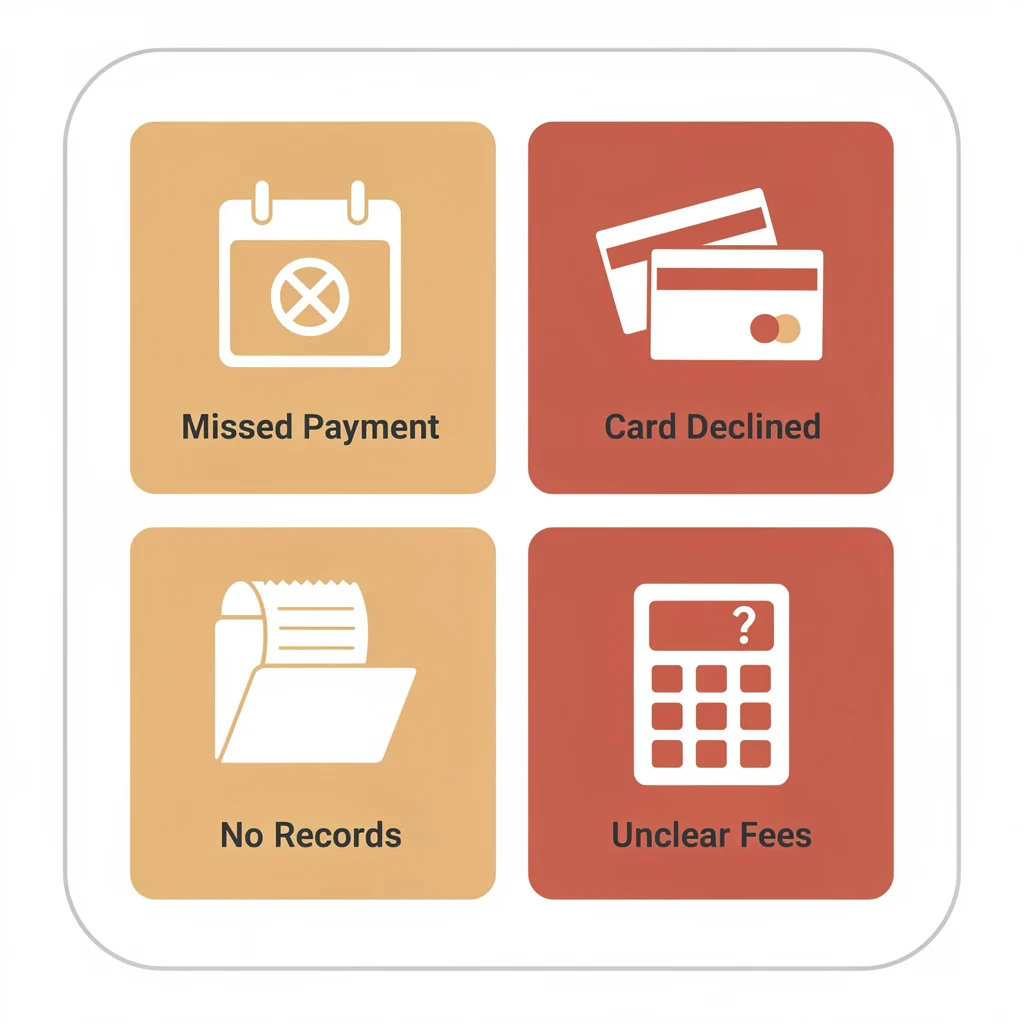
Mistake 1: Not Tracking Expenses While They Happen
Trying to reconstruct 12 months of expenses from bank statements in February is painful and inaccurate. Use a dedicated business card and log expenses monthly. Twenty minutes a month beats ten hours at tax time.
Mistake 2: Mixing Personal and Business Money
Open a separate business checking account even if it is just a free account at your local bank. It makes everything cleaner, easier to audit, and easier to hand off to an accountant. No more guessing if that $249 charge was business or personal.
Mistake 3: Skipping Quarterly Estimated Tax Payments
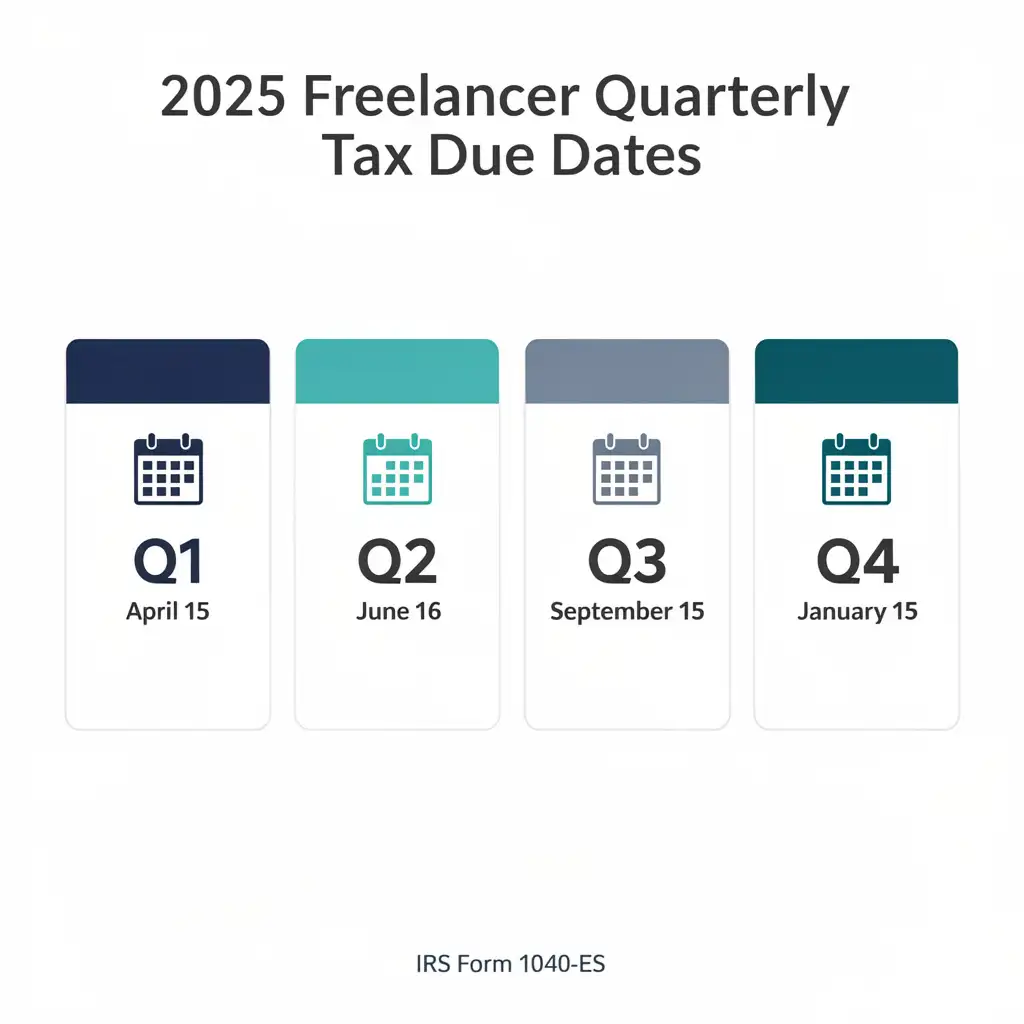
Your deductions reduce what you owe at year end, but you are still required to pay in quarterly throughout the year. The due dates are April 15, June 16, September 15, and January 15. Miss them and the IRS charges an underpayment penalty, even if you end up with a refund.
Mistake 4: Not Hiring a CPA Once Income Grows
Free tax software works when you are just starting out. Once your freelance income passes around $40,000, a CPA who works with self employed people typically saves you far more than their fee. A good one costs around $300 to $600 per year and consistently finds deductions that software misses entirely.
Best Tools to Track Your Self Employment Tax Deductions
QuickBooks Self-Employed: Expense tracking, mileage logging, quarterly tax estimates, and Schedule C prep all in one place. Best all-around option for active freelancers.
FreshBooks: Invoice management plus expense tracking. Great for freelancers who send a lot of invoices to clients and want everything in one dashboard.
Wave Accounting: Free. Genuinely solid accounting software for freelancers just getting started and watching costs closely.
MileIQ: GPS-based automatic mileage tracking. Swipe to classify each trip as business or personal. Export a full year report at tax time.
Everlance: Mileage tracking plus expense management. Alternative to MileIQ with a free tier for lower mileage needs.
A Dedicated Business Credit Card: Any no-annual-fee business card with a monthly statement keeps personal and business expenses separated automatically. The statement alone handles half your recordkeeping.
For the authoritative source on how the IRS defines self employment income and deductions, visit the IRS Self-Employed Individuals Tax Center at irs.gov. It covers filing requirements, quarterly payment rules, and links to all relevant forms including Schedule C and Schedule SE.
Frequently Asked Questions About Self Employment Tax Deductions
What can I deduct on my taxes as a freelancer?
As a freelancer you can deduct any business expense that is ordinary and necessary for your work. The most common categories are home office, health insurance premiums, retirement contributions, software subscriptions, equipment, internet and phone bills, professional development, business mileage, travel, meals with clients, bank and payment fees, and marketing costs. You can also deduct half of your self employment tax and potentially 20 percent of your net income through the QBI deduction.
Do freelancers have to pay self employment tax?
Yes. If your net freelance income is $400 or more in a year, you are required to pay self employment tax. The rate is 15.3 percent, which covers Social Security at 12.4 percent and Medicare at 2.9 percent. This applies on top of regular income tax. The good news is that you can deduct half of what you pay in self employment tax from your adjusted gross income, which reduces both your income tax and your overall tax bill.
How do I deduct 50 percent of self employment tax?
First, you calculate your total self employment tax using IRS Schedule SE. Half of that amount is then deducted on Schedule 1 of your Form 1040, Line 15. Most tax software including TurboTax and H&R Block handles this calculation and transfer automatically. You do not need to do anything special to claim it other than filling out Schedule SE, which the software also generates automatically when you report self employment income.
What expenses can I deduct for self employment on Schedule C?
Schedule C is where most of your business expense deductions are reported. Deductible expenses on Schedule C include advertising and marketing costs, car and truck expenses, commissions paid to others, contract labor, depreciation, insurance, interest on business loans, legal and professional fees, office expenses, rent on business property, repairs and maintenance, supplies, travel, meals at 50 percent, utilities, wages paid, and other business expenses. Home office costs can go on Schedule C or on Form 8829 if you use the actual expense method.
Is a laptop tax deductible for freelancers?
Yes, a laptop is deductible when it is purchased for and used in your freelance business. If you use it 100 percent for work, you can deduct 100 percent of the cost. If you use it for both work and personal purposes, you deduct the business use percentage. Using Section 179 lets you deduct the full cost in the year you buy it rather than depreciating it over several years, which most freelancers prefer for a standard laptop purchase.
Can freelancers deduct home office expenses even if they rent?
Yes. Renters and homeowners both qualify for the home office deduction. If you rent, you apply your office space percentage to your monthly rent payments and deduct that portion. You also apply the same percentage to utilities and internet costs. The rules are the same: the space must be used regularly and exclusively for business. The simplified method at $5 per square foot works the same way whether you rent or own.
What is the QBI deduction and do freelancers qualify?
The Qualified Business Income deduction, also called the QBI deduction or Section 199A, allows eligible self employed people to deduct up to 20 percent of their net business income from their taxable income. Most freelancers qualify if their income falls below the phase-out thresholds, which for 2026 are $200,900 for single filers and $401,800 for married filing jointly. This deduction was made permanent in 2026 by the One Big Beautiful Bill Act. It does not require itemizing and is one of the largest deductions available to freelancers.
Can I deduct subscriptions and software as a freelancer?
Yes. Any software subscription you use for your freelance work is a deductible business expense. This includes design tools like Adobe Creative Cloud and Figma, project management tools like Notion, communication tools like Zoom Pro, accounting software like QuickBooks or Wave, SEO platforms, cloud storage used for client files, and any other subscription that helps you do your work. Keep records of what each subscription is used for in case you are ever asked.
When do freelancers pay quarterly estimated taxes?
Quarterly estimated taxes are typically due four times a year. For the 2025 tax year the due dates are April 15 for Q1, June 16 for Q2, September 15 for Q3, and January 15, 2026 for Q4. If you expect to owe $1,000 or more in tax for the year after accounting for your deductions, you are generally required to make these payments. Underpayment can result in a penalty even if you get a refund at year end. Use IRS Form 1040-ES to calculate and send quarterly payments.
Do freelancers pay more taxes than regular employees?
In raw terms, yes, because freelancers pay both the employer and employee portions of Social Security and Medicare, which adds up to 15.3 percent in self employment tax on top of income tax. An employee only pays 7.65 percent because their employer covers the other half. However, freelancers also have access to far more deductions than employees, including home office, equipment, professional development, health insurance premiums, and retirement contributions. With good tax planning, many freelancers end up paying a similar effective rate to employees with comparable income.
What is the best tax software for self employed freelancers?
TurboTax Self-Employed and H&R Block Self-Employed are the most widely used options for freelancers filing their own taxes. Both guide you through Schedule C and include prompts for common self employment deductions. For year-round bookkeeping and expense tracking, QuickBooks Self-Employed and Wave are better suited. Wave is free and handles most freelancer needs. QuickBooks costs around $15 per month and integrates with more banking and invoicing tools. Once your income grows above $50,000, hiring a CPA often costs less than the time you spend doing it yourself.
The Tax Code Favors Freelancers. Go Claim It.
The IRS does not send you a welcome kit when you go freelance. Nobody tells you which forms to file, which deductions you qualify for, or how to structure your finances to legally keep more of what you earn. You have to go find that information yourself.
Now you have it. All 15 of the most powerful self employment tax deductions for freelancers are in this guide, along with exactly where to claim each one and what the IRS requires from you to do it safely.
The next step is simple: start tracking your expenses today. Open a spreadsheet, download a mileage app, or set up a free Wave account. The deductions do not work if the receipts do not exist. Fifteen minutes of setup today means hundreds or thousands of dollars saved next April.
Save your receipts. Use a separate card for business. Track as you go. Your future self in April will thank you.
If you’re looking for more real world insights and practical tips to level up your freelancing journey, make sure to check out our website. We regularly share simple, actionable content to help you land better clients, protect your time, and confidently grow your freelance career.
Tax Disclaimer: This article is for informational and educational purposes only. Tax laws change frequently and individual situations vary. The figures and rules referenced reflect the 2025 to 2026 US federal tax year. Always verify current limits with the IRS and consult a qualified CPA or tax professional for advice specific to your financial situation.