
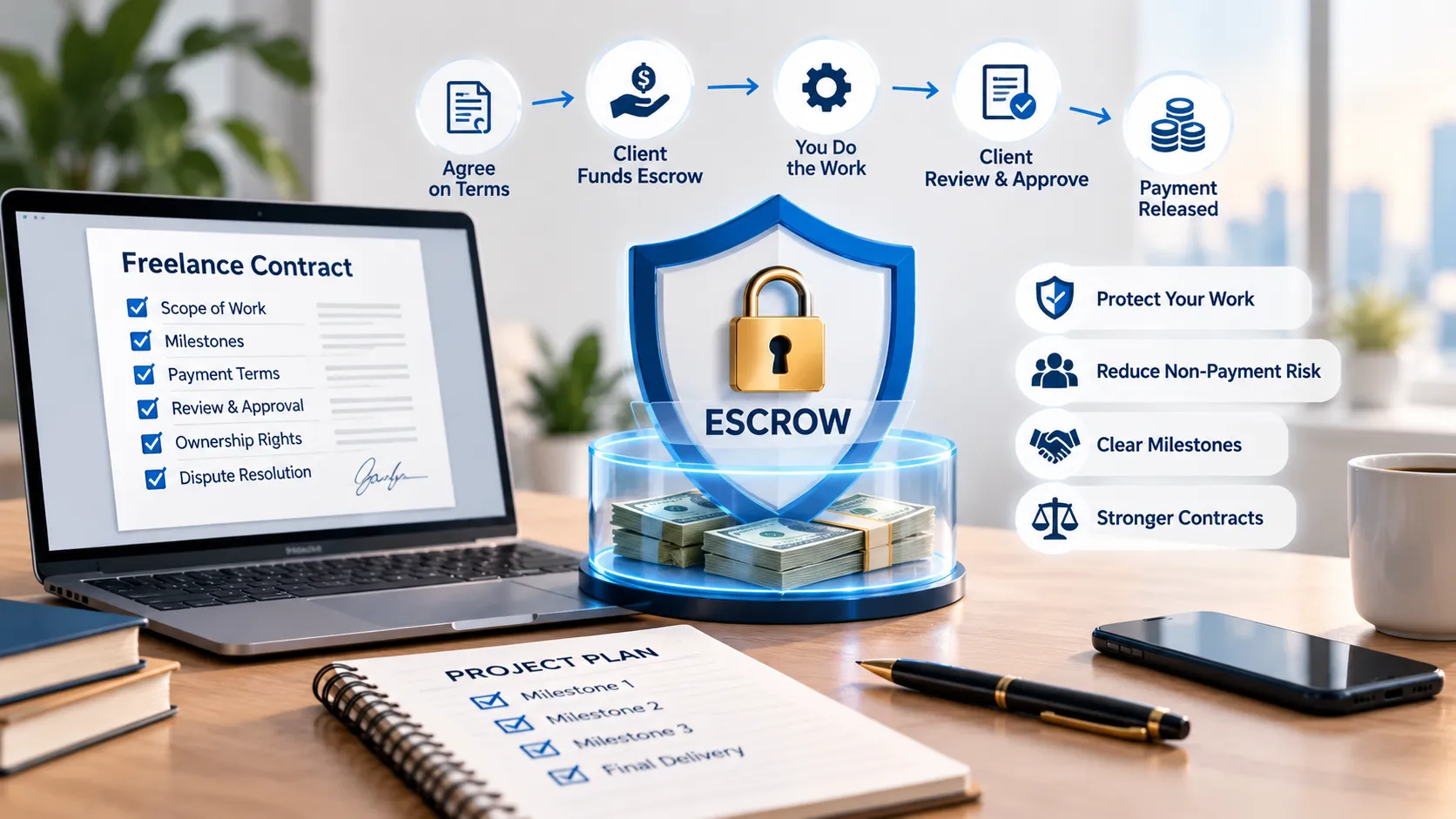
You delivered the work. The client said they loved it. Then the invoice sat unpaid for 60 days, and your follow-up emails went unanswered.
If you’re a freelancer in USA, this can happen to you at least once. The fix isn’t chasing harder after the fact. It’s setting up payment protection before you start: a written contract, clear milestones, and money held in escrow.
This guide explains where US law already protects freelancers, how escrow works step by step, and which contract clauses make escrow hold up when a client disputes the work.
What Laws Protect a Freelancer in USA?
Several US states now require clients to give freelancers a written contract and pay on time. If the contract doesn’t set a payment date, the client must pay within 30 days of the work being completed.
| Law | Covers work worth | Key rules |
|---|---|---|
| New York State Freelance Isn’t Free Act | $800 or more in 120 days | Statewide since 2024, building on New York City’s 2017 law. Freelancers can recover double damages plus attorney’s fees. |
| California Freelance Worker Protection Act | $250 or more in 120 days | In effect since January 1, 2025, for professional services like writing, design, marketing and photography. Late payment can mean up to double the unpaid amount. |
| Illinois Freelance Worker Protection Act | $500 or more in 120 days | Applies to contracts from July 1, 2024. The state labor department publishes a free model contract. |
These laws have limits. Each covers only certain workers and clients, and none of them gets the money into your account on its own. You still have to file a complaint or go to court, which takes months. If a client has already failed to pay, this guide on collecting unpaid invoices explains practical steps for pursuing the outstanding balance.
That’s why the strongest protection is making sure the money exists before you start. That’s what escrow does.
This article is general information, not legal advice. Check the rules in your state or talk to a lawyer about your situation.
How escrow works for freelancers
Escrow means a neutral third party holds the client’s money until the work is done. The client can’t take it back on a whim, and you can’t collect it until the agreed conditions are met. Both sides are protected.
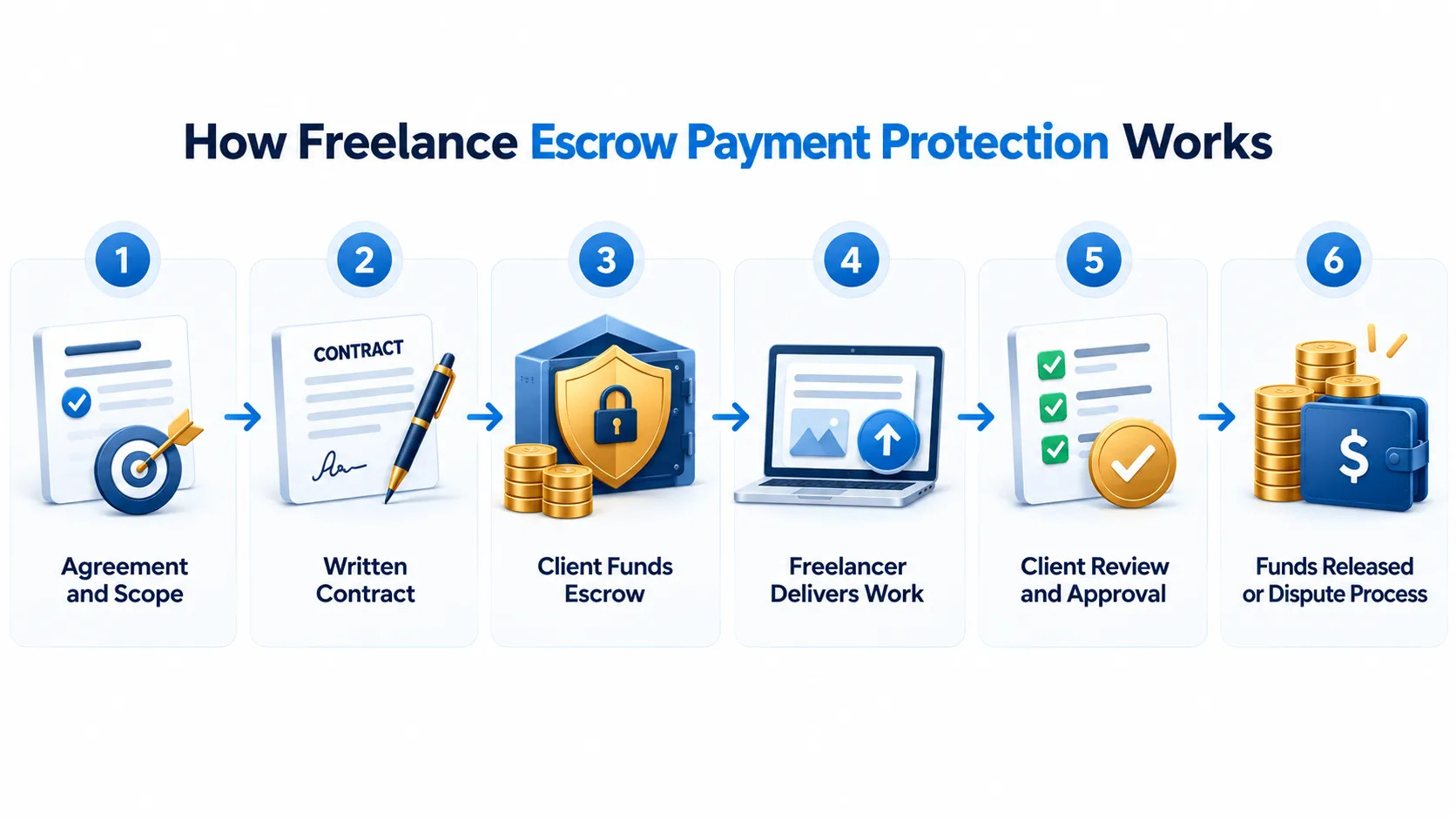
A typical escrow project runs like this:
- You agree on scope and price. You and the client sign a contract that lists the deliverables, deadlines and payment amount.
- The client funds escrow. The full amount, or the first milestone, goes to the escrow holder before you start any work.
- You do the work. You deliver against the agreed scope, knowing the money is already set aside.
- The client reviews. The client has a fixed window, such as five business days, to approve the work or request specific changes.
- The funds are released. On approval, or automatically when the review window ends without a response, the money goes to you.
- Disputes go to a process, not a standoff. If the client rejects the work, a dispute process decides what happens, and the money stays in escrow in the meantime.
You can use a standalone escrow service, or work through a platform that builds escrow into every job. Some freelance marketplaces, such as TalentedXpert, hold payment in escrow by default, so work only starts once the client’s payment is secured. Whichever you choose, check that the escrow holder is licensed or uses a regulated payment processor. Escrow services are regulated in many states.
Contract clauses that make escrow hold up
Escrow only works as well as the contract behind it. If “done” isn’t defined, a client can dispute almost anything. These six clauses close the most common gaps.
- A specific scope of work. List every deliverable, its format and its quantity, such as “five blog posts of 1,200 words each, delivered as Google Docs.” Vague scopes like “website content” are where most disputes start.
- Milestones tied to escrow deposits. Split larger projects into stages. Each stage is funded before it begins and released when it’s approved, so you’re never owed more than one milestone at a time.
- Acceptance criteria and a review window. State what counts as approved, and give the client a fixed time to respond. Add that the work is treated as accepted if the client doesn’t respond by the deadline. This stops projects from stalling forever.
- A revision limit. Include a set number of revision rounds, such as two, and a rate for extra rounds. Without a limit, “one more change” can hold payment hostage.
- Ownership transfers on payment. State that copyright or ownership of the work passes to the client only once payment is released. This gives clients a strong reason to pay.
- A dispute process. Say how disagreements are handled, whether through the platform’s process, mediation or arbitration, and which state’s law applies.
If you work in New York, California or Illinois, the laws above also require certain terms in writing, including the payment date. Building them into your standard contract alongside other freelance contract essentials can help create clearer expectations before work begins.
Escrow vs. deposits vs. invoicing
Escrow isn’t the only way to get paid. Freelancers can compare freelance payment methods based on speed, fees, client preferences, and the level of payment protection each method provides.
| Method | How it works | Risk to you | Risk to the client |
|---|---|---|---|
| Net-30 invoicing | You do the work, then bill | High: you’ve done all the work before any money moves | Low |
| Upfront deposit (often 30–50%) | Client pays part before you start | Medium: the rest is still unsecured | Medium: the deposit is in your hands |
| Escrow | A third party holds the full amount until approval | Low: the money exists before you start | Low: funds are released only for approved work |
Invoicing still works well with long-term, trusted clients. For new clients and larger projects, escrow gives you the certainty of a deposit without asking the client to take all the risk. For freelancers using longer payment windows, see this guide to Net 30 payment terms before agreeing to delayed payment.
Red flags and a checklist before you start
Watch for these warning signs from a new client:
- They refuse any written contract, or want to “sort out the details later.”
- They ask for “a quick free sample” that is really part of the paid project.
- They push you to move payment off a platform to avoid its fees or protections.
- They send an overpayment and ask you to refund the difference. This is a common scam.
- They won’t commit to a payment date.
Before you start any paid work, check that:
- The contract lists every deliverable, deadline and the payment amount.
- The payment date or trigger is in writing.
- Escrow is funded for the full project or the first milestone.
- The review window and revision limit are agreed.
- Ownership of the work transfers only on payment.
- You know how disputes will be handled.
The bottom line
New freelancer protection laws are a real step forward, but they help you after something goes wrong. Escrow and a clear contract stop it from going wrong in the first place. Get the scope in writing, fund escrow before you start, and tie ownership of your work to payment. Then you can spend your time on the work, not on chasing invoices.
About the author
Mojahed Qashoa is the Co-founder and CEO of TalentedXpert, a talent marketplace where businesses and individuals hire vetted local and online experts, with every task protected by escrow payments and two-way ratings.


