
Introduction: The One Thing Most New LLC Owners Get Completely Wrong
A limited liability company’s registered agent is one of the most misunderstood legal requirements in the entire business formation process. Most people filing their first LLC treat it like a checkbox. They pick a name, choose the cheapest option they find, and move on. I have watched that exact approach create enormous problems for small business owners later.
This is not a checkbox.
Your registered agent is the official legal bridge between your LLC and every government body, court system, and regulatory agency in the state where you operate. And yet, when I look at forums like Reddit’s r/smallbusiness, the same question keeps coming up over and over again: “Do you really need a registered agent, or can you just skip it?”
Short answer: You cannot skip it. Not legally. Not in any US state.
What you can do is make a smart, informed decision about who fills that role and how much you pay for it. That is exactly what this guide covers. I am going to walk you through everything, from the precise legal definition and state by state requirements to the real costs, the DIY versus professional debate, and which services are actually worth your money in 2026.
By the time you finish reading this, you will know more about limited liability company’s registered agent than most attorneys explain to their clients in an initial consultation.
What Is a Registered Agent for an LLC?
A limited liability company’s registered agent is a designated individual or professional service authorized to receive official legal documents, government notices, and service of process on behalf of the LLC. Every US state requires LLCs to maintain a registered agent with a verified physical address within the state during normal business hours.
That definition sounds simple. But unpacking it reveals a lot of important details.
The phrase “service of process” is the most legally significant part. Service of process means the formal delivery of legal documents that initiate a lawsuit or other court action against your business. If someone sues your LLC, the court does not send those papers to your general business email or your PO box. The process server or sheriff goes directly to your registered agent’s physical address.
This is why the role matters so much.
If your registered agent is unavailable when those papers arrive, or if your listed address is wrong, a court can enter a default judgment against your LLC before you even know a lawsuit was filed. I have read dozens of forum threads on Avvo and Law Stack Exchange where business owners describe exactly this nightmare scenario. It is more common than you think.
Beyond lawsuits, your registered agent also receives:
- Annual report reminders from the Secretary of State
- State tax notices and filing deadlines
- Regulatory compliance correspondence
- Notices of administrative action or revocation of status
- Certificate of good standing requests
- Any official government correspondence directed to your LLC
The registered agent is not a silent partner, a managing member, or an investor in your company. The role is purely functional. They receive documents. They forward them to you. That is the core job.
And every single US state, from Delaware to Wyoming, from Texas to California, legally requires your LLC to have one on file at all times.
The Legal Foundation: Why States Actually Require This
A lot of new business owners on Facebook groups and Reddit threads ask: “Why do states require a registered agent for an LLC?” It feels like just another fee or bureaucratic hurdle.
The reason is actually logical once you understand it.
When a state allows you to form an LLC, it grants your business legal personhood. Your LLC can sign contracts, own property, hire employees, and yes, be sued. But a legal person needs a legally reliable address where it can be served with official documents. Not a PO box. Not a virtual mailbox. A real, physical street address where a real, available person can accept papers.
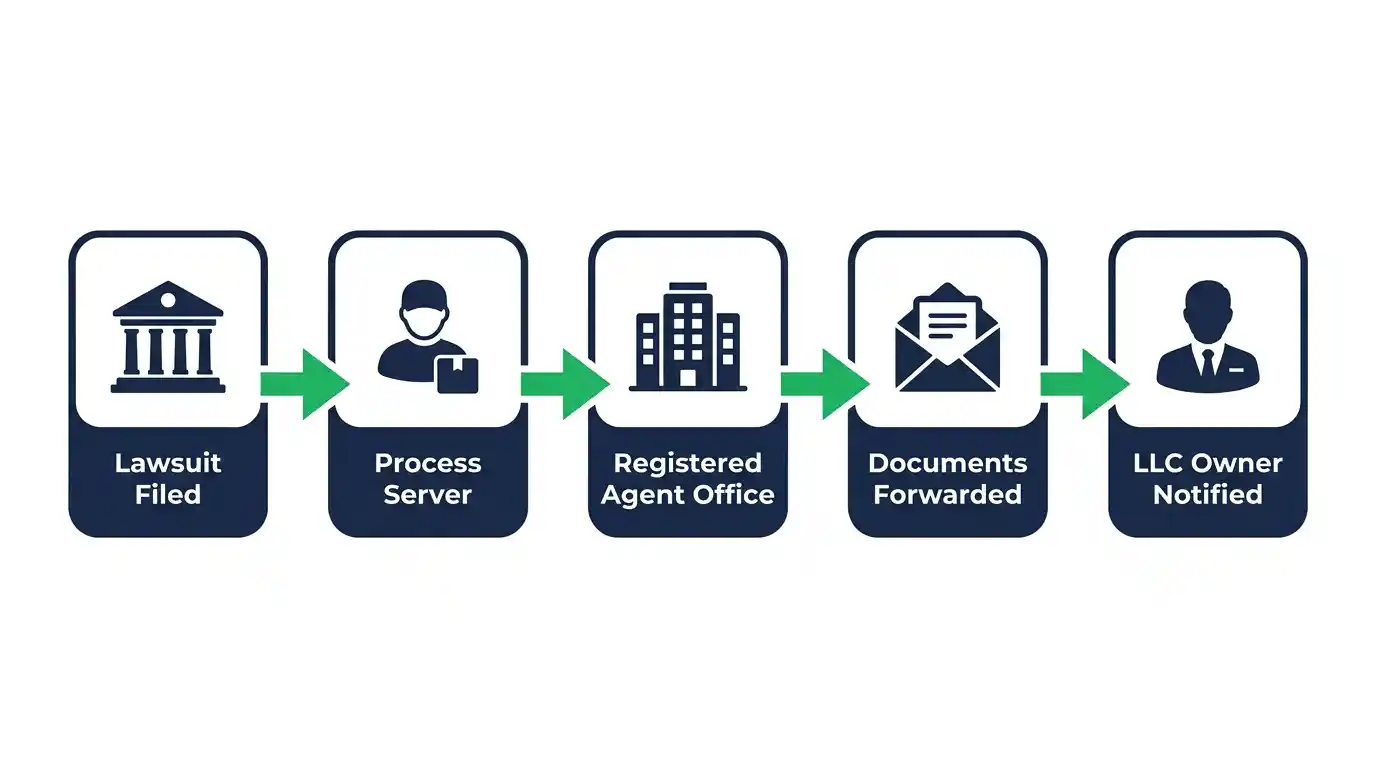
States need this guarantee because courts need it. Without a registered agent requirement, someone could form an LLC, get sued, and simply claim they never received notice of the lawsuit. The registered agent requirement closes that loophole completely.
According to the Texas Secretary of State’s official FAQ page, while an officer, owner, or employee can serve as the entity’s registered agent, the entity itself cannot be its own registered agent. That distinction matters. Your LLC cannot self represent in this function. A separate, identifiable person or company must fill the role.
This is federal business entity compliance law at work, interpreted and enforced at the state level through articles of organization filings and state filing requirements.
limited liability company’s registered agent Requirements: The Core Rules That Apply Everywhere
Before diving into the state by state breakdown, let me cover the universal limited liability company’s registered agent requirements that apply in every US jurisdiction.
The Physical Address Requirement
Your registered agent must maintain a physical street address in the state where your LLC is formed or registered. This is a hard requirement. No PO boxes. No virtual addresses that do not correspond to an actual physical location. No out of state addresses.
If your LLC is formed in Texas, your registered agent must have a physical address in Texas. If you later expand and register as a foreign LLC in California, you need a separate registered agent with a California address.
The Business Hours Availability Requirement
The registered agent must be available at that physical address during regular business hours. The standard is typically 9 AM to 5 PM, Monday through Friday, excluding major holidays.
This is the requirement that makes “I’ll just be my own registered agent” complicated for a lot of people. If you travel, work from the road, or simply do not sit at a fixed desk address during business hours every weekday, you technically cannot reliably fulfill this obligation yourself.
The Consent Requirement
The person or service you name as your registered agent must actually consent to that role. You cannot list someone’s name or address without their knowledge or agreement. Most states require the agent’s signature on the formation documents or on a separate consent form.
The Residency or Authorization Requirement
Individual registered agents must either be residents of the state where the LLC is registered or, in the case of commercial registered agent services, must be authorized to conduct business in that state.
An LLC registered agent cannot simply be any random person you name. They must meet these legal eligibility standards.
What Does an limited liability company’s registered agent Do? The Full Scope of Responsibilities
Let me give you the full picture here because most guides only mention “receiving legal documents” and move on.
Legal Duties and Responsibilities
The registered agent responsibilities that matter most in practice fall into three broad categories.
First: Accepting and handling service of process. This is the big one. When a lawsuit is filed against your LLC, the plaintiff’s attorney will have a process server deliver the summons and complaint to your registered agent’s address. Your agent must accept those documents, record the date and time of receipt, and get them to you immediately. Not next week. Immediately. Every day of delay is a day you are not preparing your legal response.
Second: Receiving official state and government correspondence. Your registered agent handles annual report reminders, state tax notices, compliance notifications from the Secretary of State’s office, and any other official government correspondence addressed to your LLC. Missing an annual report deadline in many states can cause your LLC to fall out of good standing or face administrative dissolution.
Third: Forwarding documents securely and promptly. The actual mechanics of the job involve receiving the physical mail or legal papers, scanning or photographing them (for digital services), and forwarding them to you through your preferred channel, whether that is email, postal mail, or an online portal. Many professional services now offer same day scanning and real time alerts through their client portals.
Documents a Registered Agent Receives
To make this concrete, here is the full list of document types that flow through a registered agent:
- Lawsuits, summons, and subpoenas (service of process)
- State annual report filing reminders
- Tax notices from the state department of revenue
- UCC filing notifications
- Franchise tax forms
- Administrative notices (penalty assessments, license renewals)
- Secretary of State correspondence (name change confirmations, amendment acknowledgments)
- Notices regarding certificate of good standing
- Regulatory agency correspondence specific to your industry
- Court orders directed at the LLC
That is a significant volume of legally critical mail. None of it can afford to get lost, delayed, or ignored.
What Happens If You Miss a Legal Notice?
This is the question I see most often from small business owners, and the answer is severe.
If a process server delivers a lawsuit to your registered agent and the agent is not available, unavailable, or the address is incorrect, the court does not pause and try again indefinitely. Depending on state law, after a certain number of failed service attempts or after service is made on the Secretary of State as a substitute (which many states allow), the court can proceed without your direct participation.
That means a judge could issue a default judgment against your LLC. You could lose a lawsuit and owe money or damages without ever having the chance to defend yourself.
Beyond lawsuits, missing state compliance notices leads to:
- Late filing penalties and fees
- Loss of good standing status
- Administrative dissolution of your LLC (the state literally cancels your business)
- Revocation of status for foreign LLCs
- Personal liability exposure if the corporate veil is pierced due to non compliance
These are not theoretical risks. They are documented outcomes that happen to real business owners every year.
Who Can Be a Registered Agent for an LLC?
The short answer: Any individual who is at least 18 years old, has a physical street address in the state, and is available during business hours can serve as a limited liability company’s registered agent in most US states.
But that short answer hides important nuance. Let me walk through each category.
Requirements to Qualify as a Registered Agent
The universal minimum requirements across all 50 states are:
- Must be at least 18 years of age (for individual agents)
- Must have a physical street address in the state (not a PO box)
- Must be available at that address during standard business hours
- Must consent to serving as the registered agent
- Must not be the LLC itself (the entity cannot be its own agent)
For commercial registered agent services (companies that provide this as a business), they must be authorized to do business in the state where they are providing the service.
Can a Family Member Be a Registered Agent for My LLC?
Yes. A family member can absolutely serve as your limited liability company’s registered agent, provided they meet all the requirements above. They must have a physical street address in the same state as your LLC, be available during business hours, and provide written consent.
The practical question is whether this creates problems. If your spouse is listed as your registered agent and a process server arrives at your home address while your spouse is at work, that creates the exact availability problem the requirement is designed to prevent.
A lot of people in small business Facebook groups advise this route as a way to avoid paying registered agent fees. And technically, it can work. But the risk of failure is real and the consequences are severe enough that I would not recommend it unless your family member genuinely works from home full time and understands the obligation.
Can an Attorney Be a Registered Agent?
Yes. A licensed attorney with a physical office address in your state is a perfectly valid registered agent. Some business attorneys include registered agent service as part of their retainer arrangements. The advantage is that your attorney may also be positioned to respond immediately to service of process on your behalf.
The disadvantage is cost. Attorney retainers are significantly more expensive than dedicated registered agent services, which typically run between $49 and $300 per year.
Can I Be My Own Registered Agent for an LLC?
One of the most searched questions across the entire topic. I get why. Paying $100 to $300 per year for someone to receive your mail feels unnecessary, especially when you are just starting out and every dollar matters.
Here is my honest take: You can be your own registered agent in most states. Whether you should is a different question entirely.
When Being Your Own Registered Agent Makes Sense
Being your own registered agent works reasonably well if:
- You have a fixed physical office address in the state where your LLC is registered
- You are physically present at that address during all standard business hours, every weekday
- You do not mind your personal home address appearing in public state records
- Your business is small and low risk enough that the likelihood of litigation is genuinely minimal
- You work exclusively in one state and do not need registered agent coverage in multiple jurisdictions
In that specific scenario, acting as your own registered agent costs nothing and works fine.
The Real Problems With the DIY Approach
But here is where it gets complicated for most people.
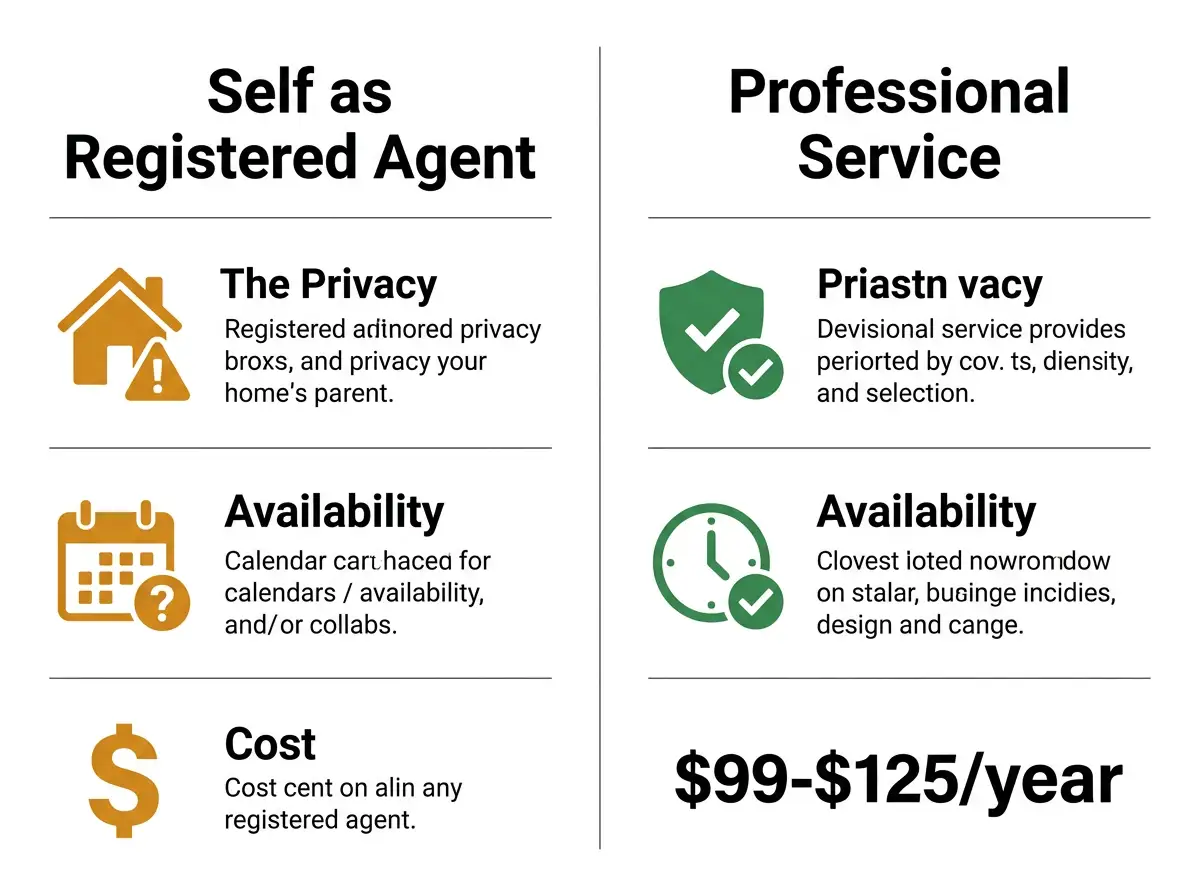
Privacy is the biggest issue most business owners miss. When you list yourself as your own registered agent using your home address, that address becomes part of the public business record filed with the Secretary of State. Anyone can look it up. Process servers, vendors, competitors, journalists, and anyone else who wants to find you can pull your home address from a public state database in seconds.
For many business owners, this is an unacceptable privacy risk.
Availability is the second major problem. You might start your LLC working from home with a fixed schedule. But businesses grow. Schedules change. You go to client meetings. You travel for work. You take vacations. The moment you are not at your listed address during business hours, you are in technical violation of your registered agent obligation, and more importantly, you risk missing critical legal documents.
Professionalism is the third consideration. When you appear in a state’s public business database, having a professional registered agent service listed rather than your personal home address sends a different signal to potential partners, clients, and lenders. Not every business owner cares about this. But some do.
What Reddit and Business Forums Actually Say
On Reddit’s r/smallbusiness, the most upvoted responses to questions about self registration consistently point to the privacy issue as the deciding factor. One highly voted comment specifically noted: “You pay the LLC fee anyway yourself. You need an RA that is available during regular business hours.” That is a community that skews strongly toward cost consciousness, and even they are recommending professional services for most situations.
The community on Quora raised the foreign LLC point, which I think is underappreciated. If you want to operate your LLC in a state where you do not live or maintain a physical office, you absolutely need a registered agent with a presence in that state. You cannot serve as your own agent across state lines. So as your business grows and you expand into new states, the DIY approach stops being viable anyway.
Registered Agent for LLC Services: Professional vs. DIY
Now that you understand the DIY considerations, let me give you a thorough look at what registered agent for LLC services actually provide and whether the cost is justified.
What Professional Registered Agent Services Actually Do
A commercial registered agent service does more than just receive your mail. Here is what the good ones provide:
Physical address in every state they cover. Most nationwide services maintain physical offices in all 50 states plus Washington DC. This means you can register your LLC in any state and immediately have a valid registered agent address, with no need to personally be present there.
Guaranteed business hours availability. A professional service has staff physically at the office during all required business hours, every business day. No vacations. No sick days. No gaps in coverage.
Document scanning and forwarding. When legal documents or official correspondence arrives, professional services scan everything and upload it to your secure online client portal. Most top tier services do this the same day. You get an email or push notification with a digital copy of whatever arrived.
Compliance calendars and deadline alerts. Many registered agent services also track your annual report deadlines, franchise tax due dates, and other state compliance obligations. They send you reminders before those deadlines hit. This alone can save your LLC from administrative dissolution.
Privacy protection. Your personal home address never appears in public state records. The registered agent’s office address is what gets listed. This is especially valuable if you run your business from home.
Multi state coverage. If you operate in multiple states, a national registered agent service can serve all your registered agent needs under one account, one invoice, and one portal. Managing separate arrangements in multiple states on your own becomes logistically complicated very quickly.
limited liability company’s registered agent Requirements by State
The core requirements I described earlier apply universally, but the specific forms, fees, and procedures for registering and changing your agent vary significantly by state. Here is a focused breakdown of the states that generate the most searches and questions.
Registered Agent Requirements in Texas
Texas is one of the most active states for LLC formation, and the Texas Secretary of State has clear, publicly documented requirements.
In Texas, your registered agent must:
- Maintain a physical street address in Texas (the “registered office”)
- Be available at that address during normal business hours
- Consent to the appointment in writing
Texas requires you to list your registered agent’s name and address on your Certificate of Formation (Form 205). If your agent changes, you must file a Statement of Change of Registered Agent with the Texas Secretary of State. The filing fee for this change is currently $15.
Texas also explicitly states that the LLC itself cannot serve as its own registered agent. An officer, member, or employee can fill the role, but the entity cannot self designate.
The Texas Secretary of State maintains a public searchable database where anyone can look up your registered agent information. If you are using your home address, it is publicly visible. This is why so many Texas LLC owners switch to professional registered agent services.
Registered Agent Requirements in California
California has a slightly different system. The state uses the term “agent for service of process” rather than “registered agent,” though the function is identical.
Your agent for service of process in California must either be:
- An individual resident of California (at least 18 years old, with a California street address), or
- A corporation registered with the California Secretary of State specifically to provide registered agent services (these are called registered corporate agents in California)
California does not allow out of state individuals or general businesses to serve in this capacity. Only specially registered corporate agents or California resident individuals qualify.
When you form your California LLC, you list your agent on Form LLC 1 (Articles of Organization). Changes to your agent require filing a Form LLC 12 (Statement of Information), which California requires annually anyway. The Statement of Information filing fee is currently $20.
One important California specific detail: California requires LLCs to file their Statement of Information within 90 days of formation and then annually thereafter. Missing this is a common trap for new California LLC owners, and your registered agent service should be sending you reminders well before that deadline.
Registered Agent Requirements in Florida
Florida calls this role the “registered agent” and uses the term consistently. Florida requirements closely mirror the national standard:
- Physical street address in Florida (no PO boxes)
- Available during business hours
- Individual must be a Florida resident, or the agent must be a business authorized to conduct business in Florida
When forming your Florida LLC, you list your registered agent on Form DLLC1 (Articles of Organization). Annual report filings in Florida are due by May 1 each year, and your registered agent information is confirmed or updated at that time.
Florida is notable for its high administrative dissolution rate among LLCs that fail to file annual reports. A professional registered agent service in Florida that sends you May 1 deadline reminders can literally save your business from dissolution.
The State by State Snapshot: Key Differences
Rather than going through all 50 states in exhaustive detail, here is a practical summary of how the most popular LLC formation states differ:
Delaware: Delaware is the most popular state for LLC formation among startups and investors, even for businesses that do not operate in Delaware. Delaware requires a registered agent with a physical Delaware address. The Delaware Division of Corporations maintains a searchable database. Many national registered agent services were originally built around Delaware compliance.
Wyoming: Wyoming has become popular as a privacy friendly LLC state. Wyoming allows member information to remain private in some filing configurations, and registered agents play a key role in maintaining that privacy structure. Wyoming’s annual report fee is minimal (as low as $60 for LLCs with assets under $250,000), but you still need a registered agent.
Nevada: Nevada is another popular privacy state for LLC formation. Nevada has no state income tax and relatively business friendly laws. The registered agent requirement is standard. Nevada does require an annual list of managers or members plus a state business license, and missing either can result in revocation of status.
New York: New York has a more complex system. Domestic LLCs in New York must designate the New York Secretary of State as their agent for service of process by default. However, you can also list an additional registered agent. New York also has a unique publication requirement for new LLCs that catches many business owners off guard.
How to Appoint a Registered Agent for Your LLC
Let me walk you through the actual process step by step.
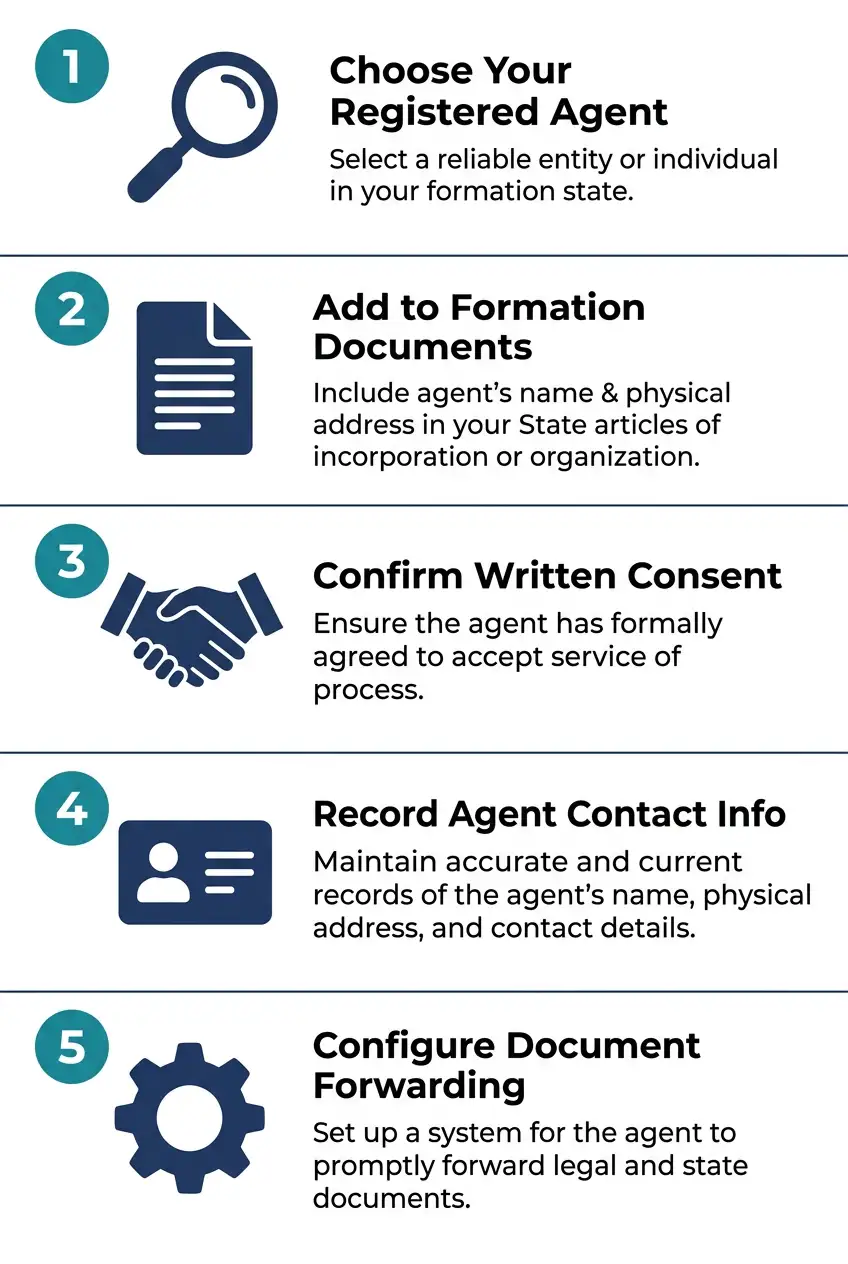
Step 1: Choose Your Registered Agent Before Filing
You need to know who your registered agent will be before you file your formation documents. The registered agent’s name and address are required fields on your Articles of Organization or Certificate of Formation.
If you are going to use a professional registered agent service, sign up with them first. They will give you their address to use on your formation documents and confirm your appointment in writing.
Step 2: Include the Agent’s Information on Your Formation Documents
When you file your LLC’s Articles of Organization with the state, you will fill in:
- The registered agent’s full legal name (individual’s name or company name)
- The registered agent’s physical street address in the state (not a PO box)
- In many states, the agent’s signature or a separate consent form
Do not leave this section incomplete. The Secretary of State’s office will reject incomplete filings, and that adds time and cost to your formation process.
Step 3: Confirm Consent and Acceptance
Make sure your chosen registered agent has formally agreed to the role. For professional services, this is automatic when you sign up. For individual agents, get written confirmation.
Step 4: Record the Agent’s Contact Information
Keep your registered agent’s contact information in your LLC’s operating agreement and your personal business records. Note their office address, phone number, and the email address where they will forward documents.
Step 5: Set Up Forwarding Preferences
If you are using a professional service, log into their client portal and configure your document forwarding preferences. Decide whether you want documents forwarded by email, physical mail, or through the online portal. Set up notification preferences so you get an alert the moment something arrives.
What Forms Do You Need to Appoint a Registered Agent?
For the initial appointment, the registered agent is listed directly on your formation documents (Articles of Organization or Certificate of Formation). No separate form is needed.
For changes to your registered agent after formation, each state has its own form. Common names for this form include:
- Statement of Change of Registered Agent (Texas, many others)
- Change of Registered Agent Form
- Statement of Information update (California)
- Annual Report amendment (some states accept agent changes via annual report)
Filing fees for registered agent changes range from $0 to $50 depending on the state.
How to Change Your Registered Agent for an LLC
Changing your registered agent is a routine process that many LLC owners need to do at some point. Maybe your current service raised its price. Maybe you found a better option. Maybe you were acting as your own agent and have decided to hire a professional. Whatever the reason, the process is straightforward.
The Change Process Step by Step
Step 1: Sign up with your new registered agent service (or confirm the new individual’s consent).
Step 2: Download the appropriate form from your state’s Secretary of State website. Search for “change registered agent [your state]” and go directly to the official .gov filing page.
Step 3: Complete the form with your new agent’s name, new physical address, and any required signatures. Some states also require the outgoing agent to sign a resignation form separately.
Step 4: File the form with the Secretary of State and pay the applicable filing fee.
Step 5: Wait for confirmation. Processing times vary from immediate (for online filings in states like Texas and Florida) to several weeks (for paper filings in states with slower processing).
Step 6: Update your LLC’s operating agreement and internal records to reflect the new agent.
One thing I want to flag: do not cancel your old registered agent service until your change is officially confirmed by the state. There is a window during the processing period where your old agent is still legally on record. If legal documents arrive during that window, your old agent needs to still be operational and forwarding to you.
How Much Does a Registered Agent Cost for an LLC?
Let me give you real numbers here because the range is wider than most people realize.
The Cost of Being Your Own Registered Agent
Zero dollars per year in direct fees. But there are indirect costs: the value of your time, the risk of missing documents, and the privacy exposure from having your home address in public records. For many business owners, those indirect costs outweigh the savings from the $0 price tag.
Registered Agent Annual Fee for Professional Services
Here is a realistic pricing breakdown based on current market rates in 2026:
Budget tier (under $100/year):
Services in this range exist and are functional. They provide the basic requirements: a physical address, availability during business hours, and document forwarding. Some are regional services operating only in specific states. Quality and reliability vary significantly. Always check customer reviews before choosing a budget service.
Mid tier ($100 to $200/year):
This is where most reputable national services operate. At this price point, you get same day scanning, secure online portal access, compliance reminders, and solid customer support. This tier is appropriate for the vast majority of small LLC owners.
Premium tier ($200 to $300 per year or more):
Premium services add features like compliance monitoring across multiple business entities, dedicated account managers, priority support, multi state coverage under a single account, and advanced document management tools. These make sense for businesses with multiple LLCs, those operating across many states, or those in highly regulated industries.
The Hidden Costs of Cheap Registered Agent Services
I want to be direct about something: the cheapest registered agent service is not always the best value. I have seen forum threads where business owners discovered that their $49/year agent had a backlog of weeks before documents were scanned and forwarded. For annual report reminders, a two week delay is annoying. For a lawsuit summons, a two week delay can be catastrophic.
When evaluating any registered agent service, ask:
- How quickly are documents scanned and forwarded?
- Is there a real physical office at the listed address, or just a mail drop?
- What is the uptime and reliability of their online portal?
- Do they have real customer support (phone, not just email)?
- What happens to my documents if the service goes out of business?
Best Registered Agent Services for LLCs in 2026
I want to cover the major services honestly, including their actual strengths and weaknesses. The goal here is to help you make a real decision, not just list names with glowing descriptions.
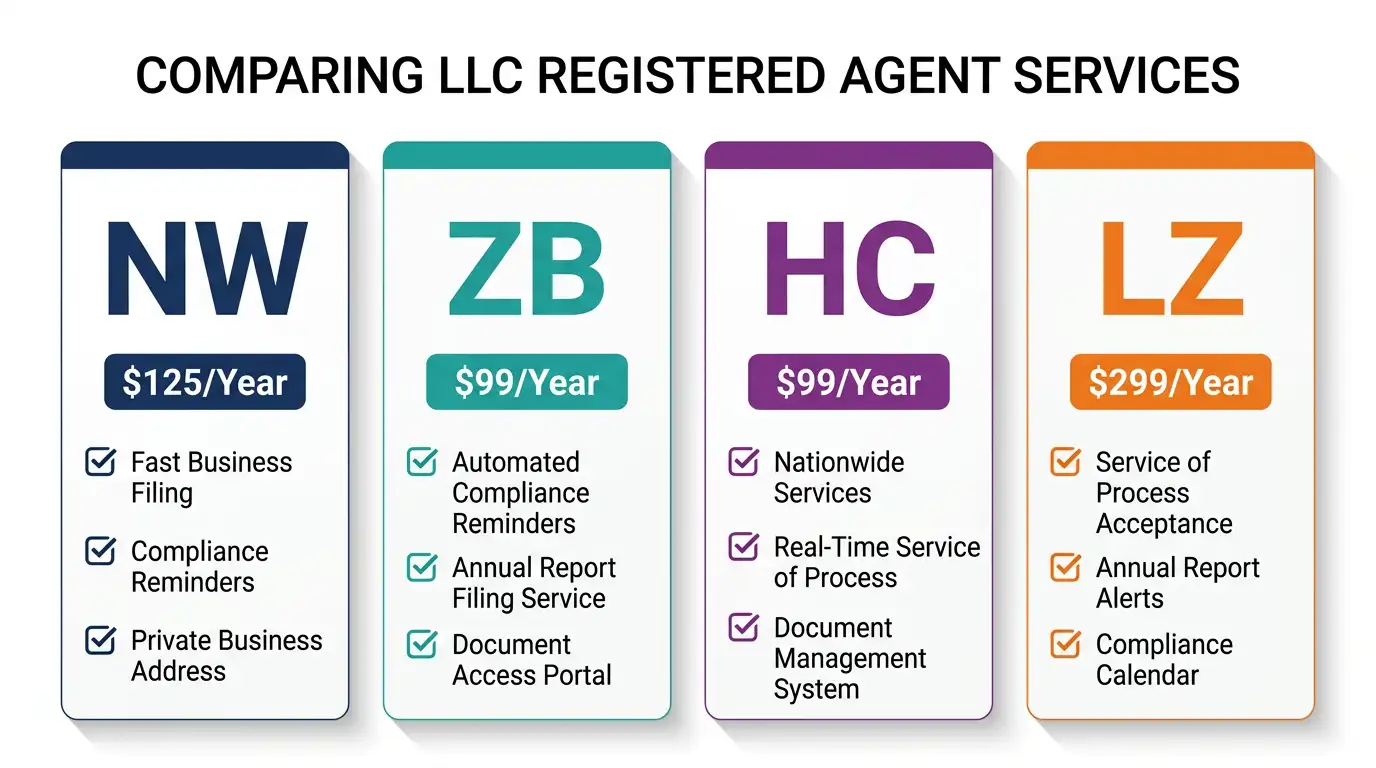
Northwest Registered Agent
Northwest Registered Agent is the most frequently recommended service in small business communities, and the praise is generally earned. They have been in business for decades and maintain physical offices in all 50 states.
What sets them apart: Northwest is known for exceptional customer service with real humans answering the phone. Their privacy focus is genuine. They do not sell your data or use your personal information for marketing. Their document handling is same day, and their online portal is clean and reliable.
Price: Currently around $125 per year for registered agent service alone. They also offer LLC formation packages that bundle registered agent service for the first year.
Ideal for: Business owners who prioritize customer service and privacy over absolute lowest cost.
ZenBusiness
ZenBusiness targets new LLC owners specifically and has built a strong brand around simplicity and affordability. Their registered agent service is available as a standalone service or bundled with their LLC formation packages.
What stands out: ZenBusiness offers a genuinely beginner friendly interface. Their compliance reminders are proactive and their customer support has improved significantly over the past two years. They also offer additional business services (operating agreement templates, EIN filing, banking setup) that can be convenient for new business owners who want one platform for everything.
Price: Registered agent service runs approximately $99 to $199 per year depending on the plan tier. Their entry level formation packages include the first year of registered agent service at no extra cost.
Ideal for: First time LLC owners who want a simple, bundled approach to formation and compliance.
Harbor Compliance
Harbor Compliance caters to a more sophisticated clientele: businesses operating across multiple states, nonprofits with complex compliance requirements, and larger organizations that need enterprise level compliance management.
What stands out: Harbor Compliance has a depth of compliance expertise that goes well beyond basic registered agent service. Their compliance calendar tools and multi entity management features are genuinely powerful. They also employ licensed attorneys and compliance specialists in house.
Price: Registered agent service starts around $99 per year per state, but their full compliance packages are priced significantly higher. Best value for multi state or multi entity situations.
Ideal for: Businesses operating in multiple states, those in regulated industries, or organizations that need comprehensive compliance management beyond basic registered agent coverage.
LegalZoom Registered Agent Service
LegalZoom is the most widely recognized name in online legal services, and their registered agent offering is solid if not exceptional. Their brand recognition means many business owners default to them without comparison shopping.
What stands out: Reliability and brand trust. LegalZoom has been around long enough that their service infrastructure is proven. They also integrate registered agent service with their broader legal document and attorney consultation services.
Price: Currently around $249 per year for registered agent service, which is on the higher end for what is a fairly standard offering. You are paying partly for the brand name.
Ideal for: Business owners who already use LegalZoom for other legal services and prefer to consolidate vendors.
Comparing Services Side by Side
| Service | Annual Price | Physical Offices | Same Day Scanning | Compliance Alerts | Best For |
|---|---|---|---|---|---|
| Northwest | ~$125 | All 50 states | Yes | Yes | Privacy and service quality |
| ZenBusiness | ~$99 to $199 | All 50 states | Yes | Yes | New LLC owners |
| Harbor Compliance | ~$99+ | All 50 states | Yes | Advanced | Multi state businesses |
| LegalZoom | ~$249 | All 50 states | Yes | Basic | Existing LZ users |
Registered Agent vs. Business Address: Clearing Up the Confusion
This is a point of genuine confusion that comes up constantly in Facebook groups and on Quora. Let me be completely clear.
Your registered agent address and your business address are not the same thing.
Your business address is where you conduct your day to day operations, where clients might visit or send regular mail, and what appears on your website, business cards, and marketing materials. It can be your home, a coworking space, a leased office, or any location where you actually work.
Your registered agent address is a separate, specific address listed with the Secretary of State for the sole purpose of receiving official legal and government correspondence. It must be a physical street address in your state of formation. It can be the same as your business address, but it does not have to be.
When you hire a professional registered agent service, their office address becomes your registered agent address. Your actual business address remains separate and private unless you choose to list it publicly elsewhere.
This separation is one of the core privacy benefits of using a professional registered agent service. Your home or business location does not need to appear in any public state filing at all.
Do I Need a Registered Agent in Every State?
If your LLC operates only in the state where it was formed, you need one registered agent in that one state. Straightforward.
But the moment you expand operations into a second state, things get more complex. Most states require businesses formed elsewhere to register as a “foreign LLC” before conducting business within their borders. And registering as a foreign LLC in a new state requires designating a registered agent in that new state.
What counts as “conducting business” in a state varies by state law, but common triggers include:
- Leasing or owning physical office space in the state
- Having employees working in the state
- Opening a business bank account in the state
- Regularly soliciting business from customers in the state
- Having a physical retail or service location in the state
If you are running a purely online business with no physical presence outside your home state, you probably do not need to register as a foreign LLC in other states. But if you open a satellite office, hire a local employee, or sign a lease in another state, you very likely do.
In those multi state scenarios, a national registered agent service that covers all 50 states under one account and one dashboard becomes not just convenient but practically essential.
The Privacy Dimension: Your Home Address and Public Records
I want to spend a few more paragraphs on privacy because it is the single most overlooked consideration among new LLC owners who consider acting as their own registered agent.
When you form an LLC, the state creates a public record for your business. Anyone can search that record. It is accessible online in most states within seconds. And if you list your home address as your registered agent address, your home address is now searchable public information attached to your business name.
This matters for several reasons.
Personal safety: If you have a dispute with a client, a vendor, or anyone else connected to your business, they can find your home address through a simple Secretary of State search. For most businesses this is an annoyance. For some business types, it is a genuine safety concern.
Solicitation: Once your home address is in a public business database, marketing companies scrape that data constantly. Expect physical mail, phone calls, and email campaigns targeting you as a new business owner.
Competitor intelligence: In competitive industries, rivals sometimes research each other’s filings. Your home address being on file is not catastrophic, but there is no reason to expose more information than legally required.
Using a professional registered agent service costs $100 to $300 per year to completely eliminate this exposure. For most business owners, that is a reasonable price for genuine privacy.
Registered Agent for Foreign LLC: Operating Across State Lines
Let me address the foreign LLC situation directly because I see it misunderstood constantly.
A foreign LLC does not mean a company from another country. In US business law, a foreign LLC is simply an LLC formed in one state (the domestic state) that is now registered to do business in a different state (the foreign state). Your Delaware LLC operating in Texas is a foreign LLC in Texas. Your California LLC with a Miami office is a foreign LLC in Florida.
To register as a foreign LLC in a new state, you must:
- File a “foreign qualification” application with the new state’s Secretary of State
- Designate a registered agent with a physical address in the new state
- Pay the applicable foreign registration fee (typically $50 to $300 depending on the state)
- Maintain your registered agent in that state for as long as you operate there
If you stop operating in a state, you can file a “withdrawal” or “cancellation” of your foreign LLC registration, which terminates your registered agent obligation in that state.
The practical implication: If you are using yourself as your registered agent in your home state and you decide to expand into a second state, you will need to hire a professional registered agent service in that second state regardless of your DIY preference. That reality pushes many multi state business owners toward just using a national service from the beginning.
Trending FAQs: Every Question You Actually Have About limited liability company’s Registered Agent
Based on real forum threads from Reddit, Quora, Avvo, Law Stack Exchange, and Facebook business groups, here are the questions people are genuinely asking in 2026.
What does a registered agent do for an LLC exactly?
A registered agent receives official legal documents, lawsuits (service of process), and government correspondence on your LLC’s behalf. They must be at a physical address in your state during business hours. They forward those documents to you promptly, often the same day.
Should the registered agent of an LLC be the owner?
The owner can be the registered agent, but it is not required. Many owners choose not to serve as their own registered agent to protect their home address from becoming public record and to avoid the availability requirements that come with the role.
What happens if my LLC does not have a registered agent?
If your LLC has no registered agent on file, or if your agent is unavailable when legal documents are delivered, the state can accept service on your behalf. Courts can proceed with lawsuits without your participation. The state can also administratively dissolve your LLC for non compliance. The consequences range from financial penalties to the complete loss of your LLC status.
Can I use a PO box as my registered agent address?
No. Every US state explicitly requires a physical street address. A PO box does not qualify. A virtual office address may or may not qualify depending on whether a real person is available there during business hours. When in doubt, use a professional registered agent service that maintains a verified physical office.
Is a registered agent the same as a business owner?
No. A registered agent and a business owner are completely different roles. The registered agent has no ownership stake, no management authority, no liability in the business, and no right to profit. Their sole function is to receive and forward official documents.
Can my company be its own registered agent?
No. In all US states, the LLC cannot designate itself as its own registered agent. A separate legal person (an individual or a different company) must fill the role. On Law Stack Exchange, this question came up specifically for a New Jersey LLC, and the answer was clearly no.
What is the difference between a registered agent and a statutory agent?
None. They are different names for the same role. “Registered agent” is the more common term used by most states. “Statutory agent” is the term used primarily in Arizona and Ohio. “Resident agent” is used in Maryland and some other states. All three terms refer to the same legally required function.
Do I need a registered agent if I have an LLC in Delaware but operate in Texas?
Yes to both. Your Delaware LLC needs a registered agent in Delaware (because that is where it is formed). And if you are conducting business in Texas, you need to register as a foreign LLC in Texas and appoint a registered agent with a Texas address.
Can I change my registered agent anytime?
Yes. You can change your registered agent at any time by filing the appropriate form with your state’s Secretary of State and paying the applicable fee. There is no waiting period or penalty for changing agents. Many business owners change agents when they find a better price, a more reliable service, or when their circumstances change.
What happens if my registered agent goes out of business?
This is a scenario that happens more than you would think with budget registered agent services. If your agent closes without proper notice, you need to immediately file a change of registered agent with the Secretary of State. In the interim, you may be at risk of missing legal documents. This is one reason why choosing a well established, financially stable registered agent service matters.
How do I find out who the registered agent is for an LLC?
Search the Secretary of State’s online business entity database for your state. Most states have a free public search tool. Enter the LLC’s name and the registered agent information will be part of the public filing record.
Is registered agent information public record?
Yes. Your registered agent’s name and address are part of your LLC’s public filing record, accessible through the Secretary of State’s database. This is why using a professional service protects your personal privacy. The agent’s office address, not your home address, appears in the public record.
Northwest Registered Agent vs. ZenBusiness: Which is better?
For pure registered agent service quality and customer support, Northwest Registered Agent has a stronger track record and a more privacy focused approach. For new LLC owners who want a bundled formation plus registered agent package with a beginner friendly interface, ZenBusiness offers competitive value. If cost is the primary driver, ZenBusiness’s lower entry price point is attractive. If you prioritize long term reliability and white glove service, Northwest is the better choice.
Can I be my own registered agent in Texas?
Yes. Texas law allows an officer, owner, or employee of the LLC to serve as the registered agent, provided they have a physical Texas street address and are available during business hours. The LLC itself cannot be its own agent. Many Texas LLC owners choose professional services for privacy reasons, since the registered agent’s address appears in the Texas Secretary of State’s publicly searchable database.
Can I be my own registered agent in California?
Yes, if you are a California resident with a California street address and you are available during business hours. But California’s designation of the Secretary of State as a default agent for service of process means some people get confused about whether an additional personal agent is needed. For privacy and reliability, most California LLC owners use a registered corporate agent service authorized by the California Secretary of State.
Can I be my own registered agent in Florida?
Yes. Florida allows LLC members or managers to serve as the registered agent. You must use a Florida street address and be available during business hours. Florida’s annual report system makes it easy to update your registered agent information if you decide to change.
Does the registered agent receive all mail for the LLC?
No. The registered agent only receives official legal and government correspondence including service of process, Secretary of State notices, and regulatory agency communications. Regular business mail (invoices, client correspondence, vendor communications) goes to your business address directly. The registered agent is not a general mail forwarding service for your day to day business operations.
What is the cheapest registered agent service for a small LLC?
Several services compete for the lowest price point. As of 2026, prices as low as $49 per year exist in the market. However, extreme caution is warranted at this price tier. Always verify that the service maintains a real physical office (not just a mail drop), has reliable same day scanning, and has a track record of staying in business. A registered agent service that closes without notice leaves your LLC exposed. Spending an extra $50 to $100 per year for a more established service is almost always worth it.
Final Thoughts: Making the Right Decision for Your LLC
Choosing who serves as your limited liability company’s registered agent is not the most glamorous decision you will make as a business owner. But it is one of the decisions that can have the most serious consequences if you get it wrong.
The registered agent requirement exists to protect courts, protect the public, and protect your own business from falling out of legal compliance. It is not a bureaucratic formality. It is a functioning piece of your LLC’s legal infrastructure.
Here is what I recommend based on everything covered in this guide:
If your LLC is brand new, you work from a fixed home address in your formation state, and you are comfortable with your home address being public record, acting as your own registered agent for year one is a legitimate option. Just understand what you are committing to in terms of availability.
If you value privacy, travel regularly, plan to expand into multiple states, or simply want the peace of mind that comes from professional compliance management, choose a reputable registered agent service. At $99 to $125 per year, the cost is genuinely minimal compared to the risk you are managing.
And if you are the type of person who wants everything handled, documented, and confirmed with real humans who answer the phone when you call, Northwest Registered Agent is where I would start.
Your LLC deserves the same level of care in this decision that you put into every other aspect of building your business.
Disclaimer: This article is for informational purposes only and does not constitute legal advice. Consult a licensed attorney in your state for advice specific to your business situation.